Gustar y verbos similares
The backwards verbs
• En español gustar significa “to be pleasing”
• In English, the equivalent is “to like”
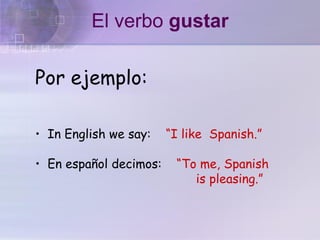
El verbo gustar
Por ejemplo:
• In English we say: “I like Spanish.”
• En español decimos: “To me, Spanish
is pleasing.”
El verbo gustar
I like basketball.
In English:
• “I” is the subject
• “like” is the verb
• “basketball” is
the direct object
(thing that is
pleasing to person)
En español:
• “basketball” is the
subject
• “to please” is the
verb
• “me” is the indirect
object (person
who is doing
the liking)
El Verbo Gustar
The form of the verb gustar
(gusta or gustan) does not depend on
who does the liking, but depends
on what is liked or what is pleasing.
Who is doing the “liking”?
Indirect Object Pronouns
(person to whom it is pleasing):
El verbo gustar
El verbo gustar
Construcción singular de GUSTAR
(A mí) me
(A ti) te
(A él/ella/Ud.) le …el libro
GUSTA …nadar
(A nosotros) nos …el chocolate
(A vosotros) os
(A ellos/as) les
Construcción plural de GUSTAR
(A mí) me
(A ti) te
(A él/ella/Ud.) le …los libros
GUSTAN
(A nosotros) nos …los árboles
(A vosotros) os
(A ellos/as) les
¿Te gusta la fruta o la ensalada mucho?
“I like fruit a lot.”
“Fruit is very pleasing to me.”
la fruta.
gusta mucho
Me
¿Qué no te gusta?
“I don’t like classical music.”
“Classical music is not pleasing to me.”
la música clásica.
gusta
No, me
¿Te gustan los deportes?
Are sports pleasing to you?
“Yes, but I like classes more.”
“Classes are more pleasing to me.”
las clases.
gustan más
Sí, pero me
¿Cómo se dice?
“You (familiar) like Italian food.”
“Italian food is pleasing to you (familiar)
la comida italiana.
gusta
Te
¿Cómo se dice?
“He likes Spanish.”
“Spanish is pleasing to him.”
el español.
gusta
(A él) le
¿Cómo se dice?
“She doesn’t like homework.”
(A ella) no le gusta la tarea
“Homework is not pleasing to her.”
¿Cómo se dice?
“We like volleyball a lot.”
Nos gusta mucho el voleibol.
“Volleyball is very pleasing to us.”
¿Cómo se dice?
“They don’t like jazz.”
(A ellos) no les gusta el jazz.
“Jazz music is not pleasing to them.”
¿Qué te gusta mucho?
Me gusta mucho la música rock.
¿Te gusta el fútbol o el tenis?
Me gusta el fútbol.
¿Qué le gusta a Juan?
A Juan le gusta la ensalada.
¿Qué les gusta a los chicos?
A los chicos les gusta la natación.
Hay más verbos que
funcionan como gustar?
Sí, pero nos gusta estudiar “gustar” primero.
Yes, but we like to study “gustar” first.
Faculty.Mansfield.edu
Are there more verbs that work like gustar?

Gustar

  • 1.
    Gustar y verbossimilares The backwards verbs
  • 2.
    • En españolgustar significa “to be pleasing” • In English, the equivalent is “to like” El verbo gustar
  • 3.
    Por ejemplo: • InEnglish we say: “I like Spanish.” • En español decimos: “To me, Spanish is pleasing.” El verbo gustar
  • 4.
    I like basketball. InEnglish: • “I” is the subject • “like” is the verb • “basketball” is the direct object (thing that is pleasing to person) En español: • “basketball” is the subject • “to please” is the verb • “me” is the indirect object (person who is doing the liking)
  • 5.
    El Verbo Gustar Theform of the verb gustar (gusta or gustan) does not depend on who does the liking, but depends on what is liked or what is pleasing.
  • 6.
    Who is doingthe “liking”? Indirect Object Pronouns (person to whom it is pleasing): El verbo gustar
  • 7.
  • 8.
    Construcción singular deGUSTAR (A mí) me (A ti) te (A él/ella/Ud.) le …el libro GUSTA …nadar (A nosotros) nos …el chocolate (A vosotros) os (A ellos/as) les
  • 9.
    Construcción plural deGUSTAR (A mí) me (A ti) te (A él/ella/Ud.) le …los libros GUSTAN (A nosotros) nos …los árboles (A vosotros) os (A ellos/as) les
  • 10.
    ¿Te gusta lafruta o la ensalada mucho? “I like fruit a lot.” “Fruit is very pleasing to me.” la fruta. gusta mucho Me
  • 11.
    ¿Qué no tegusta? “I don’t like classical music.” “Classical music is not pleasing to me.” la música clásica. gusta No, me
  • 12.
    ¿Te gustan losdeportes? Are sports pleasing to you? “Yes, but I like classes more.” “Classes are more pleasing to me.” las clases. gustan más Sí, pero me
  • 13.
    ¿Cómo se dice? “You(familiar) like Italian food.” “Italian food is pleasing to you (familiar) la comida italiana. gusta Te
  • 14.
    ¿Cómo se dice? “Helikes Spanish.” “Spanish is pleasing to him.” el español. gusta (A él) le
  • 15.
    ¿Cómo se dice? “Shedoesn’t like homework.” (A ella) no le gusta la tarea “Homework is not pleasing to her.”
  • 16.
    ¿Cómo se dice? “Welike volleyball a lot.” Nos gusta mucho el voleibol. “Volleyball is very pleasing to us.”
  • 17.
    ¿Cómo se dice? “Theydon’t like jazz.” (A ellos) no les gusta el jazz. “Jazz music is not pleasing to them.”
  • 18.
    ¿Qué te gustamucho? Me gusta mucho la música rock.
  • 19.
    ¿Te gusta elfútbol o el tenis? Me gusta el fútbol.
  • 20.
    ¿Qué le gustaa Juan? A Juan le gusta la ensalada.
  • 21.
    ¿Qué les gustaa los chicos? A los chicos les gusta la natación.
  • 22.
    Hay más verbosque funcionan como gustar? Sí, pero nos gusta estudiar “gustar” primero. Yes, but we like to study “gustar” first. Faculty.Mansfield.edu Are there more verbs that work like gustar?