¿Qué les gustó hacer 
este verano?
El Verbo “GUSTAR” 
• En español gustar significa “to be pleasing” 
• In English, the equivalent is “to like”
Por ejemplo: 
• In English we say: “I like Spanish.” 
• En español decimos: “To me, Spanish 
is pleasing.”
Who is doing the “liking”? 
Indirect Object Pronouns: 
me 
te 
le 
nos 
os 
les
“Gustó” = preterito singular 
“Gustaron” = plural
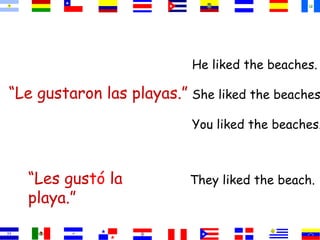
“Le gustaron las playas.” 
He liked the beaches. 
She liked the beaches. 
You liked the beaches. 
“Les gustó la 
playa.” 
They liked the beach.
¿Cómo se dice? 
“I liked coffee.” 
Me gustó el café. 
“The coffee was pleasing to me.”
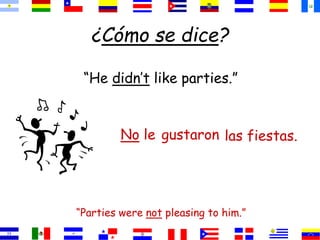
¿Cómo se dice? 
“He didn’t like parties.” 
No le gustaron las fiestas. 
“Parties were not pleasing to him.”
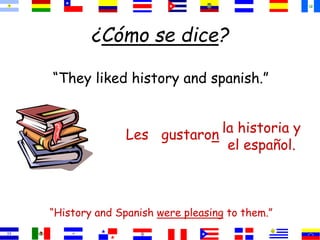
¿Cómo se dice? 
“They liked history and spanish.” 
la historia y 
el español. 
Les gustaron 
“History and Spanish were pleasing to them.”
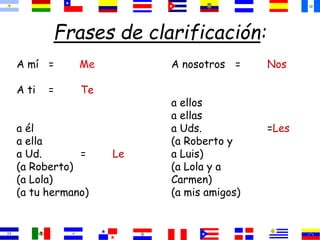
Frases de clarificación: 
A mí = Me 
A ti = Te 
a él 
a ella 
a Ud. = Le 
(a Roberto) 
(a Lola) 
(a tu hermano) 
A nosotros = Nos 
a ellos 
a ellas 
a Uds. =Les 
(a Roberto y 
a Luis) 
(a Lola y a 
Carmen) 
(a mis amigos)
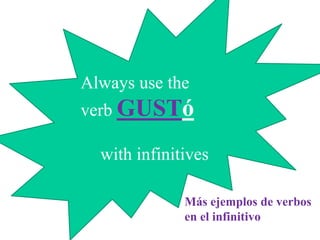
Always use the 
verb GUSTó 
with infinitives 
Más ejemplos de verbos 
en el infinitivo
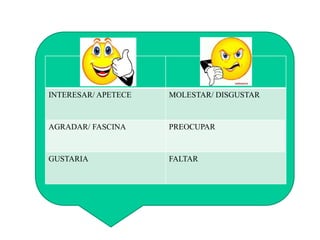
INTERESAR/ APETECE MOLESTAR/ DISGUSTAR 
AGRADAR/ FASCINA PREOCUPAR 
GUSTARIA FALTAR
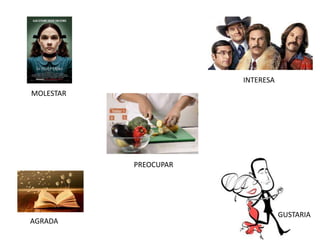
MOLESTAR 
INTERESA 
PREOCUPAR 
AGRADA 
GUSTARIA
¿Qué les disgustó 
hacer durante el verano?
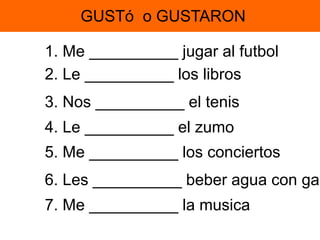
GUSTó o GUSTARON 
1. Me __________ jugar al futbol 
2. Le __________ los libros 
3. Nos __________ el tenis 
4. Le __________ el zumo 
5. Me __________ los conciertos 
6. Les __________ beber agua con gas 
7. Me __________ la musica

Gustar preterito

  • 1.
    ¿Qué les gustóhacer este verano?
  • 2.
    El Verbo “GUSTAR” • En español gustar significa “to be pleasing” • In English, the equivalent is “to like”
  • 3.
    Por ejemplo: •In English we say: “I like Spanish.” • En español decimos: “To me, Spanish is pleasing.”
  • 4.
    Who is doingthe “liking”? Indirect Object Pronouns: me te le nos os les
  • 5.
    “Gustó” = preteritosingular “Gustaron” = plural
  • 6.
    “Le gustaron lasplayas.” He liked the beaches. She liked the beaches. You liked the beaches. “Les gustó la playa.” They liked the beach.
  • 7.
    ¿Cómo se dice? “I liked coffee.” Me gustó el café. “The coffee was pleasing to me.”
  • 8.
    ¿Cómo se dice? “He didn’t like parties.” No le gustaron las fiestas. “Parties were not pleasing to him.”
  • 9.
    ¿Cómo se dice? “They liked history and spanish.” la historia y el español. Les gustaron “History and Spanish were pleasing to them.”
  • 10.
    Frases de clarificación: A mí = Me A ti = Te a él a ella a Ud. = Le (a Roberto) (a Lola) (a tu hermano) A nosotros = Nos a ellos a ellas a Uds. =Les (a Roberto y a Luis) (a Lola y a Carmen) (a mis amigos)
  • 11.
    Always use the verb GUSTó with infinitives Más ejemplos de verbos en el infinitivo
  • 12.
    INTERESAR/ APETECE MOLESTAR/DISGUSTAR AGRADAR/ FASCINA PREOCUPAR GUSTARIA FALTAR
  • 13.
  • 14.
    ¿Qué les disgustó hacer durante el verano?
  • 15.
    GUSTó o GUSTARON 1. Me __________ jugar al futbol 2. Le __________ los libros 3. Nos __________ el tenis 4. Le __________ el zumo 5. Me __________ los conciertos 6. Les __________ beber agua con gas 7. Me __________ la musica