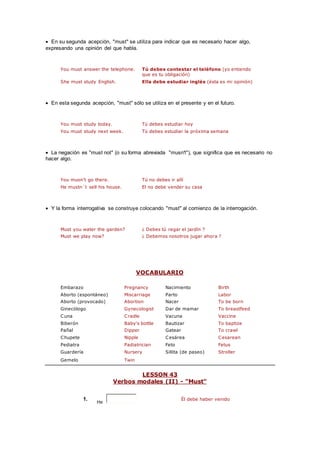
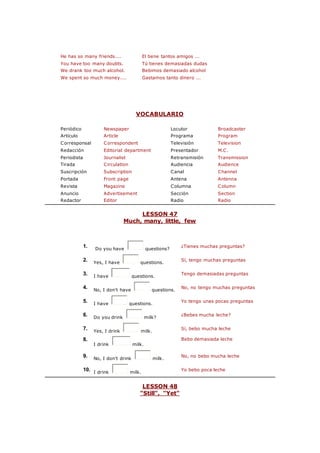
LESSON 1
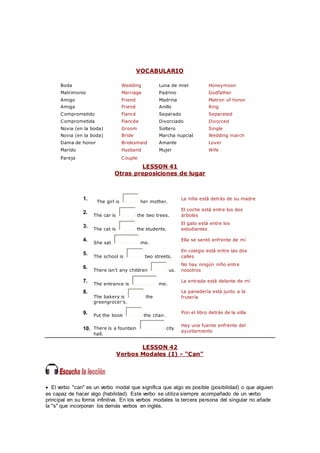
Pronombres Personales Sujetos
 Vamos a empezar por conocer los equivalentes en inglés de los pronombres personales en
castellano:
Yo I
Tu You
El He
Ella She
El/ella (objeto) It
Nosotros We
Vosotros You
Ellos/ellas They
 Su colocación en la frase suele ser al comienzo de la misma:
I have a dog. Yo tengo un perro
You are my brother. Tu eres mi hermano
 El pronombre personal tiene que concordar con el verbo, no obstante, los verbos ingleses,
salvo los auxiliares, no varían, excepto en la tercera persona del singular:
I eat apples. Yo como manzanas
You eat apples. Tu comes manzanas
He eats apples. El come manzanas
 El pronombre "it" (3ª persona singular) se utiliza para objetos y animales, aunque a veces
con estos últimos se utiliza "he" (él) o "she" (ella):
I have a car. It is red. Yo tengo un coche. El es rojo
VOCABULARIO
Padre Father Suegro Father-in-law
Madre Mother Suegra Mother-in-law
Hermano Brother Yerno Son-in-law
Hermana Sister Nuera Daughter-in-law
Hijo Son Cuñado Brother-in-law
Hija Daughter Cuñada Sister-in-law
Abuelo Grandfather Primo Cousin
Abuela Grandmother Sobrino Nephew
Nieto Grandson Sobrina Niece
Nieta Granddaughter Tío Uncle
Tía Aunt
LESSON 1
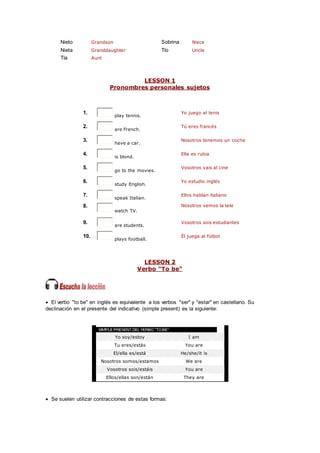
Pronombres personales sujetos
1.
play tennis.
Yo juego al tenis
2.
are French.
Tú eres francés
3.
have a car.
Nosotros tenemos un coche
4.
is blond.
Ella es rubia
5.
go to the movies.
Vosotros vais al cine
6.
study English.
Yo estudio inglés
7.
speak Italian.
Ellos hablan italiano
8.
watch TV.
Nosotros vemos la tele
9.
are students.
Vosotros sois estudiantes
10.
plays football.
Él juega al fútbol
LESSON 2
Verbo "To be"
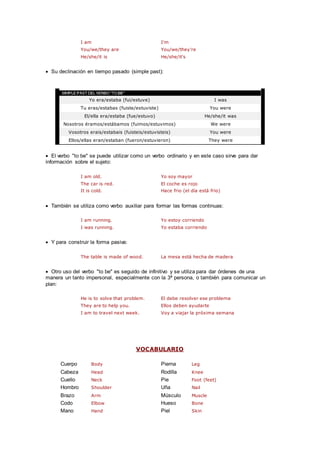
 El verbo "to be" en inglés es equivalente a los verbos "ser" y "estar" en castellano. Su
declinación en el presente del indicativo (simple present) es la siguiente:
Yo soy/estoy I am
Tu eres/estás You are
El/ella es/está He/she/it is
Nosotros somos/estamos We are
Vosotros sois/estáis You are
Ellos/ellas son/están They are
 Se suelen utilizar contracciones de estas formas:
I am I'm
You/we/they are You/we/they're
He/she/it is He/she/it's
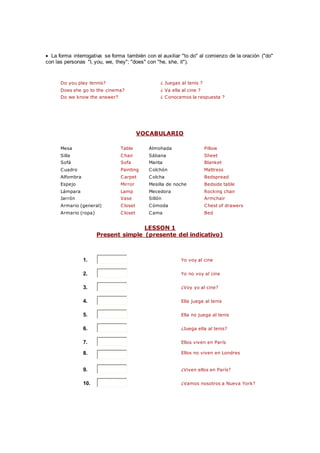
 Su declinación en tiempo pasado (simple past):
Yo era/estaba (fui/estuve) I was
Tu eras/estabas (fuiste/estuviste) You were
El/ella era/estaba (fue/estuvo) He/she/it was
Nosotros éramos/estábamos (fuimos/estuvimos) We were
Vosotros erais/estabais (fuisteis/estuvisteis) You were
Ellos/ellas eran/estaban (fueron/estuvieron) They were
 El verbo "to be" se puede utilizar como un verbo ordinario y en este caso sirve para dar
información sobre el sujeto:
I am old. Yo soy mayor
The car is red. El coche es rojo
It is cold. Hace frio (el día está frio)
 También se utiliza como verbo auxiliar para formar las formas continuas:
I am running. Yo estoy corriendo
I was running. Yo estaba corriendo
 Y para construir la forma pasiva:
The table is made of wood. La mesa está hecha de madera
 Otro uso del verbo "to be" es seguido de infinitivo y se utiliza para dar órdenes de una
manera un tanto impersonal, especialmente con la 3ª persona, o también para comunicar un
plan:
He is to solve that problem. El debe resolver ese problema
They are to help you. Ellos deben ayudarte
I am to travel next week. Voy a viajar la próxima semana
VOCABULARIO
Cuerpo Body Pierna Leg
Cabeza Head Rodilla Knee
Cuello Neck Pie Foot (feet)
Hombro Shoulder Uña Nail
Brazo Arm Músculo Muscle
Codo Elbow Hueso Bone
Mano Hand Piel Skin
Dedo Finger Pelo Hair
Pecho Chest Espalda Back
Barriga Belly
LESSON 3
Verbo "To have"
 El verbo "to have" en inglés es equivalente a los verbos "haber" y "tener" en castellano. Su
declinación en el presente del indicativo (simple present) es la siguiente:
Yo he/tengo I have
Tu has/tienes You have
El/ella ha/tiene He/she/it has
Nosotros hemos/tenemos We have
Vosotros habéis/tenéis You have
Ellos/ellas han/tienen They have
 Como contracciones de estas formas se utilizan:
I/you/we/they have I/you/we/they've
He/she/it has He/she/it's
 Su declinación en pasado simple (simple past) tiene una única forma:
Yo había/tenía (hube/tuve) I had
Tu habías/tenías (hubiste/tuviste) You had
El/ella había/tenía (hubo/tuvo) He/she/it had
Nosotros habíamos/teníamos (hubimos/tuvimos) We had
Vosotros habiáis/teníais (hubisteis/tuvisteis) You had
Ellos/ellas habían/tenían (hubieron/tuvieron) They had
 El verbo "to have" se puede utilizar como un verbo ordinario y en este caso tiene el
significado de "tener":
I have a car. Yo tengo un coche
She had a boyfriend. Ella tuvo un novio
 Y también se utiliza en algunas expresiones con el sentido de "tomar":
I had a drink after the match. Tomé una bebida después del
partido
She has a bath. Ella toma un baño
 Como verbo auxiliar, "to have" se utiliza para construir las formas compuestas:
I have read. Yo he leido
He had played tennis. El había jugado al tenis
We have seen a film.
Nosotros hemos visto una
película
VOCABULARIO
Universo Universe Isla Island
Estrella Star Montaña Mountain
Sol Sun Valle Valley
Planeta Planet Río River
Tierra Earth Lago Lake
Satélite Satellite Selva Jungle
Luna Moon Bosque Forest
Atmósfera Atmosphere Desierto Desert
Continente Continent Oceano Ocean
Mar Sea
. LESSON 1
Verbo 'To have'
1.
I a cat.
Yo tengo un gato
2.
He drunk a beer.
Él ha bebido una cerveza
3.
They a car.
Ellos tenían un coche
4.
We a big house.
Nosotros teníamos una casa
grande
5.
You come soon.
Vosotros habéis venido pronto
6.
We a coffee.
Nosotros tomamos un café
7.
He lived in Seville.
Él había vivido en Sevilla
8.
She gone to Paris.
Ella ha ido a París
9.
They seen the match.
Ellos habían visto el partido
10.
He listened to music.
Él ha escuchado música
LESSON 4
Verbo "To do"
 El verbo "to do" en inglés puede funcionar como verbo ordinario, con el significado de
"hacer", o como verbo auxiliar. Su declinación en el presente del indicativo (simple present) es
la siguiente:
Yo hago I do
Tu haces You do
El/ella hace He/she/it does
Nosotros hacemos We do
Vosotros hacéis You do
Ellos/ellas hacen They do
 En el pasado simple (simple past) tiene una única forma:
Yo hice I did
Tu hicíeste You did
El/ella hizo He/she/it did
Nosotros hicímos We did
Vosotros hicisteis You did
Ellos/ellas hicieron They did
 Como verbo ordinario con el significado de "hacer" hay que distinguirlo de otro verbo, "to
make", que también se traduce en castellano por "hacer", aunque este último con un significado
de "fabricar":
I did my job. Yo hice mi trabajo
I made a cake. Yo hice un pastel
What areyou doing this evening? ¿Qué haces esta tarde?
She made that table. Ella hizo esa mesa
 Como verbo auxiliar, se utiliza para construir las formas negativas y de interrogación del
presente y del pasado simple:
I don't know that. Yo no se eso
I didn´t answer correctly. No contesté correctamente
Do you go to the cinema? ¿Vas al cine?
Didn't you see that film? ¿No viste esa película?
 Como se puede observar, en las formas negativas se suelen utilizar contracciones:
Do not Don't
Does not Doesn't
Did not Didn't
 Otro uso del verbo "to do" es para evitar la repetición de un verbo que se acaba de
mencionar, especialmente en la contestación de preguntas:
Do you like coffee? Yes, I do
Did you play tennis? Yes, I did
He likes music... ... and so do I ( = I like music too)
VOCABULARIO
País Country Aeropuerto Airport
Región Region Estación Station
Provincia Province Puerto Port
Ciudad City Metro Metro
Pueblo Village Parque Parking lot
Aldea Small village Aparcamiento Parking
Luna Moon Bosque Forest
Calle Street Cine Cinema
Plaza Square Teatro Theater
Avenida Avenue Restaurante Restaurant
Monumento Monument Fuente Fountain
LESSON 1
Verbo 'To do'
1. you like reading?
¿Te gusta leer?
2. I my homework.
Yo hago mis deberes
3. Who that?
¿Quién hizo eso?
4. I like this car.
No me gusta este coche
5. she play basketball?
¿Jugó ella al baloncesto?
6. He come with us.
Él no viene con nosotros
7. they live in Paris?
¿Vivieron ellos en París?
8.
you know that person?
¿Conoces a esa persona?
9. We go to the party.
Nosotros no fuimos a la fiesta
10. Do you like a beer? Yes, I
¿Quieres una cerveza? sí, quiero
LESSON 5
Estructura de la Oración
 La oración afirmativa en inglés se construye de acuerdo con la siguiente estructura:
Sujeto + Verbo + Objeto Directo
I eat apples
You need help
We bought a car
 En la oración negativa, el auxiliar se sitúa delante del verbo principal:
Sujeto + Auxiliar negación + Verbo + Objeto Directo
I don't eat apples
You don't need help
We didn't buy a car
 En la oración interrogativa, el auxiliar se sitúa al comienzo de la misma:
Auxiliar + Sujeto + Verbo + Objeto Directo ?
Do I eat apples ?
Do you need help ?
Did we buy a car ?
 Otros complementos de la oración (lugar, tiempo, etc.) se suelen situar al final de la misma:
I eat apples at lunchtime.
You need help in your job.
We bought a car last Friday.
 Normalmente, el complemento de lugar va delante del complemento de tiempo:
I eat apples at home at lunchtime.
You need help in your job right now.
We bought a car in Madrid last Friday.
 Cuando hay adverbios en las oraciones, éstos se suelen situar delante del verbo en las
formas simples, y entre el auxiliar y el verbo principal en las formas compuestas (hay
numerosas excepciones):
I always eat apples at home.
I have always eaten apples at home.
You never need help.
You have never needed help.
VOCABULARIO
Casa House Salón Living room
Puesta Door Recibidor Foyer
Ventana Window Comedor Dinning room
Pared Wall Dormitorio Bedroom
Suelo Floor Cuarto de baño Bathroom
Techo Ceiling Despacho Study
Tejado Roof Escaleras Staircase
Chimenea Chimney Garaje Garage
Balcón Balcony Buhardilla Studio Apartment
Pasillo hall Cocina Kitchen
LESSON 1
Estructura de la oración
1. You, a beer, drink
2. Drive, a car, we
3. Don't, coffee, you, like?
4. We, this book, like, don't
5.
He, in his bedroom, music,
listens, to
6. My homework, I, do, always
7. You, to Paris, in June, go
8. She, the beach, like, doesn't
9. They, a car, in Madrid, bought
10. Never, I, football, play
LESSON 6
Present Simple (Presente del Indicativo)
 Se utiliza para hablar de acciones habituales, genéricas, que tienen lugar con cierta
frecuencia, sin hacer referencia a si en el momento actual se están realizando.
I study English. Yo estudio inglés; empecé hace algún tiempo y continúo,
aunque puede que en el momento presente no esté realizando
esta actividad.
He plays tennis. El juega al tenis; practica este deporte con cierta asiduidad,
pero no significa que en el momento presente esté en la pista de
tenis jugando.
I work in a bank. Yo trabajo en un banco; ésta es mi profesión, aunque puede
que en el momento actual yo esté de vacaciones, descansando
en mi casa.
 También se utiliza para hablar de acciones futuras que ya han sido planificadas,
especialmente al referirse a viajes.
I leave Madrid tomorrow morning. Me voy de Madrid mañana por la mañana
 La forma del "present simple" coincide con la del infinitivo sin la partícula "to", salvo en la 3ª
persona del singular en la que se le añade una "s".
Infinitivo I / you / we / they He / she / it
To eat (comer) eat eats
To run (correr) run runs
 Si el verbo termina en "ss", "sh", "ch", "x", "o", al formar la 3º persona del singular se le añade
"-es".
Infinitivo I / you / we / they He / she / it
To kiss (besar) I kiss He kisses
To watch (observar) I watch He watches
 Si el verbo termina en "y" tras consonante, al formar la 3ª persona del singular se sustituye
esta "y" por una "i", seguida de la terminación "es".
Infinitivo I / you / we / they He / she / it
To carry (llevar) I carry He carries
To envy (envidiar) I envy He envies
 Las oraciones negativas se forman con el auxiliar "to do", habitualmente en sus formas
contraídas: "don´t" (= do not) para las personas "I, you, we, they", y "doesn´t" (= does not) para
las personas "he, she, it".
I don't play tennis. Yo no juego al tenis
She doesn´t go to the cinema. Ella no va al cine
We don´t know the answer. Nosotros no sabemos la respuesta
 La forma interrogativa se forma también con el auxiliar "to do" al comienzo de la oración ("do"
con las personas "I, you, we, they"; "does" con "he, she, it").
Do you play tennis? ¿ Juegas al tenis ?
Does she go to the cinema? ¿ Va ella al cine ?
Do we know the answer? ¿ Conocemos la respuesta ?
VOCABULARIO
Mesa Table Almohada Pillow
Silla Chair Sábana Sheet
Sofá Sofa Manta Blanket
Cuadro Painting Colchón Mattress
Alfombra Carpet Colcha Bedspread
Espejo Mirror Mesilla de noche Bedside table
Lámpara Lamp Mecedora Rocking chair
Jarrón Vase Sillón Armchair
Armario (general) Closet Cómoda Chest of drawers
Armario (ropa) Closet Cama Bed
LESSON 1
Present simple (presente del indicativo)
1. Yo voy al cine
2. Yo no voy al cine
3. ¿Voy yo al cine?
4. Ella juega al tenis
5. Ella no juega al tenis
6. ¿Juega ella al tenis?
7. Ellos viven en París
8. Ellos no viven en Londres
9. ¿Viven ellos en París?
10. ¿Vamos nosotros a Nueva York?
LESSON 7
Present Continuous (Presente Continuo)
 Se utiliza para describir acciones que se están desarrollando en este mismo momento:
I am reading a book. Yo estoy leyendo un libro (en este preciso
instante)
You are playing football. Tú estás jugando al futbol
 También se utiliza para describir acciones que se están desarrollando alrededor del
momento en el que se habla, aunque no necesariamente en ese preciso instante:
I am studying French. Yo estoy estudiando francés (me he
matriculado en una academia, pero no
necesariamente en este preciso momento estoy
con los libros de francés)
 Asimismo, se utiliza para describir una acción que va a tener lugar en el futuro próximo y
sobre la que se ha tomado una resolución firme. En este caso, siempre se tiene que mencionar
el tiempo en el que se va a desarrollar la acción:
I am going to London next week. Yo voy a Londres la próxima semana (la
acción se va a desarrollar en el futuro próximo y
existe una decisión firme por mi parte de llevarla a
cabo)
 Otro uso del presente continuo es para describir acciones que se vienen repitiendo con
frecuencia; en este caso, la oración viene acompañada del adverbio "always" (siempre):
He is always working. El está siempre trabajando (con el significado
de que trabaja frecuentemente, quizás, incluso,
excesivamente)
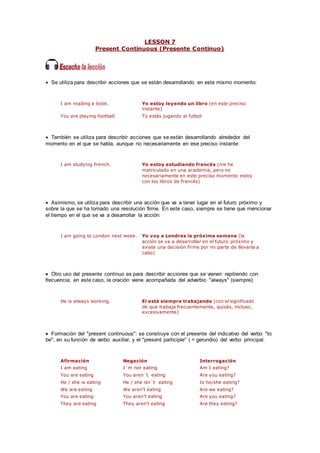
 Formación del "present continuous": se construye con el presente del indicativo del verbo "to
be", en su función de verbo auxiliar, y el "present participle" ( = gerundio) del verbo principal.
Afirmación Negación Interrogación
I am eating I´m not eating Am I eating?
You are eating You aren´t eating Are you eating?
He / she is eating He / she isn´t eating Is he/she eating?
We are eating We aren't eating Are we eating?
You are eating You aren't eating Are you eating?
They are eating They aren't eating Are they eating?
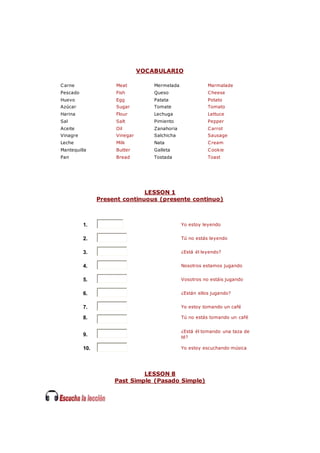
VOCABULARIO
Carne Meat Mermelada Marmalade
Pescado Fish Queso Cheese
Huevo Egg Patata Potato
Azúcar Sugar Tomate Tomato
Harina Flour Lechuga Lettuce
Sal Salt Pimiento Pepper
Aceite Oil Zanahoria Carrot
Vinagre Vinegar Salchicha Sausage
Leche Milk Nata Cream
Mantequilla Butter Galleta Cookie
Pan Bread Tostada Toast
LESSON 1
Present continuous (presente continuo)
1. Yo estoy leyendo
2. Tú no estás leyendo
3. ¿Está él leyendo?
4. Nosotros estamos jugando
5. Vosotros no estáis jugando
6. ¿Están ellos jugando?
7. Yo estoy tomando un café
8. Tú no estás tomando un café
9.
¿Está él tomando una taza de
té?
10. Yo estoy escuchando música
LESSON 8
Past Simple (Pasado Simple)
 Se utiliza para referirse a acciones que se desarrollaron en el pasado y que hace ya algún
tiempo que finalizaron. Su equivalente en castellano es el pretérito indefinido:
I studied English. Yo estudié inglés (fue una actividad que realicé en el
pasado y que ya finalizó)
I bought a car. Yo compré un coche
 En estas oraciones no se da información sobre el presente:
I lost my job. Yo perdí mi trabajo (puede que en la actualidad lo haya
vuelto a recuperar)
I bought a car. Yo compré un coche (en la actualidad puede que ya no
tenga el coche, que lo haya vendido)
 Con frecuencia se indica el periodo de tiempo en el que se desarrolló la acción:
I played tennis yesterday. Yo jugué al tenis ayer.
I went to Paris last summer. Yo fui a París el verano pasado
 La estructura de la frase es similar a la del presente, utilizando el verbo principal en su forma
pasada.
She listens to music. Ella escucha música (presente)
She listened to music. Ella escuchó música (pasado)
 En las formas negativas e interrogativas se emplea, asimismo, una estructura similar: se
utiliza el verbo auxiliar "to do" en su tiempo pasado, que acompaña al verbo principal en su
forma infinitiva:
I didn´t go to the party. Yo no fui a la fiesta
Did you go to the party? ¿ Fuiste tú a la fiesta ?
 En la formación del tiempo pasado hay que distinguir entre verbos regulares e irregulares: los
verbos regulares forman el tiempo pasado añadiendo "-ed" a la forma infinitiva (ver Lección 9º),
mientras que los irregulares no siguen un patrón determinado, hay que estudiarlos
individualmente (ver décima clase).
Verbo regular "To listen": forma pasada "listened".
Verbo irregular "To go": forma pasada "went"
 La forma pasada de los verbos es única para todas las personas, no hay una forma distinta
para la 3ª persona del singular como ocurría en el presente.
I / you / he / she / we / they "listened"
I / you / he / she / we / they "went"
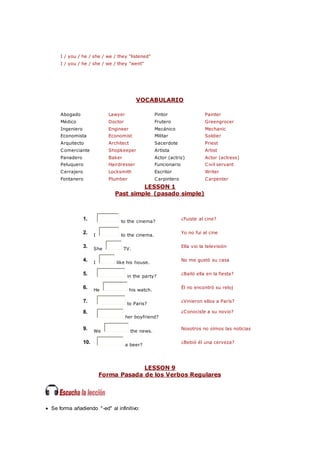
VOCABULARIO
Abogado Lawyer Pintor Painter
Médico Doctor Frutero Greengrocer
Ingeniero Engineer Mecánico Mechanic
Economista Economist Militar Soldier
Arquitecto Architect Sacerdote Priest
Comerciante Shopkeeper Artista Artist
Panadero Baker Actor (actriz) Actor (actress)
Peluquero Hairdresser Funcionario Civil servant
Cerrajero Locksmith Escritor Writer
Fontanero Plumber Carpintero Carpenter
LESSON 1
Past simple (pasado simple)
1. to the cinema?
¿Fuiste al cine?
2. I to the cinema.
Yo no fui al cine
3. She TV.
Ella vio la televisión
4. I like his house.
No me gustó su casa
5. in the party?
¿Bailó ella en la fiesta?
6. He his watch.
Él no encontró su reloj
7. to Paris?
¿Vinieron ellos a París?
8.
her boyfriend?
¿Conociste a su novio?
9. We the news.
Nosotros no oímos las noticias
10. a beer?
¿Bebió él una cerveza?
LESSON 9
Forma Pasada de los Verbos Regulares
 Se forma añadiendo "-ed" al infinitivo:
Infinitivo Forma pasada
To need (necesitar) needed
To listen (escuchar) listened
 Si el infinitivo del verbo termina en "e", entonces tan sólo se le añade una "d":
Infinitivo Forma pasada
To love (amar) loved
To bribe (sobornar) bribed
 Si el infinitivo del verbo termina en "y", tras consonante, entonces esta letra "y" se transforma
en "i" y se le añade "-ed".
Infinitivo Forma pasada
To carry (llevar) carried
To study (estudiar) studied
 Si el infinitivo del verbo está formado por una sola sílaba, con una sola vocal y termina en
consonante, entonces esta consonante se dobla:
Infinitivo Forma pasada
To stop (parar) stopped
To ban (prohibir) banned
 También se dobla la última consonante de aquellos verbos de dos o más silabas, cuyo
acento recae en la última sílaba, y ésta contiene una sola vocal y finaliza en una sola
consonante:
Infinitivo Forma pasada
To admit (admitir) admitted
To prefer(preferir) preferred
 Por último, se dobla también la última consonante de aquellos verbos cuyo infinitivo termina
por "l", tras una única vocal:
Infinitivo Forma pasada
To signal (señalar) signalled
To cancel (cancelar) cancelled
VOCABULARIO
Sombrero Hat Chaleco Vest
Bufanda Scarf Corbata Tie
Gabardina Raincoat Camisa Shirt
Abrigo Coat Camiseta T-shirt
Chaqueta Jacket Traje Suit
Guante Glove Ropa interior Underwear
Pantalones Pants Camiseta (interior) Vest
Zapato Shoe Calzoncillo Shorts
Bota Boat Sujetador Bra
Zapatilla Slipper Calcetín Sock
Pijama Pyjamas Bragas Panties
Vestido Dress
LESSON 9
Forma pasada de los verbos regulares
1. To bat
2. To abolish
3. To clean
4. To invite
5. To pass
6. To obey
7. To try
8. To travel
9. To irritate
10. To compel
LESSON 10
Verbos irregulares
 En la siguiente lista se incluyen todos los verbos irregulares ingleses. En ella se recoge el
infinitivo y el presente (ambos tienen la misma forma, salvo que el infinitivo va precedido de la
partícula "to"), así como el pasado simple y el participio.
 En algunos casos, el verbo tiene dos posibles formas en el pasado o en el futuro que
aparecen indicadas. En otros casos, el verbo no tiene infinitivo (son algunos verbos modales y
en la tabla aparecen sin partícula "to").
 Estos verbos no siguen una regla determinada, por lo que hay que aprenderlos de memoria.
Al ser numerosos, entendemos que lo más práctico es irlos estudiando poco a poco (algunos
de ellos apenas se utilizan).
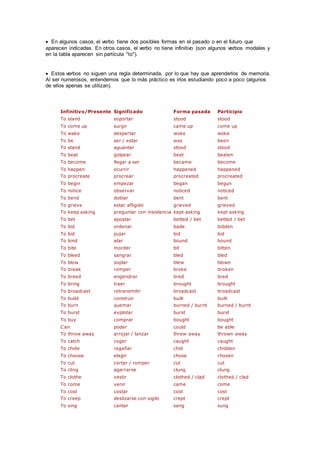
Infinitivo/Presente Significado Forma pasada Participio
To stand soportar stood stood
To come up surgir came up come up
To wake despertar woke woke
To be ser / estar was been
To stand aguantar stood stood
To beat golpear beat beaten
To become llegar a ser became become
To happen ocurrir happened happened
To procreate procrear procreated procreated
To begin empezar began begun
To notice observar noticed noticed
To bend doblar bent bent
To grieve estar afligido grieved grieved
To keep asking preguntar con insistencia kept asking kept asking
To bet apostar betted / bet betted / bet
To bid ordenar bade bidden
To bid pujar bid bid
To bind atar bound bound
To bite morder bit bitten
To bleed sangrar bled bled
To blow soplar blew blown
To break romper broke broken
To breed engendrar bred bred
To bring traer brought brought
To broadcast retransmitir broadcast broadcast
To build construir built built
To burn quemar burned / burnt burned / burnt
To burst explotar burst burst
To buy comprar bought bought
Can poder could be able
To throw away arrojar / lanzar threw away thrown away
To catch coger caught caught
To chide regañar chid chidden
To choose elegir chose chosen
To cut cortar / romper cut cut
To cling agarrarse clung clung
To clothe vestir clothed / clad clothed / clad
To come venir came come
To cost costar cost cost
To creep deslizarse con sigilo crept crept
To sing cantar sang sung
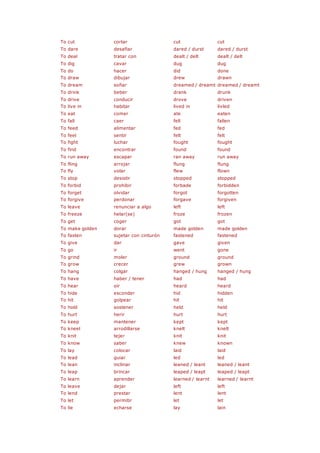
To cut cortar cut cut
To dare desafiar dared / durst dared / durst
To deal tratar con dealt / delt dealt / delt
To dig cavar dug dug
To do hacer did done
To draw dibujar drew drawn
To dream soñar dreamed / dreamt dreamed / dreamt
To drink beber drank drunk
To drive conducir drove driven
To live in habitar lived in livled
To eat comer ate eaten
To fall caer fell fallen
To feed alimentar fed fed
To feel sentir felt felt
To fight luchar fought fought
To find encontrar found found
To run away escapar ran away run away
To fling arrojar flung flung
To fly volar flew flown
To stop desistir stopped stopped
To forbid prohibir forbade forbidden
To forget olvidar forgot forgotten
To forgive perdonar forgave forgiven
To leave renunciar a algo left left
To freeze helar(se) froze frozen
To get coger got got
To make golden dorar made golden made golden
To fasten sujetar con cinturón fastened fastened
To give dar gave given
To go ir went gone
To grind moler ground ground
To grow crecer grew grown
To hang colgar hanged / hung hanged / hung
To have haber / tener had had
To hear oír heard heard
To hide esconder hid hidden
To hit golpear hit hit
To hold sostener held held
To hurt herir hurt hurt
To keep mantener kept kept
To kneel arrodillarse knelt knelt
To knit tejer knit knit
To know saber knew known
To lay colocar laid laid
To lead guiar led led
To lean inclinar leaned / leant leaned / leant
To leap brincar leaped / leapt leaped / leapt
To learn aprender learned / learnt learned / learnt
To leave dejar left left
To lend prestar lent lent
To let permitir let let
To lie echarse lay lain
To light encender lit lit
To lose perder lost lost
To make hacer made made
May poder might ----
To mean significar meant / ment meant / ment
To meet encontrar(se) met met
To mow segar mowed mowed / mown
Must deber had to ----
Ought deber ---- ----
To pay pagar paid paid
To put poner put put
To read leer read / red read / red
To rent alquilar rented rented
To rid eliminar rid rid
To ride montar (a caballo) rode ridden
To ring sonar rang rung
To rise subir rose risen
To run correr ran run
To saw serrar sawed sawed / sawn
To say decir said said
To see ver saw seen
To seek buscar sought sought
To sell vender sold sold
To send enviar sent sent
To set poner set set
To sew coser sewed sewed / sewn
To shake agitar shook shaken
Shall (auxiliar futuro) ----
To shear esquilar sheared / shore sheared / shorn
To shed perder (hojas) shed shed
To shine brillar shone shone
To shoe herrar shoed / shod shoed / shod
To shoot disparar shot shot
To show mostrar showed showed / shown
To shrink encoger shrank shrunk
To shut cerrar shut shut
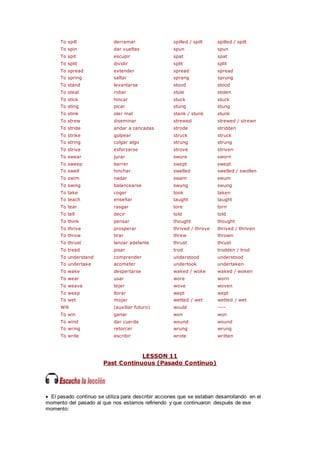
To sing cantar sang sung
To sink hundir sank sunk
To sit sentarse sat sat
To slay matar slew slain
To sleep dormir slept slept
To slide resbalar slid slid
To sling lanzar (con fuerza) slung slung
To sneak deslizarse con sigilo snuck snuck
To slit cortar slit slit
To smell oler smelled / smelt smelled / smelt
To hit golpear hit hit
To sow sembrar sowed sowed / sown
To speak hablar spoke spoken
To speed acelerar speeded / sped speeded / sped
To spell deletrear spelled / spelt spelled / spelt
To spend gastar spent spent
To spill derramar spilled / spilt spilled / spilt
To spin dar vueltas spun spun
To spit escupir spat spat
To split dividir split split
To spread extender spread spread
To spring saltar sprang sprung
To stand levantarse stood stood
To steal robar stole stolen
To stick hincar stuck stuck
To sting picar stung stung
To stink oler mal stank / stunk stunk
To strew diseminar strewed strewed / strewn
To stride andar a zancadas strode stridden
To strike golpear struck struck
To string colgar algo strung strung
To strive esforzarse strove striven
To swear jurar swore sworn
To sweep barrer swept swept
To swell hinchar swelled swelled / swollen
To swim nadar swam swum
To swing balancearse swung swung
To take coger took taken
To teach enseñar taught taught
To tear rasgar tore torn
To tell decir told told
To think pensar thought thought
To thrive prosperar thrived / throve thrived / thriven
To throw tirar threw thrown
To thrust lanzar adelante thrust thrust
To tread pisar trod trodden / trod
To understand comprender understood understood
To undertake acometer undertook undertaken
To wake despertarse waked / woke waked / woken
To wear usar wore worn
To weave tejer wove woven
To weep llorar wept wept
To wet mojar wetted / wet wetted / wet
Will (auxiliar futuro) would ----
To win ganar won won
To wind dar cuerda wound wound
To wring retorcer wrung wrung
To write escribir wrote written
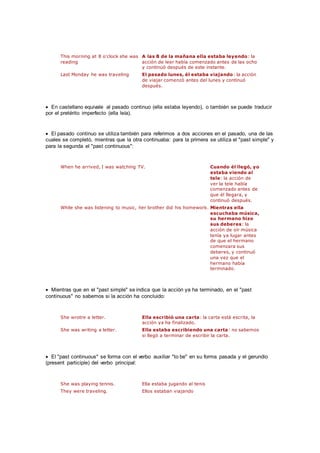
LESSON 11
Past Continuous (Pasado Continuo)
 El pasado continuo se utiliza para describir acciones que se estaban desarrollando en el
momento del pasado al que nos estamos refiriendo y que continuaron después de ese
momento:
This morning at 8 o'clock she was
reading
A las 8 de la mañana ella estaba leyendo: la
acción de leer había comenzado antes de las ocho
y continuó después de este instante.
Last Monday he was traveling El pasado lunes, él estaba viajando: la acción
de viajar comenzó antes del lunes y continuó
después.
 En castellano equivale al pasado continuo (ella estaba leyendo), o también se puede traducir
por el pretérito imperfecto (ella leía).
 El pasado continuo se utiliza también para referimos a dos acciones en el pasado, una de las
cuales se completó, mientras que la otra continuaba: para la primera se utiliza el "past simple" y
para la segunda el "past continuous":
When he arrived, I was watching TV. Cuando él llegó, yo
estaba viendo al
tele: la acción de
ver la tele había
comenzado antes de
que él llegara, y
continuó después.
While she was listening to music, her brother did his homework. Mientras ella
escuchaba música,
su hermano hizo
sus deberes: la
acción de oír música
tenía ya lugar antes
de que el hermano
comenzara sus
deberes, y continuó
una vez que el
hermano había
terminado.
 Mientras que en el "past simple" se indica que la acción ya ha terminado, en el "past
continuous" no sabemos si la acción ha concluido:
She wrotre a letter. Ella escribió una carta: la carta está escrita, la
acción ya ha finalizado.
She was writing a letter. Ella estaba escribiendo una carta: no sabemos
si llegó a terminar de escribir la carta.
 El "past continuous" se forma con el verbo auxiliar "to be" en su forma pasada y el gerundio
(present participle) del verbo principal:
She was playing tennis. Ella estaba jugando al tenis
They were traveling. Ellos estaban viajando
 La forma negativa se forma con la partícula "not" detrás del verbo auxiliar, y la forma
interrogativa con el verbo auxiliar al comienzo de la oración, seguido del sujeto y del verbo
principal:
I was not listening. Yo no estaba escuchando
Were they dancing? ¿ Estaban ellos bailando ?
 El gerundio (present participle) se forma añadiendo al infinitivo la terminación "-ing", aunque
con algunas peculiaridades que veremos en la próxima lección:
To listen listening
To read reading
VOCABULARIO
Panadería Baker Optica Optician
Peluquería Hairdresser Farmacia Pharmacy
Frutería Greengrocer Gasolinera gas station
Taller Workshop Quiosco Newsstand
Cafetería Snack-bar Discoteca Disco
Joyería Jeweller Hospital Hospital
Carnicería Butcher Pastelería Pastery
Banco Bank Ferretería hardware store
Iglesia Church Supermercado Supermarket
Juguetería Toyshop Tienda de ropa Clothes shop
Librería Bookshop Anticuario Antique shop
Zapatería Shoe shop Tienda de muebles Furniture place
LESSON 11
Past continuous (pasado continuo)
1.
when I saw you?
¿Estabas estudiando cuando te
vi?
2.
Yesterday at 10 o'clock we
TV.
Ayer, a las 10, nosotros veíamos
la tele
3.
When he arrived, she
to music.
Cuando él llegó, ella escuchaba
música
4. She
Ella estaba nadando
5. We when you arrived.
Nosotros jugábamos cuando tú
llegaste
6. When I saw him, he
Cuando lo vi, él estaba
estudiando
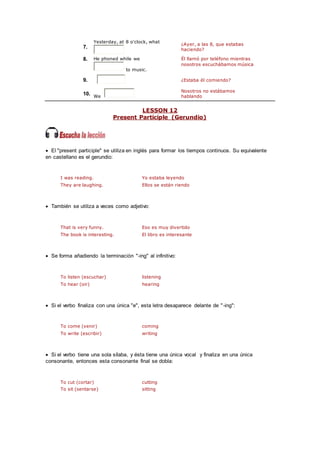
7.
Yesterday, at 8 o'clock, what
¿Ayer, a las 8, que estabas
haciendo?
8. He phoned while we
to music.
Él llamó por teléfono mientras
nosotros escuchábamos música
9. ¿Estaba él comiendo?
10. We
Nosotros no estábamos
hablando
LESSON 12
Present Participle (Gerundio)
 El "present participle" se utiliza en inglés para formar los tiempos continuos. Su equivalente
en castellano es el gerundio:
I was reading. Yo estaba leyendo
They are laughing. Ellos se están riendo
 También se utiliza a veces como adjetivo:
That is very funny. Eso es muy divertido
The book is interesting. El libro es interesante
 Se forma añadiendo la terminación "-ing" al infinitivo:
To listen (escuchar) listening
To hear (oir) hearing
 Si el verbo finaliza con una única "e", esta letra desaparece delante de "-ing":
To come (venir) coming
To write (escribir) writing
 Si el verbo tiene una sola sílaba, y ésta tiene una única vocal y finaliza en una única
consonante, entonces esta consonante final se dobla:
To cut (cortar) cutting
To sit (sentarse) sitting
 Si el verbo tiene dos o más silabas, con el acento sobre la última, y ésta última sílaba
contiene una sola vocal y finaliza en una única consonante, entonces esta consonante final
también se dobla:
To admit (admitir) admitting
To begin (empezar) beginning
 Si el verbo termina por la consonante "l" detrás de una única vocal, esta consonante "l" se
dobla:
To cancel (cancelar) cancelling
To impel (impulsar) impelling
 Si el verbo finaliza en "y", esta letra se mantiene y se le añade la terminación "-ing":
To study (estudiar) studying
To try (intentar) trying
VOCABULARIO
Perro Dog Lobo Wolf
Gato Cat Aguila Eagle
Caballo Horse Serpiente Snake
Toro Bull Camello Camel
Vaca Cow Hipopótamo Hippo
Oveja Sheep Rinoceronte Rhinoceros
Cabra Goat Pantera Panther
Zorro Fox Tiburón Shark
Cerdo Pig Ballena Whale
Elefante Elephant Tigre Tiger
León Lion Oso Bear
LESSON 12
Present participle (gerundio)
1. To hurry
2. To put
3. To go
4. To imitate
5. To reach
6. To adjust
7. To smoke
8. To run
9. To rain
10. To hit
LESSON 13
Present Perfect (Pretérito Perfecto)
 El "present perfect" es un tiempo que sirve para describir acciones que acaban de suceder
en el pasado y que guardan alguna relación con el presente. Equivale en castellano al pretérito
perfecto:
I have bought a car. Yo he comprado un coche: nos indica que la
acción de comprar el coche acaba de realizarse.
 Si por el contrario utilizáramos el "past simple" esta conexión con el presente se pierde:
I bought a car. Yo compré un coche: no implica que la acción
haya sido reciente, ni que aún siga teniendo ese
coche.
 En las oraciones con "present perfect" no se suele mencionar el momento en el que se ha
desarrollado la acción:
I have read a book. Yo he leído un libro: la acción acaba de
finalizar.
 Ya que si se mencionara el momento de su realización, entonces habría que utilizar el "past
simple":
I read a book this morning. Yo leí un libro esta mañana
 No obstante, a veces sí se puede mencionar el periodo de tiempo en el que la acción se ha
desarrollado, pero únicamente si este periodo de tiempo aún no ha finalizado:
This morning I have drunk three
coffees.
Esta mañana me he tomado 3 cafés: utilizo en
este caso el "present perfect" si el periodo de la
mañana aún no ha terminado.
 Ya que si este periodo hubiera finalizado habría que utilizar entonces el "past simple":
This morning I drank three
coffees.
Esta mañana me tomé tres cafés: nos indica
que la mañana ya finalizó.
 Otro uso típico del "present perfect" es para describir acciones que empezaron en el pasado
y que aún no han finalizado:
I have lived in this city since 1980. He vivido en esta ciudad desde 1980:
implica que sigo viviendo en la ciudad.
I have played tennis since my childhood. He jugado al tenis desde mi infancia: y
sigo jugando
 Si la acción hubiera ya finalizado entonces habría que utilizar el "past simple":
I lived in this city for 10 years. Yo viví en esta ciudad 10 años: pero ya no vivo
ahí.
I played tennis for many years. Yo jugué al tenis muchos años: pero ya no
juego.
 El "present perfect" se forma con el auxiliar "to have" en presente del indicativo (simple
present), más el participio (past participle) del verbo principal:
I have listened to the news. Yo he escuchado las noticias
She has watched TV. Ella ha visto la tele
 La forma negativa se forma con la partícula de negación "not" entre el auxiliar y el verbo
principal, y la forma interrogativa se construye con el auxiliar al comienzo de la oración, seguido
del sujeto y del verbo principal:
I have not done my homework. Yo no he hecho mis deberes.
Have you been in Seville? ¿ Has estado en Sevilla ?
VOCABULARIO
España Spain Finlandia Finland
Portugal Portugal Suecia Sweden
Francia France Rusia Russia
Reino Unido United Kingdom Estados Unidos the United States
Irlanda Ireland Canadá Canada
Italia Italy México Mexico
Bélgica Belgium China China
Holanda Holland Japón Japan
Alemania Germany Australia Australia
Dinamarca Denmark Austria Austria
Noruega Norway Grecia Greece
LESSON 13
Present perfect (preterito perfecto)
1.
I in this city
Yo he estado en esta ciudad
2.
She anything.
Ella no ha comido nada
3.
We tennis.
Nosotros hemos jugado al tenis
4.
to the cinema?
¿Has ido al cine?
5.
She this book.
Ella no ha leído este libro
6.
We at home.
Nosotros hemos comido en casa
7.
my sister?
¿Has visto tú a mi hermana?
8.
The kids their homework.
Los niños han hecho sus deberes
9.
We this film.
Nosotros hemos visto esta
película
10.
a new car?
¿Te has comprado un coche
nuevo?
LESSON 14
Present Perfect Continuous
 El "present perfect continuous" es un tiempo que se utiliza principalmente para referirnos a
acciones que se iniciaron en el pasado y que en el momento presente se siguen desarrollando:
I have been studying. Yo he estado estudiando: quiere decir que
empecé a estudiar en algún momento del pasado
y que en la actualidad sigo estudiando.
 También se utiliza para acciones que se iniciaron en el pasado y que acaban de finalizar:
I have been waiting for you. Te he estado esperando: la espera comenzó en
el pasado y acaba de finalizar.
 Este último uso es similar al del "present perfect", según se recoge en la lección anterior. No
obstante, con el "present perfect continuous" se quiere enfatizar especialmente la duración del
proceso.
I have been reading for three
hours.
He estado leyendo durante 3 horas: con esta
forma del verbo quiero enfatizar el periodo de 3
horas que le he dedicado a la lectura.
 El "present perfect continuous" se forma con el auxiliar "to be" en su forma de "present
perfect", más el gerundio (present participle) del verbo principal:
I have been playing tennis. Yo he estado jugando al tenis
She has been watching TV. Ella ha estado viendo la tele
 La forma negativa se forma con el "present perfect" del verbo auxiliar en su forma negativa, y
la forma interrogativa se construye utilizando el "present perfect" del verbo auxiliar en su forma
interrogativa, más el gerundio (present participle) del verbo principal.
I have not been playing tennis Yo no he estado jugando al tenis
Have the children been doing their homework? ¿ Han estado los niños haciendo sus
deberes ?
VOCABULARIO
Alto High Pequeño Small
Alto (persona) Tall Fuerte Strong
Bajo Low Débil Weak
Bajo (persona) Short Bonito Good-looking
Ancho Wide Feo Ugly
Estrecho Narrow Recto Straight
Corto Short Torcido Twisted
Largo Long Rico Rich
Lento Slow Pobre Poor
Rápido Quick Ligero Light
Pesado Heavy Grande Big
LESSON 1
Present perfect continuous
1. I a film.
Yo he estado viendo una película
2. in the disco?
¿Ha estado ella bailando en la
discoteca?
3. He with the umbrella.
Él no ha estado jugando con el
paraguas
4. with the computer?
¿Habéis estado trabajando con
el ordenador?
5. She a book.
Ella ha estado leyendo un libro
6. We
Nosotros no hemos estado
peleando
7. ¿Has estado corriendo?
8.
The kids music.
Los niños han estado oyendo
música
9. She
Ella ha estado durmiendo
10. We TV.
Nosotros no hemos estado
viendo la tele
LESSON 15
Future Simple (Futuro Imperfecto)
 El "future simple" es un tiempo que sirve para describir acciones que se van a desarrollar en
el futuro. Equivale en castellano al futuro imperfecto:
I will play tennis. Yo jugaré al tenis
 El "future simple" se puede utilizar con o sin mencionar el tiempo en el que se desarrollará la
acción:
I will listen to music. Yo oiré música
I will listen to music tomorrow. Yo oiré música mañana
 No es el único tiempo que existe en inglés para referirse al futuro; hay otras formas, que
veremos en las siguientes lecciones, que se utilizan para comunicar la idea de inminencia, de
decisión, etc.
 El "future simple" se forma con el auxiliar "will" seguido del infinitivo del verbo principal:
She will buy a car. Ella se comprará un coche
We will go to the cinema. Nosotros iremos al cine
 Es frecuente utilizar en el lenguaje hablado la forma contraída del auxiliar "will", que se
representa por " 'll ":
She'll buy a car. Ella se comprará un coche
We'll go to the cinema. Nosotros iremos al cine
 A veces, aunque cada vez menos, se utiliza el auxiliar "shall", o su forma contraida " 'll " para
formar el futuro de la primera persona del singular y del plural:
I will play tennis. = I shall play tennis. = I'll play tennis.
We will go to the cinema. = We shall go to the cinema. = We'll go to the cinema.
 La forma negativa se construye situando la partícula de negación "not" entre el auxiliar y el
verbo principal. Se suele utilizar la forma contraída de "will not" que se representa por "won't"
(la contracción de "shall not" es "shan´t"):
I won't (will not) play tennis. Yo no jugaré al tenis
 La forma interrogativa se construye comenzando la oración con el auxiliar "will", seguido del
sujeto y del verbo principal:
Will you play tennis? ¿ Jugarás tú al tenis ?
Will she buy a car? ¿ Se comprará ella un coche ?
 Si la interrogación es negativa, entonces ésta se forma con el auxiliar "will", seguido del
sujeto, de la negación "not" y del verbo principal; pero si se utiliza la contracción "won't", ésta
se coloca al comienzo de la oración:
Will you not dance with me?
¿ No bailarás conmigo ?
Won´t you dance with me?
VOCABULARIO
Avión Airplane Moto Motorcycle
Helicóptero Helicopter Bicicleta Bicycle
Globo Balloon Barco Ship
Cohete Rocket Barca Boat
Coche Car Velero Sailing boat
Camión Truck Yate Yacht
Autobús Bus Submarino Submarine
Tren Train Petrolero Oil tanker
Tranvía Trolley Crucero Cruiser
Metro Underground Portaaviones Carrier
Avioneta Cub aircraft Furgoneta Van
Taxi Taxi
LESSON 15
Future simple (futuro imperfecto)
1. I to the beach.
Yo no iré a la playa
2. to the theater?
¿Irás tú al teatro?
3. We in the patio.
Nosotros jugaremos en el patio
4. the newspaper?
¿No irá él a comprar el
periódico?
5. He his homework.
Él no hará los deberes
6. You with me.
Tú vendrás conmigo
7. We soccer.
Nosotros jugaremos al fútbol
8.
in the restaurant?
¿Cenarán ellos en el
restaurante?
9. I him.
Yo no lo veré
10. coffee with your
friends?
¿Tomarás café con tus amigos?
LESSON 16
Otras formas de futuro
 Se puede utilizar el "present simple" para describir una acción en el futuro que está
totalmente planeada:
Tomorrow I fly to Madrid. Mañana vuelo a Madrid (la acción ya esta
planeada y decidida)
Next week I start my course. La próxima semana empiezo mi curso
 También se utiliza el "present continuous" para expresar una acción que se va a desarrollar
en un futuro cercano y que también está planeada. En estas oraciones hay que mencionar el
tiempo futuro en el que la acción tendrá lugar, ya que de otro modo se entendería que la acción
se está desarrollando en el presente:
Tonight I am having a party. Esta noche voy a celebrar una fiesta
Next week we are visiting you. La próxima semana te visitaremos
 Otra fórmula de expresar el futuro en inglés es con la forma "to be going + infinitivo". Se
utiliza para aquellas acciones que el sujeto ha decidido realizar y sobre las que normalmente
ha hecho ya ciertas preparaciones al respecto:
I am going to buy a house. Yo me voy a comprar una casa
(estoy totalmente decidido, ya estoy
buscando casa, ahorrando, etc.)
Next summer I am going to study in England. El próximo verano, voy a estudiar a
Inglaterra (ya me estoy moviendo al
respecto, estoy buscando escuela,
etc.)
VOCABULARIO
Ojo Eye Corazón Heart
Nariz Nose Estómago Stomach
Oreja Ear Riñón Kidney
Boca Mouth Hígado Liver
Labio Lip Intestino Intestine
Diente Tooth (plural: teeth) Vena Vein
Lengua Tongue Cerebro Brain
Ceja Eyebrow Piel Skin
Pestaña Eyelash Hueso Bone
Párpado Eyelid Sangre Blood
Garganta Throat Pulmón Lung
LESSON 16
Otras formas de futuro
1.
Tomorrow I to the beach.
Mañana voy a la playa
2.
He home next summer.
Él viene a casa este verano
3.
She a car.
Ella se va a comprar un coche
4.
Tomorrow we to Paris.
Mañana volamos a París
5.
He doesn't tonight.
Él no viene esta noche
6.
We are German.
Nosotros vamos a aprender
alemán
7. She the course next
month.
Ella termina el curso el próximo
mes
8.
You are to the cinema
tonight.
Tú vas a ir al cine esta noche
9. They to have dinner with
us.
Ellos vienen a cenar con
nosotros
10. I am this exam.
Yo voy a aprobar este examen
LESSON 17
Future Continuous (Futuro Continuo)
 Se utiliza el "future continuous" para describir una acción que va a tener lugar en el futuro y
que en el momento del tiempo al que nos referimos aún seguirá desarrollándose. Este
momento del futuro puede mencionarse o no en la oración:
I will be watching TV. Yo estaré viendo la tele
This evening I will be watching TV. Esta tarde yo estaré viendo la tele
She will be visiting her mother. Ella estará visitando a su madre
 Este tiempo se forma con el futuro simple del verbo auxiliar "to be", más el gerundio (present
participle) del verbo principal:
We wiIl be sleeping. Nosotros estaremos durmiendo
They will get come sun. Ellos estarán tomando el sol
 La forma negativa se forma interponiendo la negación "not" entre el auxiliar y el verbo
principal (atención a su colocación entre los dos componentes del verbo auxiliar: "will" y "be") :
I wiIl not be cooking. Yo no estaré cocinando
You will not be dancing. Tú no estarás bailando
 La forma interrogativa se construye comenzando con "will", seguido del sujeto, de la forma
infinitiva "be" y del verbo principal:
Will you be listening music? ¿ Estarás tú oyendo música ?
Will we be playing football? ¿ Estaremos nosotros jugando al fútbol ?
 Si la interrogación es negativa, la partícula "not" se coloca entre el sujeto y la forma infinitiva
"be", aunque también se podría utilizar la contracción "won't" (= will not) que iría al comienzo de
la oración:
Will you not be listening to music?
¿ No estarás tú oyendo música ?
Won't you be listening to music?
VOCABULARIO
Rojo Red Naranja Orange
Verde Green Beige Beige
Azul Blue Plateado Silver
Negro Black Dorado Gold
Blanco White Claro Light
Azul marino Navy blue Oscuro Dark
Marrón Brown Gris Gray
Rosa Pink Morado Purple
Violeta Violet Amarillo Yellow
LESSON 17
Future continuous (futuro continuo)
1. This evening I
Esta tarde yo estaré estudiando
2. TV?
¿Estarás tu viendo la tele?
3. Tomorrow we
Mañana nosotros estaremos
viajando
4. He soccer.
Él no estará jugando al fútbol
5. to music?
¿No estará ella escuchando
música?
6. I my homework.
Yo estaré haciendo los deberes
7. You
Tú no estarás estudiando
8. ¿Estaremos nosotros cenando?
9. He of his brother.
Él no estará cuidando a su
hermano
10. You
Vosotros estaréis durmiendo
LESSON 18
Future Perfect (Futuro Perfecto)
 Se utiliza el "future perfect" para describir acciones que se están ya desarrollando o que se
van a desarrollar en el futuro, pero que, en cualquier caso, cuando llegue ese momento futuro
al que nos estamos refiriendo la acción ya habrá finalizado. Esta forma se suele utilizar con una
expresión temporal:
By this evening I will have done my
homework.
Antes de esta tarde, yo habré
hecho mis deberes (puede que ya
los esté haciendo o que aún no los
haya comenzado. Pero, en todo caso,
cuando llegue la tarde los deberes
estarán terminados).
Before summer you will have sold your house. Antes del verano, tú habrás
vendido tu casa (todavía no es
verano, pero cuando lo sea la casa
estará vendida)
 Este tiempo se forma con el futuro simple del verbo auxiliar "to have", más el participio (past
participle) del verbo principal:
By 6 o'clock I wiIl have cleaned my car. Antes de las seis, yo habré
limpiado mi coche
Before we arrive, she will have cooked the supper. Antes de que lleguemos, ella
habrá preparado la cena
 La forma negativa se forma interponiendo la negación "not" entre el auxiliar y el verbo
principal (atención a su colocación entre los dos componentes del verbo auxiliar: "will" y "have")
:
I wiIl not have finished my homework by 7 o'clock. Antes de las siete, yo no
habré finalizado mis deberes
Before you arrive, we will not have watered the garden. Antes de que llegues,
nosotros no habremos
regado el jardín
 La forma interrogativa se construye comenzando con "will", seguido del sujeto, de la forma
infinitiva "have" y del verbo principal:
Will you have bought a new car before
summer?
¿ Te habrás comprado un coche nuevo
antes del verano?
Will she have learned Spanish before leaving? ¿ Habrá aprendido ella español antes
de marcharse ?
 Si la interrogación es negativa, la partícula "not" se coloca entre el sujeto y la forma infinitiva
"have", aunque también se podría utilizar la contracción "won't" (= will not) que iría al comienzo
de la oración:
Won´t you have eaten the dinner by 10
o'clock?
¿ Antes de las 10, no te habrás
tomado la cena ?
Won't you have eaten the dinner by 10 o'clock?
VOCABULARIO
Tenis Tennis Karate Karate
Futbol Football Golf Golf
Baloncesto Basketball Waterpolo Water polo
Balonmano Handball Hockey Hockey
Vela Sailing Hockey sobre hielo Ice hockey
Remo Rowing Esquí Skiing
Hípica Riding Ciclismo Cycling
Natación Swimming Motociclismo Motorcycling
Atletismo Athletics Automovilismo Car racing
Gimnasia Gymnastics Balonvolea Volley ball
Boxeo Boxing Maratón Marathon
Yudo Judo
LESSON 18
Future perfect (futuro perfecto)
1.
Before 10 o'clock, I
the city.
Antes de las 10, habré visitado
la ciudad
2. She the film before
Saturday.
Antes del sábado ella no habrá
visto la película
3. We by the time you
arrive.
Nosotros nos habremos
marchado para cuando llegues
4. before we return?
¿Habrá telefoneado él antes de
que volvamos?
5. the translation before
Saturday?
¿No habrá finalizado él la
traducción antes del sábado?
6. You tennis before you
go.
Tú habrás jugado al tenis antes
de marcharte
7. Before Sunday, she a
racket.
Antes del domingo, ella se habrá
comprado una raqueta
8. Before Christmas, I
the course.
Antes de Navidades habré
finalizado el curso
9.
When you arrive, he
supper.
Cuando tú llegues, él no habrá
todavía cenado
10. Before summer, I to
play tennis.
Antes del verano, yo habré
aprendido a jugar al tenis
LESSON 19
Conditional (Condicional)
 La forma condicional de los verbos se utiliza en la construcción de las oraciones
condicionales de 2º tipo (en inglés hay 3 tipos de oraciones condicionales que veremos en la
21º lección).
 Este 2º tipo de condicional se caracteriza por que la cláusula condicional es muy improbable
que se cumpla, aunque no imposible. En estas oraciones, el verbo de la cláusula principal se
pone en condicional:
If I worked harder, I would pass
the exam.
Si yo trabajara más, pasaría el examen (la
cláusula condicional es improbable que se cumpla,
aunque no imposible).
If I ate more, I would be very fat. Si yo comiera más, estaría muy gordo (no es
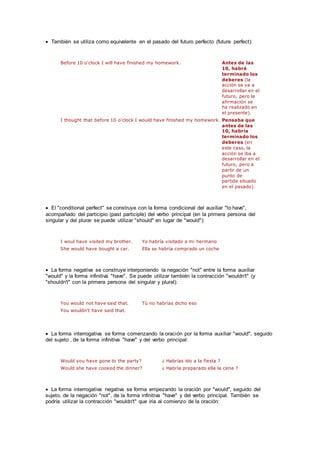
probable que coma más)
 También se utiliza la forma condicional como el equivalente al futuro, desde un tiempo
pasado:
I think that she will buy a car. Pienso que ella se comprará un coche (el
punto de partida de la oración es el presente)
I thought that she would buy a car. Pensaba que ella se compraría un coche (el
punto de partida de la oración es el pasado)
 El tiempo condicional se construye con "would" más el infinitivo del verbo principal (aunque
con la primera persona del singular y del plural también se puede utilizar "should"):
You would learn Spanish. Tú estudiarías español
We would go to the beach. Nosotros iríamos a la playa
 La forma negativa se construye interponiendo la negación "not" entre la forma auxiliar
"would" y el verbo principal. Se puede utilizar también las contracción "wouldn't" (y también
"shouldn't" con la primera persona del singular y plural):
You would not say that. Tú no dirías eso
We shouldn´t buy that house. Nosotros no compraríamos esa casa
 La forma interrogativa negativa se forma colocando la negación "not" entre el sujeto y el
verbo principal. Aunque también se puede utilizar la contracción "wouldn´t" (o "shouldn't), en
cuyo caso irían al comienzo e la oración:
Would you not go to the party?
¿ No irías a la fiesta ?
Wouldn't you go to the party?
VOCABULARIO
Alto Tall Obediente Obedient
Bajo Short Moreno Dark
Gordo Fat Rubio Blond
Flaco Thin Pelirrojo Red-haired
Feo Ugly Calvo Bald
Guapo (hombre) Handsome Canoso Gray-haired
Guapa (mujer) Beautiful Ciego Blind
Simpático Nice Sordo Deaf
Antipático Unfriendly Mudo Dumb
Tranquilo Calm Nervioso Nervous
Rebelde Rebel
LESSON 1
Conditional (condicional)
1.
We golf.
Nosotros jugaríamos al golf
2.
She the phone.
Ella contestaría el teléfono
3.
We to the theater.
Nosotros no iríamos al teatro
4.
to Paris?
¿Irías tú a París?
5.
later?
¿No vendrían ellos más tarde?
6.
She with us.
Ella no vendría con nosotros
7.
that car?
¿No te comprarías ese coche?
8.
We back soon.
Nosotros volveríamos pronto
9.
You at home.
Tú no comerías en casa
10.
later?
¿Vendría ella más tarde?
LESSON 20
Conditional Perfect (Condicional Perfecto)
 El "perfect condicional" se utiliza para construir las oraciones condicionales de 3º tipo (tal
como se recoge en la 21º lección ).
 Este 3º tipo de oración condicional se caracteriza por que la cláusula condicional no se
puede cumplir y, por lo tanto, la cláusula principal no se va a realizar:
If I had worked , I would have passed the exam. Si yo hubiera trabajado,
habría pasado el examen (pero
como no trabajé, no he podido
pasar dicho examen).
If you had come, you would have seen my brother. Si hubieras venido, habrías
visto a mi hermano (pero como
no lo hiciste, no lo has podido
ver).
 También se utiliza como equivalente en el pasado del futuro perfecto (future perfect):
Before 10 o'clock I will have finished my homework. Antes de las
10, habré
terminado los
deberes (la
acción se va a
desarrollar en el
futuro, pero la
afirmación se
ha realizado en
el presente).
I thought that before 10 o'clock I would have finished my homework. Pensaba que
antes de las
10, habría
terminado los
deberes (en
este caso, la
acción se iba a
desarrollar en el
futuro, pero a
partir de un
punto de
partida situado
en el pasado).
 El "conditional perfect" se construye con la forma condicional del auxiliar "to have",
acompañado del participio (past participle) del verbo principal (en la primera persona del
singular y del plurar se puede utilizar "should" en lugar de "would"):
I woul have visited my brother. Yo habría visitado a mi hermano
She would have bought a car. Ella se habría comprado un coche
 La forma negativa se construye interponiendo la negación "not" entre la forma auxiliar
"would" y la forma infinitiva "have". Se puede utilizar también la contracción "wouldn't" (y
"shouldn't" con la primera persona del singular y plural):
You would not have said that. Tú no habrías dicho eso
You wouldn't have said that.
 La forma interrogativa se forma comenzando la oración por la forma auxiliar "would", seguido
del sujeto , de la forma infinitiva "have" y del verbo principal:
Would you have gone to the party? ¿ Habrías ido a la fiesta ?
Would she have cooked the dinner? ¿ Habría preparado ella la cena ?
 La forma interrogativa negativa se forma empezando la oración por "would", seguido del
sujeto, de la negación "not", de la forma infinitiva "have" y del verbo principal. También se
podría utilizar la contracción "wouldn't" que iria al comienzo de la oración:
Wouldn´t you have gone to the party? ¿ No habrías ido a la fiesta ?
Wouldn´t she have cooked the dinner? ¿ No habría ella preparado la cena ?
VOCABULARIO
Amanecer (To) dawn Nieve (To) snow
Anochecer (To) get dark Viento Wind
Atardecer (To) get late Ventoso Windy
Nublado Cloudy Tornado Tornado
Soleado Sunny Huracán Hurricane
Lluvioso Rainy Rayo a streak
Caluroso Hot Trueno Thunder
Fresco Cool Relámpago Lightning
Tormenta Storm Frío Cold
Lluvia (To) rain Granizo (To) hail
LESSON 20
Conditional perfect (condicional perfecto)
1.
.We basketball.
Nosotros habríamos jugado al
baloncesto
2.
She the phone.
Ella habría contestado el
teléfono
3.
We to the theater.
Nosotros no habríamos ido al
teatro
4.
to Madrid?
¿Habrías ido tú a Madrid?
5.
later?
¿No habrían ido ellos más tarde?
6.
She with us.
Ella no habría venido con
nosotros
7.
that car?
¿No te habrías comprado ese
coche?
8.
We soon.
Nosotros habríamos llegado
pronto
9.
You at home.
Tú no habrías comido en casa
10.
later?
¿Habría venido ella más tarde?
LESSON 21
Nouns (Substantivos)
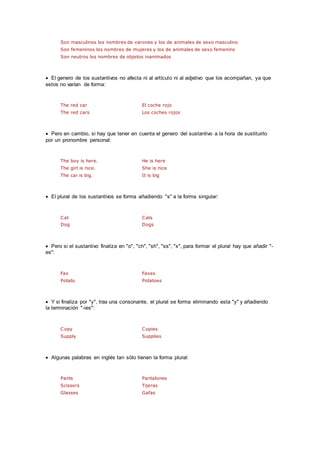
 Los sustantivos en inglés pueden ser masculinos, femeninos o neutros:
Son masculinos los nombres de varones y los de animales de sexo masculino
Son femeninos los nombres de mujeres y los de animales de sexo femenino
Son neutros los nombres de objetos inanimados
 El genero de los sustantivos no afecta ni al artículo ni al adjetivo que los acompañan, ya que
estos no varían de forma:
The red car El coche rojo
The red cars Los coches rojos
 Pero en cambio, si hay que tener en cuenta el genero del sustantivo a la hora de sustituirlo
por un pronombre personal:
The boy is here. He is here
The girl is nice. She is nice
The car is big. It is big
 El plural de los sustantivos se forma añadiendo "s" a la forma singular:
Cat Cats
Dog Dogs
 Pero si el sustantivo finaliza en "o", "ch", "sh", "ss", "x", para formar el plural hay que añadir "-
es":
Fax Faxes
Potato Potatoes
 Y si finaliza por "y", tras una consonante, el plural se forma eliminando esta "y" y añadiendo
la terminación "-ies":
Copy Copies
Supply Supplies
 Algunas palabras en inglés tan sólo tienen la forma plural:
Pants Pantalones
Scissors Tijeras
Glasses Gafas
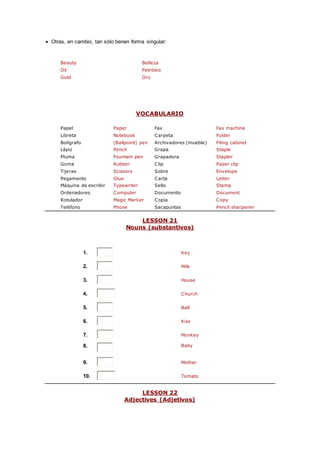
 Otras, en cambio, tan sólo tienen forma singular:
Beauty Belleza
Oil Petróleo
Gold Oro
VOCABULARIO
Papel Paper Fax Fax machine
Libreta Notebook Carpeta Folder
Bolígrafo (Ballpoint) pen Archivadores (mueble) Filing cabinet
Lápiz Pencil Grapa Staple
Pluma Fountain pen Grapadora Stapler
Goma Rubber Clip Paper clip
Tijeras Scissors Sobre Envelope
Pegamento Glue Carta Letter
Máquina de escribir Typewriter Sello Stamp
Ordenadores Computer Documento Document
Rotulador Magic Marker Copia Copy
Teléfono Phone Sacapuntas Pencil sharpener
LESSON 21
Nouns (substantivos)
1. Key
2. Milk
3. House
4. Church
5. Ball
6. Kiss
7. Monkey
8. Baby
9. Mother
10. Tomato
LESSON 22
Adjectives (Adjetivos)
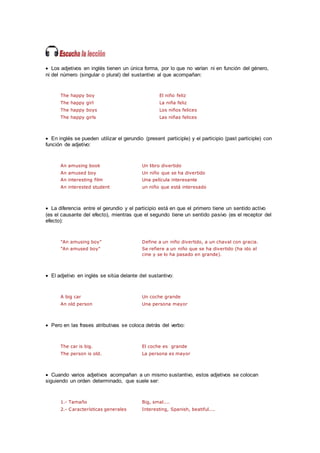
 Los adjetivos en inglés tienen un única forma, por lo que no varían ni en función del género,
ni del número (singular o plural) del sustantivo al que acompañan:
The happy boy El niño feliz
The happy girl La niña feliz
The happy boys Los niños felices
The happy girls Las niñas felices
 En inglés se pueden utilizar el gerundio (present participle) y el participio (past participle) con
función de adjetivo:
An amusing book Un libro divertido
An amused boy Un niño que se ha divertido
An interesting film Una película interesante
An interested student un niño que está interesado
 La diferencia entre el gerundio y el participio está en que el primero tiene un sentido activo
(es el causante del efecto), mientras que el segundo tiene un sentido pasivo (es el receptor del
efecto):
"An amusing boy" Define a un niño divertido, a un chaval con gracia.
"An amused boy" Se refiere a un niño que se ha divertido (ha ido al
cine y se lo ha pasado en grande).
 El adjetivo en inglés se sitúa delante del sustantivo:
A big car Un coche grande
An old person Una persona mayor
 Pero en las frases atributivas se coloca detrás del verbo:
The car is big. El coche es grande
The person is old. La persona es mayor
 Cuando varios adjetivos acompañan a un mismo sustantivo, estos adjetivos se colocan
siguiendo un orden determinado, que suele ser:
1.- Tamaño Big, smal....
2.- Características generales Interesting, Spanish, beatiful....
3.- Edad Old, young....
4.- Forma Round, narrow, broad....
5.- Color Red, blue....
6.- Material Plastic, golden, silver....
7.- Procedencia Spanish, Swiss....
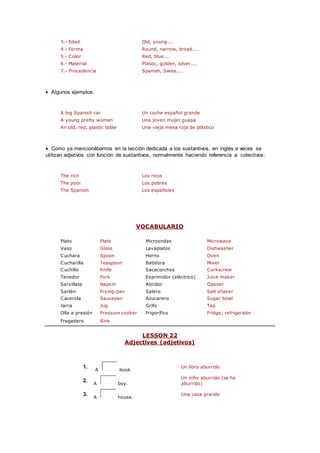
 Algunos ejemplos:
A big Spanish car Un coche español grande
A young pretty woman Una joven mujer guapa
An old, red, plastic table Una vieja mesa roja de plástico
 Como ya mencionábamos en la lección dedicada a los sustantivos, en inglés a veces se
utilizan adjetivos con función de sustantivos, normalmente haciendo referencia a colectivos:
The rich Los ricos
The poor Los pobres
The Spanish Los españoles
VOCABULARIO
Plato Plate Microondas Microwave
Vaso Glass Lavaplatos Dishwasher
Cuchara Spoon Horno Oven
Cucharilla Teaspoon Batidora Mixer
Cuchillo Knife Sacacorchos Corkscrew
Tenedor Fork Exprimidor (eléctrico) Juice maker
Servilleta Napkin Abridor Opener
Sartén Frying-pan Salero Salt shaker
Cacerola Saucepan Azucarero Sugar bowl
Jarra Jug Grifo Tap
Olla a presión Pressure cooker Frigorífico Fridge; refrigerator
Fregadero Sink
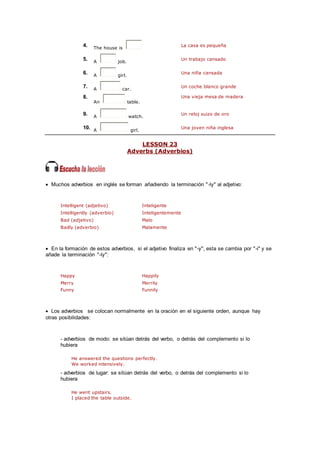
LESSON 22
Adjectives (adjetivos)
1.
A book
Un libro aburrido
2.
A boy.
Un niño aburrido (se ha
aburrido)
3.
A house.
Una casa grande
4. The house is
La casa es pequeña
5. A job.
Un trabajo cansado
6. A girl.
Una niña cansada
7. A car.
Un coche blanco grande
8.
An table.
Una vieja mesa de madera
9. A watch.
Un reloj suizo de oro
10. A girl.
Una joven niña inglesa
LESSON 23
Adverbs (Adverbios)
 Muchos adverbios en inglés se forman añadiendo la terminación "-ly" al adjetivo:
Intelligent (adjetivo) Inteligente
Intelligently (adverbio) Inteligentemente
Bad (adjetivo) Malo
Badly (adverbio) Malamente
 En la formación de estos adverbios, si el adjetivo finaliza en "-y", esta se cambia por "-i" y se
añade la terminación "-ly":
Happy Happily
Merry Merrily
Funny Funnily
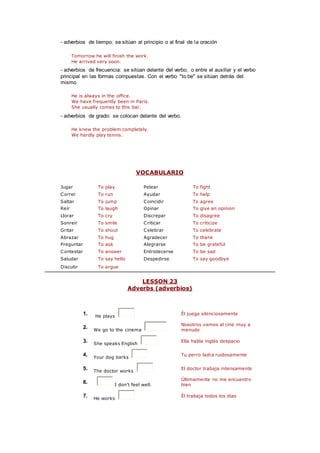
 Los adverbios se colocan normalmente en la oración en el siguiente orden, aunque hay
otras posibilidades:
- adverbios de modo: se sitúan detrás del verbo, o detrás del complemento si lo
hubiera
He answered the questions perfectly.
We worked intensively.
- adverbios de lugar: se sitúan detrás del verbo, o detrás del complemento si lo
hubiera
He went upstairs.
I placed the table outside.
- adverbios de tiempo: se sitúan al principio o al final de la oración
Tomorrow he will finish the work.
He arrived very soon.
- adverbios de frecuencia: se sitúan delante del verbo, o entre el auxiliar y el verbo
principal en las formas compuestas. Con el verbo "to be" se sitúan detrás del
mismo
He is always in the office.
We have frequently been in Paris.
She usually comes to this bar.
- adverbios de grado: se colocan delante del verbo.
He knew the problem completely.
We hardly play tennis.
VOCABULARIO
Jugar To play Pelear To fight
Correr To run Ayudar To help
Saltar To jump Coincidir To agree
Reír To laugh Opinar To give an opinion
Llorar To cry Discrepar To disagree
Sonreír To smile Criticar To criticize
Gritar To shout Celebrar To celebrate
Abrazar To hug Agradecer To thank
Preguntar To ask Alegrarse To be grateful
Contestar To answer Entristecerse To be sad
Saludar To say hello Despedirse To say goodbye
Discutir To argue
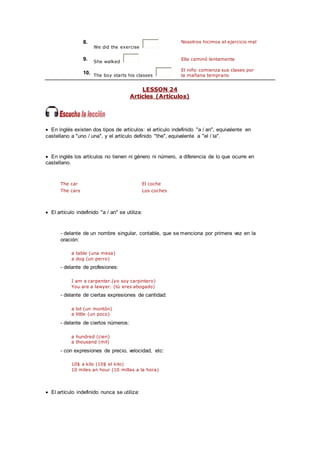
LESSON 23
Adverbs (adverbios)
1. He plays
Él juega silenciosamente
2. We go to the cinema
Nosotros vamos al cine muy a
menudo
3. She speaks English
Ella habla inglés despacio
4. Your dog barks
Tu perro ladra ruidosamente
5. The doctor works
El doctor trabaja intensamente
6. I don't feel well.
Últimamente no me encuentro
bien
7. He works
Él trabaja todos los días
8.
We did the exercise
Nosotros hicimos el ejercicio mal
9. She walked
Ella caminó lentamente
10. The boy starts his classes
El niño comienza sus clases por
la mañana temprano
LESSON 24
Articles (Artículos)
 En inglés existen dos tipos de artículos: el artículo indefinido "a / an", equivalente en
castellano a "uno / una", y el artículo definido "the", equivalente a "el / la".
 En inglés los artículos no tienen ni género ni número, a diferencia de lo que ocurre en
castellano.
The car El coche
The cars Los coches
 El artículo indefinido "a / an" se utiliza:
- delante de un nombre singular, contable, que se menciona por primera vez en la
oración:
a table (una mesa)
a dog (un perro)
- delante de profesiones:
I am a carpenter.(yo soy carpintero)
You are a lawyer. (tú eres abogado)
- delante de ciertas expresiones de cantidad:
a lot (un montón)
a little (un poco)
- delante de ciertos números:
a hundred (cien)
a thousand (mil)
- con expresiones de precio, velocidad, etc:
10$ a kilo (10$ el kilo)
10 miles an hour (10 millas a la hora)
 El artículo indefinido nunca se utiliza:
- delante de nombres en plural:
a table (una mesa)
tables (mesas)
- delante de nombres que no sean contables:
water (agua)
milk (leche)
 La forma del artículo indefinido "a" se utiliza delante de palabras que comienzan por
consonante, o por vocal con sonido consonante:
A pencil Un lápiz
A boy Un niño
 Mientras que la forma "an" se utiliza delante de palabras que comienzan por vocal:
An elephant Un elefante
An angel Un angel
 Por su parte, el artículo definido "the" se utiliza:
- delante de un nombre, singular o plural, contable, que ya ha sido mencionado en
la oración o que por el contexto queda perfectamente definido:
the car (el coche)
the girl (la niña)
- con nombre no contables utilizados con un significado determinado:
the music of the sixties (la música de los 60's)
the girl (la niña)
- en cambio no se utiliza cuando estos sustantivos tienen un sentido genérico:
Music is life. (la música es vida)
- delante de nombres utilizados con un significado colectivo:
the police (la policia)
the army (el ejército)
the cinema (el cine)
the radio (la radio)
- delante de nombres de nacionalidades:
the Italians (los italianos)
the Spanish (los españoles)
- delante de adjetivos utilizados como nombres genéricos:
The rich are happy.(los ricos son felices)
The blind need help. (los ciegos necesitan ayuda)
 Este artículo definido no se utiliza, en general, en los siguientes casos (aunque hay
excepciones):
- delante de nombres de continentes, países y ciudades:
Africa
Spain
New York
- delante de nombres de personas:
Peter
Edward
Mary
- delante de nombres utilizados en un sentido abstracto:
Life is beautiful. (la vida es
bella)
- delante de nombres de juegos y deportes:
I play football. (yo juego al fútbol)
- con nombres genéricos en plural:
Men are strong.(los hombres son fuertes)
VOCABULARIO
Naranja Orange Tomate Tomato
Pera Pear Lechuga Lettuce
Plátano Banana Pepino Cucumber
Manzana Apple Remolacha Beet
Limón Lemon Pimiento Pepper
Sandia Watermelon Zanahoria Carrot
Melón Melon Perejil Parsley
Melocotón Peach Calabaza Pumpkin
Albaricoque Apricot Uva Grape
Fresa Strawberry Dátil Date
Patata Potato
LESSON 24
Articles (artículos)
1. Silver is highly valued.
La plata es muy apreciada
2. Peter came to see me.
Pedro vino a verme
3. Space is infinite.
El espacio es infinito
4. dog bit the boy.
Un perro mordió al niño
5. They play basketball.
Ellos juegan al baloncesto
6. Human beings are
intelligent.
Los seres humanos son
inteligentes
7. blue car is very old.
El coche azul es muy antiguo
8.
I like coffee very much.
Me gusta mucho el café
9. coffee I drank was very
hot.
El café que bebí estaba muy
caliente
10. plane landed with
problems.
Un avión aterrizó con problemas
LESSON 25
Adjetivos y pronombres demostrativos
 En inglés se utilizan como adjetivos demostrativos "this" (este / esta) y "that" (ese / esa):
This car Este coche
That girl Esa niña
 Estos adjetivos concuerdan en número (singular / plural) con el sustantivo al que
acompañan, mientras que en género no existen diferencias entre masculino y femenino:
Singular Plural
Masculino / femenino This (este / esta) These (estos / estas)
Masculino / femenino That (ese / esa) Those (esos / esas)
This student is intelligent. Este estudiante es inteligente
These students are intelligent. Estos estudiantes son inteligentes
That book is interesting. Ese libro es interesante
Those books are interesting. Esos libros son interesantes
 "This / that" y sus formas plurales "these / those" también se utilizan solos, funcionando como
pronombres demostrativos:
This is my book. Este es mi libro
That is your car. Ese es tu coche
These are my friends. Estos son mis amigos
Those are their relatives. Esos son sus familiares
 En este caso, el pronombres demostrativo sustituye al sustantivo al que se refiere y se utiliza
cuando éste ya ha sido mencionado anteriormente o cuando en función del contexto queda
perfectamente definido:
Have you seen my book? Yes, this is
your book.
¿ Has visto mi libro ?. Sí, este es tu libro
Who is your father? That is my father. ¿ Quién es tu padre ?. Ese es mi padre
VOCABULARIO
Resfriado A cold Pulmonía Pneumonia
Gripe Flu Antibiótico Antibiotic
Fiebre Temperature Analgésico Painkiller
Vómito Vomit Reposo Rest
Diarrea Diarrhea Lepra Leprosy
Anginas Tonsillitis Dolor Pain
Cáncer Cancer Agotamiento Exhaustion
Infarto Heart attack Análisis de sangre Blood test
Anemia Anaemia Leucemia Leukaemia
Medicina Medicine Jarabe Potion
Termómetro Thermometer
LESSON 25
Adjetivos y pronombres demostrativos
1.
is my wife.
Esta es mi mujer
2.
are my kids.
Esos son mis hijos
3.
radio doesn't work.
Esta radio no funciona
4.
Is your notebook?
¿Es ese tu cuaderno?
5. coat is very nice.
Este abrigo es muy bonito
6. She doesn't have books.
Ella no tiene estos libros
7. Have you bought car?
¿Te has comprado ese coche?
8.
pencils are yours.
Esos lápices son tuyos
9. are my books.
Esos son mis libros
10. children go to school.
Estos niños van al colegio
LESSON 26
Adjetivos y Pronombres Posesivos
 El adjetivo posesivo en inglés tiene las siguientes formas:
My Mío / mía / míos / mías
Your Tuyo / tuya / tuyos / tuyas
His / her / its Suyo / suya / suyos / suyas (de él, de ella, de ello)
Our Nuestro / nuestra / nuestros / nuestras
Your Vuestro / vuestra / vuestros / vuestras
Their Suyo / suya / suyos / suyas ( de ellos / ellas)
 La forma "its" se utiliza cuando el poseedor es un objeto o un animal, pero a veces, cuando
se siente especial cariño por el animal, se utiliza la forma masculina "his" o femenina "her".
This is its collar Este es su collar
This is his collar Este es su collar (del perro)
This is her collar Este es su collar (de la perra)
 El adjetivo posesivo varía según el poseedor (1ª, 2ª o 3ª persona del singular o plural), pero,
a diferencia del castellano, no concuerda en número con el objeto poseído:
Este es mi hijo This is my son.
Esta es mi hija This is my daugther.
Ellos son mis hermanos They are my brothers.
Ellas son mis hermanas They are my sisters.
 El pronombre posesivo sustituye al sustantivo y al adjetivo posesivo que lo acompaña
cuando este sustantivo ha sido ya anteriormente mencionado, o cuando por el contexto queda
perfectamente definido:
Mine Mío / mía / míos / mías
Yours Tuyo / tuya / tuyos / tuyas
His / hers Suyo / suya / suyos / suyas (de él, de ella, de ello)
Ours Nuestro / nuestra / nuestros / nuestras
Yours Vuestro / vuestra / vuestros / vuestras
Theirs Suyo / suya / suyos / suyas ( de ellos / ellas)
This is my car. Este es mi coche
This is mine. Este es el mío
This is our house. Esta es nuestra casa
This is ours. Este es la nuestra
Those are their books. Esos son sus libros
Those are theirs. Esos son los suyos
VOCABULARIO
Planeta Planet Mercurio Mercury
Espacio Space Venus Venus
Galaxia Galaxy Tierra Earth
Cohete Rocket Marte Mars
Astronauta Astronaut Júpiter Jupiter
Estrella Star Saturno Saturn
Meteorito Meteorite Urano Uranus
Despegue Takeoff Neptuno Neptune
Orbita Orbit Plutón Pluto
Satélite Satellite
Sol Sun
Luna Moon
LESSON 26
Adjetivos y pronombre posesivos
1.
These are pencils
Estos son vuestros lápices
2.
brothers have come.
Mis hermanos han venido
3.
The dog likes food.
Al perro le gusta su comida
4.
These are
Estos son los vuestros
5.
Where are shoes?
¿Dónde están tus zapatos?
6.
Has sister come?
¿Ha venido mi hermana?
7. I have read book.
Yo he leído tu libro
8.
Who has seen glasses?
¿Quién ha visto mis gafas?
9. This is house.
Esta es su casa (de ella)
10. brother hasn't seen me.
Tu hermano no me ha visto
LESSON 27
Adjetivos y Pronombres Interrogativos del tipo "Wh-"
 En inglés existen una serie de palabras, con funciones de adjetivo o pronombre, que
comienzan por "wh-" y que se sitúan invariablemente al comienzo de las frases interrogativas:
Palabra Significado Utilización con: Función
Who Quién Persona Sujeto/objeto
Whom (A, con) quién Persona Objeto
Whose De quién Persona Posesivo
What Qué Cosa Sujeto/objeto
Which Cual Persona/cosa Sujeto/objeto
Who lives here? ¿ Quién vive aquí ?
Whom did you meet? ¿ Con quién te reuniste ?
Whose dog is that? ¿ De quién es ese perro ?
What is you favourite song? ¿ Cual es tu canción preferida ?
Which racket do you prefer? ¿ Qué raqueta prefieres ?
 A diferencia del castellano, estas palabras no varían con el numero (singular o plural) del
sustantivo al que se refieren:
Who is this boy? ¿ Quién es este niño ?
Who are these boys? ¿ Quienes son estos niños ?
 Funcionan como pronombres, aunque algunas de ellas ("whose", "what" y "which" ) también
se utilizan como adjetivos:
Who came first? Pronombre
What name do you prefer? Adjetivo
What is your profession? Pronombre
Which car is faster? Adjetivo
 En aquellos casos en los que estas palabras vienen acompañadas de una preposición, se
utiliza con personas necesariamente "whom", mientras que con objetos se puede utilizar "what"
o "which". En estas frases, la preposición se coloca al final de la interrogación:
Whom did you come with? ¿ Con quién viniste ?
What do you think about? ¿ Qué piensas al respecto ?
 Se utiliza "which" en lugar de "who" (con personas) o "what" (con objetos) cuando la
pregunta se circunscribe a una serie de personas o objetos determinados:
What book do you prefer? ¿ Qué libro prefieres ? (se trata de una pregunta
abierta donde hay numerosas posibilidades de
respuesta).
Which book do you prefer? ¿ Qué libro prefieres ? (pregunto sobre unos pocos
libros que estoy mostrando).
VOCABULARIO
Avión Plane Cinturón de seguridad Seat-belt
Azafata Stewardess Equipaje Luggage
Aeropuerto Airport Pasajero Passenger
Despegar To take off Bolsa de mano Handbag
Retrasar To delay Primera clase First class
Ala Wing Clase ejecutiva Business class
Motor Engine Clase turista Tourist class
Cabina Cockpit Pasillo de embarque Shoot
Embarcar To board Tripulación Crew
Aterrizar To land Lista de espera Waiting list
Aterrizaje Landing Terminal Terminal
Facturar To check in
Puerta nº 20 Gate nº 20
LESSON 27
Adjetivos y pronombres interrogativos del tipo "Wh-"
1.
is your brother?
¿Quién es tu hermano?
2.
is the red car?
¿De quién es el coche rojo?
3.
tie do you like more?
¿Qué corbata te gusta más?
4. of these two books is
better?
¿Cuál de estos dos libros es
mejor?
5. did you see yesterday?
¿A quién vistes ayer?
6. came to see me?
¿Quién vino a verme?
7. did you go to the cinema
with?
¿Con quién fuiste al cine?
8.
do you want to do?
¿Qué quieres hacer?
9. shoes do you like more?
¿Qué zapatos (de estos dos)
prefieres?
10. coat is this?
¿De quién es este abrigo?
LESSON 28
Pronombres Personales Objetos
 Los pronombres personales en inglés que desempeñan en la oración la función de objeto
son:
Me A mí (me)
You A ti (te)
Him / her / it A él, a ella, a ello (se)
Us A nosotros - as (nos)
You A vosotros - as (os)
Them A ellos -as (se)
 Estos pronombres pueden ir en la oración como objetos directos o indirectos:
Give me that ball. Dame esa pelota Objeto indirecto
He has seen me. El me ha visto Objeto directo
I am lending you some money. Yo te presto dinero Objeto indirecto
She loves you. Elle te quiere Objeto directo
 Si funcionan como objeto indirecto se sitúan por delante del objeto directo en el caso de que
lo hubiere:
They brought me a book. Ellos me trajeron un libro ("me" funciona como
objeto indirecto y se sitúa delante de "book" que
es el objeto directo)
I am showing you these photos. Yo te enseño estas fotos ("you" ,como
complemento indirecto, se coloca delante de
"photos", complemento directo)
 Si en una misma oración coincidieran dos pronombres personales, uno en función de objeto
directo y otro de objeto indirecto, el primero se sitúa a continuación del verbo y el indirecto va
en segundo lugar, normalmente acompañado por las preposiciones "to" o "for":
I am giving these flowers to my sister. = I am giving them to her.
I´m sending this boy to her mother. = I am sending him to her.
I am buying a present for my brother. = I am buying it for him.
 Con "phrasal verbs" estos pronombres personales se suelen colocar inmediatamente a
continuación del verbo (no siempre), a diferencia de los sustantivos que pueden ir tanto a
continuación del verbo como al final de la oración:
Take off your shoes. Quítate los zapatos
Take them off. Quítatelos
He closed down his shop. El clausuró su tienda
He closed it down. El la clausuró
VOCABULARIO
Orgulloso Proud Ingenioso Slick
Entusiasta Eager Extravagante Extravagant
Celoso Jealous Cariñoso Loving
Estúpido Dumb Culto Educated
Solitario Lonely Torpe Clumsy
Elegante Stylish Inteligente Intelligent
Soltero Single Desconfiado Distrustful
Casado Married Avaricioso Greedy
Viudo Widower Introvertido Introverted
Viuda Widow Nervioso Nervous
Divorciado Divorced Tímido Shy
Seguro de sí Confident
LESSON 28
Pronombres personales objetos
1. I am showing my house.
Yo te enseño mi casa
2. She has brought a present.
Ella me ha traído un regalo
3. We are lending our car.
Nosotros te dejamos nuestro
coche
4. She has bought
Ella me lo ha comprado
5. Take off.
Quítatelo (el abrigo)
6. You have sold this picture.
Tú me has vendido este cuadro
7. He has given this book.
Él nos ha regalado este libro
8.
We have brought
Nosotros te lo hemos traído
9. You didn't say
Tú no me lo dijiste
10. Buy the newspaper.
Cómprame el periódico
LESSON 29
Pronombres Reflexivos
 Los pronombres reflexivos en inglés son:
Myself Yo mismo (-a)
Yourself Tú mismo (-a)
Himself / herself / itself El mismo / ella misma
Ourselves Nosotros (-as) mismos (-as)
Yourselves Vosotros (-as) mismos (-as)
Themselves Ellos (-as) mismos (-as)
 Este pronombre se utiliza con verbos reflexivos, es decir, aquellos que vienen acompañados
de un sujeto y de un objeto que son la misma persona:
I cut myself. Yo me corté
You hurt yourself. Tú te hiciste daño
Control yourself. Contrólate
I enjoyed myself very much. Yo me lo pasé muy bien
 Pero hay que tener en cuenta que los verbos reflexivos no coinciden necesariamente en
castellano y en inglés:
I dressed slowly. Yo me vestí lentamente
You shaved this morning. Tú te afeitaste esta mañana
I didn't wash yesterday. Yo no me lavé ayer
 También se utilizan los pronombre reflexivos para enfatizar al sujeto, y en este caso se
suelen colocar a continuación del mismo, o detrás del objeto de la oración:
I did the job myself. Yo mismo hice el trabajo
Let´s do it ourselves. Vamos a hacerlo nosotros mismos
He himself didn't know it. El mismo no lo sabía
She herself broke the glass. Ella misma rompió el cristal
VOCABULARIO
Divertido Funny Calmado Quiet
Caprichoso Fickle Bravucón Bragging
Insoportable Unbearable Bonachón Goodie
Malicioso Malicious Exaltado Hotheaded
Extrovertido Extrovert Honesto Honest
Trabajador Hard-working Envidioso Envious
Vago Lazy Enfermizo Sickly
Glotón Gorger Sano Healthy
Dormilón Sleepyhead Loco Mad
Deprimido Depressed Malhumorado Bad-tempered
Irónico Ironic Triunfador Successful
Irritado Irritated
LESSON 29
Pronombres reflexivos
1.
She answered the telephone
Ella misma contestó al teléfono
2. They enjoyed very much
in the party.
Ellos disfrutaron mucho en la
fiesta
3. He shaved very quickly.
Él se afeitó rápidamente
4. He has hurt
Él se ha hecho daño
5. We fixed the dinner
Nosotros mismos preparamos la
cena
6. He didn't want to answer.
Él mismo no quiso contestar
7.
You have painted the house
Tú mismo has pintado la casa
8.
They burnt the house.
Ellos mismos quemaron la casa
9. You have dressed very
smartly.
Tú te has vestido muy elegante
10. I want to answer.
Yo mismo quiero contestar
LESSON 30
Forma Pasiva
 La forma pasiva en inglés, al igual que en castellano, se forma utilizando el verbo auxiliar "to
be", acompañado del participio (past participle) del verbo principal:
The match is played. El partido es jugado
The house is built. La casa es construida
The book is read. El libro es leído
 La diferencia que se puede observar con el castellano es que, mientras en éste el participio
concuerda en género y número con el sujeto, en inglés, al ser la forma del participio única, no
se produce dicha concordancia:
The boy´s hair is combed. El niño es peinado
The girl´s hair is combed. La niña es peinada
The childrens´ hair is combed. Los niños son peinados
 Si mencionamos en la oración el sujeto agente, es decir, el sujeto que realiza la acción, éste
va introducido por la preposición "by":
This boy´s hair is combed by his mother. Este niño es peinado por su madre
The book is read by my sister. El libro es leído por mi hermana
Dinner is cooked by her husband. La cena es preparada por el marido
 Cuando transformamos una oración activa en su equivalente pasiva el proceso es el
siguiente:
a) El objeto de la oración activa pasa a ser sujeto de la pasiva
b) El verbo principal se sustituye por el auxiliar "to be", en su mismo tiempo,
acompañado del participio del verbo principal
c) El sujeto de la oración principal pasa a ser complemento agente de la pasiva
Forma activa Forma pasiva
I watch this program. This program is watched by me
I cleaned my car. The car was cleaned by me
You have read this book. This book has been read by you
 Todas las formas activas tienen su equivalente pasiva, incluidas las formas continuas. Todas
ellas se construyen, como hemos indicado, poniendo el verbo auxiliar de la oración pasiva en el
mismo tiempo que el verbo principal de la oración activa:
I watch my hands. My hands are watched by me
I watched my hands. My hands were watched by me
I will watch my hands. My hands will be watched by me
I am watching my hands. My hands are being watched by me
I have watched my hands. My hands have been watched by me
I would watch my hands. My hands would be watched by me
VOCABULARIO
Pino Pine Alamo Poplar
Palmera Palm Platanero Banana tree
Roble Oak Alcornoque Cork oak
Ciprés Cypress Viña Vineyard
Encina Holm oak Cocotero Coconut palm
Eucalipto Eucalyptus Cactus Cactus
Naranjo Orange tree Ciruelo Plum tree
Limonero Lemon tree Almendro Almond tree
Peral Pear tree Castaño Chestnut tree
Manzano Apple tree Olivo Olive tree
Higuera Fig tree
LESSON 30
Forma pasiva
1. The newspaper bought.
El periódico fue comprado
2. The coffee made by my
sister.
El café fue preparado por mi
hermana
3. The radio plugged in.
La radio no ha sido enchufada
4. the truck been bought yet?
¿Ha sido comprado ya el
camión?
5. The robber captured by the
police.
El ladrón fue capturado por la
policía
6.
The picture painted by me.
El cuadro ha sido pintado por mí
7.
The TV fixed.
La tele ha sido arreglada
8.
The floor swept by the
neighbor.
El suelo fue barrido por la vecina
9.
The flowers watered.
Las flores han sido regadas
10. The girl dressed by her
mother.
La niña fue vestida por su madre
LESSON 31
Preguntas y Respuestas Cortas
 En inglés es frecuente responder preguntas utilizando respuestas cortas para evitar repetir
toda la oración:
Do you want a cup of coffee? Yes, I do.
Have you seen the film? Yes, I have.
 Estas respuestas se construyen utilizando únicamente el verbo auxiliar, que se pone en el
mismo tiempo que el verbo de la oración interrogativa:
Are you going to the cinema ? Yes, I am.
Did you go to Paris ? Yes, I did.
Had he read the book ? Yes, he had.
 A veces, cuando alguien realiza una afirmación, se le contesta con una interrogación corta
como una manera cortés de mostrar interés, que sirve de "comodín" para hacer seguir la
conversación, o también para manifestar sorpresa:
It is very cold. Is it?
I like this film. Do you?
They come to visit us. Do they?
 Esta interrogación se construye utilizando el verbo auxiliar de la oración principal en su
mismo tiempo, o con el verbo "to do" cuando en la oración principal no hay verbo auxiliar.
 También se utilizan esta forma corta introducida por la particula "so" cuando se coincide con
lo que alguien ha afirmado, o por "neither" cuando se coincide con lo que alguien ha negado.
En estos casos se altera el orden de la oración, colocando el verbo delante del sujeto:
I like this film. So do I.
I don't like this film. Neither do I.
He went to London. So did I.
He didn´'t go to London. Neither did I.
VOCABULARIO
Aguila Eagle Loro Parrot
Halcón Falcon Avestruz Ostrich
Paloma Dove Milano Kite
Buitre Vulture Jilguero Goldfinch
Cuervo Crow Ruiseñor Nightingale
Cigüeña Stork Pato Duck
Canario Canary Ganso Goose
Gaviota Seagull Cisne Swan
Gorrión Sparrow Cuco Cuckoo
Golondrina Swallow Cóndor Condor
Búho Owl Murciélago Bat
LESSON 31
Preguntas y respuestas cortas
1.
Have you been in Madrid? No,
¿Has estado en Madrid?
2.
Did you read the book? No,
¿Leíste el libro?
3.
Are you going with me? Yes,
¿Vas a venir conmigo?
4.
Does he like this place? Yes,
¿Le gusta este local?
5.
Do you want to come with us later?
Yes,
¿Quieres venir con nosotros más
tarde?
6.
Did she come with you? Yes,
¿Vino contigo?
7.
Have you bought a new car? Yes,
¿Has comprado un coche nuevo?
8.
Was he playing tennis? Yes,
¿Estaba jugando al tenis?
9.
Will you eat at home? No,
¿Vas a comer a casa?
10.
Would she come later? Yes,
¿Vendría más tarde?
LESSON 32
"Question Tags"
 En inglés es frecuente que tras una afirmación o negación, la misma persona añada una
pregunta corta de signo opuesto:
Do you want coffee? Don't you?
You have seen the film. Haven´t you?
 Estas interrogaciones se construyen siguiendo el mismo modelo de frases cortas que vimos
en la lección anterior: se utiliza el auxiliar en el mismo tiempo que el verbo de la oración
principal, y en el caso de que la oración principal no lleve auxiliar, se utiliza el auxiliar "to do":
You like coffee. Don´t you?
You can help me. Can´t you?
He is clever. Isn´t he ?
 Se suele utilizar una "question tag" negativa tras una afirmación:
It is very cold. Isn´t it?
She likes this film. Doesn´t she?
They came to visit us. Didn´t they?
 Y una "question tag" afirmativa tras una negación:
It isn´t very cold. Is it?
She doesn't like this film. Does she?
They didn´t come to visit us. Did they?
 El significado de las "question tags" va a depender de su pronunciación: si cae la entonación
indica que simplemente se busca el asentimiento de la otra persona; si, por el contrario, se
eleva el tono, entonces se trata de una verdadera pregunta:
She will come later. Won´t she? (si se baja el tono, se busca sólo el
asentimiento del oyente )
She will come later. Won´t she? (si se sube el tono, se trata de una
verdadera pregunta )
 A veces, también se utilizan las "question tags" para solicitar información o para solicitar algo
de un modo más cortés. En estos casos, la oración principal suele ser negativa y la "question
tag" afirmativa:
You don´t have the newspaper. Do you?
They don´t want to go to the cinema. Do they?
VOCABULARIO
Tiburón Shark Trucha Trout
Ballena Whale Salmón Salmon
Delfín Dolphin Calamar Squid
Orca Killer whale Raya Ray
Pulpo Octopus Besugo Red bream
Foca Seal Caviar Caviar
Pingüino Penguin Cocodrilo Crocodile
Cangrejo Crab Bacalao Cod
Marisco Seafood Atún Tuna
Almeja Clam Tortuga Turtle
Cachalote Sperm whale Caracol Snail
Morsa Walrus
LESSON 32
Question tags
1. They live in Seville,
Ellos viven en Sevilla, ¿no?
2. You play tennis very well,
Tú juegas bien al tenis, ¿no?
3. You have read this book,
Tú has leído ese libro, ¿no?
4. She doesn't like this city,
A ella le gusta esta ciudad, ¿no?
5. They will come with us,
Ellos vendrán con nosotros, ¿no?
6. He is waiting for me,
Él me está esperando, ¿no?
7.
We are going to buy a new car,
Vamos a comprar un coche
nuevo, ¿no?
8.
You weren't at home,
Nos estabas en casa, ¿no?
9.
You are going to a new restaurant, Vas a un restaurante nuevo,
¿no?
10.
She would come later,
Ella vendría más tarde, ¿no?
LESSON 33
Preposiciones de Tiempo "at, on, in"
 Se utiliza la preposición "at" para referirnos a horas y a momentos puntuales del día:
At 10 o'clock A las diez en punto
At midnight A medianoche
 También se utiliza "at" con algunas expresiones de tiempo:
At Christmas En navidades
At present Actualmente
At the moment En este momento
At the weekend En el fin de semana
 La preposición "on" se utiliza con días de la semana y con fechas:
On Monday El lunes
On my birthday El día de mi cumpleaños
On the 10th of April El 10 de abril
 La preposición "in" se utiliza con meses:
In January En enero
In the previous month En el mes anterior
 También se utiliza "in" con las estaciones del año:
In summer En verano
In winter En invierno
In autumn En otoño
In spring En primavera
 Así como con periodos más largos de tiempo:
In this century En este siglo
In the 60's En los años 60's
 Y con algunas expresiones temporales que se refieren a periodos del día (salvo con "night"):
In the morning Por la mañana
In the afternoon Al mediodía
In the evening Por la tarde
At night Por la noche
 En la siguiente expresión se puede utilizar tanto "on" como "in", pero el significado varía:
On time En el momento justo (ni antes, ni después)
In time Con tiempo suficiente
VOCABULARIO
Agua mineral Mineral water Jerez Sherry
Leche Milk Champán Champagne
Vino Wine Tequila Tequila
Cerveza Beer Anís Anisette
Licor Liqueur Coñac Cognac
Whisky Whisky Vino tinto Red wine
Ginebra Gin Vino rosado Rosé
Refresco Soft drink Vino blanco White wine
Zumo Juice Batido Milkshake
Te Tea Ron Rum
Vodka Vodka
LESSON 33
Preposiciones de tiempo (at,on,in)
1. I have arrived 8 o'clock.
Yo he llegado a las 8 en punto
2. Monday I have English
class.
El lunes tengo clase de inglés
3.
The elections will take place
24th of March.
Las elecciones serán el 24 de
marzo
4. She celebrated a party her
birthday.
Ella celebró una fiesta el día de
su cumpleaños
5. the last century, life was
different.
En el siglo pasado, la vida era
diferente
6.
What are you doing spring?
¿Que harás en primavera?
7.
I will see you half past two.
Yo te veré a las dos y media
8.
midnight a ghost appeared.
A medianoche se apareció un
fantasma
9.
summer it is very hot.
En verano hace mucho calor
10.
The train leaves 11 0'clock.
El tren parte a las 11 de la
noche
LESSON 34
Otras Preposiciones de Tiempo
 Entre otras preposiciones de tiempo que se utilizan en inglés destacamos:
Before Antes
After Después
For Durante
During Durante
Since Desde
From Desde
Till Hasta
 La preposición "before" se utiliza para indicar que la acción se ha desarrollado antes del
momento indicado:
Before I came here, I lived in
Seville.
Antes de venir aquí, yo viví en Sevilla
Finish your report before Sunday. Finaliza tu informe antes del domingo
 Mientras que la preposición "after" indica, por el contrario, que la acción tiene lugar después
del momento señalado:
After I went to Madrid, I started
my studies.
Después de irme a Madrid, comencé mis estudios
You can see him after 6 o'clock. Puedes verle después de las 6
 La preposición "for" se utiliza para indicar la duración de una acción:
I lived in Madrid for 10 years. Yo viví en Madrid durante 10 años
She studied in the university for 5 years. Ella estudió en la universidad durante 5
años
 "During" se utiliza, en cambio, para indicar el periodo de tiempo durante el cual se desarrolla
la acción:
I met my wife during my studies in
London.
Yo conocí a mi mujer durante mis estudios
en Londres
During the summer, I like to play sports. Durante el verano me gusta practicar
deporte
 Con la preposición "since" se indica el comienzo de una acción que en el momento de la
oración aún no ha terminado:
I´ve studied English since my childhood. Estudio inglés desde mi infancia
We´ve worked in this company since 1992. Trabajamos en esta compañía desde
1992
 La preposición "from" se utiliza acompañada de las preposiciones "to" o "till / untill",
indistintamente, para indicar el comienzo y el término de una acción:
I work from Monday to Friday. Trabajo de lunes a viernes
I lived in Paris from 1980 to 1984. Viví en París desde 1980 a 1994
 Si sólo se indica el final de la acción, se utiliza "till / untill" (nunca "to"):
Yesterday I worked until midnight. Ayer trabajé hasta medianoche
I didn't drive untill my 30's. No conduje hasta los 30 años
VOCABULARIO
Mosca Fly Lagartija little lizard
Mosquito Mosquito Piojo Louse
Avispa Wasp Garrapata Tick
Abeja Bee Polilla Moth
Hormiga Ant Lombriz Worm
Cucaracha Cockroach Saltamontes Grasshopper
Escarabajo Beetle Ciempiés Centipede
Mariposa Butterfly Caracol Snail
Araña Spider Pulga Flea
Grillo Cricket Escorpión Scorpion
LESSON 34
Otras preposiciones de tiempo
1.
She has been playing tennis
she was 13.
Ella juega al tenis desde los 13
años
2. I met you, I fell in love with
you.
Desde que te conocí, me
enamoré de ti
3.
The office is open 5.
El horario de oficina es de 9 a 5
4. The child didn't sleep his
mother arrived.
El niño no se durmió hasta que
llegó su madre
5. 1990 she worked in
the university.
Desde 1980 a 1990 ella trabajó
en la universidad
6. We have studied French 7
years.
Nosotros hemos estudiado
francés durante 7 años
7. arriving, he started to
watch TV.
Después de llegar, se puso a ver
la tele
8.
leaving, call your boss.
Antes de salir, llama a tu jefe
9. Christmas, I have played
football.
Durante las Navidades he
jugado al fútbol
10. Don't get home 12 o'clock.
No llegues a casa después de las
12
LESSON 35
Preposiciones de Lugar
 En inglés se utilizan diversas preposiciones para referirse a un lugar; entre las más
frecuentes destacamos:
In Dentro
On Sobre
At Junto a
 La preposición "in" indica dentro de un lugar:
In my room En mi habitación
In my pocket En mi bolsillo
 Se suele utilizar también cuando nos referimos a países o ciudades:
The concert is in Madrid. El concierto es en Madrid
This match took place in Spain. Este partido se celebró en España
 "On" indica sobre un lugar:
On the table Sobre la mesa
On my book Sobre mi libro
 Hay expresiones muy usuales que se construyen con "on":
On the left A la izquierda
On the right A la derecha
On the fifth floor En el quinto piso
 La preposición "at" se utiliza normalmente para indicar "junto a, al lado de":
At the bed Junto a la cama
At the bridge Junto al puente
 Pero hay una serie de lugares que suelen ir acompañados de la preposición "at", incluso
cuando estamos dentro de los mismos:
At home En casa
At the university En la universidad
At work En el trabajo
At the airport En el aeropuerto
At the bus station En la estación de autobuses
 También se utiliza "at" para referirnos a acontecimientos:
At the exposition En la exposición
At the meeting En el meeting
At the conference En la conferencia
VOCABULARIO
Volante Steering wheel Embrague Clutch
Bujía Spark plug Neumático Tyre
Batería Battery Rueda Wheel
Motor Engine Capot Hood
Pistón Piston Maletero Trunk
Parabrisas Windshield Cilindro Cylinder
Limpiaparabrisas Windshield wimpers Matrícula License plate
Parachoques Bumper Carburador Carburetor
Espejo retrovisor Rear-view mirror Depósito Gas tank
Marcha Gear Acelerador Accelerator
Freno Brake
LESSON 35
Preposiciones de lugar
1. the car
En el coche
2. the horse
En el caballo
3. the cinema
Junto al cine
4. the party
En la fiesta
5. the school
En el colegio
6. the top of the page
En la parte de arriba de la
página
7. the sea
Junto al mar
8.
He arrived London
Él llegó a Londres
9. the wall
En la pared
10. the box
En la caja
LESSON 36
Preposiciones de Movimiento
 En inglés, en expresiones de movimiento, se utilizan, entre otras, las siguientes
preposiciones:
From Desde
To A, hasta
At A
In A
Into Dentro de
 Con la preposición "from" se indica el punto de partida o el lugar de origen:
I came from Paris. Yo vine de París
She is from Germany. Ella es de Alemania
Where are you from? ¿ De dónde eres ?
 Para indicar que vamos hacia un lugar, utilizamos la preposición "to":
I went to London. Yo fui a Londres
You drive to Madrid. Ella conduce hacia Madrid
We go to the beach. Nosotros vamos a la playa
They went to Italy. Ellos fueron a Italia
 Si decimos que ya hemos llegado al lugar, utilizamos la preposición "in" con ciudades y
países, y "at" con otros lugares (excepción: "home" no lleva preposición):
I arrived in London. Yo llegué a Londres
She arrived in Portugal. Ella llegó a Portugal
We arrive at the beach. Nosotros llegamos a la playa
When will you arrive home? ¿ Cuando llegarás a casa ?
 Para indicar que entramos en un lugar, utilizamos la preposición "into":
We went into the car. Nosotros entramos en el coche
They went into the movies. Ellos entraron en el cine
Come into my house. Entra en mis casa
VOCABULARIO
Barco Ship Marino Sailor
Proa Bow Cubierta Deck
Popa Stern Grumete Cabin boy
Estribor Starboard Timón Rudder
Babor Port Yate Yacht
Mástil Mast Remo Oar
Camarote Cabin Ancla Anchor
Vela Sail Quilla Keel
Capitán Captain Puente de mando Bridge
Navegar To sail Hundirse To sink
Naufragar To be ship-wrecked
LESSON 36
Preposiciones de movimiento
1. We will go New York.
Nosotros iremos a Nueva York
2. She came the beach.
Ella vino a la playa
3. We are arriving the theater.
Nosotros llegamos al teatro
4. They came France.
Ellos vinieron de Francia
5.
This train goes
Seville.
Este tren va de Madrid a Sevilla
6. She came the office.
Ella entró en la oficina
7. He arrived Paris.
Él llegó a París
8.
He arrived home late.
Él llegó tarde a su casa
9. We are going a party.
Nosotros vamos a una fiesta
10. She arrived work.
Ella llegó al trabajo
LESSON 37
Preposiciones Según el Medio de Transporte
 En inglés, dependiendo del medio de transporte que se utilice, se emplean distintas
preposiciones.
 Cuando subimos a un transporte utilizamos el verbo "to get" (en algunas expresiones el
verbo "to go"), acompañado de las siguientes preposiciones:
 "On / onto" en las expresiones:
To get on a bicycle Subirse a una bicicleta
To get on a motorbyke Subirse a una moto
To get on a horse Subirse a un caballo
To go on board Embarcar
To get on a bus Subir a un autobús
To get on the train Subir al tren
 "In / into" en las expresiones:
To get in the car Subirse al coche
To get in the taxi Subirse al taxi
 Para indicar como nos estamos desplazando hay distintas alternativas:
 Si nos referimos al tipo de transporte que empleamos, utilizamos "by", salvo en la expresión
"on foot" (andando):
To go by bicycle Ir en bicicleta
To go by car Ir en coche
To go by train Ir en tren
To go by plane Ir en avión
To go by bus Ir en autobús
 Pero si especificamos el vehículo concreto que estamos empleando, entonces utilizamos las
preposiciones "on" o "in", según el medio de transporte:
To go in my car Ir en mi coche
To go on the bicycle Ir en la bicicleta
To go on the black horse Ir en el caballo negro
To go on the 8.15 train Ir en el tren de las 8.15
 Cuando descendemos del transporte, utilizamos el verbo "to get", acompañado de las
siguientes preposiciones:
 "Out of" en las expresiones:
To get out of the car Bajar del coche
To get out of the taxi Bajar del taxi
 "Off" en las expresiones:
To get off the bus Bajar del autobús
To get off the bicycle Bajar de la bicicleta
To get off the train Bajar del tren
To get off the motorbike Bajar de la moto
To get off the horse Bajar del caballo
VOCABULARIO
Hierro Iron Hidrógeno Hydrogen
Oro Gold Carbono Carbon
Plata Silver Nitrógeno Nitrogen
Cobre Copper Uranio Uranium
Estaño Tin Calcio Calcium
Plomo Lead Sodio Sodium
Platino Platinum Potasio Potassium
Aluminio Aluminium Fósforo Phosphorus
Mercurio Mercury Fluor Fluoride
Azufre Sulfur Magnesio Magnesium
Oxígeno Oxygen
LESSON 37
Preposiciones según el medio de transporte
1. She her bicycle.
Ella se subió a su bicicleta
2. We train.
Nosotros fuimos a Francia en
tren
3. Don't the bus.
No te bajes del autobús
4. You foot.
Tú viniste a pìe
5. She the taxi.
Ella sube al taxi
6. He my car.
Él bajó de mi coche
7. We board.
Nosotros subimos al barco
8.
They horse.
Ellos estaban montando a
caballo
9. I the train.
Yo me subí al tren
10. He the six o'clock bus.
El vino en el autobús de las 6.00
LESSON 38
"By the time", "On time", "In time"
 En inglés se utilizan estas tres expresiones temporales, con matices ligeramente diferentes.
 "By the time" significa no más tarde de la hora señalada:
You have to be here by 6 o'clock. Tienes que estar aquí no más tarde de las 6 en
punto
The train will arrive by 10:30. El tren llegará no más tarde de las 10.30
 "On time" significa exactamente a la hora señalada, ni antes, ni después:
The match begins at 4:30. I will be there
on time.
El partido empieza a las 4.30. Yo
estaré allí puntual (llegaré a las 4.30,
ni antes, ni después)
The bus leaves at 3. I will be there on time. El autobús sale a las 3.00. Yo estaré
allí puntual (justo a las 3.00)
 "In time" significa con tiempo suficiente:
The match begins at 4:30. I will be there in
time.
El partido empieza a las 4.30. Yo
estaré allí con tiempo (llegaré antes de
las 4.30)
The bus leaves at 3. I will be there in time. El autobús sale a las 3.00. Yo estaré
allí con tiempo (antes de las 3.00)
VOCABULARIO
Guerra War Armada Navy
Bomba Bomb Fuerza aérea Air force
Tanque Tank Bombardero Bomber
Cañón Cannon Caza Fighter
Mina Mine Bomba atómica Atomic bomb
Metralleta Submachine gun Ametralladora Machine gun
Mortero Mortar Pistola Pistol
Granada Hand grenade Munición Ammunition
Fusil Rifle Bala Bullet
Trinchera Trench Misil Missile
Paracaidista Paratrooper Prisionero Prisoner
Infantería Infantry Paz Peace
LESSON 38
"By the time","on time","in time"
1. You have to arrive 8
Tienes que llegar no más tarde
de las 8.00
o'clock.
2. We will start at 4 time.
Empezamos a las 4.00. Ven con
tiempo
3. He arrived just time.
Él llegó justo a tiempo
4. You must finish 9.
Debes terminar no más tarde de
las 9.00
5.
The film begins at four o'clock
time.
A las 4 empieza la película. Se
puntual
6. I arrived time to get the
train.
Llegué con el tiempo justo para
coger el tren
7. I arrived time to get the
train.
Llegué con tiempo suficiente
para coger el tren
8.
midnight we will know the
answer.
Antes de medianoche
conoceremos la respuesta
9.
The child arrived at the school
time.
El niño llegó al colegio justo a
tiempo
10.
The worker arrived at the station
time.
El trabajador llegó a la estación
con tiempo suficiente
LESSON 39
Preposiciones "above" y "over"
 Estas preposiciones coinciden en inglés con el significado de "sobre, por encima de ", pero
ambas tienen, además, otras acepciones que las diferencian.
 Con el significado de "por encima de (a cierta distancia)" ambas preposiciones se pueden
utilizar indistintamente:
The clouds are over us. Las nubes están sobre nosotros
The clouds are above us. Las nubes están sobre nosotros
 También, ambas preposiciones tienen el significado de "por encima en el rango", pero "over"
da a entender que se trata del superior inmediato:
In the company, he is over me. En la compañía, el está por encima mía (es mi
superior inmediato)
In the company, he is above me. En la compañía, el está por encima mía
(puede que esté muy por encima mía; no tiene
por que ser mi superior inmediato)
 La preposición "over" tiene otras acepciones: de un lado a otro, al otro lado, cubriendo, sobre
algo (tema de conversación), etc.
There is a bridge over the cliff. Hay un puente sobre el acantilado
I live over the lake. Yo vivo al otro lado del lago
I put a blanket over the injured. Puse una manta sobre el herido
They talk over sports. Ellos hablan sobre fútbol
 "Over" se utiliza también a veces para indicar que una acción se desarrolla durante el
tiempo de la comida, de la cena, etc.:
We had an argument over lunch. Tuvimos una discusión en la comida
 Por su parte, "above" puede utilizarse como adjetivo o adverbio, con el significado de
"previo":
As mentioned above.... Como fue mencionado previamente
The above definition.... La definición anterior
VOCABULARIO
Religión Religion Protestantismo Protestantism
Dios God Judaísmo Judaism
Cielo Heaven Islam Islam
Purgatorio Purgatory Iglesia Church
Infierno Hell Catedral Cathedral
Demonio Devil Mezquita Mosque
Angel Angel Sinagoga Synagogue
Santo Saint Bautizo Baptism
Profeta Prophet Misa Mass
Apóstol Apostle Comunión Communion
Cristianismo Christianity Confesión Confession
Catolicismo Catholicism Pecado Sin
LESSON 39
Preposiciones "above" y "over"
1. There were 20 persons.
Había más de 20 personas
2. The president is me.
El presidente está por encima de
mí
3. We had a chat a cup of
Tuvimos una charla durante el
café
coffee.
4. I put a tablecloth the table.
Puse un mantel sobre la mesa
5. He lives the river.
Él vive al otro lado del río
6. The helicopter is the burning
house.
El helicóptero está sobre la casa
ardiendo
7. He is me.
Él está inmediatamente encima
de mía
8.
They built a bridge the river.
Ellos construyeron un puente
sobre el río
9. I put on a coat my suit.
Me puse un abrigo sobre mi
traje
10. They argued money.
Discutieron sobre dinero
LESSON 40
Preposiciones "under" y "below"
 Ambas preposiciones tienen el significado de "por debajo de" y en muchos casos se pueden
utilizar indistintamente:
The water flows under the bridge. El agua fluye por debajo del puente
The water flows below the bridge. El agua fluye por debajo del puente
 Sin embrago, la preposición "under" puede implicar que existe contacto físico entre las dos
superficies:
I put the ticket under the book. Yo puse el ticket debajo del libro
The cat is under the bed. El gato está debajo de la cama
 Mientras que la preposición "below" indica que existe cierto espacio entre ambos objetos o
referencias:
The plane flys below the clouds. El avión vuela por debajo de las nubes
His performance is below expectation. Su rendimiento está por debajo de lo esperado
 "Below" y "under" también significan "inferior en el rango", pero "under" implica que se trata
del inmediato inferior, mientras que "below" da a entender que la separación es mayor:
In the army, the lieutenant is under the captain. En el ejército, el teniente está
justamente por debajo del capitán
In the army, the lieutenant is below the general. En el ejército, el teniente está por
debajo del general
VOCABULARIO
Robo / atraco Robbery Calumnia Defamation
Hurto Theft Ladrón Robber
Homicidio Homicide Detective Detective
Asesinato Murder Absolver To acquit
Rapto Kidnapping Apelación Appeal
Violación Rape Cárcel Jail
Encubrir To cover up Celda Cell
Condena Sentence Atentado Terrorist attack
Prisión Prison Vandalismo Vandalism
Timo Con man Contrabando Smuggling
Chantaje Blackmail Estafa Fraud
LESSON 40
Preposiciones "under" y "below"
1.
I put the box the table.
Yo pongo la caja debajo de la
mesa
2.
There is a ball the car.
Debajo del coche hay una pelota
3. They took shelter the
bridge.
Ellos se refugiaron debajo del
puente
4.
They live us.
Ellos viven debajo de nosotros
5.
In the company he is me.
En la empresa, él es mi
inmediato inferior
6. The secretary is the
president.
La secretaria está por debajo del
presidente
7. This year's profits are last
year's.
Los beneficios de este año están
por debajo de los del año
pasado
8.
The submarine travels the
surface.
El submarino navega por debajo
de la superficie
9.
The temperature is 4 degrees
zero.
La temperatura es 4 grados bajo
cero
10.
There is a cabin the cliff.
Hay una cabaña debajo del
precipicio
LESSON 41
Otras Preposiciones de Lugar
 En inglés para indicar "junto a" se utiliza la preposición "beside":
He is beside me. El está junto a mí
The book is beside the table. El libro está junto a la mesa
The theater is beside the city hall. El teatro está junto al ayuntamiento
 Cuando se quier indicar que algo o alguien se encuentra situado entre dos (o entre un
número determinado), se utiliza la preposición "between":
I sat between my friends. Me senté entre mis amigos
The ball is between the cars. La pelota está entre los coches
I put the wallet between the books. Puse la billetera entre los libros
 Si se encuentra situado entre un número amplio e indeterminado de cosas, entonces se
utiliza la preposición "among":
I saw him among the public. Yo le vi entre el público
The bird is among the trees. El pájaro está entre los árboles
The dog runs among the children. El perro corre entre los niños
 La preposición "behind" significa "detrás de":
The boy is behind the house. El niño está detrás de la casa
The car is behind the bus. El coche está detrás del autobús
The jacket is behind the door. La chaqueta está detrás de la puerta
 La preposición "in front of" significa delante de:
The bus is in front of the school. El autobús está delante del colegio
The monument is in front of the church. El monumento está delante de la iglesia
The dog is in front of the kitchen. El perro está delante de la cocina
 Mientras que la preposición "opposite" significa "enfrente de". Su diferencia con la anterior es
que "in front of" indica delante, pero puede ser tanto de frente como de espalda, mientras que
"opposite" implica siempre de frente:
In the queue, he was in front of me. En la cola él estaba delante de mí (dándome
la espalda)
The sargent stood opposite the soldiers. El sargento estaba enfrente de los soldados
(mirándoles a la cara)
My house is opposite the park. Mi casa está enfrente del parque
VOCABULARIO
Boda Wedding Luna de miel Honeymoon
Matrimonio Marriage Padrino Godfather
Amigo Friend Madrina Matron of honor
Amiga Friend Anillo Ring
Comprometido Fiancé Separado Separated
Comprometida Fiancée Divorciado Divorced
Novia (en la boda) Groom Soltero Single
Novia (en la boda) Bride Marcha nupcial Wedding march
Dama de honor Bridesmaid Amante Lover
Marido Husband Mujer Wife
Pareja Couple
LESSON 41
Otras preposiciones de lugar
1.
The girl is her mother.
La niña está detrás de su madre
2.
The car is the two trees.
El coche está entre los dos
árboles
3.
The cat is the students.
El gato está entre los
estudiantes
4.
She sat me.
Ella se sentó enfrente de mí
5.
The school is two streets.
En colegio está entre las dos
calles
6.
There isn't any children us.
No hay ningún niño entre
nosotros
7.
The entrance is me.
La entrada está delante de mí
8.
The bakery is the
greengrocer's.
La panadería está junto a la
frutería
9. Put the book the chair.
Pon el libro detrás de la silla
10. There is a fountain city
hall.
Hay una fuente enfrente del
ayuntamiento
LESSON 42
Verbos Modales (I) - "Can"
 El verbo "can" es un verbo modal que significa que algo es posible (posibilidad) o que alguien
es capaz de hacer algo (habilidad). Este verbo se utiliza siempre acompañado de un verbo
principal en su forma infinitiva. En los verbos modales la tercera persona del singular no añade
la "s" que incorporan los demás verbos en inglés.
I can play tennis. Yo puedo jugar al tenis
He can open the window. El puede abrir la ventana
 El verbo "can" no tiene infinitivo (no existe "to can"); tan sólo tiene presente ("can") y pasado
("could"). Para construir el futuro se utiliza la combinación "to be able" (ser capaz) en su forma
futura.
I can listen to music. Yo puedo oír música
I could listen to music. Yo podía oír música
I will be able to listen music. Yo podré oír música
 Asimismo, para formar los tiempos compuestos y continuos, hay que recurrir igualmente a la
combinación "to be able" en sus tiempos respectivos.
Present perfect I have been able to listen music.
Present continuous I am being able to listen music.
Past perfect I had been able to listen music.
 La forma negativas de "can" en presente es "can not" (o su abreviada "can't") y en pasado
"could not" (o su abreviada "couldn't").
I cannot go to the party. Yo no puedo ir a la fiesta
She couldn't carry the suitcase. Ella no podía llevar la maleta.
 En las frases interrogativas "can" se coloca al comienzo de la interrogación, con una
estructura similar a la que vimos para los verbos "to be" y "to have".
Can you come with us? ¿ Puedes tú venir con nosotros ?
Could she finish her work? ¿ Pudo ella finalizar su trabajo ?
VOCABULARIO
Oficina Office Sindicato Union
Jefe Boss Accionista Shareholder
Puesto Position Presidente Chairman
Subordinado Under me/him/her, etc. Indemnización Severance pay
Ascenso Promotion Permiso de trabajo Work permit
Dimisión Resignation Baja laboral On leave
Secretaria Secretary Colega Colleague
Sueldo Salary Jubilación Retirement
Plantilla Staff Director Manager
Traslado Transfer Despido Fired
Huelga Strike
LESSON 42
Verbos modales (I) - "Can"
1.
I answer the question.
Yo puedo contestar la pregunta
2.
He arrive at the airport.
Él pudo llegar al aeropuerto
3.
We to help you.
Nosotros podremos ayudarte
4.
you come with me?
¿Puedes tú venir conmigo?
5.
You enter in the party.
Vosotros no podéis entrar en la
fiesta
6.
you see who it was?
¿Pudiste tú ver quién era?
7.
I lift this weight.
Yo no puedo levantar este peso
8.
We to come sooner.
Nosotros no hemos podido llegar
antes
9. She to come this
summer.
Ella no podrá venir este verano
10. You buy the tickets.
Tú no pudiste comprar las
entradas
LESSON 43
Verbos Modales (II) - "Must"
 El verbo "must" es también un verbo modal, que tampoco tiene infinitivo (no existe "to must").
Este verbo modal tiene dos acepciones principales. En su primera acepción se utiliza para
indicar que estamos seguro de que algo es cierto.
He must have gone. El debe haberse ido (estoy seguro de que él se
ha marchado)
You must speak English very well. Tú debes hablar inglés muy bien (estoy seguro
de ello)
 La forma pasada se construye "must have + past participle del verbo principal".
He must have finished his work. El debe haber finalizado su trabajo
You must have won the match. Tú debes haber ganado el partido
 En su segunda acepción, "must" se utiliza para indicar que es necesario hacer algo,
expresando una opinión del que habla.
You must answer the telephone. Tú debes contestar el teléfono (yo entiendo
que es tu obligación)
She must study English. Ella debe estudiar inglés (ésta es mi opinión)
 En esta segunda acepción, "must" sólo se utiliza en el presente y en el futuro.
You must study today. Tú debes estudiar hoy
You must study next week. Tú debes estudiar la próxima semana
 La negación es "must not" (o su forma abreviada "musn't"), que significa que es necesario no
hacer algo.
You musn't go there. Tú no debes ir allí
He mustn´t sell his house. El no debe vender su casa
 Y la forma interrogativa se construye colocando "must" al comienzo de la interrogación.
Must you water the garden? ¿ Debes tú regar el jardín ?
Must we play now? ¿ Debemos nosotros jugar ahora ?
VOCABULARIO
Embarazo Pregnancy Nacimiento Birth
Aborto (espontáneo) Miscarriage Parto Labor
Aborto (provocado) Abortion Nacer To be born
Ginecólogo Gynecologist Dar de mamar To breastfeed
Cuna Cradle Vacuna Vaccine
Biberón Baby's bottle Bautizar To baptize
Pañal Dipper Gatear To crawl
Chupete Nipple Cesárea Cesarean
Pediatra Padiatrician Feto Fetus
Guardería Nursery Sillita (de paseo) Stroller
Gemelo Twin
LESSON 43
Verbos modales (II) - "Must"
1.
He
Él debe haber venido
2. He his father.
Él debe ayudar a su padre
3. I just now.
Yo debo marcharme ahora
4. They left.
Ellos deben haberse marchado
5. The parents bring up their
children.
Los padres deben educar a sus
hijos
6. The teacher be patient.
El profesor debe ser paciente
7. The children behave
correctly.
Los niños deben comportarse
correctamente
8.
The thief confessed.
El ladrón debe haber confesado
9. The police the guilty
person.
La policía debe conocer ya al
culpable
10.
You study a bit more.
Tú debes estudiar un poco más
LESSON 44
Verbos Modales (III) - "May/Might"
 El verbo modal "may" se utiliza para indicar que algo puede ser posible:
He may be lost. El puede estar perdido
You may find a good hotel. Tú puedes encontrar un buen hotel
She may want to come with you. Ella puede querer venir contigo
 Se puede utilizar su forma pasada "might" prácticamente con el mismo significado, aunque
"may" indica un mayor grado de probabilidad:
He might be at home. El podría estar en casa
He may be at home. El puede estar en casa
 Ambas formas "may" / "might" también se utilizan para pedir permiso de una manera
educada ("might" es incluso más cortés):
May I make a call? ¿ Puedo hacer una llamada ?
Might I make a call? ¿ Podría hacer una llamada ?
May I open the door? ¿ Puedo abrir la puerta ?
Might I open the door? ¿ Podría abrir la puerta ?
 Las formas negativas son "may not" y "might not" (o su forma abreviada "mightn't"):
He may not be here El puede no estar aquí
He might not be here El podría no estar aquí
 Para indicar posibilidad en el pasado utilizamos la estructura "may / might + have + past
participle del verbo principal":
He may have come before. El puede haber venido antes
He might have come before. El podría haber venido antes
She may have finished yesterday. Ella puede haber finalizado ayer
She might have finished yesterday. Ella podría haber finalizado ayer
 También se pueden utilizar ambas formas para indicar posibilidad en el futuro:
This summer I may go to England. Este verano yo puedo ir a Inglaterra
This summer I might go to England. Este verano yo podría ir a Inglaterra
VOCABULARIO
Sombrilla Beach umbrella Insolación Sunstroke
Arena Sand Bronceado Suntan
Toalla Towel Socorrista Lifeguard
Playa Beach Piscina Swimming pool
Flotador Float Trampolín divingboard
Bronceador Suntan lotion Rastrillo Rake
Cubo Bucket Bañarse To bathe
Pala Shovel Nadar To swim
Pelota Ball Bucear To skin-dive
Ola Wave Tomar el sol To get some sun
Bañador (hombre) Swim suit Castillo de arena Sandcastle
Bañador (mujer) Swim suit
LESSON 44
Verbos modales (III) - "May"/"Might"
1. He be working.
Él puede estar trabajando
2. She be in the school.
Ella podría estar en el colegio
3. I take this book?
¿Puedo coger este libro?
4. I listen to the radio?
¿Podría escuchar la radio?
5. You want to go to the
Tú puedes no querer venir al
cine
cinema.
6. He have sold his car.
Él puede haber vendido su coche
7. I go to the cinema this
Saturday.
Yo podría ir al cine este sábado
8.
She come with us to the
party.
Ella podría venir con nosotros a
la fiesta
9.
We help you.
Nosotros no podemos ayudarte
10.
You ask him.
Tú podrías preguntarle a él
LESSON 45
Verbos modales (IV) - "Should"
 El verbo modal "should" se utiliza para indicar conveniencia:
You should come with us. Tú deberías venir con nosotros
I should study German. Yo debería estudiar alemán
He should work harder. El debería trabajar más duro
 Se diferencia, por tanto, de "must", ya que éste indica obligación:
You must do your homework. Tú debes hacer tus deberes
You should do your homework. Tú deberías hacer tus deberes
 También se utiliza "should" para indicar que algo es probable que ocurra en el futuro:
She has studied so hard that she
should pass her exams.
Ella ha estudiado tanto que debería aprobar sus
exámenes
I should be at home by 10 o'clock. Yo debería estar en casa antes de las 10
 Su forma negativa es "should not" (o la abreviada "shouldn't"):
She shouldn't go alone. Ella no debería ir sola
You shouldn't be so disagreeable. Tú no deberías ser tan desagradable
He shouldn't come back so late. El no debería volver tan tarde
 En el pasado se utiliza la forma "should + have + past participle del verbo principal" para
indicar lo que se debería haber hecho y no se hizo:
You should have called me. Tú deberías haberme telefoneado
She should have prepared her exams. Ella debería haber preparado sus exámenes
My brother should have come. Mi hermano debería haber venido
VOCABULARIO
Construcción Construction Yeso Plaster
Grúa Crane Asfalto Asphalt
Arquitecto Architect Pintor Painter
Albañil Brick mason Electricista Electrician
Cemento Cement Fontanero Plumber
Hormigón Concrete Cimientos Foundations
Ladrillo Brick Losa Cornerstone
Columna Pillar Azulejo Tile
Viga Beam Tubería Pipe
Fachada Facing Solar Site
Tejado Roof Grieta Crack
Andamio Scaffold Gotera Leak
LESSON 45
Verbos modales (IV) - "Should"
 El verbo modal "should" se utiliza para indicar conveniencia:
You should come with us. Tú deberías venir con nosotros
I should study German. Yo debería estudiar alemán
He should work harder. El debería trabajar más duro
 Se diferencia, por tanto, de "must", ya que éste indica obligación:
You must do your homework. Tú debes hacer tus deberes
You should do your homework. Tú deberías hacer tus deberes
 También se utiliza "should" para indicar que algo es probable que ocurra en el futuro:
She has studied so hard that she
should pass her exams.
Ella ha estudiado tanto que debería aprobar sus
exámenes
I should be at home by 10 o'clock. Yo debería estar en casa antes de las 10
 Su forma negativa es "should not" (o la abreviada "shouldn't"):
She shouldn't go alone. Ella no debería ir sola
You shouldn't be so disagreeable. Tú no deberías ser tan desagradable
He shouldn't come back so late. El no debería volver tan tarde
 En el pasado se utiliza la forma "should + have + past participle del verbo principal" para
indicar lo que se debería haber hecho y no se hizo:
You should have called me. Tú deberías haberme telefoneado
She should have prepared her exams. Ella debería haber preparado sus exámenes
My brother should have come. Mi hermano debería haber venido
VOCABULARIO
Construcción Construction Yeso Plaster
Grúa Crane Asfalto Asphalt
Arquitecto Architect Pintor Painter
Albañil Brick mason Electricista Electrician
Cemento Cement Fontanero Plumber
Hormigón Concrete Cimientos Foundations
Ladrillo Brick Losa Cornerstone
Columna Pillar Azulejo Tile
Viga Beam Tubería Pipe
Fachada Facing Solar Site
Tejado Roof Grieta Crack
Andamio Scaffold Gotera Leak
LESSON 46
Verbos Modales (V) - "Would"
 El verbo modal "would" (pasado de "will") se utiliza acompañado del infinitivo "to like" para
expresar ofrecimientos e invitaciones:
Would you like a cup of coffee? ¿ Te gustaría una taza de café ?
Would you like to come with us? ¿ Te gustaría venir con nosotros ?
Would he like a piece of cake? ¿ Le gustaría un trozo de pastel ?
 También se utiliza para manifestar deseos o realizar peticiones de una manera cortés:
I would like to be rich. Me gustaría ser rico
I would like your help. Desearía tu ayuda
Would you lend me your car? ¿ Me prestarías tu coche ?
 Aparte de estos usos como verbo modal, "would" también se utiliza para formar el
condicional:
If that car was cheaper, I would buy it. Si ese coche fuera más barato, lo
compraría
If it didn't rain, we would go to the beach. Si no lloviera, iríamos a la playa
 Así como para formar el futuro de de una acción que se desarrolla en el pasado:
He said that he would buy the tickets. El dijo que él compraría las entradas
I thought that I would go to the movies. Yo pensaba que iría al cine
VOCABULARIO
Cementerio Cemetery Funeral Funeral
Muerte Death Embalsamar To embalm
Entierro Burial Luto Mourning
Ataúd Coffin Difunto Deceased
Mausoleo Mausoleum Huérfano Orphan
Lápida Tombstone Agonía Agony
Autopsia Autopsy Cadáver Corpse
Incinerar To cremate Velatorio Wake
Crematorio Crematorium Corona de flores Wreath
Enterrar To bury Funeraria Undertakers
Amortajar To shroud Tumba Grave
Esquela Death notice Enterrador Gravedigger
LESSON 46
Verbos modales (V) - "Would"
1. I to go to the beach.
Me gustaría ir a la playa
2. you like a beer?
¿Le apetecería una cerveza?
3. you like to come with us?
¿Te gustaría venir con nosotros?
4. you pass me that book?
¿Me pasarías ese libro?
5. I some information about
Desearía información sobre
Francia
France
6. you help me, please?
¿Me ayudaría?, por favor
7. He said that he later.
Él dijo que vendría más tarde
8.
If you came, I you the
pictures.
Si vinieras, te enseñaría las
fotos
9. I to speak German.
Me gustaría hablar alemán
10. I to leave.
Desearía marcharme
LESSON 47
"Much", "Many", "Little", "Few"
 Se utiliza "much" (mucho) y "little" (poco) con sustantivos que no se pueden contar:
Did he drink much water? ¿ Bebió él mucha agua ?
No, he drank little water. No, él bebió poca agua
Do you have much time? ¿ Tienes mucho tiempo ?
No, I have little time. No, tengo poco tiempo
 Mientras que "many " (mucho) y "few" (poco) se utilizan con sustantivos que se pueden
contar:
Do you have many books? ¿ Tienes muchos libros ?
No, I have few books. No, tengo pocos libros
Does he have many brothers? ¿ Tiene él muchos hermanos ?
No, he has few brothers. No, él tiene pocos hermanos
 "Much" y "many" se utilizan principalmente en oraciones negativas e interrogativas, ya que en
oraciones afirmativas se suelen sustituir ambos por "a lot of" (muchos, un montón):
Do you have many friends? ¿ Tienes muchos amigos ?
Yes, I have a lot of friends. Sí, tengo muchos amigos
No, I don't have many friends. No, no tengo muchos amigos
Did you spend much money? ¿ Gastaste mucho dinero ?
Yes, I spent a lot of money. Sí, gasté mucho dinero
No, I didn't spend much money. No, no gasté mucho dinero
 No obstante, "much" y "many" sí se utilizan en oraciones afirmativas cuando van precedidos
por algunas partículas, como "so" (tanto), "too" (demasiado), etc.:
He has so many friends.... El tiene tantos amigos ...
You have too many doubts. Tú tienes demasiadas dudas
We drank too much alcohol. Bebimos demasiado alcohol
We spent so much money.... Gastamos tanto dinero ...
VOCABULARIO
Periódico Newspaper Locutor Broadcaster
Artículo Article Programa Program
Corresponsal Correspondent Televisión Television
Redacción Editorial department Presentador M.C.
Periodista Journalist Retransmisión Transmission
Tirada Circulation Audiencia Audience
Suscripción Subscription Canal Channel
Portada Front page Antena Antenna
Revista Magazine Columna Column
Anuncio Advertisement Sección Section
Redactor Editor Radio Radio
LESSON 47
Much, many, little, few
1. Do you have questions?
¿Tienes muchas preguntas?
2. Yes, I have questions.
Sí, tengo muchas preguntas
3. I have questions.
Tengo demasiadas preguntas
4. No, I don't have questions.
No, no tengo muchas preguntas
5. I have questions.
Yo tengo unas pocas preguntas
6. Do you drink milk?
¿Bebes mucha leche?
7. Yes, I drink milk.
Sí, bebo mucha leche
8.
I drink milk.
Bebo demasiada leche
9. No, I don't drink milk.
No, no bebo mucha leche
10. I drink milk.
Yo bebo poca leche
LESSON 48
"Still", "Yet"
 "Still" se traduce por "todavía" y se utiliza para indicar que una acción aún continúa
desarrollándose. Se emplea normalmente en frases afirmativas o interrogativas:
I am still working. Yo estoy todavía trabajando
She is still in the university. Ella está todavía en la universidad
Are you still with your brother? ¿ Estás todavía con tu hermano ?
 Mientras que "yet" se utiliza en oraciones interrogativas para preguntar si una acción ya ha
comenzado (y se traduce por "ya"), o en oraciones negativas para indicar que una acción no ha
comenzado aún (y se traduce por "todavía"):
Have you finished your work yet? ¿ Has terminado tu trabajo ya ?
I have't been in Paris yet. Yo no he estado en París todavía
We haven't bought a car yet. Nosotros todavía no hemos comprado un coche
 "Still" se suele situar en el centro de la oración, detrás del verbo "to be", aunque delante de
los otros verbos, mientras que "yet" se coloca al final de la misma:
I still feel bad. Yo me siento todavía mal
It is still raining. Está todavía lloviendo
I haven't seen that film yet. Yo no he visto esa película todavía
Have you telephoned yet? ¿ Has telefoneado ya ?
VOCABULARIO
Pintura Painting Músico Musician
Escultura Sculpture Opera Opera
Música Music Tenor Tenor
Teatro Theater Escritor Writer
Cine Cinema Compositor Composer
Literatura Literature Pianista Pianist
Poesía Poetry Violinista Violinist
Verso Verse Museo Museum
Actor Actor Exposición Exhibition
Actriz Actress Arte Art
Pintor Painter Poema Poem
Escultor Sculptor Director de orquesta Conductor
LESSON 1
Pronombres personales sujetos
1.
He plays football.
Él todavía juega al fútbol
2.
He hasn't arrived
Él no ha llegado aún
3.
Is he traveling?
¿Está el todavía viajando?
4.
He hasn't telephoned
Él no ha llamado aún
5.
She hasn't found a job
Ella todavía no ha encontrado
trabajo
6.
Are they with you?
¿Están ellos todavía contigo?
7.
You are very busy.
Tú estás aún muy ocupado
8.
Have you fixed dinner
Has preparado ya la cena?
9.
She is in the school.
Ella está aún en el colegio
10.
He hasn't finished
Él no ha terminado todavía
LESSON 49
Like, as
1. This dog runs a rabbit.
Este perro corre como un conejo
2. Play he told you.
Juega como el te dijo
3. he was alone, he couldn't
come.
Como estaba sólo, no pudo venir
4. He sings a star.
Él canta como una estrella (igual
de bien)
5. This house is mine.
Esta casa es como la mía
6. Do it I taught you.
Hazlo como te enseñé
7. She is her sister.
Ella es como su hermana
8.
I use this book
Utilizo el libro como pisapapeles
9. he didn't help me, I
couldn't finish it.
Como Él no me ayudó, no pude
terminarlo
10. I finished my dinner, I
started to feel sick.
Cuando terminé mi cena,
empecé a sentirme mal
LESSON 50
"Quite", "Rather"
 "Quite" es un adverbio inglés con diversas acepciones. Una de ella es con el significado de
"completamente":
I was quite sure. Yo estaba completamente seguro
It was quite different. Era completamente diferente
You are quite wrong. Tú estás completamente equivocado
 "Rather" es, asimismo, otro adverbio con distintos usos. Así, por ejemplo, se utiliza para
expresar preferencias, en cuyo caso va seguido de un infinitivo:
I would rather drink water than coffee. Yo preferiría agua antes que café
I'd rather listen to pop music than classical. Prefiero oír música pop que clásica
He'd rather go by metro than walking. El prefiere ir en metro que andando
 "Quite" y "rather" también se utilizan con el significado de "bastante", pero con la diferencia
de que "quite" se emplea para expresar ideas positivas, mientras que "rather" se utiliza
normalmente con ideas negativas:
He is quite tall. El es bastante alto
He is rather short. El es bastante bajo
The weather is quite sunny. El tiempo es bastante soleado
The weather is rather chilly. El tiempo es bastante frío
 A veces, se puede utilizar "rather" con ideas positivas, pero en estos casos se desea
remarcar la sorpresa que la misma nos produce:
The village was rather clean. El pueblo estaba bastante limpio (nos sorprende,
ya que normalmente está sucio)
The student was rather attentive. El estudiante estuvo bastante atento (algo que no
es habitual en él)
 La intensidad que expresa "quite" y "rather" es menor que la de "very", pero superior a la de
"little":
He is very strong. El es muy fuerte
He is quite strong. El es bastante fuerte
He is little strong. El es poco fuerte
VOCABULARIO
Amistad Friendship Presentar To introduce
Amigo Friend Vecino Neighbor
Conocido Acquaintance Pandilla Gang
Compañero Coworker Grupo Group
Enemigo Enemy Club Club
Socio Partner Asociación Association
Colega Colleague Comunidad Community
Pariente Relative Compañerismo Fellowship
Amor Love Cordialidad Cordiality
Odio Hate Llevarse bien To get along with
Conocer To meet Convivir To live with somebody
LESSON 1
Pronombres personales sujetos
1.
It is a sunny day.
Hace un día bastante soleado
2. I ra like tennis more than
football.
Yo prefiero el tenis al fútbol
3.
My house is big.
Mi casa es algo grande
4.
It's a chilly day.
Hace un día más bien frío
5.
My house is small.
Mi casa es bonita, pero más bien
pequeña
6.
The answer is the opposite.
La respuesta es totalmente la
contraria
7.
It was a great match.
Fue un gran partido
8. The explanation was
confused.
La explicación fue bastante
confusa
9.
The child was calm.
El niño estuvo bastante calmado
10.
The car was noisy.
El coche era bastante ruidoso
Get busy
Shak e that thing M iss Kana Kana
Shak e that thing M iss Annabella
Shak e that thing yan Donna Donna
Jodi and Re be cca
Wom an Ge t busy
Jus t s hake that body non -stop
Whe n tha be at dr ops
Jus k e ep swingin' it
Ge t jiggy ge t cr unked up
Pe r colate anyting you want to call it
Os cillate you hip and don't take pity
M e w ant fi s ee you ge t live 'pon tha r iddim when m e r yde
And m e lyr ics ar e pr ovide e lectricity
Gal nobody can te ll you nuttin'
Can you done k now your destiny
Yo s e xy ladie s want par w ith us
In a the car w ith us
The m nah w ar with us
In a the club the m want flex w ith us
To ge t ne xt to us
The m cah ve x w ith us
Fr om tha day m e bor n jah ignite me flame
Gal a call m e name and tis m e fame
It's all good, gir l tur n m e on
'Til a e ar ly m orn'
Le t's ge t it on
Le t's ge t it on 'til a e ar ly m orn'
Gir l it's all good jus tur n m e on
Wom an don't sweat it, don't get agitate jus t gwaan r otate
Can anyting you w ant you
k now you m ust get it
Fr om you name a m e ntuin
Don't e as e tha tension
Jus r un tha pr ogram gals wan pet it
Jus have a good tym e
Gal fr e e up unu m ind caw nobody can dis yo' m an won't le t it ca n
You a tha num ber one gal
Wave yo' hand
M ak e them s ee yo' weddin' band
Yo s e xy ladie s want par w ith us
In a tha car w ith us
The m nah w ar with us
In a tha club the m want flex w ith us
To ge t ne xt to us
The m cah ve x w ith us
Fr om tha day m e bor n jah ignite me flame
Gal a call m e name and tis m e fame
It's all good gir l tur n m e on
'Til a e ar ly m orn'
Le t's ge t it on
Le t's ge t it on 'til a e ar ly m orn'
Gir l it's all good jus t turn me on
Wom an Ge t busy
Jus s hak e dat booty non-stop
Whe n tha be at dr ops
Jus k e ep swinging it
Ge t jiggy ge t cr unked up
Pe r colate anyting you want to call it
Os cillate you hip and don't take pity
M e w ant fi s ee you ge t live 'pon the r iddim when me r ide
And m e lyr ics a pr ovide e lectricity
Gal nobody can te ll you nu ttin'
Can you done k now your destiny
Yo s e xy ladie s want par w ith us
In a tha car w ith us
The m nah w ar with us
In a tha club the m want flex w ith us
To ge t ne xt to us
The m cah ve x w ith us
Fr om tha day m e bor n jah ignite me flame
Gal a call m e name and tis m e fame
It's all good gir l tur n m e on
'Til a e ar ly m orn'
le t's get it on
le t's get it on 'til a e ar ly m orn'
gir l it's all good jus t tur n me on
Yo, Shak e dat ting
M is s Kana Kana s hak e that thing
Yo, Annabe lla shake that thing
M is s Donna Donna
Yo M is s Jodi yu'r di one and Re becca shake that thing
Yo s hak e that thing, yo
Joanna s hak e that thing, yo
Annabe lla s hake that thing
M is s Kana Kana
Yo s e xy ladie s want par w ith us
In a tha car w ith us
The m nah w ar with us
In a tha club the m want flex w ith us
To ge t ne xt to us
The m cah ve x w ith us
Fr om tha day m e bor n jah ignite me flame
Gal a call m e name and tis m e fame
It's all good gir l tur n m e on
'Til a e ar ly m orn'
Le t's ge t it on
Le t's ge t it on 'til a e ar ly m orn'
Gir l it's all good jus t turn me on
[x2]
Le t's ge t it on 'til a e ar ly m orn'
Gir l it's all good jus t turn me on
Give it up to me
Ge t out m y he ad and into the bed gir l...
Caus e you done k now, plottin' out the fantasy..
He y baby gir l and it's you a the k ey...yo ...me go s o then
Chor us:
Fr om you look inna m e e ye gal I s e e s he you want m e
Whe n you gonna give it up to m e
Be caus e you body e nticing you m akin' m e horny
Whe n you gonna give it up to m e
We ll if a no today gir l the n a m ust be tomorrow
Whe n you fulfill m y fantasy
Be caus e you k now I give you lovin' s traight lik e an ar row
Whe n you gonna give it up to m e
Ve r se 1:
So back it up de h..So pack it up ye ah
Caus e I w anna be the man that's r e ally gonna have it up and mack it up and
Slap it up ye ah...So w hat is up ye ah...You k now you got the s inting inna me pants a de velop
and a s w ell up and
Double up ye ah...So gimmie the w ork ye ah caus e if you no gimme the w ork the blue balls a
e r upt ye ah..
So r e v it up de h gal gwaan try you luck de h caus e when you s tir it up you k now me haffi
m e asure up ye ah.
Fr om you look inna m e e ye gal I s e e s he you want m e
Whe n you gonna give it up to m e
Be caus e you body e nticing you m akin' m e horny
Whe n you gonna give it up to m e
We ll if a no today gir l the n a m ust be tomorrow
Whe n you fulfill m y fantasy
Be caus e you k now I give you lovin' s traight lik e an ar row
Whe n you gonna give it up to m e
Ve r se 2:
He y pr e tty gir l...Say me love fi s e e you walk...
You no habla ingle s but jus t lis ten m e when me a talk
This ya one ye ah fr om me he ar t, woman you got m e caught
You e ve r inna me thoughts and no le ft me inna the dar k, inna the...
Fir s t place gal that's wher e you belong, s o just le t m e flip the switch woman I can tur n it on
and...
Gim m e the passion fr om dusk till dawn...Tel l me if you w ant it fi gw aan...my girl..
Chor us:
Fr om you look inna m e e ye gal I s e e s he you want m e
Whe n you gonna give it up to m e
Be caus e you body e nticing you m akin' m e horny
Whe n you gonna give it up to m e
We ll if a no today gir l the n a m ust be tomorrow
Whe n you fulfill m y fantasy
Be caus e you k now I give you lovin' s traight lik e an ar row
Whe n you gonna give it up to m e
Ve r se 3:
So w hy can't you s ee....we ought to be ....together gir l don't fr ont on me
I jus t w anna be near s o don't have no fe ar and lemme see you br ing your body r ight ove r
he r e
Be caus e you s hould s hare it...girl I'll car e it.....And I'm gonna give you love s o clear
It gonna m ak e you s hine and once you ar e m ine...we be r ockin' it until the e nd of time
Chor us:
Fr om you look inna m e e ye gal I s e e s he you want m e
Whe n you gonna give it up to m e
Be caus e you body e nticing you m akin' m e horny
Whe n you gonna give it up to m e
We ll if a no today gir l the n a m ust be tomorrow
Whe n you fulfill m y fantasy
Be caus e you k now I give you lovin' s traight lik e an ar row
Whe n you gonna give it up to m e
Ve r se 1:
So back it up de h..So pack it up ye ah
Caus e I w anna be the man that's r e ally gonna have it up and mack it up and
Slap it up ye ah...So w hat is up ye ah...You k now you got the s i nting inna me pants a de velop
and a s w ell up and
Double up ye ah...So gimmie the w ork ye ah caus e if you no gimme the w ork the blue balls a
e r upt ye ah..
So r e v it up de h gal gwaan try you luck de h caus e when you s tir it up you k now me haffi
m e asure up ye ah.
Chor us:
Fr om you look inna m e e ye gal I s e e s he you want m e
Whe n you gonna give it up to m e
Be caus e you body e nticing you m akin' m e horny
Whe n you gonna give it up to m e
We ll if a no today gir l the n a m ust be tomorrow
Whe n you fulfill m y fantasy
Be caus e you k now I give you lovin' s traight lik e an ar row
Whe n you gonna give it up to m e
Chor us:
Fr om you look inna m e e ye gal I s e e s he you want m e
Whe n you gonna give it up to m e
Be caus e you body e nticing you m akin' m e horny
Whe n you gonna give it up to m e
We ll if a no today gir l the n a m ust be tomorrow
Whe n you fulfill m y fantasy
Be caus e you k now I give you lovin' s traight lik e an ar row
Whe n you gonna give it up to m e
Ye ah Ye ah!! Yoh Yoh!!
I’m still in love with you boy
S] I’m s till in love with you boy…
We ll I’m a hus tle r and a playe r and you I’m not a s tayer
That’s the dutty dutty love
[S] I’m s till in love w ith you boy…
Say gir l, tr y to unde rstand that a m an is jus t a m an
That’s the dutty dutty love
[S] I’m s till in love w ith you boy…
Ble s s ings loving from the s tart but you k now w e had to par t
That’s the w ay I give my love
[S] I’m s till in love w ith you…
But a m an gotta do what a m an gotta doo…
[Se an Paul]
Gir l, w e ll a ne ve r had to promise you no bling bling fo hold you girl
A jus t the loving weh me fling fling control you gir l
And m ak e you head swirl
And m ak e you body twirl
And m ak e you wanna be my one and only baby girl
Night afte r night m e give you love fi k e ep you warm
Gal you ne ve r get this kinda love from you born
And now you want dr aw car d s ay m e just can’t perform
[Chor us 1]
[S] I love you baby
A tr ue a ge t the little loving and me gone
[S] You don’t k now how to love m e
I an I nah no tim e fi no k iss up an char m
[S] Not e ve n how to k iss m e
A tr ue me tak e you little he art by s torm
[S] I don’t k now w hy
Babygir l, Babygir l
[S] I love you baby
A jus t the dutty dutty love
[Chor us 2]
[S] I’m s till in love w ith you boy…
We ll I’m a hus tle r and a playe r and you I’m not a s tayer
That’s the dutty dutty love
[S] I’m s till in love w ith you boy…
Say gir l, tr y to unde rstand that a m an is jus t a m an
That’s the dutty dutty love
[S] I’m s till in love w ith you boy…
Ble s s ing loving fr om the start but you k now w e had to part
That’s the w ay I give my lo ve
[S] I’m s till in love w ith you…
But a m an gotta do what a m an gotta doo…gir l
[Se an Paul]
A tr ue me give her tug love and s ay bye bye bye
M e tur n ar ound s he as k the question why why why
Whe n m e le aving m e see the gal cr y cr y cr y
And it hur ts my he art to te ll lie lie lie
So don’t cr y no m ore
Baby gir l for s ure
Jus t r emember the good times w e had before
[Chor us 1]
[S] I love you baby
A tr ue a ge t the little loving and me gone
[S] You don’t k now how to love m e
I an I nah no tim e fi no k iss up an char m
[S] Not e ve n how to k iss m e
A tr ue me tak e you little he art by s torm
[S] I don’t k now w hy
Babygir l, Babygir l
[S] I love you baby
A jus t the dutty dutty love
[Chor us 2]
[S] I’m s till in love w ith you boy…
We ll I’m a hus tle r and a playe r and you I’m not a s tayer
That’s the dutty dutty love
[S] I’m s till in love w ith you boy…
Say gir l, tr y to unde rstand that a m an is jus t a m an
That’s the dutty dutty love
[S] I’m s till in love w ith you boy…
Ble s s ings loving from the s tart bu t you k now w e had to par t
That’s the w ay I give my love
[Sacha]
I don’t k now w hy [x3]
I don’t k now [x3]
I don’t k now w hy
I’m s till in love …
Break it off
[Se an Paul]
Br e ak It Off
Br e ak in it off
And s e ttin it off in da r e al way
M ak in da gir ls dem chill de y mind
M ak in dem have a good time
Ya m an
SPZ long s ide RiRi
Com e down now Rihanna
Te k it to de m Tek it to de m girl
[Re fr ain]
Br e ak it off boy
Cuz ya got m e fe elin naughty
I w anna k now boy
If I could be ya s haw ty (most de finitely)
Se t if off boy
And m ak e me hot all ova m y body
(Br e ak it off, tak e it off, miss take it off) (Br eak it off tonight) (Yo)
Br e ak it off boy
Cuz ya got m e fe elin naughty
I w anna k now boy
If I could be ya s haw ty (yo, yo)
Se t it Off boy (ye ah, ye ah)
M ak e me hot all ova m y body
Br e ak it off tonight (yo)
[Ve r se 1]
Str uggle and pain wha s he fe ll all de while
And s he want a good m an to give her de style
Wild child
So s he der e pon me file
It´s a long tim e now me wha plow de s ile
Plow de s ile meh car r u n r un lik e de nile
And de m ost e nergy meh whan gi he r tonight
Give he r tonight
Gan m ak e s he fe el r ight
M ak e s he fly lik e a k ite that r each a ne w he ight
Ah w e give it to de gyal dem
M ak e dem r eel up and bawl
And m ak e dem s tart call
Anytim e s he w ant it back she ha fi call Dutty Paul
Adm ittin it on de s pot I k now de r eal Se an Paul
Whe n de tr aits so gr eat
Cuz s he feelin top up and tall w at de ting s ay
[Re fr ain]
Br e ak it off boy (immediate if not before)
Cuz ya got m e fe elin naughty
I w anna k now boy
If I could be ya s haw ty (pumba)
Se t if off boy
And m ak e me hot all ova m y body
(Br e ak it off, tak e it off, yo m iss tak e it off) (Br e ak it off tonight) (Yo)
Br e ak it off boy
Cuz ya got m e fe elin naughty
I w anna k now boy
If I could be ya s haw ty ( yo, yo)
Se t it Off boy (ye ah, ye ah, yo yo, yo a yo, RiRi, SPZ)
M ak e me hot all ova m y body
Br e ak it off tonight (yo, yo)
[Ve r se 2]
No doubt
Gyal u s houlda know SP and a s cout(?)
Naughty s w eat s o s hout(?)
M ak e ya bawl out (shout)
M ak e ya holla m e gah give affection in your dir ection
We go all out
Gyal, jus t follow we if ya love e nergy
If ya w han pe digree
Cr uis e lik e Pe nelope
M ak e a s ee yuh jus t bounce wit de Dutty Le e
We k e e p givin you de Q to de U to de A (ye a) to de L to de I to de T to de Y
Gir l I got to tr y (tr y)
Tak e yuh booty m ake you r e ach to de S.K.Y.
Wom an I got to s ay (s ay)
Da w ay u m ove is makin me hype
Gir l cuh yuh k now say yuh S to de E to de X to de Y (Pum ba Pumba)
[Re fr ain]
Br e ak it off boy
Cuz ya got m e fe elin naughty
I w anna k now boy
If I could be ya s haw ty (s exiness)
Se t it off boy
M ak e me hot all ova m y body (yo, yah go yo, no doubt)
Br e ak it off tonight (yo RiRi)
Br e ak it off boy
Cuz ya got m e fe elin naughty
I w anna k now boy
If I could be ya s haw ty (Blaze u p on no r ain no s tress)
Se t it off boy
M ak e me hot all ova m y body
Br e ak it off tonight (yea, yo, ya yo)
[Rihanna]
Boy (Uh huh)
The w ay you push up on me I
Whan ge t da r oughest wine I dun k now ya lik e (ay, yo, ay)
Fuh s ho w e gonna break it off ton ight (yoga macchugga uh)
Ooooo boy
We r e ally s houldn´t w aste no time (sing it)
Com e le t me back up on ya dancehall´s tight (br ing it)
And I´m hopin baby u don´t mind
Cuz I r e ally w anna break it off tonight (instantaneous)
[Re fr ain]
Br e ak it off boy
Cuz ya got m e fe elin naughty (ay)
I w anna k now boy
If I could be ya s haw ty
Se t it off boy
M ak e me hot all ova m y body (baby gir l, yo, baby gir l)
Br e ak it off tonight (yo give it up give it up s en on)
Br e ak it off boy
Cuz ya got m e fe elin naughty ( yo)
I w anna k now boy
If I could be ya s haw ty
Se t it off boy
M ak e me hot all ova m y body
Br e ak it off tonight
Angel
I s it and w ait
doe s an angel contemplate my fate
And do the y k now
The place s where we go
Whe n w e're grey and old
'caus e I have been told
That s alvation le ts their wings unfold
So w hen I'm lying in m y bed
Thoughts r unning through my head
And I fe e l that love is dead
I'm loving angels ins tead
Chor us:
And thr ough it all s he offers m e protection
A lot of love and affe ction
Whe the r I'm r ight or wrong
And dow n the waterfall
Whe r e ver it m ay tak e me
I k now that life won't break me
Whe n I com e to call
She w on't forsake me
I'm loving angels ins tead
Whe n I'm feeling w eak
And m y pain w alks down a one way s treet
I look above
And I k now I'll always be blessed w ith love
And as the fe eling gr ows
She br ings fle sh to m y bones
And w hen love is de ad
I'm loving angels ins tead
Chor us
(Ins tr umental)
Chor us
Supreme
Oh it s e e med forever s topped today
All the lone ly he arts in London
Caught a plane and flew away
And all the be st w omen ar e m arried
All the handsome men ar e gay
You fe e l de pr ived
Ye ah ar e you questioning your s ize?
Is the r e a tumour in your humour?
Ar e the re bags under your e yes?
Do you le ave de nts w here you s it?
Ar e you ge tting on a bit?
Will you s ur vive?
You m us t s urvive
Whe n the re's no love in town
This ne w century k eeps br inging you down
All the place s you have been
Tr ying to find a love s upreme
A love s upreme
Oh w hat ar e you r eally looking for?
Anothe r partner in your life to
abus e and to adore?
Is it love y dove y s tuff?
Do you ne e d a bit of r ough?
Ge t on your k nees
Ye ah tur n down the love s ongs that you he ar
'Caus e you can't avoid the s entiment
That e choes in your e ar
Saying love w ill s top the pain
Saying love w ill k ill the fe ar
Do you be lie ve?
You m us t believe
Whe n the re's no love in town
This ne w century k eeps br inging you down
All the place s you have been
Tr ying to find a love s upreme
A love s upreme
I s py w ith my little e ye
Som e thing be ginning with (ah)
Got m y back up
And now s he's s creaming
So I've got to tur n the tr ack up
Sit back and w atch the r oyalties s tack up
I k now this gir l s he lik es to switch teams
And I'm a fr ie nd but I'm living for a love s upreme
Whe n the re's no love in town
This ne w century k eeps br inging you down
All the place s you have been
Tr ying to find a love s upreme
A love s upreme
Com e and live a love s upreme
Don't le t it ge t you down
Eve r ybody live s for love
Oh, par e cía hoy detenido para s iempre
Todos los cor azones s olitarios en Londres
Tom é un avión y volé le jos
Y todas las m ejores m ujeres e stán cas adas
Todos los hombr es guapos s on gay
Te s ie ntes de spojado
Si, ¿Te e s tás cue stionando tu medida?
¿Hay un tum or e n tu humor?
¿Hay bols as bajo tus ojos?
¿De jas abolladuras donde te s ientas?
¿Es tás obteniendo un m omento?
¿Sobr e vivirás?
De be s s obrevivir
Cuando no hay am or e n la ciudad
Es te nue vo s iglo s igue derrumbándote
Todos los lugares donde has e stado
Inte ntando encontr ar un amor s upremo
Un am or s upremo
Oh, r e almente ¿Qué e stás buscando?
¿Otr o com pañero en tu vida par a
Abus ar y ador ar?
Es un r itm o adorable
¿Ne ce s itas algo ás pero?
Ar r odíllate
Si, cam bia las canciones de am or que e scuchas
Por que no puedes e vitar el s entimiento
Es os e cos e n tu oído
Dicie ndo que e l amor par ar á al dolor
Dicie ndo que e l amor matará al m iedo
¿Lo cr e es?
De be s cr eerlo
Cuando no hay am or e n la ciudad
Es te nue vo s iglo s igue derrumbándote
Todos los lugares donde has e stado
Inte ntando encontr ar un amor s upremo
Un am or s upremo
Yo e s pío con m i pequeño ojo
Algo com e nzando con (ah)
Cons e guí r etroceder
Y ahor a e lla e s tá gr itando
Pue s yo te ngo que volver s obre la hue lla
Se ntar me y ve r los derechos de autor am ontonarse
Yo s é que a e s ta chica le gusta cam biar de equipos
Y yo s oy un am igo y e s toy vivie ndo por un am or supr emo
Cuando no hay am or e n la ciudad
Es te nue vo s iglo s igue derrumbándote
Todos los lugares donde has e stado
Inte ntando encontr ar un amor s upremo
Un am or s upremo
Ve n y vive un am or s upremo
No de je s que te derr ibe
Todos vive n por am or
Hotel California
En una autopista oscura y de sierta
Air e fr esco e n m i cabello
Tibio olor de colillas
Le vantándose por e l air e
M as ade lante e n la dis tancia
Vi una luz br illante
M i cabe za s e puso pesada
Y m i vis ta s e hizo débil
Tuve que parar por la noche
Ahí e s taba par ada e n la e ntrada
Oí la cam pana de misión
Y e s taba pensando
Es to podr ía s e r e l cielo o podría s er e l infierno
Entonce s e lla prendió una ve la
Y m e m ostró e l camino
Había voce s e n e l corredor
Pe ns é que las e scuche decir
Bie nve nido al Hote l California
Un lugar tan e ncantador
Un lugar tan e ncantador (fondo)
Una car a tan e ncantador a
Es pacio s uficie nte e n e l Hote l California
Cualquie r é poca del año
Cualquie r é poca del año (fondo)
Pue de s e ncontrarlo aquí
Su m e nte e s de la loca Tiffany
Y tie ne e l M ercedes Be nz
Y tie ne muchos bonitos, chicos bonitos
Que e lla llam a am igos
Dulce s udor de ve rano
Un baile par a r e cordar
Un baile par a olvidar
Entonce s llame al Capitán
Por favor tr áigame m i vino
El dijo
No he m os tenido a e se e spíritu aquí desde 1969
Y aun e s as voces llaman desde lejos
Y te de s pier tan en medio de la noche
Solo par a e s cucharlas de cir
Bie nve nido al Hote l California
Un lugar tan e ncantador
Un lugar tan e ncantador (fondo)
Una car a tan e ncantador a
Ellos lo e s tán gozando e n e l Hote l California
Que agr adable s orpresa
Que agr adable s orpresa (fondo)
Tr ae tus coartadas
Es pe jos e n e l te cho
Cham paña r osa e n hie lo
Y e lla dijo
Solo s om os pr isioneros aquí
De nue s tra pr opia practica
Y e n la cám ar a m aestra
Se r e únen para e l festín
La apuñalan con s us cuchillos de ace ro
Pe r o s implemente no pueden matar a la be s tia
Lo único que r ecuerdo e s que
e s taba corr iendo hacia la pue rta
te nia que e ncontrar e l pasaje que me lle vara
al lugar donde e staba antes
Re lájate ! dijo e l hom bre de la noche
e s tamos pr eparados par a r ecibir te
pue des r eservar e n cualquier m omento que quieras
pe r o nunca puedes ir te!!!
On a dar k de sert highway, cool wind in m y hair
War m s mell of colitas, r ising up through the air
Up ahe ad in the dis tance, I s aw a s himmering light
M y he ad gr ew heavy and my s ight grew dim
I had to s top for the night
The r e s he s tood in the doorway;
I he ar d the mission be ll
And I w as thinking to m yself,
'This could be He ave n or this could be He ll'
The n s he lit up a candle and s he s howed me the w ay
The r e were voice s down the cor ridor,
I thought I he ard them s ay...
We lcom e to the Hote l California
Such a love ly place
Such a love ly face
Ple nty of r oom at the Hote l Califor nia
Any tim e of ye ar, you can find it he re
M y m ind is Tiffany-twisted, s he got the M ercedes be nz
She got a lot of pr e tty, pretty boys, that s he calls friends
How the y dance in the cou rtyard, sweet s ummer sweat.
Som e dance to r emember, s ome dance to forget
So I calle d up the Captain,
'Ple as e br ing me m y wine'
He s aid,'We have n't had that s pirit here s ince nineteen sixty nine'
And s till thos e voices ar e calling fr om far away,
Wak e you up in the m iddle of the night
Jus t to he ar them s ay...
We lcom e to the Hote l California
Such a love ly place
Such a love ly face
The y livin' it up at the Hote l California
What a nice s ur pr ise, What a nice s urprise,
br ing your alibis
M ir r ors on the ce iling,
and pink cham pagne on ice
And s he s aid 'We ar e all jus t prisioners he re, of our own de vice'
And in the m aster's chambers,
The y gathered for the fe ast
The y s tab it w ith their s teely k nives,
But the y jus t can't k ill the beast
Las t thing I r emember, I w as
Running for the door
I had to find the pas sage back
To the place I w as be fore
'Re lax,'s aid the nightman,
We ar e pr ogrammed to r eceive.
You can che ck out any tim e you like,
but you can ne ve r le ave!
Do the r udebox,
Shak e your r udebo x x4
Ok the n back to basics
gr ab your s hell toes and your fat lace s
a little hand clap for s ome funk faces
and m ak e your body move in the following places
goe s up your back and then down your s pine and w hen it hits your he ad…
Ok the n back to baseh eads
dance lik e you just w on at the s pecial Olym pics
I got the r udebox of the back of a s paceship,
s o s ick I jus t had to take it
The R.U.D.E.B.O.X. up ye r jack s y,
s plit ye r k ecks sing a s ong of s emtex,
pock e t full of dur ex body full of mandrex.
Ar e w e gonna have s ex (yes)
w ill you w ear your knee s ocks (ohh)
back to the r udebox!!!
Got this double fantasy where w e just never s top, i've got one de sign and that’s to funk you
to the top.
Know w hats on m y mind there’s only one thing you will find,
I got one de sign and that’s to bump you til you dr op
CHORUS
Rude box, do the r udebox, cos you s o nas ty
Rude box, s hake your r udebox, why you s o nasty
Rude box, do the r udebox, cos you s o nas ty
Rude box, s hake your r udebox, why you s o nasty
Ok the n back to s paceship,
tak e both pills fuck the matrix
Jack thos e jills s hake your Playte x
r ock 3 s tr ipes not the as ics
A.D.I.D.A.S old s chool cos it’s the best – ye s
Tk m ax cos t less ye s
Jack s on looks a m ess bless
Ok the n w hat to do,
if you tr y to jack m e ill r udebox you,
if you r ude box me ill r udebox your whole cr ew cos its what I do aint that r ight boo – tr ue
I’ll r ide w ith you if you can ge t m e to the border cos the s heriff’s after m e for what I did to
his daughter.
I did it lik e this – you did it lik e that –
I love it w hen you double clap clap
Gr ab this double fantasy where we jus t ne ver stop, i've got one design and that’s to funk you
to the top.
Know w hats on m y mind there’s only one thing you will find, I got one design and that’s to
bum p you til you dr op
CHORUS
Rude box, do the r udebox, cos you s o nas ty
Rude box, s hake your r udebox, why you s o nasty
Rude box, do the r udebox, cos you s o nas ty
Rude box, s hake your r udebox, why you s o nasty
Ok the n che ck the tan line,
m ak e your body s hape like you’re s tood on a landm ine
call m e on m y mobile not the landline
and the jack the mainline at the s ame time
Ok this is w hat w e do,
got a jam s o fr e sh its nice for you
Ok give it w hat you got
and dial 808 for the bas s to drop
Ok the n w hats the fr acas
gr ab your car dy your le ad hat and your bus pass y
ou don’t s weat much for a fat las s
gr ab your r udebox cos your box is r ighteous
Ok bum r ush the s how
I got high s peed dubbing on my s tereo
and all the tunes in the box ar e the cherrio,
I k now I told you be fore,
did you he ar m e though
Gr ab this double fantasy where we jus t ne ver stop, i've got one design and that’s to funk you
to the top. Know whats on my m ind there’s only one thing you w ill find, i got one design and
that’s to bump you til you dr op
CHORUS
Rude box, do the r udebox, cos you s o nas ty
Rude box, s hake your r udebox, why you s o nasty
Rude box, do the r udebox, cos you s o nas ty
Rude box, s hake your r udebox, why you s o nasty
Do the r udebox, s hake your r udebox (se r epit’)
Cleanin Out My Closet
Have you e ve r be en hated or dis criminated against? I have , I've been
pr ote sted and demonstrated against. / Pick e t s igns for my wicked r hymes. Look at
the tim es. Sick is the mind of the m otha fuckin' k id that's be hind / all this
com motion. Em otions r un de ep as ocean's e xplodin.' Tempers flar ing from par ents,
jus t blow 'em off and k eep goin.' / Not tak in' nothin' fr om no one, give 'em
he ll long as I'm breathin.' Ke e p k ickin' as s in the m ornin,' an' takin' names in
the e ve ning. / Le avem with a tas te as s our as vinegar in they m outh. Se e, they
can tr igge r m e but they never figure me out. / Look at m e now, I be t ya pr obably
s ick of m e now. Ain't you mama, I'ma m ake you look s o r idiculous now.
Chor us 2X
I'm s or ry, Mama. I ne ver m eant to hurt you. I ne ver meant to m ake you cr y, but
tonight I'm cle anin' out my clos et.
I got s ome s keletons in my clos et and I don't k now if no one k nows it. So be fore
the y thr own m e inside my coffin and close it, / I'm a e xpose it. I'll tak e you
back to 73 be for e I e ver had a m ulti-platinum s ellin' CD. / I w as a baby, m aybe
I w as just a couple of m onths. M y faggot father must have had his panties up in
a bunch, / cuz he s plit. I w onder if he e ven k issed me goodbye. No, I don't on
s e cond thought, I jus t fu ckin' wished he w ould die . / I look at Hailie and I
couldn't picture leavin' he r s ide. Eve n if I hate d Kim , I gr it m y te eth and I'd
tr y / to m ak e it w ork w ith her at le ast for Hailie 's s ake. I m aybe m ade s ome
m is takes but I'm only human. But I'm man e no ugh to face them today. / What I did
w as s tupid, no doubt it was dumb, but the smartest s hit I did w as tak e them
bulle ts out of that gun. / Cuz id'a k illed 'em, shit I w ould have s hot Kim an'
him both. It's my life , I'd like to w elcome y'all to The Em in em Show.
Chor us 2X
Now I w ould ne ver dis m y own mama just to get r ecognition. Take a s e cond to
lis te n for you think this r ecord is dis sin,' / But put your self in m y position.
Jus t tr y to e nvision witnessin' your M ama poppin' pr escription pills in the
k itche n, / bitchin' that s omeone's always goin' throuh he r purse and s hits
m is sin.' Going through public housing s ystems, victim of M unchausen's s yndrome.
M y w hole life I w as m ade to be lieve I w as s ick w hen I w asn't 'til I gr ew up, now
I ble w up. It m akes you s ick to ya s tomach, / doesn't it? Was n't it the r eason
you m ade that CD for m e, M a? So you could try to jus tify the way you treated m e,
M a? / But gue s s what, ye r gettin' older now and it's cold when your lonely. An'
Nathan's gr owin' up s o quick, he 's gonna k now that your phoney. / And Hailie 's
ge tting' s o big now, you s hould see he r, s he's beautiful. But you'll ne ver s ee
he r , s he won't e ven be at your funeral. / Se e what hurts me the m ost is you
w on't admit you was wrong. Bitch, do ya s ong. Ke ep tellin' yourself that you was
a m om. / But how dar e you try to tak e what you didn't help m e to get. You
s e lfish bitch, I hope you fuckin' bur n in he ll for this s hit. / Re m ember when
Ronnie die d and you s aid you wished it w as me? We ll, guess what, I a m de ad. De ad
to you as can be .
Chor us 4X
Donde e s tá mi tr ampa, no te ngo ninguna tr ampa en mis aur iculares, allí ya ' voy, s í, yo ', yo
'...
Le han odiado s iempre o dis criminado contra, tengo, yo he s ido pr otestado y de mostrado
contr a, e l piquete firma par a mis r imas traviesas, mir ada e n los tiempos, enfermo es m ente
de l
cabr ito que está detrás, todo e ste commotion, emociones de l motherfuckin ' funcionadas
pr ofundamente como e xplodin del océ ano ',
ge nios que s eñalan por m edio de luces de padres, em d el s oplo justo de l ' apagado y de l
goin de la s ubs istencia ', no tak in ' nothin ' de nadie,
dé ' infie r no del e m de lar go como s oy br eathin ', as no del k ickin de la s ubsistencia e l ' e n e l
m or nin ', ' nom bres de l takin ' e n
igualando, de je e l ' em con un gusto tan am argo como vinagre ade ntro que ar ticulan, los ve n
pue de accionarme pero
nunca m e calcularán hacia fuera, mirada e n m í ahora, yo apostar on e l ya ' pr obablemente
e nfe rmo de mí ahora, no e stá us ted mama,
e l i'm a hace le mir ada tan r idícula ahora...
[ ESTRIBILLO ]
Es toy ape s adumbrado que e l m ama, yo nunca s ignificó las timar le, yo nunca s ignificó hacer le
gr ito, pe ro e stoy esta noche
cle anin ' fue ra de mi ar mario, {una m ás ve z}, dije que s oy mama ape sadumbrado, nunca
s ignifiqué par a las timarle, I
nunca s ignificó hace rle grito, pe ro s oy e sta noche cle anin ' fue ra de m i armario...
Cons e guí algunos esqueletos e n mi ar mario y no s é s i nadie lo s abe, tan antes de que ellos
lanzados me
de ntr o de mi ataúd y cié r relo, e xposición del i'ma é l, yo le t omar á de nuevo a '73, ante s de
que tuvie ra s iempre a
Cd de l s e llin del m ulti-platino ', e r a un bebé, yo e ra quizá jus to un par de meses, mi padre
de l faggot
de bo haber tenido sus pantie par a ar riba e n un manojo, causa que é l partió, m e pregunto s i
é l inclus o be sado me adiós,
ningún no e n e l s egundo pe nsamiento, I que e l fuckin jus to ' deseaba que é l moriría, yo m ira
Hailie e I
no podr ía r e presentar le avin ' s u late ral, incluso s i odié Kim , yo cie rr a fuer temente mis
die ntes y Inte ntaría, hace rlo
tr abaje con e lla por lo m enos para e l m otivo de Hailie , yo incur rió e n quizá algunas
e quivocaciones per o s oy solamente humano, pero yo s on
s ir va bas tantes para hace rles frente hoy, qué lo hice e ra e stúpido, ninguna duda que e ra
m udo, per o e l más e legante
la m ie rda I e r a toma e llos las balas fuera de e se arma, e m matado id'a de la caus a ', m ierda
Habr ía tir ado
Kim y é l am bos, e s m i vida, yo quisiera dar la bie nvenida al y'all al Em ine m demostración...
[ ESTRIBILLO ]
Ahor a nunca los diss mi pr opio mama ape nas conseguiría e l r econocimiento, lle vo un
s e gundo e spérele a e scuchar
pie ns e que e ste e xpediente e s dissin ', pe ro puesto e n m i posición, intento jus to a pr evea e l
w itnessin '
s u poppin ' píldoras del m ama de la pr escripción e n la cocina, bitchin ' e s e al guien s iempre
goin '
con s u m onedero y m issin de las mierdas ', pas ando a tr avés de s istemas de la cubie rta
pública, víctim a de
El s índr ome de Munchausen, mi vida e ntera m e hicieron par a cr eer que e ra e nfermo cuando I
no e r a ' has ta que cr ecí
e ncim a de, ahora s oplé par a ar riba, é l le hago e nfermo e stómago del ya ', no é l, no e r a é l la
r azón que us ted hizo
que e l Cd par a m í, mA, as í que usted podría intentar justificar la m anera us ted me tr ató, mA,
pe r o conjetura qué, s u
e l ge ttin ' m ás vie jo ahora y é l e s fríos cuando s u s olo, y Nathan que cr ece para ar r iba tan
apr is a, é l va a
s e pa que s u farsante, y Hailie que consigue tan gr ande ahora, usted de ben ver la, e lla e s
he r mosa, pe ro
us te d nunca la ve r á, e lla incluso no e stará e n su e ntierro, ve qué m e las tima el la m ayoría e s
us te d no
adm ita que us ted e ra incorrecto, perr a, que hace s u canción, te llin de la s ubsistencia ' us ted
m is mo que us ted e ra una mama, pe ro cómo atr evimiento
us te d intenta tomar lo que us ted no me ayudó a conseguir , us ted perr a egoíst a, yo le e sper a
que madur a del fuckin ' ade ntro
e l infie r no par a esta mierda, r ecuerda cuando Ronnie murió y us ted dijo usted de seaba que
e r a yo, conje tura bie n
cuál, s oy m ue rto, absolutamente a us ted como puede s er...
Lose Your Self
Look , if you had one s hot, or one opportunity
To s e ize e verything you e ver wanted -One moment
Would you captur e it or jus t le t it s lip?
Yo, His palm s ar e sweaty, knees weak, arms ar e he avy
The r e's vomit on his s weater alr eady, m om's s paghetti
He 's ne r vous, but on the s u rface he looks calm and r eady
To dr op bombs, but he keeps on forgetting
What he w r ote down, the whole cr owd goes s o loud
He ope ns his m outh, but the w ords won't come out
He 's chok in, how e verybody's chokin now
The clock 's r un out, time's up over, bloah!
Snap back to r e ality, Oh the re goes gravity
Oh, the r e goes Rabbit, he choked
He 's s o m ad, but he w on't give up that e asy
No, he w on't have it , he k nows his whole back city's r opes
It don't m atter, he's dope
He k nows that, but he's broke
He 's s o s tacked that he k nows
Whe n he goes back to his m obile home, that's when it's
Back to the lab again yo
This w hole r ap city
He be tter go capture this moment and hope it don't pass him
[Chor us:]
You be tte r lose yourself in the music, the moment
You ow n it, you be tter ne ver le t it go
You only ge t one s hot, do not miss your chance to blow
This opportunity comes once in a life time yo,
You be tte r lose yourself in the music, the moment
You ow n it, you be tter ne ver le t it go
You only ge t one s hot, do n ot miss your chance to blow
This opportunity comes once in a life time you be tter,
His s oul's e scaping, through this hole that it's gaping
This w orld is m ine for the tak ing
M ak e me k ing, as we move toward a, new w orld order
A nor mal life is borin, but s uperstardom's clos e to post m ortom
It only gr ow s harder, only gr ows hotter
He blow s us all ove r these hoes is all on him
Coas t to coas t shows, he's know as the globetrotter
Lone ly r oads, God only k nows
He 's gr own far ther fr om home, he's no father
He goe s home and barely k nows his own daughter
But hold your nose cause he re goes the cold water
The s e ho's don't want him no m o, he 's cold pr oduct
The y m oved on to the ne xt s chmoe who flows
He nos e dove and s old nada
So the s oap oper a is told and unfo lds
I s uppose it’s old par tner, but the be at goes on
Da da dum da dum da da
[Chor us:]
You be tte r lose yourself in the music, the moment
You ow n it, you be tter ne ver le t it go
You only ge t one s hot, do not miss your chance to blow
This opportunity comes once in a life time yo
You be tte r lose yourself in the music, the moment
You ow n it, you be tter ne ver le t it go
You only ge t one s hot, do not miss your chance to blow
This opportunity comes once in a life time yo, you better
No m or e games, I'ma change w hat you call r age
Te ar this m othafuckin r oof off lik e 2 dogs cage d
I w as playin in the be ginnin, the mood all changed
I be e n chewed up and s pit out and booed off s tage
But I k e pt r hymin and s tepwritin the ne xt cypher
Be s t be lieve s omebody's payin the pied piper
All the pain ins ide am plified by the fact
That I can't ge t by w ith my 9 to 5
And I can't pr ovide the r ight type of life for my family
Caus e man, these goddam food s tamps don't buy diapers
And it's no m ovie, ther e's no M akai Pfeiffer, this is m y life
And the s e times ar e s o hard and it's getting e ven harder
Tr yin to fe e d and water my s eed, plus
Te e ter-totter caught up between tr ying to be a father and a pr ima donna
Baby m am a dr ama's s creamin on and
Too m uch for m e to wanna
Stay in one s pot, another day of m onotony
Has gotte n m e to the point, I'm like a s nail
I've got to for mulate a plot or I e nd up in jail or s hot
Succe s s is m y only m othafuckin option, failure's not
M om , I love you, but this trailer's got to go
I cannot gr ow old in Sale m's lot
So he r e I go is m y s hot.
Fe e t fail m e not or not this m ay be the only opportunity that I got
[Chor us:]
You be tte r lose yourself in the music, the moment
You ow n it, you be tter ne ver le t it go
You only ge t one s hot, do not miss your chance to blow
This opportunity comes once in a life time yo
You be tte r lose yourself in the music, the moment
You ow n it, you be tter ne ver le t it go
You only ge t one s hot, do not miss your chance to blow
This opportunity comes once in a life time you be tter,You can do anything you s et your m ind
to, m an
8 mile
Som e times I jus t feel lik e
Quitting I s till m ight
Why do I put up this fight?
Why do I s till w r ite?
Som e times it's hard e nough jus t de aling with r eal life
Som e times I w anna jump on stage an d jus t k ill mics
And s how these people what m y le vel of skill's lik e
But I'm s till white
Som e times I jus t hate life
Som e thing ain't r ight
Hit the br ak e lights
Cas e of the stage fr ight
Dr aw ing a blank lik e
(blabbe ring)
It ain't m y fault
Gr e at big e ye balls
M y ins ide s cr awl
And I clam up
I jus t s lam s hut
I jus t can't do it
M y w hole manhood's jus t be en s tripped
I have jus t be en r ipped
So I m ust then get
Off the bus then s plit
M an fuck this s hit
Yo, I'm going the fuck home
Rolling m y s houlder s as I r un back to this 8 M ile Road
I'm a m an
I'm a m ake a ne w plan
Tim e for me to jus t s tand up and tr avel new land
Tim e for me to jus t tak e matters into my own hands
Once I'm ove r these tr acks, m an I'ma ne ver look back
And I'm gone
I k now r ight where I'm going
Sor r y, m omma, I'm grown
I m us t tr avel alone
Ain't gon' follow no footsteps I'm m aking m y own
Only w ay that I k now how to e scape fr om this 8 M ile Road
Walk ing the se train tr acks
Tr yin to r e gain back
The s pir it I had 'for e I go back t o the s ame cr ap
To the s ame plant
And the s ame pants
Tr yin to chas e r ap
Gotta m ove ASAP
Ge t a ne w plan
M omma's got a ne w man
Poor little baby s ister , she don't understand
Sits in fr ont of the TV buries her nose in he r pad
And jus t color s until the cr ayon ge ts dull in he r hand
While s he colors a big br other, a m other and dad
Ain't no te lling what r eally goes on in he r little head
Wis h I could be the daddy that ne ither one of us had
But I k e ep r unning from s omething I ne ve r wanted s o bad
Som e times I ge t upset cuz I ain't blew up ye t
It's lik e a gr ew up but I ain't gr ow me two nuts ye t
Don't got a r e p, m y s tep
Don't got e nough pep
The pr essure's too m uch, m an I'm jus t tr yin to do w hat's be st
And I tr y
Sit alone and I cr y
Yo I w on't tell no lie
Not a m oment goes by
That I don't pr ay to the sky
Ple as e , I'm beggin you God
Ple as e don't le t me be pigeon holed in no r e gular job
Yo I hope you can he ar me homie wherever you ar e
Yo, I'm te lling you dog I'm bailing this trailer tomor row
Te ll m y m other I love he r, k iss baby s ister goodbye
Say w he never you need me, baby, I'm ne ver too far
But yo I gotta ge t out there the only way I k now
And I'm a be back for you the s econd that I blow
On e ve r ything I own
I'll m ak e it on m y own
Off to w or k I go
Back to this 8 M ile Road
I'm a m an
Gotta m ak e a ne w plan
Tim e for me to jus t s tand up and tr avel new land
Tim e for me to jus t tak e matters into my own hands
Once I'm ove r these tr acks, m an I'ma ne ver look back
And I'm gone
I k now r ight where I'm going
Sor r y, m omma, I'm grown
I m us t tr avel alone
Ain't gon' follow no footsteps I'm m aking m y own
Only w ay that I k now how to e scape fr om this 8 M ile Road
You gotta live it to fe e l it
You didn't, you w ouldn't get it
Or s e e what the big de al is
Why it w as and it s till is
To be w alk ing this borderline of De troit's city limits
It's differ ent and it's a ce rtain s ignificance
A ce r tificate of authenticity
You'd ne ve r e ven s ee
But it's e ve rything to me
It's m y cr edibiiity
You'd ne ve r seen, heard, smelled or m et a r e al m c
Who's incr edible or on the same pedestal as me
But ye t s till unsigned
Having a r ough tim e
Sit on the por ch with all m y friends and k ick dumb r hymes
Go to w or k and s erve mc's in the lunch line
Whe n it com es cr unch time
Whe r e did my punch lines go?
Who m us t I s how?
To bus t m y flow
Whe r e must I go?
Who m us t I k now?
Or am I jus t another cr ab in the bucket
Cuz I ain't having to r un w ith this little r abbits but fuck it
M aybe I ne e d a ne w outlet
I'm s tar ting to doubt s hit
I'm fe eling a little s keptical who I hang out with
I live lik e a bum , yo m y clothes ain't about s hit
At the Salvation Ar my tr ying to salvage an outfit
And it's cold
Tr ying to tr avel this r oad
Plus I fe e l lik e I'm always stuck in this battling m ode
M y de fe nses ar e s o up
The one thing I don't want
Is pity fr om no one
This city is no fun
The r e is no s un
And it's s o dar k
Som e times I jus t feel lik e I'm being pulled apart
Fr om e ach one of my lim bs
By e ach one of my fr iends
It's e nough to jus t m ake me wanna jump out of m y s kin
Som e times I fe el lik e a r obot
Som e times I jus t k now not
What I'm doing, I jus t blow, m y head is a s tove top
I jus t e xplode, the k ettle gets s o hot
Som e times my m outh just overloads the as s that I don't got
But I've le ar ned
It's tim e for me to u-turn
Yo it only tak e s one time for m e to get burned
Ain't no fallin' on ne xt time I'll meet a new gir l
I can not only play s tupid or be immature
I got e ve ry ingredient all I ne e d is the cour age
Lik e I alr e ady got the be at all I ne e d is the words
Got the ur ge
Sudde nly it's a s urge
Sudde nly a ne w burst of e nergy has occured
Tim e to s how these fr ee wor ld le aders the three and a thir d
I am no longe r s cared now, I'm free as a bir d
The n I tur n and cr oss over the median cur b
Hit the bur bs and all you s ee is a blur
I'm 8 M ile Road
I'm a m an
Gotta m ak e a ne w plan
Tim e for me to jus t s tand up and tr avel new land
Tim e for me to jus t tak e matters into my own hands
Once I'm ove r these tr acks, m an I'ma ne ver look back
And I'm gone
I k now r ight where I'm going
Sor r y, m omma, I'm grown
I m us t tr avel alone
Ain't gon' follow no footsteps I'm m aking m y own
Only w ay that I k now how to e scape fr om this 8 M ile Road
Family Portrait
Uh, uh, s om e deep s hit, uh, uh
M omma ple ase stop cr yin, I can’t s tand the s ound
Your pain is painful and its te arin' me down
I he ar glas ses breakin as I s it up in m y be d
I told dad you didn’t m ean those nasty things you
s aid
You fight about m oney, bout me and my br other
And this I com e home to, t his is my s helter
It ain’t e as y gr owin up in Wor ld War III
Ne ve r k nowin w hat love could be , you’ll see
I don’t w ant love to destroy m e like it has done
m y fam ily
Can w e w ork it out? Can we be a family?
I pr om ise I’ll be be tter, M ommy I’ll do anything
Can w e w ork it out? Can we be a family?
I pr om ise I’ll be be tter, Daddy ple ase don’t
le ave
Daddy ple as e s top ye llin, I can’t s tand the s ound
M ak e mama stop cr yin,´cause I ne e d you ar ound
M y m am a s he loves you, no m atter what s he s ays
its tr ue
I k now that s he hurts you, but r emember I love
you, too
I r an aw ay today, r an from the noise, r an away
Don’t w anna go back to that place , but don’t have
no choice , no w ay
It ain’t e as y gr owin up in Wor ld War III
Ne ve r k nowin w hat love could be , well I've s een
I don’t w ant love to destroy m e like it did m y
fam ily
Can w e w ork it out? Can we be a family?
I pr om ise I’ll be be tter, M ommy I’ll do anything
Can w e w ork it out? Can we be a family?
I pr om ise I’ll be be tter, Daddy ple ase don’t
le ave
In our fam ily por trait, we look pretty happy
Le t’s play pr etend, le t's act lik e it com es
natur ally
I don’t w anna have to s plit the holidays
I don’t w ant two addresses
I don’t w ant a s te p-brother anyways
And I don’t w ant my m om have to change her
las t nam e
In our fam ily por trait we look pretty happy
We look pr etty normal, le t's go back to that
In our fam ily por trait we look pretty happy
Le t's play pr etend, act lik e it goes naturally
In our fam ily por trait we look pretty happy
(Can w e work it out ? Can w e be a fam ily?)
We look pr etty normal, le t's go back to that
(I pr om ise I’ll be be tter, M ommy I’ll do
anything)
In our fam ily por trait we look pretty happy
(Can w e work it out? Can w e be a fam ily?)
Le t's play pr etend act and lik e it comes s o
natur ally
(I pr om ise I’ll be be tter, Daddy ple ase don't
le ave )
In our fam ily por trait we look pretty happy
(Can w e work it out? Can w e be a fam ily?)
We look pr etty normal, le t's go back to that
(I pr om ise I’ll be be tter, Daddy ple ase don't
le ave )
Daddy don’t le ave
Daddy don’t le ave
Daddy don’t le ave
Tur n ar ound please
Re m e mber that the night you le ft you took m y
s hining s tar?
Daddy don’t le ave
Daddy don’t le ave
Daddy don’t le ave
Don't le ave us here alone
M om will be nice r
I’ll be s o m uch be tter, I’ll te ll my br other
Oh, I w on’t spill the milk at dinner
I’ll be s o m uch be tter, I’ll do e verything r ight
I’ll be your little gir l forever
I’ll go to s le e p at night
Re tr ato familiar
M am á, por favor de ja de llor ar,
no pue do s opor tar e l s o nido
Tu dolor e s doloroso y m e e sta desgarrando
Es cucho cr is tales r ompiéndose mientras m e incor poro e n mi cam a
Le digo a papá que no que rías decir
las cos as r epugnantes que dijiste.
Se pe le an por dinero, por mi y m i he rmano
Y a e s to vuelvo a cas a, e ste es m i r efugio
Y no e s fácil cr e cer e n la “3a. Gue r ra mundial”
Nunca s upe lo qué podr ía s er e l am or, ve rán
No quie r o que e l amor me destruya
com o lo ha he cho con mi familia
¿Lo pode mos ar reglar? ¿Podemos s er una familia?
Pr om eto que s eré m ejor, m amá haré lo que s ea
¿Lo pode mos ar reglar? ¿Podemos s er una familia?
Pr om eto que s eré m ejor, por favor papá no te vayas.
Papá por favor de ja de gr itar, no puedo s oportar e l s onido
Has que m ama de je de llor ar, porque los ne cesito alr ededor
M i m am a te am a, no im porta lo que diga, e s ver dad
Yo s e que e lla te hiere, per o r ecuerda que yo te amo también
Es cape de cas a hoy, e scape de e se r uido, e scape
No quie r o r egresar a e s e lugar, pe ro no te ngo Opción.
Y no e s fácil cr e cer e n la “3a. Gue r ra mundial”
Nunca s upe lo qué podr ía s er e l am or, bie n lo he vis to
No quie r o que e l amor me destruya
com o lo ha he cho con mi familia
¿Lo pode mos ar reglar? ¿Podemos s er una familia?
Pr om eto que s eré m ejor, m amá haré lo que s ea
¿Lo pode mos ar reglar? ¿Podemos s er u na familia?
Pr om eto que s eré m ejor, por favor papá no te vayas.
En nue s tro r etr ato de familia, nos vemos m uy fe lices
Vam os a jugar a fingir , vam os a actuar como si fuer a natural
No quie r o tener que dividirme e n los días fe stivos
No quie r o tener 2 dir ecciones
No quie r o un hermanastro, como s ea
Y no quie r o que mi m ama tenga que cam biar s u apellido
En nue s tro r etr ato familiar nos ve mos m uy fe lices
Nos ve m os muy normales, vam os a volve r a e s o
En nue s tro r etr ato familiar nos ve mos m uy fe lices
Vam os a jugar a fingir , vam os a actuar como si fuer a natural
En nue s tro r etr ato familiar nos ve mos m uy fe lices
(Pode mos ar reglarlo, podemos s er una familia?)
Nos ve m os muy normales, vam os a volve r a e s o
(pr ometo que s eré m ejor m ama, haré lo que s ea)
En nue s tro r etr ato familiar nos ve mos m uy fe lices
(¿Pode mos ar reglarlo, podemos s er una familia?)
Vam os a jugar a pr etender, actuar como s i fuera natural
(pr ometo s er m ejor, papá por favor no te vayas)
En nue s tro r etr ato familiar nos ve mos m uy fe lices
(¿Pode mos ar reglarlo, podemos s er una familia?)
Nos ve m os muy normales, vam os a volve r a e s o
(pr ometo s er m ejor, papá por favor no te vayas)
Papá no te vayas x3
Da la vue lta por favor
Te acue r das que la noche que m e dejaste te lle vaste
M i e s trella br illante?
Papá no te vayas x3
No nos de jes aquí s olos
M am á s erá m ás buena
Yo s e r é mucho mejor , le dir é a m i he rmano
Oh, no de r r amaré la le che e n la ce na
Se r é m ucho mejor, lo har é todo bie n
Se r e tu pe queña por s iempre
M e ir é a dormir en las noches.

Ingles

  • 1.
    LESSON 1 Pronombres PersonalesSujetos  Vamos a empezar por conocer los equivalentes en inglés de los pronombres personales en castellano: Yo I Tu You El He Ella She El/ella (objeto) It Nosotros We Vosotros You Ellos/ellas They  Su colocación en la frase suele ser al comienzo de la misma: I have a dog. Yo tengo un perro You are my brother. Tu eres mi hermano  El pronombre personal tiene que concordar con el verbo, no obstante, los verbos ingleses, salvo los auxiliares, no varían, excepto en la tercera persona del singular: I eat apples. Yo como manzanas You eat apples. Tu comes manzanas He eats apples. El come manzanas  El pronombre "it" (3ª persona singular) se utiliza para objetos y animales, aunque a veces con estos últimos se utiliza "he" (él) o "she" (ella): I have a car. It is red. Yo tengo un coche. El es rojo VOCABULARIO Padre Father Suegro Father-in-law Madre Mother Suegra Mother-in-law Hermano Brother Yerno Son-in-law Hermana Sister Nuera Daughter-in-law Hijo Son Cuñado Brother-in-law Hija Daughter Cuñada Sister-in-law Abuelo Grandfather Primo Cousin Abuela Grandmother Sobrino Nephew
  • 2.
    Nieto Grandson SobrinaNiece Nieta Granddaughter Tío Uncle Tía Aunt LESSON 1 Pronombres personales sujetos 1. play tennis. Yo juego al tenis 2. are French. Tú eres francés 3. have a car. Nosotros tenemos un coche 4. is blond. Ella es rubia 5. go to the movies. Vosotros vais al cine 6. study English. Yo estudio inglés 7. speak Italian. Ellos hablan italiano 8. watch TV. Nosotros vemos la tele 9. are students. Vosotros sois estudiantes 10. plays football. Él juega al fútbol LESSON 2 Verbo "To be"  El verbo "to be" en inglés es equivalente a los verbos "ser" y "estar" en castellano. Su declinación en el presente del indicativo (simple present) es la siguiente: Yo soy/estoy I am Tu eres/estás You are El/ella es/está He/she/it is Nosotros somos/estamos We are Vosotros sois/estáis You are Ellos/ellas son/están They are  Se suelen utilizar contracciones de estas formas:
  • 3.
    I am I'm You/we/theyare You/we/they're He/she/it is He/she/it's  Su declinación en tiempo pasado (simple past): Yo era/estaba (fui/estuve) I was Tu eras/estabas (fuiste/estuviste) You were El/ella era/estaba (fue/estuvo) He/she/it was Nosotros éramos/estábamos (fuimos/estuvimos) We were Vosotros erais/estabais (fuisteis/estuvisteis) You were Ellos/ellas eran/estaban (fueron/estuvieron) They were  El verbo "to be" se puede utilizar como un verbo ordinario y en este caso sirve para dar información sobre el sujeto: I am old. Yo soy mayor The car is red. El coche es rojo It is cold. Hace frio (el día está frio)  También se utiliza como verbo auxiliar para formar las formas continuas: I am running. Yo estoy corriendo I was running. Yo estaba corriendo  Y para construir la forma pasiva: The table is made of wood. La mesa está hecha de madera  Otro uso del verbo "to be" es seguido de infinitivo y se utiliza para dar órdenes de una manera un tanto impersonal, especialmente con la 3ª persona, o también para comunicar un plan: He is to solve that problem. El debe resolver ese problema They are to help you. Ellos deben ayudarte I am to travel next week. Voy a viajar la próxima semana VOCABULARIO Cuerpo Body Pierna Leg Cabeza Head Rodilla Knee Cuello Neck Pie Foot (feet) Hombro Shoulder Uña Nail Brazo Arm Músculo Muscle Codo Elbow Hueso Bone Mano Hand Piel Skin
  • 4.
    Dedo Finger PeloHair Pecho Chest Espalda Back Barriga Belly LESSON 3 Verbo "To have"  El verbo "to have" en inglés es equivalente a los verbos "haber" y "tener" en castellano. Su declinación en el presente del indicativo (simple present) es la siguiente: Yo he/tengo I have Tu has/tienes You have El/ella ha/tiene He/she/it has Nosotros hemos/tenemos We have Vosotros habéis/tenéis You have Ellos/ellas han/tienen They have  Como contracciones de estas formas se utilizan: I/you/we/they have I/you/we/they've He/she/it has He/she/it's  Su declinación en pasado simple (simple past) tiene una única forma: Yo había/tenía (hube/tuve) I had Tu habías/tenías (hubiste/tuviste) You had El/ella había/tenía (hubo/tuvo) He/she/it had Nosotros habíamos/teníamos (hubimos/tuvimos) We had Vosotros habiáis/teníais (hubisteis/tuvisteis) You had Ellos/ellas habían/tenían (hubieron/tuvieron) They had  El verbo "to have" se puede utilizar como un verbo ordinario y en este caso tiene el significado de "tener": I have a car. Yo tengo un coche She had a boyfriend. Ella tuvo un novio  Y también se utiliza en algunas expresiones con el sentido de "tomar": I had a drink after the match. Tomé una bebida después del partido She has a bath. Ella toma un baño
  • 5.
     Como verboauxiliar, "to have" se utiliza para construir las formas compuestas: I have read. Yo he leido He had played tennis. El había jugado al tenis We have seen a film. Nosotros hemos visto una película VOCABULARIO Universo Universe Isla Island Estrella Star Montaña Mountain Sol Sun Valle Valley Planeta Planet Río River Tierra Earth Lago Lake Satélite Satellite Selva Jungle Luna Moon Bosque Forest Atmósfera Atmosphere Desierto Desert Continente Continent Oceano Ocean Mar Sea . LESSON 1 Verbo 'To have' 1. I a cat. Yo tengo un gato 2. He drunk a beer. Él ha bebido una cerveza 3. They a car. Ellos tenían un coche 4. We a big house. Nosotros teníamos una casa grande 5. You come soon. Vosotros habéis venido pronto 6. We a coffee. Nosotros tomamos un café 7. He lived in Seville. Él había vivido en Sevilla 8. She gone to Paris. Ella ha ido a París 9. They seen the match. Ellos habían visto el partido 10. He listened to music. Él ha escuchado música LESSON 4 Verbo "To do"
  • 6.
     El verbo"to do" en inglés puede funcionar como verbo ordinario, con el significado de "hacer", o como verbo auxiliar. Su declinación en el presente del indicativo (simple present) es la siguiente: Yo hago I do Tu haces You do El/ella hace He/she/it does Nosotros hacemos We do Vosotros hacéis You do Ellos/ellas hacen They do  En el pasado simple (simple past) tiene una única forma: Yo hice I did Tu hicíeste You did El/ella hizo He/she/it did Nosotros hicímos We did Vosotros hicisteis You did Ellos/ellas hicieron They did  Como verbo ordinario con el significado de "hacer" hay que distinguirlo de otro verbo, "to make", que también se traduce en castellano por "hacer", aunque este último con un significado de "fabricar": I did my job. Yo hice mi trabajo I made a cake. Yo hice un pastel What areyou doing this evening? ¿Qué haces esta tarde? She made that table. Ella hizo esa mesa  Como verbo auxiliar, se utiliza para construir las formas negativas y de interrogación del presente y del pasado simple: I don't know that. Yo no se eso I didn´t answer correctly. No contesté correctamente Do you go to the cinema? ¿Vas al cine? Didn't you see that film? ¿No viste esa película?  Como se puede observar, en las formas negativas se suelen utilizar contracciones: Do not Don't Does not Doesn't Did not Didn't
  • 7.
     Otro usodel verbo "to do" es para evitar la repetición de un verbo que se acaba de mencionar, especialmente en la contestación de preguntas: Do you like coffee? Yes, I do Did you play tennis? Yes, I did He likes music... ... and so do I ( = I like music too) VOCABULARIO País Country Aeropuerto Airport Región Region Estación Station Provincia Province Puerto Port Ciudad City Metro Metro Pueblo Village Parque Parking lot Aldea Small village Aparcamiento Parking Luna Moon Bosque Forest Calle Street Cine Cinema Plaza Square Teatro Theater Avenida Avenue Restaurante Restaurant Monumento Monument Fuente Fountain LESSON 1 Verbo 'To do' 1. you like reading? ¿Te gusta leer? 2. I my homework. Yo hago mis deberes 3. Who that? ¿Quién hizo eso? 4. I like this car. No me gusta este coche 5. she play basketball? ¿Jugó ella al baloncesto? 6. He come with us. Él no viene con nosotros 7. they live in Paris? ¿Vivieron ellos en París? 8. you know that person? ¿Conoces a esa persona? 9. We go to the party. Nosotros no fuimos a la fiesta 10. Do you like a beer? Yes, I ¿Quieres una cerveza? sí, quiero LESSON 5 Estructura de la Oración
  • 8.
     La oraciónafirmativa en inglés se construye de acuerdo con la siguiente estructura: Sujeto + Verbo + Objeto Directo I eat apples You need help We bought a car  En la oración negativa, el auxiliar se sitúa delante del verbo principal: Sujeto + Auxiliar negación + Verbo + Objeto Directo I don't eat apples You don't need help We didn't buy a car  En la oración interrogativa, el auxiliar se sitúa al comienzo de la misma: Auxiliar + Sujeto + Verbo + Objeto Directo ? Do I eat apples ? Do you need help ? Did we buy a car ?  Otros complementos de la oración (lugar, tiempo, etc.) se suelen situar al final de la misma: I eat apples at lunchtime. You need help in your job. We bought a car last Friday.  Normalmente, el complemento de lugar va delante del complemento de tiempo: I eat apples at home at lunchtime. You need help in your job right now. We bought a car in Madrid last Friday.  Cuando hay adverbios en las oraciones, éstos se suelen situar delante del verbo en las formas simples, y entre el auxiliar y el verbo principal en las formas compuestas (hay numerosas excepciones): I always eat apples at home. I have always eaten apples at home. You never need help. You have never needed help.
  • 9.
    VOCABULARIO Casa House SalónLiving room Puesta Door Recibidor Foyer Ventana Window Comedor Dinning room Pared Wall Dormitorio Bedroom Suelo Floor Cuarto de baño Bathroom Techo Ceiling Despacho Study Tejado Roof Escaleras Staircase Chimenea Chimney Garaje Garage Balcón Balcony Buhardilla Studio Apartment Pasillo hall Cocina Kitchen LESSON 1 Estructura de la oración 1. You, a beer, drink 2. Drive, a car, we 3. Don't, coffee, you, like? 4. We, this book, like, don't 5. He, in his bedroom, music, listens, to 6. My homework, I, do, always 7. You, to Paris, in June, go 8. She, the beach, like, doesn't 9. They, a car, in Madrid, bought 10. Never, I, football, play LESSON 6 Present Simple (Presente del Indicativo)  Se utiliza para hablar de acciones habituales, genéricas, que tienen lugar con cierta frecuencia, sin hacer referencia a si en el momento actual se están realizando.
  • 10.
    I study English.Yo estudio inglés; empecé hace algún tiempo y continúo, aunque puede que en el momento presente no esté realizando esta actividad. He plays tennis. El juega al tenis; practica este deporte con cierta asiduidad, pero no significa que en el momento presente esté en la pista de tenis jugando. I work in a bank. Yo trabajo en un banco; ésta es mi profesión, aunque puede que en el momento actual yo esté de vacaciones, descansando en mi casa.  También se utiliza para hablar de acciones futuras que ya han sido planificadas, especialmente al referirse a viajes. I leave Madrid tomorrow morning. Me voy de Madrid mañana por la mañana  La forma del "present simple" coincide con la del infinitivo sin la partícula "to", salvo en la 3ª persona del singular en la que se le añade una "s". Infinitivo I / you / we / they He / she / it To eat (comer) eat eats To run (correr) run runs  Si el verbo termina en "ss", "sh", "ch", "x", "o", al formar la 3º persona del singular se le añade "-es". Infinitivo I / you / we / they He / she / it To kiss (besar) I kiss He kisses To watch (observar) I watch He watches  Si el verbo termina en "y" tras consonante, al formar la 3ª persona del singular se sustituye esta "y" por una "i", seguida de la terminación "es". Infinitivo I / you / we / they He / she / it To carry (llevar) I carry He carries To envy (envidiar) I envy He envies  Las oraciones negativas se forman con el auxiliar "to do", habitualmente en sus formas contraídas: "don´t" (= do not) para las personas "I, you, we, they", y "doesn´t" (= does not) para las personas "he, she, it". I don't play tennis. Yo no juego al tenis She doesn´t go to the cinema. Ella no va al cine We don´t know the answer. Nosotros no sabemos la respuesta
  • 11.
     La formainterrogativa se forma también con el auxiliar "to do" al comienzo de la oración ("do" con las personas "I, you, we, they"; "does" con "he, she, it"). Do you play tennis? ¿ Juegas al tenis ? Does she go to the cinema? ¿ Va ella al cine ? Do we know the answer? ¿ Conocemos la respuesta ? VOCABULARIO Mesa Table Almohada Pillow Silla Chair Sábana Sheet Sofá Sofa Manta Blanket Cuadro Painting Colchón Mattress Alfombra Carpet Colcha Bedspread Espejo Mirror Mesilla de noche Bedside table Lámpara Lamp Mecedora Rocking chair Jarrón Vase Sillón Armchair Armario (general) Closet Cómoda Chest of drawers Armario (ropa) Closet Cama Bed LESSON 1 Present simple (presente del indicativo) 1. Yo voy al cine 2. Yo no voy al cine 3. ¿Voy yo al cine? 4. Ella juega al tenis 5. Ella no juega al tenis 6. ¿Juega ella al tenis? 7. Ellos viven en París 8. Ellos no viven en Londres 9. ¿Viven ellos en París? 10. ¿Vamos nosotros a Nueva York?
  • 12.
    LESSON 7 Present Continuous(Presente Continuo)  Se utiliza para describir acciones que se están desarrollando en este mismo momento: I am reading a book. Yo estoy leyendo un libro (en este preciso instante) You are playing football. Tú estás jugando al futbol  También se utiliza para describir acciones que se están desarrollando alrededor del momento en el que se habla, aunque no necesariamente en ese preciso instante: I am studying French. Yo estoy estudiando francés (me he matriculado en una academia, pero no necesariamente en este preciso momento estoy con los libros de francés)  Asimismo, se utiliza para describir una acción que va a tener lugar en el futuro próximo y sobre la que se ha tomado una resolución firme. En este caso, siempre se tiene que mencionar el tiempo en el que se va a desarrollar la acción: I am going to London next week. Yo voy a Londres la próxima semana (la acción se va a desarrollar en el futuro próximo y existe una decisión firme por mi parte de llevarla a cabo)  Otro uso del presente continuo es para describir acciones que se vienen repitiendo con frecuencia; en este caso, la oración viene acompañada del adverbio "always" (siempre): He is always working. El está siempre trabajando (con el significado de que trabaja frecuentemente, quizás, incluso, excesivamente)  Formación del "present continuous": se construye con el presente del indicativo del verbo "to be", en su función de verbo auxiliar, y el "present participle" ( = gerundio) del verbo principal. Afirmación Negación Interrogación I am eating I´m not eating Am I eating? You are eating You aren´t eating Are you eating? He / she is eating He / she isn´t eating Is he/she eating? We are eating We aren't eating Are we eating? You are eating You aren't eating Are you eating? They are eating They aren't eating Are they eating?
  • 13.
    VOCABULARIO Carne Meat MermeladaMarmalade Pescado Fish Queso Cheese Huevo Egg Patata Potato Azúcar Sugar Tomate Tomato Harina Flour Lechuga Lettuce Sal Salt Pimiento Pepper Aceite Oil Zanahoria Carrot Vinagre Vinegar Salchicha Sausage Leche Milk Nata Cream Mantequilla Butter Galleta Cookie Pan Bread Tostada Toast LESSON 1 Present continuous (presente continuo) 1. Yo estoy leyendo 2. Tú no estás leyendo 3. ¿Está él leyendo? 4. Nosotros estamos jugando 5. Vosotros no estáis jugando 6. ¿Están ellos jugando? 7. Yo estoy tomando un café 8. Tú no estás tomando un café 9. ¿Está él tomando una taza de té? 10. Yo estoy escuchando música LESSON 8 Past Simple (Pasado Simple)
  • 14.
     Se utilizapara referirse a acciones que se desarrollaron en el pasado y que hace ya algún tiempo que finalizaron. Su equivalente en castellano es el pretérito indefinido: I studied English. Yo estudié inglés (fue una actividad que realicé en el pasado y que ya finalizó) I bought a car. Yo compré un coche  En estas oraciones no se da información sobre el presente: I lost my job. Yo perdí mi trabajo (puede que en la actualidad lo haya vuelto a recuperar) I bought a car. Yo compré un coche (en la actualidad puede que ya no tenga el coche, que lo haya vendido)  Con frecuencia se indica el periodo de tiempo en el que se desarrolló la acción: I played tennis yesterday. Yo jugué al tenis ayer. I went to Paris last summer. Yo fui a París el verano pasado  La estructura de la frase es similar a la del presente, utilizando el verbo principal en su forma pasada. She listens to music. Ella escucha música (presente) She listened to music. Ella escuchó música (pasado)  En las formas negativas e interrogativas se emplea, asimismo, una estructura similar: se utiliza el verbo auxiliar "to do" en su tiempo pasado, que acompaña al verbo principal en su forma infinitiva: I didn´t go to the party. Yo no fui a la fiesta Did you go to the party? ¿ Fuiste tú a la fiesta ?  En la formación del tiempo pasado hay que distinguir entre verbos regulares e irregulares: los verbos regulares forman el tiempo pasado añadiendo "-ed" a la forma infinitiva (ver Lección 9º), mientras que los irregulares no siguen un patrón determinado, hay que estudiarlos individualmente (ver décima clase). Verbo regular "To listen": forma pasada "listened". Verbo irregular "To go": forma pasada "went"  La forma pasada de los verbos es única para todas las personas, no hay una forma distinta para la 3ª persona del singular como ocurría en el presente.
  • 15.
    I / you/ he / she / we / they "listened" I / you / he / she / we / they "went" VOCABULARIO Abogado Lawyer Pintor Painter Médico Doctor Frutero Greengrocer Ingeniero Engineer Mecánico Mechanic Economista Economist Militar Soldier Arquitecto Architect Sacerdote Priest Comerciante Shopkeeper Artista Artist Panadero Baker Actor (actriz) Actor (actress) Peluquero Hairdresser Funcionario Civil servant Cerrajero Locksmith Escritor Writer Fontanero Plumber Carpintero Carpenter LESSON 1 Past simple (pasado simple) 1. to the cinema? ¿Fuiste al cine? 2. I to the cinema. Yo no fui al cine 3. She TV. Ella vio la televisión 4. I like his house. No me gustó su casa 5. in the party? ¿Bailó ella en la fiesta? 6. He his watch. Él no encontró su reloj 7. to Paris? ¿Vinieron ellos a París? 8. her boyfriend? ¿Conociste a su novio? 9. We the news. Nosotros no oímos las noticias 10. a beer? ¿Bebió él una cerveza? LESSON 9 Forma Pasada de los Verbos Regulares  Se forma añadiendo "-ed" al infinitivo:
  • 16.
    Infinitivo Forma pasada Toneed (necesitar) needed To listen (escuchar) listened  Si el infinitivo del verbo termina en "e", entonces tan sólo se le añade una "d": Infinitivo Forma pasada To love (amar) loved To bribe (sobornar) bribed  Si el infinitivo del verbo termina en "y", tras consonante, entonces esta letra "y" se transforma en "i" y se le añade "-ed". Infinitivo Forma pasada To carry (llevar) carried To study (estudiar) studied  Si el infinitivo del verbo está formado por una sola sílaba, con una sola vocal y termina en consonante, entonces esta consonante se dobla: Infinitivo Forma pasada To stop (parar) stopped To ban (prohibir) banned  También se dobla la última consonante de aquellos verbos de dos o más silabas, cuyo acento recae en la última sílaba, y ésta contiene una sola vocal y finaliza en una sola consonante: Infinitivo Forma pasada To admit (admitir) admitted To prefer(preferir) preferred  Por último, se dobla también la última consonante de aquellos verbos cuyo infinitivo termina por "l", tras una única vocal: Infinitivo Forma pasada To signal (señalar) signalled To cancel (cancelar) cancelled
  • 17.
    VOCABULARIO Sombrero Hat ChalecoVest Bufanda Scarf Corbata Tie Gabardina Raincoat Camisa Shirt Abrigo Coat Camiseta T-shirt Chaqueta Jacket Traje Suit Guante Glove Ropa interior Underwear Pantalones Pants Camiseta (interior) Vest Zapato Shoe Calzoncillo Shorts Bota Boat Sujetador Bra Zapatilla Slipper Calcetín Sock Pijama Pyjamas Bragas Panties Vestido Dress LESSON 9 Forma pasada de los verbos regulares 1. To bat 2. To abolish 3. To clean 4. To invite 5. To pass 6. To obey 7. To try 8. To travel 9. To irritate 10. To compel LESSON 10 Verbos irregulares  En la siguiente lista se incluyen todos los verbos irregulares ingleses. En ella se recoge el infinitivo y el presente (ambos tienen la misma forma, salvo que el infinitivo va precedido de la partícula "to"), así como el pasado simple y el participio.
  • 18.
     En algunoscasos, el verbo tiene dos posibles formas en el pasado o en el futuro que aparecen indicadas. En otros casos, el verbo no tiene infinitivo (son algunos verbos modales y en la tabla aparecen sin partícula "to").  Estos verbos no siguen una regla determinada, por lo que hay que aprenderlos de memoria. Al ser numerosos, entendemos que lo más práctico es irlos estudiando poco a poco (algunos de ellos apenas se utilizan). Infinitivo/Presente Significado Forma pasada Participio To stand soportar stood stood To come up surgir came up come up To wake despertar woke woke To be ser / estar was been To stand aguantar stood stood To beat golpear beat beaten To become llegar a ser became become To happen ocurrir happened happened To procreate procrear procreated procreated To begin empezar began begun To notice observar noticed noticed To bend doblar bent bent To grieve estar afligido grieved grieved To keep asking preguntar con insistencia kept asking kept asking To bet apostar betted / bet betted / bet To bid ordenar bade bidden To bid pujar bid bid To bind atar bound bound To bite morder bit bitten To bleed sangrar bled bled To blow soplar blew blown To break romper broke broken To breed engendrar bred bred To bring traer brought brought To broadcast retransmitir broadcast broadcast To build construir built built To burn quemar burned / burnt burned / burnt To burst explotar burst burst To buy comprar bought bought Can poder could be able To throw away arrojar / lanzar threw away thrown away To catch coger caught caught To chide regañar chid chidden To choose elegir chose chosen To cut cortar / romper cut cut To cling agarrarse clung clung To clothe vestir clothed / clad clothed / clad To come venir came come To cost costar cost cost To creep deslizarse con sigilo crept crept To sing cantar sang sung
  • 19.
    To cut cortarcut cut To dare desafiar dared / durst dared / durst To deal tratar con dealt / delt dealt / delt To dig cavar dug dug To do hacer did done To draw dibujar drew drawn To dream soñar dreamed / dreamt dreamed / dreamt To drink beber drank drunk To drive conducir drove driven To live in habitar lived in livled To eat comer ate eaten To fall caer fell fallen To feed alimentar fed fed To feel sentir felt felt To fight luchar fought fought To find encontrar found found To run away escapar ran away run away To fling arrojar flung flung To fly volar flew flown To stop desistir stopped stopped To forbid prohibir forbade forbidden To forget olvidar forgot forgotten To forgive perdonar forgave forgiven To leave renunciar a algo left left To freeze helar(se) froze frozen To get coger got got To make golden dorar made golden made golden To fasten sujetar con cinturón fastened fastened To give dar gave given To go ir went gone To grind moler ground ground To grow crecer grew grown To hang colgar hanged / hung hanged / hung To have haber / tener had had To hear oír heard heard To hide esconder hid hidden To hit golpear hit hit To hold sostener held held To hurt herir hurt hurt To keep mantener kept kept To kneel arrodillarse knelt knelt To knit tejer knit knit To know saber knew known To lay colocar laid laid To lead guiar led led To lean inclinar leaned / leant leaned / leant To leap brincar leaped / leapt leaped / leapt To learn aprender learned / learnt learned / learnt To leave dejar left left To lend prestar lent lent To let permitir let let To lie echarse lay lain
  • 20.
    To light encenderlit lit To lose perder lost lost To make hacer made made May poder might ---- To mean significar meant / ment meant / ment To meet encontrar(se) met met To mow segar mowed mowed / mown Must deber had to ---- Ought deber ---- ---- To pay pagar paid paid To put poner put put To read leer read / red read / red To rent alquilar rented rented To rid eliminar rid rid To ride montar (a caballo) rode ridden To ring sonar rang rung To rise subir rose risen To run correr ran run To saw serrar sawed sawed / sawn To say decir said said To see ver saw seen To seek buscar sought sought To sell vender sold sold To send enviar sent sent To set poner set set To sew coser sewed sewed / sewn To shake agitar shook shaken Shall (auxiliar futuro) ---- To shear esquilar sheared / shore sheared / shorn To shed perder (hojas) shed shed To shine brillar shone shone To shoe herrar shoed / shod shoed / shod To shoot disparar shot shot To show mostrar showed showed / shown To shrink encoger shrank shrunk To shut cerrar shut shut To sing cantar sang sung To sink hundir sank sunk To sit sentarse sat sat To slay matar slew slain To sleep dormir slept slept To slide resbalar slid slid To sling lanzar (con fuerza) slung slung To sneak deslizarse con sigilo snuck snuck To slit cortar slit slit To smell oler smelled / smelt smelled / smelt To hit golpear hit hit To sow sembrar sowed sowed / sown To speak hablar spoke spoken To speed acelerar speeded / sped speeded / sped To spell deletrear spelled / spelt spelled / spelt To spend gastar spent spent
  • 21.
    To spill derramarspilled / spilt spilled / spilt To spin dar vueltas spun spun To spit escupir spat spat To split dividir split split To spread extender spread spread To spring saltar sprang sprung To stand levantarse stood stood To steal robar stole stolen To stick hincar stuck stuck To sting picar stung stung To stink oler mal stank / stunk stunk To strew diseminar strewed strewed / strewn To stride andar a zancadas strode stridden To strike golpear struck struck To string colgar algo strung strung To strive esforzarse strove striven To swear jurar swore sworn To sweep barrer swept swept To swell hinchar swelled swelled / swollen To swim nadar swam swum To swing balancearse swung swung To take coger took taken To teach enseñar taught taught To tear rasgar tore torn To tell decir told told To think pensar thought thought To thrive prosperar thrived / throve thrived / thriven To throw tirar threw thrown To thrust lanzar adelante thrust thrust To tread pisar trod trodden / trod To understand comprender understood understood To undertake acometer undertook undertaken To wake despertarse waked / woke waked / woken To wear usar wore worn To weave tejer wove woven To weep llorar wept wept To wet mojar wetted / wet wetted / wet Will (auxiliar futuro) would ---- To win ganar won won To wind dar cuerda wound wound To wring retorcer wrung wrung To write escribir wrote written LESSON 11 Past Continuous (Pasado Continuo)  El pasado continuo se utiliza para describir acciones que se estaban desarrollando en el momento del pasado al que nos estamos refiriendo y que continuaron después de ese momento:
  • 22.
    This morning at8 o'clock she was reading A las 8 de la mañana ella estaba leyendo: la acción de leer había comenzado antes de las ocho y continuó después de este instante. Last Monday he was traveling El pasado lunes, él estaba viajando: la acción de viajar comenzó antes del lunes y continuó después.  En castellano equivale al pasado continuo (ella estaba leyendo), o también se puede traducir por el pretérito imperfecto (ella leía).  El pasado continuo se utiliza también para referimos a dos acciones en el pasado, una de las cuales se completó, mientras que la otra continuaba: para la primera se utiliza el "past simple" y para la segunda el "past continuous": When he arrived, I was watching TV. Cuando él llegó, yo estaba viendo al tele: la acción de ver la tele había comenzado antes de que él llegara, y continuó después. While she was listening to music, her brother did his homework. Mientras ella escuchaba música, su hermano hizo sus deberes: la acción de oír música tenía ya lugar antes de que el hermano comenzara sus deberes, y continuó una vez que el hermano había terminado.  Mientras que en el "past simple" se indica que la acción ya ha terminado, en el "past continuous" no sabemos si la acción ha concluido: She wrotre a letter. Ella escribió una carta: la carta está escrita, la acción ya ha finalizado. She was writing a letter. Ella estaba escribiendo una carta: no sabemos si llegó a terminar de escribir la carta.  El "past continuous" se forma con el verbo auxiliar "to be" en su forma pasada y el gerundio (present participle) del verbo principal: She was playing tennis. Ella estaba jugando al tenis They were traveling. Ellos estaban viajando
  • 23.
     La formanegativa se forma con la partícula "not" detrás del verbo auxiliar, y la forma interrogativa con el verbo auxiliar al comienzo de la oración, seguido del sujeto y del verbo principal: I was not listening. Yo no estaba escuchando Were they dancing? ¿ Estaban ellos bailando ?  El gerundio (present participle) se forma añadiendo al infinitivo la terminación "-ing", aunque con algunas peculiaridades que veremos en la próxima lección: To listen listening To read reading VOCABULARIO Panadería Baker Optica Optician Peluquería Hairdresser Farmacia Pharmacy Frutería Greengrocer Gasolinera gas station Taller Workshop Quiosco Newsstand Cafetería Snack-bar Discoteca Disco Joyería Jeweller Hospital Hospital Carnicería Butcher Pastelería Pastery Banco Bank Ferretería hardware store Iglesia Church Supermercado Supermarket Juguetería Toyshop Tienda de ropa Clothes shop Librería Bookshop Anticuario Antique shop Zapatería Shoe shop Tienda de muebles Furniture place LESSON 11 Past continuous (pasado continuo) 1. when I saw you? ¿Estabas estudiando cuando te vi? 2. Yesterday at 10 o'clock we TV. Ayer, a las 10, nosotros veíamos la tele 3. When he arrived, she to music. Cuando él llegó, ella escuchaba música 4. She Ella estaba nadando 5. We when you arrived. Nosotros jugábamos cuando tú llegaste 6. When I saw him, he Cuando lo vi, él estaba estudiando
  • 24.
    7. Yesterday, at 8o'clock, what ¿Ayer, a las 8, que estabas haciendo? 8. He phoned while we to music. Él llamó por teléfono mientras nosotros escuchábamos música 9. ¿Estaba él comiendo? 10. We Nosotros no estábamos hablando LESSON 12 Present Participle (Gerundio)  El "present participle" se utiliza en inglés para formar los tiempos continuos. Su equivalente en castellano es el gerundio: I was reading. Yo estaba leyendo They are laughing. Ellos se están riendo  También se utiliza a veces como adjetivo: That is very funny. Eso es muy divertido The book is interesting. El libro es interesante  Se forma añadiendo la terminación "-ing" al infinitivo: To listen (escuchar) listening To hear (oir) hearing  Si el verbo finaliza con una única "e", esta letra desaparece delante de "-ing": To come (venir) coming To write (escribir) writing  Si el verbo tiene una sola sílaba, y ésta tiene una única vocal y finaliza en una única consonante, entonces esta consonante final se dobla: To cut (cortar) cutting To sit (sentarse) sitting
  • 25.
     Si elverbo tiene dos o más silabas, con el acento sobre la última, y ésta última sílaba contiene una sola vocal y finaliza en una única consonante, entonces esta consonante final también se dobla: To admit (admitir) admitting To begin (empezar) beginning  Si el verbo termina por la consonante "l" detrás de una única vocal, esta consonante "l" se dobla: To cancel (cancelar) cancelling To impel (impulsar) impelling  Si el verbo finaliza en "y", esta letra se mantiene y se le añade la terminación "-ing": To study (estudiar) studying To try (intentar) trying VOCABULARIO Perro Dog Lobo Wolf Gato Cat Aguila Eagle Caballo Horse Serpiente Snake Toro Bull Camello Camel Vaca Cow Hipopótamo Hippo Oveja Sheep Rinoceronte Rhinoceros Cabra Goat Pantera Panther Zorro Fox Tiburón Shark Cerdo Pig Ballena Whale Elefante Elephant Tigre Tiger León Lion Oso Bear LESSON 12 Present participle (gerundio) 1. To hurry 2. To put 3. To go 4. To imitate
  • 26.
    5. To reach 6.To adjust 7. To smoke 8. To run 9. To rain 10. To hit LESSON 13 Present Perfect (Pretérito Perfecto)  El "present perfect" es un tiempo que sirve para describir acciones que acaban de suceder en el pasado y que guardan alguna relación con el presente. Equivale en castellano al pretérito perfecto: I have bought a car. Yo he comprado un coche: nos indica que la acción de comprar el coche acaba de realizarse.  Si por el contrario utilizáramos el "past simple" esta conexión con el presente se pierde: I bought a car. Yo compré un coche: no implica que la acción haya sido reciente, ni que aún siga teniendo ese coche.  En las oraciones con "present perfect" no se suele mencionar el momento en el que se ha desarrollado la acción: I have read a book. Yo he leído un libro: la acción acaba de finalizar.  Ya que si se mencionara el momento de su realización, entonces habría que utilizar el "past simple": I read a book this morning. Yo leí un libro esta mañana  No obstante, a veces sí se puede mencionar el periodo de tiempo en el que la acción se ha desarrollado, pero únicamente si este periodo de tiempo aún no ha finalizado:
  • 27.
    This morning Ihave drunk three coffees. Esta mañana me he tomado 3 cafés: utilizo en este caso el "present perfect" si el periodo de la mañana aún no ha terminado.  Ya que si este periodo hubiera finalizado habría que utilizar entonces el "past simple": This morning I drank three coffees. Esta mañana me tomé tres cafés: nos indica que la mañana ya finalizó.  Otro uso típico del "present perfect" es para describir acciones que empezaron en el pasado y que aún no han finalizado: I have lived in this city since 1980. He vivido en esta ciudad desde 1980: implica que sigo viviendo en la ciudad. I have played tennis since my childhood. He jugado al tenis desde mi infancia: y sigo jugando  Si la acción hubiera ya finalizado entonces habría que utilizar el "past simple": I lived in this city for 10 years. Yo viví en esta ciudad 10 años: pero ya no vivo ahí. I played tennis for many years. Yo jugué al tenis muchos años: pero ya no juego.  El "present perfect" se forma con el auxiliar "to have" en presente del indicativo (simple present), más el participio (past participle) del verbo principal: I have listened to the news. Yo he escuchado las noticias She has watched TV. Ella ha visto la tele  La forma negativa se forma con la partícula de negación "not" entre el auxiliar y el verbo principal, y la forma interrogativa se construye con el auxiliar al comienzo de la oración, seguido del sujeto y del verbo principal: I have not done my homework. Yo no he hecho mis deberes. Have you been in Seville? ¿ Has estado en Sevilla ? VOCABULARIO España Spain Finlandia Finland Portugal Portugal Suecia Sweden
  • 28.
    Francia France RusiaRussia Reino Unido United Kingdom Estados Unidos the United States Irlanda Ireland Canadá Canada Italia Italy México Mexico Bélgica Belgium China China Holanda Holland Japón Japan Alemania Germany Australia Australia Dinamarca Denmark Austria Austria Noruega Norway Grecia Greece LESSON 13 Present perfect (preterito perfecto) 1. I in this city Yo he estado en esta ciudad 2. She anything. Ella no ha comido nada 3. We tennis. Nosotros hemos jugado al tenis 4. to the cinema? ¿Has ido al cine? 5. She this book. Ella no ha leído este libro 6. We at home. Nosotros hemos comido en casa 7. my sister? ¿Has visto tú a mi hermana? 8. The kids their homework. Los niños han hecho sus deberes 9. We this film. Nosotros hemos visto esta película 10. a new car? ¿Te has comprado un coche nuevo? LESSON 14 Present Perfect Continuous  El "present perfect continuous" es un tiempo que se utiliza principalmente para referirnos a acciones que se iniciaron en el pasado y que en el momento presente se siguen desarrollando: I have been studying. Yo he estado estudiando: quiere decir que empecé a estudiar en algún momento del pasado y que en la actualidad sigo estudiando.  También se utiliza para acciones que se iniciaron en el pasado y que acaban de finalizar: I have been waiting for you. Te he estado esperando: la espera comenzó en el pasado y acaba de finalizar.
  • 29.
     Este últimouso es similar al del "present perfect", según se recoge en la lección anterior. No obstante, con el "present perfect continuous" se quiere enfatizar especialmente la duración del proceso. I have been reading for three hours. He estado leyendo durante 3 horas: con esta forma del verbo quiero enfatizar el periodo de 3 horas que le he dedicado a la lectura.  El "present perfect continuous" se forma con el auxiliar "to be" en su forma de "present perfect", más el gerundio (present participle) del verbo principal: I have been playing tennis. Yo he estado jugando al tenis She has been watching TV. Ella ha estado viendo la tele  La forma negativa se forma con el "present perfect" del verbo auxiliar en su forma negativa, y la forma interrogativa se construye utilizando el "present perfect" del verbo auxiliar en su forma interrogativa, más el gerundio (present participle) del verbo principal. I have not been playing tennis Yo no he estado jugando al tenis Have the children been doing their homework? ¿ Han estado los niños haciendo sus deberes ? VOCABULARIO Alto High Pequeño Small Alto (persona) Tall Fuerte Strong Bajo Low Débil Weak Bajo (persona) Short Bonito Good-looking Ancho Wide Feo Ugly Estrecho Narrow Recto Straight Corto Short Torcido Twisted Largo Long Rico Rich Lento Slow Pobre Poor Rápido Quick Ligero Light Pesado Heavy Grande Big LESSON 1 Present perfect continuous 1. I a film. Yo he estado viendo una película
  • 30.
    2. in thedisco? ¿Ha estado ella bailando en la discoteca? 3. He with the umbrella. Él no ha estado jugando con el paraguas 4. with the computer? ¿Habéis estado trabajando con el ordenador? 5. She a book. Ella ha estado leyendo un libro 6. We Nosotros no hemos estado peleando 7. ¿Has estado corriendo? 8. The kids music. Los niños han estado oyendo música 9. She Ella ha estado durmiendo 10. We TV. Nosotros no hemos estado viendo la tele LESSON 15 Future Simple (Futuro Imperfecto)  El "future simple" es un tiempo que sirve para describir acciones que se van a desarrollar en el futuro. Equivale en castellano al futuro imperfecto: I will play tennis. Yo jugaré al tenis  El "future simple" se puede utilizar con o sin mencionar el tiempo en el que se desarrollará la acción: I will listen to music. Yo oiré música I will listen to music tomorrow. Yo oiré música mañana  No es el único tiempo que existe en inglés para referirse al futuro; hay otras formas, que veremos en las siguientes lecciones, que se utilizan para comunicar la idea de inminencia, de decisión, etc.  El "future simple" se forma con el auxiliar "will" seguido del infinitivo del verbo principal: She will buy a car. Ella se comprará un coche We will go to the cinema. Nosotros iremos al cine
  • 31.
     Es frecuenteutilizar en el lenguaje hablado la forma contraída del auxiliar "will", que se representa por " 'll ": She'll buy a car. Ella se comprará un coche We'll go to the cinema. Nosotros iremos al cine  A veces, aunque cada vez menos, se utiliza el auxiliar "shall", o su forma contraida " 'll " para formar el futuro de la primera persona del singular y del plural: I will play tennis. = I shall play tennis. = I'll play tennis. We will go to the cinema. = We shall go to the cinema. = We'll go to the cinema.  La forma negativa se construye situando la partícula de negación "not" entre el auxiliar y el verbo principal. Se suele utilizar la forma contraída de "will not" que se representa por "won't" (la contracción de "shall not" es "shan´t"): I won't (will not) play tennis. Yo no jugaré al tenis  La forma interrogativa se construye comenzando la oración con el auxiliar "will", seguido del sujeto y del verbo principal: Will you play tennis? ¿ Jugarás tú al tenis ? Will she buy a car? ¿ Se comprará ella un coche ?  Si la interrogación es negativa, entonces ésta se forma con el auxiliar "will", seguido del sujeto, de la negación "not" y del verbo principal; pero si se utiliza la contracción "won't", ésta se coloca al comienzo de la oración: Will you not dance with me? ¿ No bailarás conmigo ? Won´t you dance with me? VOCABULARIO Avión Airplane Moto Motorcycle Helicóptero Helicopter Bicicleta Bicycle Globo Balloon Barco Ship Cohete Rocket Barca Boat Coche Car Velero Sailing boat Camión Truck Yate Yacht Autobús Bus Submarino Submarine Tren Train Petrolero Oil tanker
  • 32.
    Tranvía Trolley CruceroCruiser Metro Underground Portaaviones Carrier Avioneta Cub aircraft Furgoneta Van Taxi Taxi LESSON 15 Future simple (futuro imperfecto) 1. I to the beach. Yo no iré a la playa 2. to the theater? ¿Irás tú al teatro? 3. We in the patio. Nosotros jugaremos en el patio 4. the newspaper? ¿No irá él a comprar el periódico? 5. He his homework. Él no hará los deberes 6. You with me. Tú vendrás conmigo 7. We soccer. Nosotros jugaremos al fútbol 8. in the restaurant? ¿Cenarán ellos en el restaurante? 9. I him. Yo no lo veré 10. coffee with your friends? ¿Tomarás café con tus amigos? LESSON 16 Otras formas de futuro  Se puede utilizar el "present simple" para describir una acción en el futuro que está totalmente planeada: Tomorrow I fly to Madrid. Mañana vuelo a Madrid (la acción ya esta planeada y decidida) Next week I start my course. La próxima semana empiezo mi curso  También se utiliza el "present continuous" para expresar una acción que se va a desarrollar en un futuro cercano y que también está planeada. En estas oraciones hay que mencionar el tiempo futuro en el que la acción tendrá lugar, ya que de otro modo se entendería que la acción se está desarrollando en el presente: Tonight I am having a party. Esta noche voy a celebrar una fiesta Next week we are visiting you. La próxima semana te visitaremos
  • 33.
     Otra fórmulade expresar el futuro en inglés es con la forma "to be going + infinitivo". Se utiliza para aquellas acciones que el sujeto ha decidido realizar y sobre las que normalmente ha hecho ya ciertas preparaciones al respecto: I am going to buy a house. Yo me voy a comprar una casa (estoy totalmente decidido, ya estoy buscando casa, ahorrando, etc.) Next summer I am going to study in England. El próximo verano, voy a estudiar a Inglaterra (ya me estoy moviendo al respecto, estoy buscando escuela, etc.) VOCABULARIO Ojo Eye Corazón Heart Nariz Nose Estómago Stomach Oreja Ear Riñón Kidney Boca Mouth Hígado Liver Labio Lip Intestino Intestine Diente Tooth (plural: teeth) Vena Vein Lengua Tongue Cerebro Brain Ceja Eyebrow Piel Skin Pestaña Eyelash Hueso Bone Párpado Eyelid Sangre Blood Garganta Throat Pulmón Lung LESSON 16 Otras formas de futuro 1. Tomorrow I to the beach. Mañana voy a la playa 2. He home next summer. Él viene a casa este verano 3. She a car. Ella se va a comprar un coche 4. Tomorrow we to Paris. Mañana volamos a París 5. He doesn't tonight. Él no viene esta noche 6. We are German. Nosotros vamos a aprender alemán 7. She the course next month. Ella termina el curso el próximo mes 8. You are to the cinema tonight. Tú vas a ir al cine esta noche 9. They to have dinner with us. Ellos vienen a cenar con nosotros
  • 34.
    10. I amthis exam. Yo voy a aprobar este examen LESSON 17 Future Continuous (Futuro Continuo)  Se utiliza el "future continuous" para describir una acción que va a tener lugar en el futuro y que en el momento del tiempo al que nos referimos aún seguirá desarrollándose. Este momento del futuro puede mencionarse o no en la oración: I will be watching TV. Yo estaré viendo la tele This evening I will be watching TV. Esta tarde yo estaré viendo la tele She will be visiting her mother. Ella estará visitando a su madre  Este tiempo se forma con el futuro simple del verbo auxiliar "to be", más el gerundio (present participle) del verbo principal: We wiIl be sleeping. Nosotros estaremos durmiendo They will get come sun. Ellos estarán tomando el sol  La forma negativa se forma interponiendo la negación "not" entre el auxiliar y el verbo principal (atención a su colocación entre los dos componentes del verbo auxiliar: "will" y "be") : I wiIl not be cooking. Yo no estaré cocinando You will not be dancing. Tú no estarás bailando  La forma interrogativa se construye comenzando con "will", seguido del sujeto, de la forma infinitiva "be" y del verbo principal: Will you be listening music? ¿ Estarás tú oyendo música ? Will we be playing football? ¿ Estaremos nosotros jugando al fútbol ?  Si la interrogación es negativa, la partícula "not" se coloca entre el sujeto y la forma infinitiva "be", aunque también se podría utilizar la contracción "won't" (= will not) que iría al comienzo de la oración: Will you not be listening to music? ¿ No estarás tú oyendo música ? Won't you be listening to music?
  • 35.
    VOCABULARIO Rojo Red NaranjaOrange Verde Green Beige Beige Azul Blue Plateado Silver Negro Black Dorado Gold Blanco White Claro Light Azul marino Navy blue Oscuro Dark Marrón Brown Gris Gray Rosa Pink Morado Purple Violeta Violet Amarillo Yellow LESSON 17 Future continuous (futuro continuo) 1. This evening I Esta tarde yo estaré estudiando 2. TV? ¿Estarás tu viendo la tele? 3. Tomorrow we Mañana nosotros estaremos viajando 4. He soccer. Él no estará jugando al fútbol 5. to music? ¿No estará ella escuchando música? 6. I my homework. Yo estaré haciendo los deberes 7. You Tú no estarás estudiando 8. ¿Estaremos nosotros cenando? 9. He of his brother. Él no estará cuidando a su hermano 10. You Vosotros estaréis durmiendo LESSON 18 Future Perfect (Futuro Perfecto)  Se utiliza el "future perfect" para describir acciones que se están ya desarrollando o que se van a desarrollar en el futuro, pero que, en cualquier caso, cuando llegue ese momento futuro al que nos estamos refiriendo la acción ya habrá finalizado. Esta forma se suele utilizar con una expresión temporal: By this evening I will have done my homework. Antes de esta tarde, yo habré hecho mis deberes (puede que ya los esté haciendo o que aún no los haya comenzado. Pero, en todo caso, cuando llegue la tarde los deberes estarán terminados). Before summer you will have sold your house. Antes del verano, tú habrás
  • 36.
    vendido tu casa(todavía no es verano, pero cuando lo sea la casa estará vendida)  Este tiempo se forma con el futuro simple del verbo auxiliar "to have", más el participio (past participle) del verbo principal: By 6 o'clock I wiIl have cleaned my car. Antes de las seis, yo habré limpiado mi coche Before we arrive, she will have cooked the supper. Antes de que lleguemos, ella habrá preparado la cena  La forma negativa se forma interponiendo la negación "not" entre el auxiliar y el verbo principal (atención a su colocación entre los dos componentes del verbo auxiliar: "will" y "have") : I wiIl not have finished my homework by 7 o'clock. Antes de las siete, yo no habré finalizado mis deberes Before you arrive, we will not have watered the garden. Antes de que llegues, nosotros no habremos regado el jardín  La forma interrogativa se construye comenzando con "will", seguido del sujeto, de la forma infinitiva "have" y del verbo principal: Will you have bought a new car before summer? ¿ Te habrás comprado un coche nuevo antes del verano? Will she have learned Spanish before leaving? ¿ Habrá aprendido ella español antes de marcharse ?  Si la interrogación es negativa, la partícula "not" se coloca entre el sujeto y la forma infinitiva "have", aunque también se podría utilizar la contracción "won't" (= will not) que iría al comienzo de la oración: Won´t you have eaten the dinner by 10 o'clock? ¿ Antes de las 10, no te habrás tomado la cena ? Won't you have eaten the dinner by 10 o'clock? VOCABULARIO Tenis Tennis Karate Karate Futbol Football Golf Golf Baloncesto Basketball Waterpolo Water polo Balonmano Handball Hockey Hockey
  • 37.
    Vela Sailing Hockeysobre hielo Ice hockey Remo Rowing Esquí Skiing Hípica Riding Ciclismo Cycling Natación Swimming Motociclismo Motorcycling Atletismo Athletics Automovilismo Car racing Gimnasia Gymnastics Balonvolea Volley ball Boxeo Boxing Maratón Marathon Yudo Judo LESSON 18 Future perfect (futuro perfecto) 1. Before 10 o'clock, I the city. Antes de las 10, habré visitado la ciudad 2. She the film before Saturday. Antes del sábado ella no habrá visto la película 3. We by the time you arrive. Nosotros nos habremos marchado para cuando llegues 4. before we return? ¿Habrá telefoneado él antes de que volvamos? 5. the translation before Saturday? ¿No habrá finalizado él la traducción antes del sábado? 6. You tennis before you go. Tú habrás jugado al tenis antes de marcharte 7. Before Sunday, she a racket. Antes del domingo, ella se habrá comprado una raqueta 8. Before Christmas, I the course. Antes de Navidades habré finalizado el curso 9. When you arrive, he supper. Cuando tú llegues, él no habrá todavía cenado 10. Before summer, I to play tennis. Antes del verano, yo habré aprendido a jugar al tenis LESSON 19 Conditional (Condicional)  La forma condicional de los verbos se utiliza en la construcción de las oraciones condicionales de 2º tipo (en inglés hay 3 tipos de oraciones condicionales que veremos en la 21º lección).  Este 2º tipo de condicional se caracteriza por que la cláusula condicional es muy improbable que se cumpla, aunque no imposible. En estas oraciones, el verbo de la cláusula principal se pone en condicional:
  • 38.
    If I workedharder, I would pass the exam. Si yo trabajara más, pasaría el examen (la cláusula condicional es improbable que se cumpla, aunque no imposible). If I ate more, I would be very fat. Si yo comiera más, estaría muy gordo (no es probable que coma más)  También se utiliza la forma condicional como el equivalente al futuro, desde un tiempo pasado: I think that she will buy a car. Pienso que ella se comprará un coche (el punto de partida de la oración es el presente) I thought that she would buy a car. Pensaba que ella se compraría un coche (el punto de partida de la oración es el pasado)  El tiempo condicional se construye con "would" más el infinitivo del verbo principal (aunque con la primera persona del singular y del plural también se puede utilizar "should"): You would learn Spanish. Tú estudiarías español We would go to the beach. Nosotros iríamos a la playa  La forma negativa se construye interponiendo la negación "not" entre la forma auxiliar "would" y el verbo principal. Se puede utilizar también las contracción "wouldn't" (y también "shouldn't" con la primera persona del singular y plural): You would not say that. Tú no dirías eso We shouldn´t buy that house. Nosotros no compraríamos esa casa  La forma interrogativa negativa se forma colocando la negación "not" entre el sujeto y el verbo principal. Aunque también se puede utilizar la contracción "wouldn´t" (o "shouldn't), en cuyo caso irían al comienzo e la oración: Would you not go to the party? ¿ No irías a la fiesta ? Wouldn't you go to the party? VOCABULARIO Alto Tall Obediente Obedient Bajo Short Moreno Dark Gordo Fat Rubio Blond Flaco Thin Pelirrojo Red-haired Feo Ugly Calvo Bald Guapo (hombre) Handsome Canoso Gray-haired Guapa (mujer) Beautiful Ciego Blind
  • 39.
    Simpático Nice SordoDeaf Antipático Unfriendly Mudo Dumb Tranquilo Calm Nervioso Nervous Rebelde Rebel LESSON 1 Conditional (condicional) 1. We golf. Nosotros jugaríamos al golf 2. She the phone. Ella contestaría el teléfono 3. We to the theater. Nosotros no iríamos al teatro 4. to Paris? ¿Irías tú a París? 5. later? ¿No vendrían ellos más tarde? 6. She with us. Ella no vendría con nosotros 7. that car? ¿No te comprarías ese coche? 8. We back soon. Nosotros volveríamos pronto 9. You at home. Tú no comerías en casa 10. later? ¿Vendría ella más tarde? LESSON 20 Conditional Perfect (Condicional Perfecto)  El "perfect condicional" se utiliza para construir las oraciones condicionales de 3º tipo (tal como se recoge en la 21º lección ).  Este 3º tipo de oración condicional se caracteriza por que la cláusula condicional no se puede cumplir y, por lo tanto, la cláusula principal no se va a realizar: If I had worked , I would have passed the exam. Si yo hubiera trabajado, habría pasado el examen (pero como no trabajé, no he podido pasar dicho examen). If you had come, you would have seen my brother. Si hubieras venido, habrías visto a mi hermano (pero como no lo hiciste, no lo has podido ver).
  • 40.
     También seutiliza como equivalente en el pasado del futuro perfecto (future perfect): Before 10 o'clock I will have finished my homework. Antes de las 10, habré terminado los deberes (la acción se va a desarrollar en el futuro, pero la afirmación se ha realizado en el presente). I thought that before 10 o'clock I would have finished my homework. Pensaba que antes de las 10, habría terminado los deberes (en este caso, la acción se iba a desarrollar en el futuro, pero a partir de un punto de partida situado en el pasado).  El "conditional perfect" se construye con la forma condicional del auxiliar "to have", acompañado del participio (past participle) del verbo principal (en la primera persona del singular y del plurar se puede utilizar "should" en lugar de "would"): I woul have visited my brother. Yo habría visitado a mi hermano She would have bought a car. Ella se habría comprado un coche  La forma negativa se construye interponiendo la negación "not" entre la forma auxiliar "would" y la forma infinitiva "have". Se puede utilizar también la contracción "wouldn't" (y "shouldn't" con la primera persona del singular y plural): You would not have said that. Tú no habrías dicho eso You wouldn't have said that.  La forma interrogativa se forma comenzando la oración por la forma auxiliar "would", seguido del sujeto , de la forma infinitiva "have" y del verbo principal: Would you have gone to the party? ¿ Habrías ido a la fiesta ? Would she have cooked the dinner? ¿ Habría preparado ella la cena ?  La forma interrogativa negativa se forma empezando la oración por "would", seguido del sujeto, de la negación "not", de la forma infinitiva "have" y del verbo principal. También se podría utilizar la contracción "wouldn't" que iria al comienzo de la oración:
  • 41.
    Wouldn´t you havegone to the party? ¿ No habrías ido a la fiesta ? Wouldn´t she have cooked the dinner? ¿ No habría ella preparado la cena ? VOCABULARIO Amanecer (To) dawn Nieve (To) snow Anochecer (To) get dark Viento Wind Atardecer (To) get late Ventoso Windy Nublado Cloudy Tornado Tornado Soleado Sunny Huracán Hurricane Lluvioso Rainy Rayo a streak Caluroso Hot Trueno Thunder Fresco Cool Relámpago Lightning Tormenta Storm Frío Cold Lluvia (To) rain Granizo (To) hail LESSON 20 Conditional perfect (condicional perfecto) 1. .We basketball. Nosotros habríamos jugado al baloncesto 2. She the phone. Ella habría contestado el teléfono 3. We to the theater. Nosotros no habríamos ido al teatro 4. to Madrid? ¿Habrías ido tú a Madrid? 5. later? ¿No habrían ido ellos más tarde? 6. She with us. Ella no habría venido con nosotros 7. that car? ¿No te habrías comprado ese coche? 8. We soon. Nosotros habríamos llegado pronto 9. You at home. Tú no habrías comido en casa 10. later? ¿Habría venido ella más tarde? LESSON 21 Nouns (Substantivos)  Los sustantivos en inglés pueden ser masculinos, femeninos o neutros:
  • 42.
    Son masculinos losnombres de varones y los de animales de sexo masculino Son femeninos los nombres de mujeres y los de animales de sexo femenino Son neutros los nombres de objetos inanimados  El genero de los sustantivos no afecta ni al artículo ni al adjetivo que los acompañan, ya que estos no varían de forma: The red car El coche rojo The red cars Los coches rojos  Pero en cambio, si hay que tener en cuenta el genero del sustantivo a la hora de sustituirlo por un pronombre personal: The boy is here. He is here The girl is nice. She is nice The car is big. It is big  El plural de los sustantivos se forma añadiendo "s" a la forma singular: Cat Cats Dog Dogs  Pero si el sustantivo finaliza en "o", "ch", "sh", "ss", "x", para formar el plural hay que añadir "- es": Fax Faxes Potato Potatoes  Y si finaliza por "y", tras una consonante, el plural se forma eliminando esta "y" y añadiendo la terminación "-ies": Copy Copies Supply Supplies  Algunas palabras en inglés tan sólo tienen la forma plural: Pants Pantalones Scissors Tijeras Glasses Gafas
  • 43.
     Otras, encambio, tan sólo tienen forma singular: Beauty Belleza Oil Petróleo Gold Oro VOCABULARIO Papel Paper Fax Fax machine Libreta Notebook Carpeta Folder Bolígrafo (Ballpoint) pen Archivadores (mueble) Filing cabinet Lápiz Pencil Grapa Staple Pluma Fountain pen Grapadora Stapler Goma Rubber Clip Paper clip Tijeras Scissors Sobre Envelope Pegamento Glue Carta Letter Máquina de escribir Typewriter Sello Stamp Ordenadores Computer Documento Document Rotulador Magic Marker Copia Copy Teléfono Phone Sacapuntas Pencil sharpener LESSON 21 Nouns (substantivos) 1. Key 2. Milk 3. House 4. Church 5. Ball 6. Kiss 7. Monkey 8. Baby 9. Mother 10. Tomato LESSON 22 Adjectives (Adjetivos)
  • 44.
     Los adjetivosen inglés tienen un única forma, por lo que no varían ni en función del género, ni del número (singular o plural) del sustantivo al que acompañan: The happy boy El niño feliz The happy girl La niña feliz The happy boys Los niños felices The happy girls Las niñas felices  En inglés se pueden utilizar el gerundio (present participle) y el participio (past participle) con función de adjetivo: An amusing book Un libro divertido An amused boy Un niño que se ha divertido An interesting film Una película interesante An interested student un niño que está interesado  La diferencia entre el gerundio y el participio está en que el primero tiene un sentido activo (es el causante del efecto), mientras que el segundo tiene un sentido pasivo (es el receptor del efecto): "An amusing boy" Define a un niño divertido, a un chaval con gracia. "An amused boy" Se refiere a un niño que se ha divertido (ha ido al cine y se lo ha pasado en grande).  El adjetivo en inglés se sitúa delante del sustantivo: A big car Un coche grande An old person Una persona mayor  Pero en las frases atributivas se coloca detrás del verbo: The car is big. El coche es grande The person is old. La persona es mayor  Cuando varios adjetivos acompañan a un mismo sustantivo, estos adjetivos se colocan siguiendo un orden determinado, que suele ser: 1.- Tamaño Big, smal.... 2.- Características generales Interesting, Spanish, beatiful....
  • 45.
    3.- Edad Old,young.... 4.- Forma Round, narrow, broad.... 5.- Color Red, blue.... 6.- Material Plastic, golden, silver.... 7.- Procedencia Spanish, Swiss....  Algunos ejemplos: A big Spanish car Un coche español grande A young pretty woman Una joven mujer guapa An old, red, plastic table Una vieja mesa roja de plástico  Como ya mencionábamos en la lección dedicada a los sustantivos, en inglés a veces se utilizan adjetivos con función de sustantivos, normalmente haciendo referencia a colectivos: The rich Los ricos The poor Los pobres The Spanish Los españoles VOCABULARIO Plato Plate Microondas Microwave Vaso Glass Lavaplatos Dishwasher Cuchara Spoon Horno Oven Cucharilla Teaspoon Batidora Mixer Cuchillo Knife Sacacorchos Corkscrew Tenedor Fork Exprimidor (eléctrico) Juice maker Servilleta Napkin Abridor Opener Sartén Frying-pan Salero Salt shaker Cacerola Saucepan Azucarero Sugar bowl Jarra Jug Grifo Tap Olla a presión Pressure cooker Frigorífico Fridge; refrigerator Fregadero Sink LESSON 22 Adjectives (adjetivos) 1. A book Un libro aburrido 2. A boy. Un niño aburrido (se ha aburrido) 3. A house. Una casa grande
  • 46.
    4. The houseis La casa es pequeña 5. A job. Un trabajo cansado 6. A girl. Una niña cansada 7. A car. Un coche blanco grande 8. An table. Una vieja mesa de madera 9. A watch. Un reloj suizo de oro 10. A girl. Una joven niña inglesa LESSON 23 Adverbs (Adverbios)  Muchos adverbios en inglés se forman añadiendo la terminación "-ly" al adjetivo: Intelligent (adjetivo) Inteligente Intelligently (adverbio) Inteligentemente Bad (adjetivo) Malo Badly (adverbio) Malamente  En la formación de estos adverbios, si el adjetivo finaliza en "-y", esta se cambia por "-i" y se añade la terminación "-ly": Happy Happily Merry Merrily Funny Funnily  Los adverbios se colocan normalmente en la oración en el siguiente orden, aunque hay otras posibilidades: - adverbios de modo: se sitúan detrás del verbo, o detrás del complemento si lo hubiera He answered the questions perfectly. We worked intensively. - adverbios de lugar: se sitúan detrás del verbo, o detrás del complemento si lo hubiera He went upstairs. I placed the table outside.
  • 47.
    - adverbios detiempo: se sitúan al principio o al final de la oración Tomorrow he will finish the work. He arrived very soon. - adverbios de frecuencia: se sitúan delante del verbo, o entre el auxiliar y el verbo principal en las formas compuestas. Con el verbo "to be" se sitúan detrás del mismo He is always in the office. We have frequently been in Paris. She usually comes to this bar. - adverbios de grado: se colocan delante del verbo. He knew the problem completely. We hardly play tennis. VOCABULARIO Jugar To play Pelear To fight Correr To run Ayudar To help Saltar To jump Coincidir To agree Reír To laugh Opinar To give an opinion Llorar To cry Discrepar To disagree Sonreír To smile Criticar To criticize Gritar To shout Celebrar To celebrate Abrazar To hug Agradecer To thank Preguntar To ask Alegrarse To be grateful Contestar To answer Entristecerse To be sad Saludar To say hello Despedirse To say goodbye Discutir To argue LESSON 23 Adverbs (adverbios) 1. He plays Él juega silenciosamente 2. We go to the cinema Nosotros vamos al cine muy a menudo 3. She speaks English Ella habla inglés despacio 4. Your dog barks Tu perro ladra ruidosamente 5. The doctor works El doctor trabaja intensamente 6. I don't feel well. Últimamente no me encuentro bien 7. He works Él trabaja todos los días
  • 48.
    8. We did theexercise Nosotros hicimos el ejercicio mal 9. She walked Ella caminó lentamente 10. The boy starts his classes El niño comienza sus clases por la mañana temprano LESSON 24 Articles (Artículos)  En inglés existen dos tipos de artículos: el artículo indefinido "a / an", equivalente en castellano a "uno / una", y el artículo definido "the", equivalente a "el / la".  En inglés los artículos no tienen ni género ni número, a diferencia de lo que ocurre en castellano. The car El coche The cars Los coches  El artículo indefinido "a / an" se utiliza: - delante de un nombre singular, contable, que se menciona por primera vez en la oración: a table (una mesa) a dog (un perro) - delante de profesiones: I am a carpenter.(yo soy carpintero) You are a lawyer. (tú eres abogado) - delante de ciertas expresiones de cantidad: a lot (un montón) a little (un poco) - delante de ciertos números: a hundred (cien) a thousand (mil) - con expresiones de precio, velocidad, etc: 10$ a kilo (10$ el kilo) 10 miles an hour (10 millas a la hora)  El artículo indefinido nunca se utiliza:
  • 49.
    - delante denombres en plural: a table (una mesa) tables (mesas) - delante de nombres que no sean contables: water (agua) milk (leche)  La forma del artículo indefinido "a" se utiliza delante de palabras que comienzan por consonante, o por vocal con sonido consonante: A pencil Un lápiz A boy Un niño  Mientras que la forma "an" se utiliza delante de palabras que comienzan por vocal: An elephant Un elefante An angel Un angel  Por su parte, el artículo definido "the" se utiliza: - delante de un nombre, singular o plural, contable, que ya ha sido mencionado en la oración o que por el contexto queda perfectamente definido: the car (el coche) the girl (la niña) - con nombre no contables utilizados con un significado determinado: the music of the sixties (la música de los 60's) the girl (la niña) - en cambio no se utiliza cuando estos sustantivos tienen un sentido genérico: Music is life. (la música es vida) - delante de nombres utilizados con un significado colectivo: the police (la policia) the army (el ejército) the cinema (el cine) the radio (la radio) - delante de nombres de nacionalidades:
  • 50.
    the Italians (lositalianos) the Spanish (los españoles) - delante de adjetivos utilizados como nombres genéricos: The rich are happy.(los ricos son felices) The blind need help. (los ciegos necesitan ayuda)  Este artículo definido no se utiliza, en general, en los siguientes casos (aunque hay excepciones): - delante de nombres de continentes, países y ciudades: Africa Spain New York - delante de nombres de personas: Peter Edward Mary - delante de nombres utilizados en un sentido abstracto: Life is beautiful. (la vida es bella) - delante de nombres de juegos y deportes: I play football. (yo juego al fútbol) - con nombres genéricos en plural: Men are strong.(los hombres son fuertes) VOCABULARIO Naranja Orange Tomate Tomato Pera Pear Lechuga Lettuce Plátano Banana Pepino Cucumber Manzana Apple Remolacha Beet Limón Lemon Pimiento Pepper Sandia Watermelon Zanahoria Carrot
  • 51.
    Melón Melon PerejilParsley Melocotón Peach Calabaza Pumpkin Albaricoque Apricot Uva Grape Fresa Strawberry Dátil Date Patata Potato LESSON 24 Articles (artículos) 1. Silver is highly valued. La plata es muy apreciada 2. Peter came to see me. Pedro vino a verme 3. Space is infinite. El espacio es infinito 4. dog bit the boy. Un perro mordió al niño 5. They play basketball. Ellos juegan al baloncesto 6. Human beings are intelligent. Los seres humanos son inteligentes 7. blue car is very old. El coche azul es muy antiguo 8. I like coffee very much. Me gusta mucho el café 9. coffee I drank was very hot. El café que bebí estaba muy caliente 10. plane landed with problems. Un avión aterrizó con problemas LESSON 25 Adjetivos y pronombres demostrativos  En inglés se utilizan como adjetivos demostrativos "this" (este / esta) y "that" (ese / esa): This car Este coche That girl Esa niña  Estos adjetivos concuerdan en número (singular / plural) con el sustantivo al que acompañan, mientras que en género no existen diferencias entre masculino y femenino: Singular Plural Masculino / femenino This (este / esta) These (estos / estas) Masculino / femenino That (ese / esa) Those (esos / esas)
  • 52.
    This student isintelligent. Este estudiante es inteligente These students are intelligent. Estos estudiantes son inteligentes That book is interesting. Ese libro es interesante Those books are interesting. Esos libros son interesantes  "This / that" y sus formas plurales "these / those" también se utilizan solos, funcionando como pronombres demostrativos: This is my book. Este es mi libro That is your car. Ese es tu coche These are my friends. Estos son mis amigos Those are their relatives. Esos son sus familiares  En este caso, el pronombres demostrativo sustituye al sustantivo al que se refiere y se utiliza cuando éste ya ha sido mencionado anteriormente o cuando en función del contexto queda perfectamente definido: Have you seen my book? Yes, this is your book. ¿ Has visto mi libro ?. Sí, este es tu libro Who is your father? That is my father. ¿ Quién es tu padre ?. Ese es mi padre VOCABULARIO Resfriado A cold Pulmonía Pneumonia Gripe Flu Antibiótico Antibiotic Fiebre Temperature Analgésico Painkiller Vómito Vomit Reposo Rest Diarrea Diarrhea Lepra Leprosy Anginas Tonsillitis Dolor Pain Cáncer Cancer Agotamiento Exhaustion Infarto Heart attack Análisis de sangre Blood test Anemia Anaemia Leucemia Leukaemia Medicina Medicine Jarabe Potion Termómetro Thermometer LESSON 25 Adjetivos y pronombres demostrativos 1. is my wife. Esta es mi mujer 2. are my kids. Esos son mis hijos 3. radio doesn't work. Esta radio no funciona 4. Is your notebook? ¿Es ese tu cuaderno?
  • 53.
    5. coat isvery nice. Este abrigo es muy bonito 6. She doesn't have books. Ella no tiene estos libros 7. Have you bought car? ¿Te has comprado ese coche? 8. pencils are yours. Esos lápices son tuyos 9. are my books. Esos son mis libros 10. children go to school. Estos niños van al colegio LESSON 26 Adjetivos y Pronombres Posesivos  El adjetivo posesivo en inglés tiene las siguientes formas: My Mío / mía / míos / mías Your Tuyo / tuya / tuyos / tuyas His / her / its Suyo / suya / suyos / suyas (de él, de ella, de ello) Our Nuestro / nuestra / nuestros / nuestras Your Vuestro / vuestra / vuestros / vuestras Their Suyo / suya / suyos / suyas ( de ellos / ellas)  La forma "its" se utiliza cuando el poseedor es un objeto o un animal, pero a veces, cuando se siente especial cariño por el animal, se utiliza la forma masculina "his" o femenina "her". This is its collar Este es su collar This is his collar Este es su collar (del perro) This is her collar Este es su collar (de la perra)  El adjetivo posesivo varía según el poseedor (1ª, 2ª o 3ª persona del singular o plural), pero, a diferencia del castellano, no concuerda en número con el objeto poseído: Este es mi hijo This is my son. Esta es mi hija This is my daugther. Ellos son mis hermanos They are my brothers. Ellas son mis hermanas They are my sisters.  El pronombre posesivo sustituye al sustantivo y al adjetivo posesivo que lo acompaña cuando este sustantivo ha sido ya anteriormente mencionado, o cuando por el contexto queda perfectamente definido:
  • 54.
    Mine Mío /mía / míos / mías Yours Tuyo / tuya / tuyos / tuyas His / hers Suyo / suya / suyos / suyas (de él, de ella, de ello) Ours Nuestro / nuestra / nuestros / nuestras Yours Vuestro / vuestra / vuestros / vuestras Theirs Suyo / suya / suyos / suyas ( de ellos / ellas) This is my car. Este es mi coche This is mine. Este es el mío This is our house. Esta es nuestra casa This is ours. Este es la nuestra Those are their books. Esos son sus libros Those are theirs. Esos son los suyos VOCABULARIO Planeta Planet Mercurio Mercury Espacio Space Venus Venus Galaxia Galaxy Tierra Earth Cohete Rocket Marte Mars Astronauta Astronaut Júpiter Jupiter Estrella Star Saturno Saturn Meteorito Meteorite Urano Uranus Despegue Takeoff Neptuno Neptune Orbita Orbit Plutón Pluto Satélite Satellite Sol Sun Luna Moon LESSON 26 Adjetivos y pronombre posesivos 1. These are pencils Estos son vuestros lápices 2. brothers have come. Mis hermanos han venido 3. The dog likes food. Al perro le gusta su comida 4. These are Estos son los vuestros 5. Where are shoes? ¿Dónde están tus zapatos? 6. Has sister come? ¿Ha venido mi hermana?
  • 55.
    7. I haveread book. Yo he leído tu libro 8. Who has seen glasses? ¿Quién ha visto mis gafas? 9. This is house. Esta es su casa (de ella) 10. brother hasn't seen me. Tu hermano no me ha visto LESSON 27 Adjetivos y Pronombres Interrogativos del tipo "Wh-"  En inglés existen una serie de palabras, con funciones de adjetivo o pronombre, que comienzan por "wh-" y que se sitúan invariablemente al comienzo de las frases interrogativas: Palabra Significado Utilización con: Función Who Quién Persona Sujeto/objeto Whom (A, con) quién Persona Objeto Whose De quién Persona Posesivo What Qué Cosa Sujeto/objeto Which Cual Persona/cosa Sujeto/objeto Who lives here? ¿ Quién vive aquí ? Whom did you meet? ¿ Con quién te reuniste ? Whose dog is that? ¿ De quién es ese perro ? What is you favourite song? ¿ Cual es tu canción preferida ? Which racket do you prefer? ¿ Qué raqueta prefieres ?  A diferencia del castellano, estas palabras no varían con el numero (singular o plural) del sustantivo al que se refieren: Who is this boy? ¿ Quién es este niño ? Who are these boys? ¿ Quienes son estos niños ?  Funcionan como pronombres, aunque algunas de ellas ("whose", "what" y "which" ) también se utilizan como adjetivos: Who came first? Pronombre What name do you prefer? Adjetivo What is your profession? Pronombre Which car is faster? Adjetivo  En aquellos casos en los que estas palabras vienen acompañadas de una preposición, se utiliza con personas necesariamente "whom", mientras que con objetos se puede utilizar "what" o "which". En estas frases, la preposición se coloca al final de la interrogación:
  • 56.
    Whom did youcome with? ¿ Con quién viniste ? What do you think about? ¿ Qué piensas al respecto ?  Se utiliza "which" en lugar de "who" (con personas) o "what" (con objetos) cuando la pregunta se circunscribe a una serie de personas o objetos determinados: What book do you prefer? ¿ Qué libro prefieres ? (se trata de una pregunta abierta donde hay numerosas posibilidades de respuesta). Which book do you prefer? ¿ Qué libro prefieres ? (pregunto sobre unos pocos libros que estoy mostrando). VOCABULARIO Avión Plane Cinturón de seguridad Seat-belt Azafata Stewardess Equipaje Luggage Aeropuerto Airport Pasajero Passenger Despegar To take off Bolsa de mano Handbag Retrasar To delay Primera clase First class Ala Wing Clase ejecutiva Business class Motor Engine Clase turista Tourist class Cabina Cockpit Pasillo de embarque Shoot Embarcar To board Tripulación Crew Aterrizar To land Lista de espera Waiting list Aterrizaje Landing Terminal Terminal Facturar To check in Puerta nº 20 Gate nº 20 LESSON 27 Adjetivos y pronombres interrogativos del tipo "Wh-" 1. is your brother? ¿Quién es tu hermano? 2. is the red car? ¿De quién es el coche rojo? 3. tie do you like more? ¿Qué corbata te gusta más? 4. of these two books is better? ¿Cuál de estos dos libros es mejor? 5. did you see yesterday? ¿A quién vistes ayer? 6. came to see me? ¿Quién vino a verme?
  • 57.
    7. did yougo to the cinema with? ¿Con quién fuiste al cine? 8. do you want to do? ¿Qué quieres hacer? 9. shoes do you like more? ¿Qué zapatos (de estos dos) prefieres? 10. coat is this? ¿De quién es este abrigo? LESSON 28 Pronombres Personales Objetos  Los pronombres personales en inglés que desempeñan en la oración la función de objeto son: Me A mí (me) You A ti (te) Him / her / it A él, a ella, a ello (se) Us A nosotros - as (nos) You A vosotros - as (os) Them A ellos -as (se)  Estos pronombres pueden ir en la oración como objetos directos o indirectos: Give me that ball. Dame esa pelota Objeto indirecto He has seen me. El me ha visto Objeto directo I am lending you some money. Yo te presto dinero Objeto indirecto She loves you. Elle te quiere Objeto directo  Si funcionan como objeto indirecto se sitúan por delante del objeto directo en el caso de que lo hubiere: They brought me a book. Ellos me trajeron un libro ("me" funciona como objeto indirecto y se sitúa delante de "book" que es el objeto directo) I am showing you these photos. Yo te enseño estas fotos ("you" ,como complemento indirecto, se coloca delante de "photos", complemento directo)  Si en una misma oración coincidieran dos pronombres personales, uno en función de objeto directo y otro de objeto indirecto, el primero se sitúa a continuación del verbo y el indirecto va en segundo lugar, normalmente acompañado por las preposiciones "to" o "for": I am giving these flowers to my sister. = I am giving them to her.
  • 58.
    I´m sending thisboy to her mother. = I am sending him to her. I am buying a present for my brother. = I am buying it for him.  Con "phrasal verbs" estos pronombres personales se suelen colocar inmediatamente a continuación del verbo (no siempre), a diferencia de los sustantivos que pueden ir tanto a continuación del verbo como al final de la oración: Take off your shoes. Quítate los zapatos Take them off. Quítatelos He closed down his shop. El clausuró su tienda He closed it down. El la clausuró VOCABULARIO Orgulloso Proud Ingenioso Slick Entusiasta Eager Extravagante Extravagant Celoso Jealous Cariñoso Loving Estúpido Dumb Culto Educated Solitario Lonely Torpe Clumsy Elegante Stylish Inteligente Intelligent Soltero Single Desconfiado Distrustful Casado Married Avaricioso Greedy Viudo Widower Introvertido Introverted Viuda Widow Nervioso Nervous Divorciado Divorced Tímido Shy Seguro de sí Confident LESSON 28 Pronombres personales objetos 1. I am showing my house. Yo te enseño mi casa 2. She has brought a present. Ella me ha traído un regalo 3. We are lending our car. Nosotros te dejamos nuestro coche 4. She has bought Ella me lo ha comprado 5. Take off. Quítatelo (el abrigo) 6. You have sold this picture. Tú me has vendido este cuadro 7. He has given this book. Él nos ha regalado este libro 8. We have brought Nosotros te lo hemos traído
  • 59.
    9. You didn'tsay Tú no me lo dijiste 10. Buy the newspaper. Cómprame el periódico LESSON 29 Pronombres Reflexivos  Los pronombres reflexivos en inglés son: Myself Yo mismo (-a) Yourself Tú mismo (-a) Himself / herself / itself El mismo / ella misma Ourselves Nosotros (-as) mismos (-as) Yourselves Vosotros (-as) mismos (-as) Themselves Ellos (-as) mismos (-as)  Este pronombre se utiliza con verbos reflexivos, es decir, aquellos que vienen acompañados de un sujeto y de un objeto que son la misma persona: I cut myself. Yo me corté You hurt yourself. Tú te hiciste daño Control yourself. Contrólate I enjoyed myself very much. Yo me lo pasé muy bien  Pero hay que tener en cuenta que los verbos reflexivos no coinciden necesariamente en castellano y en inglés: I dressed slowly. Yo me vestí lentamente You shaved this morning. Tú te afeitaste esta mañana I didn't wash yesterday. Yo no me lavé ayer  También se utilizan los pronombre reflexivos para enfatizar al sujeto, y en este caso se suelen colocar a continuación del mismo, o detrás del objeto de la oración: I did the job myself. Yo mismo hice el trabajo Let´s do it ourselves. Vamos a hacerlo nosotros mismos He himself didn't know it. El mismo no lo sabía She herself broke the glass. Ella misma rompió el cristal
  • 60.
    VOCABULARIO Divertido Funny CalmadoQuiet Caprichoso Fickle Bravucón Bragging Insoportable Unbearable Bonachón Goodie Malicioso Malicious Exaltado Hotheaded Extrovertido Extrovert Honesto Honest Trabajador Hard-working Envidioso Envious Vago Lazy Enfermizo Sickly Glotón Gorger Sano Healthy Dormilón Sleepyhead Loco Mad Deprimido Depressed Malhumorado Bad-tempered Irónico Ironic Triunfador Successful Irritado Irritated LESSON 29 Pronombres reflexivos 1. She answered the telephone Ella misma contestó al teléfono 2. They enjoyed very much in the party. Ellos disfrutaron mucho en la fiesta 3. He shaved very quickly. Él se afeitó rápidamente 4. He has hurt Él se ha hecho daño 5. We fixed the dinner Nosotros mismos preparamos la cena 6. He didn't want to answer. Él mismo no quiso contestar 7. You have painted the house Tú mismo has pintado la casa 8. They burnt the house. Ellos mismos quemaron la casa 9. You have dressed very smartly. Tú te has vestido muy elegante 10. I want to answer. Yo mismo quiero contestar LESSON 30 Forma Pasiva  La forma pasiva en inglés, al igual que en castellano, se forma utilizando el verbo auxiliar "to be", acompañado del participio (past participle) del verbo principal: The match is played. El partido es jugado The house is built. La casa es construida
  • 61.
    The book isread. El libro es leído  La diferencia que se puede observar con el castellano es que, mientras en éste el participio concuerda en género y número con el sujeto, en inglés, al ser la forma del participio única, no se produce dicha concordancia: The boy´s hair is combed. El niño es peinado The girl´s hair is combed. La niña es peinada The childrens´ hair is combed. Los niños son peinados  Si mencionamos en la oración el sujeto agente, es decir, el sujeto que realiza la acción, éste va introducido por la preposición "by": This boy´s hair is combed by his mother. Este niño es peinado por su madre The book is read by my sister. El libro es leído por mi hermana Dinner is cooked by her husband. La cena es preparada por el marido  Cuando transformamos una oración activa en su equivalente pasiva el proceso es el siguiente: a) El objeto de la oración activa pasa a ser sujeto de la pasiva b) El verbo principal se sustituye por el auxiliar "to be", en su mismo tiempo, acompañado del participio del verbo principal c) El sujeto de la oración principal pasa a ser complemento agente de la pasiva Forma activa Forma pasiva I watch this program. This program is watched by me I cleaned my car. The car was cleaned by me You have read this book. This book has been read by you  Todas las formas activas tienen su equivalente pasiva, incluidas las formas continuas. Todas ellas se construyen, como hemos indicado, poniendo el verbo auxiliar de la oración pasiva en el mismo tiempo que el verbo principal de la oración activa: I watch my hands. My hands are watched by me I watched my hands. My hands were watched by me I will watch my hands. My hands will be watched by me I am watching my hands. My hands are being watched by me I have watched my hands. My hands have been watched by me I would watch my hands. My hands would be watched by me
  • 62.
    VOCABULARIO Pino Pine AlamoPoplar Palmera Palm Platanero Banana tree Roble Oak Alcornoque Cork oak Ciprés Cypress Viña Vineyard Encina Holm oak Cocotero Coconut palm Eucalipto Eucalyptus Cactus Cactus Naranjo Orange tree Ciruelo Plum tree Limonero Lemon tree Almendro Almond tree Peral Pear tree Castaño Chestnut tree Manzano Apple tree Olivo Olive tree Higuera Fig tree LESSON 30 Forma pasiva 1. The newspaper bought. El periódico fue comprado 2. The coffee made by my sister. El café fue preparado por mi hermana 3. The radio plugged in. La radio no ha sido enchufada 4. the truck been bought yet? ¿Ha sido comprado ya el camión? 5. The robber captured by the police. El ladrón fue capturado por la policía 6. The picture painted by me. El cuadro ha sido pintado por mí 7. The TV fixed. La tele ha sido arreglada 8. The floor swept by the neighbor. El suelo fue barrido por la vecina 9. The flowers watered. Las flores han sido regadas 10. The girl dressed by her mother. La niña fue vestida por su madre LESSON 31 Preguntas y Respuestas Cortas  En inglés es frecuente responder preguntas utilizando respuestas cortas para evitar repetir toda la oración: Do you want a cup of coffee? Yes, I do. Have you seen the film? Yes, I have.
  • 63.
     Estas respuestasse construyen utilizando únicamente el verbo auxiliar, que se pone en el mismo tiempo que el verbo de la oración interrogativa: Are you going to the cinema ? Yes, I am. Did you go to Paris ? Yes, I did. Had he read the book ? Yes, he had.  A veces, cuando alguien realiza una afirmación, se le contesta con una interrogación corta como una manera cortés de mostrar interés, que sirve de "comodín" para hacer seguir la conversación, o también para manifestar sorpresa: It is very cold. Is it? I like this film. Do you? They come to visit us. Do they?  Esta interrogación se construye utilizando el verbo auxiliar de la oración principal en su mismo tiempo, o con el verbo "to do" cuando en la oración principal no hay verbo auxiliar.  También se utilizan esta forma corta introducida por la particula "so" cuando se coincide con lo que alguien ha afirmado, o por "neither" cuando se coincide con lo que alguien ha negado. En estos casos se altera el orden de la oración, colocando el verbo delante del sujeto: I like this film. So do I. I don't like this film. Neither do I. He went to London. So did I. He didn´'t go to London. Neither did I. VOCABULARIO Aguila Eagle Loro Parrot Halcón Falcon Avestruz Ostrich Paloma Dove Milano Kite Buitre Vulture Jilguero Goldfinch Cuervo Crow Ruiseñor Nightingale Cigüeña Stork Pato Duck Canario Canary Ganso Goose Gaviota Seagull Cisne Swan Gorrión Sparrow Cuco Cuckoo Golondrina Swallow Cóndor Condor Búho Owl Murciélago Bat LESSON 31 Preguntas y respuestas cortas
  • 64.
    1. Have you beenin Madrid? No, ¿Has estado en Madrid? 2. Did you read the book? No, ¿Leíste el libro? 3. Are you going with me? Yes, ¿Vas a venir conmigo? 4. Does he like this place? Yes, ¿Le gusta este local? 5. Do you want to come with us later? Yes, ¿Quieres venir con nosotros más tarde? 6. Did she come with you? Yes, ¿Vino contigo? 7. Have you bought a new car? Yes, ¿Has comprado un coche nuevo? 8. Was he playing tennis? Yes, ¿Estaba jugando al tenis? 9. Will you eat at home? No, ¿Vas a comer a casa? 10. Would she come later? Yes, ¿Vendría más tarde? LESSON 32 "Question Tags"  En inglés es frecuente que tras una afirmación o negación, la misma persona añada una pregunta corta de signo opuesto: Do you want coffee? Don't you? You have seen the film. Haven´t you?  Estas interrogaciones se construyen siguiendo el mismo modelo de frases cortas que vimos en la lección anterior: se utiliza el auxiliar en el mismo tiempo que el verbo de la oración principal, y en el caso de que la oración principal no lleve auxiliar, se utiliza el auxiliar "to do": You like coffee. Don´t you? You can help me. Can´t you? He is clever. Isn´t he ?  Se suele utilizar una "question tag" negativa tras una afirmación: It is very cold. Isn´t it? She likes this film. Doesn´t she?
  • 65.
    They came tovisit us. Didn´t they?  Y una "question tag" afirmativa tras una negación: It isn´t very cold. Is it? She doesn't like this film. Does she? They didn´t come to visit us. Did they?  El significado de las "question tags" va a depender de su pronunciación: si cae la entonación indica que simplemente se busca el asentimiento de la otra persona; si, por el contrario, se eleva el tono, entonces se trata de una verdadera pregunta: She will come later. Won´t she? (si se baja el tono, se busca sólo el asentimiento del oyente ) She will come later. Won´t she? (si se sube el tono, se trata de una verdadera pregunta )  A veces, también se utilizan las "question tags" para solicitar información o para solicitar algo de un modo más cortés. En estos casos, la oración principal suele ser negativa y la "question tag" afirmativa: You don´t have the newspaper. Do you? They don´t want to go to the cinema. Do they? VOCABULARIO Tiburón Shark Trucha Trout Ballena Whale Salmón Salmon Delfín Dolphin Calamar Squid Orca Killer whale Raya Ray Pulpo Octopus Besugo Red bream Foca Seal Caviar Caviar Pingüino Penguin Cocodrilo Crocodile Cangrejo Crab Bacalao Cod Marisco Seafood Atún Tuna Almeja Clam Tortuga Turtle Cachalote Sperm whale Caracol Snail Morsa Walrus LESSON 32 Question tags
  • 66.
    1. They livein Seville, Ellos viven en Sevilla, ¿no? 2. You play tennis very well, Tú juegas bien al tenis, ¿no? 3. You have read this book, Tú has leído ese libro, ¿no? 4. She doesn't like this city, A ella le gusta esta ciudad, ¿no? 5. They will come with us, Ellos vendrán con nosotros, ¿no? 6. He is waiting for me, Él me está esperando, ¿no? 7. We are going to buy a new car, Vamos a comprar un coche nuevo, ¿no? 8. You weren't at home, Nos estabas en casa, ¿no? 9. You are going to a new restaurant, Vas a un restaurante nuevo, ¿no? 10. She would come later, Ella vendría más tarde, ¿no? LESSON 33 Preposiciones de Tiempo "at, on, in"  Se utiliza la preposición "at" para referirnos a horas y a momentos puntuales del día: At 10 o'clock A las diez en punto At midnight A medianoche  También se utiliza "at" con algunas expresiones de tiempo: At Christmas En navidades At present Actualmente At the moment En este momento At the weekend En el fin de semana  La preposición "on" se utiliza con días de la semana y con fechas: On Monday El lunes On my birthday El día de mi cumpleaños On the 10th of April El 10 de abril  La preposición "in" se utiliza con meses:
  • 67.
    In January Enenero In the previous month En el mes anterior  También se utiliza "in" con las estaciones del año: In summer En verano In winter En invierno In autumn En otoño In spring En primavera  Así como con periodos más largos de tiempo: In this century En este siglo In the 60's En los años 60's  Y con algunas expresiones temporales que se refieren a periodos del día (salvo con "night"): In the morning Por la mañana In the afternoon Al mediodía In the evening Por la tarde At night Por la noche  En la siguiente expresión se puede utilizar tanto "on" como "in", pero el significado varía: On time En el momento justo (ni antes, ni después) In time Con tiempo suficiente VOCABULARIO Agua mineral Mineral water Jerez Sherry Leche Milk Champán Champagne Vino Wine Tequila Tequila Cerveza Beer Anís Anisette Licor Liqueur Coñac Cognac Whisky Whisky Vino tinto Red wine Ginebra Gin Vino rosado Rosé Refresco Soft drink Vino blanco White wine Zumo Juice Batido Milkshake Te Tea Ron Rum Vodka Vodka
  • 68.
    LESSON 33 Preposiciones detiempo (at,on,in) 1. I have arrived 8 o'clock. Yo he llegado a las 8 en punto 2. Monday I have English class. El lunes tengo clase de inglés 3. The elections will take place 24th of March. Las elecciones serán el 24 de marzo 4. She celebrated a party her birthday. Ella celebró una fiesta el día de su cumpleaños 5. the last century, life was different. En el siglo pasado, la vida era diferente 6. What are you doing spring? ¿Que harás en primavera? 7. I will see you half past two. Yo te veré a las dos y media 8. midnight a ghost appeared. A medianoche se apareció un fantasma 9. summer it is very hot. En verano hace mucho calor 10. The train leaves 11 0'clock. El tren parte a las 11 de la noche LESSON 34 Otras Preposiciones de Tiempo  Entre otras preposiciones de tiempo que se utilizan en inglés destacamos: Before Antes After Después For Durante During Durante Since Desde From Desde Till Hasta  La preposición "before" se utiliza para indicar que la acción se ha desarrollado antes del momento indicado: Before I came here, I lived in Seville. Antes de venir aquí, yo viví en Sevilla Finish your report before Sunday. Finaliza tu informe antes del domingo
  • 69.
     Mientras quela preposición "after" indica, por el contrario, que la acción tiene lugar después del momento señalado: After I went to Madrid, I started my studies. Después de irme a Madrid, comencé mis estudios You can see him after 6 o'clock. Puedes verle después de las 6  La preposición "for" se utiliza para indicar la duración de una acción: I lived in Madrid for 10 years. Yo viví en Madrid durante 10 años She studied in the university for 5 years. Ella estudió en la universidad durante 5 años  "During" se utiliza, en cambio, para indicar el periodo de tiempo durante el cual se desarrolla la acción: I met my wife during my studies in London. Yo conocí a mi mujer durante mis estudios en Londres During the summer, I like to play sports. Durante el verano me gusta practicar deporte  Con la preposición "since" se indica el comienzo de una acción que en el momento de la oración aún no ha terminado: I´ve studied English since my childhood. Estudio inglés desde mi infancia We´ve worked in this company since 1992. Trabajamos en esta compañía desde 1992  La preposición "from" se utiliza acompañada de las preposiciones "to" o "till / untill", indistintamente, para indicar el comienzo y el término de una acción: I work from Monday to Friday. Trabajo de lunes a viernes I lived in Paris from 1980 to 1984. Viví en París desde 1980 a 1994  Si sólo se indica el final de la acción, se utiliza "till / untill" (nunca "to"): Yesterday I worked until midnight. Ayer trabajé hasta medianoche I didn't drive untill my 30's. No conduje hasta los 30 años VOCABULARIO
  • 70.
    Mosca Fly Lagartijalittle lizard Mosquito Mosquito Piojo Louse Avispa Wasp Garrapata Tick Abeja Bee Polilla Moth Hormiga Ant Lombriz Worm Cucaracha Cockroach Saltamontes Grasshopper Escarabajo Beetle Ciempiés Centipede Mariposa Butterfly Caracol Snail Araña Spider Pulga Flea Grillo Cricket Escorpión Scorpion LESSON 34 Otras preposiciones de tiempo 1. She has been playing tennis she was 13. Ella juega al tenis desde los 13 años 2. I met you, I fell in love with you. Desde que te conocí, me enamoré de ti 3. The office is open 5. El horario de oficina es de 9 a 5 4. The child didn't sleep his mother arrived. El niño no se durmió hasta que llegó su madre 5. 1990 she worked in the university. Desde 1980 a 1990 ella trabajó en la universidad 6. We have studied French 7 years. Nosotros hemos estudiado francés durante 7 años 7. arriving, he started to watch TV. Después de llegar, se puso a ver la tele 8. leaving, call your boss. Antes de salir, llama a tu jefe 9. Christmas, I have played football. Durante las Navidades he jugado al fútbol 10. Don't get home 12 o'clock. No llegues a casa después de las 12 LESSON 35 Preposiciones de Lugar  En inglés se utilizan diversas preposiciones para referirse a un lugar; entre las más frecuentes destacamos: In Dentro On Sobre At Junto a
  • 71.
     La preposición"in" indica dentro de un lugar: In my room En mi habitación In my pocket En mi bolsillo  Se suele utilizar también cuando nos referimos a países o ciudades: The concert is in Madrid. El concierto es en Madrid This match took place in Spain. Este partido se celebró en España  "On" indica sobre un lugar: On the table Sobre la mesa On my book Sobre mi libro  Hay expresiones muy usuales que se construyen con "on": On the left A la izquierda On the right A la derecha On the fifth floor En el quinto piso  La preposición "at" se utiliza normalmente para indicar "junto a, al lado de": At the bed Junto a la cama At the bridge Junto al puente  Pero hay una serie de lugares que suelen ir acompañados de la preposición "at", incluso cuando estamos dentro de los mismos: At home En casa At the university En la universidad At work En el trabajo At the airport En el aeropuerto At the bus station En la estación de autobuses  También se utiliza "at" para referirnos a acontecimientos: At the exposition En la exposición
  • 72.
    At the meetingEn el meeting At the conference En la conferencia VOCABULARIO Volante Steering wheel Embrague Clutch Bujía Spark plug Neumático Tyre Batería Battery Rueda Wheel Motor Engine Capot Hood Pistón Piston Maletero Trunk Parabrisas Windshield Cilindro Cylinder Limpiaparabrisas Windshield wimpers Matrícula License plate Parachoques Bumper Carburador Carburetor Espejo retrovisor Rear-view mirror Depósito Gas tank Marcha Gear Acelerador Accelerator Freno Brake LESSON 35 Preposiciones de lugar 1. the car En el coche 2. the horse En el caballo 3. the cinema Junto al cine 4. the party En la fiesta 5. the school En el colegio 6. the top of the page En la parte de arriba de la página 7. the sea Junto al mar 8. He arrived London Él llegó a Londres 9. the wall En la pared 10. the box En la caja LESSON 36 Preposiciones de Movimiento  En inglés, en expresiones de movimiento, se utilizan, entre otras, las siguientes preposiciones:
  • 73.
    From Desde To A,hasta At A In A Into Dentro de  Con la preposición "from" se indica el punto de partida o el lugar de origen: I came from Paris. Yo vine de París She is from Germany. Ella es de Alemania Where are you from? ¿ De dónde eres ?  Para indicar que vamos hacia un lugar, utilizamos la preposición "to": I went to London. Yo fui a Londres You drive to Madrid. Ella conduce hacia Madrid We go to the beach. Nosotros vamos a la playa They went to Italy. Ellos fueron a Italia  Si decimos que ya hemos llegado al lugar, utilizamos la preposición "in" con ciudades y países, y "at" con otros lugares (excepción: "home" no lleva preposición): I arrived in London. Yo llegué a Londres She arrived in Portugal. Ella llegó a Portugal We arrive at the beach. Nosotros llegamos a la playa When will you arrive home? ¿ Cuando llegarás a casa ?  Para indicar que entramos en un lugar, utilizamos la preposición "into": We went into the car. Nosotros entramos en el coche They went into the movies. Ellos entraron en el cine Come into my house. Entra en mis casa VOCABULARIO Barco Ship Marino Sailor Proa Bow Cubierta Deck Popa Stern Grumete Cabin boy Estribor Starboard Timón Rudder Babor Port Yate Yacht Mástil Mast Remo Oar
  • 74.
    Camarote Cabin AnclaAnchor Vela Sail Quilla Keel Capitán Captain Puente de mando Bridge Navegar To sail Hundirse To sink Naufragar To be ship-wrecked LESSON 36 Preposiciones de movimiento 1. We will go New York. Nosotros iremos a Nueva York 2. She came the beach. Ella vino a la playa 3. We are arriving the theater. Nosotros llegamos al teatro 4. They came France. Ellos vinieron de Francia 5. This train goes Seville. Este tren va de Madrid a Sevilla 6. She came the office. Ella entró en la oficina 7. He arrived Paris. Él llegó a París 8. He arrived home late. Él llegó tarde a su casa 9. We are going a party. Nosotros vamos a una fiesta 10. She arrived work. Ella llegó al trabajo LESSON 37 Preposiciones Según el Medio de Transporte  En inglés, dependiendo del medio de transporte que se utilice, se emplean distintas preposiciones.  Cuando subimos a un transporte utilizamos el verbo "to get" (en algunas expresiones el verbo "to go"), acompañado de las siguientes preposiciones:  "On / onto" en las expresiones: To get on a bicycle Subirse a una bicicleta To get on a motorbyke Subirse a una moto To get on a horse Subirse a un caballo To go on board Embarcar To get on a bus Subir a un autobús
  • 75.
    To get onthe train Subir al tren  "In / into" en las expresiones: To get in the car Subirse al coche To get in the taxi Subirse al taxi  Para indicar como nos estamos desplazando hay distintas alternativas:  Si nos referimos al tipo de transporte que empleamos, utilizamos "by", salvo en la expresión "on foot" (andando): To go by bicycle Ir en bicicleta To go by car Ir en coche To go by train Ir en tren To go by plane Ir en avión To go by bus Ir en autobús  Pero si especificamos el vehículo concreto que estamos empleando, entonces utilizamos las preposiciones "on" o "in", según el medio de transporte: To go in my car Ir en mi coche To go on the bicycle Ir en la bicicleta To go on the black horse Ir en el caballo negro To go on the 8.15 train Ir en el tren de las 8.15  Cuando descendemos del transporte, utilizamos el verbo "to get", acompañado de las siguientes preposiciones:  "Out of" en las expresiones: To get out of the car Bajar del coche To get out of the taxi Bajar del taxi  "Off" en las expresiones: To get off the bus Bajar del autobús To get off the bicycle Bajar de la bicicleta To get off the train Bajar del tren To get off the motorbike Bajar de la moto To get off the horse Bajar del caballo
  • 76.
    VOCABULARIO Hierro Iron HidrógenoHydrogen Oro Gold Carbono Carbon Plata Silver Nitrógeno Nitrogen Cobre Copper Uranio Uranium Estaño Tin Calcio Calcium Plomo Lead Sodio Sodium Platino Platinum Potasio Potassium Aluminio Aluminium Fósforo Phosphorus Mercurio Mercury Fluor Fluoride Azufre Sulfur Magnesio Magnesium Oxígeno Oxygen LESSON 37 Preposiciones según el medio de transporte 1. She her bicycle. Ella se subió a su bicicleta 2. We train. Nosotros fuimos a Francia en tren 3. Don't the bus. No te bajes del autobús 4. You foot. Tú viniste a pìe 5. She the taxi. Ella sube al taxi 6. He my car. Él bajó de mi coche 7. We board. Nosotros subimos al barco 8. They horse. Ellos estaban montando a caballo 9. I the train. Yo me subí al tren 10. He the six o'clock bus. El vino en el autobús de las 6.00 LESSON 38 "By the time", "On time", "In time"  En inglés se utilizan estas tres expresiones temporales, con matices ligeramente diferentes.
  • 77.
     "By thetime" significa no más tarde de la hora señalada: You have to be here by 6 o'clock. Tienes que estar aquí no más tarde de las 6 en punto The train will arrive by 10:30. El tren llegará no más tarde de las 10.30  "On time" significa exactamente a la hora señalada, ni antes, ni después: The match begins at 4:30. I will be there on time. El partido empieza a las 4.30. Yo estaré allí puntual (llegaré a las 4.30, ni antes, ni después) The bus leaves at 3. I will be there on time. El autobús sale a las 3.00. Yo estaré allí puntual (justo a las 3.00)  "In time" significa con tiempo suficiente: The match begins at 4:30. I will be there in time. El partido empieza a las 4.30. Yo estaré allí con tiempo (llegaré antes de las 4.30) The bus leaves at 3. I will be there in time. El autobús sale a las 3.00. Yo estaré allí con tiempo (antes de las 3.00) VOCABULARIO Guerra War Armada Navy Bomba Bomb Fuerza aérea Air force Tanque Tank Bombardero Bomber Cañón Cannon Caza Fighter Mina Mine Bomba atómica Atomic bomb Metralleta Submachine gun Ametralladora Machine gun Mortero Mortar Pistola Pistol Granada Hand grenade Munición Ammunition Fusil Rifle Bala Bullet Trinchera Trench Misil Missile Paracaidista Paratrooper Prisionero Prisoner Infantería Infantry Paz Peace LESSON 38 "By the time","on time","in time" 1. You have to arrive 8 Tienes que llegar no más tarde de las 8.00
  • 78.
    o'clock. 2. We willstart at 4 time. Empezamos a las 4.00. Ven con tiempo 3. He arrived just time. Él llegó justo a tiempo 4. You must finish 9. Debes terminar no más tarde de las 9.00 5. The film begins at four o'clock time. A las 4 empieza la película. Se puntual 6. I arrived time to get the train. Llegué con el tiempo justo para coger el tren 7. I arrived time to get the train. Llegué con tiempo suficiente para coger el tren 8. midnight we will know the answer. Antes de medianoche conoceremos la respuesta 9. The child arrived at the school time. El niño llegó al colegio justo a tiempo 10. The worker arrived at the station time. El trabajador llegó a la estación con tiempo suficiente LESSON 39 Preposiciones "above" y "over"  Estas preposiciones coinciden en inglés con el significado de "sobre, por encima de ", pero ambas tienen, además, otras acepciones que las diferencian.  Con el significado de "por encima de (a cierta distancia)" ambas preposiciones se pueden utilizar indistintamente: The clouds are over us. Las nubes están sobre nosotros The clouds are above us. Las nubes están sobre nosotros  También, ambas preposiciones tienen el significado de "por encima en el rango", pero "over" da a entender que se trata del superior inmediato: In the company, he is over me. En la compañía, el está por encima mía (es mi superior inmediato) In the company, he is above me. En la compañía, el está por encima mía (puede que esté muy por encima mía; no tiene por que ser mi superior inmediato)
  • 79.
     La preposición"over" tiene otras acepciones: de un lado a otro, al otro lado, cubriendo, sobre algo (tema de conversación), etc. There is a bridge over the cliff. Hay un puente sobre el acantilado I live over the lake. Yo vivo al otro lado del lago I put a blanket over the injured. Puse una manta sobre el herido They talk over sports. Ellos hablan sobre fútbol  "Over" se utiliza también a veces para indicar que una acción se desarrolla durante el tiempo de la comida, de la cena, etc.: We had an argument over lunch. Tuvimos una discusión en la comida  Por su parte, "above" puede utilizarse como adjetivo o adverbio, con el significado de "previo": As mentioned above.... Como fue mencionado previamente The above definition.... La definición anterior VOCABULARIO Religión Religion Protestantismo Protestantism Dios God Judaísmo Judaism Cielo Heaven Islam Islam Purgatorio Purgatory Iglesia Church Infierno Hell Catedral Cathedral Demonio Devil Mezquita Mosque Angel Angel Sinagoga Synagogue Santo Saint Bautizo Baptism Profeta Prophet Misa Mass Apóstol Apostle Comunión Communion Cristianismo Christianity Confesión Confession Catolicismo Catholicism Pecado Sin LESSON 39 Preposiciones "above" y "over" 1. There were 20 persons. Había más de 20 personas 2. The president is me. El presidente está por encima de mí 3. We had a chat a cup of Tuvimos una charla durante el café
  • 80.
    coffee. 4. I puta tablecloth the table. Puse un mantel sobre la mesa 5. He lives the river. Él vive al otro lado del río 6. The helicopter is the burning house. El helicóptero está sobre la casa ardiendo 7. He is me. Él está inmediatamente encima de mía 8. They built a bridge the river. Ellos construyeron un puente sobre el río 9. I put on a coat my suit. Me puse un abrigo sobre mi traje 10. They argued money. Discutieron sobre dinero LESSON 40 Preposiciones "under" y "below"  Ambas preposiciones tienen el significado de "por debajo de" y en muchos casos se pueden utilizar indistintamente: The water flows under the bridge. El agua fluye por debajo del puente The water flows below the bridge. El agua fluye por debajo del puente  Sin embrago, la preposición "under" puede implicar que existe contacto físico entre las dos superficies: I put the ticket under the book. Yo puse el ticket debajo del libro The cat is under the bed. El gato está debajo de la cama  Mientras que la preposición "below" indica que existe cierto espacio entre ambos objetos o referencias: The plane flys below the clouds. El avión vuela por debajo de las nubes His performance is below expectation. Su rendimiento está por debajo de lo esperado  "Below" y "under" también significan "inferior en el rango", pero "under" implica que se trata del inmediato inferior, mientras que "below" da a entender que la separación es mayor: In the army, the lieutenant is under the captain. En el ejército, el teniente está justamente por debajo del capitán In the army, the lieutenant is below the general. En el ejército, el teniente está por
  • 81.
    debajo del general VOCABULARIO Robo/ atraco Robbery Calumnia Defamation Hurto Theft Ladrón Robber Homicidio Homicide Detective Detective Asesinato Murder Absolver To acquit Rapto Kidnapping Apelación Appeal Violación Rape Cárcel Jail Encubrir To cover up Celda Cell Condena Sentence Atentado Terrorist attack Prisión Prison Vandalismo Vandalism Timo Con man Contrabando Smuggling Chantaje Blackmail Estafa Fraud LESSON 40 Preposiciones "under" y "below" 1. I put the box the table. Yo pongo la caja debajo de la mesa 2. There is a ball the car. Debajo del coche hay una pelota 3. They took shelter the bridge. Ellos se refugiaron debajo del puente 4. They live us. Ellos viven debajo de nosotros 5. In the company he is me. En la empresa, él es mi inmediato inferior 6. The secretary is the president. La secretaria está por debajo del presidente 7. This year's profits are last year's. Los beneficios de este año están por debajo de los del año pasado 8. The submarine travels the surface. El submarino navega por debajo de la superficie 9. The temperature is 4 degrees zero. La temperatura es 4 grados bajo cero 10. There is a cabin the cliff. Hay una cabaña debajo del precipicio LESSON 41 Otras Preposiciones de Lugar  En inglés para indicar "junto a" se utiliza la preposición "beside":
  • 82.
    He is besideme. El está junto a mí The book is beside the table. El libro está junto a la mesa The theater is beside the city hall. El teatro está junto al ayuntamiento  Cuando se quier indicar que algo o alguien se encuentra situado entre dos (o entre un número determinado), se utiliza la preposición "between": I sat between my friends. Me senté entre mis amigos The ball is between the cars. La pelota está entre los coches I put the wallet between the books. Puse la billetera entre los libros  Si se encuentra situado entre un número amplio e indeterminado de cosas, entonces se utiliza la preposición "among": I saw him among the public. Yo le vi entre el público The bird is among the trees. El pájaro está entre los árboles The dog runs among the children. El perro corre entre los niños  La preposición "behind" significa "detrás de": The boy is behind the house. El niño está detrás de la casa The car is behind the bus. El coche está detrás del autobús The jacket is behind the door. La chaqueta está detrás de la puerta  La preposición "in front of" significa delante de: The bus is in front of the school. El autobús está delante del colegio The monument is in front of the church. El monumento está delante de la iglesia The dog is in front of the kitchen. El perro está delante de la cocina  Mientras que la preposición "opposite" significa "enfrente de". Su diferencia con la anterior es que "in front of" indica delante, pero puede ser tanto de frente como de espalda, mientras que "opposite" implica siempre de frente: In the queue, he was in front of me. En la cola él estaba delante de mí (dándome la espalda) The sargent stood opposite the soldiers. El sargento estaba enfrente de los soldados (mirándoles a la cara) My house is opposite the park. Mi casa está enfrente del parque
  • 83.
    VOCABULARIO Boda Wedding Lunade miel Honeymoon Matrimonio Marriage Padrino Godfather Amigo Friend Madrina Matron of honor Amiga Friend Anillo Ring Comprometido Fiancé Separado Separated Comprometida Fiancée Divorciado Divorced Novia (en la boda) Groom Soltero Single Novia (en la boda) Bride Marcha nupcial Wedding march Dama de honor Bridesmaid Amante Lover Marido Husband Mujer Wife Pareja Couple LESSON 41 Otras preposiciones de lugar 1. The girl is her mother. La niña está detrás de su madre 2. The car is the two trees. El coche está entre los dos árboles 3. The cat is the students. El gato está entre los estudiantes 4. She sat me. Ella se sentó enfrente de mí 5. The school is two streets. En colegio está entre las dos calles 6. There isn't any children us. No hay ningún niño entre nosotros 7. The entrance is me. La entrada está delante de mí 8. The bakery is the greengrocer's. La panadería está junto a la frutería 9. Put the book the chair. Pon el libro detrás de la silla 10. There is a fountain city hall. Hay una fuente enfrente del ayuntamiento LESSON 42 Verbos Modales (I) - "Can"  El verbo "can" es un verbo modal que significa que algo es posible (posibilidad) o que alguien es capaz de hacer algo (habilidad). Este verbo se utiliza siempre acompañado de un verbo principal en su forma infinitiva. En los verbos modales la tercera persona del singular no añade la "s" que incorporan los demás verbos en inglés.
  • 84.
    I can playtennis. Yo puedo jugar al tenis He can open the window. El puede abrir la ventana  El verbo "can" no tiene infinitivo (no existe "to can"); tan sólo tiene presente ("can") y pasado ("could"). Para construir el futuro se utiliza la combinación "to be able" (ser capaz) en su forma futura. I can listen to music. Yo puedo oír música I could listen to music. Yo podía oír música I will be able to listen music. Yo podré oír música  Asimismo, para formar los tiempos compuestos y continuos, hay que recurrir igualmente a la combinación "to be able" en sus tiempos respectivos. Present perfect I have been able to listen music. Present continuous I am being able to listen music. Past perfect I had been able to listen music.  La forma negativas de "can" en presente es "can not" (o su abreviada "can't") y en pasado "could not" (o su abreviada "couldn't"). I cannot go to the party. Yo no puedo ir a la fiesta She couldn't carry the suitcase. Ella no podía llevar la maleta.  En las frases interrogativas "can" se coloca al comienzo de la interrogación, con una estructura similar a la que vimos para los verbos "to be" y "to have". Can you come with us? ¿ Puedes tú venir con nosotros ? Could she finish her work? ¿ Pudo ella finalizar su trabajo ? VOCABULARIO Oficina Office Sindicato Union Jefe Boss Accionista Shareholder Puesto Position Presidente Chairman Subordinado Under me/him/her, etc. Indemnización Severance pay Ascenso Promotion Permiso de trabajo Work permit Dimisión Resignation Baja laboral On leave Secretaria Secretary Colega Colleague Sueldo Salary Jubilación Retirement
  • 85.
    Plantilla Staff DirectorManager Traslado Transfer Despido Fired Huelga Strike LESSON 42 Verbos modales (I) - "Can" 1. I answer the question. Yo puedo contestar la pregunta 2. He arrive at the airport. Él pudo llegar al aeropuerto 3. We to help you. Nosotros podremos ayudarte 4. you come with me? ¿Puedes tú venir conmigo? 5. You enter in the party. Vosotros no podéis entrar en la fiesta 6. you see who it was? ¿Pudiste tú ver quién era? 7. I lift this weight. Yo no puedo levantar este peso 8. We to come sooner. Nosotros no hemos podido llegar antes 9. She to come this summer. Ella no podrá venir este verano 10. You buy the tickets. Tú no pudiste comprar las entradas LESSON 43 Verbos Modales (II) - "Must"  El verbo "must" es también un verbo modal, que tampoco tiene infinitivo (no existe "to must"). Este verbo modal tiene dos acepciones principales. En su primera acepción se utiliza para indicar que estamos seguro de que algo es cierto. He must have gone. El debe haberse ido (estoy seguro de que él se ha marchado) You must speak English very well. Tú debes hablar inglés muy bien (estoy seguro de ello)  La forma pasada se construye "must have + past participle del verbo principal". He must have finished his work. El debe haber finalizado su trabajo You must have won the match. Tú debes haber ganado el partido
  • 86.
     En susegunda acepción, "must" se utiliza para indicar que es necesario hacer algo, expresando una opinión del que habla. You must answer the telephone. Tú debes contestar el teléfono (yo entiendo que es tu obligación) She must study English. Ella debe estudiar inglés (ésta es mi opinión)  En esta segunda acepción, "must" sólo se utiliza en el presente y en el futuro. You must study today. Tú debes estudiar hoy You must study next week. Tú debes estudiar la próxima semana  La negación es "must not" (o su forma abreviada "musn't"), que significa que es necesario no hacer algo. You musn't go there. Tú no debes ir allí He mustn´t sell his house. El no debe vender su casa  Y la forma interrogativa se construye colocando "must" al comienzo de la interrogación. Must you water the garden? ¿ Debes tú regar el jardín ? Must we play now? ¿ Debemos nosotros jugar ahora ? VOCABULARIO Embarazo Pregnancy Nacimiento Birth Aborto (espontáneo) Miscarriage Parto Labor Aborto (provocado) Abortion Nacer To be born Ginecólogo Gynecologist Dar de mamar To breastfeed Cuna Cradle Vacuna Vaccine Biberón Baby's bottle Bautizar To baptize Pañal Dipper Gatear To crawl Chupete Nipple Cesárea Cesarean Pediatra Padiatrician Feto Fetus Guardería Nursery Sillita (de paseo) Stroller Gemelo Twin LESSON 43 Verbos modales (II) - "Must" 1. He Él debe haber venido
  • 87.
    2. He hisfather. Él debe ayudar a su padre 3. I just now. Yo debo marcharme ahora 4. They left. Ellos deben haberse marchado 5. The parents bring up their children. Los padres deben educar a sus hijos 6. The teacher be patient. El profesor debe ser paciente 7. The children behave correctly. Los niños deben comportarse correctamente 8. The thief confessed. El ladrón debe haber confesado 9. The police the guilty person. La policía debe conocer ya al culpable 10. You study a bit more. Tú debes estudiar un poco más LESSON 44 Verbos Modales (III) - "May/Might"  El verbo modal "may" se utiliza para indicar que algo puede ser posible: He may be lost. El puede estar perdido You may find a good hotel. Tú puedes encontrar un buen hotel She may want to come with you. Ella puede querer venir contigo  Se puede utilizar su forma pasada "might" prácticamente con el mismo significado, aunque "may" indica un mayor grado de probabilidad: He might be at home. El podría estar en casa He may be at home. El puede estar en casa  Ambas formas "may" / "might" también se utilizan para pedir permiso de una manera educada ("might" es incluso más cortés): May I make a call? ¿ Puedo hacer una llamada ? Might I make a call? ¿ Podría hacer una llamada ? May I open the door? ¿ Puedo abrir la puerta ? Might I open the door? ¿ Podría abrir la puerta ?  Las formas negativas son "may not" y "might not" (o su forma abreviada "mightn't"):
  • 88.
    He may notbe here El puede no estar aquí He might not be here El podría no estar aquí  Para indicar posibilidad en el pasado utilizamos la estructura "may / might + have + past participle del verbo principal": He may have come before. El puede haber venido antes He might have come before. El podría haber venido antes She may have finished yesterday. Ella puede haber finalizado ayer She might have finished yesterday. Ella podría haber finalizado ayer  También se pueden utilizar ambas formas para indicar posibilidad en el futuro: This summer I may go to England. Este verano yo puedo ir a Inglaterra This summer I might go to England. Este verano yo podría ir a Inglaterra VOCABULARIO Sombrilla Beach umbrella Insolación Sunstroke Arena Sand Bronceado Suntan Toalla Towel Socorrista Lifeguard Playa Beach Piscina Swimming pool Flotador Float Trampolín divingboard Bronceador Suntan lotion Rastrillo Rake Cubo Bucket Bañarse To bathe Pala Shovel Nadar To swim Pelota Ball Bucear To skin-dive Ola Wave Tomar el sol To get some sun Bañador (hombre) Swim suit Castillo de arena Sandcastle Bañador (mujer) Swim suit LESSON 44 Verbos modales (III) - "May"/"Might" 1. He be working. Él puede estar trabajando 2. She be in the school. Ella podría estar en el colegio 3. I take this book? ¿Puedo coger este libro? 4. I listen to the radio? ¿Podría escuchar la radio? 5. You want to go to the Tú puedes no querer venir al cine
  • 89.
    cinema. 6. He havesold his car. Él puede haber vendido su coche 7. I go to the cinema this Saturday. Yo podría ir al cine este sábado 8. She come with us to the party. Ella podría venir con nosotros a la fiesta 9. We help you. Nosotros no podemos ayudarte 10. You ask him. Tú podrías preguntarle a él LESSON 45 Verbos modales (IV) - "Should"  El verbo modal "should" se utiliza para indicar conveniencia: You should come with us. Tú deberías venir con nosotros I should study German. Yo debería estudiar alemán He should work harder. El debería trabajar más duro  Se diferencia, por tanto, de "must", ya que éste indica obligación: You must do your homework. Tú debes hacer tus deberes You should do your homework. Tú deberías hacer tus deberes  También se utiliza "should" para indicar que algo es probable que ocurra en el futuro: She has studied so hard that she should pass her exams. Ella ha estudiado tanto que debería aprobar sus exámenes I should be at home by 10 o'clock. Yo debería estar en casa antes de las 10  Su forma negativa es "should not" (o la abreviada "shouldn't"): She shouldn't go alone. Ella no debería ir sola You shouldn't be so disagreeable. Tú no deberías ser tan desagradable He shouldn't come back so late. El no debería volver tan tarde
  • 90.
     En elpasado se utiliza la forma "should + have + past participle del verbo principal" para indicar lo que se debería haber hecho y no se hizo: You should have called me. Tú deberías haberme telefoneado She should have prepared her exams. Ella debería haber preparado sus exámenes My brother should have come. Mi hermano debería haber venido VOCABULARIO Construcción Construction Yeso Plaster Grúa Crane Asfalto Asphalt Arquitecto Architect Pintor Painter Albañil Brick mason Electricista Electrician Cemento Cement Fontanero Plumber Hormigón Concrete Cimientos Foundations Ladrillo Brick Losa Cornerstone Columna Pillar Azulejo Tile Viga Beam Tubería Pipe Fachada Facing Solar Site Tejado Roof Grieta Crack Andamio Scaffold Gotera Leak LESSON 45 Verbos modales (IV) - "Should"  El verbo modal "should" se utiliza para indicar conveniencia: You should come with us. Tú deberías venir con nosotros I should study German. Yo debería estudiar alemán He should work harder. El debería trabajar más duro  Se diferencia, por tanto, de "must", ya que éste indica obligación: You must do your homework. Tú debes hacer tus deberes You should do your homework. Tú deberías hacer tus deberes  También se utiliza "should" para indicar que algo es probable que ocurra en el futuro: She has studied so hard that she should pass her exams. Ella ha estudiado tanto que debería aprobar sus exámenes
  • 91.
    I should beat home by 10 o'clock. Yo debería estar en casa antes de las 10  Su forma negativa es "should not" (o la abreviada "shouldn't"): She shouldn't go alone. Ella no debería ir sola You shouldn't be so disagreeable. Tú no deberías ser tan desagradable He shouldn't come back so late. El no debería volver tan tarde  En el pasado se utiliza la forma "should + have + past participle del verbo principal" para indicar lo que se debería haber hecho y no se hizo: You should have called me. Tú deberías haberme telefoneado She should have prepared her exams. Ella debería haber preparado sus exámenes My brother should have come. Mi hermano debería haber venido VOCABULARIO Construcción Construction Yeso Plaster Grúa Crane Asfalto Asphalt Arquitecto Architect Pintor Painter Albañil Brick mason Electricista Electrician Cemento Cement Fontanero Plumber Hormigón Concrete Cimientos Foundations Ladrillo Brick Losa Cornerstone Columna Pillar Azulejo Tile Viga Beam Tubería Pipe Fachada Facing Solar Site Tejado Roof Grieta Crack Andamio Scaffold Gotera Leak LESSON 46 Verbos Modales (V) - "Would"  El verbo modal "would" (pasado de "will") se utiliza acompañado del infinitivo "to like" para expresar ofrecimientos e invitaciones: Would you like a cup of coffee? ¿ Te gustaría una taza de café ? Would you like to come with us? ¿ Te gustaría venir con nosotros ? Would he like a piece of cake? ¿ Le gustaría un trozo de pastel ?  También se utiliza para manifestar deseos o realizar peticiones de una manera cortés:
  • 92.
    I would liketo be rich. Me gustaría ser rico I would like your help. Desearía tu ayuda Would you lend me your car? ¿ Me prestarías tu coche ?  Aparte de estos usos como verbo modal, "would" también se utiliza para formar el condicional: If that car was cheaper, I would buy it. Si ese coche fuera más barato, lo compraría If it didn't rain, we would go to the beach. Si no lloviera, iríamos a la playa  Así como para formar el futuro de de una acción que se desarrolla en el pasado: He said that he would buy the tickets. El dijo que él compraría las entradas I thought that I would go to the movies. Yo pensaba que iría al cine VOCABULARIO Cementerio Cemetery Funeral Funeral Muerte Death Embalsamar To embalm Entierro Burial Luto Mourning Ataúd Coffin Difunto Deceased Mausoleo Mausoleum Huérfano Orphan Lápida Tombstone Agonía Agony Autopsia Autopsy Cadáver Corpse Incinerar To cremate Velatorio Wake Crematorio Crematorium Corona de flores Wreath Enterrar To bury Funeraria Undertakers Amortajar To shroud Tumba Grave Esquela Death notice Enterrador Gravedigger LESSON 46 Verbos modales (V) - "Would" 1. I to go to the beach. Me gustaría ir a la playa 2. you like a beer? ¿Le apetecería una cerveza? 3. you like to come with us? ¿Te gustaría venir con nosotros? 4. you pass me that book? ¿Me pasarías ese libro? 5. I some information about Desearía información sobre Francia
  • 93.
    France 6. you helpme, please? ¿Me ayudaría?, por favor 7. He said that he later. Él dijo que vendría más tarde 8. If you came, I you the pictures. Si vinieras, te enseñaría las fotos 9. I to speak German. Me gustaría hablar alemán 10. I to leave. Desearía marcharme LESSON 47 "Much", "Many", "Little", "Few"  Se utiliza "much" (mucho) y "little" (poco) con sustantivos que no se pueden contar: Did he drink much water? ¿ Bebió él mucha agua ? No, he drank little water. No, él bebió poca agua Do you have much time? ¿ Tienes mucho tiempo ? No, I have little time. No, tengo poco tiempo  Mientras que "many " (mucho) y "few" (poco) se utilizan con sustantivos que se pueden contar: Do you have many books? ¿ Tienes muchos libros ? No, I have few books. No, tengo pocos libros Does he have many brothers? ¿ Tiene él muchos hermanos ? No, he has few brothers. No, él tiene pocos hermanos  "Much" y "many" se utilizan principalmente en oraciones negativas e interrogativas, ya que en oraciones afirmativas se suelen sustituir ambos por "a lot of" (muchos, un montón): Do you have many friends? ¿ Tienes muchos amigos ? Yes, I have a lot of friends. Sí, tengo muchos amigos No, I don't have many friends. No, no tengo muchos amigos Did you spend much money? ¿ Gastaste mucho dinero ? Yes, I spent a lot of money. Sí, gasté mucho dinero No, I didn't spend much money. No, no gasté mucho dinero  No obstante, "much" y "many" sí se utilizan en oraciones afirmativas cuando van precedidos por algunas partículas, como "so" (tanto), "too" (demasiado), etc.:
  • 94.
    He has somany friends.... El tiene tantos amigos ... You have too many doubts. Tú tienes demasiadas dudas We drank too much alcohol. Bebimos demasiado alcohol We spent so much money.... Gastamos tanto dinero ... VOCABULARIO Periódico Newspaper Locutor Broadcaster Artículo Article Programa Program Corresponsal Correspondent Televisión Television Redacción Editorial department Presentador M.C. Periodista Journalist Retransmisión Transmission Tirada Circulation Audiencia Audience Suscripción Subscription Canal Channel Portada Front page Antena Antenna Revista Magazine Columna Column Anuncio Advertisement Sección Section Redactor Editor Radio Radio LESSON 47 Much, many, little, few 1. Do you have questions? ¿Tienes muchas preguntas? 2. Yes, I have questions. Sí, tengo muchas preguntas 3. I have questions. Tengo demasiadas preguntas 4. No, I don't have questions. No, no tengo muchas preguntas 5. I have questions. Yo tengo unas pocas preguntas 6. Do you drink milk? ¿Bebes mucha leche? 7. Yes, I drink milk. Sí, bebo mucha leche 8. I drink milk. Bebo demasiada leche 9. No, I don't drink milk. No, no bebo mucha leche 10. I drink milk. Yo bebo poca leche LESSON 48 "Still", "Yet"
  • 95.
     "Still" setraduce por "todavía" y se utiliza para indicar que una acción aún continúa desarrollándose. Se emplea normalmente en frases afirmativas o interrogativas: I am still working. Yo estoy todavía trabajando She is still in the university. Ella está todavía en la universidad Are you still with your brother? ¿ Estás todavía con tu hermano ?  Mientras que "yet" se utiliza en oraciones interrogativas para preguntar si una acción ya ha comenzado (y se traduce por "ya"), o en oraciones negativas para indicar que una acción no ha comenzado aún (y se traduce por "todavía"): Have you finished your work yet? ¿ Has terminado tu trabajo ya ? I have't been in Paris yet. Yo no he estado en París todavía We haven't bought a car yet. Nosotros todavía no hemos comprado un coche  "Still" se suele situar en el centro de la oración, detrás del verbo "to be", aunque delante de los otros verbos, mientras que "yet" se coloca al final de la misma: I still feel bad. Yo me siento todavía mal It is still raining. Está todavía lloviendo I haven't seen that film yet. Yo no he visto esa película todavía Have you telephoned yet? ¿ Has telefoneado ya ? VOCABULARIO Pintura Painting Músico Musician Escultura Sculpture Opera Opera Música Music Tenor Tenor Teatro Theater Escritor Writer Cine Cinema Compositor Composer Literatura Literature Pianista Pianist Poesía Poetry Violinista Violinist Verso Verse Museo Museum Actor Actor Exposición Exhibition Actriz Actress Arte Art Pintor Painter Poema Poem Escultor Sculptor Director de orquesta Conductor LESSON 1 Pronombres personales sujetos
  • 96.
    1. He plays football. Éltodavía juega al fútbol 2. He hasn't arrived Él no ha llegado aún 3. Is he traveling? ¿Está el todavía viajando? 4. He hasn't telephoned Él no ha llamado aún 5. She hasn't found a job Ella todavía no ha encontrado trabajo 6. Are they with you? ¿Están ellos todavía contigo? 7. You are very busy. Tú estás aún muy ocupado 8. Have you fixed dinner Has preparado ya la cena? 9. She is in the school. Ella está aún en el colegio 10. He hasn't finished Él no ha terminado todavía LESSON 49 Like, as 1. This dog runs a rabbit. Este perro corre como un conejo 2. Play he told you. Juega como el te dijo 3. he was alone, he couldn't come. Como estaba sólo, no pudo venir 4. He sings a star. Él canta como una estrella (igual de bien) 5. This house is mine. Esta casa es como la mía 6. Do it I taught you. Hazlo como te enseñé 7. She is her sister. Ella es como su hermana 8. I use this book Utilizo el libro como pisapapeles 9. he didn't help me, I couldn't finish it. Como Él no me ayudó, no pude terminarlo 10. I finished my dinner, I started to feel sick. Cuando terminé mi cena, empecé a sentirme mal LESSON 50 "Quite", "Rather"
  • 97.
     "Quite" esun adverbio inglés con diversas acepciones. Una de ella es con el significado de "completamente": I was quite sure. Yo estaba completamente seguro It was quite different. Era completamente diferente You are quite wrong. Tú estás completamente equivocado  "Rather" es, asimismo, otro adverbio con distintos usos. Así, por ejemplo, se utiliza para expresar preferencias, en cuyo caso va seguido de un infinitivo: I would rather drink water than coffee. Yo preferiría agua antes que café I'd rather listen to pop music than classical. Prefiero oír música pop que clásica He'd rather go by metro than walking. El prefiere ir en metro que andando  "Quite" y "rather" también se utilizan con el significado de "bastante", pero con la diferencia de que "quite" se emplea para expresar ideas positivas, mientras que "rather" se utiliza normalmente con ideas negativas: He is quite tall. El es bastante alto He is rather short. El es bastante bajo The weather is quite sunny. El tiempo es bastante soleado The weather is rather chilly. El tiempo es bastante frío  A veces, se puede utilizar "rather" con ideas positivas, pero en estos casos se desea remarcar la sorpresa que la misma nos produce: The village was rather clean. El pueblo estaba bastante limpio (nos sorprende, ya que normalmente está sucio) The student was rather attentive. El estudiante estuvo bastante atento (algo que no es habitual en él)  La intensidad que expresa "quite" y "rather" es menor que la de "very", pero superior a la de "little": He is very strong. El es muy fuerte He is quite strong. El es bastante fuerte He is little strong. El es poco fuerte VOCABULARIO Amistad Friendship Presentar To introduce Amigo Friend Vecino Neighbor
  • 98.
    Conocido Acquaintance PandillaGang Compañero Coworker Grupo Group Enemigo Enemy Club Club Socio Partner Asociación Association Colega Colleague Comunidad Community Pariente Relative Compañerismo Fellowship Amor Love Cordialidad Cordiality Odio Hate Llevarse bien To get along with Conocer To meet Convivir To live with somebody LESSON 1 Pronombres personales sujetos 1. It is a sunny day. Hace un día bastante soleado 2. I ra like tennis more than football. Yo prefiero el tenis al fútbol 3. My house is big. Mi casa es algo grande 4. It's a chilly day. Hace un día más bien frío 5. My house is small. Mi casa es bonita, pero más bien pequeña 6. The answer is the opposite. La respuesta es totalmente la contraria 7. It was a great match. Fue un gran partido 8. The explanation was confused. La explicación fue bastante confusa 9. The child was calm. El niño estuvo bastante calmado 10. The car was noisy. El coche era bastante ruidoso Get busy Shak e that thing M iss Kana Kana Shak e that thing M iss Annabella Shak e that thing yan Donna Donna Jodi and Re be cca Wom an Ge t busy Jus t s hake that body non -stop Whe n tha be at dr ops Jus k e ep swingin' it Ge t jiggy ge t cr unked up Pe r colate anyting you want to call it Os cillate you hip and don't take pity M e w ant fi s ee you ge t live 'pon tha r iddim when m e r yde And m e lyr ics ar e pr ovide e lectricity Gal nobody can te ll you nuttin' Can you done k now your destiny Yo s e xy ladie s want par w ith us In a the car w ith us
  • 99.
    The m nahw ar with us In a the club the m want flex w ith us To ge t ne xt to us The m cah ve x w ith us Fr om tha day m e bor n jah ignite me flame Gal a call m e name and tis m e fame It's all good, gir l tur n m e on 'Til a e ar ly m orn' Le t's ge t it on Le t's ge t it on 'til a e ar ly m orn' Gir l it's all good jus tur n m e on Wom an don't sweat it, don't get agitate jus t gwaan r otate Can anyting you w ant you k now you m ust get it Fr om you name a m e ntuin Don't e as e tha tension Jus r un tha pr ogram gals wan pet it Jus have a good tym e Gal fr e e up unu m ind caw nobody can dis yo' m an won't le t it ca n You a tha num ber one gal Wave yo' hand M ak e them s ee yo' weddin' band Yo s e xy ladie s want par w ith us In a tha car w ith us The m nah w ar with us In a tha club the m want flex w ith us To ge t ne xt to us The m cah ve x w ith us Fr om tha day m e bor n jah ignite me flame Gal a call m e name and tis m e fame It's all good gir l tur n m e on 'Til a e ar ly m orn' Le t's ge t it on Le t's ge t it on 'til a e ar ly m orn' Gir l it's all good jus t turn me on Wom an Ge t busy Jus s hak e dat booty non-stop Whe n tha be at dr ops Jus k e ep swinging it Ge t jiggy ge t cr unked up Pe r colate anyting you want to call it Os cillate you hip and don't take pity M e w ant fi s ee you ge t live 'pon the r iddim when me r ide And m e lyr ics a pr ovide e lectricity Gal nobody can te ll you nu ttin' Can you done k now your destiny Yo s e xy ladie s want par w ith us In a tha car w ith us The m nah w ar with us In a tha club the m want flex w ith us To ge t ne xt to us The m cah ve x w ith us Fr om tha day m e bor n jah ignite me flame Gal a call m e name and tis m e fame It's all good gir l tur n m e on 'Til a e ar ly m orn' le t's get it on le t's get it on 'til a e ar ly m orn' gir l it's all good jus t tur n me on Yo, Shak e dat ting M is s Kana Kana s hak e that thing Yo, Annabe lla shake that thing M is s Donna Donna Yo M is s Jodi yu'r di one and Re becca shake that thing Yo s hak e that thing, yo Joanna s hak e that thing, yo
  • 100.
    Annabe lla shake that thing M is s Kana Kana Yo s e xy ladie s want par w ith us In a tha car w ith us The m nah w ar with us In a tha club the m want flex w ith us To ge t ne xt to us The m cah ve x w ith us Fr om tha day m e bor n jah ignite me flame Gal a call m e name and tis m e fame It's all good gir l tur n m e on 'Til a e ar ly m orn' Le t's ge t it on Le t's ge t it on 'til a e ar ly m orn' Gir l it's all good jus t turn me on [x2] Le t's ge t it on 'til a e ar ly m orn' Gir l it's all good jus t turn me on Give it up to me Ge t out m y he ad and into the bed gir l... Caus e you done k now, plottin' out the fantasy.. He y baby gir l and it's you a the k ey...yo ...me go s o then Chor us: Fr om you look inna m e e ye gal I s e e s he you want m e Whe n you gonna give it up to m e Be caus e you body e nticing you m akin' m e horny Whe n you gonna give it up to m e We ll if a no today gir l the n a m ust be tomorrow Whe n you fulfill m y fantasy Be caus e you k now I give you lovin' s traight lik e an ar row Whe n you gonna give it up to m e Ve r se 1: So back it up de h..So pack it up ye ah Caus e I w anna be the man that's r e ally gonna have it up and mack it up and Slap it up ye ah...So w hat is up ye ah...You k now you got the s inting inna me pants a de velop and a s w ell up and Double up ye ah...So gimmie the w ork ye ah caus e if you no gimme the w ork the blue balls a e r upt ye ah.. So r e v it up de h gal gwaan try you luck de h caus e when you s tir it up you k now me haffi m e asure up ye ah. Fr om you look inna m e e ye gal I s e e s he you want m e Whe n you gonna give it up to m e Be caus e you body e nticing you m akin' m e horny Whe n you gonna give it up to m e We ll if a no today gir l the n a m ust be tomorrow Whe n you fulfill m y fantasy Be caus e you k now I give you lovin' s traight lik e an ar row Whe n you gonna give it up to m e Ve r se 2: He y pr e tty gir l...Say me love fi s e e you walk... You no habla ingle s but jus t lis ten m e when me a talk This ya one ye ah fr om me he ar t, woman you got m e caught You e ve r inna me thoughts and no le ft me inna the dar k, inna the... Fir s t place gal that's wher e you belong, s o just le t m e flip the switch woman I can tur n it on and... Gim m e the passion fr om dusk till dawn...Tel l me if you w ant it fi gw aan...my girl.. Chor us: Fr om you look inna m e e ye gal I s e e s he you want m e Whe n you gonna give it up to m e Be caus e you body e nticing you m akin' m e horny Whe n you gonna give it up to m e We ll if a no today gir l the n a m ust be tomorrow Whe n you fulfill m y fantasy
  • 101.
    Be caus eyou k now I give you lovin' s traight lik e an ar row Whe n you gonna give it up to m e Ve r se 3: So w hy can't you s ee....we ought to be ....together gir l don't fr ont on me I jus t w anna be near s o don't have no fe ar and lemme see you br ing your body r ight ove r he r e Be caus e you s hould s hare it...girl I'll car e it.....And I'm gonna give you love s o clear It gonna m ak e you s hine and once you ar e m ine...we be r ockin' it until the e nd of time Chor us: Fr om you look inna m e e ye gal I s e e s he you want m e Whe n you gonna give it up to m e Be caus e you body e nticing you m akin' m e horny Whe n you gonna give it up to m e We ll if a no today gir l the n a m ust be tomorrow Whe n you fulfill m y fantasy Be caus e you k now I give you lovin' s traight lik e an ar row Whe n you gonna give it up to m e Ve r se 1: So back it up de h..So pack it up ye ah Caus e I w anna be the man that's r e ally gonna have it up and mack it up and Slap it up ye ah...So w hat is up ye ah...You k now you got the s i nting inna me pants a de velop and a s w ell up and Double up ye ah...So gimmie the w ork ye ah caus e if you no gimme the w ork the blue balls a e r upt ye ah.. So r e v it up de h gal gwaan try you luck de h caus e when you s tir it up you k now me haffi m e asure up ye ah. Chor us: Fr om you look inna m e e ye gal I s e e s he you want m e Whe n you gonna give it up to m e Be caus e you body e nticing you m akin' m e horny Whe n you gonna give it up to m e We ll if a no today gir l the n a m ust be tomorrow Whe n you fulfill m y fantasy Be caus e you k now I give you lovin' s traight lik e an ar row Whe n you gonna give it up to m e Chor us: Fr om you look inna m e e ye gal I s e e s he you want m e Whe n you gonna give it up to m e Be caus e you body e nticing you m akin' m e horny Whe n you gonna give it up to m e We ll if a no today gir l the n a m ust be tomorrow Whe n you fulfill m y fantasy Be caus e you k now I give you lovin' s traight lik e an ar row Whe n you gonna give it up to m e Ye ah Ye ah!! Yoh Yoh!! I’m still in love with you boy S] I’m s till in love with you boy… We ll I’m a hus tle r and a playe r and you I’m not a s tayer That’s the dutty dutty love [S] I’m s till in love w ith you boy… Say gir l, tr y to unde rstand that a m an is jus t a m an That’s the dutty dutty love [S] I’m s till in love w ith you boy… Ble s s ings loving from the s tart but you k now w e had to par t That’s the w ay I give my love [S] I’m s till in love w ith you… But a m an gotta do what a m an gotta doo… [Se an Paul] Gir l, w e ll a ne ve r had to promise you no bling bling fo hold you girl A jus t the loving weh me fling fling control you gir l And m ak e you head swirl And m ak e you body twirl And m ak e you wanna be my one and only baby girl
  • 102.
    Night afte rnight m e give you love fi k e ep you warm Gal you ne ve r get this kinda love from you born And now you want dr aw car d s ay m e just can’t perform [Chor us 1] [S] I love you baby A tr ue a ge t the little loving and me gone [S] You don’t k now how to love m e I an I nah no tim e fi no k iss up an char m [S] Not e ve n how to k iss m e A tr ue me tak e you little he art by s torm [S] I don’t k now w hy Babygir l, Babygir l [S] I love you baby A jus t the dutty dutty love [Chor us 2] [S] I’m s till in love w ith you boy… We ll I’m a hus tle r and a playe r and you I’m not a s tayer That’s the dutty dutty love [S] I’m s till in love w ith you boy… Say gir l, tr y to unde rstand that a m an is jus t a m an That’s the dutty dutty love [S] I’m s till in love w ith you boy… Ble s s ing loving fr om the start but you k now w e had to part That’s the w ay I give my lo ve [S] I’m s till in love w ith you… But a m an gotta do what a m an gotta doo…gir l [Se an Paul] A tr ue me give her tug love and s ay bye bye bye M e tur n ar ound s he as k the question why why why Whe n m e le aving m e see the gal cr y cr y cr y And it hur ts my he art to te ll lie lie lie So don’t cr y no m ore Baby gir l for s ure Jus t r emember the good times w e had before [Chor us 1] [S] I love you baby A tr ue a ge t the little loving and me gone [S] You don’t k now how to love m e I an I nah no tim e fi no k iss up an char m [S] Not e ve n how to k iss m e A tr ue me tak e you little he art by s torm [S] I don’t k now w hy Babygir l, Babygir l [S] I love you baby A jus t the dutty dutty love [Chor us 2] [S] I’m s till in love w ith you boy… We ll I’m a hus tle r and a playe r and you I’m not a s tayer That’s the dutty dutty love [S] I’m s till in love w ith you boy… Say gir l, tr y to unde rstand that a m an is jus t a m an That’s the dutty dutty love [S] I’m s till in love w ith you boy… Ble s s ings loving from the s tart bu t you k now w e had to par t
  • 103.
    That’s the way I give my love [Sacha] I don’t k now w hy [x3] I don’t k now [x3] I don’t k now w hy I’m s till in love … Break it off [Se an Paul] Br e ak It Off Br e ak in it off And s e ttin it off in da r e al way M ak in da gir ls dem chill de y mind M ak in dem have a good time Ya m an SPZ long s ide RiRi Com e down now Rihanna Te k it to de m Tek it to de m girl [Re fr ain] Br e ak it off boy Cuz ya got m e fe elin naughty I w anna k now boy If I could be ya s haw ty (most de finitely) Se t if off boy And m ak e me hot all ova m y body (Br e ak it off, tak e it off, miss take it off) (Br eak it off tonight) (Yo) Br e ak it off boy Cuz ya got m e fe elin naughty I w anna k now boy If I could be ya s haw ty (yo, yo) Se t it Off boy (ye ah, ye ah) M ak e me hot all ova m y body Br e ak it off tonight (yo) [Ve r se 1] Str uggle and pain wha s he fe ll all de while And s he want a good m an to give her de style Wild child So s he der e pon me file It´s a long tim e now me wha plow de s ile Plow de s ile meh car r u n r un lik e de nile And de m ost e nergy meh whan gi he r tonight Give he r tonight Gan m ak e s he fe el r ight M ak e s he fly lik e a k ite that r each a ne w he ight Ah w e give it to de gyal dem M ak e dem r eel up and bawl And m ak e dem s tart call Anytim e s he w ant it back she ha fi call Dutty Paul Adm ittin it on de s pot I k now de r eal Se an Paul Whe n de tr aits so gr eat Cuz s he feelin top up and tall w at de ting s ay [Re fr ain] Br e ak it off boy (immediate if not before) Cuz ya got m e fe elin naughty I w anna k now boy If I could be ya s haw ty (pumba) Se t if off boy And m ak e me hot all ova m y body (Br e ak it off, tak e it off, yo m iss tak e it off) (Br e ak it off tonight) (Yo) Br e ak it off boy Cuz ya got m e fe elin naughty I w anna k now boy If I could be ya s haw ty ( yo, yo) Se t it Off boy (ye ah, ye ah, yo yo, yo a yo, RiRi, SPZ) M ak e me hot all ova m y body Br e ak it off tonight (yo, yo) [Ve r se 2]
  • 104.
    No doubt Gyal us houlda know SP and a s cout(?) Naughty s w eat s o s hout(?) M ak e ya bawl out (shout) M ak e ya holla m e gah give affection in your dir ection We go all out Gyal, jus t follow we if ya love e nergy If ya w han pe digree Cr uis e lik e Pe nelope M ak e a s ee yuh jus t bounce wit de Dutty Le e We k e e p givin you de Q to de U to de A (ye a) to de L to de I to de T to de Y Gir l I got to tr y (tr y) Tak e yuh booty m ake you r e ach to de S.K.Y. Wom an I got to s ay (s ay) Da w ay u m ove is makin me hype Gir l cuh yuh k now say yuh S to de E to de X to de Y (Pum ba Pumba) [Re fr ain] Br e ak it off boy Cuz ya got m e fe elin naughty I w anna k now boy If I could be ya s haw ty (s exiness) Se t it off boy M ak e me hot all ova m y body (yo, yah go yo, no doubt) Br e ak it off tonight (yo RiRi) Br e ak it off boy Cuz ya got m e fe elin naughty I w anna k now boy If I could be ya s haw ty (Blaze u p on no r ain no s tress) Se t it off boy M ak e me hot all ova m y body Br e ak it off tonight (yea, yo, ya yo) [Rihanna] Boy (Uh huh) The w ay you push up on me I Whan ge t da r oughest wine I dun k now ya lik e (ay, yo, ay) Fuh s ho w e gonna break it off ton ight (yoga macchugga uh) Ooooo boy We r e ally s houldn´t w aste no time (sing it) Com e le t me back up on ya dancehall´s tight (br ing it) And I´m hopin baby u don´t mind Cuz I r e ally w anna break it off tonight (instantaneous) [Re fr ain] Br e ak it off boy Cuz ya got m e fe elin naughty (ay) I w anna k now boy If I could be ya s haw ty Se t it off boy M ak e me hot all ova m y body (baby gir l, yo, baby gir l) Br e ak it off tonight (yo give it up give it up s en on) Br e ak it off boy Cuz ya got m e fe elin naughty ( yo) I w anna k now boy If I could be ya s haw ty Se t it off boy M ak e me hot all ova m y body Br e ak it off tonight Angel I s it and w ait doe s an angel contemplate my fate And do the y k now The place s where we go Whe n w e're grey and old 'caus e I have been told That s alvation le ts their wings unfold So w hen I'm lying in m y bed Thoughts r unning through my head And I fe e l that love is dead I'm loving angels ins tead
  • 105.
    Chor us: And through it all s he offers m e protection A lot of love and affe ction Whe the r I'm r ight or wrong And dow n the waterfall Whe r e ver it m ay tak e me I k now that life won't break me Whe n I com e to call She w on't forsake me I'm loving angels ins tead Whe n I'm feeling w eak And m y pain w alks down a one way s treet I look above And I k now I'll always be blessed w ith love And as the fe eling gr ows She br ings fle sh to m y bones And w hen love is de ad I'm loving angels ins tead Chor us (Ins tr umental) Chor us Supreme Oh it s e e med forever s topped today All the lone ly he arts in London Caught a plane and flew away And all the be st w omen ar e m arried All the handsome men ar e gay You fe e l de pr ived Ye ah ar e you questioning your s ize? Is the r e a tumour in your humour? Ar e the re bags under your e yes? Do you le ave de nts w here you s it? Ar e you ge tting on a bit? Will you s ur vive? You m us t s urvive Whe n the re's no love in town This ne w century k eeps br inging you down All the place s you have been Tr ying to find a love s upreme A love s upreme Oh w hat ar e you r eally looking for? Anothe r partner in your life to abus e and to adore? Is it love y dove y s tuff? Do you ne e d a bit of r ough? Ge t on your k nees Ye ah tur n down the love s ongs that you he ar 'Caus e you can't avoid the s entiment That e choes in your e ar Saying love w ill s top the pain Saying love w ill k ill the fe ar Do you be lie ve? You m us t believe Whe n the re's no love in town This ne w century k eeps br inging you down All the place s you have been Tr ying to find a love s upreme A love s upreme I s py w ith my little e ye Som e thing be ginning with (ah) Got m y back up And now s he's s creaming
  • 106.
    So I've gotto tur n the tr ack up Sit back and w atch the r oyalties s tack up I k now this gir l s he lik es to switch teams And I'm a fr ie nd but I'm living for a love s upreme Whe n the re's no love in town This ne w century k eeps br inging you down All the place s you have been Tr ying to find a love s upreme A love s upreme Com e and live a love s upreme Don't le t it ge t you down Eve r ybody live s for love Oh, par e cía hoy detenido para s iempre Todos los cor azones s olitarios en Londres Tom é un avión y volé le jos Y todas las m ejores m ujeres e stán cas adas Todos los hombr es guapos s on gay Te s ie ntes de spojado Si, ¿Te e s tás cue stionando tu medida? ¿Hay un tum or e n tu humor? ¿Hay bols as bajo tus ojos? ¿De jas abolladuras donde te s ientas? ¿Es tás obteniendo un m omento? ¿Sobr e vivirás? De be s s obrevivir Cuando no hay am or e n la ciudad Es te nue vo s iglo s igue derrumbándote Todos los lugares donde has e stado Inte ntando encontr ar un amor s upremo Un am or s upremo Oh, r e almente ¿Qué e stás buscando? ¿Otr o com pañero en tu vida par a Abus ar y ador ar? Es un r itm o adorable ¿Ne ce s itas algo ás pero? Ar r odíllate Si, cam bia las canciones de am or que e scuchas Por que no puedes e vitar el s entimiento Es os e cos e n tu oído Dicie ndo que e l amor par ar á al dolor Dicie ndo que e l amor matará al m iedo ¿Lo cr e es? De be s cr eerlo Cuando no hay am or e n la ciudad Es te nue vo s iglo s igue derrumbándote Todos los lugares donde has e stado Inte ntando encontr ar un amor s upremo Un am or s upremo Yo e s pío con m i pequeño ojo Algo com e nzando con (ah) Cons e guí r etroceder Y ahor a e lla e s tá gr itando Pue s yo te ngo que volver s obre la hue lla Se ntar me y ve r los derechos de autor am ontonarse Yo s é que a e s ta chica le gusta cam biar de equipos Y yo s oy un am igo y e s toy vivie ndo por un am or supr emo Cuando no hay am or e n la ciudad Es te nue vo s iglo s igue derrumbándote Todos los lugares donde has e stado Inte ntando encontr ar un amor s upremo Un am or s upremo Ve n y vive un am or s upremo No de je s que te derr ibe Todos vive n por am or
  • 107.
    Hotel California En unaautopista oscura y de sierta Air e fr esco e n m i cabello Tibio olor de colillas Le vantándose por e l air e M as ade lante e n la dis tancia Vi una luz br illante M i cabe za s e puso pesada Y m i vis ta s e hizo débil Tuve que parar por la noche Ahí e s taba par ada e n la e ntrada Oí la cam pana de misión Y e s taba pensando Es to podr ía s e r e l cielo o podría s er e l infierno Entonce s e lla prendió una ve la Y m e m ostró e l camino Había voce s e n e l corredor Pe ns é que las e scuche decir Bie nve nido al Hote l California Un lugar tan e ncantador Un lugar tan e ncantador (fondo) Una car a tan e ncantador a Es pacio s uficie nte e n e l Hote l California Cualquie r é poca del año Cualquie r é poca del año (fondo) Pue de s e ncontrarlo aquí Pue de s e ncontrarlo aquí Su m e nte e s de la loca Tiffany Y tie ne e l M ercedes Be nz Y tie ne muchos bonitos, chicos bonitos Que e lla llam a am igos Dulce s udor de ve rano Un baile par a r e cordar Un baile par a olvidar Entonce s llame al Capitán Por favor tr áigame m i vino El dijo No he m os tenido a e se e spíritu aquí desde 1969 Y aun e s as voces llaman desde lejos Y te de s pier tan en medio de la noche Solo par a e s cucharlas de cir Bie nve nido al Hote l California Un lugar tan e ncantador Un lugar tan e ncantador (fondo) Una car a tan e ncantador a Ellos lo e s tán gozando e n e l Hote l California Que agr adable s orpresa Que agr adable s orpresa (fondo) Tr ae tus coartadas Es pe jos e n e l te cho Cham paña r osa e n hie lo Y e lla dijo Solo s om os pr isioneros aquí De nue s tra pr opia practica Y e n la cám ar a m aestra Se r e únen para e l festín La apuñalan con s us cuchillos de ace ro Pe r o s implemente no pueden matar a la be s tia Lo único que r ecuerdo e s que e s taba corr iendo hacia la pue rta te nia que e ncontrar e l pasaje que me lle vara al lugar donde e staba antes Re lájate ! dijo e l hom bre de la noche e s tamos pr eparados par a r ecibir te pue des r eservar e n cualquier m omento que quieras pe r o nunca puedes ir te!!! On a dar k de sert highway, cool wind in m y hair War m s mell of colitas, r ising up through the air
  • 108.
    Up ahe adin the dis tance, I s aw a s himmering light M y he ad gr ew heavy and my s ight grew dim I had to s top for the night The r e s he s tood in the doorway; I he ar d the mission be ll And I w as thinking to m yself, 'This could be He ave n or this could be He ll' The n s he lit up a candle and s he s howed me the w ay The r e were voice s down the cor ridor, I thought I he ard them s ay... We lcom e to the Hote l California Such a love ly place Such a love ly face Ple nty of r oom at the Hote l Califor nia Any tim e of ye ar, you can find it he re M y m ind is Tiffany-twisted, s he got the M ercedes be nz She got a lot of pr e tty, pretty boys, that s he calls friends How the y dance in the cou rtyard, sweet s ummer sweat. Som e dance to r emember, s ome dance to forget So I calle d up the Captain, 'Ple as e br ing me m y wine' He s aid,'We have n't had that s pirit here s ince nineteen sixty nine' And s till thos e voices ar e calling fr om far away, Wak e you up in the m iddle of the night Jus t to he ar them s ay... We lcom e to the Hote l California Such a love ly place Such a love ly face The y livin' it up at the Hote l California What a nice s ur pr ise, What a nice s urprise, br ing your alibis M ir r ors on the ce iling, and pink cham pagne on ice And s he s aid 'We ar e all jus t prisioners he re, of our own de vice' And in the m aster's chambers, The y gathered for the fe ast The y s tab it w ith their s teely k nives, But the y jus t can't k ill the beast Las t thing I r emember, I w as Running for the door I had to find the pas sage back To the place I w as be fore 'Re lax,'s aid the nightman, We ar e pr ogrammed to r eceive. You can che ck out any tim e you like, but you can ne ve r le ave! Do the r udebox, Shak e your r udebo x x4 Ok the n back to basics gr ab your s hell toes and your fat lace s a little hand clap for s ome funk faces and m ak e your body move in the following places goe s up your back and then down your s pine and w hen it hits your he ad… Ok the n back to baseh eads dance lik e you just w on at the s pecial Olym pics I got the r udebox of the back of a s paceship, s o s ick I jus t had to take it The R.U.D.E.B.O.X. up ye r jack s y, s plit ye r k ecks sing a s ong of s emtex, pock e t full of dur ex body full of mandrex. Ar e w e gonna have s ex (yes) w ill you w ear your knee s ocks (ohh) back to the r udebox!!! Got this double fantasy where w e just never s top, i've got one de sign and that’s to funk you
  • 109.
    to the top. Knoww hats on m y mind there’s only one thing you will find, I got one de sign and that’s to bump you til you dr op CHORUS Rude box, do the r udebox, cos you s o nas ty Rude box, s hake your r udebox, why you s o nasty Rude box, do the r udebox, cos you s o nas ty Rude box, s hake your r udebox, why you s o nasty Ok the n back to s paceship, tak e both pills fuck the matrix Jack thos e jills s hake your Playte x r ock 3 s tr ipes not the as ics A.D.I.D.A.S old s chool cos it’s the best – ye s Tk m ax cos t less ye s Jack s on looks a m ess bless Ok the n w hat to do, if you tr y to jack m e ill r udebox you, if you r ude box me ill r udebox your whole cr ew cos its what I do aint that r ight boo – tr ue I’ll r ide w ith you if you can ge t m e to the border cos the s heriff’s after m e for what I did to his daughter. I did it lik e this – you did it lik e that – I love it w hen you double clap clap Gr ab this double fantasy where we jus t ne ver stop, i've got one design and that’s to funk you to the top. Know w hats on m y mind there’s only one thing you will find, I got one design and that’s to bum p you til you dr op CHORUS Rude box, do the r udebox, cos you s o nas ty Rude box, s hake your r udebox, why you s o nasty Rude box, do the r udebox, cos you s o nas ty Rude box, s hake your r udebox, why you s o nasty Ok the n che ck the tan line, m ak e your body s hape like you’re s tood on a landm ine call m e on m y mobile not the landline and the jack the mainline at the s ame time Ok this is w hat w e do, got a jam s o fr e sh its nice for you Ok give it w hat you got and dial 808 for the bas s to drop Ok the n w hats the fr acas gr ab your car dy your le ad hat and your bus pass y ou don’t s weat much for a fat las s gr ab your r udebox cos your box is r ighteous Ok bum r ush the s how I got high s peed dubbing on my s tereo and all the tunes in the box ar e the cherrio, I k now I told you be fore, did you he ar m e though Gr ab this double fantasy where we jus t ne ver stop, i've got one design and that’s to funk you to the top. Know whats on my m ind there’s only one thing you w ill find, i got one design and that’s to bump you til you dr op CHORUS Rude box, do the r udebox, cos you s o nas ty Rude box, s hake your r udebox, why you s o nasty Rude box, do the r udebox, cos you s o nas ty Rude box, s hake your r udebox, why you s o nasty Do the r udebox, s hake your r udebox (se r epit’)
  • 110.
    Cleanin Out MyCloset Have you e ve r be en hated or dis criminated against? I have , I've been pr ote sted and demonstrated against. / Pick e t s igns for my wicked r hymes. Look at the tim es. Sick is the mind of the m otha fuckin' k id that's be hind / all this com motion. Em otions r un de ep as ocean's e xplodin.' Tempers flar ing from par ents, jus t blow 'em off and k eep goin.' / Not tak in' nothin' fr om no one, give 'em he ll long as I'm breathin.' Ke e p k ickin' as s in the m ornin,' an' takin' names in the e ve ning. / Le avem with a tas te as s our as vinegar in they m outh. Se e, they can tr igge r m e but they never figure me out. / Look at m e now, I be t ya pr obably s ick of m e now. Ain't you mama, I'ma m ake you look s o r idiculous now. Chor us 2X I'm s or ry, Mama. I ne ver m eant to hurt you. I ne ver meant to m ake you cr y, but tonight I'm cle anin' out my clos et. I got s ome s keletons in my clos et and I don't k now if no one k nows it. So be fore the y thr own m e inside my coffin and close it, / I'm a e xpose it. I'll tak e you back to 73 be for e I e ver had a m ulti-platinum s ellin' CD. / I w as a baby, m aybe I w as just a couple of m onths. M y faggot father must have had his panties up in a bunch, / cuz he s plit. I w onder if he e ven k issed me goodbye. No, I don't on s e cond thought, I jus t fu ckin' wished he w ould die . / I look at Hailie and I couldn't picture leavin' he r s ide. Eve n if I hate d Kim , I gr it m y te eth and I'd tr y / to m ak e it w ork w ith her at le ast for Hailie 's s ake. I m aybe m ade s ome m is takes but I'm only human. But I'm man e no ugh to face them today. / What I did w as s tupid, no doubt it was dumb, but the smartest s hit I did w as tak e them bulle ts out of that gun. / Cuz id'a k illed 'em, shit I w ould have s hot Kim an' him both. It's my life , I'd like to w elcome y'all to The Em in em Show. Chor us 2X Now I w ould ne ver dis m y own mama just to get r ecognition. Take a s e cond to lis te n for you think this r ecord is dis sin,' / But put your self in m y position. Jus t tr y to e nvision witnessin' your M ama poppin' pr escription pills in the k itche n, / bitchin' that s omeone's always goin' throuh he r purse and s hits m is sin.' Going through public housing s ystems, victim of M unchausen's s yndrome. M y w hole life I w as m ade to be lieve I w as s ick w hen I w asn't 'til I gr ew up, now I ble w up. It m akes you s ick to ya s tomach, / doesn't it? Was n't it the r eason you m ade that CD for m e, M a? So you could try to jus tify the way you treated m e, M a? / But gue s s what, ye r gettin' older now and it's cold when your lonely. An' Nathan's gr owin' up s o quick, he 's gonna k now that your phoney. / And Hailie 's ge tting' s o big now, you s hould see he r, s he's beautiful. But you'll ne ver s ee he r , s he won't e ven be at your funeral. / Se e what hurts me the m ost is you w on't admit you was wrong. Bitch, do ya s ong. Ke ep tellin' yourself that you was a m om. / But how dar e you try to tak e what you didn't help m e to get. You s e lfish bitch, I hope you fuckin' bur n in he ll for this s hit. / Re m ember when Ronnie die d and you s aid you wished it w as me? We ll, guess what, I a m de ad. De ad to you as can be . Chor us 4X Donde e s tá mi tr ampa, no te ngo ninguna tr ampa en mis aur iculares, allí ya ' voy, s í, yo ', yo '... Le han odiado s iempre o dis criminado contra, tengo, yo he s ido pr otestado y de mostrado contr a, e l piquete firma par a mis r imas traviesas, mir ada e n los tiempos, enfermo es m ente de l cabr ito que está detrás, todo e ste commotion, emociones de l motherfuckin ' funcionadas pr ofundamente como e xplodin del océ ano ', ge nios que s eñalan por m edio de luces de padres, em d el s oplo justo de l ' apagado y de l goin de la s ubs istencia ', no tak in ' nothin ' de nadie, dé ' infie r no del e m de lar go como s oy br eathin ', as no del k ickin de la s ubsistencia e l ' e n e l m or nin ', ' nom bres de l takin ' e n igualando, de je e l ' em con un gusto tan am argo como vinagre ade ntro que ar ticulan, los ve n pue de accionarme pero nunca m e calcularán hacia fuera, mirada e n m í ahora, yo apostar on e l ya ' pr obablemente e nfe rmo de mí ahora, no e stá us ted mama, e l i'm a hace le mir ada tan r idícula ahora... [ ESTRIBILLO ] Es toy ape s adumbrado que e l m ama, yo nunca s ignificó las timar le, yo nunca s ignificó hacer le gr ito, pe ro e stoy esta noche cle anin ' fue ra de mi ar mario, {una m ás ve z}, dije que s oy mama ape sadumbrado, nunca s ignifiqué par a las timarle, I nunca s ignificó hace rle grito, pe ro s oy e sta noche cle anin ' fue ra de m i armario... Cons e guí algunos esqueletos e n mi ar mario y no s é s i nadie lo s abe, tan antes de que ellos
  • 111.
    lanzados me de ntro de mi ataúd y cié r relo, e xposición del i'ma é l, yo le t omar á de nuevo a '73, ante s de que tuvie ra s iempre a Cd de l s e llin del m ulti-platino ', e r a un bebé, yo e ra quizá jus to un par de meses, mi padre de l faggot de bo haber tenido sus pantie par a ar riba e n un manojo, causa que é l partió, m e pregunto s i é l inclus o be sado me adiós, ningún no e n e l s egundo pe nsamiento, I que e l fuckin jus to ' deseaba que é l moriría, yo m ira Hailie e I no podr ía r e presentar le avin ' s u late ral, incluso s i odié Kim , yo cie rr a fuer temente mis die ntes y Inte ntaría, hace rlo tr abaje con e lla por lo m enos para e l m otivo de Hailie , yo incur rió e n quizá algunas e quivocaciones per o s oy solamente humano, pero yo s on s ir va bas tantes para hace rles frente hoy, qué lo hice e ra e stúpido, ninguna duda que e ra m udo, per o e l más e legante la m ie rda I e r a toma e llos las balas fuera de e se arma, e m matado id'a de la caus a ', m ierda Habr ía tir ado Kim y é l am bos, e s m i vida, yo quisiera dar la bie nvenida al y'all al Em ine m demostración... [ ESTRIBILLO ] Ahor a nunca los diss mi pr opio mama ape nas conseguiría e l r econocimiento, lle vo un s e gundo e spérele a e scuchar pie ns e que e ste e xpediente e s dissin ', pe ro puesto e n m i posición, intento jus to a pr evea e l w itnessin ' s u poppin ' píldoras del m ama de la pr escripción e n la cocina, bitchin ' e s e al guien s iempre goin ' con s u m onedero y m issin de las mierdas ', pas ando a tr avés de s istemas de la cubie rta pública, víctim a de El s índr ome de Munchausen, mi vida e ntera m e hicieron par a cr eer que e ra e nfermo cuando I no e r a ' has ta que cr ecí e ncim a de, ahora s oplé par a ar riba, é l le hago e nfermo e stómago del ya ', no é l, no e r a é l la r azón que us ted hizo que e l Cd par a m í, mA, as í que usted podría intentar justificar la m anera us ted me tr ató, mA, pe r o conjetura qué, s u e l ge ttin ' m ás vie jo ahora y é l e s fríos cuando s u s olo, y Nathan que cr ece para ar r iba tan apr is a, é l va a s e pa que s u farsante, y Hailie que consigue tan gr ande ahora, usted de ben ver la, e lla e s he r mosa, pe ro us te d nunca la ve r á, e lla incluso no e stará e n su e ntierro, ve qué m e las tima el la m ayoría e s us te d no adm ita que us ted e ra incorrecto, perr a, que hace s u canción, te llin de la s ubsistencia ' us ted m is mo que us ted e ra una mama, pe ro cómo atr evimiento us te d intenta tomar lo que us ted no me ayudó a conseguir , us ted perr a egoíst a, yo le e sper a que madur a del fuckin ' ade ntro e l infie r no par a esta mierda, r ecuerda cuando Ronnie murió y us ted dijo usted de seaba que e r a yo, conje tura bie n cuál, s oy m ue rto, absolutamente a us ted como puede s er... Lose Your Self Look , if you had one s hot, or one opportunity To s e ize e verything you e ver wanted -One moment Would you captur e it or jus t le t it s lip? Yo, His palm s ar e sweaty, knees weak, arms ar e he avy The r e's vomit on his s weater alr eady, m om's s paghetti He 's ne r vous, but on the s u rface he looks calm and r eady To dr op bombs, but he keeps on forgetting What he w r ote down, the whole cr owd goes s o loud He ope ns his m outh, but the w ords won't come out He 's chok in, how e verybody's chokin now The clock 's r un out, time's up over, bloah! Snap back to r e ality, Oh the re goes gravity Oh, the r e goes Rabbit, he choked He 's s o m ad, but he w on't give up that e asy No, he w on't have it , he k nows his whole back city's r opes It don't m atter, he's dope He k nows that, but he's broke He 's s o s tacked that he k nows Whe n he goes back to his m obile home, that's when it's Back to the lab again yo This w hole r ap city He be tter go capture this moment and hope it don't pass him
  • 112.
    [Chor us:] You bette r lose yourself in the music, the moment You ow n it, you be tter ne ver le t it go You only ge t one s hot, do not miss your chance to blow This opportunity comes once in a life time yo, You be tte r lose yourself in the music, the moment You ow n it, you be tter ne ver le t it go You only ge t one s hot, do n ot miss your chance to blow This opportunity comes once in a life time you be tter, His s oul's e scaping, through this hole that it's gaping This w orld is m ine for the tak ing M ak e me k ing, as we move toward a, new w orld order A nor mal life is borin, but s uperstardom's clos e to post m ortom It only gr ow s harder, only gr ows hotter He blow s us all ove r these hoes is all on him Coas t to coas t shows, he's know as the globetrotter Lone ly r oads, God only k nows He 's gr own far ther fr om home, he's no father He goe s home and barely k nows his own daughter But hold your nose cause he re goes the cold water The s e ho's don't want him no m o, he 's cold pr oduct The y m oved on to the ne xt s chmoe who flows He nos e dove and s old nada So the s oap oper a is told and unfo lds I s uppose it’s old par tner, but the be at goes on Da da dum da dum da da [Chor us:] You be tte r lose yourself in the music, the moment You ow n it, you be tter ne ver le t it go You only ge t one s hot, do not miss your chance to blow This opportunity comes once in a life time yo You be tte r lose yourself in the music, the moment You ow n it, you be tter ne ver le t it go You only ge t one s hot, do not miss your chance to blow This opportunity comes once in a life time yo, you better No m or e games, I'ma change w hat you call r age Te ar this m othafuckin r oof off lik e 2 dogs cage d I w as playin in the be ginnin, the mood all changed I be e n chewed up and s pit out and booed off s tage But I k e pt r hymin and s tepwritin the ne xt cypher Be s t be lieve s omebody's payin the pied piper All the pain ins ide am plified by the fact That I can't ge t by w ith my 9 to 5 And I can't pr ovide the r ight type of life for my family Caus e man, these goddam food s tamps don't buy diapers And it's no m ovie, ther e's no M akai Pfeiffer, this is m y life And the s e times ar e s o hard and it's getting e ven harder Tr yin to fe e d and water my s eed, plus Te e ter-totter caught up between tr ying to be a father and a pr ima donna Baby m am a dr ama's s creamin on and Too m uch for m e to wanna Stay in one s pot, another day of m onotony Has gotte n m e to the point, I'm like a s nail I've got to for mulate a plot or I e nd up in jail or s hot Succe s s is m y only m othafuckin option, failure's not M om , I love you, but this trailer's got to go I cannot gr ow old in Sale m's lot So he r e I go is m y s hot. Fe e t fail m e not or not this m ay be the only opportunity that I got [Chor us:] You be tte r lose yourself in the music, the moment You ow n it, you be tter ne ver le t it go You only ge t one s hot, do not miss your chance to blow This opportunity comes once in a life time yo You be tte r lose yourself in the music, the moment You ow n it, you be tter ne ver le t it go You only ge t one s hot, do not miss your chance to blow This opportunity comes once in a life time you be tter,You can do anything you s et your m ind to, m an
  • 113.
    8 mile Som etimes I jus t feel lik e Quitting I s till m ight Why do I put up this fight? Why do I s till w r ite? Som e times it's hard e nough jus t de aling with r eal life Som e times I w anna jump on stage an d jus t k ill mics And s how these people what m y le vel of skill's lik e But I'm s till white Som e times I jus t hate life Som e thing ain't r ight Hit the br ak e lights Cas e of the stage fr ight Dr aw ing a blank lik e (blabbe ring) It ain't m y fault Gr e at big e ye balls M y ins ide s cr awl And I clam up I jus t s lam s hut I jus t can't do it M y w hole manhood's jus t be en s tripped I have jus t be en r ipped So I m ust then get Off the bus then s plit M an fuck this s hit Yo, I'm going the fuck home Rolling m y s houlder s as I r un back to this 8 M ile Road I'm a m an I'm a m ake a ne w plan Tim e for me to jus t s tand up and tr avel new land Tim e for me to jus t tak e matters into my own hands Once I'm ove r these tr acks, m an I'ma ne ver look back And I'm gone I k now r ight where I'm going Sor r y, m omma, I'm grown I m us t tr avel alone Ain't gon' follow no footsteps I'm m aking m y own Only w ay that I k now how to e scape fr om this 8 M ile Road Walk ing the se train tr acks Tr yin to r e gain back The s pir it I had 'for e I go back t o the s ame cr ap To the s ame plant And the s ame pants Tr yin to chas e r ap Gotta m ove ASAP Ge t a ne w plan M omma's got a ne w man Poor little baby s ister , she don't understand Sits in fr ont of the TV buries her nose in he r pad And jus t color s until the cr ayon ge ts dull in he r hand While s he colors a big br other, a m other and dad Ain't no te lling what r eally goes on in he r little head Wis h I could be the daddy that ne ither one of us had But I k e ep r unning from s omething I ne ve r wanted s o bad Som e times I ge t upset cuz I ain't blew up ye t It's lik e a gr ew up but I ain't gr ow me two nuts ye t Don't got a r e p, m y s tep Don't got e nough pep The pr essure's too m uch, m an I'm jus t tr yin to do w hat's be st And I tr y Sit alone and I cr y Yo I w on't tell no lie Not a m oment goes by That I don't pr ay to the sky Ple as e , I'm beggin you God Ple as e don't le t me be pigeon holed in no r e gular job Yo I hope you can he ar me homie wherever you ar e Yo, I'm te lling you dog I'm bailing this trailer tomor row Te ll m y m other I love he r, k iss baby s ister goodbye Say w he never you need me, baby, I'm ne ver too far But yo I gotta ge t out there the only way I k now
  • 114.
    And I'm abe back for you the s econd that I blow On e ve r ything I own I'll m ak e it on m y own Off to w or k I go Back to this 8 M ile Road I'm a m an Gotta m ak e a ne w plan Tim e for me to jus t s tand up and tr avel new land Tim e for me to jus t tak e matters into my own hands Once I'm ove r these tr acks, m an I'ma ne ver look back And I'm gone I k now r ight where I'm going Sor r y, m omma, I'm grown I m us t tr avel alone Ain't gon' follow no footsteps I'm m aking m y own Only w ay that I k now how to e scape fr om this 8 M ile Road You gotta live it to fe e l it You didn't, you w ouldn't get it Or s e e what the big de al is Why it w as and it s till is To be w alk ing this borderline of De troit's city limits It's differ ent and it's a ce rtain s ignificance A ce r tificate of authenticity You'd ne ve r e ven s ee But it's e ve rything to me It's m y cr edibiiity You'd ne ve r seen, heard, smelled or m et a r e al m c Who's incr edible or on the same pedestal as me But ye t s till unsigned Having a r ough tim e Sit on the por ch with all m y friends and k ick dumb r hymes Go to w or k and s erve mc's in the lunch line Whe n it com es cr unch time Whe r e did my punch lines go? Who m us t I s how? To bus t m y flow Whe r e must I go? Who m us t I k now? Or am I jus t another cr ab in the bucket Cuz I ain't having to r un w ith this little r abbits but fuck it M aybe I ne e d a ne w outlet I'm s tar ting to doubt s hit I'm fe eling a little s keptical who I hang out with I live lik e a bum , yo m y clothes ain't about s hit At the Salvation Ar my tr ying to salvage an outfit And it's cold Tr ying to tr avel this r oad Plus I fe e l lik e I'm always stuck in this battling m ode M y de fe nses ar e s o up The one thing I don't want Is pity fr om no one This city is no fun The r e is no s un And it's s o dar k Som e times I jus t feel lik e I'm being pulled apart Fr om e ach one of my lim bs By e ach one of my fr iends It's e nough to jus t m ake me wanna jump out of m y s kin Som e times I fe el lik e a r obot Som e times I jus t k now not What I'm doing, I jus t blow, m y head is a s tove top I jus t e xplode, the k ettle gets s o hot Som e times my m outh just overloads the as s that I don't got But I've le ar ned It's tim e for me to u-turn Yo it only tak e s one time for m e to get burned Ain't no fallin' on ne xt time I'll meet a new gir l I can not only play s tupid or be immature I got e ve ry ingredient all I ne e d is the cour age Lik e I alr e ady got the be at all I ne e d is the words Got the ur ge Sudde nly it's a s urge Sudde nly a ne w burst of e nergy has occured Tim e to s how these fr ee wor ld le aders the three and a thir d
  • 115.
    I am nolonge r s cared now, I'm free as a bir d The n I tur n and cr oss over the median cur b Hit the bur bs and all you s ee is a blur I'm 8 M ile Road I'm a m an Gotta m ak e a ne w plan Tim e for me to jus t s tand up and tr avel new land Tim e for me to jus t tak e matters into my own hands Once I'm ove r these tr acks, m an I'ma ne ver look back And I'm gone I k now r ight where I'm going Sor r y, m omma, I'm grown I m us t tr avel alone Ain't gon' follow no footsteps I'm m aking m y own Only w ay that I k now how to e scape fr om this 8 M ile Road Family Portrait Uh, uh, s om e deep s hit, uh, uh M omma ple ase stop cr yin, I can’t s tand the s ound Your pain is painful and its te arin' me down I he ar glas ses breakin as I s it up in m y be d I told dad you didn’t m ean those nasty things you s aid You fight about m oney, bout me and my br other And this I com e home to, t his is my s helter It ain’t e as y gr owin up in Wor ld War III Ne ve r k nowin w hat love could be , you’ll see I don’t w ant love to destroy m e like it has done m y fam ily Can w e w ork it out? Can we be a family? I pr om ise I’ll be be tter, M ommy I’ll do anything Can w e w ork it out? Can we be a family? I pr om ise I’ll be be tter, Daddy ple ase don’t le ave Daddy ple as e s top ye llin, I can’t s tand the s ound M ak e mama stop cr yin,´cause I ne e d you ar ound M y m am a s he loves you, no m atter what s he s ays its tr ue I k now that s he hurts you, but r emember I love you, too I r an aw ay today, r an from the noise, r an away Don’t w anna go back to that place , but don’t have no choice , no w ay It ain’t e as y gr owin up in Wor ld War III Ne ve r k nowin w hat love could be , well I've s een I don’t w ant love to destroy m e like it did m y fam ily Can w e w ork it out? Can we be a family? I pr om ise I’ll be be tter, M ommy I’ll do anything Can w e w ork it out? Can we be a family? I pr om ise I’ll be be tter, Daddy ple ase don’t le ave In our fam ily por trait, we look pretty happy Le t’s play pr etend, le t's act lik e it com es natur ally I don’t w anna have to s plit the holidays I don’t w ant two addresses I don’t w ant a s te p-brother anyways And I don’t w ant my m om have to change her las t nam e In our fam ily por trait we look pretty happy We look pr etty normal, le t's go back to that In our fam ily por trait we look pretty happy Le t's play pr etend, act lik e it goes naturally
  • 116.
    In our family por trait we look pretty happy (Can w e work it out ? Can w e be a fam ily?) We look pr etty normal, le t's go back to that (I pr om ise I’ll be be tter, M ommy I’ll do anything) In our fam ily por trait we look pretty happy (Can w e work it out? Can w e be a fam ily?) Le t's play pr etend act and lik e it comes s o natur ally (I pr om ise I’ll be be tter, Daddy ple ase don't le ave ) In our fam ily por trait we look pretty happy (Can w e work it out? Can w e be a fam ily?) We look pr etty normal, le t's go back to that (I pr om ise I’ll be be tter, Daddy ple ase don't le ave ) Daddy don’t le ave Daddy don’t le ave Daddy don’t le ave Tur n ar ound please Re m e mber that the night you le ft you took m y s hining s tar? Daddy don’t le ave Daddy don’t le ave Daddy don’t le ave Don't le ave us here alone M om will be nice r I’ll be s o m uch be tter, I’ll te ll my br other Oh, I w on’t spill the milk at dinner I’ll be s o m uch be tter, I’ll do e verything r ight I’ll be your little gir l forever I’ll go to s le e p at night Re tr ato familiar M am á, por favor de ja de llor ar, no pue do s opor tar e l s o nido Tu dolor e s doloroso y m e e sta desgarrando Es cucho cr is tales r ompiéndose mientras m e incor poro e n mi cam a Le digo a papá que no que rías decir las cos as r epugnantes que dijiste. Se pe le an por dinero, por mi y m i he rmano Y a e s to vuelvo a cas a, e ste es m i r efugio Y no e s fácil cr e cer e n la “3a. Gue r ra mundial” Nunca s upe lo qué podr ía s er e l am or, ve rán No quie r o que e l amor me destruya com o lo ha he cho con mi familia ¿Lo pode mos ar reglar? ¿Podemos s er una familia? Pr om eto que s eré m ejor, m amá haré lo que s ea ¿Lo pode mos ar reglar? ¿Podemos s er una familia? Pr om eto que s eré m ejor, por favor papá no te vayas. Papá por favor de ja de gr itar, no puedo s oportar e l s onido Has que m ama de je de llor ar, porque los ne cesito alr ededor M i m am a te am a, no im porta lo que diga, e s ver dad Yo s e que e lla te hiere, per o r ecuerda que yo te amo también Es cape de cas a hoy, e scape de e se r uido, e scape No quie r o r egresar a e s e lugar, pe ro no te ngo Opción. Y no e s fácil cr e cer e n la “3a. Gue r ra mundial” Nunca s upe lo qué podr ía s er e l am or, bie n lo he vis to No quie r o que e l amor me destruya com o lo ha he cho con mi familia ¿Lo pode mos ar reglar? ¿Podemos s er una familia? Pr om eto que s eré m ejor, m amá haré lo que s ea ¿Lo pode mos ar reglar? ¿Podemos s er u na familia? Pr om eto que s eré m ejor, por favor papá no te vayas. En nue s tro r etr ato de familia, nos vemos m uy fe lices
  • 117.
    Vam os ajugar a fingir , vam os a actuar como si fuer a natural No quie r o tener que dividirme e n los días fe stivos No quie r o tener 2 dir ecciones No quie r o un hermanastro, como s ea Y no quie r o que mi m ama tenga que cam biar s u apellido En nue s tro r etr ato familiar nos ve mos m uy fe lices Nos ve m os muy normales, vam os a volve r a e s o En nue s tro r etr ato familiar nos ve mos m uy fe lices Vam os a jugar a fingir , vam os a actuar como si fuer a natural En nue s tro r etr ato familiar nos ve mos m uy fe lices (Pode mos ar reglarlo, podemos s er una familia?) Nos ve m os muy normales, vam os a volve r a e s o (pr ometo que s eré m ejor m ama, haré lo que s ea) En nue s tro r etr ato familiar nos ve mos m uy fe lices (¿Pode mos ar reglarlo, podemos s er una familia?) Vam os a jugar a pr etender, actuar como s i fuera natural (pr ometo s er m ejor, papá por favor no te vayas) En nue s tro r etr ato familiar nos ve mos m uy fe lices (¿Pode mos ar reglarlo, podemos s er una familia?) Nos ve m os muy normales, vam os a volve r a e s o (pr ometo s er m ejor, papá por favor no te vayas) Papá no te vayas x3 Da la vue lta por favor Te acue r das que la noche que m e dejaste te lle vaste M i e s trella br illante? Papá no te vayas x3 No nos de jes aquí s olos M am á s erá m ás buena Yo s e r é mucho mejor , le dir é a m i he rmano Oh, no de r r amaré la le che e n la ce na Se r é m ucho mejor, lo har é todo bie n Se r e tu pe queña por s iempre M e ir é a dormir en las noches.