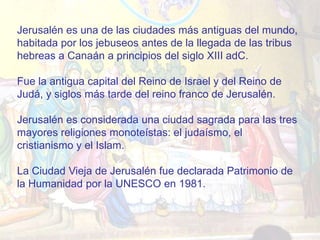
Jerusalén es una de las ciudades más antiguas del mundo,
habitada por los jebuseos antes de la llegada de las tribus
hebreas a Canaán a principios del siglo XIII adC.

Fue la antigua capital del Reino de Israel y del Reino de
Judá, y siglos más tarde del reino franco de Jerusalén.

Jerusalén es considerada una ciudad sagrada para las tres
mayores religiones monoteístas: el judaísmo, el
cristianismo y el Islam.

La Ciudad Vieja de Jerusalén fue declarada Patrimonio de
la Humanidad por la UNESCO en 1981.
Restos arqueológicos
de la Jerusalén antigua
Vista desde las colinas
Puerta Dorada.
Puerta de de Sión, cerca del Cenáculo
Puerta de Herodes
Puerta de Damasco.
Puerta de Damasco – año 1900
Explanada del Templo
Explanada del Templo. Mezquita de la Roca.
Cúpula de La Roca
Fachada de La Roca
Entrada principal de la Mezquita Al-Aqsa
Muro de la mezquita Al-Aqsa
MURO
Entrada
Jerusalén. El Cenáculo.
Jerusalén vista desde el monte de los olivos
Monte de los Olivos
Basílica de Getsemaní
Entrada Monte
de Los Olivos
Olivos del Huerto
Iglesia de
Getsemaní
En el interior, la roca donde Jesús pasó las últimas horas antes de ser prendido.


              Jesus resting on the rock after The Last Supper
Getsemaní
  1
Getsemaní
      1


Pretorio                   Casa de Caifàs
de Pilato                      3
      4
  5
Via Dolorosa

              6 Calvario             2
          7                    Casa de Anàs
Sepultura
Iglesia del Santo
We finish with the Church of the Holy Sepulcher. This is the holiest site to
Christianity, even holier then St Peter’s basilica in the Vatican. This enormous
church is built on Jesus' crucifixion site – Golgotha, and inside is the cave were
 Jesus was buried in, resurrected and ascended. The place was first identified
by Helena – mother of Constantine, the emperor who declared Christianity as
     the official country’s religion in 324 A.C. In 326 A.C. Helena arrived to
   Jerusalem to locate the place. In the site there was a Roman/pagan shrine,
    apparently to blur the memory of Jesus, but post factum it seems to have
  brought certainty to the identification of the site. The shrine was destroyed
 and instead Constantine and Helena established the first Church of the Holy
 Sepulcher, inaugurated in 333 A.C. The church was destroyed and renovated
 several times due to the different conquests, and the structure we know today
     was built in 1099 with the crusaders conquest and standing still though
                                repeatedly renovated.
  Unlike most churches in the Christian world, that belong each to its certain
 order, this church is joint managed by 7 different orders, the three dominant
   ones being: the Greek orthodox, the Armenians and the Franciscans. On a
    lower rank are the Copts, the Syrians, the Ya’acobits and the Ethiopians
 (located on the church’s roof). (And the keys for the church, believe it or not,
                     are in the hands of a Muslim family!!!)
Iglesia del Santo Sepulcro
Santo Sepulcro
Cúpula de la Iglesia del Santo sepulcro
Interior de la Iglesia del Santo Sepulcro
Pintura del Gólgota, el lugar de la ejecución de Jesús. Queda dentro de la iglesia
                               del Santo Sepulcro.
Convento Pater Noster
Fue construido sobre el lugar donde Jesús enseñó a sus discípulos la Oración del Señor
Basílica de Santa Ana, del siglo XII, de estilo medieval, se le considera
              uno de los mejores templos de Jerusalén.
Basílica de Santa Ana: según la tradición aquí nació la Virgen María.
Iglesia de SAN PEDRO EN GALLOCANTA
La capilla principal. Véase la adoración en el techo.


The descent to the room where Jesus was imprisoned
               The lower story chapel
Iglesia de la tumba de María
Los franciscanos salen a la calle cada viernes a hacer el Vía-Crucis.
En aquell temps,
Cima de la
ASCENSIÓN

Jerusalen

  • 3.
    Jerusalén es unade las ciudades más antiguas del mundo, habitada por los jebuseos antes de la llegada de las tribus hebreas a Canaán a principios del siglo XIII adC. Fue la antigua capital del Reino de Israel y del Reino de Judá, y siglos más tarde del reino franco de Jerusalén. Jerusalén es considerada una ciudad sagrada para las tres mayores religiones monoteístas: el judaísmo, el cristianismo y el Islam. La Ciudad Vieja de Jerusalén fue declarada Patrimonio de la Humanidad por la UNESCO en 1981.
  • 4.
    Restos arqueológicos de laJerusalén antigua
  • 5.
  • 9.
  • 10.
    Puerta de deSión, cerca del Cenáculo
  • 11.
  • 12.
  • 13.
    Puerta de Damasco– año 1900
  • 14.
  • 15.
    Explanada del Templo.Mezquita de la Roca.
  • 17.
  • 18.
  • 19.
    Entrada principal dela Mezquita Al-Aqsa
  • 20.
    Muro de lamezquita Al-Aqsa
  • 21.
  • 25.
  • 26.
  • 27.
    Jerusalén vista desdeel monte de los olivos
  • 28.
  • 29.
  • 31.
  • 32.
  • 33.
  • 34.
    En el interior,la roca donde Jesús pasó las últimas horas antes de ser prendido. Jesus resting on the rock after The Last Supper
  • 35.
  • 36.
    Getsemaní 1 Pretorio Casa de Caifàs de Pilato 3 4 5 Via Dolorosa 6 Calvario 2 7 Casa de Anàs Sepultura
  • 37.
  • 38.
    We finish withthe Church of the Holy Sepulcher. This is the holiest site to Christianity, even holier then St Peter’s basilica in the Vatican. This enormous church is built on Jesus' crucifixion site – Golgotha, and inside is the cave were Jesus was buried in, resurrected and ascended. The place was first identified by Helena – mother of Constantine, the emperor who declared Christianity as the official country’s religion in 324 A.C. In 326 A.C. Helena arrived to Jerusalem to locate the place. In the site there was a Roman/pagan shrine, apparently to blur the memory of Jesus, but post factum it seems to have brought certainty to the identification of the site. The shrine was destroyed and instead Constantine and Helena established the first Church of the Holy Sepulcher, inaugurated in 333 A.C. The church was destroyed and renovated several times due to the different conquests, and the structure we know today was built in 1099 with the crusaders conquest and standing still though repeatedly renovated. Unlike most churches in the Christian world, that belong each to its certain order, this church is joint managed by 7 different orders, the three dominant ones being: the Greek orthodox, the Armenians and the Franciscans. On a lower rank are the Copts, the Syrians, the Ya’acobits and the Ethiopians (located on the church’s roof). (And the keys for the church, believe it or not, are in the hands of a Muslim family!!!)
  • 39.
  • 40.
  • 41.
    Cúpula de laIglesia del Santo sepulcro
  • 43.
    Interior de laIglesia del Santo Sepulcro
  • 44.
    Pintura del Gólgota,el lugar de la ejecución de Jesús. Queda dentro de la iglesia del Santo Sepulcro.
  • 45.
    Convento Pater Noster Fueconstruido sobre el lugar donde Jesús enseñó a sus discípulos la Oración del Señor
  • 47.
    Basílica de SantaAna, del siglo XII, de estilo medieval, se le considera uno de los mejores templos de Jerusalén.
  • 48.
    Basílica de SantaAna: según la tradición aquí nació la Virgen María.
  • 49.
    Iglesia de SANPEDRO EN GALLOCANTA
  • 50.
    La capilla principal.Véase la adoración en el techo. The descent to the room where Jesus was imprisoned The lower story chapel
  • 51.
    Iglesia de latumba de María
  • 52.
    Los franciscanos salena la calle cada viernes a hacer el Vía-Crucis.
  • 56.
  • 59.
  • 60.