Una introducción
al verbo GUSTAR
Using indirect object pronouns
me, te, and le
 
¿(A ti) Te gusta 
la matemáticas?
Sí. (A mí) Me gusta 
la matemáticas.
¿(A ella) Le gusta 
la matemáticas?
Sí. (A ella) Le gusta 
la matemáticas.
¿(A ti) Te gusta 
el drama?
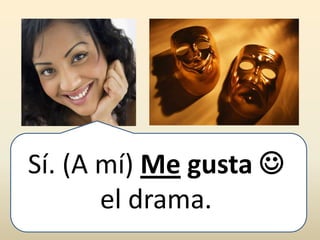
Sí. (A mí) Me gusta 
el drama.
¿(A ella) Le gusta 
el drama?
Sí. (A ella) Le gusta 
el drama.
¿Te gusta 
la música?
Sí. Me gusta 
la música.
¿Le gusta 
la música?
Sí. Le gusta 
la música.
¿Te gusta 
la historia?
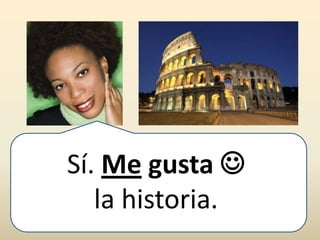
Sí. Me gusta 
la historia.
¿Le gusta 
la historia?
Sí. Le gusta 
la historia.
¿(A ti) Te gusta 
la astronomía?
Sí. (A mí) Me gusta 
la astronomía.
¿(A él) Le gusta 
la astronomía?
Sí. (A él) Le gusta 
la astronomía.
¿(A ti) Te gusta 
la química?
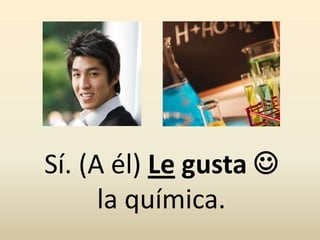
Sí. (A mí) Me gusta 
la química.
¿(A él) Le gusta 
la química?
Sí. (A él) Le gusta 
la química.
¿Te gusta 
la geografía?
Sí. Me gusta 
la geografía.
¿Le gusta 
la geografía?
Sí. Le gusta 
la geografía.
la geografíala geografía
¿Te gusta 
la biología?
Sí. Me gusta 
la biología.
¿Le gusta 
la biología?
Sí. Le gusta 
la biología.
la geografíala geografía
¿(A ti) Te gusta 
la antropología?
No. (A mi) No me gusta
 la antropología.
¿(A ella) Le gusta 
la antropología?
No. (A ella) No le gusta
 la antropología.
¿(A ti) Te gusta 
la sicología?
No. (A mi) No me gusta
 la sicología.
¿(A él) Le gusta 
la sicología?
No. (A él) No le gusta
 la sicología.
¿(A ti) Te gusta 
la educación física?
No. (A mi) No me gusta
 la educación física.
¿(A él) Le gusta 
la educación física?
No. (A él) No le gusta
 la educación física.
¿Te gusta 
el arte?
No. No me gusta 
el arte.
Le gusta 
el arte?
No. No le gusta 
el arte.
¿Te gusta 
la literatura?
No. No me gusta 
la literatura.
¿Le gusta 
la literatura?
No. No le gusta 
la literatura.
El verbo GUSTAR

El verbo GUSTAR