Introducción a Modelos RelacionalesJulián Castiblanco P.Julian_castiblancop@hotmail.comLíder ITPros-DC
Agenda del CicloPrimera Sesión:Modelos RelacionalesNormalizaciónEjemploSegunda Sesión:Creación de Bases de datosCreación de TablasCreación de restriccionesIntroducción a Transact SQLEjemploTercera Sesión:Creación de ProcedimientosCreación de VistasSeguridad de Bases de datos
Agenda de la SesiónModelos RelacionalesHistoriaNormalizaciónEjemploInstalación de SQL Server
El origen…
Eniac17,468 tubos al vacío.7,200 diodos.1,500 relevos70,000 resistencias10,000 condensadores5 de puntos de soldadura. Su tamaño (2.4 m × 0.9 m × 30 m).Pesabamás de 27 toneladas
Transistor
Era Digital
Edgar Codd
Un tema de capacidad…Acer  486:Procesos X486Ram: 1MBDD: 180 MBFloppy: 1.4MB
Como optimizar el almacenamiento…
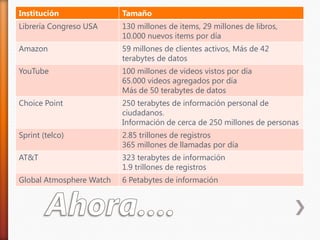
Ahora….
NormalizaciónLa normalización es el proceso de organizar los datos de una base de datos. Se incluye la creación de tablas y el establecimiento de relaciones entre ellas según reglas diseñadas tanto para proteger los datos como para hacer que la base de datos sea más flexible al eliminar la redundancia y las dependencias incoherentes.
Primera Forma NormalElimine los grupos repetidos de las tablas individuales. Cree una tabla independiente para cada conjunto de datos relacionados. Identifique cada conjunto de datos relacionados con una clave principal.
Tabla Desnormalizada
Primera forma Normal
Primera forma NormalCree una tabla independiente para cada conjunto de datos relacionados
Segunda Forma NormalCree tablas independientes para conjuntos de valores que se apliquen a varios registros. Relacione estas tablas con una clave externa.
Segunda Forma Normal
Tercera Forma NormalElimine los campos que no dependan de la clave.
Tercera Forma Normal
Inicial
Demostración
Fuenteshttps://www.microsoft.com/betaexperience/pd/SQLDENEXPPOST/enus/default.aspxhttp://www.computerhistory.org/semiconductor/timeline/1953-transistorized-computers-emerge.htmlhttp://en.wikipedia.org/wiki/Edgar_F._Coddhttp://en.wikipedia.org/wiki/Floppy_diskhttp://support.microsoft.com/kb/283878/esSQL and RelationalTheory. C.J. Date. Junio 2009Data ArchitectureFrom Zen toReality. Tupper Charles.  2011

Modelos Relacionales SQL Server

Notas del editor

  • #7 Primer transistor patentado en 1925 en Canadá por Julius Edgar Lilienfeld.De allí su desarrollo más importante lo realizaron los laboratorios BellOriginador de la electrónica moderna.1953 el primer computador a transistores con 92 transistores, 505 diodos, máquina de 48 bits.
  • #9 WorkIn the 1960s and 1970s he worked out his theories of data arrangement, issuing his paper "A Relational Model of Data for Large Shared Data Banks" [link] in 1970, after an internal IBM paper one year earlier.[5] To his disappointment, IBM proved slow to exploit his suggestions until commercial rivals started implementing them.Initially, IBM refused to implement the relational model in order to preserve revenue from IMS/DB. Codd then showed IBM customers the potential of the implementation of its model, and they in turn pressured IBM. Then IBM included in its Future Systems project a System R subproject — but put in charge of it developers who were not thoroughly familiar with Codd's ideas, and isolated the team from Codd[citation needed]. As a result, they did not use Codd's own Alpha language but created a non-relational one, SEQUEL. Even so, SEQUEL was so superior to pre-relational systems that it was copied, based on pre-launch papers presented at conferences, by Larry Ellison in his Oracle Database, which actually reached market before SQL/DS — due to the then-already proprietary status of the original name, SEQUEL had been renamed SQL.Codd continued to develop and extend his relational model, sometimes in collaboration with Chris Date. One of the normalized forms, the Boyce–Codd normal form, is named after him.Codd's theorem, a result proven in his seminal work on the relational model, equates the expressive power of relational algebra and relational calculus (which, in essence, is equivalent to first-order logic).
  • #12 Documented errors[edit] Before 2000 On 28 December 1999, 10,000 card swipe machines issued by HSBC and manufactured by Racal stopped processing credit and debit card transactions.[2] The stores relied on paper transactions until the machines started working again on 1 January.[22][edit] On 1 January 2000When 1 January 2000 arrived, there were problems generally regarded as minor. Problems did not always have to occur precisely at midnight. Some programs were not active at that moment and would only show up when they were invoked. Not all problems recorded were directly linked to Y2K programming in a causality; minor technological glitches occur on a regular basis.Reported problems include: In Ishikawa, Japan, radiation-monitoring equipment failed at midnight; however, officials stated there was no risk to the public.[23] In Onagawa, Japan, an alarm sounded at a nuclear power plant at two minutes after midnight.[23] In Japan, at two minutes past midnight, Osaka Media Port, a telecommunications carrier, found errors in the date management part of the company's network. The problem was fixed by 02:43 and no services were disrupted.[24] In Japan, NTT Mobile Communications Network (NTT DoCoMo), Japan's largest cellular operator, reported on 1 January 2000, that some models of mobile telephones were deleting new messages received, rather than the older messages, as the memory filled up.[24] In Australia, bus-ticket-validation machines in two states failed to operate.[25] In the United States, 150 slot machines at race tracks in Delaware stopped working.[25] In the United States, the U.S. Naval Observatory, which runs the master clock that keeps the country's official time, gave the date on its website as Jan. 1, 19100.[26] In France, the national weather forecasting service, Meteo France, said a Y2K bug made the date on a webpage show a map with Saturday's weather forecast as "01/01/19100".[25] This also occurred on other websites, including att.net, at the time a general-purpose portal site primarily for AT&T Worldnet customers in the United States.
  • #14 Hay algunas reglas en la normalización de una base de datos. Cada regla se denomina una "forma normal". Si se cumple la primera regla, se dice que la base de datos está en la "primera forma normal". Si se cumplen las tres primeras reglas, la base de datos se considera que está en la "tercera forma normal". Aunque son posibles otros niveles de normalización, la tercera forma normal se considera el máximo nivel necesario para la mayor parte de las aplicaciones. Al igual que con otras muchas reglas y especificaciones formales, en los escenarios reales no siempre se cumplen los estándares de forma perfecta. En general, la normalización requiere tablas adicionales y algunos clientes consideran éste un trabajo considerable. Si decide infringir una de las tres primeras reglas de la normalización, asegúrese de que su aplicación se anticipa a los problemas que puedan aparecer, como la existencia de datos redundantes y de dependencias incoherentes.