UNIT 5 A DAY IN CANADA
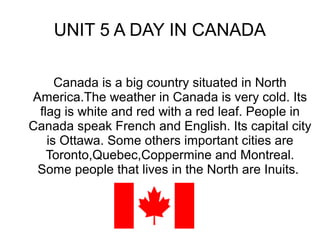
Canada is a big country situated in North
America.The weather in Canada is very cold. Its
flag is white and red with a red leaf. People in
Canada speak French and English. Its capital city
is Ottawa. Some others important cities are
Toronto,Quebec,Coppermine and Montreal.
Some people that live in the North are Inuits.
Daily routines
Para expresar las rutinas diarias usamos el
presente simple acompañadas de las expresiones
de tiempo.
Ejemplo:
What time do you make your bed?
(¿A qué hora haces tu cama?)
I make my bed at half past eight.
(Yo hago mi cama a las ocho y media)
Vocabulary
(New)
Get/gets dressed: vestirse
Make/makes the bed: hacer mi cama
Start/starts school: empezar el colegio
Finish/finishes school: terminar el colegio
Do/does my homework: hacer mis deberes
Go/goes fishing: ir a pescar
Feed/feeds the dog: ponerle la comida al perro
Wash/washes the dishes: fregar los platos
Vocabulary (Review)
Get/gets up: levantarse
Go/goes to schol: ir al colegio
Go/goes home: ir a casa
Watch/watches television: ver la televisión
Have/has breakfast: desayunar
Have/has lunch. Almorzar
Have/has dinner: cenar
Play/plays computer games: jugar a videojuegos
Have/has a shower: ducharse
Go/goes to bed. acostarse
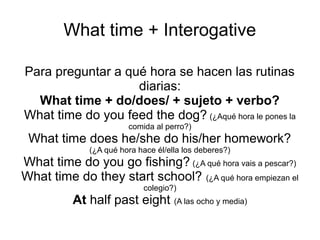
What time + Interogative
Para preguntar a qué hora se hacen las rutinas
diarias:
What time + do/does/ + sujeto + verbo?
What time do you feed the dog? (¿Aqué hora le pones la
comida al perro?)
What time does he/she do his/her homework?
(¿A qué hora hace él/ella los deberes?)
What time do you go fishing? (¿A qué hora vais a pescar?)
What time do they start school? (¿A qué hora empiezan ellos
el colegio?)
At half past eight (A las ocho y media)
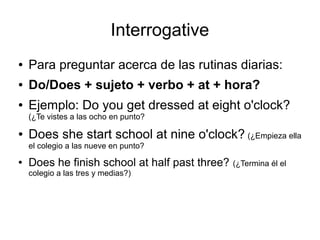
Interrogative
● Para preguntar acerca de las rutinas diarias:
● Do/Does + sujeto + verbo + at + hora?
● Ejemplo: Do you get dressed at eight o'clock?
(¿Te vistes a las ocho en punto?
● Does she start school at nine o'clock? (¿Empieza ella
el colegio a las nueve en punto?
● Does he finish school at half past three? (¿Termina él el
colegio a las tres y medias?)
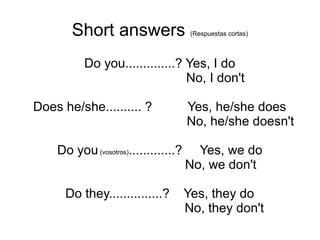
Short answers (Respuestas cortas)
Do you..............? Yes, I do
No, I don't
Does he/she.......... ? Yes, he/she does
No, he/she doesn't
Do you(vosotros).............? Yes, we do
No, we don't
Do they...............? Yes, they do
No, they don't
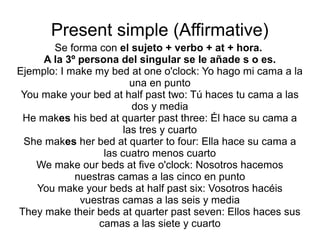
Present simple (Affirmative)
Se forma con el sujeto + verbo + at + hora.
A la 3º persona del singular se le añade s o es.
Ejemplo: I make my bed at one o'clock: Yo hago mi cama a la
una en punto
You make your bed at half past two: Tú haces tu cama a las
dos y media
He makes his bed at quarter past three: Él hace su cama a
las tres y cuarto
She makes her bed at quarter to four: Ella hace su cama a
las cuatro menos cuarto
We make our beds at five o'clock: Nosotros hacemos
nuestras camas a las cinco en punto
You make your beds at half past six: Vosotros hacéis
vuestras camas a las seis y media
They make their beds at quarter past seven: Ellos haces sus
camas a las siete y cuarto
Negative
Se forma con el sujeto + don't/doesn't + verbo + at + hora.
Ejemplo:
I don't wash the dishes at four oćlock: Yo no friego los platos a las
cuatro en punto
You don't wash the dishes at half past five: Tú no friegas los platos
a las cinco y media
He doesn't wash the dishes at quarter past one: Él no friega los
platos a launa y cuarto
She doesn't wash the dishes at quarter to two: Ella no friega los
platos a las dos menos curto
We don't wash the dishes at half past six: Nosotros no fregamos
los platos a las seis y media
You don't wash the dishes at three o'clock: Vosotros no fregáis los
platos a las tres y en punto
They don't wash the dishes at half past seven: Ellos no friegan los
platos a as siete y media
Possessive Adjetives
My mi (my homework: mis deberes)
Your tu (your teeth: tus dientes)
His su (él) (his bed: su cama)
Her su (ella) (her dog: su perro)
Its su (cosa o animal) (its food: su comida)
Our nuestro/a (our homework: nuestros deberes)
Your vuestro/a (your beds: vuestras camas)
Their sus (ellos/ellas) (their books: sus libros)
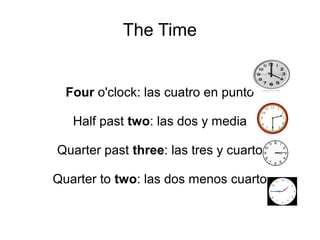
The Time
Four o'clock: las cuatro en punto
Half past two: las dos y media
Quarter past three: las tres y cuarto
Quarter to two: las dos menos cuarto
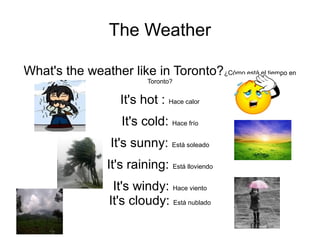
The Weather
What's the weather like in Toronto?¿Cómo está el tiempo en
Toronto?
It's hot : Hace calor
It's cold: Hace frío
It's sunny: Está soleado
It's raining: Está lloviendo
It's windy: Hace viento
It's cloudy: Está nublado
Sentence with weather and time
When it's rainy Tom watches television at five
o'clock. (Cuando está lloviendo Tom ve la tele a las cinco en punto)
When it's sunny Sally has lunch in the
playground at half past twelve(Cuando está soleado Sally toma el
almuerzo en el patio a las doce y media)
Write about a friend's daily life
(Escribe acerca de la vida diaria de un amigo/a)
This is Peter. He's 10 years old. He lives in
London, in the UK. He's got two sisters.
He gets up at seven o'clock. Then he goes to
school at half past eight. When he finishes
school he plays football, and then he makes his
homework. He has dinner at seven o'clock and
goes to bed at quarter past nine.

Power point tema 5 2

  • 1.
    UNIT 5 ADAY IN CANADA Canada is a big country situated in North America.The weather in Canada is very cold. Its flag is white and red with a red leaf. People in Canada speak French and English. Its capital city is Ottawa. Some others important cities are Toronto,Quebec,Coppermine and Montreal. Some people that live in the North are Inuits.
  • 2.
    Daily routines Para expresarlas rutinas diarias usamos el presente simple acompañadas de las expresiones de tiempo. Ejemplo: What time do you make your bed? (¿A qué hora haces tu cama?) I make my bed at half past eight. (Yo hago mi cama a las ocho y media)
  • 3.
    Vocabulary (New) Get/gets dressed: vestirse Make/makesthe bed: hacer mi cama Start/starts school: empezar el colegio Finish/finishes school: terminar el colegio Do/does my homework: hacer mis deberes Go/goes fishing: ir a pescar Feed/feeds the dog: ponerle la comida al perro Wash/washes the dishes: fregar los platos
  • 4.
    Vocabulary (Review) Get/gets up:levantarse Go/goes to schol: ir al colegio Go/goes home: ir a casa Watch/watches television: ver la televisión Have/has breakfast: desayunar Have/has lunch. Almorzar Have/has dinner: cenar Play/plays computer games: jugar a videojuegos Have/has a shower: ducharse Go/goes to bed. acostarse
  • 5.
    What time +Interogative Para preguntar a qué hora se hacen las rutinas diarias: What time + do/does/ + sujeto + verbo? What time do you feed the dog? (¿Aqué hora le pones la comida al perro?) What time does he/she do his/her homework? (¿A qué hora hace él/ella los deberes?) What time do you go fishing? (¿A qué hora vais a pescar?) What time do they start school? (¿A qué hora empiezan ellos el colegio?) At half past eight (A las ocho y media)
  • 6.
    Interrogative ● Para preguntaracerca de las rutinas diarias: ● Do/Does + sujeto + verbo + at + hora? ● Ejemplo: Do you get dressed at eight o'clock? (¿Te vistes a las ocho en punto? ● Does she start school at nine o'clock? (¿Empieza ella el colegio a las nueve en punto? ● Does he finish school at half past three? (¿Termina él el colegio a las tres y medias?)
  • 7.
    Short answers (Respuestascortas) Do you..............? Yes, I do No, I don't Does he/she.......... ? Yes, he/she does No, he/she doesn't Do you(vosotros).............? Yes, we do No, we don't Do they...............? Yes, they do No, they don't
  • 8.
    Present simple (Affirmative) Seforma con el sujeto + verbo + at + hora. A la 3º persona del singular se le añade s o es. Ejemplo: I make my bed at one o'clock: Yo hago mi cama a la una en punto You make your bed at half past two: Tú haces tu cama a las dos y media He makes his bed at quarter past three: Él hace su cama a las tres y cuarto She makes her bed at quarter to four: Ella hace su cama a las cuatro menos cuarto We make our beds at five o'clock: Nosotros hacemos nuestras camas a las cinco en punto You make your beds at half past six: Vosotros hacéis vuestras camas a las seis y media They make their beds at quarter past seven: Ellos haces sus camas a las siete y cuarto
  • 9.
    Negative Se forma conel sujeto + don't/doesn't + verbo + at + hora. Ejemplo: I don't wash the dishes at four oćlock: Yo no friego los platos a las cuatro en punto You don't wash the dishes at half past five: Tú no friegas los platos a las cinco y media He doesn't wash the dishes at quarter past one: Él no friega los platos a launa y cuarto She doesn't wash the dishes at quarter to two: Ella no friega los platos a las dos menos curto We don't wash the dishes at half past six: Nosotros no fregamos los platos a las seis y media You don't wash the dishes at three o'clock: Vosotros no fregáis los platos a las tres y en punto They don't wash the dishes at half past seven: Ellos no friegan los platos a as siete y media
  • 10.
    Possessive Adjetives My mi(my homework: mis deberes) Your tu (your teeth: tus dientes) His su (él) (his bed: su cama) Her su (ella) (her dog: su perro) Its su (cosa o animal) (its food: su comida) Our nuestro/a (our homework: nuestros deberes) Your vuestro/a (your beds: vuestras camas) Their sus (ellos/ellas) (their books: sus libros)
  • 11.
    The Time Four o'clock:las cuatro en punto Half past two: las dos y media Quarter past three: las tres y cuarto Quarter to two: las dos menos cuarto
  • 12.
    The Weather What's theweather like in Toronto?¿Cómo está el tiempo en Toronto? It's hot : Hace calor It's cold: Hace frío It's sunny: Está soleado It's raining: Está lloviendo It's windy: Hace viento It's cloudy: Está nublado
  • 13.
    Sentence with weatherand time When it's rainy Tom watches television at five o'clock. (Cuando está lloviendo Tom ve la tele a las cinco en punto) When it's sunny Sally has lunch in the playground at half past twelve(Cuando está soleado Sally toma el almuerzo en el patio a las doce y media)
  • 14.
    Write about afriend's daily life (Escribe acerca de la vida diaria de un amigo/a) This is Peter. He's 10 years old. He lives in London, in the UK. He's got two sisters. He gets up at seven o'clock. Then he goes to school at half past eight. When he finishes school he plays football, and then he makes his homework. He has dinner at seven o'clock and goes to bed at quarter past nine.