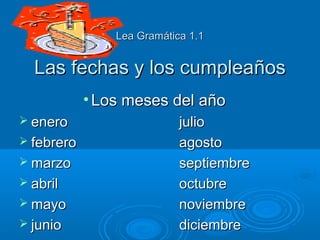
Lea Gramática 1.1


  Las fechas y los cumpleaños
            • Los meses del año
 enero                     julio
 febrero                   agosto
 marzo                     septiembre
 abril                     octubre
 mayo                      noviembre
 junio                     diciembre
Las estaciones
               (seasons)
La primavera                 (spring)

El verano                     (summer)
El otoño                  (fall, autumn)

El invierno                  (winter)
Los diás de la semana
 (el) lunes
 (el) martes
 (el) miércoles
 (el) jueves
 (el) viernes
 (el) sábado
 (el) domingo
(1.1)

 Counting Numbers 100-1000 & Dates
 154   ciento cincuenta y cuatro
 200   doscientos /as
 300   trescientos /as
 400   cuatrocientos /as
 500   quinientos /as
 600   seiscientos / as
 700   setecientos / as
 800   ochocientos /as
 900   novecientos / as

(1.2)
   Talking about Habitual Actions:
   Present Tense of Regular –er and –ir Verbs

                    leer (to read)

(yo)                     leo         I read
(tú)                     lees        you (inf. Sing.) read
(usted, él /ella)        lee         you (pol.sing.) read; he/she
                                                       reads
(nosotros / as)      leemos          we read
(vosotros / as)      leéis           you (inf.pl., Spain) read
(ustedes,ellos / as) leen            you (pl.) read; they read
(1.2)

                    Vivir (to live)
                                      I live
(yo)                     vivo
                                      you (inf.sing.) live
(tú)                     vives
                                      you (pol. sing.) live;
(usted,él / ella)        vive         he/she lives

                                      We live
(nosotros / as)        vivimos
                                      you (inf.pl. Spain) live
(vosotros / as)          vivís
                                      you (pl.) live; they live
(ustedes,                viven
 ellos / as)
Asking Questions: Question
              Formation (1.3)
 Statements in Spanish are normally formed by:
 subject + verb + an object and/or description


 Ernestito tiene un perro grande.
   subject   verb         object adjective


Amanda es delgada.
 subject verb adjective
 Negative statements are formed by using a
    negative immediately before the verb.


 Ernestito no tiene un perro grande.


   Amanda no es delgada.
Questions are formed…
 By placing the subject after the verb, with the
  object or any description either following or
  preceding the subject.
 ¿Es joven Esteban?
  verb description subject
 ¿Eres trabajadora, Nora?
     verb    description   subject
 ¿Tiene hermanos Amanda?
  
      verb    object        subject
 ¿Quieres un reloj para el diá de tu
 cumpleaños?
(1.3)

To answer a question negatively
 Use No, no + verb
 ¿Hay gatos en el salón de clase?
   No, no hay gatos en el salón de clase.

 ¿Viven tus padres en Guadalajara?
 No, no viven   en Guadalajara, viven en
    Morelia.
(1.3)

 Another way to ask questions is using
         interrogative words:
 ¿Qué?                What?
 ¿Cuándo?             When?
 ¿(De) Quién?         Whose?
 ¿Dónde?              Where?
 ¿Cuántos?           How much?/How many?
 ¿Cómo?               How? What?
 ¿Cuál(es)?           Which?
 ¿Por qué?            Why?
Examples on pg. 79
(1.4)

Telling Time: Hours and Minutes
¿Qué hora es?
      (What time is it?)
   Es la una.
    (It’s one o’clock)

Son las tres.
    (It’s three o’clock)
(1.4)

                     Telling Time…

 Use Y (and) to express minutes
    after the hour
   _¿Son las seis y diez? (6:10)
   _No, son las seis y veinte. (6:20)
 Use menos (less) or para (to, till) to
    express minutes before the hour
   Son las siete menos veinte. (It’s twenty to seven)
   Son veinte para las siete.(It’s twenty to (till) seven
(1.4)

 Use cuarto (quarter) and media (half)
     for fifteen and thirty minutes
 _¿Qué hora tiene usted?        What time do you have?
 _Son las tres y   cuarto (media)     It’s a quarter after
                                       (half past) three.


 Use a to express when (at what time) an event
  occurs.
 a la una               = at one o’clock
 a las cuarto y media. =    at four thirty
 tengo clase a las nueve.= I have class at nine
 el concierto es a las ocho.= The concert is at 8.
(!.4 La hora pagina 63)

              ¿Qué hora es?
 1. Es la una. (1:00)
 2. Son las tres.  (3:00)
 3. Son las nueve menos diez. (8:50)
 4. Es la una y media. (1:30)
 5. Son las diez menos veinte. (9:40)
 6. Son las once y cuarto. (11:15)
 7. Es mediodía. (12:00 p.m.)
 8. es medianoche.(12:00 a.m.)
 9. son las siete y seis. (7:06)
 10. son las tres menos veinticinco. (2:35)
(1.4)

             El reloj de 24 horas
 Después del mediodía:
 1:00 = 13:00
 2:00 = 14:00
 3:00 = 15:00
 4:00 = 16:00 etcétera
 La medianoche (12:00) = 00:00
 Haga Act. 6 Diálogo: ¿Qué hora es?
       Use Expresiones Útiles (replace words in
                     italics with Expresiones
    Útiles )

(1.5)

     Expressing Likes and Dislikes:
           gustar + infinitive
 gustar = to like
 gustar is usually used with pronouns    that
 tell to whom something is pleasing

 Singular
 me gusta     (to me)
 te gusta     (to you inf.sing.)
 le gusta     (to you pol. sing.; to him/her)
(1.5)

              gustar + infinitive
 Singular
 me gusta           (to me)
 te gusta            (to you inf.sing.)
 le gusta       (to you pol. sing.; to
  him/her)
 Me gusta ir a bailar.
 Te gusta leer en la biblioteca.
 Monica le gusta ir a visitar su familia.
(1.5)

     Expressing Likes and Dislikes:
           gustar + infinitive
Plural
nos     = to us
os      = to you inf. pl. ,Spain
les     = to you (pl.); to them
 Nos gusta cocinar.
 Les gusta cantar.
(1.5)

        Expressing Likes and Dislikes:
              gustar + infinitive
 Pronoun      +   gusta     +   Infinitive

 me           +   gusta     +   estudiar
 te           +   gusta     +   jugar
 le           +   gusta     +   comer
 nos          +   gusta     +   correr
 os           +   gusta     +   competir
 les          +   gusta     +   escribir
(1.5)

Las actividades favoritas y los deportes
 Un fin de semana típico de los Saucedo


 A Guillermo y a sus amigos les gusta jugar al
 fútbol.

 A Ernesto y a Guillermo les gusta ver un
 partido de béisbol en el estadio.
(1.5)

Las actividades favoritas y los deportes
 A Estela le gusta ir de compras.
 A Amanda y a Graciela les gusta jugar al
     tenis.
 A Ernesto le gusta leer.
 A Ernestito le gusta andar en bicicleta.
 A Amanda le gusta ver su telenovela
  favorita.
 A los Saucedo les gusta cenar en un
  restaurante italiano.

Capitulo 1 Powerpoint Lesson 4

  • 1.
    Lea Gramática 1.1 Las fechas y los cumpleaños • Los meses del año  enero julio  febrero agosto  marzo septiembre  abril octubre  mayo noviembre  junio diciembre
  • 2.
    Las estaciones (seasons) La primavera (spring) El verano (summer) El otoño (fall, autumn) El invierno (winter)
  • 3.
    Los diás dela semana  (el) lunes  (el) martes  (el) miércoles  (el) jueves  (el) viernes  (el) sábado  (el) domingo
  • 4.
    (1.1) Counting Numbers100-1000 & Dates  154 ciento cincuenta y cuatro  200 doscientos /as  300 trescientos /as  400 cuatrocientos /as  500 quinientos /as  600 seiscientos / as  700 setecientos / as  800 ochocientos /as  900 novecientos / as 
  • 5.
    (1.2) Talking about Habitual Actions: Present Tense of Regular –er and –ir Verbs leer (to read) (yo) leo I read (tú) lees you (inf. Sing.) read (usted, él /ella) lee you (pol.sing.) read; he/she reads (nosotros / as) leemos we read (vosotros / as) leéis you (inf.pl., Spain) read (ustedes,ellos / as) leen you (pl.) read; they read
  • 6.
    (1.2) Vivir (to live) I live (yo) vivo you (inf.sing.) live (tú) vives you (pol. sing.) live; (usted,él / ella) vive he/she lives We live (nosotros / as) vivimos you (inf.pl. Spain) live (vosotros / as) vivís you (pl.) live; they live (ustedes, viven ellos / as)
  • 7.
    Asking Questions: Question Formation (1.3)  Statements in Spanish are normally formed by: subject + verb + an object and/or description  Ernestito tiene un perro grande. subject verb object adjective Amanda es delgada. subject verb adjective
  • 8.
     Negative statementsare formed by using a negative immediately before the verb.  Ernestito no tiene un perro grande.  Amanda no es delgada.
  • 9.
    Questions are formed… By placing the subject after the verb, with the object or any description either following or preceding the subject.  ¿Es joven Esteban? verb description subject  ¿Eres trabajadora, Nora?  verb description subject  ¿Tiene hermanos Amanda?  verb object subject  ¿Quieres un reloj para el diá de tu cumpleaños?
  • 10.
    (1.3) To answer aquestion negatively  Use No, no + verb  ¿Hay gatos en el salón de clase?  No, no hay gatos en el salón de clase.  ¿Viven tus padres en Guadalajara?  No, no viven en Guadalajara, viven en Morelia.
  • 11.
    (1.3) Another wayto ask questions is using interrogative words:  ¿Qué? What?  ¿Cuándo? When?  ¿(De) Quién? Whose?  ¿Dónde? Where?  ¿Cuántos? How much?/How many?  ¿Cómo? How? What?  ¿Cuál(es)? Which?  ¿Por qué? Why? Examples on pg. 79
  • 12.
    (1.4) Telling Time: Hoursand Minutes ¿Qué hora es? (What time is it?)  Es la una. (It’s one o’clock) Son las tres. (It’s three o’clock)
  • 13.
    (1.4) Telling Time…  Use Y (and) to express minutes after the hour  _¿Son las seis y diez? (6:10)  _No, son las seis y veinte. (6:20)  Use menos (less) or para (to, till) to express minutes before the hour  Son las siete menos veinte. (It’s twenty to seven)  Son veinte para las siete.(It’s twenty to (till) seven
  • 14.
    (1.4) Use cuarto(quarter) and media (half) for fifteen and thirty minutes  _¿Qué hora tiene usted? What time do you have?  _Son las tres y cuarto (media) It’s a quarter after (half past) three.  Use a to express when (at what time) an event occurs.  a la una = at one o’clock  a las cuarto y media. = at four thirty  tengo clase a las nueve.= I have class at nine  el concierto es a las ocho.= The concert is at 8.
  • 15.
    (!.4 La horapagina 63) ¿Qué hora es?  1. Es la una. (1:00)  2. Son las tres. (3:00)  3. Son las nueve menos diez. (8:50)  4. Es la una y media. (1:30)  5. Son las diez menos veinte. (9:40)  6. Son las once y cuarto. (11:15)  7. Es mediodía. (12:00 p.m.)  8. es medianoche.(12:00 a.m.)  9. son las siete y seis. (7:06)  10. son las tres menos veinticinco. (2:35)
  • 16.
    (1.4) El reloj de 24 horas  Después del mediodía:  1:00 = 13:00  2:00 = 14:00  3:00 = 15:00  4:00 = 16:00 etcétera  La medianoche (12:00) = 00:00  Haga Act. 6 Diálogo: ¿Qué hora es?  Use Expresiones Útiles (replace words in italics with Expresiones Útiles ) 
  • 17.
    (1.5) Expressing Likes and Dislikes: gustar + infinitive  gustar = to like  gustar is usually used with pronouns that tell to whom something is pleasing  Singular  me gusta (to me)  te gusta (to you inf.sing.)  le gusta (to you pol. sing.; to him/her)
  • 18.
    (1.5) gustar + infinitive  Singular  me gusta (to me)  te gusta (to you inf.sing.)  le gusta (to you pol. sing.; to him/her)  Me gusta ir a bailar.  Te gusta leer en la biblioteca.  Monica le gusta ir a visitar su familia.
  • 19.
    (1.5) Expressing Likes and Dislikes: gustar + infinitive Plural nos = to us os = to you inf. pl. ,Spain les = to you (pl.); to them  Nos gusta cocinar.  Les gusta cantar.
  • 20.
    (1.5) Expressing Likes and Dislikes: gustar + infinitive  Pronoun + gusta + Infinitive  me + gusta + estudiar  te + gusta + jugar  le + gusta + comer  nos + gusta + correr  os + gusta + competir  les + gusta + escribir
  • 21.
    (1.5) Las actividades favoritasy los deportes  Un fin de semana típico de los Saucedo  A Guillermo y a sus amigos les gusta jugar al fútbol.  A Ernesto y a Guillermo les gusta ver un partido de béisbol en el estadio.
  • 22.
    (1.5) Las actividades favoritasy los deportes  A Estela le gusta ir de compras.  A Amanda y a Graciela les gusta jugar al tenis.  A Ernesto le gusta leer.  A Ernestito le gusta andar en bicicleta.  A Amanda le gusta ver su telenovela favorita.  A los Saucedo les gusta cenar en un restaurante italiano.