Programa con for:
1.-
disp('-----------------------------------------------------------------------------------')
disp ('programa para determinar el tiempo de alcance de 2 móviles')
disp('-----------------------------------------------------------------------------------')
clc
clear all
va=input('velocidad del móvil a lento=');
vb=input('velocidad del móvil b rápido=');
d=input('distancia de separación entre móviles=');
da=0;
db=d;
te=d/(vb-va);
if da~=db;
disp [tiempo distanciaA distanciaB]
for t=0:te;
da=d+va*t;
db=vb*t;
disp([t da db])
end
end
2.-
disp('----------------')
disp('integracion')
disp('----------------')
clc
clear all
a=input('limite inferior=');
b=input('limite superior=');
n=input('numero de variables=');
h=(b-a)/n;
n=n+1;
y=zeros(n,1);
x=zeros(n,1);
suma=0;
for i=1:n
x(i)=a+h*(i-1);
y(i)=feval(x,i);
end
for i=2:n-1
if rem(i-1,3)==0
suma=suma+2*y(i);
else
suma=suma+3*y(i);
end
end
p=3*h*(y(i)+suma+y(n))/8;
%integracion
a=input('limite inferior');
b=input('limite superior');
n=input('numero de variables');
h=(b-a)/n;
n=n+1;
y=zeros(n,1);
x=zeros(n,1);
suma=0;
for i=1:n
x(i)=a+h*(i-1);
y(i)=feval(x(i));
end
for i=2:n-1
if rem(i-1,3)==0
suma=suma+2*y(i);
else
suma=suma+3*y(i);
end
end
p=3*h*(y(i)+suma+y(n))/8;
simpsom8('exp2',0,1,9);
3.-
disp('-----------------------------------------------')
disp('para hallar el numero de divisores')
disp('-----------------------------------------------')
clc
clear all
n=input('ingrese valor=')
c=0;
for g=(1:n);
if mod(n,g)==0
d=n;
c=c+1;
end
end
'el numero de divisores es'
disp([c])
4.-
disp('--------------------------------------------------')
disp('para saber si es un numero perfecto')
disp('-------------------------------------------------')
clc
clear all
n=input('ingrese el numero=')
while n<=0;
n=input('ingrese el numero=')
end
c=0;
for d=1:n;
resto=rem(n,d);
if resto==0
c=c+1;
end
end
disp(c)
5.-
disp('----------------------------')
disp('suma de cuadrados')
disp('----------------------------')
clc
clear all
disp [numero suma]
for n= 7:49;
if n>8;
S=n*(n+1)*(2*n+1)/6;
disp([n,S])
end
end
6.-
disp('-----------------------------------------------')
disp('para hacer una tabla de multiplicar')
disp('-----------------------------------------------')
clc
clear all
m=2;
disp [numero suma]
for a=0:1:12;
if a~=2
f=m*a;
disp([a,m,f])
end
end
7.-
disp('----------------------------------------')
disp('tabla de multiplicar mas algo')
disp('----------------------------------------')
clc
clear all
m=input('ingrese valor a m=');
h=input('ingrese valor a h=');
p=input('ingrese valor a p=');
for c=0:1:p;
if c>0;
D=m*c+h;
disp([m,h,c,D])
end
end
8.-
disp('------------------------------------------')
disp('para hallar la velocidad angular')
disp('------------------------------------------')
clc
clear all
d=input('ingrese el valor del desplazamiento:');
t=input('ingrese el tiempo:');
if t>0
end
for D=1:d;
w=(D.*pi./180)./t;
disp([D w])
end
D=1:d;
w=(D.*pi./180)./t;
plot(D,w)
title('velocidad angular')
xlabel('desplazamiento')
ylabel('velocidad')
9.-
%programa con for 3
%APLICADO AL CURSO DE FISICA i
%Programa para hallar el movimiento armónico simple de un móvil
%hallando periodo y frecuencia,posición, vel angular,
%velocidad y aceleración
clc
disp('*******************************************************************
*******')
disp('!!!!!!!!!!!!!!!!hallando periodo,
frecuencia,posición!!!!!!!!!!!!!!!!!!!!!')
disp('!!!!!!!!!!!!!!!!!velangular,velocidad y aceleración
!!!!!!!!!!!!!!!!!!!!!!')
disp('!!!!!!!!!!!!!!El movimiento armónico simple de un
móvil!!!!!!!!!!!!!!!!!!!')
disp('*******************************************************************
*******')
fprintf('n')
t=input('ingrese el tiempo del móvil en s:');
alfa=input('ingrese el ángulo alfa en rad:');
A=input('ingrese la amplitud en m:');
m=input('ingrese la masa del movil en kg:');
K=input('ingrese la rigidez en m/s:');
format bank
disp('===================================================================
========')
disp('"""""""""""""""""""""""""""tenemos la
frecuencia"""""""""""""""""""""""""""')
disp('la frecuencia hallada es:');
disp('==tiempo frecuencia==');
for t=0:2:10;
f=1/t;
disp([num2str(t) 's ' num2str(f) 'hertz'])
end
disp('===================================================================
========')
disp('""""""""""""""""""""""""""""tenemos la
velangular""""""""""""""""""""""""""')
disp('alfa ángulo velangular :');
for t=5:1:10;
velangular=alfa/t;
disp([num2str(alfa) 'rad / ' num2str(t) 's = ' num2str(velangular)
'rad/s'])
end
disp('===================================================================
========')
disp('""""""""tenemos la posición del móvil en cualquier instante de
tiempo""""""')
disp('==tiempo posición==');
for A=0:10;
X=A*sin(velangular*t+alfa); % x=deformación
disp([num2str(t) 's ' num2str(X) 'm'])
end
disp('===================================================================
========')
disp('"""""""""""tenemos la velocidad del móvil en m/s2 para el
M.A.S""""""""""""')
disp('==amplitud velocidad==');
for A=0:2:10;
v=A*velangular*cos(velangular*t+alfa);
disp([num2str(A) 'm ' num2str(v) 'm/s2'])
end
disp('"==================================================================
========')
disp('""""""""""""""""""tenemos la aceleracion del móvil en
m/s""""""""""""""""""')
disp('==tiempo aceleración==');
for t=0:1:7;
abs(-A);
a=-A*(velangular)^2*sin(velangular*t+alfa);
disp([num2str(t) 's ' num2str(a) 'm/s'])
end
fprintf('n')
disp(':::::::::::::::::fin de programa::::::::::::::::::')
disp('**************************************************
10.- °
clc
clear memory
clf
disp('===================================================')
disp(' CENTRO DE MASA DE "n" PARTICULAS ')
disp('===================================================')
n=input('Número de partículas: ');
mt=0;
mx=0;
my=0;
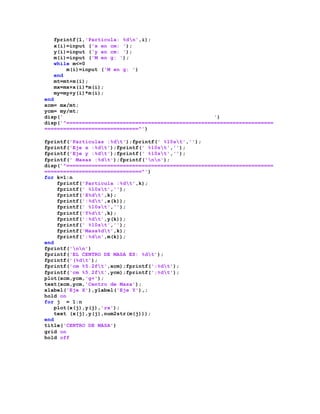
for i=1:n
fprintf(1,'Partícula: %dn',i);
x(i)=input ('x en cm: ');
y(i)=input ('y en cm: ');
m(i)=input ('M en g: ');
while m<=0
m(i)=input ('M en g: ')
end
mt=mt+m(i);
mx=mx+x(i)*m(i);
my=my+y(i)*m(i);
end
xcm= mx/mt;
ycm= my/mt;
disp(' ')
disp('^==================================================================
==============================^')
fprintf('Particulas :%dt');fprintf(' %10st','');
fprintf('Eje x :%dt');fprintf(' %10st','');
fprintf('Eje y :%dt');fprintf(' %10st','');
fprintf(' Masas :%dt');fprintf('nn');
disp('^==================================================================
===============================^')
for k=1:n
fprintf('Particula :%dt',k);
fprintf(' %10st','');
fprintf('X%dt',k);
fprintf(':%dt',x(k));
fprintf(' %10st','');
fprintf('Y%dt',k);
fprintf(':%dt',y(k));
fprintf(' %10st','');
fprintf('Masa%dt',k);
fprintf(':%dn',m(k));
end
fprintf('nn')
fprintf('EL CENTRO DE MASA ES: %dt');
fprintf('(%dt');
fprintf('cm %5.2ft',xcm);fprintf(';%dt');
fprintf('cm %5.2ft',ycm);fprintf(';%dt');
plot(xcm,ycm,'g+');
text(xcm,ycm,'Centro de Masa');
xlabel('Eje X'),ylabel('Eje Y'),;
hold on
for j = 1:n
plot(x(j),y(j),'rx');
text (x(j),y(j),num2str(m(j)));
end
title('CENTRO DE MASA')
grid on
hold off
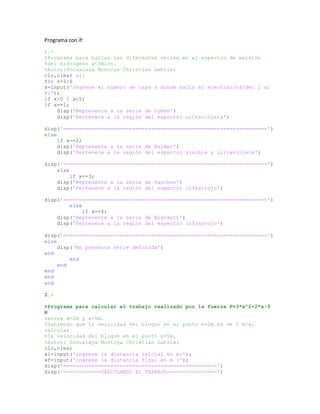
Programa con if:
1.-
%Programa para hallar las diferentes series en el espectro de emisión
%del hidrogeno atómico.
%Autor:Socualaya Montoya Christian Gabriel
clc,clear all
for z=1:6
x=input('Ingrese el número de capa a donde salta el electrón(nf)del 1 al
4:');
if x>0 | x<5;
if x==1;
disp('Representa a la serie de Lyman')
disp('Pertenece a la región del espectro ultravioleta')
disp('=================================================================')
else
if x==2;
disp('Representa a la serie de Balmer')
disp('Pertenece a la región del espectro visible y ultravioleta')
disp('=================================================================')
else
if x==3;
disp('Representa a la serie de Paschen')
disp('Pertenece a la región del espectro infrarrojo')
disp('=================================================================')
else
if x==4;
disp('Representa a la serie de Brackett')
disp('Pertenece a la región del espectro infrarrojo')
disp('=================================================================')
else
disp('No presenta serie definida')
end
end
end
end
end
end
2.-
%Programa para calcular el trabajo realizado por la fuerza F=3*x^2+2*x-5
N
%entre x=2m y x=5m.
%Sabiendo que la velocidad del bloque en el punto x=2m es de 5 m/s,
calcular
%la velocidad del bloque en el punto x=5m.
%Autor: Socualaya Montoya Christian Gabriel
clc,clear
xi=input('ingrese la distancia inicial en m:');
xf=input('ingrese la distancia final en m :');
disp('=================================================')
disp('============CALCULANDO EL TRABAJO================')
for D=xi:xf
disp('Distancia(D) Fuerza(F) Trabajo(W)')
F=3*D^2+2*D-5; %Fuerza en Newton(N)
W=F*D; %Trabajo en Joules(J)
disp([num2str(D) ' m * ' num2str(F) ' N = '
num2str(W) ' J '])
end
disp('=================================================')
disp('=====CALCULANDO LA INTEGRAL DE LA FUERZA(F)======')
syms x;
f=input('ingrese la integral 3*x^2+2*x-5:');
I=inline(char(f)); %El comando inline crea una cadena y el comando char
convierte la función f en expresión simbólica
a=input('ingrese el límite inferior de la integral:');
b=input('ingrese el límite superior de la integral:');
I=int(f,a,b); %Calcula la integral de la función
disp('El valor de la integral es:')
disp(I)
disp('=================================================')
disp('=======CALCULANDO LA Vf DEL BLOQUE===============')
m=10; %Masa en Kg
Vi=5; %Velocidad inicial en m/s
I=123;
Vf=sqrt(((I+(1/2)*m*Vi^2)*2)/m);
format short
fprintf('El valor de la Vf es %g m/s.',Vf);
end
end
end
3.-
%programa con input y disp 1
%programa para hallar la cantidad de carbono en el acero(fe + c)
%tambien para hallar la densidad de la aleación
%veamos:
clc
disp('===================================================================
==================')
disp('""""""""""""""""""""" programa para hallar la densidad en esta
aleación """""""""""""')
disp('"""""""""""""""" e ingresar la cantidad de carbono en el acero para
que nos """""""""')
disp('"""""""""""""""""""""""""""" muestre en que estado esta
""""""""""""""""""""""""""""')
disp('===================================================================
==================')
masa=input('ingrese la masa del (fe + c) en kg:');
volumen=input('ingrese el volumen del acero en m3:');
dens=(masa/volumen);
fprintf('n')
disp('*************hallando la densidad del acero******************')
disp('la densidad es:')
disp([num2str(masa) ' / ' num2str(volumen) ' = ' num2str(dens) 'kg/m3']);
fprintf('n')
disp('===================================================================
==================')
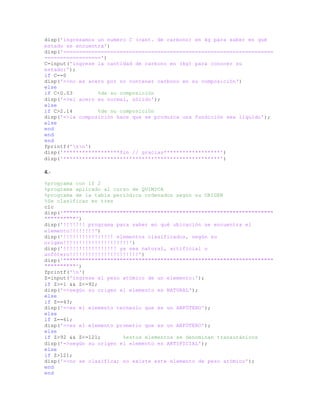
disp('ingresamos un numero C (cant. de carbono) en kg para saber en qué
estado se encuentra')
disp('===================================================================
==================')
C=input('ingrese la cantidad de carbono en (kg) para conocer su
estado:');
if C==0
disp('=>no es acero por no contener carbono en su composición')
else
if C<0.03 %de su composición
disp('=>el acero es normal, sólido');
else
if C>2.14 %de su composición
disp('=>la composición hace que se produzca una fundición sea liquido');
else
end
end
end
fprintf('nn')
disp('******************fin // gracias******************')
disp('**************************************************')
4.-
%programa con if 2
%programa aplicado al curso de QUIMICA
%programa de la tabla periódica ordenados según su ORIGEN
%Se clasifican en tres
clc
disp('"""""""""""""""""""""""""""""""""""""""""""""""""""""""""""""""""""
""""""""""')
disp('!!!!!!! programa para saber en qué ubicación se encuentra el
elemento!!!!!!!!')
disp('!!!!!!!!!!!!!!!! elementos clasificados, según su
origen!!!!!!!!!!!!!!!!!!!!!')
disp('!!!!!!!!!!!!!!!!! ya sea natural, artificial u
anfótero!!!!!!!!!!!!!!!!!!!!!!')
disp('"""""""""""""""""""""""""""""""""""""""""""""""""""""""""""""""""""
""""""""""')
fprintf('n')
Z=input('ingrese el peso atómico de un elemento:');
if Z>=1 && Z<=92;
disp('=>según su origen el elemento es NATURAL');
else
if Z==43;
disp('=>es el elemento tecnesio que es un ANFÓTERO');
else
if Z==61;
disp('=>es el elemento prometio que es un ANFÓTERO');
else
if Z>92 && Z<=121; %estos elementos se denominan transuránicos
disp('=>según su origen el elemento es ARTIFICIAL');
else
if Z>121;
disp('=>no se clasifica; no existe este elemento de peso atómico');
end
end
end
end
end
fprintf('n')
disp('================================FIN //
GRACIAS================================')
disp('===================================================================
===========')
5.-
disp('----------------------')
disp('hallar numeros inpares')
disp('----------------------')
clc
clear all
a = 15
b = 10
if a > b then
disp([invertimos])
x = a
a = b
b = x
end
if a mod 2 = 0 then
a = a + 1
for n = a to b
disp([n])
end
6.-
clc;clf;
disp('|||CALCULAR Y GRAFICAR LA VARIACION DE LA ENERGIA LIBRE DE
GIBBS|||')
disp('|||||||||||||||||||||DE LA SIGUIENTE
REACCION|||||||||||||||||||||')
disp('|||||||||||||||||||CH4(g)+2O2(g)=CO2(g)+2H2O(g)|||||||||||||||||||'
)
disp('-------------------------------------------------')
x=input('Ingrese la entalpia del CH4 (KJ/mol) -74.8 :');
y=input('Ingrese la entalpia del CO2 (KJ/mol) -393.5 :');
z=input('Ingrese la entalpia del H2O (KJ/mol) -241.6 :');
disp('-------------------------------------------------')
m=input('Ingrese la entropía del CH4 (J/mol K) 186.3 :');
n=input('Ingrese la entropía del CO2 (J/mol K) 213.4 :');
q=input('Ingrese la entropía del H2O (J/mol K) 188.7 :');
p=input('Ingrese la entropía del 2O2 (J/mol K) 49 :');
t=input('Ingrese la temperatura (°C) 25 :');
T=t+273;%kelvin
H=y+(2*z)-x;
fprintf('LA ENTALPIA ES: %3.2f',H);disp(' (KJ/mol)');
if H>0
disp('LA REACCION ES ENDOTERMICA');
else
disp('LA REACCION ES EXOTERMICA');
end
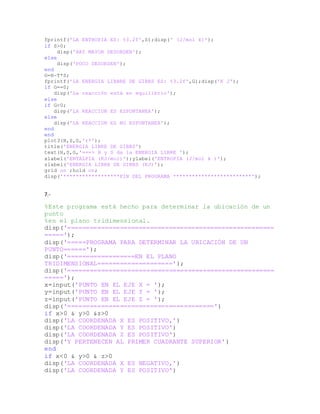
S=(n+2*q-(m+2*p))/1000;
fprintf('LA ENTROPIA ES: %3.2f',S);disp(' (J/mol k)');
if S>0;
disp('HAY MAYOR DESORDEN');
else
disp('POCO DESORDEN');
end
G=H-T*S;
fprintf('LA ENERGIA LIBBRE DE GIBBS ES: %3.2f',G);disp('K J');
if G==0;
disp('La reacción está en equilibrio');
else
if G<0;
disp('LA REACCION ES ESPONTANEA');
else
disp('LA REACCION ES NO ESPONTANEA');
end
end
plot3(H,S,G,'r*');
title('ENERGIA LIBRE DE GIBBS')
text(H,S,G,'===> H y S da la ENERGIA LIBRE ');
xlabel('ENTALPIA (KJ/mol)');ylabel('ENTROPIA (J/mol k )');
zlabel('ENERGIA LIBRE DE GIBBS (KJ)');
grid on ;hold on;
disp('******************FIN DEL PROGRAMA *************************');
7.-
%Este programa está hecho para determinar la ubicación de un
punto
%en el plano tridimensional.
disp('=======================================================
=====');
disp('=====PROGRAMA PARA DETERMINAR LA UBICACIÓN DE UN
PUNTO======');
disp('==================EN EL PLANO
TRIDIMENSIONAL====================');
disp('=======================================================
=====');
x=input('PUNTO EN EL EJE X = ');
y=input('PUNTO EN EL EJE Y = ');
z=input('PUNTO EN EL EJE Z = ');
disp('=======================================')
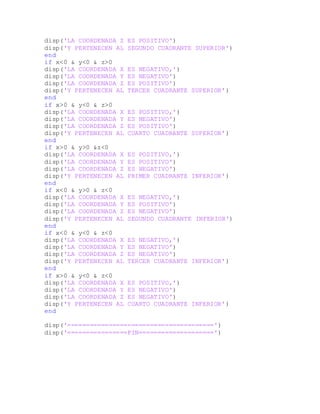
if x>0 & y>0 &z>0
disp('LA COORDENADA X ES POSITIVO,')
disp('LA COORDENADA Y ES POSITIVO')
disp('LA COORDENADA Z ES POSITIVO')
disp('Y PERTENECEN AL PRIMER CUADRANTE SUPERIOR')
end
if x<0 & y>0 & z>0
disp('LA COORDENADA X ES NEGATIVO,')
disp('LA COORDENADA Y ES POSITIVO')
disp('LA COORDENADA Z ES POSITIVO')
disp('Y PERTENECEN AL SEGUNDO CUADRANTE SUPERIOR')
end
if x<0 & y<0 & z>0
disp('LA COORDENADA X ES NEGATIVO,')
disp('LA COORDENADA Y ES NEGATIVO')
disp('LA COORDENADA Z ES POSITIVO')
disp('Y PERTENECEN AL TERCER CUADRANTE SUPERIOR')
end
if x>0 & y<0 & z>0
disp('LA COORDENADA X ES POSITIVO,')
disp('LA COORDENADA Y ES NEGATIVO')
disp('LA COORDENADA Z ES POSITIVO')
disp('Y PERTENECEN AL CUARTO CUADRANTE SUPERIOR')
end
if x>0 & y>0 &z<0
disp('LA COORDENADA X ES POSITIVO,')
disp('LA COORDENADA Y ES POSITIVO')
disp('LA COORDENADA Z ES NEGATIVO')
disp('Y PERTENECEN AL PRIMER CUADRANTE INFERIOR')
end
if x<0 & y>0 & z<0
disp('LA COORDENADA X ES NEGATIVO,')
disp('LA COORDENADA Y ES POSITIVO')
disp('LA COORDENADA Z ES NEGATIVO')
disp('Y PERTENECEN AL SEGUNDO CUADRANTE INFERIOR')
end
if x<0 & y<0 & z<0
disp('LA COORDENADA X ES NEGATIVO,')
disp('LA COORDENADA Y ES NEGATIVO')
disp('LA COORDENADA Z ES NEGATIVO')
disp('Y PERTENECEN AL TERCER CUADRANTE INFERIOR')
end
if x>0 & y<0 & z<0
disp('LA COORDENADA X ES POSITIVO,')
disp('LA COORDENADA Y ES NEGATIVO')
disp('LA COORDENADA Z ES NEGATIVO')
disp('Y PERTENECEN AL CUARTO CUADRANTE INFERIOR')
end
disp('=======================================')
disp('================FIN====================')
8.-
clc
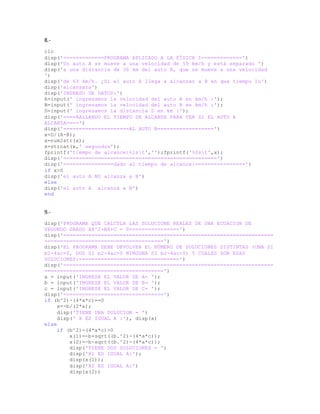
disp('=============PROGRAMA APLICADO A LA FÍSICA I=============')
disp('Un auto A se mueve a una velocidad de 59 km/h y está separado ')
disp('a una distancia de 30 km del auto B, que se mueve a una velocidad
')
disp('de 63 km/h. ¿Si el auto A llega a alcanzar a B en que tiempo lo')
disp('alcansara')
disp('INGRESO DE DATOS:')
A=input(' ingresamos la velocidad del auto A en km/h :');
B=input(' ingresamos la velocidad del auto B en km/h :');
D=input(' ingresamos la distancia D en km :');
disp('====HALLANDO EL TIEMPO DE ALCANSE PARA VER SI EL AUTO A
ALCANZA====')
disp('=====================AL AUTO B==================')
x=D/(A-B);
x=num2str(x);
x=strcat(x,' segundos');
fprintf('tiempo de alcance:%1st','');fprintf('%0st',x);
disp('=================================================')
disp('================dado al tiempo de alcance:================')
if x>0
disp('el auto A NO alcanza a B')
else
disp('el auto A alcanza a B')
end
9.-
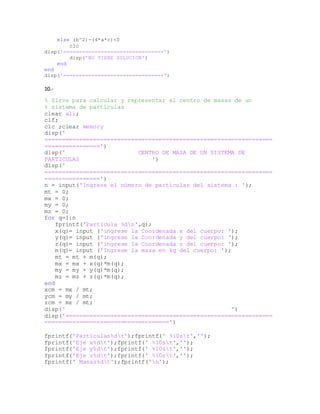
disp('PROGRAMA QUE CALCULA LAS SOLUCIONE REALES DE UNA ECUACION DE
SEGUNDO GRADO AX^2+BX+C = 0================')
disp('===================================================================
======================================')
disp('EL PROGRAMA DEBE DEVOLVER EL NÚMERO DE SOLUCIONES DISTINTAS (UNA SI
b2-4ac=0, DOS SI b2-4ac>0 NINGUNA SI b2-4ac<0) Y CUALES SON ESAS
SOLUCIONES:================================')
disp('===================================================================
======================================')
a = input('INGRESE EL VALOR DE A= ');
b = input('INGRESE EL VALOR DE B= ');
c = input('INGRESE EL VALOR DE C= ');
disp('================================')
if (b^2)-(4*a*c)==0
x=-b/(2*a);
disp('TIENE UNA SOLUCION = ')
disp(' X ES IGUAL A :'), disp(x)
else
if (b^2)-(4*a*c)>0
x(1)=-b+sqrt((b.^2)-(4*a*c));
x(2)=-b-sqrt((b.^2)-(4*a*c));
disp('TIENE DOS SOLUCIONES = ')
disp('X1 ES IGUAL A:');
disp(x(1));
disp('X2 ES IGUAL A:')
disp(x(2))
else (b^2)-(4*a*c)<0
clc
disp('================================')
disp('NO TIENE SOLUCION')
end
end
disp('================================')
10.-
% Sirve para calcular y representar el centro de masas de un
% sistema de partículas
clear all;
clf;
clc ;clear memory
disp('
==================================================================
================')
disp(' CENTRO DE MASA DE UN SISTEMA DE
PARTICULAS ')
disp('
==================================================================
================')
n = input('Ingrese el número de partículas del sistema : ');
mt = 0;
mx = 0;
my = 0;
mz = 0;
for q=1:n
fprintf('Partícula %dn',q);
x(q)= input ('ingrese la Coordenada x del cuerpo: ');
y(q)= input ('ingrese la Coordenada y del cuerpo: ');
z(q)= input ('ingrese la Coordenada z del cuerpo: ');
m(q)= input ('Ingrese la masa en kg del cuerpo: ');
mt = mt + m(q);
mx = mx + x(q)*m(q);
my = my + y(q)*m(q);
mz = mz + z(q)*m(q);
end
xcm = mx / mt;
ycm = my / mt;
zcm = mz / mt;
disp(' ')
disp('============================================================
====================================')
fprintf('Particulas%dt');fprintf(' %10st','');
fprintf('Eje x%dt');fprintf(' %10st','');
fprintf('Eje y%dt');fprintf(' %10st','');
fprintf('Eje z%dt');fprintf(' %10st','');
fprintf(' Masas%dt');fprintf('n');
disp('============================================================
=====================================')
for k=1:n
fprintf('Particula %dt',k);
fprintf(' %10st','');
fprintf('X%dt',k);
fprintf(':%dt',x(k));
fprintf(' %10st','');
fprintf('Y%dt',k);
fprintf(':%dt',y(k));
fprintf(' %10st','');
fprintf('Z%dt',k);
fprintf(':%dt',z(k));
fprintf(' %10st','');
fprintf('Masa%dt',k);
fprintf(':%dn',m(k));
end
disp(' el cemtro de masa es :');
disp([ num2str(xcm) ' i ' num2str(ycm) ' j ' num2str(zcm) ' k ' ]
)
plot3(xcm,ycm,zcm,'rx');
text(xcm+.1,ycm+.1,zcm+.1,'Centro de Masa');
xlabel('Eje X'),ylabel('Eje Y'),zlabel('Eje Z');
hold on
for j = 1:n
plot3(x(j),y(j),z(j),'bo');
text (x(j)+.1,y(j)+.1,z(j)+.1,num2str(m(j)));
end
title('CENTRO DE MASA')
grid on
hold off
programa while:
1.- clc
clear all
disp('----------------------------------------')
disp('programa de la biseccion')
disp('----------------------------------------')
fprintf('n');
nombre_f=input(' ingrese funcion asociada f(x)= ','s');%x.*sin(1/x)-0.2*exp(-x)
a=input(' ingrese limite inferior: ');%0.1
b=input(' ingrese limite superior: ');%0.5
fprintf('n');
fprintf(' it a b aprox errorn');
i=1;e=1; r=0;
while e>=3E-6 & i<=10
va=r;
r=(a+b)/2;
x=a;fa=eval(nombre_f);
x=b;fb=eval(nombre_f);
x=r;fr=eval(nombre_f);
fprintf(' %3.0f %10.6f %10.6f %10.6f',i,a,b,r);
if fa*fr<=0
b=r; e=abs((r-va)/r);
fprintf(' %10.6fn',e);
else
a=r; e=abs((r-va)/r);
fprintf(' %10.6fn',e);
end
i=i+1;
end
fprintf('n'); fprintf('la raiz es: %10.9fn', r);
2.-
clc
clear all
disp('----------------------------------')
disp('programa para hallar los divisores')
disp('----------------------------------')
n=input('ingrese el numero:');
while n<=1
n=input('ingrese el numero:');
end
D=n;
sum=0;
for d=1:n;
resto=rem(D,d);
if resto==0
sum=sum+d;
disp([d])
end
end
if sum==2*d;
'perfecto'
else
' no es perfecto'
end
3.-
function m=euclides(a,b)
% Cálculo del máximo común divisor de dos números naturales
% mediante el algoritmo de Euclides
clc
clear all
disp('------------------')
disp('metodo de euclides')
disp('------------------')
a= input('ingrese el primer numero:')
b= input('ingrese el segundo numero:')
if a<b
c=b;
b=a;
a=c;
end
while b>0
c=rem(a,b);
a=b;
b=c;
end
m=a;
disp('maximo comun divisor')
4.-
clc,clear all
n=0;
while n<1;
'el numero de notas no es promediable'
n=input('cuantas notas se va a promediar:');
end
sum=0;
c=0;
nota=1;
while nota>-1 & nota<=20
while c<n
nota=input('ingrese nota:');
if nota>=0 & nota<=20
sum=sum+nota;
c=c+1;
end
end
nota=100;
end
p=sum/c;
'promedio:'
disp(p)
5.-
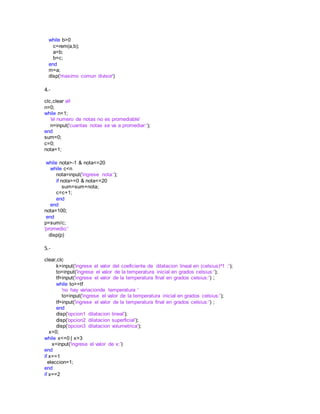
clear,clc
k=input('ingrese el valor del coeficiente de dilatacion lineal en (celsius)^1 :');
to=input('ingrese el valor de la temperatura inicial en grados celsius:');
tf=input('ingrese el valor de la temperatura final en grados celsius:') ;
while to>=tf
'no hay variacionde temperatura '
to=input('ingrese el valor de la temperatura inicial en grados celsius:');
tf=input('ingrese el valor de la temperatura final en grados celsius:') ;
end
disp('opcion1 dilatacion lineal');
disp('opcion2 dilatacion superficial');
disp('opcion3 dilatacion volumetrica');
x=0;
while x<=0 | x>3
x=input('ingrese el valor de x:')
end
if x==1
eleccion=1;
end
if x==2
eleccion=2;
end
if x==3
eleccion=3;
end
switch eleccion
case 1
disp('dilatacion lineal');
lo=input('ingrese el valor de la longitud inicial en m:');
vl=k*lo*(tf-to);
disp('el valor de la variacion de longitud en metros es:');
disp([vl]);
case 2
disp('dilatacion superficial');
Ao=input('ingrese el valor deL AREA inicial en m^2:');
vA=k*Ao*(tf-to);
disp('el valor de la variacion de AREA en m^2 es:');
disp([vA]);
case 3
disp('dilatacion volumetrica');
Vo=input('ingrese el valor deL VOLUMEN incial en m^3:');
vV=k*Vo*(tf-to);
disp('el valor de la variacion de VOLUMEN en m^3 es:');
disp([vV]);
end
6.-
clc,clear all
clc
clear all
disp('----------------------------------------')
disp('programa para hallar si un numero es primo')
disp('----------------------------------------')
n=input('Número natural que deseas saber si es primo ');
i=2;
primo=1;
while i<=sqrt(n)
if rem(n,i)==0 % Resto de dividir n entre i
primo=0;
break
end
i=i+1;
end
if primo
disp('El número dado es primo.')
else
disp('El número dado no es primo.')
disp('De hecho, es divisible por:')
disp(i)
end
clc,clear all
n=input('ingrese el numero:');
while n<=1
n=input('ingrese el numero:');
end
D=n;
for d=1:n;
resto=rem(D,d);
if resto==0
disp([d])
if d==2
'numero primo'
else
'divisible'
end
end
end
7.-
%programa con while 4
%Programa aplicado al curso de fisica ii
%Programa para hallar el campo eléctrico y el potencial eléctrico
%sabiendo q la constante eléctrica es k= (9*10^9) N.m^2/c^2
%calculos escalarmente
clc
disp('-------------------------------------------------------------------
---------')
disp('--PROGRAMA PARA CALCULAR EL CAMPO ELÉCTRICO(E)Y EL POTENCIAL
ELÉCTRICO(Vp)--')
disp('--------- usando la fórmula E=(9*(10^9))*Q/(d^2) y
Vp=(9*(10^9))*Q/d -------')
disp('------------------- de constante k= (9*10^9) N.m^2/c^2 ------------
---------')
disp('-------------------------------------------------------------------
---------')
Q=input('ingrese la carga del cuerpo en Coulomb(C): ');
d=input('ingrese la distancia en metros(m): ');
while d<0;
d=input('ingrese distancia mayor que cero: ');
end
%fórmulas
k=9*10^9;
if Q>0;
E=(9*(10^9))*Q/(d^2); %fórmula del campo
disp('hallando el campo en (N/C):');
disp(E);
Vp=(9*(10^9))*Q/d; %fórmula del potencial
disp('hallando potencial en (voltios):');
disp(Vp);
plot(E,Vp,'bo')
xlabel('campo eléctrico')
ylabel('potencial eléctrico')
title('campo eléctrico& potencial eléctrico')
hold on;
grid on;
else
if Q<0;
E1=-(9*(10^9))*Q/(d^2);
disp('hallando el campo en (N/C):');
disp(E1);
Vp1=(9*(10^9))*Q/d;
disp('hallando potencial en (voltios):');
disp(Vp1);
plot(E,Vp,'r*');
xlabel('campo eléctrico')
ylabel('potencial eléctrico ')
title('campo eléctrico& potencial eléctrico')
hold on;
grid on;
end
end
disp('"""""""""""""""""""""""""""""""""""""""""""""""""""""""""""""')
disp('_____________________________ FIN ___________________________')
disp('"""""""""""""""""""""""""""""""""""""""""""""""""""""""""""""')
8.-
clc; clf ;clear memory;format short;
disp('------------------CINETICA QUIMICA-------------------------');
disp('-PROGRAMA PARA HALLAR Y GRAFICAR LA CONSTANTE DE VELOCIDAD-');
disp('***************DEL PERMANGANATO DE POTASIO*****************');
m=input('Ingrese la masa del KMnO4 (g) 500 : ');
pm=158; %g/mol
V=input('Ingrese el volumen (L) 1 : ');
t1=input('Ingrese el tiempo en (min) 3 : ');
while t1<=1 | t1>=60 ;
disp('FUERA DEL TIEMPO EN MINUTOS');
t1=input('Ingrese el tiempo correcto');
end
t=t1*60;M=m/(pm*V);z=t+11;k=M/t;
disp(' CONSTANTE MOLARIDAD (M) TIEMPO(segundos)');
disp('RESULTADO:');
disp([num2str(k) ' = ' num2str(M) ' / ' num2str(t)]);
disp('Los 11 primeros tiempos:');
while t<=z;
t=t+1;k=M/t; %k=constante
disp([num2str(k) ' = ' num2str(M) ' / '
num2str(t)]);
grid on;hold on;
figure(1)
plot(k,M,'ro');
title(' CONSTANTE Vs MOLARIDAD ');
xlabel('CONSTANTE ');ylabel('MOLARIDAD (M)');
grid on;hold on;
figure(2)
plot(k,t,'ko');
title(' CONSTANTE Vs TIEMPO (seg) ');
xlabel(' CONSTANTE ');ylabel('TIEMPO (seg)');
end
disp('......................FIN DEL PROGRAMA.....................');
9.-
%Programa para hallar el campo eléctrico que existe entre 2
cargas
clear memory
clc
disp('-------------------------------------------------------
----------------')
disp('PROGRAMA PARA HALLAR EL CAMPO ELECTRICO ENTRE DOS
CARGAS PUNTUALES');
disp('_____________________EN EL CURSO DE FISICA
II________________________')
disp('-------------------------------------------------------
----------------')
Q=input('ingrese carga (Q) en coulomb(C): ');
d=input('ingrese la distancia en metros(m): ');
while d<0;
d=input('ingrese distancia mayor que cero: ');
end
k=9*10^9;
E=(k*abs(Q))/d^2;
disp(' -----------------------')
fprintf('E=%5.9fn',E)
disp(' -----------------------')
10.-
clc,clear all
disp('-------------------------------------------------------------------
-----------------')
disp('--- Halla la recta en forma paramétrica----------------------------
--------------------')
%Nos permite representar una curva o superficie mediante una variable
llamada parámetro
disp('-----------------------[p=po+E*a]----------------------------------
---------------------------')
po=input('ingrese el punto de paso:');
while po<=0;
disp('ingrese el punto de paso mayor a cero');
po=input('ingrese el punto de paso:');
end
t=input('ingrese t:');
while t<0;
disp('ingrese el t positivo');
t=input('ingrese t :');
end
a=input('vector direccional:');
while a<0,
disp('ingrese el vector direccional positivo');
a=input('ingrese el vector direccional:');
end
format bank
disp(' t parámetro ');
for E=0:t;
p=po+E*a;%forma de la ecuación paramétrica
disp([ E p ])
end
x=[0:5:E];
y=x.*a+po;
plot(x,y,'r*');title('ecuación paramétrica');xlabel('t');ylabel('el
parámetro')
axis([0 50 0 2000])
hold on
grid on

Programa con for.if word

  • 1.
    Programa con for: 1.- disp('-----------------------------------------------------------------------------------') disp('programa para determinar el tiempo de alcance de 2 móviles') disp('-----------------------------------------------------------------------------------') clc clear all va=input('velocidad del móvil a lento='); vb=input('velocidad del móvil b rápido='); d=input('distancia de separación entre móviles='); da=0; db=d; te=d/(vb-va); if da~=db; disp [tiempo distanciaA distanciaB] for t=0:te; da=d+va*t; db=vb*t; disp([t da db]) end end 2.- disp('----------------') disp('integracion') disp('----------------') clc clear all a=input('limite inferior='); b=input('limite superior='); n=input('numero de variables='); h=(b-a)/n; n=n+1; y=zeros(n,1); x=zeros(n,1); suma=0; for i=1:n x(i)=a+h*(i-1); y(i)=feval(x,i); end for i=2:n-1 if rem(i-1,3)==0 suma=suma+2*y(i); else suma=suma+3*y(i); end end p=3*h*(y(i)+suma+y(n))/8; %integracion a=input('limite inferior'); b=input('limite superior'); n=input('numero de variables'); h=(b-a)/n;
  • 2.
    n=n+1; y=zeros(n,1); x=zeros(n,1); suma=0; for i=1:n x(i)=a+h*(i-1); y(i)=feval(x(i)); end for i=2:n-1 ifrem(i-1,3)==0 suma=suma+2*y(i); else suma=suma+3*y(i); end end p=3*h*(y(i)+suma+y(n))/8; simpsom8('exp2',0,1,9); 3.- disp('-----------------------------------------------') disp('para hallar el numero de divisores') disp('-----------------------------------------------') clc clear all n=input('ingrese valor=') c=0; for g=(1:n); if mod(n,g)==0 d=n; c=c+1; end end 'el numero de divisores es' disp([c]) 4.- disp('--------------------------------------------------') disp('para saber si es un numero perfecto') disp('-------------------------------------------------') clc clear all n=input('ingrese el numero=') while n<=0; n=input('ingrese el numero=') end c=0; for d=1:n; resto=rem(n,d); if resto==0 c=c+1; end end disp(c)
  • 3.
    5.- disp('----------------------------') disp('suma de cuadrados') disp('----------------------------') clc clearall disp [numero suma] for n= 7:49; if n>8; S=n*(n+1)*(2*n+1)/6; disp([n,S]) end end 6.- disp('-----------------------------------------------') disp('para hacer una tabla de multiplicar') disp('-----------------------------------------------') clc clear all m=2; disp [numero suma] for a=0:1:12; if a~=2 f=m*a; disp([a,m,f]) end end 7.- disp('----------------------------------------') disp('tabla de multiplicar mas algo') disp('----------------------------------------') clc clear all m=input('ingrese valor a m='); h=input('ingrese valor a h='); p=input('ingrese valor a p='); for c=0:1:p; if c>0; D=m*c+h; disp([m,h,c,D]) end end
  • 4.
    8.- disp('------------------------------------------') disp('para hallar lavelocidad angular') disp('------------------------------------------') clc clear all d=input('ingrese el valor del desplazamiento:'); t=input('ingrese el tiempo:'); if t>0 end for D=1:d; w=(D.*pi./180)./t; disp([D w]) end D=1:d; w=(D.*pi./180)./t; plot(D,w) title('velocidad angular') xlabel('desplazamiento') ylabel('velocidad') 9.- %programa con for 3 %APLICADO AL CURSO DE FISICA i %Programa para hallar el movimiento armónico simple de un móvil %hallando periodo y frecuencia,posición, vel angular, %velocidad y aceleración clc disp('******************************************************************* *******') disp('!!!!!!!!!!!!!!!!hallando periodo, frecuencia,posición!!!!!!!!!!!!!!!!!!!!!') disp('!!!!!!!!!!!!!!!!!velangular,velocidad y aceleración !!!!!!!!!!!!!!!!!!!!!!') disp('!!!!!!!!!!!!!!El movimiento armónico simple de un móvil!!!!!!!!!!!!!!!!!!!') disp('******************************************************************* *******') fprintf('n') t=input('ingrese el tiempo del móvil en s:'); alfa=input('ingrese el ángulo alfa en rad:'); A=input('ingrese la amplitud en m:'); m=input('ingrese la masa del movil en kg:'); K=input('ingrese la rigidez en m/s:'); format bank disp('=================================================================== ========') disp('"""""""""""""""""""""""""""tenemos la frecuencia"""""""""""""""""""""""""""') disp('la frecuencia hallada es:'); disp('==tiempo frecuencia=='); for t=0:2:10; f=1/t;
  • 5.
    disp([num2str(t) 's 'num2str(f) 'hertz']) end disp('=================================================================== ========') disp('""""""""""""""""""""""""""""tenemos la velangular""""""""""""""""""""""""""') disp('alfa ángulo velangular :'); for t=5:1:10; velangular=alfa/t; disp([num2str(alfa) 'rad / ' num2str(t) 's = ' num2str(velangular) 'rad/s']) end disp('=================================================================== ========') disp('""""""""tenemos la posición del móvil en cualquier instante de tiempo""""""') disp('==tiempo posición=='); for A=0:10; X=A*sin(velangular*t+alfa); % x=deformación disp([num2str(t) 's ' num2str(X) 'm']) end disp('=================================================================== ========') disp('"""""""""""tenemos la velocidad del móvil en m/s2 para el M.A.S""""""""""""') disp('==amplitud velocidad=='); for A=0:2:10; v=A*velangular*cos(velangular*t+alfa); disp([num2str(A) 'm ' num2str(v) 'm/s2']) end disp('"================================================================== ========') disp('""""""""""""""""""tenemos la aceleracion del móvil en m/s""""""""""""""""""') disp('==tiempo aceleración=='); for t=0:1:7; abs(-A); a=-A*(velangular)^2*sin(velangular*t+alfa); disp([num2str(t) 's ' num2str(a) 'm/s']) end fprintf('n') disp(':::::::::::::::::fin de programa::::::::::::::::::') disp('************************************************** 10.- ° clc clear memory clf disp('===================================================') disp(' CENTRO DE MASA DE "n" PARTICULAS ') disp('===================================================') n=input('Número de partículas: '); mt=0; mx=0; my=0; for i=1:n
  • 6.
    fprintf(1,'Partícula: %dn',i); x(i)=input ('xen cm: '); y(i)=input ('y en cm: '); m(i)=input ('M en g: '); while m<=0 m(i)=input ('M en g: ') end mt=mt+m(i); mx=mx+x(i)*m(i); my=my+y(i)*m(i); end xcm= mx/mt; ycm= my/mt; disp(' ') disp('^================================================================== ==============================^') fprintf('Particulas :%dt');fprintf(' %10st',''); fprintf('Eje x :%dt');fprintf(' %10st',''); fprintf('Eje y :%dt');fprintf(' %10st',''); fprintf(' Masas :%dt');fprintf('nn'); disp('^================================================================== ===============================^') for k=1:n fprintf('Particula :%dt',k); fprintf(' %10st',''); fprintf('X%dt',k); fprintf(':%dt',x(k)); fprintf(' %10st',''); fprintf('Y%dt',k); fprintf(':%dt',y(k)); fprintf(' %10st',''); fprintf('Masa%dt',k); fprintf(':%dn',m(k)); end fprintf('nn') fprintf('EL CENTRO DE MASA ES: %dt'); fprintf('(%dt'); fprintf('cm %5.2ft',xcm);fprintf(';%dt'); fprintf('cm %5.2ft',ycm);fprintf(';%dt'); plot(xcm,ycm,'g+'); text(xcm,ycm,'Centro de Masa'); xlabel('Eje X'),ylabel('Eje Y'),; hold on for j = 1:n plot(x(j),y(j),'rx'); text (x(j),y(j),num2str(m(j))); end title('CENTRO DE MASA') grid on hold off
  • 7.
    Programa con if: 1.- %Programapara hallar las diferentes series en el espectro de emisión %del hidrogeno atómico. %Autor:Socualaya Montoya Christian Gabriel clc,clear all for z=1:6 x=input('Ingrese el número de capa a donde salta el electrón(nf)del 1 al 4:'); if x>0 | x<5; if x==1; disp('Representa a la serie de Lyman') disp('Pertenece a la región del espectro ultravioleta') disp('=================================================================') else if x==2; disp('Representa a la serie de Balmer') disp('Pertenece a la región del espectro visible y ultravioleta') disp('=================================================================') else if x==3; disp('Representa a la serie de Paschen') disp('Pertenece a la región del espectro infrarrojo') disp('=================================================================') else if x==4; disp('Representa a la serie de Brackett') disp('Pertenece a la región del espectro infrarrojo') disp('=================================================================') else disp('No presenta serie definida') end end end end end end 2.- %Programa para calcular el trabajo realizado por la fuerza F=3*x^2+2*x-5 N %entre x=2m y x=5m. %Sabiendo que la velocidad del bloque en el punto x=2m es de 5 m/s, calcular %la velocidad del bloque en el punto x=5m. %Autor: Socualaya Montoya Christian Gabriel clc,clear xi=input('ingrese la distancia inicial en m:'); xf=input('ingrese la distancia final en m :'); disp('=================================================') disp('============CALCULANDO EL TRABAJO================')
  • 8.
    for D=xi:xf disp('Distancia(D) Fuerza(F)Trabajo(W)') F=3*D^2+2*D-5; %Fuerza en Newton(N) W=F*D; %Trabajo en Joules(J) disp([num2str(D) ' m * ' num2str(F) ' N = ' num2str(W) ' J ']) end disp('=================================================') disp('=====CALCULANDO LA INTEGRAL DE LA FUERZA(F)======') syms x; f=input('ingrese la integral 3*x^2+2*x-5:'); I=inline(char(f)); %El comando inline crea una cadena y el comando char convierte la función f en expresión simbólica a=input('ingrese el límite inferior de la integral:'); b=input('ingrese el límite superior de la integral:'); I=int(f,a,b); %Calcula la integral de la función disp('El valor de la integral es:') disp(I) disp('=================================================') disp('=======CALCULANDO LA Vf DEL BLOQUE===============') m=10; %Masa en Kg Vi=5; %Velocidad inicial en m/s I=123; Vf=sqrt(((I+(1/2)*m*Vi^2)*2)/m); format short fprintf('El valor de la Vf es %g m/s.',Vf); end end end 3.- %programa con input y disp 1 %programa para hallar la cantidad de carbono en el acero(fe + c) %tambien para hallar la densidad de la aleación %veamos: clc disp('=================================================================== ==================') disp('""""""""""""""""""""" programa para hallar la densidad en esta aleación """""""""""""') disp('"""""""""""""""" e ingresar la cantidad de carbono en el acero para que nos """""""""') disp('"""""""""""""""""""""""""""" muestre en que estado esta """"""""""""""""""""""""""""') disp('=================================================================== ==================') masa=input('ingrese la masa del (fe + c) en kg:'); volumen=input('ingrese el volumen del acero en m3:'); dens=(masa/volumen); fprintf('n') disp('*************hallando la densidad del acero******************') disp('la densidad es:') disp([num2str(masa) ' / ' num2str(volumen) ' = ' num2str(dens) 'kg/m3']); fprintf('n') disp('=================================================================== ==================')
  • 9.
    disp('ingresamos un numeroC (cant. de carbono) en kg para saber en qué estado se encuentra') disp('=================================================================== ==================') C=input('ingrese la cantidad de carbono en (kg) para conocer su estado:'); if C==0 disp('=>no es acero por no contener carbono en su composición') else if C<0.03 %de su composición disp('=>el acero es normal, sólido'); else if C>2.14 %de su composición disp('=>la composición hace que se produzca una fundición sea liquido'); else end end end fprintf('nn') disp('******************fin // gracias******************') disp('**************************************************') 4.- %programa con if 2 %programa aplicado al curso de QUIMICA %programa de la tabla periódica ordenados según su ORIGEN %Se clasifican en tres clc disp('""""""""""""""""""""""""""""""""""""""""""""""""""""""""""""""""""" """"""""""') disp('!!!!!!! programa para saber en qué ubicación se encuentra el elemento!!!!!!!!') disp('!!!!!!!!!!!!!!!! elementos clasificados, según su origen!!!!!!!!!!!!!!!!!!!!!') disp('!!!!!!!!!!!!!!!!! ya sea natural, artificial u anfótero!!!!!!!!!!!!!!!!!!!!!!') disp('""""""""""""""""""""""""""""""""""""""""""""""""""""""""""""""""""" """"""""""') fprintf('n') Z=input('ingrese el peso atómico de un elemento:'); if Z>=1 && Z<=92; disp('=>según su origen el elemento es NATURAL'); else if Z==43; disp('=>es el elemento tecnesio que es un ANFÓTERO'); else if Z==61; disp('=>es el elemento prometio que es un ANFÓTERO'); else if Z>92 && Z<=121; %estos elementos se denominan transuránicos disp('=>según su origen el elemento es ARTIFICIAL'); else if Z>121; disp('=>no se clasifica; no existe este elemento de peso atómico'); end end
  • 10.
    end end end fprintf('n') disp('================================FIN // GRACIAS================================') disp('=================================================================== ===========') 5.- disp('----------------------') disp('hallar numerosinpares') disp('----------------------') clc clear all a = 15 b = 10 if a > b then disp([invertimos]) x = a a = b b = x end if a mod 2 = 0 then a = a + 1 for n = a to b disp([n]) end 6.- clc;clf; disp('|||CALCULAR Y GRAFICAR LA VARIACION DE LA ENERGIA LIBRE DE GIBBS|||') disp('|||||||||||||||||||||DE LA SIGUIENTE REACCION|||||||||||||||||||||') disp('|||||||||||||||||||CH4(g)+2O2(g)=CO2(g)+2H2O(g)|||||||||||||||||||' ) disp('-------------------------------------------------') x=input('Ingrese la entalpia del CH4 (KJ/mol) -74.8 :'); y=input('Ingrese la entalpia del CO2 (KJ/mol) -393.5 :'); z=input('Ingrese la entalpia del H2O (KJ/mol) -241.6 :'); disp('-------------------------------------------------') m=input('Ingrese la entropía del CH4 (J/mol K) 186.3 :'); n=input('Ingrese la entropía del CO2 (J/mol K) 213.4 :'); q=input('Ingrese la entropía del H2O (J/mol K) 188.7 :'); p=input('Ingrese la entropía del 2O2 (J/mol K) 49 :'); t=input('Ingrese la temperatura (°C) 25 :'); T=t+273;%kelvin H=y+(2*z)-x; fprintf('LA ENTALPIA ES: %3.2f',H);disp(' (KJ/mol)'); if H>0 disp('LA REACCION ES ENDOTERMICA'); else disp('LA REACCION ES EXOTERMICA'); end S=(n+2*q-(m+2*p))/1000;
  • 11.
    fprintf('LA ENTROPIA ES:%3.2f',S);disp(' (J/mol k)'); if S>0; disp('HAY MAYOR DESORDEN'); else disp('POCO DESORDEN'); end G=H-T*S; fprintf('LA ENERGIA LIBBRE DE GIBBS ES: %3.2f',G);disp('K J'); if G==0; disp('La reacción está en equilibrio'); else if G<0; disp('LA REACCION ES ESPONTANEA'); else disp('LA REACCION ES NO ESPONTANEA'); end end plot3(H,S,G,'r*'); title('ENERGIA LIBRE DE GIBBS') text(H,S,G,'===> H y S da la ENERGIA LIBRE '); xlabel('ENTALPIA (KJ/mol)');ylabel('ENTROPIA (J/mol k )'); zlabel('ENERGIA LIBRE DE GIBBS (KJ)'); grid on ;hold on; disp('******************FIN DEL PROGRAMA *************************'); 7.- %Este programa está hecho para determinar la ubicación de un punto %en el plano tridimensional. disp('======================================================= ====='); disp('=====PROGRAMA PARA DETERMINAR LA UBICACIÓN DE UN PUNTO======'); disp('==================EN EL PLANO TRIDIMENSIONAL===================='); disp('======================================================= ====='); x=input('PUNTO EN EL EJE X = '); y=input('PUNTO EN EL EJE Y = '); z=input('PUNTO EN EL EJE Z = '); disp('=======================================') if x>0 & y>0 &z>0 disp('LA COORDENADA X ES POSITIVO,') disp('LA COORDENADA Y ES POSITIVO') disp('LA COORDENADA Z ES POSITIVO') disp('Y PERTENECEN AL PRIMER CUADRANTE SUPERIOR') end if x<0 & y>0 & z>0 disp('LA COORDENADA X ES NEGATIVO,') disp('LA COORDENADA Y ES POSITIVO')
  • 12.
    disp('LA COORDENADA ZES POSITIVO') disp('Y PERTENECEN AL SEGUNDO CUADRANTE SUPERIOR') end if x<0 & y<0 & z>0 disp('LA COORDENADA X ES NEGATIVO,') disp('LA COORDENADA Y ES NEGATIVO') disp('LA COORDENADA Z ES POSITIVO') disp('Y PERTENECEN AL TERCER CUADRANTE SUPERIOR') end if x>0 & y<0 & z>0 disp('LA COORDENADA X ES POSITIVO,') disp('LA COORDENADA Y ES NEGATIVO') disp('LA COORDENADA Z ES POSITIVO') disp('Y PERTENECEN AL CUARTO CUADRANTE SUPERIOR') end if x>0 & y>0 &z<0 disp('LA COORDENADA X ES POSITIVO,') disp('LA COORDENADA Y ES POSITIVO') disp('LA COORDENADA Z ES NEGATIVO') disp('Y PERTENECEN AL PRIMER CUADRANTE INFERIOR') end if x<0 & y>0 & z<0 disp('LA COORDENADA X ES NEGATIVO,') disp('LA COORDENADA Y ES POSITIVO') disp('LA COORDENADA Z ES NEGATIVO') disp('Y PERTENECEN AL SEGUNDO CUADRANTE INFERIOR') end if x<0 & y<0 & z<0 disp('LA COORDENADA X ES NEGATIVO,') disp('LA COORDENADA Y ES NEGATIVO') disp('LA COORDENADA Z ES NEGATIVO') disp('Y PERTENECEN AL TERCER CUADRANTE INFERIOR') end if x>0 & y<0 & z<0 disp('LA COORDENADA X ES POSITIVO,') disp('LA COORDENADA Y ES NEGATIVO') disp('LA COORDENADA Z ES NEGATIVO') disp('Y PERTENECEN AL CUARTO CUADRANTE INFERIOR') end disp('=======================================') disp('================FIN====================')
  • 13.
    8.- clc disp('=============PROGRAMA APLICADO ALA FÍSICA I=============') disp('Un auto A se mueve a una velocidad de 59 km/h y está separado ') disp('a una distancia de 30 km del auto B, que se mueve a una velocidad ') disp('de 63 km/h. ¿Si el auto A llega a alcanzar a B en que tiempo lo') disp('alcansara') disp('INGRESO DE DATOS:') A=input(' ingresamos la velocidad del auto A en km/h :'); B=input(' ingresamos la velocidad del auto B en km/h :'); D=input(' ingresamos la distancia D en km :'); disp('====HALLANDO EL TIEMPO DE ALCANSE PARA VER SI EL AUTO A ALCANZA====') disp('=====================AL AUTO B==================') x=D/(A-B); x=num2str(x); x=strcat(x,' segundos'); fprintf('tiempo de alcance:%1st','');fprintf('%0st',x); disp('=================================================') disp('================dado al tiempo de alcance:================') if x>0 disp('el auto A NO alcanza a B') else disp('el auto A alcanza a B') end 9.- disp('PROGRAMA QUE CALCULA LAS SOLUCIONE REALES DE UNA ECUACION DE SEGUNDO GRADO AX^2+BX+C = 0================') disp('=================================================================== ======================================') disp('EL PROGRAMA DEBE DEVOLVER EL NÚMERO DE SOLUCIONES DISTINTAS (UNA SI b2-4ac=0, DOS SI b2-4ac>0 NINGUNA SI b2-4ac<0) Y CUALES SON ESAS SOLUCIONES:================================') disp('=================================================================== ======================================') a = input('INGRESE EL VALOR DE A= '); b = input('INGRESE EL VALOR DE B= '); c = input('INGRESE EL VALOR DE C= '); disp('================================') if (b^2)-(4*a*c)==0 x=-b/(2*a); disp('TIENE UNA SOLUCION = ') disp(' X ES IGUAL A :'), disp(x) else if (b^2)-(4*a*c)>0 x(1)=-b+sqrt((b.^2)-(4*a*c)); x(2)=-b-sqrt((b.^2)-(4*a*c)); disp('TIENE DOS SOLUCIONES = ') disp('X1 ES IGUAL A:'); disp(x(1)); disp('X2 ES IGUAL A:') disp(x(2))
  • 14.
    else (b^2)-(4*a*c)<0 clc disp('================================') disp('NO TIENESOLUCION') end end disp('================================') 10.- % Sirve para calcular y representar el centro de masas de un % sistema de partículas clear all; clf; clc ;clear memory disp(' ================================================================== ================') disp(' CENTRO DE MASA DE UN SISTEMA DE PARTICULAS ') disp(' ================================================================== ================') n = input('Ingrese el número de partículas del sistema : '); mt = 0; mx = 0; my = 0; mz = 0; for q=1:n fprintf('Partícula %dn',q); x(q)= input ('ingrese la Coordenada x del cuerpo: '); y(q)= input ('ingrese la Coordenada y del cuerpo: '); z(q)= input ('ingrese la Coordenada z del cuerpo: '); m(q)= input ('Ingrese la masa en kg del cuerpo: '); mt = mt + m(q); mx = mx + x(q)*m(q); my = my + y(q)*m(q); mz = mz + z(q)*m(q); end xcm = mx / mt; ycm = my / mt; zcm = mz / mt; disp(' ') disp('============================================================ ====================================') fprintf('Particulas%dt');fprintf(' %10st',''); fprintf('Eje x%dt');fprintf(' %10st',''); fprintf('Eje y%dt');fprintf(' %10st',''); fprintf('Eje z%dt');fprintf(' %10st',''); fprintf(' Masas%dt');fprintf('n');
  • 15.
    disp('============================================================ =====================================') for k=1:n fprintf('Particula %dt',k); fprintf('%10st',''); fprintf('X%dt',k); fprintf(':%dt',x(k)); fprintf(' %10st',''); fprintf('Y%dt',k); fprintf(':%dt',y(k)); fprintf(' %10st',''); fprintf('Z%dt',k); fprintf(':%dt',z(k)); fprintf(' %10st',''); fprintf('Masa%dt',k); fprintf(':%dn',m(k)); end disp(' el cemtro de masa es :'); disp([ num2str(xcm) ' i ' num2str(ycm) ' j ' num2str(zcm) ' k ' ] ) plot3(xcm,ycm,zcm,'rx'); text(xcm+.1,ycm+.1,zcm+.1,'Centro de Masa'); xlabel('Eje X'),ylabel('Eje Y'),zlabel('Eje Z'); hold on for j = 1:n plot3(x(j),y(j),z(j),'bo'); text (x(j)+.1,y(j)+.1,z(j)+.1,num2str(m(j))); end title('CENTRO DE MASA') grid on hold off programa while: 1.- clc clear all disp('----------------------------------------') disp('programa de la biseccion') disp('----------------------------------------') fprintf('n'); nombre_f=input(' ingrese funcion asociada f(x)= ','s');%x.*sin(1/x)-0.2*exp(-x) a=input(' ingrese limite inferior: ');%0.1 b=input(' ingrese limite superior: ');%0.5 fprintf('n'); fprintf(' it a b aprox errorn'); i=1;e=1; r=0; while e>=3E-6 & i<=10 va=r; r=(a+b)/2; x=a;fa=eval(nombre_f); x=b;fb=eval(nombre_f); x=r;fr=eval(nombre_f);
  • 16.
    fprintf(' %3.0f %10.6f%10.6f %10.6f',i,a,b,r); if fa*fr<=0 b=r; e=abs((r-va)/r); fprintf(' %10.6fn',e); else a=r; e=abs((r-va)/r); fprintf(' %10.6fn',e); end i=i+1; end fprintf('n'); fprintf('la raiz es: %10.9fn', r); 2.- clc clear all disp('----------------------------------') disp('programa para hallar los divisores') disp('----------------------------------') n=input('ingrese el numero:'); while n<=1 n=input('ingrese el numero:'); end D=n; sum=0; for d=1:n; resto=rem(D,d); if resto==0 sum=sum+d; disp([d]) end end if sum==2*d; 'perfecto' else ' no es perfecto' end 3.- function m=euclides(a,b) % Cálculo del máximo común divisor de dos números naturales % mediante el algoritmo de Euclides clc clear all disp('------------------') disp('metodo de euclides') disp('------------------') a= input('ingrese el primer numero:') b= input('ingrese el segundo numero:') if a<b c=b; b=a; a=c; end
  • 17.
    while b>0 c=rem(a,b); a=b; b=c; end m=a; disp('maximo comundivisor') 4.- clc,clear all n=0; while n<1; 'el numero de notas no es promediable' n=input('cuantas notas se va a promediar:'); end sum=0; c=0; nota=1; while nota>-1 & nota<=20 while c<n nota=input('ingrese nota:'); if nota>=0 & nota<=20 sum=sum+nota; c=c+1; end end nota=100; end p=sum/c; 'promedio:' disp(p) 5.- clear,clc k=input('ingrese el valor del coeficiente de dilatacion lineal en (celsius)^1 :'); to=input('ingrese el valor de la temperatura inicial en grados celsius:'); tf=input('ingrese el valor de la temperatura final en grados celsius:') ; while to>=tf 'no hay variacionde temperatura ' to=input('ingrese el valor de la temperatura inicial en grados celsius:'); tf=input('ingrese el valor de la temperatura final en grados celsius:') ; end disp('opcion1 dilatacion lineal'); disp('opcion2 dilatacion superficial'); disp('opcion3 dilatacion volumetrica'); x=0; while x<=0 | x>3 x=input('ingrese el valor de x:') end if x==1 eleccion=1; end if x==2
  • 18.
    eleccion=2; end if x==3 eleccion=3; end switch eleccion case1 disp('dilatacion lineal'); lo=input('ingrese el valor de la longitud inicial en m:'); vl=k*lo*(tf-to); disp('el valor de la variacion de longitud en metros es:'); disp([vl]); case 2 disp('dilatacion superficial'); Ao=input('ingrese el valor deL AREA inicial en m^2:'); vA=k*Ao*(tf-to); disp('el valor de la variacion de AREA en m^2 es:'); disp([vA]); case 3 disp('dilatacion volumetrica'); Vo=input('ingrese el valor deL VOLUMEN incial en m^3:'); vV=k*Vo*(tf-to); disp('el valor de la variacion de VOLUMEN en m^3 es:'); disp([vV]); end 6.- clc,clear all clc clear all disp('----------------------------------------') disp('programa para hallar si un numero es primo') disp('----------------------------------------') n=input('Número natural que deseas saber si es primo '); i=2; primo=1; while i<=sqrt(n) if rem(n,i)==0 % Resto de dividir n entre i primo=0; break end i=i+1; end if primo disp('El número dado es primo.') else disp('El número dado no es primo.') disp('De hecho, es divisible por:') disp(i) end
  • 19.
    clc,clear all n=input('ingrese elnumero:'); while n<=1 n=input('ingrese el numero:'); end D=n; for d=1:n; resto=rem(D,d); if resto==0 disp([d]) if d==2 'numero primo' else 'divisible' end end end 7.- %programa con while 4 %Programa aplicado al curso de fisica ii %Programa para hallar el campo eléctrico y el potencial eléctrico %sabiendo q la constante eléctrica es k= (9*10^9) N.m^2/c^2 %calculos escalarmente clc disp('------------------------------------------------------------------- ---------') disp('--PROGRAMA PARA CALCULAR EL CAMPO ELÉCTRICO(E)Y EL POTENCIAL ELÉCTRICO(Vp)--') disp('--------- usando la fórmula E=(9*(10^9))*Q/(d^2) y Vp=(9*(10^9))*Q/d -------') disp('------------------- de constante k= (9*10^9) N.m^2/c^2 ------------ ---------') disp('------------------------------------------------------------------- ---------') Q=input('ingrese la carga del cuerpo en Coulomb(C): '); d=input('ingrese la distancia en metros(m): '); while d<0; d=input('ingrese distancia mayor que cero: '); end %fórmulas k=9*10^9; if Q>0; E=(9*(10^9))*Q/(d^2); %fórmula del campo disp('hallando el campo en (N/C):'); disp(E); Vp=(9*(10^9))*Q/d; %fórmula del potencial disp('hallando potencial en (voltios):'); disp(Vp); plot(E,Vp,'bo') xlabel('campo eléctrico') ylabel('potencial eléctrico') title('campo eléctrico& potencial eléctrico')
  • 20.
    hold on; grid on; else ifQ<0; E1=-(9*(10^9))*Q/(d^2); disp('hallando el campo en (N/C):'); disp(E1); Vp1=(9*(10^9))*Q/d; disp('hallando potencial en (voltios):'); disp(Vp1); plot(E,Vp,'r*'); xlabel('campo eléctrico') ylabel('potencial eléctrico ') title('campo eléctrico& potencial eléctrico') hold on; grid on; end end disp('"""""""""""""""""""""""""""""""""""""""""""""""""""""""""""""') disp('_____________________________ FIN ___________________________') disp('"""""""""""""""""""""""""""""""""""""""""""""""""""""""""""""') 8.- clc; clf ;clear memory;format short; disp('------------------CINETICA QUIMICA-------------------------'); disp('-PROGRAMA PARA HALLAR Y GRAFICAR LA CONSTANTE DE VELOCIDAD-'); disp('***************DEL PERMANGANATO DE POTASIO*****************'); m=input('Ingrese la masa del KMnO4 (g) 500 : '); pm=158; %g/mol V=input('Ingrese el volumen (L) 1 : '); t1=input('Ingrese el tiempo en (min) 3 : '); while t1<=1 | t1>=60 ; disp('FUERA DEL TIEMPO EN MINUTOS'); t1=input('Ingrese el tiempo correcto'); end t=t1*60;M=m/(pm*V);z=t+11;k=M/t; disp(' CONSTANTE MOLARIDAD (M) TIEMPO(segundos)'); disp('RESULTADO:'); disp([num2str(k) ' = ' num2str(M) ' / ' num2str(t)]); disp('Los 11 primeros tiempos:'); while t<=z; t=t+1;k=M/t; %k=constante disp([num2str(k) ' = ' num2str(M) ' / ' num2str(t)]); grid on;hold on; figure(1) plot(k,M,'ro'); title(' CONSTANTE Vs MOLARIDAD '); xlabel('CONSTANTE ');ylabel('MOLARIDAD (M)'); grid on;hold on; figure(2) plot(k,t,'ko'); title(' CONSTANTE Vs TIEMPO (seg) '); xlabel(' CONSTANTE ');ylabel('TIEMPO (seg)'); end disp('......................FIN DEL PROGRAMA.....................');
  • 21.
    9.- %Programa para hallarel campo eléctrico que existe entre 2 cargas clear memory clc disp('------------------------------------------------------- ----------------') disp('PROGRAMA PARA HALLAR EL CAMPO ELECTRICO ENTRE DOS CARGAS PUNTUALES'); disp('_____________________EN EL CURSO DE FISICA II________________________') disp('------------------------------------------------------- ----------------') Q=input('ingrese carga (Q) en coulomb(C): '); d=input('ingrese la distancia en metros(m): '); while d<0; d=input('ingrese distancia mayor que cero: '); end k=9*10^9; E=(k*abs(Q))/d^2; disp(' -----------------------') fprintf('E=%5.9fn',E) disp(' -----------------------') 10.- clc,clear all disp('------------------------------------------------------------------- -----------------') disp('--- Halla la recta en forma paramétrica---------------------------- --------------------') %Nos permite representar una curva o superficie mediante una variable llamada parámetro disp('-----------------------[p=po+E*a]---------------------------------- ---------------------------') po=input('ingrese el punto de paso:'); while po<=0; disp('ingrese el punto de paso mayor a cero'); po=input('ingrese el punto de paso:'); end t=input('ingrese t:'); while t<0; disp('ingrese el t positivo'); t=input('ingrese t :'); end a=input('vector direccional:'); while a<0, disp('ingrese el vector direccional positivo'); a=input('ingrese el vector direccional:'); end format bank
  • 22.
    disp(' t parámetro'); for E=0:t; p=po+E*a;%forma de la ecuación paramétrica disp([ E p ]) end x=[0:5:E]; y=x.*a+po; plot(x,y,'r*');title('ecuación paramétrica');xlabel('t');ylabel('el parámetro') axis([0 50 0 2000]) hold on grid on