ABECEDARIO EN INGLÉS
Abecedario en inglés en letra mayúscula

El abecedario en inglés con pronunciación:
A = (ei)                                        N = (en)
B = (bi)                                        O = (ou)
C = (ci)                                        P = (pi)
D = (di)                                        Q = (kiu)
E= (i)                                          R = (ar)
F = (ef)                                        S = (es)
G = (yi)                                        T = (ti)
H = (eich)                                      U = (iu)
I = (ai)                                        V = (vi)
J = (yei)                                       W = (dabliu)
K = (key)                                       X = (ex)
L = (el)                                        Y= (uai)
M = (em)                                        Z = (zi)

                                           UNIT 1
Verbo TO BE - Ser o Estar

El verbo TO BE, que en castellano se traduce como SER o ESTAR, en el idioma inglés goza
de una particular importancia. Su significado depende del sentido de la oración. Por
ejemplo:

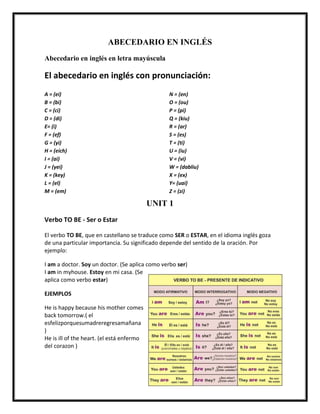
I am a doctor. Soy un doctor. (Se aplica como verbo ser)
I am in myhouse. Estoy en mi casa. (Se
aplica como verbo estar)

EJEMPLOS

He is happy because his mother comes
back tomorrow.( el
esfelizporquesumadreregresamañana
)
He is ill of the heart. (el está enfermo
del corazon )
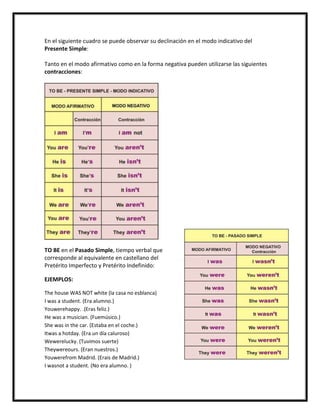
En el siguiente cuadro se puede observar su declinación en el modo indicativo del
Presente Simple:

Tanto en el modo afirmativo como en la forma negativa pueden utilizarse las siguientes
contracciones:


TO BE en el Pasado Simple, tiempo verbal que
corresponde al equivalente en castellano del
Pretérito Imperfecto y Pretérito Indefinido:

EJEMPLOS:

The house WAS NOT white (la casa no esblanca)
I was a student. (Era alumno.)
Youwerehappy. .(Eras feliz.)
He was a musician. (Fuemúsico.)
She was in the car. (Estaba en el coche.)
Itwas a hotday. (Era un día caluroso)
Wewerelucky. (Tuvimos suerte)
Theywereours. (Eran nuestros.)
Youwerefrom Madrid. (Erais de Madrid.)
I wasnot a student. (No era alumno. )
El verbo "To be" en futuro se traduce normalmente como:

yo seré

yo estaré.

Aunque conserva todos los usos que vimos en el presente.

 -Cuando se usa con There,significa Habrá o Habrán:

There will be a house.                            Habrá una casa.
There will be two houses.                         Habrán dos casas.

La respuesta corta se hace con el pronombre will para la respuesta afirmativa y won't para
la negativa.

Will she be a dancer?                           Yes,shewill.
                                                No,shewon't.


EJEMPLOS

You will be the best in the class (Futuro)
You WILL BE the best in your class (futuro)
I will be a rock star(futuro)
Diana will be the best in the school for her great grades(futuro)


                                           UNIDAD 2

                    PARTE1: THERE TO BE (HABER, EXIXTIR)

Significa 'haber' (de existir). There + be se utiliza para hablar acerca de la existencia de
algo, por lo tanto, ubicamos el sujeto real después del verbo.

There is - hay (singular)
There are - hay (plural)
There was - hubo, había (singular)
There were - hubo, había (plural)
There is a lighthouse on the beach.
Hay un faro en la playa.
LA FORMA NEGATIVA SE EXPRESA CON THERE IS/NOT / THERE ISNT O THERE ARE NOT / THERE
AREN´T

Examples:


There isn't a telephone in the kitchen.            No hay teléfono en la cocina..

There isn't a balcony.            No hay balcón.

There isn't an orange on the table.            No hay una naranja sobre la mesa.

EN FORMA INTERROGATIVA

Is there a balcony in the flat?           ¿Hay balcón en el departamento?

Is there a Post Office near hear?         ¿Hay un correo cerca de aqui?


Yes, there is                                       Sí, hay

No, there isn't                                      No, no hay

Are there two telephone lines?

Yes, there are                                      Sí, hay

No, therearen't                                     No, no hay

OTROS EJEMPLOS:

Thereissomewater in thebottle              Hay algo de agua en la botella

Thereissomemilk in thejar                  Hay un poco de leche en la jarra

Unit 1

  • 1.
    ABECEDARIO EN INGLÉS Abecedarioen inglés en letra mayúscula El abecedario en inglés con pronunciación: A = (ei) N = (en) B = (bi) O = (ou) C = (ci) P = (pi) D = (di) Q = (kiu) E= (i) R = (ar) F = (ef) S = (es) G = (yi) T = (ti) H = (eich) U = (iu) I = (ai) V = (vi) J = (yei) W = (dabliu) K = (key) X = (ex) L = (el) Y= (uai) M = (em) Z = (zi) UNIT 1 Verbo TO BE - Ser o Estar El verbo TO BE, que en castellano se traduce como SER o ESTAR, en el idioma inglés goza de una particular importancia. Su significado depende del sentido de la oración. Por ejemplo: I am a doctor. Soy un doctor. (Se aplica como verbo ser) I am in myhouse. Estoy en mi casa. (Se aplica como verbo estar) EJEMPLOS He is happy because his mother comes back tomorrow.( el esfelizporquesumadreregresamañana ) He is ill of the heart. (el está enfermo del corazon )
  • 2.
    En el siguientecuadro se puede observar su declinación en el modo indicativo del Presente Simple: Tanto en el modo afirmativo como en la forma negativa pueden utilizarse las siguientes contracciones: TO BE en el Pasado Simple, tiempo verbal que corresponde al equivalente en castellano del Pretérito Imperfecto y Pretérito Indefinido: EJEMPLOS: The house WAS NOT white (la casa no esblanca) I was a student. (Era alumno.) Youwerehappy. .(Eras feliz.) He was a musician. (Fuemúsico.) She was in the car. (Estaba en el coche.) Itwas a hotday. (Era un día caluroso) Wewerelucky. (Tuvimos suerte) Theywereours. (Eran nuestros.) Youwerefrom Madrid. (Erais de Madrid.) I wasnot a student. (No era alumno. )
  • 3.
    El verbo "Tobe" en futuro se traduce normalmente como: yo seré yo estaré. Aunque conserva todos los usos que vimos en el presente. -Cuando se usa con There,significa Habrá o Habrán: There will be a house. Habrá una casa. There will be two houses. Habrán dos casas. La respuesta corta se hace con el pronombre will para la respuesta afirmativa y won't para la negativa. Will she be a dancer? Yes,shewill. No,shewon't. EJEMPLOS You will be the best in the class (Futuro) You WILL BE the best in your class (futuro) I will be a rock star(futuro) Diana will be the best in the school for her great grades(futuro) UNIDAD 2 PARTE1: THERE TO BE (HABER, EXIXTIR) Significa 'haber' (de existir). There + be se utiliza para hablar acerca de la existencia de algo, por lo tanto, ubicamos el sujeto real después del verbo. There is - hay (singular) There are - hay (plural) There was - hubo, había (singular) There were - hubo, había (plural) There is a lighthouse on the beach. Hay un faro en la playa.
  • 4.
    LA FORMA NEGATIVASE EXPRESA CON THERE IS/NOT / THERE ISNT O THERE ARE NOT / THERE AREN´T Examples: There isn't a telephone in the kitchen. No hay teléfono en la cocina.. There isn't a balcony. No hay balcón. There isn't an orange on the table. No hay una naranja sobre la mesa. EN FORMA INTERROGATIVA Is there a balcony in the flat? ¿Hay balcón en el departamento? Is there a Post Office near hear? ¿Hay un correo cerca de aqui? Yes, there is Sí, hay No, there isn't No, no hay Are there two telephone lines? Yes, there are Sí, hay No, therearen't No, no hay OTROS EJEMPLOS: Thereissomewater in thebottle Hay algo de agua en la botella Thereissomemilk in thejar Hay un poco de leche en la jarra