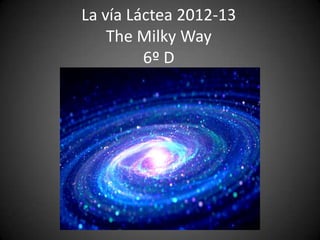
La vía Láctea 2012-13
    The Milky Way
         6º D


        6º D
        6th D
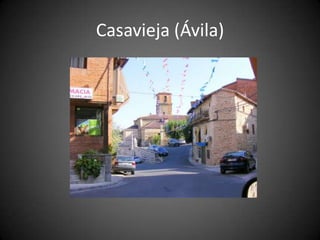
Casavieja (Ávila)
Casavieja (Ávila)
Historia
• Casavieja dependió del señorío de La Adrada que fue
   concedido por el rey Alfonso XI a mediados del s. XIV a Ruy
   López Dávalos, después a D. Álvaro de Luna y por último a
   D. Beltrán de la Cueva. Casavieja y los pueblos circundantes
   pasan a depender de La Adrada.
• Posteriormente consiguió la carta de villazgo con sus
   correspondientes privilegios, tardíamente en 1662 por
   parte del rey Felipe IV, estaba citada ya como aldea en el
   Libro de la Montería, escrito por mandato de Alfonso XI en
   el siglo XIV, pudiendo pensarse que por aquel entonces
   alguna choza o cabaña que hubiera habido en este
   lugar, fuera el origen del nombre de la villa.
Casavieja (Ávila)
History
• Casavieja Adrada Manor was granted by King Alfonso XI
  in mid-s. Ruy Lopez Davalos XIV, then D. Alvaro de Luna
  and finally to D. Beltran de la Cueva. Casavieja and
  surrounding towns became dependent on Adrada.
  Subsequently villazgo got the letter with corresponding
  privileges, late in 1662 by King Philip IV, was named as
  a village and in the Book of Hunting, written by Alfonso
  XI mandate in the fourteenth century, it may think that
  by then a hut or cottage that had been in this place,
  was the origin of the name of the town.
Casavieja (Ávila)
Fauna y Flora
• La fauna y la flora es de lo más variada, viéndose
  especies como milanos, tordos, águilas, cigüeñas
  y anidadas en la finca de familias de gorriones,
  verderones, chochines, jilgueros, herrerillos,
  carboneros, petirrojo, zorzales y en la época de
  apareamiento se puede escuchar el canto del
  ruiseñor, así como también algunas rapaces
  nocturnas como el carabo la lechuza y el
  mochuelo que te deleitan con sus cantos
  característicos.
Casavieja (Avila)
Fauna and Flora
The fauna and flora is varied, seeing species like
  robins, eagles, storks nested on the farm and
  family of sparrows, finches, wrens, finches,
  titmice, chickadees, robins, thrushes and
  mating season you can hear the song of the
  nightingale, as well as some as the tawny owls
  and other owls delight you with their
  distinctive songs.
Auriga
The Charioteer (actually more of a shepherd).


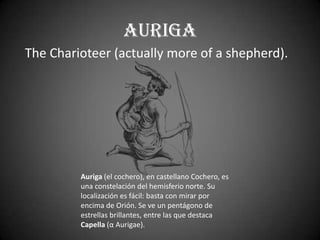
         Auriga (el cochero), en castellano Cochero, es
         una constelación del hemisferio norte. Su
         localización es fácil: basta con mirar por
         encima de Orión. Se ve un pentágono de
         estrellas brillantes, entre las que destaca
         Capella (α Aurigae).
Auriga

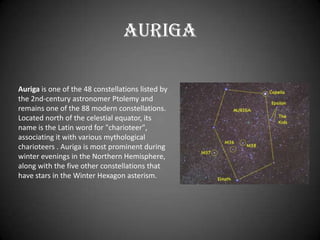
Auriga is one of the 48 constellations listed by
the 2nd-century astronomer Ptolemy and
remains one of the 88 modern constellations.
Located north of the celestial equator, its
name is the Latin word for "charioteer",
associating it with various mythological
charioteers . Auriga is most prominent during
winter evenings in the Northern Hemisphere,
along with the five other constellations that
have stars in the Winter Hexagon asterism.
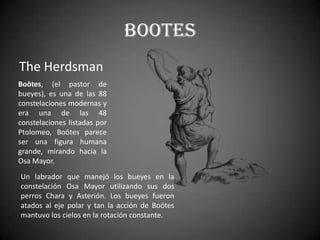
Bootes
The Herdsman
Boötes, (el pastor de
bueyes), es una de las 88
constelaciones modernas y
era una de las 48
constelaciones listadas por
Ptolomeo, Boötes parece
ser una figura humana
grande, mirando hacia la
Osa Mayor.
Un labrador que manejó los bueyes en la
constelación Osa Mayor utilizando sus dos
perros Chara y Asterión. Los bueyes fueron
atados al eje polar y tan la acción de Boötes
mantuvo los cielos en la rotación constante.
Bootes
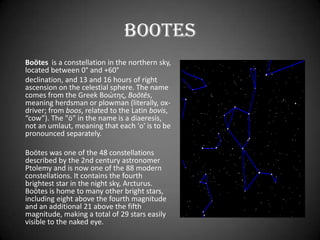
Boötes is a constellation in the northern sky,
located between 0° and +60°
declination, and 13 and 16 hours of right
ascension on the celestial sphere. The name
comes from the Greek Βοώτης, Boōtēs,
meaning herdsman or plowman (literally, ox-
driver; from boos, related to the Latin bovis,
“cow”). The "ö" in the name is a diaeresis,
not an umlaut, meaning that each 'o' is to be
pronounced separately.

Boötes was one of the 48 constellations
described by the 2nd century astronomer
Ptolemy and is now one of the 88 modern
constellations. It contains the fourth
brightest star in the night sky, Arcturus.
Boötes is home to many other bright stars,
including eight above the fourth magnitude
and an additional 21 above the fifth
magnitude, making a total of 29 stars easily
visible to the naked eye.
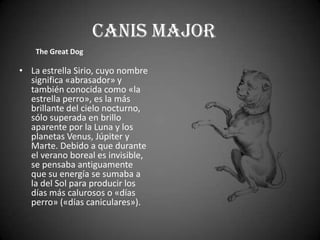
Canis Major
    The Great Dog

• La estrella Sirio, cuyo nombre
  significa «abrasador» y
  también conocida como «la
  estrella perro», es la más
  brillante del cielo nocturno,
  sólo superada en brillo
  aparente por la Luna y los
  planetas Venus, Júpiter y
  Marte. Debido a que durante
  el verano boreal es invisible,
  se pensaba antiguamente
  que su energía se sumaba a
  la del Sol para producir los
  días más calurosos o «días
  perro» («días caniculares»).
Canis Major
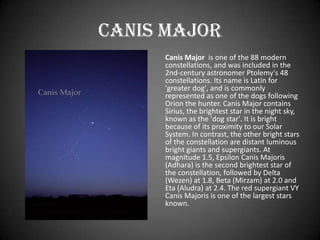
     Canis Major is one of the 88 modern
     constellations, and was included in the
     2nd-century astronomer Ptolemy's 48
     constellations. Its name is Latin for
     'greater dog', and is commonly
     represented as one of the dogs following
     Orion the hunter. Canis Major contains
     Sirius, the brightest star in the night sky,
     known as the 'dog star'. It is bright
     because of its proximity to our Solar
     System. In contrast, the other bright stars
     of the constellation are distant luminous
     bright giants and supergiants. At
     magnitude 1.5, Epsilon Canis Majoris
     (Adhara) is the second brightest star of
     the constellation, followed by Delta
     (Wezen) at 1.8, Beta (Mirzam) at 2.0 and
     Eta (Aludra) at 2.4. The red supergiant VY
     Canis Majoris is one of the largest stars
     known.
The end
  Fin

Vía láctea 2012 6ºd

  • 1.
    La vía Láctea2012-13 The Milky Way 6º D 6º D 6th D
  • 2.
  • 3.
    Casavieja (Ávila) Historia • Casaviejadependió del señorío de La Adrada que fue concedido por el rey Alfonso XI a mediados del s. XIV a Ruy López Dávalos, después a D. Álvaro de Luna y por último a D. Beltrán de la Cueva. Casavieja y los pueblos circundantes pasan a depender de La Adrada. • Posteriormente consiguió la carta de villazgo con sus correspondientes privilegios, tardíamente en 1662 por parte del rey Felipe IV, estaba citada ya como aldea en el Libro de la Montería, escrito por mandato de Alfonso XI en el siglo XIV, pudiendo pensarse que por aquel entonces alguna choza o cabaña que hubiera habido en este lugar, fuera el origen del nombre de la villa.
  • 4.
    Casavieja (Ávila) History • CasaviejaAdrada Manor was granted by King Alfonso XI in mid-s. Ruy Lopez Davalos XIV, then D. Alvaro de Luna and finally to D. Beltran de la Cueva. Casavieja and surrounding towns became dependent on Adrada. Subsequently villazgo got the letter with corresponding privileges, late in 1662 by King Philip IV, was named as a village and in the Book of Hunting, written by Alfonso XI mandate in the fourteenth century, it may think that by then a hut or cottage that had been in this place, was the origin of the name of the town.
  • 5.
    Casavieja (Ávila) Fauna yFlora • La fauna y la flora es de lo más variada, viéndose especies como milanos, tordos, águilas, cigüeñas y anidadas en la finca de familias de gorriones, verderones, chochines, jilgueros, herrerillos, carboneros, petirrojo, zorzales y en la época de apareamiento se puede escuchar el canto del ruiseñor, así como también algunas rapaces nocturnas como el carabo la lechuza y el mochuelo que te deleitan con sus cantos característicos.
  • 6.
    Casavieja (Avila) Fauna andFlora The fauna and flora is varied, seeing species like robins, eagles, storks nested on the farm and family of sparrows, finches, wrens, finches, titmice, chickadees, robins, thrushes and mating season you can hear the song of the nightingale, as well as some as the tawny owls and other owls delight you with their distinctive songs.
  • 7.
    Auriga The Charioteer (actuallymore of a shepherd). Auriga (el cochero), en castellano Cochero, es una constelación del hemisferio norte. Su localización es fácil: basta con mirar por encima de Orión. Se ve un pentágono de estrellas brillantes, entre las que destaca Capella (α Aurigae).
  • 8.
    Auriga Auriga is oneof the 48 constellations listed by the 2nd-century astronomer Ptolemy and remains one of the 88 modern constellations. Located north of the celestial equator, its name is the Latin word for "charioteer", associating it with various mythological charioteers . Auriga is most prominent during winter evenings in the Northern Hemisphere, along with the five other constellations that have stars in the Winter Hexagon asterism.
  • 9.
    Bootes The Herdsman Boötes, (elpastor de bueyes), es una de las 88 constelaciones modernas y era una de las 48 constelaciones listadas por Ptolomeo, Boötes parece ser una figura humana grande, mirando hacia la Osa Mayor. Un labrador que manejó los bueyes en la constelación Osa Mayor utilizando sus dos perros Chara y Asterión. Los bueyes fueron atados al eje polar y tan la acción de Boötes mantuvo los cielos en la rotación constante.
  • 10.
    Bootes Boötes is aconstellation in the northern sky, located between 0° and +60° declination, and 13 and 16 hours of right ascension on the celestial sphere. The name comes from the Greek Βοώτης, Boōtēs, meaning herdsman or plowman (literally, ox- driver; from boos, related to the Latin bovis, “cow”). The "ö" in the name is a diaeresis, not an umlaut, meaning that each 'o' is to be pronounced separately. Boötes was one of the 48 constellations described by the 2nd century astronomer Ptolemy and is now one of the 88 modern constellations. It contains the fourth brightest star in the night sky, Arcturus. Boötes is home to many other bright stars, including eight above the fourth magnitude and an additional 21 above the fifth magnitude, making a total of 29 stars easily visible to the naked eye.
  • 11.
    Canis Major The Great Dog • La estrella Sirio, cuyo nombre significa «abrasador» y también conocida como «la estrella perro», es la más brillante del cielo nocturno, sólo superada en brillo aparente por la Luna y los planetas Venus, Júpiter y Marte. Debido a que durante el verano boreal es invisible, se pensaba antiguamente que su energía se sumaba a la del Sol para producir los días más calurosos o «días perro» («días caniculares»).
  • 12.
    Canis Major Canis Major is one of the 88 modern constellations, and was included in the 2nd-century astronomer Ptolemy's 48 constellations. Its name is Latin for 'greater dog', and is commonly represented as one of the dogs following Orion the hunter. Canis Major contains Sirius, the brightest star in the night sky, known as the 'dog star'. It is bright because of its proximity to our Solar System. In contrast, the other bright stars of the constellation are distant luminous bright giants and supergiants. At magnitude 1.5, Epsilon Canis Majoris (Adhara) is the second brightest star of the constellation, followed by Delta (Wezen) at 1.8, Beta (Mirzam) at 2.0 and Eta (Aludra) at 2.4. The red supergiant VY Canis Majoris is one of the largest stars known.
  • 13.