THE VERB TENSES
1.) PRESENT SIMPLE
• Se usa para expresar acciones habituales
• Ejemplos:
• I take the bus to work everyday = Cojo el autobús al trabajo todos los días
• We like to walk in the country = Nos gusta andar por el campo
• Do you always have coffee in the morning? = Siempre tomas café por la mañana?
• I prefer to read rather than watch TV = Prefiero leer en lugar de ver la tele
• Lucy lives and works in Dublin = Lucy vive y trabaja en Dublin
2.) PRESENT CONTINUOS:
VERBO SER / ESTAR + VERBO EN GERUNDIO
• Se usa para una acción que está ocurriendo en este momento
• Ejemplos:
• I´m talking on the phone right now = Estoy hablando por teléfono ahora mismo
• What are you eating? I´m eating egg plant = Que estas comiendo? Estoy
comiendo berenjena
• Everybody is swimming in the pool = Todo el mundo está nadando en la piscina
• I´m talking on the phone = Estoy hablando por teléfono
TAMBIÉN SE USA EL PRESENTE CONTINUO PARA EL
FUTURO AL USAR UNA PALABRA QUE INDICA CUANDO
• Ejemplos:
• We are having dinner with some friends tonight = Vamos a cenar con unos amigos
esta noche
• Are we playing paddle tomorrow = Vamos a jugar al padel mañana?
• She is starting her new job on Monday = Ella va a empezar su nuevo trabajo el Lunes
• I´m visiting my grandmother this evening = Voy a visitar a mi abuela esta tarde
• My sister´s coming for lunch at two o´clock = Mi hermana viene a comer a las dos
3.) PAST SIMPLE
• Se usa para expresar acciones ya completadas
• Ejemplos:
• I already finished the book the other day = Ya terminé el libro el otro día
• They bought a house last week = Se compraron una casa la semana pasada
• We saw a good movie this weekend = Vimos una buena película este fin de semana
• When were you in New York? = Cuando estuviste en Nueva York?
• Juan called me this morning = Juan me llamó esta mañana
• Where did you meet your wife? = Donde conociste a tu mujer?
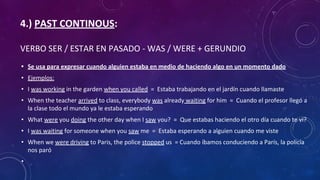
4.) PAST CONTINOUS:
VERBO SER / ESTAR EN PASADO - WAS / WERE + GERUNDIO
• Se usa para expresar cuando alguien estaba en medio de haciendo algo en un momento dado
• Ejemplos:
• I was working in the garden when you called = Estaba trabajando en el jardín cuando llamaste
• When the teacher arrived to class, everybody was already waiting for him = Cuando el profesor llegó a
la clase todo el mundo ya le estaba esperando
• What were you doing the other day when I saw you? = Que estabas haciendo el otro día cuando te vi?
• I was waiting for someone when you saw me = Estaba esperando a alguien cuando me viste
• When we were driving to Paris, the police stopped us = Cuando íbamos conduciendo a París, la policía
nos paró
•
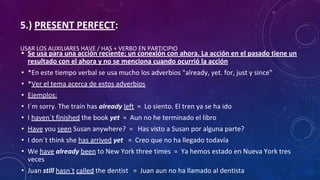
5.) PRESENT PERFECT:
USAR LOS AUXILIARES HAVE / HAS + VERBO EN PARTICIPIO
• Se usa para una acción reciente; un conexión con ahora. La acción en el pasado tiene un
resultado con el ahora y no se menciona cuando ocurrió la acción
• *En este tiempo verbal se usa mucho los adverbios "already, yet. for, just y since"
• *Ver el tema acerca de estos adverbios
• Ejemplos:
• I´m sorry. The train has already left = Lo siento. El tren ya se ha ido
• I haven´t finished the book yet = Aun no he terminado el libro
• Have you seen Susan anywhere? = Has visto a Susan por alguna parte?
• I don´t think she has arrived yet = Creo que no ha llegado todavía
• We have already been to New York three times = Ya hemos estado en Nueva York tres
veces
• Juan still hasn´t called the dentist = Juan aun no ha llamado al dentista
6.) PRESENT PERFECT CONTINUOUS:
USAR AUXILIARES HAVE / HAS + BEEN + GERUNDIO
• Se usa para una acción que empezó en el pasado y aún está continuando
• Ejemplos:
• I´m tired. I have been working since 7:00 this morning = Estoy cansado. He estado trabajando desde
las siete de la mañana
• How long have you been waiting for the bus? = Cuanto tiempo has estado esperando el autobús?
• It has been raining all day = Ha estado lloviendo todo el día
• We have been driving for more than four hours = Hemos estado conduciendo durante mas de cuatro
horas
• I have been working on this blog since last year = He estado trabajando en este blog desde el año
pasado
7.) PASSIVE: USAR EL VERBO SER O ESTAR + PARTICIPIO DEL
VERBO
• Al usar el pasivo, el "Quien" o el "Que" no es tan importante en la frase
• Ejemplos:
• The report was finished last week = El informe fue terminado la semana pasada (no sabemos quien
terminó el informe)
• I didn´t go to the party because I wasn´t invited = No fui a la fiesta porqué no fui invitado
• All our things were stolen from our hotel room = Todo nuestras cosas fueron robadas de nuestra
habitación del hotel
• Many accidents are caused by distractions when driving = Muchos accidentes son causadas por
distracciónes al conducir
• Cars are made to last many years = Los coches están hechos para durar muchos años
8.) FUTURE SIMPLE: SE USA WILL + VERBO EN PRESENTE
• Normalmente se usa para cuando se decide hacer algo en el futuro próximo en el momento de estar
hablando con alguien;y muchas veces es espontaneo
• Ejemplos:
• Don´t worry. I will take you to the airport = No te preocupes. Te llevaré al aeropuerto
• I will call you later because I´m busy at the moment = Te llamo después porque estoy ocupado en este
momento
• I will help you paint the house = Te ayudaré pintar la casa
• Juan will probably arrive late to work this morning = Juan probablemente llegará tarde al trabajo esta
mañana
• They said they won´t come to the party = Dijeron que no vendrán a la fiesta
•
9.) GOING TO:
USAR EL VERBO SER / ESTAR + GOING TO + VERBO EN PRESENTE
• Se usa cuando ya se ha planeado o decidido hacer algo en el futuro o para predecir algo que ves o
sientes
• Ejemplos:
• We´re going to Italy next month = Nos vamos a Italia el mes que viene
• I´m going to have dinner with some friends tonight = Voy a cenar con unos amigos esta noche
• The boss is going to get angry = El jefe se va a enfadar
• It´s going to be a nice day today = Va a ser un día bonito hoy
• Susan is going to work in London = Susan va a trabajar en Londres
• Look at those dark clouds. I think it´s going to rain = Mira a esa nubes obscuras. Creo que va a llover
10.) CONDITIONAL TYPE 1:
PARA EXPRESAR QUE ES BASTANTE POSIBLE Y PROBABLE QUE SUCEDA LA ACCIÓN
• Se usa: If + Sujeto + verbo en presente / + sujeto + will + verb en presente
• Ejemplos:
• If I buy a new car, I will give you my old car = Si me compro un coche nuevo, te daré mi coche
viejo
• *I will go to the party if you come with me = Iré a la fiesta si vienes conmigo (se puede
invertir la frase)
• If it rains, we won´t go by bike = Si llueve, no iremos en bici
• I will call you if I know something = Te llamaré si se algo
• What will you tell him if you see him at the party? = Que le dirás so le ves en la fiesta?
• We will go to the concert if there are good groups = Iremos al concierto si hay buenos
grupos
•
11.) CONDITIONAL TYPE 2.: ES POSIBLE PERO
IMPROBABLE QUE LA ACCIÓN PUEDA SUCEDER
• Se usa: If + sujeto + had + verbo en participio / + sujeto + would + have + verbo en participio
• Ejemplos:
• If I had known you were in the city, I would have called you to have lunch = Si hubiera sabido que
estabas en la ciudad, te hubiera llamado para almorzar
• If María had prepared herself for the interview, she would have gotten the job = Si María se hubiera
preparado para la entrevista, hubiera conseguido el trabajo
• If you hadn´t drunk so much beer, you wouldn´t have had the accident = Si no hubieras bebido tanta
cerveza, no hubieras tenido el accidente
• If you had studied more, you would have passed the test = Si hubieras estudiado mas, hubieras
aprobado el examen
•
12.) CONDITIONAL TYPE 3:
ES IMPOSIBLE QUE LA ACCIÓN SEA CUMPLIDA PORQUE SE REFIERE YA AL PASADO
• Se usa: If + sujeto + had + verbo en participio / + sujeto + would + have + verbo en
participio
• Ejemplos:
• If I had known you were in the city, I would have called you to have lunch = Si hubiera
sabido que estabas en la ciudad, te hubiera llamado para almorzar
• If María had prepared herself for the interview, she would have gotten the job = Si
María se hubiera prepardo para la entrevista, hubiera conseguido el trabajo
• If you hadn´t drunk so much beer, you wouldn´t have had the accident = Si no hubieras
bebido tanta cerveza, no hubieras tenido el accidente
• If you had studied more, you would have passed the test = Si hubieras estudiado mas,
hubieras aprobado el examen

Verb tenses presentation.pdf

  • 1.
  • 5.
    1.) PRESENT SIMPLE •Se usa para expresar acciones habituales • Ejemplos: • I take the bus to work everyday = Cojo el autobús al trabajo todos los días • We like to walk in the country = Nos gusta andar por el campo • Do you always have coffee in the morning? = Siempre tomas café por la mañana? • I prefer to read rather than watch TV = Prefiero leer en lugar de ver la tele • Lucy lives and works in Dublin = Lucy vive y trabaja en Dublin
  • 6.
    2.) PRESENT CONTINUOS: VERBOSER / ESTAR + VERBO EN GERUNDIO • Se usa para una acción que está ocurriendo en este momento • Ejemplos: • I´m talking on the phone right now = Estoy hablando por teléfono ahora mismo • What are you eating? I´m eating egg plant = Que estas comiendo? Estoy comiendo berenjena • Everybody is swimming in the pool = Todo el mundo está nadando en la piscina • I´m talking on the phone = Estoy hablando por teléfono
  • 7.
    TAMBIÉN SE USAEL PRESENTE CONTINUO PARA EL FUTURO AL USAR UNA PALABRA QUE INDICA CUANDO • Ejemplos: • We are having dinner with some friends tonight = Vamos a cenar con unos amigos esta noche • Are we playing paddle tomorrow = Vamos a jugar al padel mañana? • She is starting her new job on Monday = Ella va a empezar su nuevo trabajo el Lunes • I´m visiting my grandmother this evening = Voy a visitar a mi abuela esta tarde • My sister´s coming for lunch at two o´clock = Mi hermana viene a comer a las dos
  • 8.
    3.) PAST SIMPLE •Se usa para expresar acciones ya completadas • Ejemplos: • I already finished the book the other day = Ya terminé el libro el otro día • They bought a house last week = Se compraron una casa la semana pasada • We saw a good movie this weekend = Vimos una buena película este fin de semana • When were you in New York? = Cuando estuviste en Nueva York? • Juan called me this morning = Juan me llamó esta mañana • Where did you meet your wife? = Donde conociste a tu mujer?
  • 9.
    4.) PAST CONTINOUS: VERBOSER / ESTAR EN PASADO - WAS / WERE + GERUNDIO • Se usa para expresar cuando alguien estaba en medio de haciendo algo en un momento dado • Ejemplos: • I was working in the garden when you called = Estaba trabajando en el jardín cuando llamaste • When the teacher arrived to class, everybody was already waiting for him = Cuando el profesor llegó a la clase todo el mundo ya le estaba esperando • What were you doing the other day when I saw you? = Que estabas haciendo el otro día cuando te vi? • I was waiting for someone when you saw me = Estaba esperando a alguien cuando me viste • When we were driving to Paris, the police stopped us = Cuando íbamos conduciendo a París, la policía nos paró •
  • 10.
    5.) PRESENT PERFECT: USARLOS AUXILIARES HAVE / HAS + VERBO EN PARTICIPIO • Se usa para una acción reciente; un conexión con ahora. La acción en el pasado tiene un resultado con el ahora y no se menciona cuando ocurrió la acción • *En este tiempo verbal se usa mucho los adverbios "already, yet. for, just y since" • *Ver el tema acerca de estos adverbios • Ejemplos: • I´m sorry. The train has already left = Lo siento. El tren ya se ha ido • I haven´t finished the book yet = Aun no he terminado el libro • Have you seen Susan anywhere? = Has visto a Susan por alguna parte? • I don´t think she has arrived yet = Creo que no ha llegado todavía • We have already been to New York three times = Ya hemos estado en Nueva York tres veces • Juan still hasn´t called the dentist = Juan aun no ha llamado al dentista
  • 11.
    6.) PRESENT PERFECTCONTINUOUS: USAR AUXILIARES HAVE / HAS + BEEN + GERUNDIO • Se usa para una acción que empezó en el pasado y aún está continuando • Ejemplos: • I´m tired. I have been working since 7:00 this morning = Estoy cansado. He estado trabajando desde las siete de la mañana • How long have you been waiting for the bus? = Cuanto tiempo has estado esperando el autobús? • It has been raining all day = Ha estado lloviendo todo el día • We have been driving for more than four hours = Hemos estado conduciendo durante mas de cuatro horas • I have been working on this blog since last year = He estado trabajando en este blog desde el año pasado
  • 12.
    7.) PASSIVE: USAREL VERBO SER O ESTAR + PARTICIPIO DEL VERBO • Al usar el pasivo, el "Quien" o el "Que" no es tan importante en la frase • Ejemplos: • The report was finished last week = El informe fue terminado la semana pasada (no sabemos quien terminó el informe) • I didn´t go to the party because I wasn´t invited = No fui a la fiesta porqué no fui invitado • All our things were stolen from our hotel room = Todo nuestras cosas fueron robadas de nuestra habitación del hotel • Many accidents are caused by distractions when driving = Muchos accidentes son causadas por distracciónes al conducir • Cars are made to last many years = Los coches están hechos para durar muchos años
  • 13.
    8.) FUTURE SIMPLE:SE USA WILL + VERBO EN PRESENTE • Normalmente se usa para cuando se decide hacer algo en el futuro próximo en el momento de estar hablando con alguien;y muchas veces es espontaneo • Ejemplos: • Don´t worry. I will take you to the airport = No te preocupes. Te llevaré al aeropuerto • I will call you later because I´m busy at the moment = Te llamo después porque estoy ocupado en este momento • I will help you paint the house = Te ayudaré pintar la casa • Juan will probably arrive late to work this morning = Juan probablemente llegará tarde al trabajo esta mañana • They said they won´t come to the party = Dijeron que no vendrán a la fiesta •
  • 14.
    9.) GOING TO: USAREL VERBO SER / ESTAR + GOING TO + VERBO EN PRESENTE • Se usa cuando ya se ha planeado o decidido hacer algo en el futuro o para predecir algo que ves o sientes • Ejemplos: • We´re going to Italy next month = Nos vamos a Italia el mes que viene • I´m going to have dinner with some friends tonight = Voy a cenar con unos amigos esta noche • The boss is going to get angry = El jefe se va a enfadar • It´s going to be a nice day today = Va a ser un día bonito hoy • Susan is going to work in London = Susan va a trabajar en Londres • Look at those dark clouds. I think it´s going to rain = Mira a esa nubes obscuras. Creo que va a llover
  • 15.
    10.) CONDITIONAL TYPE1: PARA EXPRESAR QUE ES BASTANTE POSIBLE Y PROBABLE QUE SUCEDA LA ACCIÓN • Se usa: If + Sujeto + verbo en presente / + sujeto + will + verb en presente • Ejemplos: • If I buy a new car, I will give you my old car = Si me compro un coche nuevo, te daré mi coche viejo • *I will go to the party if you come with me = Iré a la fiesta si vienes conmigo (se puede invertir la frase) • If it rains, we won´t go by bike = Si llueve, no iremos en bici • I will call you if I know something = Te llamaré si se algo • What will you tell him if you see him at the party? = Que le dirás so le ves en la fiesta? • We will go to the concert if there are good groups = Iremos al concierto si hay buenos grupos •
  • 16.
    11.) CONDITIONAL TYPE2.: ES POSIBLE PERO IMPROBABLE QUE LA ACCIÓN PUEDA SUCEDER • Se usa: If + sujeto + had + verbo en participio / + sujeto + would + have + verbo en participio • Ejemplos: • If I had known you were in the city, I would have called you to have lunch = Si hubiera sabido que estabas en la ciudad, te hubiera llamado para almorzar • If María had prepared herself for the interview, she would have gotten the job = Si María se hubiera preparado para la entrevista, hubiera conseguido el trabajo • If you hadn´t drunk so much beer, you wouldn´t have had the accident = Si no hubieras bebido tanta cerveza, no hubieras tenido el accidente • If you had studied more, you would have passed the test = Si hubieras estudiado mas, hubieras aprobado el examen •
  • 17.
    12.) CONDITIONAL TYPE3: ES IMPOSIBLE QUE LA ACCIÓN SEA CUMPLIDA PORQUE SE REFIERE YA AL PASADO • Se usa: If + sujeto + had + verbo en participio / + sujeto + would + have + verbo en participio • Ejemplos: • If I had known you were in the city, I would have called you to have lunch = Si hubiera sabido que estabas en la ciudad, te hubiera llamado para almorzar • If María had prepared herself for the interview, she would have gotten the job = Si María se hubiera prepardo para la entrevista, hubiera conseguido el trabajo • If you hadn´t drunk so much beer, you wouldn´t have had the accident = Si no hubieras bebido tanta cerveza, no hubieras tenido el accidente • If you had studied more, you would have passed the test = Si hubieras estudiado mas, hubieras aprobado el examen