

Connect the unconnected:
Internet para todos
Patrick Lopez
VP Networks
Innovation at Telefonica
3
programme to connect the unconnected
4
100 million people live in Latin
America without access to the
internet
because of…
geography, orography, economic
conditions, density y population
dispersion, …
…current technologies are
insuficient
Big data & Connect the Unconnected
We are using Big Data, Machine
Learning and AI to :
• Localize and identify the
unconnected,
• Optimize our transport
network
• Optimize our network
operations
5
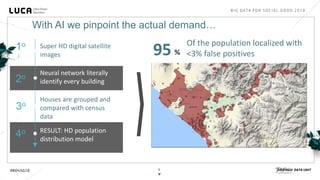
With AI we pinpoint the
actual demand…
+
Data: satellite images
model: Neural network
Training: census data
Result: actual population
distribution map
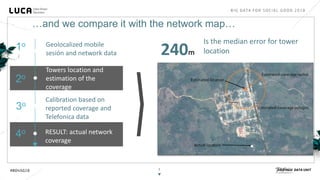
…and we compare it with the network
map…
=
Data: geolocalized mobile
sessions
Model: coverage polygons
Training: Telefónica coverage and
regulatory data
Result: Real coverage map
… we then deduce the unconnected
population
Result: clasification y
clusterization of the
uncovered population
Where are the unconnected?
6
2o
Neural network literally
identify every building
3o
4o
1o Super HD digital satellite
images
Houses are grouped and
compared with census
data
RESULT: HD population
distribution model
Of the population localized with
<3% false positives95 %
With AI we pinpoint the actual demand…
7
1o
2o
3o
4o
Geolocalized mobile
sesión and network data
Towers location and
estimation of the
coverage
Calibration based on
reported coverage and
Telefonica data
RESULT: actual network
coverage
Is the median error for tower
location240m
…and we compare it with the network map…
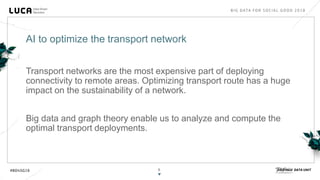
8
Transport networks are the most expensive part of deploying
connectivity to remote areas. Optimizing transport route has a huge
impact on the sustainability of a network.
Big data and graph theory enable us to analyze and compute the
optimal transport deployments.
AI to optimize the transport network
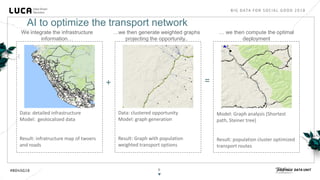
9
We integrate the infrastructure
information…
…we then generate weighted graphs
projecting the opportunity..
… we then compute the optimal
deployment
+ =
Data: detailed infrastructure
Model: geolocalized data
Result: infratructure map of twoers
and roads
Data: clustered opportunity
Model: graph generation
Result: Graph with population
weighted transport options
Model: Graph analysis (Shortest
path, Steiner tree)
Result: population cluster optimized
transport routes
AI to optimize the transport network
10
To connect very remote zones, optimizing operations and minimizing
maintenance and upgrade is key to a sustainable operational model.
AI to optimize networks operation
11
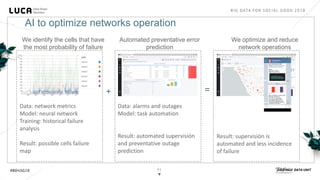
We identify the cells that have
the most probability of failure
Automated preventative error
prediction
We optimize and reduce
network operations
+ =
Data: network metrics
Model: neural network
Training: historical failure
analysis
Result: possible cells failure
map
Data: alarms and outages
Model: task automation
Result: automated supervisión
and preventative outage
prediction
Result: supervisión is
automated and less incidence
of failure
AI to optimize networks operation
12
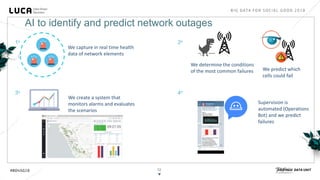
We capture in real time health
data of network elements
1o 2o
We determine the conditions
of the most common failures We predict which
cells could fail
3o
We create a system that
monitors alarms and evaluates
the scenarios
4o
Supervision is
automated (Operations
Bot) and we predict
failures
AI to identify and predict network outages
13
So what does all of this has to
do with climate change and
natural disasters?
14
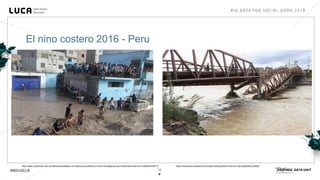
El nino costero 2016 - Peru
http://www.conclusion.com.ar/internacionales/peru-la-mitad-de-la-poblacion-vive-en-emergencia-por-el-fenomeno-del-nino-costero/03/2017/ https://elcomercio.pe/peru/nino-costero-549-puentes-6-mil-km-vias-afectadas-416020
15
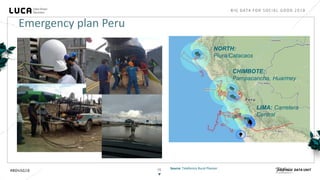
Emergency plan Peru
NORTH:
Piura/Catacaos
CHIMBOTE:
Pampacancha, Huarmey
LIMA: Carretera
Central
Source: Telefonica Rural Planner
16
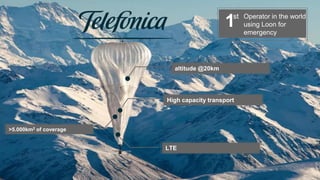
altitude @20km
1st Operator in the world
using Loon for
emergency
LTE
High capacity transport
>5.000km2 of coverage
www.luca-d3.com
Follow us online!
2018 © Telefónica Digital España, S.L.U. Todos los derechos reservados.
La información contenida en el presente documento es propiedad de Telefónica Digital España, S.L.U. (“TDE”) y/o de cualquier otra entidad dentro del Grupo Telefónica o sus licenciantes. TDE y/o cualquier compañía
del Grupo Telefónica o los licenciantes de TDE se reservan todos los derechos de propiedad industrial e intelectual (incluida cualquier patente o copyright) que se deriven o recaigan sobre este documento, incluidos
los derechos de diseño, producción, reproducción, uso y venta del mismo, salvo en el supuesto de que dichos derechos sean expresamente conferidos a terceros por escrito. La información contenida en el presente
documento podrá ser objeto de modificación en cualquier momento sin necesidad de previo aviso.
La información contenida en el presente documento no podrá ser ni parcial ni totalmente copiada, distribuida, adaptada o reproducida en ningún soporte sin que medie el previo consentimiento por escrito por
parte de TDE.
El presente documento tiene como único objetivo servir de soporte a su lector en el uso del producto o servicio descrito en el mismo. El lector se compromete y queda obligado a usar la información contenida en el
mismo para su propio uso y no para ningún otro.
TDE no será responsable de ninguna pérdida o daño que se derive del uso de la información contenida en el presente documento o de cualquier error u omisión del documento o por el uso incorrecto del servicio o
producto. El uso del producto o servicio descrito en el presente documento se regulará de acuerdo con lo establecido en los términos y condiciones aceptados por el usuario del mismo para su uso.
TDE y sus marcas (así como cualquier marca perteneciente al Grupo Telefónica) son marcas registradas. TDE y sus filiales se reservan todo los derechos sobre las mismas.

Big data for social good

  • 2.
    Connect the unconnected: Internetpara todos Patrick Lopez VP Networks Innovation at Telefonica
  • 3.
    3 programme to connectthe unconnected
  • 4.
    4 100 million peoplelive in Latin America without access to the internet because of… geography, orography, economic conditions, density y population dispersion, … …current technologies are insuficient Big data & Connect the Unconnected We are using Big Data, Machine Learning and AI to : • Localize and identify the unconnected, • Optimize our transport network • Optimize our network operations
  • 5.
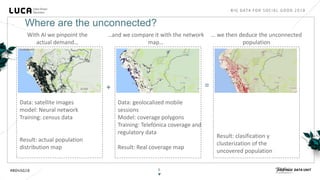
    5 With AI wepinpoint the actual demand… + Data: satellite images model: Neural network Training: census data Result: actual population distribution map …and we compare it with the network map… = Data: geolocalized mobile sessions Model: coverage polygons Training: Telefónica coverage and regulatory data Result: Real coverage map … we then deduce the unconnected population Result: clasification y clusterization of the uncovered population Where are the unconnected?
  • 6.
    6 2o Neural network literally identifyevery building 3o 4o 1o Super HD digital satellite images Houses are grouped and compared with census data RESULT: HD population distribution model Of the population localized with <3% false positives95 % With AI we pinpoint the actual demand…
  • 7.
    7 1o 2o 3o 4o Geolocalized mobile sesión andnetwork data Towers location and estimation of the coverage Calibration based on reported coverage and Telefonica data RESULT: actual network coverage Is the median error for tower location240m …and we compare it with the network map…
  • 8.
    8 Transport networks arethe most expensive part of deploying connectivity to remote areas. Optimizing transport route has a huge impact on the sustainability of a network. Big data and graph theory enable us to analyze and compute the optimal transport deployments. AI to optimize the transport network
  • 9.
    9 We integrate theinfrastructure information… …we then generate weighted graphs projecting the opportunity.. … we then compute the optimal deployment + = Data: detailed infrastructure Model: geolocalized data Result: infratructure map of twoers and roads Data: clustered opportunity Model: graph generation Result: Graph with population weighted transport options Model: Graph analysis (Shortest path, Steiner tree) Result: population cluster optimized transport routes AI to optimize the transport network
  • 10.
    10 To connect veryremote zones, optimizing operations and minimizing maintenance and upgrade is key to a sustainable operational model. AI to optimize networks operation
  • 11.
    11 We identify thecells that have the most probability of failure Automated preventative error prediction We optimize and reduce network operations + = Data: network metrics Model: neural network Training: historical failure analysis Result: possible cells failure map Data: alarms and outages Model: task automation Result: automated supervisión and preventative outage prediction Result: supervisión is automated and less incidence of failure AI to optimize networks operation
  • 12.
    12 We capture inreal time health data of network elements 1o 2o We determine the conditions of the most common failures We predict which cells could fail 3o We create a system that monitors alarms and evaluates the scenarios 4o Supervision is automated (Operations Bot) and we predict failures AI to identify and predict network outages
  • 13.
    13 So what doesall of this has to do with climate change and natural disasters?
  • 14.
    14 El nino costero2016 - Peru http://www.conclusion.com.ar/internacionales/peru-la-mitad-de-la-poblacion-vive-en-emergencia-por-el-fenomeno-del-nino-costero/03/2017/ https://elcomercio.pe/peru/nino-costero-549-puentes-6-mil-km-vias-afectadas-416020
  • 15.
    15 Emergency plan Peru NORTH: Piura/Catacaos CHIMBOTE: Pampacancha,Huarmey LIMA: Carretera Central Source: Telefonica Rural Planner
  • 16.
    16 altitude @20km 1st Operatorin the world using Loon for emergency LTE High capacity transport >5.000km2 of coverage
  • 17.
    www.luca-d3.com Follow us online! 2018© Telefónica Digital España, S.L.U. Todos los derechos reservados. La información contenida en el presente documento es propiedad de Telefónica Digital España, S.L.U. (“TDE”) y/o de cualquier otra entidad dentro del Grupo Telefónica o sus licenciantes. TDE y/o cualquier compañía del Grupo Telefónica o los licenciantes de TDE se reservan todos los derechos de propiedad industrial e intelectual (incluida cualquier patente o copyright) que se deriven o recaigan sobre este documento, incluidos los derechos de diseño, producción, reproducción, uso y venta del mismo, salvo en el supuesto de que dichos derechos sean expresamente conferidos a terceros por escrito. La información contenida en el presente documento podrá ser objeto de modificación en cualquier momento sin necesidad de previo aviso. La información contenida en el presente documento no podrá ser ni parcial ni totalmente copiada, distribuida, adaptada o reproducida en ningún soporte sin que medie el previo consentimiento por escrito por parte de TDE. El presente documento tiene como único objetivo servir de soporte a su lector en el uso del producto o servicio descrito en el mismo. El lector se compromete y queda obligado a usar la información contenida en el mismo para su propio uso y no para ningún otro. TDE no será responsable de ninguna pérdida o daño que se derive del uso de la información contenida en el presente documento o de cualquier error u omisión del documento o por el uso incorrecto del servicio o producto. El uso del producto o servicio descrito en el presente documento se regulará de acuerdo con lo establecido en los términos y condiciones aceptados por el usuario del mismo para su uso. TDE y sus marcas (así como cualquier marca perteneciente al Grupo Telefónica) son marcas registradas. TDE y sus filiales se reservan todo los derechos sobre las mismas.