



Tópicos de Estadística & Data Mining 
en Big Data 
Link Analysis - PageRank 
Lic. Ernesto Mislej 
Maestría en Exploración de Datos y 
Descubrimiento del Conocimiento 
Universidad de Buenos Aires 
ernesto@7puentes.com 
Octubre 2014
Outline 
 Intro 
 PageRank 
 Los comienzos de los buscadores de Internet 
 Term Spam 
 La estructura de la Web 
 Evitando los Dead Ends y Spider Traps. 
 La solución: el Teleport. 
 Link Spam. Spam Farm
Intro 
Una de las tecnologías más revolucionarias que ha cambiado 
para siempre nuestra vida, sin duda es la Internet; y con ella los 
motores de búsqueda como Google. Google no fue el primer 
buscador, sino el primero que pudo combatir eficientemente a 
los spammers quienes intentan intervenir en la propuesta 
original de información de la Web. Discutiremos la innovación 
más grande realizada por Google, el PageRank. 
La batalla entre quienes hacer la Web más útil y quienes quieren 
manipularla para su propio beneficio pareciera nunca terminar. 
Veremos las formas de vencer y manipular el PageRank, 
construyendo pequeñas webs llamadas link spam.
Los Search Engines de antaño 
 Gestionan un índice invertido para hallar ágilmente todos 
los lugares donde se encuentran las palabras. 
 Cuando se realiza una consulta (lista de terms) se filtran 
aquéllas páginas que contienen los términos buscados 
utilizando el índice. 
 Existen algunas estrategias para realizar un ranking, como 
la cantidad de veces que un término aparece en el 
documento. 
 Además, se tomaron otras ideas como sumar más relevancia 
si el término se encuentra en el header de la página, si 
aparece en negrita y demás características sintácticas.
Term Spam 
 Unethical people ve la oportunidad de engañar a los 
buscadores para atraer visitas a sus propias páginas. 
 Imagina agregar el termino como película a tu página 
muchas veces, unas miles. Luego el buscador creerá que tu 
hablas de cine y que debes ser muy importante, ya que casi 
ni hablas de otra cosa. Cuando un visitante el pregunta al 
buscador por alguna película, tu apareces en la primera 
página. 
 Parece simple. A las menciones de terminos cinéfilos le 
cambias el color de la letra para que se confunda con el 
fondo. 
 Pero tu vendes zapatillas, no sabes nada de críticas de 
películas.
PageRank 
Para combatir al term spam, Google incorpora 2 innovaciones: 
1 El contenido a ser indexado no se encuentra en las páginas 
sino en los hiper-textos. 
2 El PageRank. Un ranking de relevancia de las páginas que 
simula el comportamiento de los navegantes. 
 Random Surf: Si comienzas a navegar la Internet desde 
cualquier página, siguiendo aleatoriamente cualquier 
out-link propuesto, ¿cuál es la página que más visitas?
Random Surfer
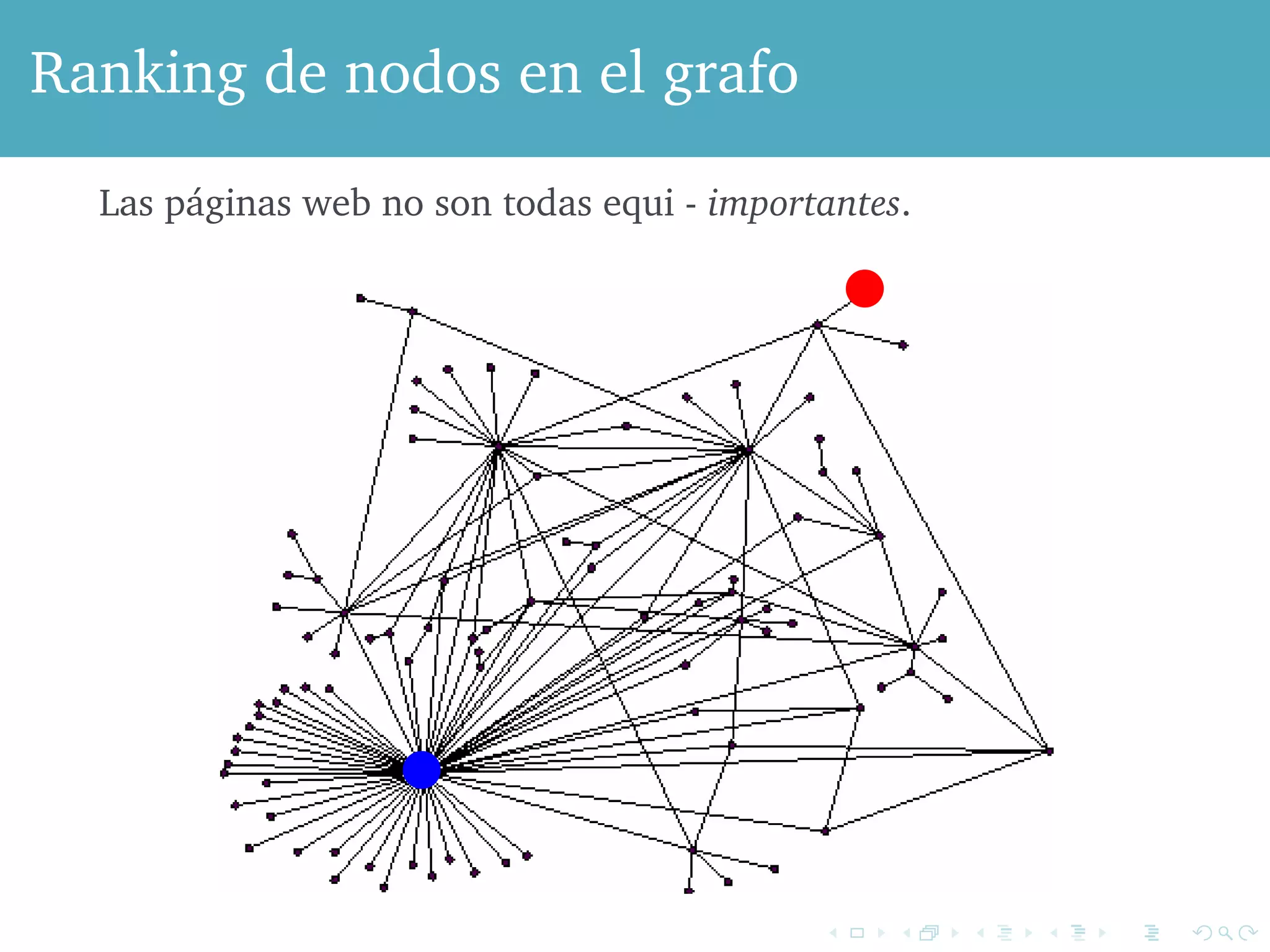
Ranking de nodos en el grafo 
1'5-8++ 
Las páginas web no son todas equi - importantes. 
0+-)%++ 
vs. 
I.-.'%-'+ ;+
Links como votos 
 Idea: Links como votos 
 Una página es más importante si tiene más links. 
 In-coming links? 
 Out-going links? 
 Pensar a los in-links como votos: 
 www.stanford.edu tiene 23.400 inlinks 
 www.joe-schmoe.com tiene 1 inlink 
 Todos los in-links son igual de importantes? 
 Links de páginas importantes deberían contar más 
 Pregunta recursiva!
Forma recursiva 
!#$%'()*+%,-./%'+%01-0-1.'-(%.-%.$/% 
!#$%'()*%-2%'.+%+-31#/%04/% 
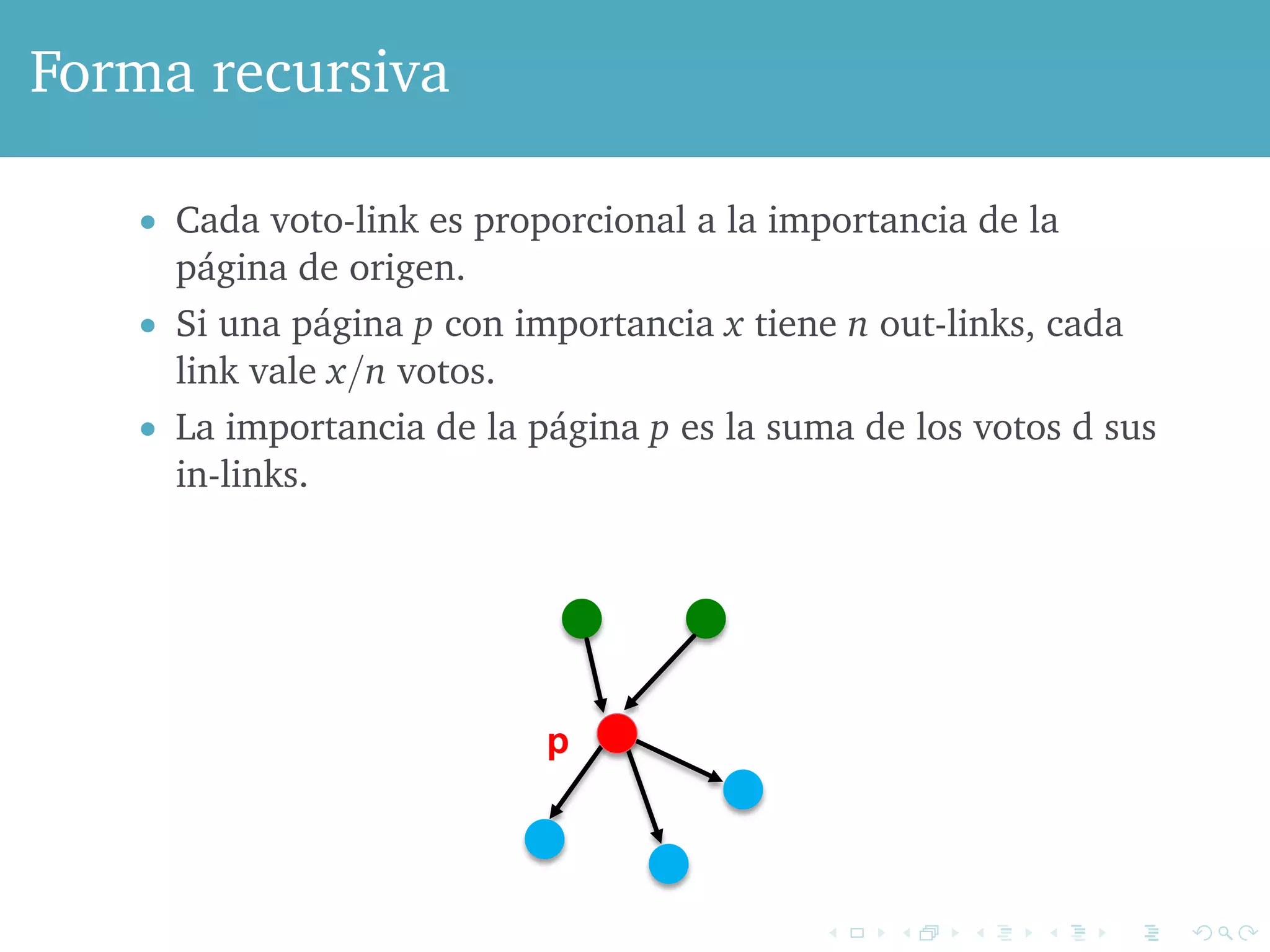
 Cada voto-link es proporcional a la importancia de la 
página ! 
de origen. 
 Si una página p con importancia x tiene n out-links, cada 
link vale x=n votos. 
 La importancia de la página p es la suma de los votos d sus 
in-links. 
04/%!%6'.$%'70-1.(#/%%$+%#%-3.8'()+9% 
/#$%'()%4/.+%$#%,-./+% 
! 
4/%!*+%-6(%'70-1.(#/%'+%.$/%+37%-2%.$/% 
,-./+%-(%'.+%'(8'()+% 
p 
A31/%B/+)-,/#9%C.(2-1D%E;FGH%I'('(4%I++',/%J.+/.+% @%
C, and D, so this surfer will next be at each of those pages CHAPTER 5. LINK ANALYSIS 
1/3, and has zero probability of being at A. A randomsurfer next step, probability 1/2 of being at A, 1/2 of being at D, and B or C. 
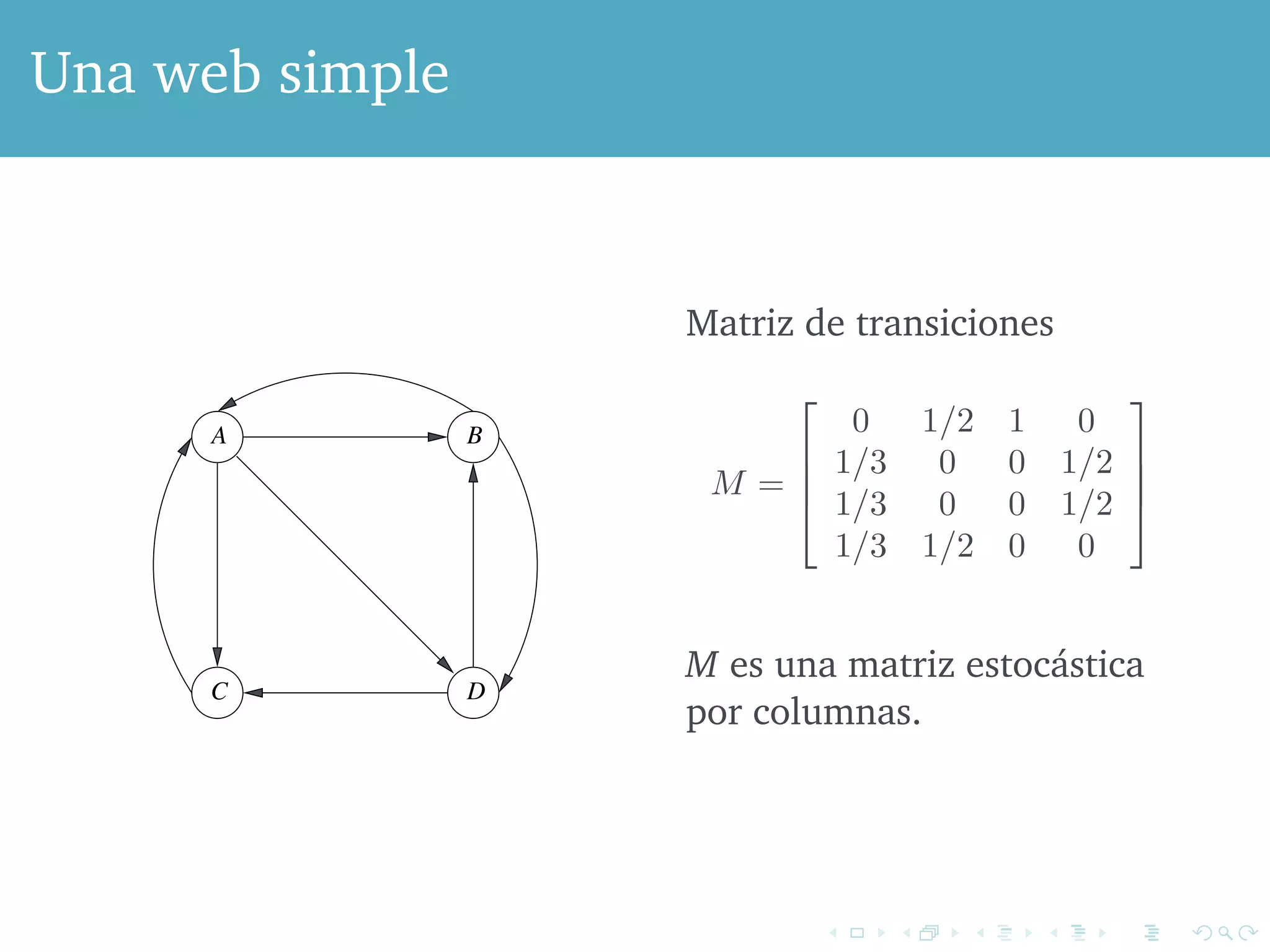
Una web simple 
modifications that are necessary for dealing with some real-world problems 
the structure of the Web. 
of the Web as a directed graph, where pages are the nodes, and there 
from page p1 to page p2 if there are one or more links from p1 to p2. 
is an example of a tiny version of the Web, where there are only four 
Page A has links to each of the other three pages; page B has links to 
In general, we can define the transition matrix of the Web happens to random surfers after one step. This matrix M columns, if there are n pages. The element mij in row i and column 1/k if page j has k arcs out, and one of them is to page i. Otherwise, Example 5.1 : The transition matrix for the Web of Fig. 5.1 M = 
only; page C has a link only to A, and page D has links to B and C 
A B 
C D 
Figure 5.1: A hypothetical example of the Web 
Matriz de transiciones 
⎡ 
⎢⎢⎣ 
Suppose a random surfer starts at page A in Fig. 5.1. There are links to B, 
so this surfer will next be at each of those pages with probability 
has zero probability of being at A. A randomsurfer at B has, at the 
probability 1/2 of being at A, 1/2 of being at D, and 0 of being at 
0 1/2 1 0 
1/3 0 0 1/2 
1/3 0 0 1/2 
1/3 1/2 0 0 
⎤ 
⎥⎥⎦ 
In this matrix, the order of the pages is the natural one, A, B, the first column expresses M es the una fact, matriz already estocástica 
discussed, that a surfer 1/3 probability of next por being columnas. 
at each of the other pages. The expresses the fact that a surfer at B has a 1/2 probability of and the same of being at D. The third column says a surfer at be at A next. The last column says a surfer at D has a 1/2 probability next at B and the same at C. ✷
PageRank 
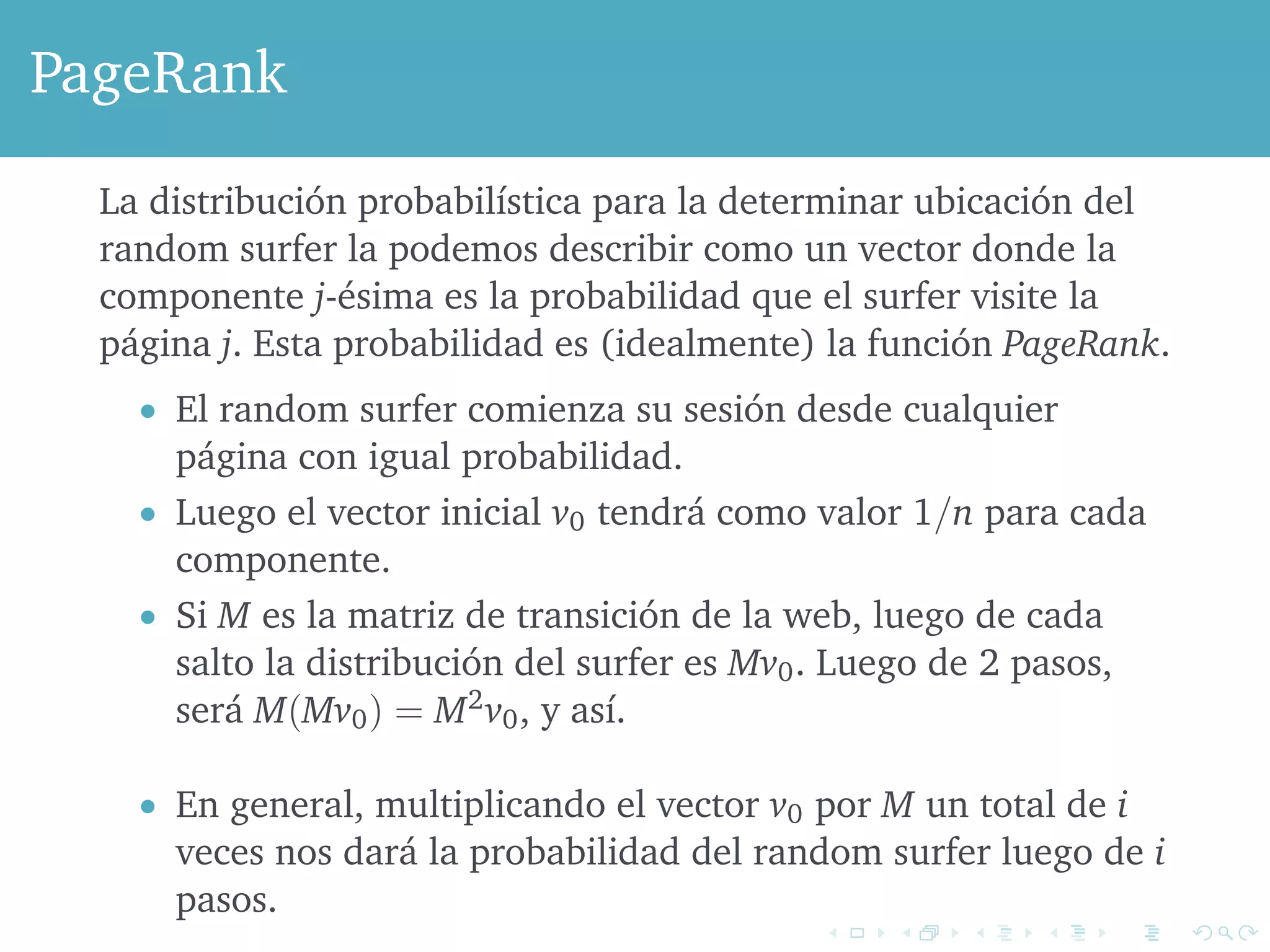
La distribución probabilística para la determinar ubicación del 
random surfer la podemos describir como un vector donde la 
componente j-ésima es la probabilidad que el surfer visite la 
página j. Esta probabilidad es (idealmente) la función PageRank. 
 El random surfer comienza su sesión desde cualquier 
página con igual probabilidad. 
 Luego el vector inicial v0 tendrá como valor 1=n para cada 
componente. 
 Si M es la matriz de transición de la web, luego de cada 
salto la distribución del surfer es Mv0. Luego de 2 pasos, 
será M(Mv0) = M2v0, y así. 
 En general, multiplicando el vector v0 por M un total de i 
veces nos dará la probabilidad del random surfer luego de i 
pasos.
any fixed constant c, and get another solution to the same equation. When 
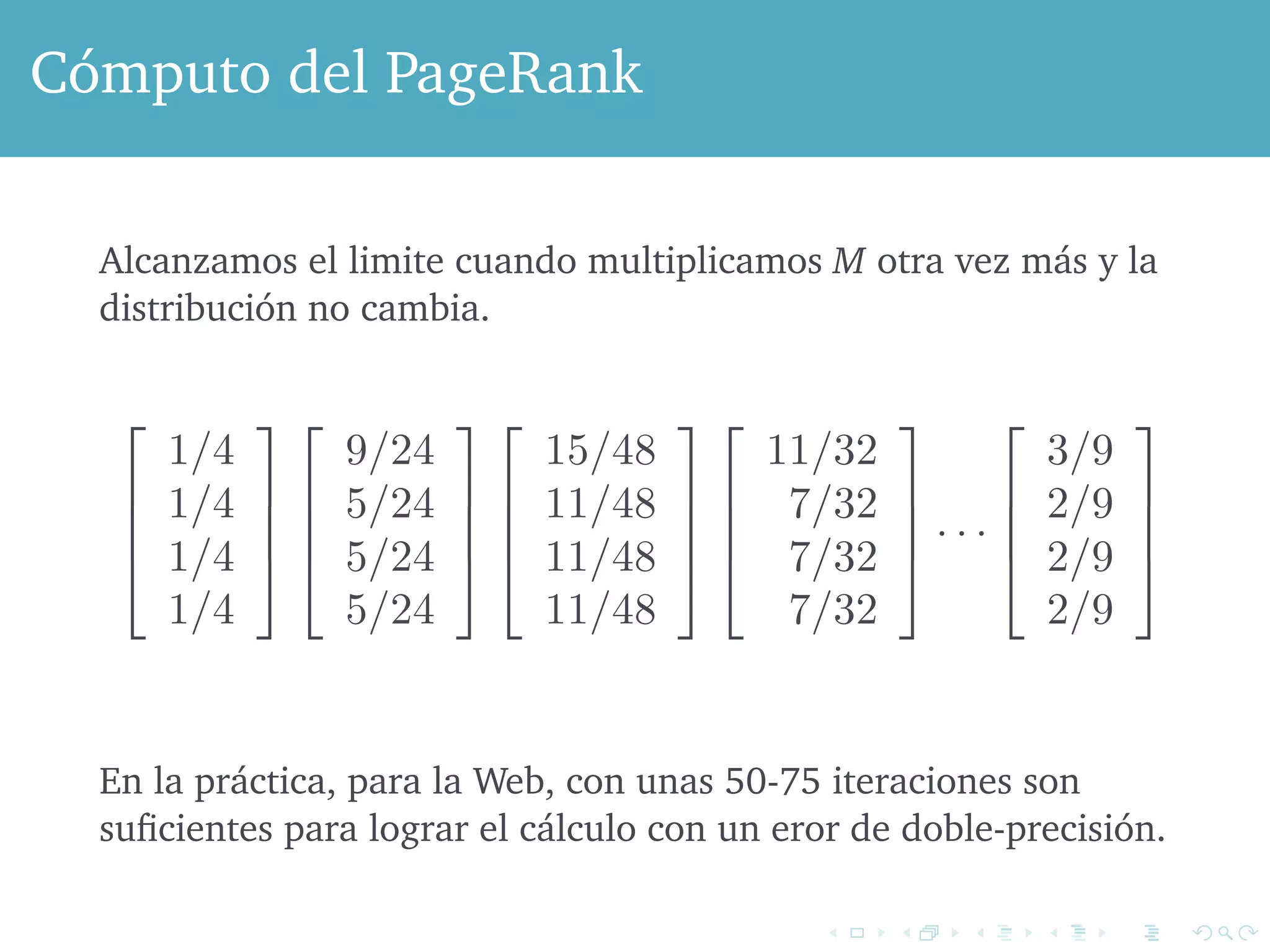
Cómputo del PageRank 
include the constraint that the sum of the components is 1, as we done, then we get a unique solution. 
Alcanzamos el limite cuando multiplicamos M otra vez más y la 
distribución no cambia. 
by multiplying at each step by M is: 
! 
# 
1/4 
1/4 
1/4 
1/4 
$ 
%% 
! 
# 
9/24 
5/24 
5/24 
5/24 
$ 
%% 
! 
# 15/48 
11/48 
11/48 
11/48 
$ 
%% 
! 
# 
11/32 
7/32 
7/32 
7/32 
$ 
%% 
· · · 
! 
# 
3/9 
2/9 
2/9 
2/9 
$ 
%% 
Notice that in this example, the probabilities for B, C, and D remain It is En easy la práctica, to see that para B la and Web, C con must unas always 50-75 iteraciones have the son 
same values iteration, because suficientes their para rows lograr in el M cálculo are identical. con un eror To de show doble-precisión. 
that their values the same as the value for D, an inductive proof works, and we leave exercise. Given that the last three values of the limiting vector must
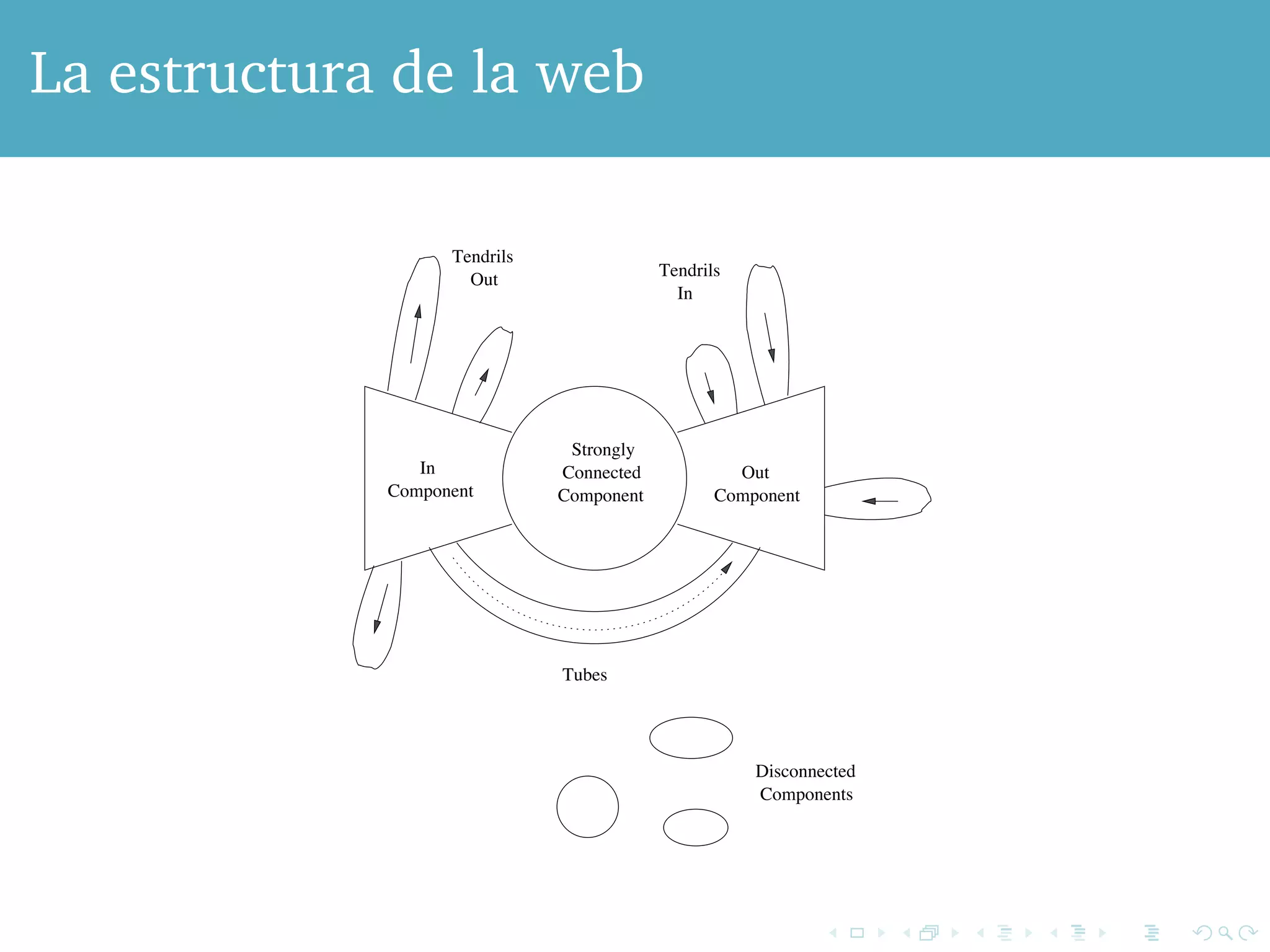
1. The in-component, consisting of pages that could reach the SCC by fol-lowing 
links, but were not reachable from the SCC. 
La estructura de la web 
2. The out-component, consisting of pages reachable from the SCC but un-able 
to reach the SCC. 
3. Tendrils, which are of two types. Some tendrils consist of pages reachable 
from the in-component but not able to reach the in-component. The 
other tendrils can reach the out-component, but are not reachable from 
the out-component. 
Strongly 
Connected 
Component 
Tubes 
In 
Tendrils 
Component 
Out 
Tendrils 
Component 
Out 
In 
Disconnected 
Components 
Figure 5.2: The “bowtie” picture of the Web 
In addition, there were small numbers of pages found either in
PageRank: 3 preguntas 
r = Mr 
 ¿Esto converge? 
 ¿Converge a lo que queremos? 
 ¿Los resultados son rasonables?
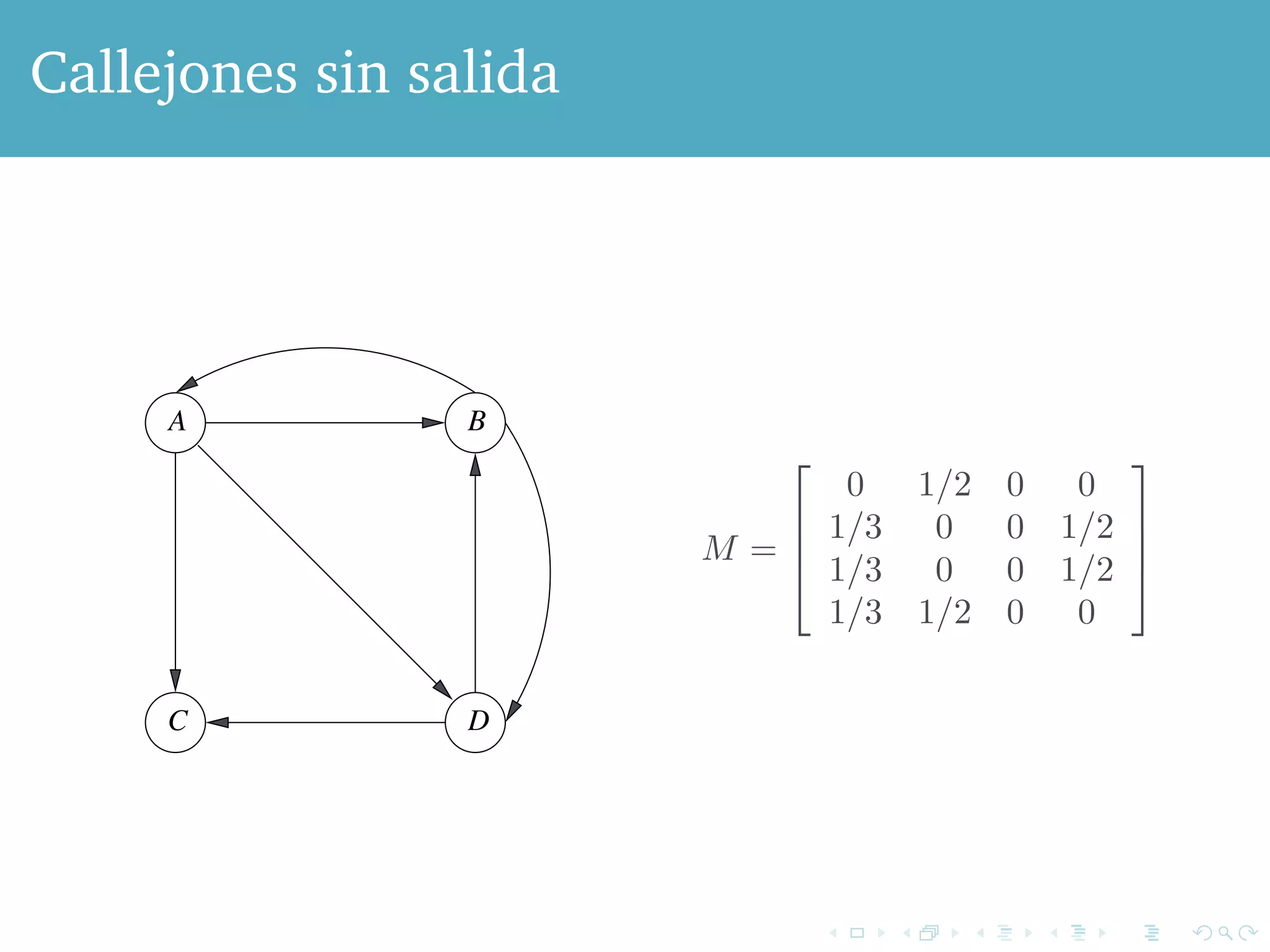
Recall that a page with no link out is called a dead end. ends, the transition matrix of the Web is no longer stochastic, the columns will sum to 0 rather than 1. A matrix whose column most 1 is called substochastic. IfwecomputeMiv for increasing substochastic matrix M, then some or all of the components to 0. That is, importance “drains out” of the Web, and we get about the relative importance of pages. 
Callejones sin salida 
PAGERANK 153 
Example 5.3 : In Fig. 5.3 we have modified Fig. 5.1 by removing C to A. Thus, C becomes a dead end. In terms of random a surfer reaches C they disappear at the next round. The describes Fig. 5.3 is 
A B 
C D 
Figure 5.3: C is now a dead end 
M = 
! 
# 
0 1/2 0 0 
1/3 0 0 1/2 
1/3 0 0 1/2 
1/3 1/2 0 0 
substochastic, but not stochastic, because the sum of the third 
is 0, not 1. Here is the sequence of vectors that result by starting 
$ 
%% 
3They are so called because the programs that crawl the Web, recording are often referred to as “spiders.” Once a spider enters a spider trap, it
PageRank con Figure Callejones 5.3: C is now Sin a dead Salida 
end 
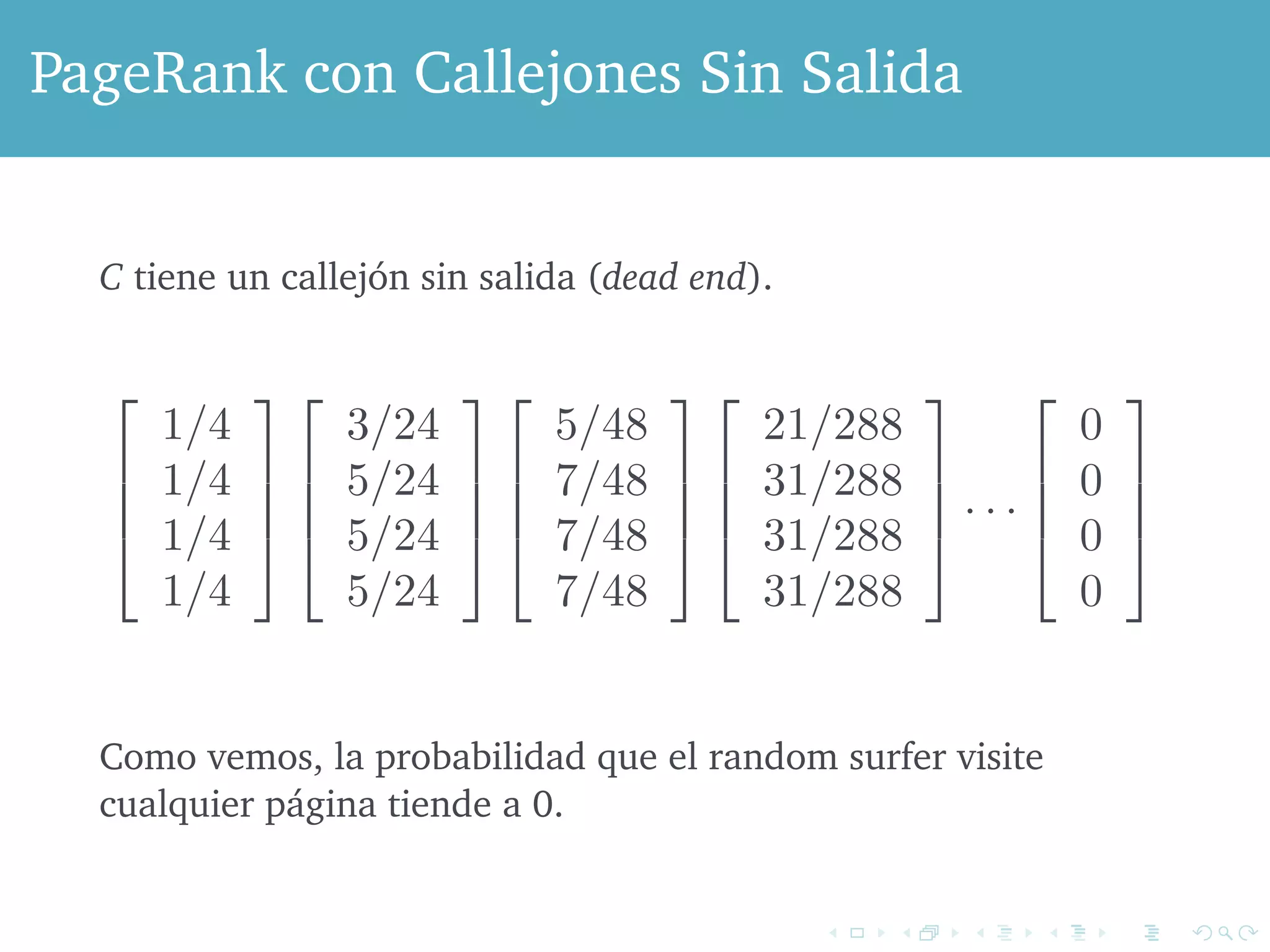
that it is substochastic, but not stochastic, because the sum of the for C, C tiene is 0, un not callejón 1. Here sin is salida the (sequence dead end). 
of vectors that result by starting 
the vector with each component 1/4, and repeatedly multiplying the ! 
# 
1/4 
1/4 
1/4 
1/4 
$ 
%% 
! 
# 
3/24 
5/24 
5/24 
5/24 
$ 
%% 
! 
# 5/48 
7/48 
7/48 
7/48 
$ 
%% 
! 
# 
21/288 
31/288 
31/288 
31/288 
$ 
%% 
· · · 
! 
# 
0 
0 
0 
0 
$ 
%% 
see, the probability of a surfer being anywhere goes to 0, as the increase. ! 
Como vemos, la probabilidad que el random surfer visite 
cualquier página tiende a 0. 
There are two approaches to dealing with dead ends. 
We can drop the dead ends from the graph, and also drop their incoming
out. These structures can appear intentionally or unintentionally and they cause the PageRank calculation to place all the PageRank spider traps. 
Trampa para arañas 
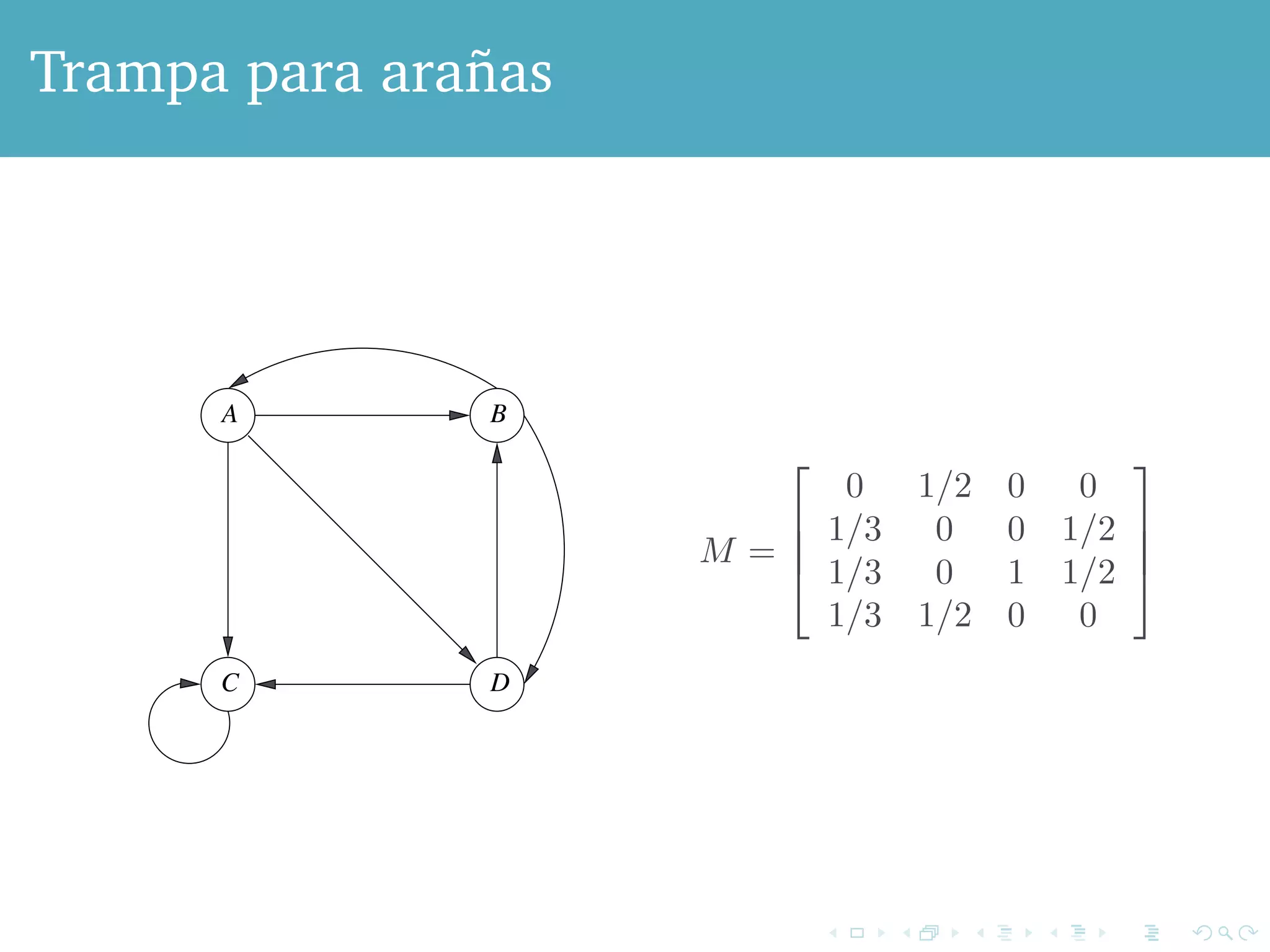
Example 5.5 : Consider Fig. 5.6, which is Fig. 5.1 with the changed to point to C itself. That change makes C a simple spider node. Note CHAPTER that in 5. general LINK ANALYSIS 
spider traps can have many nodes, see in Section 5.4, there are spider traps with millions of nodes construct intentionally. 
The transition matrix for Fig. 5.6 is 
A B 
C D 
Figure 5.6: A graph with a one-node spider trap 
M = 
perform the usual iteration to compute the PageRank of the nodes, we 
! 
$ 
! 
$ 
! 
$ 
! 
$ 
! 
$ 
! 
%% 
0 1/2 0 0 
1/3 0 0 1/2 
1/3 0 1 1/2 
1/3 1/2 0 0 
# 
$
C D 
PageRank con Trampas para arañas 
Figure 5.6: A graph with a one-node spider trap 
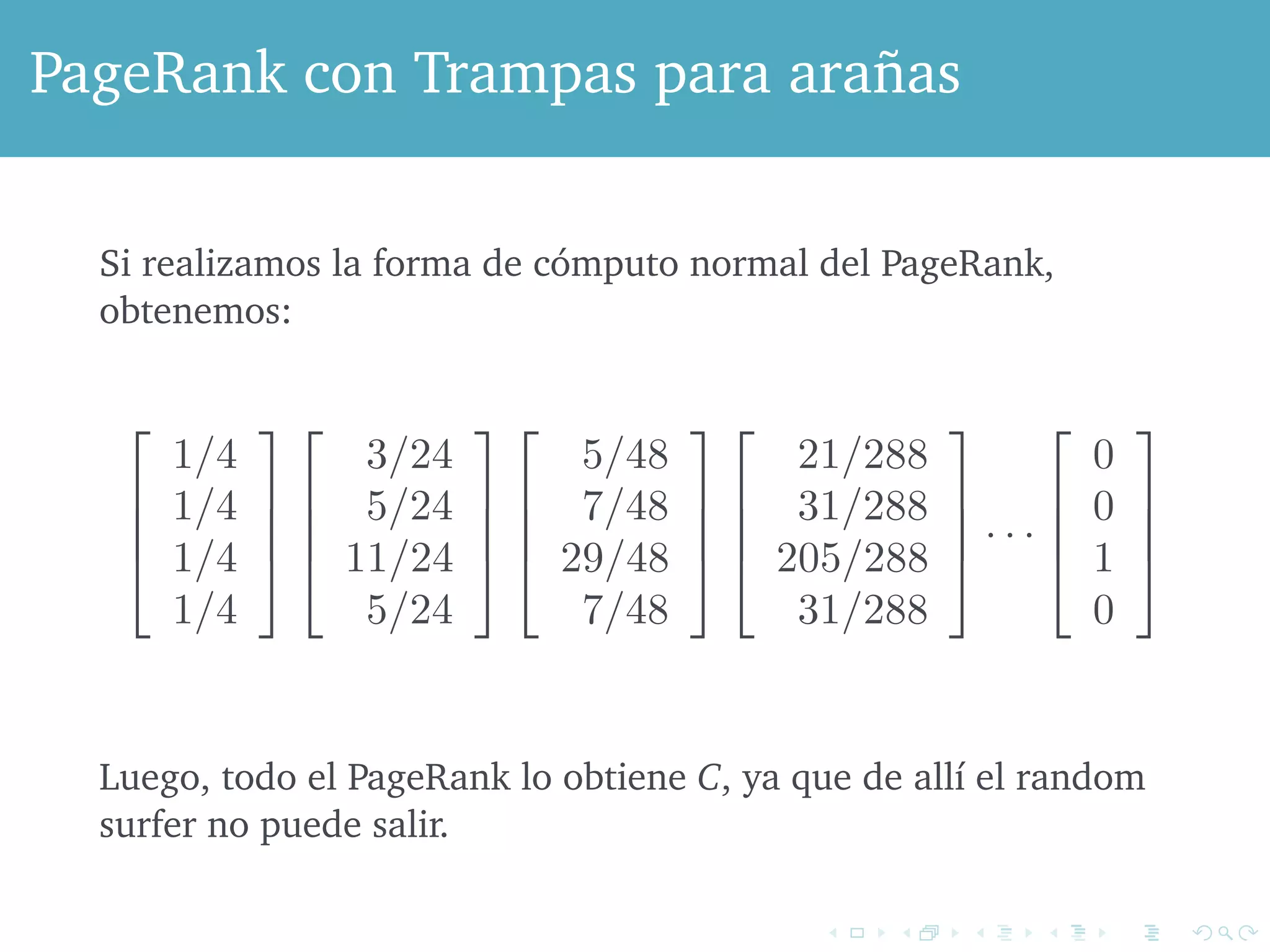
Si realizamos la forma de cómputo normal del PageRank, 
obtenemos: 
perform the usual iteration to compute the PageRank of the nodes, ! 
# 
1/4 
1/4 
1/4 
1/4 
$ 
%% 
! 
# 
3/24 
5/24 
11/24 
5/24 
$ 
%% 
! 
# 
5/48 
7/48 
29/48 
7/48 
$ 
%% 
! 
# 
21/288 
31/288 
205/288 
31/288 
$ 
%% 
· · · 
! 
# 
0 
0 
1 
0 
$ 
%% 
predicted, all the PageRank is at C, since once there a random surfer never leave. ! 
todo el PageRank lo obtiene C, ya que de allí el random 
Luego, surfer no puede salir. 
random page, rather than following an out-link from their current To avoid the problem illustrated by Example 5.5, we modify the calculation 
PageRank by allowing each random surfer a small probability of teleporting
Random Teleport
Solución: Random Teleport 
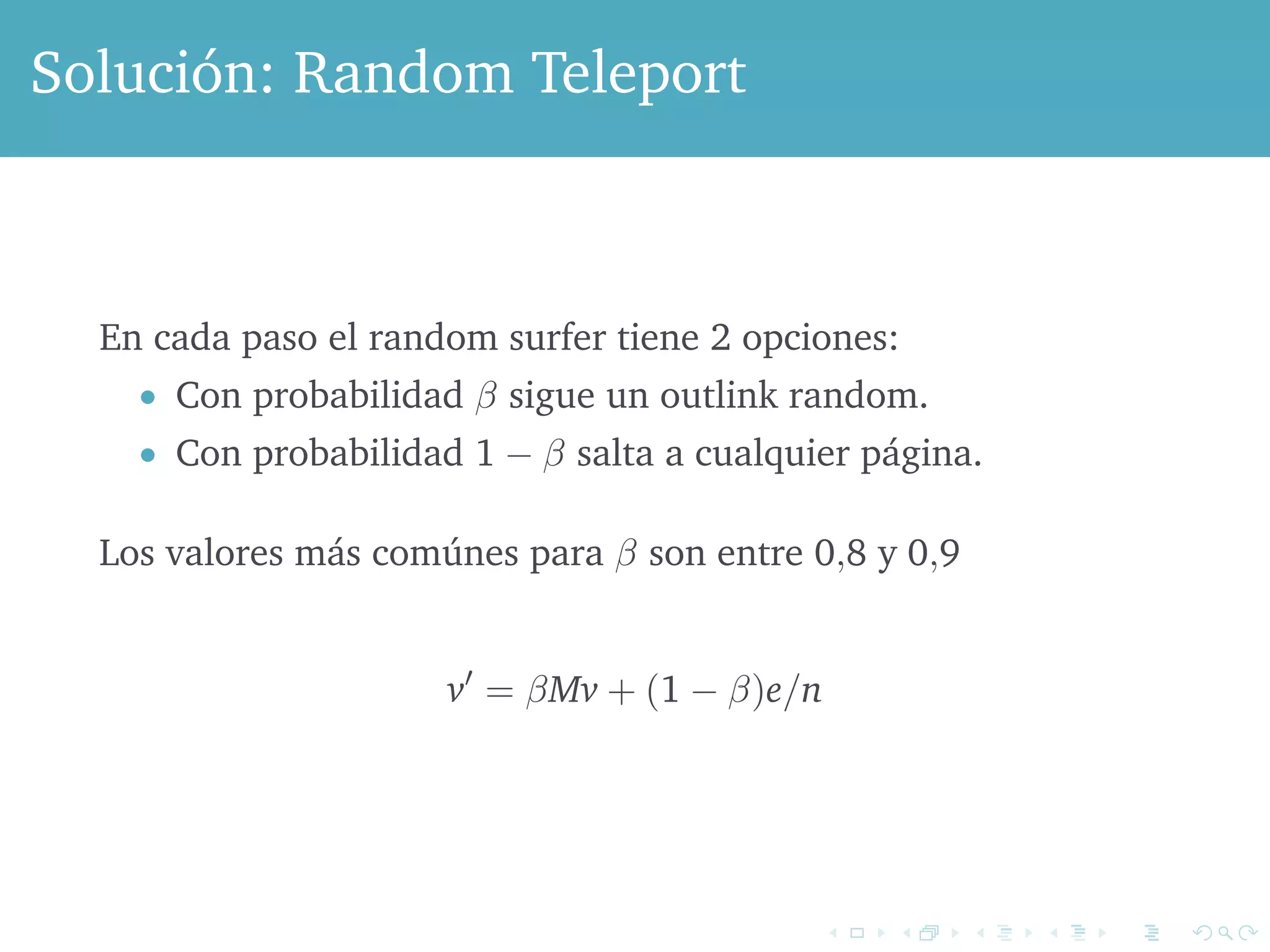
En cada paso el random surfer tiene 2 opciones: 
 Con probabilidad
sigue un outlink random. 
 Con probabilidad 1
salta a cualquier página. 
Los valores más comúnes para
son entre 0;8 y 0;9 
v0 =
Mv + (1
)e=n
of a surfer operating on the Web. That is, when there are dead ends, the sum 
of the components of v may be less than 1, but it will never reach 0. 
the sum of the components of the vector v, there will always be some fraction 
of a Teleport 
surfer operating on the Web. That is, when there are dead ends, the sum 
of the components of v may be less than 1, but it will never reach 0. 
Example 5.6 : Let us see how the new approach to computing PageRank 
fares on the graph of Fig. 5.6. We shall use ! = 0.8 in this example. Thus, the 
equation for the iteration becomes 
Example 5.6 : Let us see how the new approach to computing PageRank 
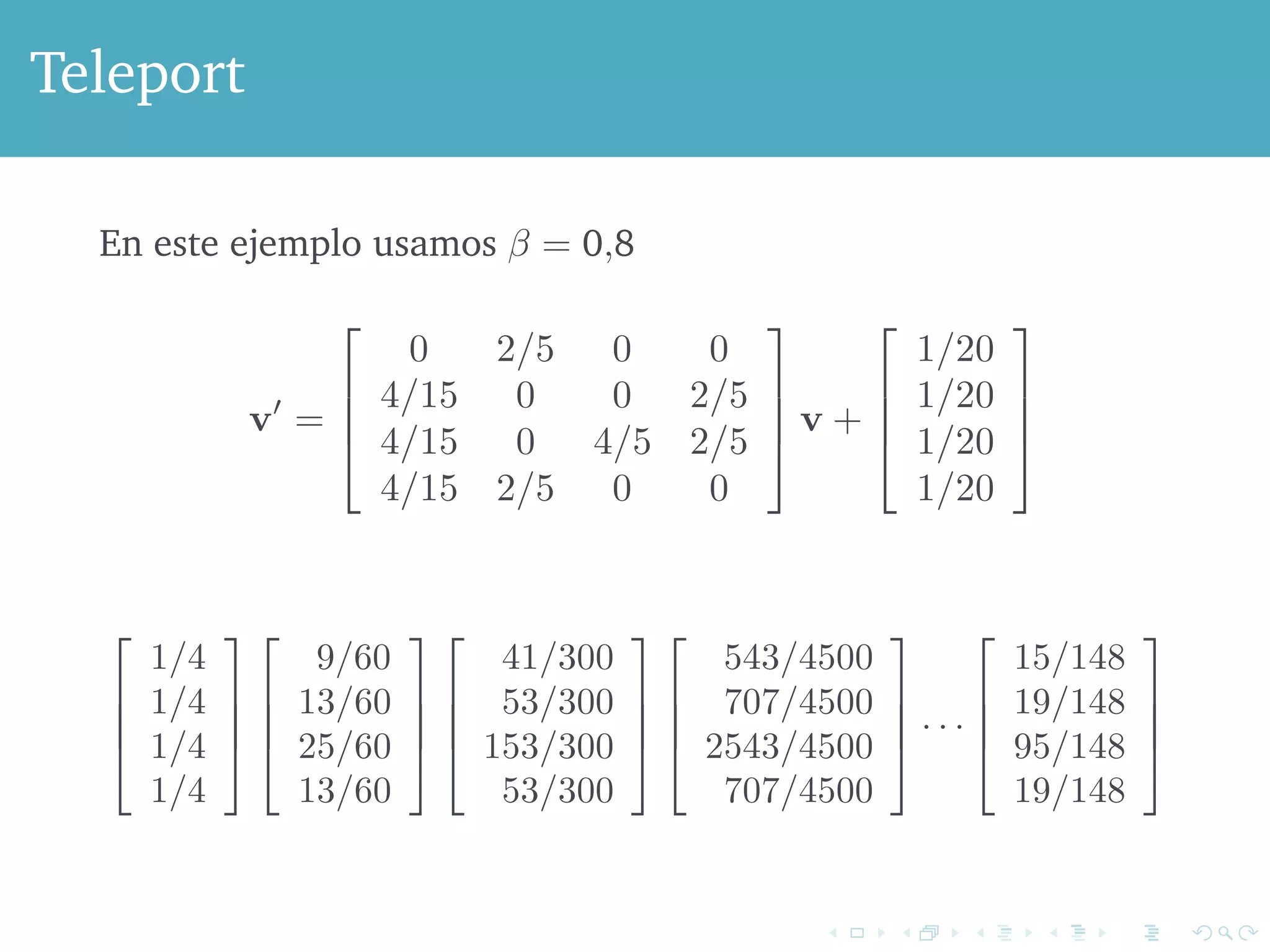
fares on En the este graph ejemplo of Fig. usamos 5.6. We shall
= 0;8 
use ! = 0.8 in this example. Thus, the 
equation for the iteration becomes 
v! = 
v! = 
! 
! 
# 
# 
0 2/5 0 0 
4/15 0 0 2/5 
4/15 0 4/5 2/5 
4/15 2/5 0 0 
0 2/5 0 0 
4/15 0 0 2/5 
4/15 0 4/5 2/5 
4/15 2/5 0 0 
$ 
$ 
%% 
v + 
%% 
! 
# 
v + 
! 
# 
1/20 
1/20 
1/20 
1/20 
$ 
%% 
1/20 
1/20 
1/20 
1/20 
$ 
%% 
Notice that we have incorporated the factor ! into M by multiplying each of 
its elements by 4/5. The components of the vector (1 − !)e/n are each 1/20, 
since 1 − ! = 1/5 and n = 4. Here are the first few iterations: 
Notice that we have incorporated the factor ! into M by multiplying each its elements ! 
by 4/5. The components of the vector (1 − !)e/n are each 1/20, 
since 1 − ! = 1/5 and n = 4. Here are the first few iterations: 
# 
! 
# 
1/4 
1/4 
1/4 
1/4 
1/4 
1/4 
1/4 
1/4 
$ 
%% 
$ 
! 
# 
! 
# 
%% 9/60 
13/60 
25/60 
13/60 
9/60 
13/60 
25/60 
13/60 
$ 
%% 
$ 
%% 
! 
# 
! 
# 
41/300 
53/300 
153/300 
41/300 
53/300 
153/300 
53/300 
$ 
%% 
! 
# 
$ 
%% 
! 
# 
543/4500 
707/4500 
2543/4500 
707/4500 
$ 
%% 
543/4500 
707/4500 
2543/4500 
707/4500 
$ 
· · · 
%% 
! 
# 
· · · 
15/148 
19/148 
95/148 
19/148 
! 
# 
$ 
%% 
15/148 
19/148 
95/148 
19/148 
$ 
%% 
By being a spider trap, C has managed to get more than half of the PageRank 
for itself. However, the effect has been limited, and each of the nodes gets some 
of the PageRank. ! 
By being a spider trap, C has managed to get more than half of the PageRank
¿Por qué Teleport resuelve el problema? 
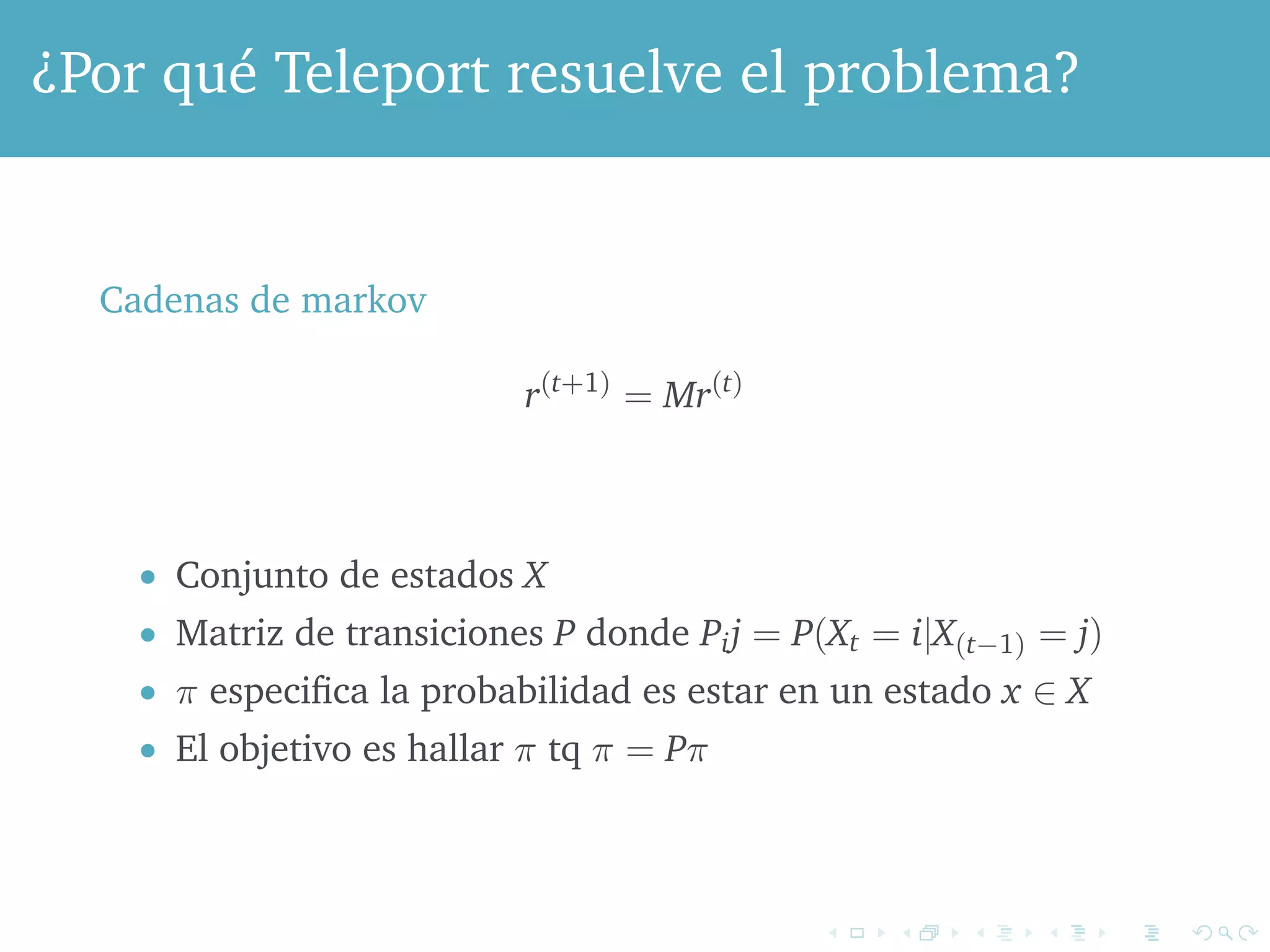
Cadenas de markov 
r(t+1) = Mr(t) 
 Conjunto de estados X 
 Matriz de transiciones P donde Pij = P(Xt = ijX(t1) = j) 
  especifica la probabilidad es estar en un estado x 2 X 
 El objetivo es hallar  tq  = P
Cadenas de Markov 
Para cualquier vector inicial, iterando sobre la matriz de 
transición P converge a una única distribución estacionaria (o 
de equilibrio) cuando P es estocástica, irreducible y aperiódica. 
Hagamos M una P estocástica, irreducible y aperiódica. 
Estocástica Cada columna suma 1. 
Irreducible Cada estado tiene una probabilidad no-nula en 
moverse a otro estado 
Aperiódica Una cadena es periódica si existe un k  1 tq los 
intervalos entre visitas al estado s siempre sean 
múltiplo de k.
Topic-Specific PageRank 
Una web, muchas ¿webes? Un PageRank, muchos ¿PageRankes? 
 Objetivo: Evaluar la relevancia de una página sobre un 
tópico particular por ej. deportes o historia. 
 Le permite al usuario realizar consultas sobre diferentes 
intereses. 
 Ejemplo: La consulta Jaguar podría presentar diferentes 
rankings según si el usuario está interesado en Animales o 
en Autos.

Tópicos de Big Data - Link Analysis

  • 1.
    Tópicos de Estadística& Data Mining en Big Data Link Analysis - PageRank Lic. Ernesto Mislej Maestría en Exploración de Datos y Descubrimiento del Conocimiento Universidad de Buenos Aires ernesto@7puentes.com Octubre 2014
  • 2.
    Outline Intro PageRank Los comienzos de los buscadores de Internet Term Spam La estructura de la Web Evitando los Dead Ends y Spider Traps. La solución: el Teleport. Link Spam. Spam Farm
  • 3.
    Intro Una delas tecnologías más revolucionarias que ha cambiado para siempre nuestra vida, sin duda es la Internet; y con ella los motores de búsqueda como Google. Google no fue el primer buscador, sino el primero que pudo combatir eficientemente a los spammers quienes intentan intervenir en la propuesta original de información de la Web. Discutiremos la innovación más grande realizada por Google, el PageRank. La batalla entre quienes hacer la Web más útil y quienes quieren manipularla para su propio beneficio pareciera nunca terminar. Veremos las formas de vencer y manipular el PageRank, construyendo pequeñas webs llamadas link spam.
  • 4.
    Los Search Enginesde antaño Gestionan un índice invertido para hallar ágilmente todos los lugares donde se encuentran las palabras. Cuando se realiza una consulta (lista de terms) se filtran aquéllas páginas que contienen los términos buscados utilizando el índice. Existen algunas estrategias para realizar un ranking, como la cantidad de veces que un término aparece en el documento. Además, se tomaron otras ideas como sumar más relevancia si el término se encuentra en el header de la página, si aparece en negrita y demás características sintácticas.
  • 5.
    Term Spam Unethical people ve la oportunidad de engañar a los buscadores para atraer visitas a sus propias páginas. Imagina agregar el termino como película a tu página muchas veces, unas miles. Luego el buscador creerá que tu hablas de cine y que debes ser muy importante, ya que casi ni hablas de otra cosa. Cuando un visitante el pregunta al buscador por alguna película, tu apareces en la primera página. Parece simple. A las menciones de terminos cinéfilos le cambias el color de la letra para que se confunda con el fondo. Pero tu vendes zapatillas, no sabes nada de críticas de películas.
  • 6.
    PageRank Para combatiral term spam, Google incorpora 2 innovaciones: 1 El contenido a ser indexado no se encuentra en las páginas sino en los hiper-textos. 2 El PageRank. Un ranking de relevancia de las páginas que simula el comportamiento de los navegantes. Random Surf: Si comienzas a navegar la Internet desde cualquier página, siguiendo aleatoriamente cualquier out-link propuesto, ¿cuál es la página que más visitas?
  • 7.
  • 8.
    Ranking de nodosen el grafo 1'5-8++ Las páginas web no son todas equi - importantes. 0+-)%++ vs. I.-.'%-'+ ;+
  • 9.
    Links como votos Idea: Links como votos Una página es más importante si tiene más links. In-coming links? Out-going links? Pensar a los in-links como votos: www.stanford.edu tiene 23.400 inlinks www.joe-schmoe.com tiene 1 inlink Todos los in-links son igual de importantes? Links de páginas importantes deberían contar más Pregunta recursiva!
  • 10.
    Forma recursiva !#$%'()*+%,-./%'+%01-0-1.'-(%.-%.$/% !#$%'()*%-2%'.+%+-31#/%04/% Cada voto-link es proporcional a la importancia de la página ! de origen. Si una página p con importancia x tiene n out-links, cada link vale x=n votos. La importancia de la página p es la suma de los votos d sus in-links. 04/%!%6'.$%'70-1.(#/%%$+%#%-3.8'()+9% /#$%'()%4/.+%$#%,-./+% ! 4/%!*+%-6(%'70-1.(#/%'+%.$/%+37%-2%.$/% ,-./+%-(%'.+%'(8'()+% p A31/%B/+)-,/#9%C.(2-1D%E;FGH%I'('(4%I++',/%J.+/.+% @%
  • 11.
    C, and D,so this surfer will next be at each of those pages CHAPTER 5. LINK ANALYSIS 1/3, and has zero probability of being at A. A randomsurfer next step, probability 1/2 of being at A, 1/2 of being at D, and B or C. Una web simple modifications that are necessary for dealing with some real-world problems the structure of the Web. of the Web as a directed graph, where pages are the nodes, and there from page p1 to page p2 if there are one or more links from p1 to p2. is an example of a tiny version of the Web, where there are only four Page A has links to each of the other three pages; page B has links to In general, we can define the transition matrix of the Web happens to random surfers after one step. This matrix M columns, if there are n pages. The element mij in row i and column 1/k if page j has k arcs out, and one of them is to page i. Otherwise, Example 5.1 : The transition matrix for the Web of Fig. 5.1 M = only; page C has a link only to A, and page D has links to B and C A B C D Figure 5.1: A hypothetical example of the Web Matriz de transiciones ⎡ ⎢⎢⎣ Suppose a random surfer starts at page A in Fig. 5.1. There are links to B, so this surfer will next be at each of those pages with probability has zero probability of being at A. A randomsurfer at B has, at the probability 1/2 of being at A, 1/2 of being at D, and 0 of being at 0 1/2 1 0 1/3 0 0 1/2 1/3 0 0 1/2 1/3 1/2 0 0 ⎤ ⎥⎥⎦ In this matrix, the order of the pages is the natural one, A, B, the first column expresses M es the una fact, matriz already estocástica discussed, that a surfer 1/3 probability of next por being columnas. at each of the other pages. The expresses the fact that a surfer at B has a 1/2 probability of and the same of being at D. The third column says a surfer at be at A next. The last column says a surfer at D has a 1/2 probability next at B and the same at C. ✷
  • 12.
    PageRank La distribuciónprobabilística para la determinar ubicación del random surfer la podemos describir como un vector donde la componente j-ésima es la probabilidad que el surfer visite la página j. Esta probabilidad es (idealmente) la función PageRank. El random surfer comienza su sesión desde cualquier página con igual probabilidad. Luego el vector inicial v0 tendrá como valor 1=n para cada componente. Si M es la matriz de transición de la web, luego de cada salto la distribución del surfer es Mv0. Luego de 2 pasos, será M(Mv0) = M2v0, y así. En general, multiplicando el vector v0 por M un total de i veces nos dará la probabilidad del random surfer luego de i pasos.
  • 13.
    any fixed constantc, and get another solution to the same equation. When Cómputo del PageRank include the constraint that the sum of the components is 1, as we done, then we get a unique solution. Alcanzamos el limite cuando multiplicamos M otra vez más y la distribución no cambia. by multiplying at each step by M is: ! # 1/4 1/4 1/4 1/4 $ %% ! # 9/24 5/24 5/24 5/24 $ %% ! # 15/48 11/48 11/48 11/48 $ %% ! # 11/32 7/32 7/32 7/32 $ %% · · · ! # 3/9 2/9 2/9 2/9 $ %% Notice that in this example, the probabilities for B, C, and D remain It is En easy la práctica, to see that para B la and Web, C con must unas always 50-75 iteraciones have the son same values iteration, because suficientes their para rows lograr in el M cálculo are identical. con un eror To de show doble-precisión. that their values the same as the value for D, an inductive proof works, and we leave exercise. Given that the last three values of the limiting vector must
  • 14.
    1. The in-component,consisting of pages that could reach the SCC by fol-lowing links, but were not reachable from the SCC. La estructura de la web 2. The out-component, consisting of pages reachable from the SCC but un-able to reach the SCC. 3. Tendrils, which are of two types. Some tendrils consist of pages reachable from the in-component but not able to reach the in-component. The other tendrils can reach the out-component, but are not reachable from the out-component. Strongly Connected Component Tubes In Tendrils Component Out Tendrils Component Out In Disconnected Components Figure 5.2: The “bowtie” picture of the Web In addition, there were small numbers of pages found either in
  • 15.
    PageRank: 3 preguntas r = Mr ¿Esto converge? ¿Converge a lo que queremos? ¿Los resultados son rasonables?
  • 16.
    Recall that apage with no link out is called a dead end. ends, the transition matrix of the Web is no longer stochastic, the columns will sum to 0 rather than 1. A matrix whose column most 1 is called substochastic. IfwecomputeMiv for increasing substochastic matrix M, then some or all of the components to 0. That is, importance “drains out” of the Web, and we get about the relative importance of pages. Callejones sin salida PAGERANK 153 Example 5.3 : In Fig. 5.3 we have modified Fig. 5.1 by removing C to A. Thus, C becomes a dead end. In terms of random a surfer reaches C they disappear at the next round. The describes Fig. 5.3 is A B C D Figure 5.3: C is now a dead end M = ! # 0 1/2 0 0 1/3 0 0 1/2 1/3 0 0 1/2 1/3 1/2 0 0 substochastic, but not stochastic, because the sum of the third is 0, not 1. Here is the sequence of vectors that result by starting $ %% 3They are so called because the programs that crawl the Web, recording are often referred to as “spiders.” Once a spider enters a spider trap, it
  • 17.
    PageRank con FigureCallejones 5.3: C is now Sin a dead Salida end that it is substochastic, but not stochastic, because the sum of the for C, C tiene is 0, un not callejón 1. Here sin is salida the (sequence dead end). of vectors that result by starting the vector with each component 1/4, and repeatedly multiplying the ! # 1/4 1/4 1/4 1/4 $ %% ! # 3/24 5/24 5/24 5/24 $ %% ! # 5/48 7/48 7/48 7/48 $ %% ! # 21/288 31/288 31/288 31/288 $ %% · · · ! # 0 0 0 0 $ %% see, the probability of a surfer being anywhere goes to 0, as the increase. ! Como vemos, la probabilidad que el random surfer visite cualquier página tiende a 0. There are two approaches to dealing with dead ends. We can drop the dead ends from the graph, and also drop their incoming
  • 18.
    out. These structurescan appear intentionally or unintentionally and they cause the PageRank calculation to place all the PageRank spider traps. Trampa para arañas Example 5.5 : Consider Fig. 5.6, which is Fig. 5.1 with the changed to point to C itself. That change makes C a simple spider node. Note CHAPTER that in 5. general LINK ANALYSIS spider traps can have many nodes, see in Section 5.4, there are spider traps with millions of nodes construct intentionally. The transition matrix for Fig. 5.6 is A B C D Figure 5.6: A graph with a one-node spider trap M = perform the usual iteration to compute the PageRank of the nodes, we ! $ ! $ ! $ ! $ ! $ ! %% 0 1/2 0 0 1/3 0 0 1/2 1/3 0 1 1/2 1/3 1/2 0 0 # $
  • 19.
    C D PageRankcon Trampas para arañas Figure 5.6: A graph with a one-node spider trap Si realizamos la forma de cómputo normal del PageRank, obtenemos: perform the usual iteration to compute the PageRank of the nodes, ! # 1/4 1/4 1/4 1/4 $ %% ! # 3/24 5/24 11/24 5/24 $ %% ! # 5/48 7/48 29/48 7/48 $ %% ! # 21/288 31/288 205/288 31/288 $ %% · · · ! # 0 0 1 0 $ %% predicted, all the PageRank is at C, since once there a random surfer never leave. ! todo el PageRank lo obtiene C, ya que de allí el random Luego, surfer no puede salir. random page, rather than following an out-link from their current To avoid the problem illustrated by Example 5.5, we modify the calculation PageRank by allowing each random surfer a small probability of teleporting
  • 20.
  • 21.
    Solución: Random Teleport En cada paso el random surfer tiene 2 opciones: Con probabilidad
  • 22.
    sigue un outlinkrandom. Con probabilidad 1
  • 23.
    salta a cualquierpágina. Los valores más comúnes para
  • 24.
    son entre 0;8y 0;9 v0 =
  • 25.
  • 26.
  • 27.
    of a surferoperating on the Web. That is, when there are dead ends, the sum of the components of v may be less than 1, but it will never reach 0. the sum of the components of the vector v, there will always be some fraction of a Teleport surfer operating on the Web. That is, when there are dead ends, the sum of the components of v may be less than 1, but it will never reach 0. Example 5.6 : Let us see how the new approach to computing PageRank fares on the graph of Fig. 5.6. We shall use ! = 0.8 in this example. Thus, the equation for the iteration becomes Example 5.6 : Let us see how the new approach to computing PageRank fares on En the este graph ejemplo of Fig. usamos 5.6. We shall
  • 28.
    = 0;8 use! = 0.8 in this example. Thus, the equation for the iteration becomes v! = v! = ! ! # # 0 2/5 0 0 4/15 0 0 2/5 4/15 0 4/5 2/5 4/15 2/5 0 0 0 2/5 0 0 4/15 0 0 2/5 4/15 0 4/5 2/5 4/15 2/5 0 0 $ $ %% v + %% ! # v + ! # 1/20 1/20 1/20 1/20 $ %% 1/20 1/20 1/20 1/20 $ %% Notice that we have incorporated the factor ! into M by multiplying each of its elements by 4/5. The components of the vector (1 − !)e/n are each 1/20, since 1 − ! = 1/5 and n = 4. Here are the first few iterations: Notice that we have incorporated the factor ! into M by multiplying each its elements ! by 4/5. The components of the vector (1 − !)e/n are each 1/20, since 1 − ! = 1/5 and n = 4. Here are the first few iterations: # ! # 1/4 1/4 1/4 1/4 1/4 1/4 1/4 1/4 $ %% $ ! # ! # %% 9/60 13/60 25/60 13/60 9/60 13/60 25/60 13/60 $ %% $ %% ! # ! # 41/300 53/300 153/300 41/300 53/300 153/300 53/300 $ %% ! # $ %% ! # 543/4500 707/4500 2543/4500 707/4500 $ %% 543/4500 707/4500 2543/4500 707/4500 $ · · · %% ! # · · · 15/148 19/148 95/148 19/148 ! # $ %% 15/148 19/148 95/148 19/148 $ %% By being a spider trap, C has managed to get more than half of the PageRank for itself. However, the effect has been limited, and each of the nodes gets some of the PageRank. ! By being a spider trap, C has managed to get more than half of the PageRank
  • 29.
    ¿Por qué Teleportresuelve el problema? Cadenas de markov r(t+1) = Mr(t) Conjunto de estados X Matriz de transiciones P donde Pij = P(Xt = ijX(t1) = j) especifica la probabilidad es estar en un estado x 2 X El objetivo es hallar tq = P
  • 30.
    Cadenas de Markov Para cualquier vector inicial, iterando sobre la matriz de transición P converge a una única distribución estacionaria (o de equilibrio) cuando P es estocástica, irreducible y aperiódica. Hagamos M una P estocástica, irreducible y aperiódica. Estocástica Cada columna suma 1. Irreducible Cada estado tiene una probabilidad no-nula en moverse a otro estado Aperiódica Una cadena es periódica si existe un k 1 tq los intervalos entre visitas al estado s siempre sean múltiplo de k.
  • 31.
    Topic-Specific PageRank Unaweb, muchas ¿webes? Un PageRank, muchos ¿PageRankes? Objetivo: Evaluar la relevancia de una página sobre un tópico particular por ej. deportes o historia. Le permite al usuario realizar consultas sobre diferentes intereses. Ejemplo: La consulta Jaguar podría presentar diferentes rankings según si el usuario está interesado en Animales o en Autos.
  • 32.
    Topic-Specific PageRank Lo resolvemos con un vector inicial v0 no uniforme con páginas del tópico que nos interesa. El vector topic-specific de páginas curadas también es el vector de Teleport. Por ejemplo: Open Directory (DMOZ) Y si comenzamos con un set especial de Trust-Pages? ! TrustRank.
  • 33.
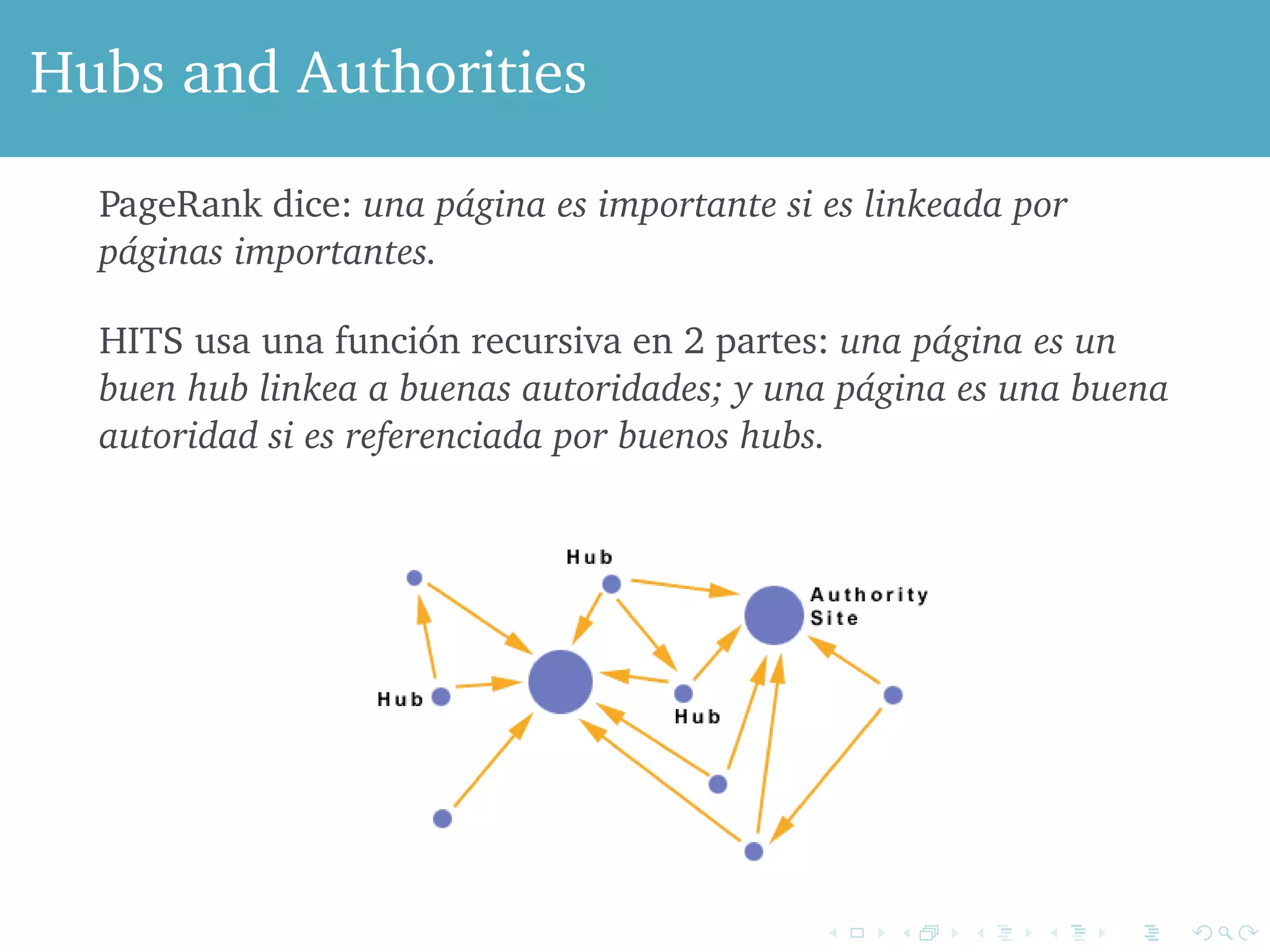
    Hubs y Authorities El algoritmo hubs-and-authorities, llamado HITS (hyperlink-induced topic search). PageRank asume una visión unidimensional de la importancia de las páginas. HITS ve la web con 2 nociones de importancia. 1 Ciertas páginas dan infomación sobre un tópico. Esas páginas son las autoridades. 2 Otras páginas proveen información donde se encuentan las páginas relevantes, pensemos en índices, revistas, etc. Estas páginas son las hubs.
  • 34.
    Hubs and Authorities PageRank dice: una página es importante si es linkeada por páginas importantes. HITS usa una función recursiva en 2 partes: una página es un buen hub linkea a buenas autoridades; y una página es una buena autoridad si es referenciada por buenos hubs.
  • 35.
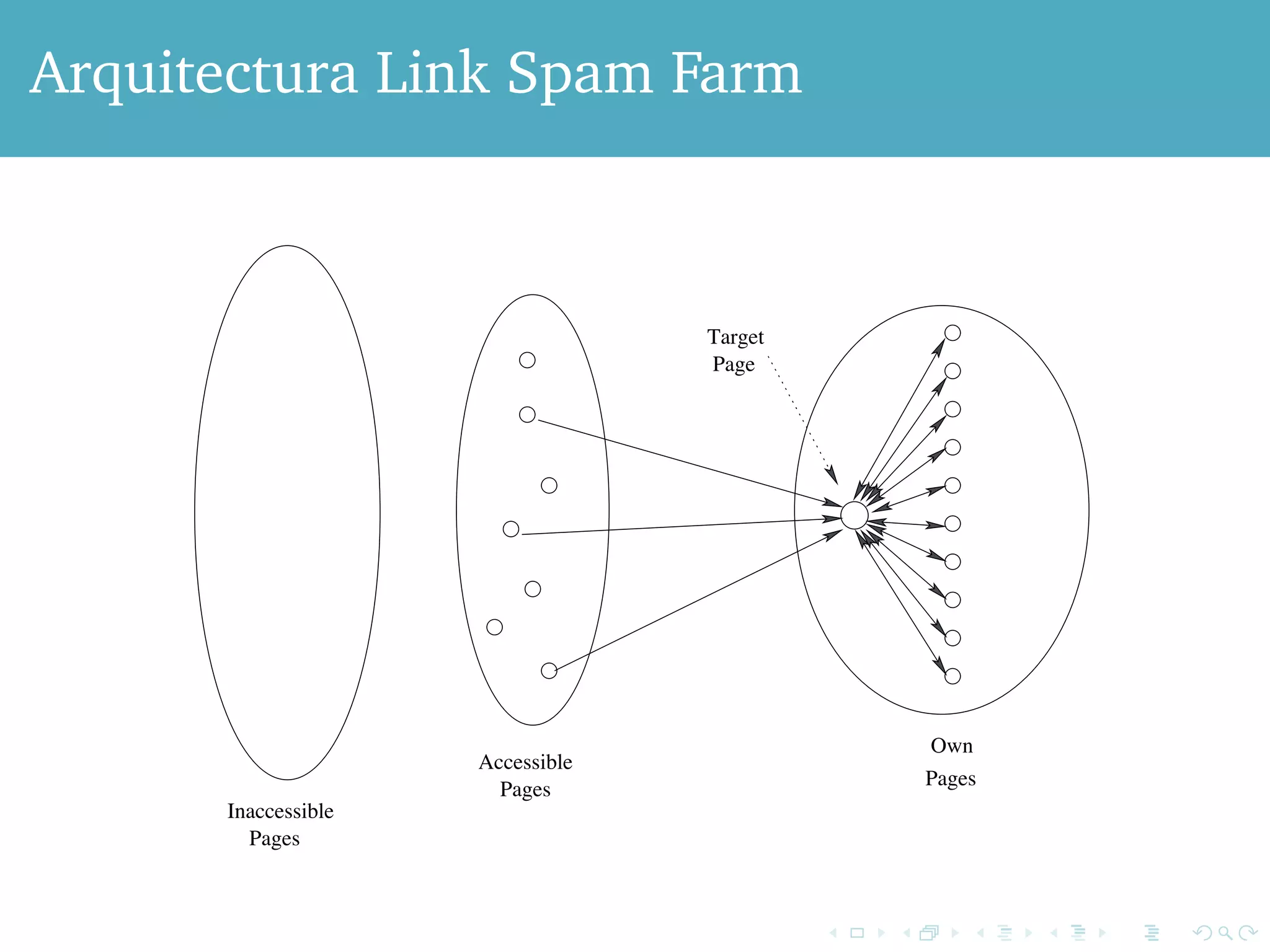
    Link Spam Crearuna mini-web para boost el PageRank de una página. Desde el punto de vista del spammer, la Web está dividida en 3 partes: Páginas inaccesibles: Páginas en las cuales el spammer no puede intervenir. La mayoría de la Web es así. Páginas accessibles: Páginas no-propias donde el spammer tiene cierto grado de intervención (wikis, comentarios, etc). Páginas propias: Páginas propias donde el spammer tiene control completo.
  • 36.
    Arquitectura Link SpamFarm 170 CHAPTER 5. LINK ANALYSIS 3. Own pages: the pages that the spammer owns and controls. Accessible Pages Own Pages Inaccessible Pages Target Page Figure 5.16: The Web from the point of view of the link spammer
  • 37.
    8)+0 Ejemplo depágina Link Spam LM