PRONOUNS


NAME: GABRIELA MONTENEGRO


     THIRD LEVEL “B”


TECHNOLOGIST: Gary Jacome


     YEAR: 2011-2012
Personal Pronouns (Pronombres
                       personales)
En inglés no existe la forma "usted" o "ustedes" formal. Por lo tanto
los nativos de la lengua ni siquiera lo tienen conceptualizado como
una forma aquí llamada "formal". Se tiene que entender entonces
que la forma masculina, femenina y neutra es lo mismo, lo único
que les diferencia es el género.

Además, ten en cuenta que en inglés sólo existe una forma para
"tu" y "vosotros" - "you," excepto en la forma reflexiva que
distingue entre el singular (yourself) y plural (yourselves).

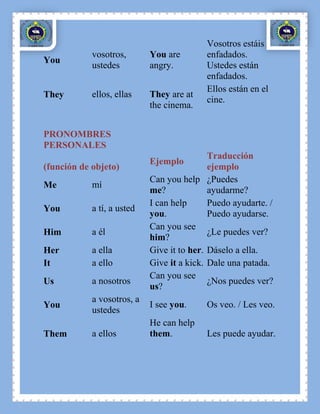
PRONOMBRES
PERSONALES

                                                Traducción
                               Ejemplo
(función de sujeto)                             ejemplo
                                                Yo estoy
I             yo               I am ill.
                                                enfermo.
                                                Tú eres alto. /
You           tú, usted        You are tall.
                                                Usted es alto.
                               He is
He            él                              Él es guapo.
                               handsome.
She           ella             She is pretty. Ella es guapa.
                               It is cold
It            ello (neutro)                   Hoy hace frío.
                               today.
                                              Nosotros estamos
We            nosotros         We are tired.
                                              cansados.
Vosotros estáis
            vosotros,       You are        enfadados.
You
            ustedes         angry.         Ustedes están
                                           enfadados.
                                           Ellos están en el
They        ellos, ellas    They are at
                                           cine.
                            the cinema.


PRONOMBRES
PERSONALES
                                            Traducción
                            Ejemplo
(función de objeto)                         ejemplo
                            Can you help ¿Puedes
Me          mí
                            me?             ayudarme?
                            I can help      Puedo ayudarte. /
You         a tí, a usted
                            you.            Puedo ayudarse.
                            Can you see
Him         a él                            ¿Le puedes ver?
                            him?
Her         a ella          Give it to her. Dáselo a ella.
It          a ello          Give it a kick. Dale una patada.
                            Can you see
Us          a nosotros                      ¿Nos puedes ver?
                            us?
            a vosotros, a
You                         I see you.     Os veo. / Les veo.
            ustedes
                            He can help
Them        a ellos         them.          Les puede ayudar.
PRONOMBRES
POSESIVOS

                                                Traducción
                            Ejemplo
(en función de                                  ejemplo
determinante de sujeto)
                            This is my
My         mi, mis                              Ésta es mi casa.
                            house.
           tu, tus (de tú) /
                             This is your       Éste es tu libro. /
Your       su, sus (de
                             book.              Éste es su libro.
           usted)
                             This is his        Ésta es su
His        su, sus (de él)
                             bicycle.           bicicleta.
           su, sus (de       This is her
Her                                             Éste es su vestido.
           ella)             dress.
                             This is its (the   Ésta es su casa.
Its        su, sus
                             cat's) home.       (del gato)
           nuestro/a         These are our      Éstas son nuestras
Our
           nuestros/as       suitcases.         maletas.
           vuestro/a,
                                                Éstos son vuestros
           vuestros/as, These are
Your                                            asientos. Éstos
           su, sus (de       your seats.
                                                son sus asientos.
           ustedes)
           su, sus (de       These are          Éstos son sus
Their
           ellos)            their books.       libros.
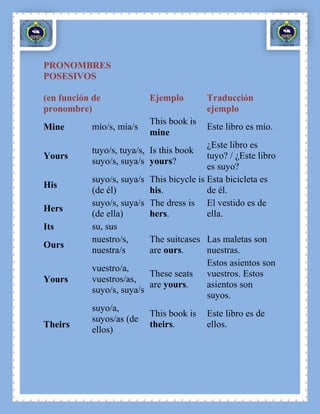
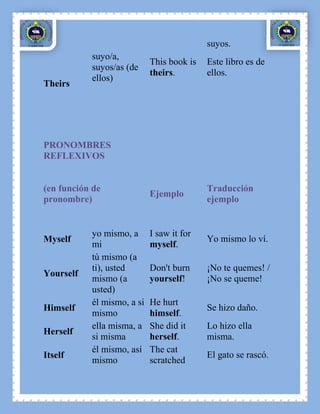
PRONOMBRES
POSESIVOS

(en función de            Ejemplo         Traducción
pronombre)                                ejemplo
                          This book is
Mine       mío/s, mía/s                   Este libro es mío.
                          mine
                                          ¿Este libro es
           tuyo/s, tuya/s, Is this book
Yours                                     tuyo? / ¿Este libro
           suyo/s, suya/s yours?
                                          es suyo?
           suyo/s, suya/s This bicycle is Esta bicicleta es
His
           (de él)        his.            de él.
           suyo/s, suya/s The dress is El vestido es de
Hers
           (de ella)      hers.           ella.
Its        su, sus
           nuestro/s,     The suitcases Las maletas son
Ours
           nuestra/s      are ours.       nuestras.
                                          Estos asientos son
           vuestro/a,
                          These seats vuestros. Estos
Yours      vuestros/as,
                          are yours.      asientos son
           suyo/s, suya/s
                                          suyos.
           suyo/a,
                          This book is Este libro es de
           suyos/as (de
Theirs                    theirs.         ellos.
           ellos)
PRONOMBRES
REFLEXIVOS


(en función de                              Traducción
                             Ejemplo
pronombre)                                  ejemplo
            yo mismo, a      I saw it for
Myself                                      Yo mismo lo ví.
            mi               myself.
            tú mismo (a
            ti), usted       Don't burn     ¡No te quemes! /
Yourself
            mismo (a         yourself!      ¡No se queme!
            usted)
            él mismo, a si
                         He hurt
Himself                                     Se hizo daño.
            mismo        himself.
            ella misma, aShe did it         Lo hizo ella
Herself
            si misma     herself.           misma.
                         The cat
           él mismo, así
Itself                   scratched          El gato se rascó.
           mismo
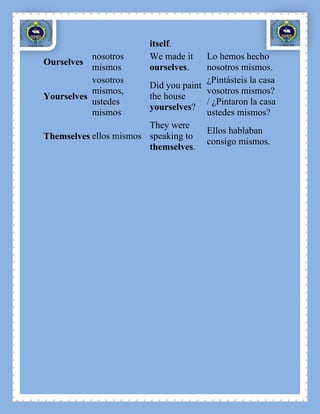
                         itself.
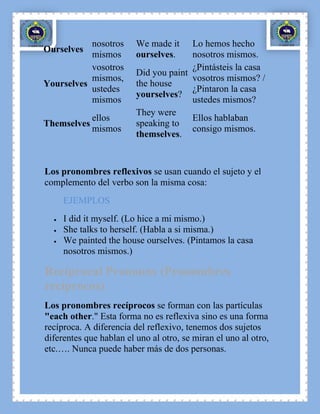
           nosotros      We made it         Lo hemos hecho
Ourselves
           mismos        ourselves.         nosotros mismos.
           vosotros                         ¿Pintásteis la casa
                         Did you paint
           mismos,                          vosotros mismos?
Yourselves               the house
           ustedes                          / ¿Pintaron la casa
                         yourselves?
           mismos                           ustedes mismos?
Themselves ellos mismos They were           Ellos hablaban
speaking to     consigo mismos.
                         themselves.

Possessive Pronouns (Pronombres
posesivos)
PRONOMBRES
POSESIVOS

(en función de
determinante del       Ejemplo        Traducción ejemplo
sujeto)
                        This is my
My    mi, mis                         Ésta es mi casa.
                        house.
     tu, tus (de tú) / This is your   Éste es tu libro. / Éste
Your
     su, sus (de usted) book.         es su libro.
                        This is his
His  su, sus (de él)                  Ésta es su bicicleta.
                        bicycle.
                        This is her
Her su, sus (de ella)                 Éste es su vestido.
                        dress.
                        This is its
                                      Ésta es su casa. (la
Its  su, sus            (the cat's)
                                      casa del gato)
                        home.
                        These are
     nuestro/a                        Éstas son nuestras
Our                     our
     nuestros/as                      maletas.
                        suitcases.
     vuestro/a,                       Éstos son vuestros
                        These are
Your vuestros/as, su,                 asientos. Éstos son
                        your seats.
     sus (de ustedes)                 sus asientos.
These are
Their su, sus (de ellos) their books. Éstos son sus libros.


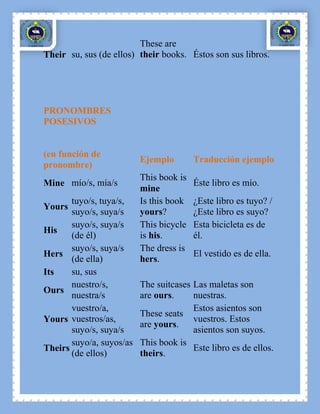
PRONOMBRES
POSESIVOS


(en función de
                          Ejemplo        Traducción ejemplo
pronombre)
                          This book is
Mine mío/s, mía/s                        Éste libro es mío.
                          mine
       tuyo/s, tuya/s,    Is this book   ¿Este libro es tuyo? /
Yours
       suyo/s, suya/s     yours?         ¿Este libro es suyo?
       suyo/s, suya/s     This bicycle   Esta bicicleta es de
His
       (de él)            is his.        él.
       suyo/s, suya/s     The dress is
Hers                                     El vestido es de ella.
       (de ella)          hers.
Its    su, sus
       nuestro/s,         The suitcases Las maletas son
Ours
       nuestra/s          are ours.     nuestras.
       vuestro/a,                       Estos asientos son
                          These seats
Yours vuestros/as,                      vuestros. Estos
                          are yours.
       suyo/s, suya/s                   asientos son suyos.
       suyo/a, suyos/as   This book is
Theirs                                  Este libro es de ellos.
       (de ellos)         theirs.
Los pronombres posesivos varían según el que posee y no
según la cantidad poseida:
my book, your book, his book, our book, my books, your
books, his books...
    Ejemplos:
    His bike is red. (Su bicicleta es roja.)
    My house is small. (Mi casa es pequeño.)


Function (Función)
Los pronombres posesivos: hay de dos tipos según su
función en la oración:
En función de artículo determinativo del sujeto:
Gramaticalmente funciona como un artículo determinativo
del sustantivo al que acompaña, por lo tanto siempre va en
primera posición dentro de la oración:
    Ejemplos:
    My car is blue. (Mi coche es azul.)
    His house is big. (Su casa es grande.)
En función de pronombre:
Gramaticalmente funciona como un pronombre en función
de complemento directo. Siempre va al final de la oración.
Possessive vs. Genitive Pronouns
(Pronombres posesivos y el genitivo)
El genitivo "-s" no se ha de confundir con los pronombres
posesivos. Así podemos decir:
     Her dress... (Su vestido...[de ella])
O podemos decir:
     Andrea's dress... (El vestido de Andrea...)
En ambos casos expresamos un poseedor y un poseído, en
este caso el vestido. En la primera frase, el pronombre
posesivo femenino "her" indica que tanto el hablante como
el oyente acaban de hacer referencia a la misma persona. En
cambio en el segundo caso, el hablante quiere dar a conocer
el nombre del poseedor.
Siempre utilizamos el genitivo para referirnos a personas:
     Paul's house... (La casa de Paul...)
     Mary's bike... (La bicicleta de Maria...)
Cuando nos referimos a cosas o lugares utilizaremos la
preposición "of":
     The wheel of the bike... (La rueda de la bicicleta...)
     Washington is the capital of the United States.
     (Washington es la capital de los Estados Unidos.)
También podemos utilizar el genitivo a final de la oración
que acostumbra a ser la respuesta a una pregunta anterior. En
estes casos no necesitamos el nombre.
     Question (pregunta):
     Where is your sister? (¿Dónde está tu hermana?)
     Answer (repuesta):
     She is at my parent's. (Está en la casa de mis padres.)


     Question (pregunta):
     Whose house is this? (¿De quién es esta casa?)
     Answer (repuesta):
     It is Michael's. (Es de Miguel.)
WARNING!
Cuando el nombre de el poseedor termina en una "s", el
genitivo se añade a final del poseedor pero sólo añadiendo el
apostrofe "-‘" y no la "-s" del genitivo.
     Luis' house... (La casa de Luis....)
     Ejemplos:
     This house is mine. (Esta casa es mía.)
     This dress is hers. (Este vestido es suyo.)
Nota: Estas frases contestan a la pregunta "Whose is this?"
(¿De quién es?)
Demonstrative Pronouns
(Pronombres demostrativos)
Es importante comenzar señalando que los pronombres
pueden estar en singular o plural y que pueden hacer
referencia a la distancia:
    This (Este/a/o)
    That (Ese/a/o, aquél, aquello/a)
    These (Estos/as)
    Those (Esos/as, aquéllos/as)
    EJEMPLOS
    Singular and here (singular y aquí):
    I like this car. (Me gusta este coche.)
    Plural and here (plural y aquí):
    I like these cars. (Me gustan estos coches.)
    Singular and there (singular y allí):
    I like that car. (Me gusta ese coche.)
    Plural and there (plural y allí):
    I like those cars. (Me gustan aquellos coches.)


Los pronombres demostrativos pueden ir acompañados de
un nombre como vemos en los ejemplos anteriores, o pueden
ir solos como en los siguientes ejemplos:
    This is a good book. (Este es un buen libro.)
What is that? (¿Qué es eso?)


Other Uses of Demonstrative Pronouns
(Otros usos de los demostrativos)
 1. Podemos utilizarlos cuando nos presentamos a otra
    persona al otro lado de la línea telefónica:
       o Hello. This is Alicia. (Hola. Soy Alicia.)

 2. O cuando no estamos seguros de con quién estamos
    hablando al otro lado de la línea o a alguien que no
    vemos por que estamos en un sitio oscuro o en otra
    habitación:
       o Peter, is that you? (¿Eres tu, Peter?)

 3. "This": También lo podemos utilizar cuando
    presentamos a personas:
       o Lucy, this is my friend Jill. (Lucy, esta es mi

         amiga Jill.)
 4. "That": También lo podemos utilizar para referirnos a
    algo del pasado:
       o That pizza was delicious. (Aquella pizza estaba

         riquísima.)
   Nota: Tanto puede ser una pizza que acabamos de
   comer como una pizza que comimos en las vacaciones
   del año pasado.
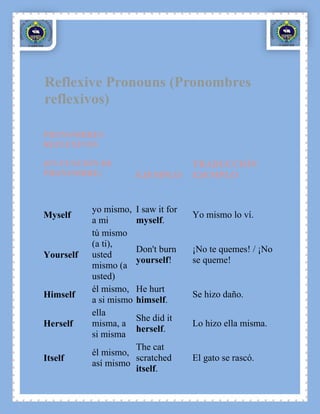
Reflexive Pronouns (Pronombres
reflexivos)

PRONOMBRES
REFLEXIVOS

(EN FUNCIÓN DE                         TRADUCCIÓN
PRONOMBRE)              EJEMPLO        EJEMPLO


           yo mismo,    I saw it for
Myself                                 Yo mismo lo ví.
           a mi         myself.
           tú mismo
           (a ti),
                        Don't burn     ¡No te quemes! / ¡No
Yourself   usted
                        yourself!      se queme!
           mismo (a
           usted)
           él mismo,    He hurt
Himself                                Se hizo daño.
           a si mismo   himself.
           ella
                        She did it
Herself    misma, a                    Lo hizo ella misma.
                        herself.
           si misma
                     The cat
           él mismo,
Itself               scratched         El gato se rascó.
           así mismo
                     itself.
nosotros      We made it    Lo hemos hecho
Ourselves
           mismos        ourselves.    nosotros mismos.
           vosotros                    ¿Pintásteis la casa
                         Did you paint
           mismos,                     vosotros mismos? /
Yourselves               the house
           ustedes                     ¿Pintaron la casa
                         yourselves?
           mismos                      ustedes mismos?
                         They were
             ellos                     Ellos hablaban
Themselves               speaking to
             mismos                    consigo mismos.
                         themselves.


Los pronombres reflexivos se usan cuando el sujeto y el
complemento del verbo son la misma cosa:
     EJEMPLOS
     I did it myself. (Lo hice a mi mismo.)
     She talks to herself. (Habla a si misma.)
     We painted the house ourselves. (Pintamos la casa
     nosotros mismos.)

Reciprocal Pronouns (Pronombres
recíprocos)
Los pronombres recíprocos se forman con las partículas
"each other." Esta forma no es reflexiva sino es una forma
recíproca. A diferencia del reflexivo, tenemos dos sujetos
diferentes que hablan el uno al otro, se miran el uno al otro,
etc.…. Nunca puede haber más de dos personas.
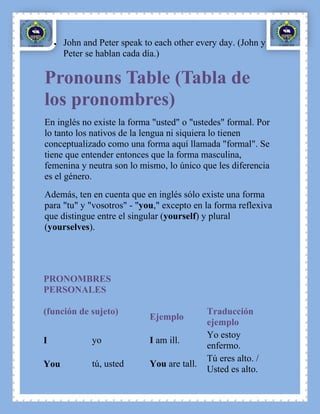
John and Peter speak to each other every day. (John y
      Peter se hablan cada día.)

Pronouns Table (Tabla de
los pronombres)
En inglés no existe la forma "usted" o "ustedes" formal. Por
lo tanto los nativos de la lengua ni siquiera lo tienen
conceptualizado como una forma aquí llamada "formal". Se
tiene que entender entonces que la forma masculina,
femenina y neutra son lo mismo, lo único que les diferencia
es el género.
Además, ten en cuenta que en inglés sólo existe una forma
para "tu" y "vosotros" - "you," excepto en la forma reflexiva
que distingue entre el singular (yourself) y plural
(yourselves).


PRONOMBRES
PERSONALES

(función de sujeto)                         Traducción
                            Ejemplo
                                            ejemplo
                                            Yo estoy
I            yo             I am ill.
                                            enfermo.
                                            Tú eres alto. /
You          tú, usted      You are tall.
                                            Usted es alto.
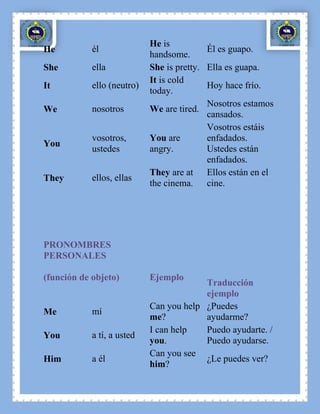
He is
He          él                             Él es guapo.
                            handsome.
She         ella            She is pretty. Ella es guapa.
                            It is cold
It          ello (neutro)                  Hoy hace frío.
                            today.
                                           Nosotros estamos
We          nosotros        We are tired.
                                           cansados.
                                           Vosotros estáis
            vosotros,       You are        enfadados.
You
            ustedes         angry.         Ustedes están
                                           enfadados.
                            They are at Ellos están en el
They        ellos, ellas
                            the cinema. cine.


PRONOMBRES
PERSONALES

(función de objeto)         Ejemplo
                                         Traducción
                                         ejemplo
                            Can you help ¿Puedes
Me          mí
                            me?          ayudarme?
                            I can help   Puedo ayudarte. /
You         a tí, a usted
                            you.         Puedo ayudarse.
                            Can you see
Him         a él                         ¿Le puedes ver?
                            him?
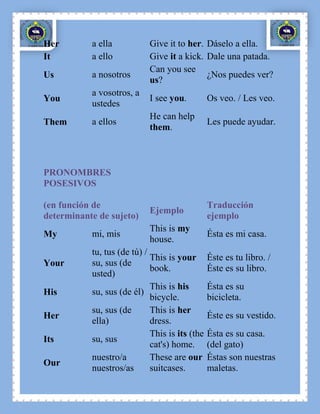
Her        a ella           Give it to her. Dáselo a ella.
It         a ello           Give it a kick. Dale una patada.
                            Can you see
Us         a nosotros                       ¿Nos puedes ver?
                            us?
           a vosotros, a
You                         I see you.          Os veo. / Les veo.
           ustedes
                            He can help
Them       a ellos                              Les puede ayudar.
                            them.


PRONOMBRES
POSESIVOS

(en función de                                  Traducción
                            Ejemplo
determinante de sujeto)                         ejemplo
                            This is my
My         mi, mis                              Ésta es mi casa.
                            house.
           tu, tus (de tú) /
                             This is your       Éste es tu libro. /
Your       su, sus (de
                             book.              Éste es su libro.
           usted)
                             This is his        Ésta es su
His        su, sus (de él)
                             bicycle.           bicicleta.
           su, sus (de       This is her
Her                                             Éste es su vestido.
           ella)             dress.
                             This is its (the   Ésta es su casa.
Its        su, sus
                             cat's) home.       (del gato)
           nuestro/a         These are our      Éstas son nuestras
Our
           nuestros/as       suitcases.         maletas.
vuestro/a,
                                          Éstos son vuestros
           vuestros/as,   These are
Your                                      asientos. Éstos
           su, sus (de    your seats.
                                          son sus asientos.
           ustedes)
           su, sus (de    These are       Éstos son sus
Their
           ellos)         their books.    libros.


PRONOMBRES
POSESIVOS


(en función de                            Traducción
                          Ejemplo
pronombre)                                ejemplo
                          This book is
Mine       mío/s, mía/s                   Este libro es mío.
                          mine
                                          ¿Este libro es
           tuyo/s, tuya/s, Is this book
Yours                                     tuyo? / ¿Este libro
           suyo/s, suya/s yours?
                                          es suyo?
           suyo/s, suya/s This bicycle is Esta bicicleta es
His
           (de él)        his.            de él.
           suyo/s, suya/s The dress is El vestido es de
Hers
           (de ella)      hers.           ella.
Its        su, sus
           nuestro/s,     The suitcases Las maletas son
Ours
           nuestra/s      are ours.       nuestras.
           vuestro/a,                     Estos asientos son
                          These seats
Yours      vuestros/as,                   vuestros. Estos
                          are yours.
           suyo/s, suya/s                 asientos son
suyos.
           suyo/a,
                            This book is   Este libro es de
           suyos/as (de
                            theirs.        ellos.
           ellos)
Theirs


PRONOMBRES
REFLEXIVOS


(en función de                             Traducción
                            Ejemplo
pronombre)                                 ejemplo


           yo mismo, a      I saw it for
Myself                                     Yo mismo lo ví.
           mi               myself.
           tú mismo (a
           ti), usted       Don't burn     ¡No te quemes! /
Yourself
           mismo (a         yourself!      ¡No se queme!
           usted)
           él mismo, a si   He hurt
Himself                                    Se hizo daño.
           mismo            himself.
           ella misma, a    She did it     Lo hizo ella
Herself
           si misma         herself.       misma.
           él mismo, así    The cat
Itself                                     El gato se rascó.
           mismo            scratched
itself.
           nosotros       We made it  Lo hemos hecho
Ourselves
           mismos         ourselves.  nosotros mismos.
           vosotros                   ¿Pintásteis la casa
                        Did you paint
           mismos,                    vosotros mismos?
Yourselves              the house
           ustedes                    / ¿Pintaron la casa
                        yourselves?
           mismos                     ustedes mismos?
                        They were
                                      Ellos hablaban
Themselves ellos mismos speaking to
                                      consigo mismos.
                        themselves.
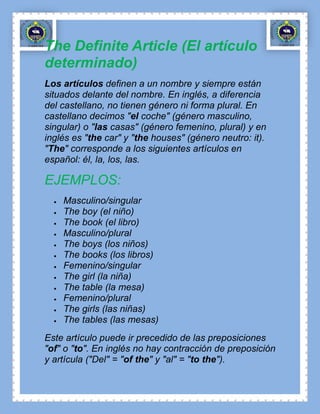
The Definite Article (El artículo
determinado)
Los artículos definen a un nombre y siempre están
situados delante del nombre. En inglés, a diferencia
del castellano, no tienen género ni forma plural. En
castellano decimos "el coche" (género masculino,
singular) o "las casas" (género femenino, plural) y en
inglés es "the car" y "the houses" (género neutro: it).
"The" corresponde a los siguientes artículos en
español: él, la, los, las.

EJEMPLOS:
    Masculino/singular
    The boy (el niño)
    The book (el libro)
    Masculino/plural
    The boys (los niños)
    The books (los libros)
    Femenino/singular
    The girl (la niña)
    The table (la mesa)
    Femenino/plural
    The girls (las niñas)
    The tables (las mesas)
Este artículo puede ir precedido de las preposiciones
"of" o "to". En inglés no hay contracción de preposición
y artícula ("Del" = "of the" y "al" = "to the").
EJEMPLOS:
   The days of the week. (Los días de la semana)
   I am going to the garden. (Me voy al jardín.)


Uses Of The Definite Article (Usos del
artículo determinado)
 1. Cuando sabemos de quién o de qué estamos
    hablando.
    Utilizamos "the" para indicar algo o alguien en
    particular, por ello se llama definido. Hablamos de
    algo o alguien concreto que tanto el emisor como
    el receptor del mensaje conocen porque ya ha
    salido anteriormente en la conversación o porque
    los dos lo conocen previamente.
EJEMPLOS:
     o   What is the name of the restaurant? (¿Cuál es
         el nombre del restaurante?)
     o   Do you remember the day we went to New
         York? (¿Recuerdas el día que fuimos a
         Nueva York?)
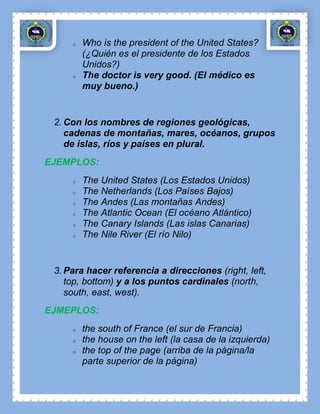
o   Who is the president of the United States?
         (¿Quién es el presidente de los Estados
         Unidos?)
     o   The doctor is very good. (El médico es
         muy bueno.)


 2. Con los nombres de regiones geológicas,
    cadenas de montañas, mares, océanos, grupos
    de islas, ríos y países en plural.
EJEMPLOS:
     o   The United States (Los Estados Unidos)
     o   The Netherlands (Los Países Bajos)
     o   The Andes (Las montañas Andes)
     o   The Atlantic Ocean (El océano Atlántico)
     o   The Canary Islands (Las islas Canarias)
     o   The Nile River (El río Nilo)


 3. Para hacer referencia a direcciones (right, left,
    top, bottom) y a los puntos cardinales (north,
    south, east, west).
EJMEPLOS:
     o   the south of France (el sur de Francia)
     o   the house on the left (la casa de la izquierda)
     o   the top of the page (arriba de la página/la
         parte superior de la página)
4. Con los adjetivos en grado superlativo y
    números ordinales:
EJEMPLOS:
     o   the tallest building (el edificio más alto)
     o   the strongest man (el hombre más fuerte)
     o   the first time (la primera vez)
     o   the second floor (la segunda planta)


When Not To Use The Definite Article
(Cuando no usamos el artículo
DETERMINADO)
 1. Cuando hablamos de algo en general.
EJEMPLOS:
     o   I like ice cream. (Me gusta el helado.)
       o Math is difficult. (Las matemáticas son

         difíciles.)
 2. Nunca utilizaremos "the" cuando nos
    referimos a la television, o cuando nos referimos
    a las horas de las comidas, los días de la semana,
    los meses del año, las estaciones, los años o la
    hora.
EJEMPLOS:
o  I do not like to watch television [TV]. (No me
        gusta ver la televisión [tele].)
      o I have an appointment on Monday. (Tengo

        una cita el lunes.)
      o We eat breakfast at 9:00. (Comemos el

        desayuno [Desayunamos] a las 9:00.)
 3. Con instituciones y modos de transporte
    cuando estamos hablando en general.
EJEMPLOS:
     o   We like school. (Nos gusta la escuela.)
       o I go to work by train. (Voy a trabajo en tren.)

       o They go to church on Sundays. (Van a la

         iglesia los domingos.)
 4. No se utiliza el artículo con nombres de
    ciudades ni nombres de lugares en general,
    aunque hay algunas excepciones como hemos
    visto en el apartado anterior. Además, no se utiliza
    el artículo con lagos o calles.
EJEMPLOS:
     o   I went to Lake Titicaca. (Fui al lago Titicaca.)
     o   She lives on Flores Street. (Vive en la calle
         Flores.)
The Indefinite Article (El
artículo indeterminado)
El significado de "a" o "an" es el mismo y se utilizan
para indicar algo o alguien en singular. Nunca lo
utilizaremos para referirnos a más de una cosa.
"A" o "an", corresponde a los siguientes artículos en
español: un, una.

Grammatical Rules (Reglas
Gramaticales)
  1. "A" se utiliza con nombres que comienzan por
     consonante.
EJEMPLOS:
       o abook (un libro)
       o apen (un bolígrafo)

       o achair (una silla)

       o agirl (una chica)

  2. "An" se usa con nombres que comienzan por
     vocal.
EJEMPLOS:
       o   ananimal (un animal)
       o   anice cream (un helado)
o   anexample (un ejemplo)
     o   anorange (una naranja)
     o   anumbrella (un paraguas)
   Excepciones:
   Usamos "a" antes de las palabras que comienzan
   por la letras "u" o "eu" cuando estas son
   pronunciadas como el sonido figurado "yu".
     o   Ejemplos:
     o   auniversity (una universidad)
     o   aeuro (un euro)
   "An" se usa con palabras que comienzan por "h",
   pero sólo cuando esta no se pronuncia.
EJEMPLOS:
     o   anhour (una hora)
     o   ahospital (un hospital)

Uses Of The Indefinite Article (Usos
del artículo indeterminado)
 1. Se utiliza para hablar de algo en general.
EJEMPLOS:
     o   He has acomputer. (El tiene un ordenador.)
     o   We work in aschool. (Trabajamos en una
         escuela.)
     o   I want anorange. (Quiero una naranja.)
2. También puedes usarlo en vez de "1".
EJEMPLOS:
     o  I want anapple and two oranges. (Quiero una
        manzana y dos naranjas.)
      o There are ahundred students in the school.

        (Hay cien estudiantes en la escuela.)
 3. Se usa para referirnos a una cosa por primera
    vez. La próxima vez que nos referimos a esta
    cosa, utilizaremos el artículo determinado.
EJEMPLO:
     o   I live in anapartment. The apartment is big.
         (Vivo en un piso. El piso es amplio.)
 4. Se usa para hablar del oficio de alguien o de
    afiliación política.
EJEMPLOS:
     o   Maria is adoctor. (María es médico.)
     o   Juan is anarchitect. (Juan es arquitecto.)
     o   I am ademocrat. (Soy demócrata.)
Prepositions (Las
preposiciones)
Las preposiciones son una de las partes de la lengua inglesa que
más cuesta aprender a los hablantes de lengua española. Por ello es
recomendable memorizar las diferentes variaciones y usos
dependiendo de si hablamos de preposiciones de lugar, movimiento
o tiempo. Veremos que muchas de las preposiciones se repiten en
los diferentes apartados. Por ello se recomienda hacer ejercicios
prácticos que sean variados y que nos ayuden a ver la diferencia
entre ellos.

En otros casos veremos que habrá expresiones que simplemente
tendremos que memorizar. Es altamente recomendable que el
alumno lea diferentes textos de diferentes fuentes para facilitar el
aprendizaje.

In / At / On
Son unas de las preposiciones más comunes que se pueden usar para
indicar lugar o tiempo: in, at and on.

IN

Significado: en, dentro, dentro de
Uso (lugar): Se usa para indicar tanto espacios cerrados como
espacios abiertos. Lo utilizamos para indicar que algo está dentro de
una cosa, en un lugar cerrado, o en el interior de algo físicamente.
Sin embargo, como vemos en los ejemplos también se utiliza para
indicar que se está en un lugar geográfico.
Ejemplos:
     I live in Brighton. (Vivo en Brighton.)
     The cat is in the box. (El gato está dentro la caja.)
     I found your address in the phone book. (He encontrado tu
     dirección en la guía telefónica.)
     My parents arrive in France on Monday. (Mis padres llegan a
     Francia el lunes.)

Uso (tiempo): Lo utilizamos con meses, años, épocas, partes del día,
y períodos de tiempo (duración).

Ejemplos:
     We went to Mexico in May. (Fuimos a Méjico en mayo.)
     I always run in the mornings. (Siempre corro por las mañanas.)
     I will see him in a week. (Le veré en una semana.)
     She was born in 1976. (Nació en 1976.)


AT
Significado: en, a, al, cerca de, tocando
Uso (lugar): Se usa delante de edificios como casas, aeropuertos,
universidades (para indicar que estamos dentro), antes de "top"
(parte superior), "bottom" (parte inferior), "the end of" (al final de),
para indicar acontecimientos como reuniones, fiestas, conciertos,
deportes, etc..., detrás de "arrive" (llegar) cuando nos referimos a
lugares que no sean ciudades o países.
Ejemplos:
     He is at home. (Él está en casa.)
     I always visit my sister at work. (Siempre visito a mi hermana
     en el trabajo.)
     We eat at the table. (Comemos en la mesa.)
     I will see him at the theatre. (Le veré en el teatro.)
     Her name is at the bottom of the page. (Su nombre está en la
     parte inferior de la página.)
     When did you arrive at the airport? (¿Cuándo llegaste al
     aeropuerto?)

Uso (tiempo): Lo utilizamos delante de la hora y de fiestas.

Ejemplos:
     He runs every morning at 6. (Él corre cada mañana a las 6.)
     I will see them at Christmas. (Les veré en Navidad.)

ON
Significado: sobre, encima de algo, tocando
Uso (lugar): Se coloca delante de nombres de lugares con base
como mesas, suelos, etc…, cuando nos referimos a lugares de una
habitación como techo o pared y para indicar que alguien está dentro
de un transporte público o en una planta de un edificio.

     Ejemplos:
     The pen is on the table. (El bolígrafo está sobre la mesa.)
     They have a photograph of Paris on the wall. (Tienen una foto
     de París en la pared.)
     I am on the bus. (Estoy en el autobús.)
     Her apartment is on the second floor. (Su piso está en la
     segunda planta.)
Uso (tiempo): Lo utilizamos con días de la semana, fechas y fiestas.

     Ejemplos:
     We went to Mexico on the first of May. (Fuimos a Méjico a
     primeros de mayo.)
     He runs on Mondays and Fridays. (Él corre los lunes y los
     viernes.)
     I will see Luis on his birthday. (Veré a Luis en su
     cumpleaños.)


Prepositions Of Place
(Preposiciones de lugar)
Las preposiciones de lugar se colocan detrás del verbo principal,
que suele ser el verbo "to be" (estar, ser) en cualquiera de los
tiempos pasados, presentes o futuros y en sus formas tanto simples
como compuestas.

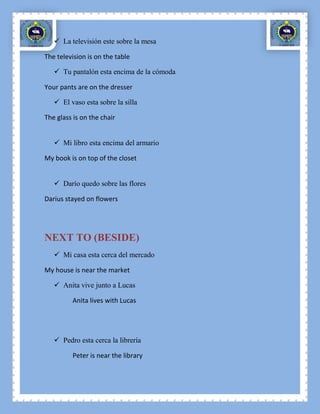
NEXT TO (BESIDE)
Significado: al lado de, junto a
Uso: Tanto "next to" como "beside" se pueden utilizar
indistintamente. Utilizar una forma u otra dependerá del hablante y
del contexto.

Ejemplos:
     The supermarket is next to (beside) the bank. (El
     supermercado está junto al banco.)
     Sit next to (beside) me. (Siéntate a mi lado.)
BY
Significado: cerca, al lado de, junto a
Uso: Se puede utilizar en los mismos contextos que "next to" pero
el significado de "by" es más como "cerca" en castellano.

     Ejemplos:
     I sit by the window. (Me siento a lado de la ventana.)
     Our house is by the river. (Nuestra casa está cerca del rio.)

BETWEEN
Significado: entre

Ejemplos:
     The shop is between the bank and the train station. (La tienda
     está entre el banco y la estación de tren.)
     She is standing between Peter and John. (Permanece de pie
     entre Pedro y Juan.)

BEHIND
Significado: detrás de

Ejemplos:
     The church is behind the school. (La iglesia está detrás de la
     escuela.)
     He is standing behind you. (Está de pie detrás de ti.)
IN FRONT OF vs. OPPOSITE
Significado: contrario, en frente de, opuesto, delante de
Usos: La diferencia entre ellos es cuando estamos hablando de
personas, "in front of" no implica estar delante y cara a cara, en
cambio "opposite" significa delante y cara a cara.

Ejemplos:
     The hotel is in front of the station. (El hotel está en frente de la
     estación.)
     The bank is opposite the market. (El banco está delante del
     mercado.)
     He is standing in front of you. (Está de pie delante de ti.)
     She is sitting opposite me. (Está sentando en frente mío.)

UNDER
Significado: debajo de

Ejemplos:
     The ball is under the chair. (La pelota está debajo la silla.)
     The dog is under the tree. (El perro está debajo del árbol.)

ABOVE
Significado: por encima sin tocar

Ejemplo:
The clock is above the table. (El reloj está por encima de la
     mesa.)

     Nota: La traducción literal puede llevar a confusión cuando la
     traducimos al castellano, ya que en castellano diríamos: "el
     reloj está colgado en la pared." Si quisiéramos especificar
     diríamos: "y por debajo en la misma pared está apoyada la
     mesa."

BELOW
Significado: por debajo sin tocar

Ejemplo:
     The table is below the clock. (La mesa está por debajo del
     reloj.)

     Nota: Como en el caso anterior, la traducción literal de
     "below" puede llevar a confusión. En este caso diríamos que la
     mesa está apoyada en la misma pared en la que se encuentra el
     reloj colgado un poco más arriba.


Prepositions Of Time
(Preposiciones de tiempo)
BEFORE

Significado: antes, antes de
Uso: Se coloca detrás de verbos y nombres o sustantivos.

Ejemplos:
Ring [call] me before one. (Llámame antes de la una.)
     They arrived before me. (Llegaron antes que yo.)

AFTER
Significado: después, después de, tras
Uso: Se coloca tras verbos y nombres o sustantivos.

Ejemplos:
     We will see you after the movie. (Te veremos después de la
     película.)
     I arrived after them. (Llegue después de ellos.)

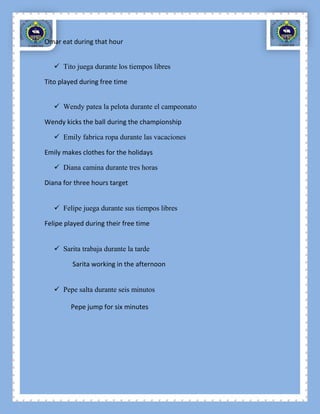
DURING
Significado: durante
Uso: Puede ir seguido de verbos y nombres o sustantivos.

Ejemplos:
     Don’t talk during the movie. (No hables durante la película.)
     I don’t like to watch television during the day. (No me gusta
     ver la televisión durante el día.)


FOR
Significado: durante
Uso: Se coloca detrás de verbos y nombres o sustantivos. Aunque
signifique lo mismo que "during" no tienen exactamente el mismo
matiz. Este se utiliza para expresar un período de tiempo ya sean
días, horas, meses o años.
Ejemplos:
     I lived in England for three years. (Viví en Inglaterra durante
     tres años.)
     He studied for the exam for one week. (Estudié para el examen
     durante una semana.


WHILE
Significado: mientras
Uso: Se coloca tras verbos y nombres o sustantivos.

Ejemplos:
     I will work while I can. (Trabajaré mientras pueda.)
     He called while we were out. (Llamó mientras estábamos
     fuera.)


Prepositions of Direction/Movement
(Preposiciones de
direccion/movimiento)
TO

Significado: hacia, dirección a (siempre indica movimiento)
Uso: Se coloca detrás de los verbos de movimiento como ir, venir,
volver, caminar, volar, etc…
Ejemplos:
     They came to the wedding. (Vinieron a la boda.)
     Sofia flew to Canada. (Sofia voló a Canadá.)

Nota: Existen más preposiciones de cada grupo que estudiáremos en
próximas lecciones.


Nouns (Los nombres)
Los nombres se usan para referirse a personas, animales, cosas y
objetos, eventos, lugares o ideas abstractas. Como hemos visto en la
lección sobre los artículos, los nombres no tienen género.

EJEMPLOS:
     teacher (profesor)
     dog (perro)
     ball (pelota)
     table (mesa)
     party (fiesta)
     house (casa)
     happiness (felicidad)
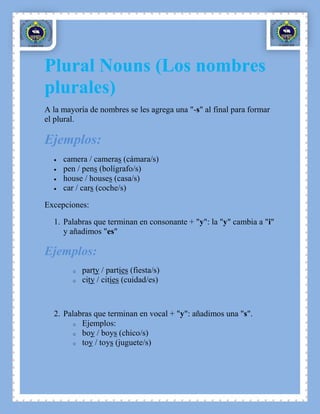
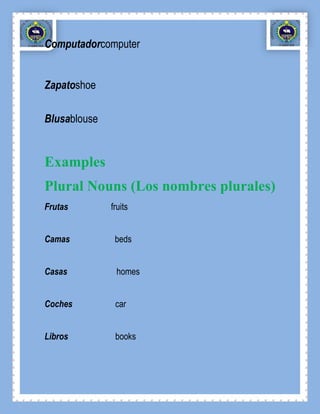
Plural Nouns (Los nombres
plurales)
A la mayoría de nombres se les agrega una "-s" al final para formar
el plural.

Ejemplos:
     camera / cameras (cámara/s)
     pen / pens (bolígrafo/s)
     house / houses (casa/s)
     car / cars (coche/s)

Excepciones:

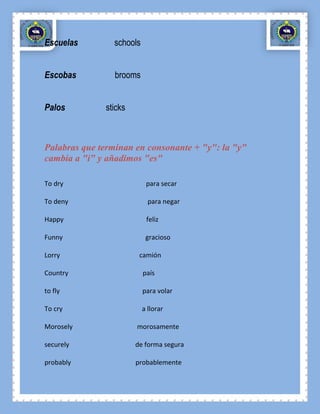
  1. Palabras que terminan en consonante + "y": la "y" cambia a "i"
     y añadimos "es"

Ejemplos:
        o   party / parties (fiesta/s)
        o   city / cities (cuidad/es)


  2. Palabras que terminan en vocal + "y": añadimos una "s".
       o Ejemplos:
       o boy / boys (chico/s)
       o toy / toys (juguete/s)
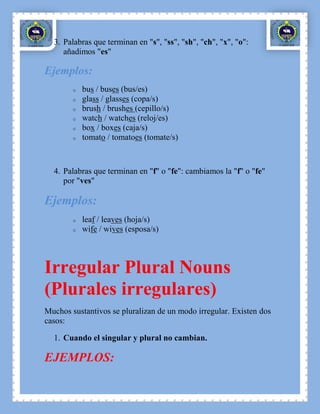
3. Palabras que terminan en "s", "ss", "sh", "ch", "x", "o":
     añadimos "es"

Ejemplos:
        o   bus / buses (bus/es)
        o   glass / glasses (copa/s)
        o   brush / brushes (cepillo/s)
        o   watch / watches (reloj/es)
        o   box / boxes (caja/s)
        o   tomato / tomatoes (tomate/s)


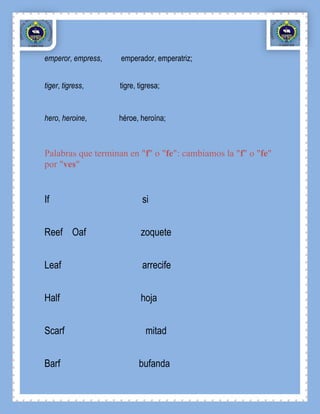
  4. Palabras que terminan en "f" o "fe": cambiamos la "f" o "fe"
     por "ves"

Ejemplos:
        o   leaf / leaves (hoja/s)
        o   wife / wives (esposa/s)


Irregular Plural Nouns
(Plurales irregulares)
Muchos sustantivos se pluralizan de un modo irregular. Existen dos
casos:

  1. Cuando el singular y plural no cambian.

EJEMPLOS:
Singular
      o   fish (pez o pescado)
      o   sheep (oveja)

Plural
      o   fish (peces o pescados)
      o   fishes
      o   sheep (ovejas)
      o   sheeps


 2. Cuando el plural varía de modo irregular. Por lo tanto, no
    existe regla la cual se pueda seguir y hay que aprenderse las
    formas irregulares de cada uno.


SINGULAR SIGNIFICADO PLURAL SIGNIFICADO
   man              hombre            men            hombres
  woman              mujer           women           mujeres
   child              niño          children           niños
  person            persona          people       personas/gente
   tooth             diente           teeth           dientes
    foot               pie             feet             pies
  mouse              ratón            mice            ratones
Verbs (Los verbos)
Los verbos son palabras que indican acciones, existencia (ser/estar), posesión
(tener) o ánimo.

En inglés, usamos la preposición "to" para formar el infinitivo, por ejemplo: "to
talk" (hablar), "to eat" (comer), "to change" (cambiar), etc.

Los verbos son la parte de la oración más complicada. Hay muchos tipos de
verbos. El verbo puede indicar la acción principal. Un verbo auxiliar añade detalle
a la acción o ayuda el verbo principal (también se llaman "verbos
complementarios"). Los verbos modales añaden modalidad. Los verbos transitivos
conectan un sujeto con un objeto. Otros verbos sólo necesitan un sujeto (verbos
intransitivos). Hay verbos que están compuestos de más de una palabra (verbos
frasales). Los verbos pueden ser activos o pasivos. Por ahora y en este nivel, nos
concentraremos en los usos de los verbos principales y auxiliares.

Además de los muchos tipos y usos de los verbos, necesitamos conjugar verbos.
La conjugación de los verbos depende del sujeto y del tiempo. En las siguientes
lecciones y niveles, hay explicaciones para las conjugaciones del tiempo. En este
nivel, sólo vamos a estudiar el tiempopresente simple de los verbos.

Algunos de los verbos más comunes en inglés:

       To be (ser/estar)
       To have (tener/haber)
       To do (hacer)
       To make (hacer)
       To take (tomar/coger)
       To get (conseguir)
       To go (ir)
       To come (venir)
       To leave (salir/irse)
       To know (saber/conocer)
       To like (gustar)
       To want (querer)
       To feel (sentirse)
       To begin (empezar)
       To end, finish (acabar/terminar)
       To stay (quedarse)
       To change (cambiar)
       To wait (esperar)
       To put (poner)
       To be able (poder)
       To think (pensar)
       To believe (creer)
To hope, wish (esperar)
      To look (mirar)
      To see (ver)
      To call (US) / To ring (UK) (llamar)
      To read (leer)
      To write (escribir)
      To listen (escuchar)
      To eat (comer)
      To drink (beber)
      To learn (aprender)
      To teach (enseñar)


EJEMPLOS
 Auxiliary Verbs (Verbos auxiliares)
Hay tres verbos importantes en inglés que se pueden usar como verbos
principales o verbos auxiliares: "to be", "to have" y "to do". Dependiendo del uso,
el significado cambia pero la conjugación es siempre la misma.

To be (ser/estar)

Como en español, este verbo es muy importante y lo usamos mucho. Al mismo
tiempo, es un verbo irregular en todos los tiempos. Además, la construcción de
frases negativas e interrogativas es diferente a como construimos las de los otros
verbos, como veremos en la lección de construir frases. También, usamos este
verbo para construir el presente continuo, como veremos luego. Por lo tanto, es
importante entender bien la conjugación de este verbo.

                    Sujeto                   Presente simple
                    I                        am
                    You, We, They            are
                    He, She, It              is


To have (haber)
Este verbo significa "tener" cuando lo usamos como verbo principal y significa
"haber" cuando se usa como verbo auxiliar. Aprenderemos más sobre el uso del
verbo "to have" como auxiliar en la lección sobre pretérito perfecto. Por ahora es
importante tener en cuenta que se puede usar este verbo en las dos situaciones y
es un verbo irregular
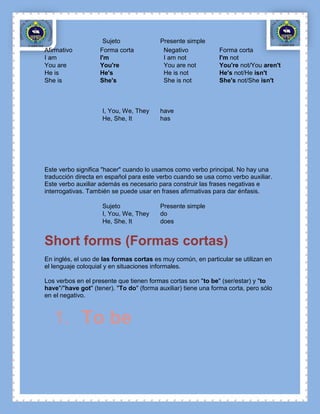
Sujeto               Presente simple
Afirmativo          Forma corta            Negativo            Forma corta
I am                I'm                    I am not            I'm not
You are             You're                 You are not         You're not/You aren't
He is               He's                   He is not           He's not/He isn't
She is              She's                  She is not          She's not/She isn't


                     I, You, We, They     have
                     He, She, It          has


To do
Este verbo significa "hacer" cuando lo usamos como verbo principal. No hay una
traducción directa en español para este verbo cuando se usa como verbo auxiliar.
Este verbo auxiliar además es necesario para construir las frases negativas e
interrogativas. También se puede usar en frases afirmativas para dar énfasis.

                     Sujeto               Presente simple
                     I, You, We, They     do
                     He, She, It          does


Short forms (Formas cortas)
En inglés, el uso de las formas cortas es muy común, en particular se utilizan en
el lenguaje coloquial y en situaciones informales.

Los verbos en el presente que tienen formas cortas son "to be" (ser/estar) y "to
have"/"have got" (tener). "To do" (forma auxiliar) tiene una forma corta, pero sólo
en el negativo.


   1. To be
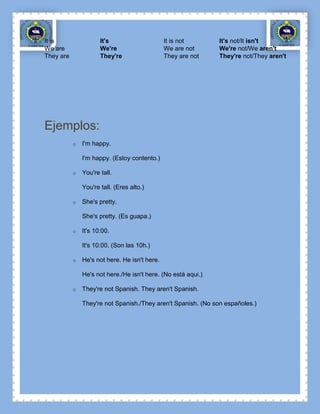
It is                 It's                     It is not       It's not/It isn't
We are                We're                    We are not      We're not/We aren't
They are              They're                  They are not    They're not/They aren't


Ejemplos:
           o   I'm happy.

               I'm happy. (Estoy contento.)

           o   You're tall.

               You're tall. (Eres alto.)

           o   She's pretty.

               She's pretty. (Es guapa.)

           o   It's 10:00.

               It's 10:00. (Son las 10h.)

           o   He's not here. He isn't here.

               He's not here./He isn't here. (No está aqui.)

           o   They're not Spanish. They aren't Spanish.

               They're not Spanish./They aren't Spanish. (No son españoles.)
2.        To have/have got
Afirmativo                Forma corta           Negativo                  Forma corta
I have                    I've                  I have not                I've not/I haven't
You have                  You've                You have not              You've not/You haven't
He has                    He's                  He has not                He's not/He hasn't
She has                   She's                 She has not               She's not/She hasn't
It has                    It's                  It has not                It's not/It hasn't
We have                   We've                 We have not               We've not/We haven't
They have                 They've               They have not             They've not/They haven't


       Ejemplos:
                   o   I've got a car.

                       I've got a car.(Tengo un coche.)

                   o   You've got blue eyes.

                       You've got blue eyes. (Tienes ojos azules.)

                   o   He's got big feet.

                       He's got big feet. (Tiene pies grandes.)

                   o   It's not got a home. It hasn't got a home.

                       It's [the cat] not got a home./It hasn't got a home. (No tiene casa.)

                   o   They've not got children. They haven't got children.

                       They've not got children./They haven't got children. (No tienen hijos.)

             3. Nota: Para "have got" solemos usar la forma corta en el presente en vez
                de la forma larga. No usamos la forma corta de "to have" para indicar
                posesión. Veremos ejemplos del uso de la forma corta de "to have" en la
                lección del presente perfecto.
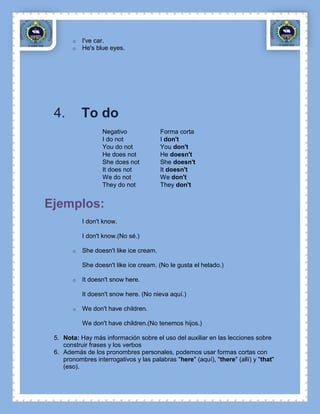
                   o Para indicar posesión, no podemos decir:
o   I've car.
        o   He's blue eyes.


 4.         To do
                   Negativo               Forma corta
                   I do not               I don't
                   You do not             You don't
                   He does not            He doesn't
                   She does not           She doesn't
                   It does not            It doesn't
                   We do not              We don't
                   They do not            They don't


Ejemplos:
            I don't know.

            I don't know.(No sé.)

        o   She doesn't like ice cream.

            She doesn't like ice cream. (No le gusta el helado.)

        o   It doesn't snow here.

            It doesn't snow here. (No nieva aquí.)

        o   We don't have children.

            We don't have children.(No tenemos hijos.)

 5. Nota: Hay más información sobre el uso del auxiliar en las lecciones sobre
    construir frases y los verbos
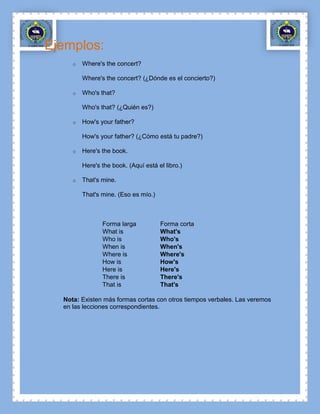
 6. Además de los pronombres personales, podemos usar formas cortas con
    pronombres interrogativos y las palabras "here" (aquí), "there" (allí) y "that"
    (eso).
Ejemplos:
     o   Where's the concert?

         Where's the concert? (¿Dónde es el concierto?)

     o   Who's that?

         Who's that? (¿Quién es?)

     o   How's your father?

         How's your father? (¿Cómo está tu padre?)

     o   Here's the book.

         Here's the book. (Aquí está el libro.)

     o   That's mine.

         That's mine. (Eso es mío.)


                Forma larga           Forma corta
                What is               What's
                Who is                Who's
                When is               When's
                Where is              Where's
                How is                How's
                Here is               Here's
                There is              There's
                That is               That's

  Nota: Existen más formas cortas con otros tiempos verbales. Las veremos
  en las lecciones correspondientes.
Continuous Verb Tenses
(Tiempos continuos de los
verbos)
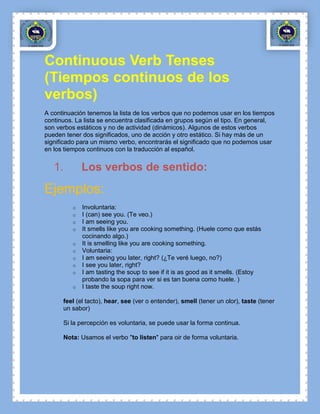
A continuación tenemos la lista de los verbos que no podemos usar en los tiempos
continuos. La lista se encuentra clasificada en grupos según el tipo. En general,
son verbos estáticos y no de actividad (dinámicos). Algunos de estos verbos
pueden tener dos significados, uno de acción y otro estático. Si hay más de un
significado para un mismo verbo, encontrarás el significado que no podemos usar
en los tiempos continuos con la traducción al español.


   1.        Los verbos de sentido:
Ejemplos:
         o   Involuntaria:
         o   I (can) see you. (Te veo.)
         o   I am seeing you.
         o   It smells like you are cooking something. (Huele como que estás
             cocinando algo.)
         o   It is smelling like you are cooking something.
         o   Voluntaria:
         o   I am seeing you later, right? (¿Te veré luego, no?)
         o   I see you later, right?
         o   I am tasting the soup to see if it is as good as it smells. (Estoy
             probando la sopa para ver si es tan buena como huele. )
         o   I taste the soup right now.

      feel (el tacto), hear, see (ver o entender), smell (tener un olor), taste (tener
      un sabor)

      Si la percepción es voluntaria, se puede usar la forma continua.

      Nota: Usamos el verbo "to listen" para oir de forma voluntaria.
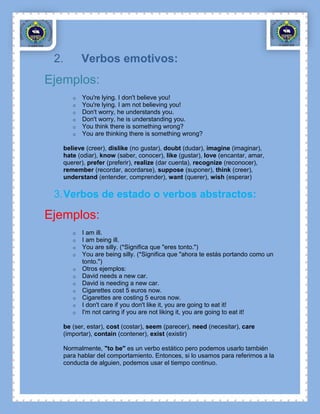
2.       Verbos emotivos:
Ejemplos:
      o   You're lying. I don't believe you!
      o   You're lying. I am not believing you!
      o   Don't worry, he understands you.
      o   Don't worry, he is understanding you.
      o   You think there is something wrong?
      o   You are thinking there is something wrong?

   believe (creer), dislike (no gustar), doubt (dudar), imagine (imaginar),
   hate (odiar), know (saber, conocer), like (gustar), love (encantar, amar,
   querer), prefer (preferir), realize (dar cuenta), recognize (reconocer),
   remember (recordar, acordarse), suppose (suponer), think (creer),
   understand (entender, comprender), want (querer), wish (esperar)

 3. Verbos de estado o verbos abstractos:

Ejemplos:
      o   I am ill.
      o   I am being ill.
      o   You are silly. (*Significa que "eres tonto.")
      o   You are being silly. (*Significa que "ahora te estás portando como un
          tonto.")
      o   Otros ejemplos:
      o   David needs a new car.
      o   David is needing a new car.
      o   Cigarettes cost 5 euros now.
      o   Cigarettes are costing 5 euros now.
      o   I don't care if you don't like it, you are going to eat it!
      o   I'm not caring if you are not liking it, you are going to eat it!

   be (ser, estar), cost (costar), seem (parecer), need (necesitar), care
   (importar), contain (contener), exist (existir)

   Normalmente, "to be" es un verbo estático pero podemos usarlo también
   para hablar del comportamiento. Entonces, si lo usamos para referirnos a la
   conducta de alguien, podemos usar el tiempo continuo.
4.         Verbos de posesión:
Ejemplos:
          o   I have [I've got] a car.
          o   I am having a car.
          o   I am having dinner right now.
          o   I have dinner right now.
          o   Otros ejemplos:
          o   Ann owned a house when she lived in New York.
          o   Ann was owning a house when she lived in New York.
          o   That belongs to me!
          o   That is belonging to me!

      belong (pertenecer), have (poseer), possess (poseer), own (poseer)

      Cuando usamos "to have" para refirirnos a algo que poseemos (una cosa,
      una cantidad, etc.), no podemos usarlo en el tiempo continuo. Pero si es
      parte de una expresión, podemos usarlo en el continuo.


   5.         Verbos de comunicación:
      agree (acordar), astonish (asombrar), deny (negar), disagree (no estar de
      acuerdo), impress (impresionar), mean (significar), please (agradar),
      promise (prometer), satisfy (satisfacer), surprise (sorprender)


Ejemplos:
      I disagree, I think it's a great idea.
      I am disagreeing, I am thinking it's a great idea.
      You suprised me!
      You were surprising me!


  Constructing Sentences
    (Construir frases)
Hay tres tipos de frases: afirmativas, negativas e interrogativas. La estructura de
estas frases es diferente.
Affirmative Sentences (Frases afirmativas)

Estructura Sujeto + verbo + nombre, adjetivo...

Ejemplos:
      I'm happy. (Estoy contento.)
      She likes ice cream. (Le gusta el helado.)
      We live in Madrid. (Vivimos en Madrid.)
      They have [they've got] a car. (Tienen un coche.)

Negative Sentences (Frases negativas)

Dependiendo del verbo, hay dos formas para construir frases negativas:

   1. Como regla general, para construir frases negativas necesitamos el
      verbo auxiliar "to do". Conjugamos el verbo auxiliar ("to do") en frases
      negativas. El verbo principal es en la forma infinitiva.

      Estructura Sujeto + verbo auxiliar ("to do") + auxiliar negativo
      + verbo principal + nombre, adjetivo...


Ejemplos
          o   She doesn't like ice cream. (No le gusta el helado.)
          o   We don't live in Madrid. (No vivimos en Madrid.)
          o   They don't have [haven't got] a car. (No tienen un coche.)

      Nota a tener en cuenta con los verbos "have" y "have got".
      Los dos verbos significan "tener". La única diferencia está en el uso del
      auxiliar en el momento de hacer frases interrogativas o frases negativas. En
      la forma "have got" el verbo "have" ya hace de auxiliar, pero el verbo
      "have" sí necesita el auxiliar "to do" para construir la frase negativa e
      interrogativa.

   2. Con los verbos "to be" (ser/estar) y "have got" (tener) no necesitamos
      un auxiliar adicional para hacer negaciones. Ten en cuenta que con el
      verbo "have got" la partícula negativa se coloca entre "have" y "got".

      EstructuraSujeto + verbo + auxiliar negativo + nombre, adjetivo...


Ejemplos
          o   I'm not happy. (No estoy contento.)
o   They've not [they haven't] got a car. (No tienen un coche.)


Interrogative Sentences
(Frases interogativas)
Como en las frases negativas, hay dos formas de frases interrogativas.

   1. Como regla general, necesitamos el verbo auxiliar ("to do") para
      construir frases interrogativas. Como con las frases negativas,
      conjugamos el verbo auxiliar ("to do") y el verbo principal es en la forma
      infinitiva.

      Estructura Verbo auxiliar ("to do") + sujeto + verbo + nombre, adjetivo...

Ejemplos
          o Does she like ice cream? (¿Le gusta el helado?)
          o Do you live in Madrid? (¿Vives en Madrid?)
          o Do they have a car? (¿Tienen un coche?)
   2. Con los verbos "to be" (ser/estar) y "have got" (tener).

      Estructura Verbo + sujeto + nombre, adjetivo...

          o   Ejemplos
          o   Is he happy? (¿Está contento?)
          o   Have they got a car? (¿Tienen un coche?)

Imperative Sentences (Frases imperativas)

Imperative Sentences (Frases imperativas)
En inglés no se usa el imperativo tanto como en el español. En general, se usa
para dar órdenes, instrucciones o advertencias. Las frases imperativas se
construyen de manera diferente a las afirmativas: no se utiliza un sujeto porque se
supone que el sujeto es siempre "you" y el verbo principal es en la forma infinitiva.
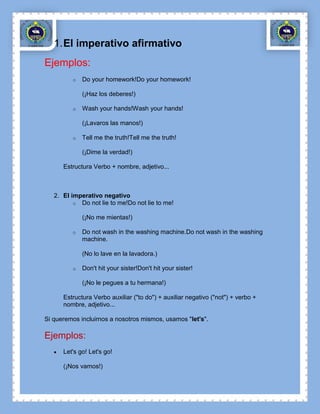
1. El imperativo afirmativo
Ejemplos:
         o   Do your homework!Do your homework!

             (¡Haz los deberes!)

         o   Wash your hands!Wash your hands!

             (¡Lavaros las manos!)

         o   Tell me the truth!Tell me the truth!

             (¡Dime la verdad!)

      Estructura Verbo + nombre, adjetivo...


   2. El imperativo negativo
          o Do not lie to me!Do not lie to me!

             (¡No me mientas!)

         o   Do not wash in the washing machine.Do not wash in the washing
             machine.

             (No lo lave en la lavadora.)

         o   Don't hit your sister!Don't hit your sister!

             (¡No le pegues a tu hermana!)

      Estructura Verbo auxiliar ("to do") + auxiliar negativo ("not") + verbo +
      nombre, adjetivo...

Si queremos incluirnos a nosotros mismos, usamos "let's".

Ejemplos:
      Let's go! Let's go!

      (¡Nos vamos!)
Let's not fight. Let's not fight.

   (No nos peleemos.)


3. Constructing Sentences
  (Construir frases)


4. Lección gramática: Constructing Sentences
5. Completa las siguientes cuestiones y haz clic en el botón -Corregir

6. Ejercicio- para obtener la corrección de este ejercicio.
8. Q1 of 12: happy/you/are
9.
10. Q2 of 12: lives/she/New York/in
11.
12. Q3 of 12: don't/like/I/ice cream
13.
14. Q4 of 12: a/they/dog/got/have
15.
16. Q5 of 12: not/is/tired/he
17.
18. Q6 of 12: we/Spain/don't/live/in
19.
20. Q7 of 12: got/car/has/he/a/?
21.
22. Q8 of 12: are/happy/?/they
23.
24. Q9 of 12: hands/your/wash/!
25.
26. Q10 of 12: does/like/he/?/dogs
27.
28. Q11 of 12: lie/me/!/don't/to
29.
30. Q12 of 12: go/cinema/the/let's/to
Present Simple (Presente simple)


 Ver tabla de conjugacion: Present Simple


Grammatical Rules
(Reglas gramaticales)
Form (Forma)

Para conjugar el presente simple usamos el inifinitivo para los sujetos "I", "you",
"we" y "they" y para las terceras personas "he", "she" y "it", añadimos un "-s" al
final del verbo.

Nota: Ten en cuenta que los verbos que terminen en "-o" añadimos "-es".

              Sujeto                        Conjugación
              I, You, We, They              talk, eat, learn, do, go...
                                            talks, eats, learns, does,
              He, She, It
                                            goes...

Structure (Estructura)
    1. Affirmative Sentences (Frases afirmativas)
Ejemplos:
             o    I talk

                  I talk. (Yo hablo.)

             o    He eats

                  He eats. (Él come.)

             o    They learn.
They learn. (Ellos aprenden.)

   Estructura Sujeto + verbo principal.

 2. Negative Sentences (Frases negativas)
   Estructura Sujeto + verbo auxiliar ("to do") + auxiliar negativo ("not") + verbo
   principal.


Ejemplos:
      o   I do not talk.

          I do not [don't] talk. (Yo no hablo.)

      o   He does not eat.

          He does not [doesn't] eat. (Él no come.)

      o   They do not learn.

          They do not [don't] learn. (Ellos no aprenden.)

   Nota: En frases negativas, el verbo auxiliar ("to do") cambia y el verbo
   principal es en el infinitivo.


 3. Interrogative Sentences
  (Frases interagotivas)
Ejemplos:
      o   Do you talk?

          Do you talk? (¿Hablas tú?)

      o   Does he eat?

          Does he eat? (¿Come él?)

      o   Do they learn?
Do they learn? (¿Aprenden ellos?)

    Estructura Verbo auxiliar ("to do") + sujeto + verbo principal?

    Nota: Como en frases negativas, en frases interrogativas el verbo auxiliar
    ("to do") cambia y el verbo principal es en el infinitivo.


Uses (Usos)
  1. El presente simple se utiliza para hablar de cosas que suceden
     habitualmente. A diferencia a español, no se usa el presente simple para
     hablar sobre algo que está pasando en el momento en el que hablamos.

Ejemplos:
       o   I always talk to my mother on Sunday.

           I always talk to my mother on Sunday. (Siempre hablo con mi madre
           el domingo.)

       o   He never eats vegetables.

           He never eats vegetables. (Nunca come las verduras.)

       o   They learn something new in class.They usually learn something new
           in class. (Normalmente aprenden algo nuevo en la clase.)

    Se suele utilizar el presente simple con adverbios de tiempo:

    Always (siempre), everyday (cada día), usually (normalmente), often (a
    menudo), sometimes (a veces), rarely (raramente), hardly ever (casi
    nunca), never (nunca)...

    Excepción:

    Los adverbios de tiempo van delante del verbo, excepto el verbo "to be"
    (ser/estar). Cuando se usa "to be" el verbo va delante del adverbio.


Ejemplos:
       o   I am always happy.

           I am always happy. (Siempre estoy contento.)
o   He is often sick.

            He is often sick. (A menudo él está enfermo.)

        o   They are rarely late.

            They are rarely late. (En raras ocasiones llegan tarde.)


  2.   Se utiliza para hablar de
       generalidades o hechos científicos.
Ejemplos:
        o   He does not eat vegetables.

            He does not [doesn't] eat vegetables. (Él no come verduras.)

        o   She works in a hospital.

            She works in a hospital. (Ella trabaja en una hospital.)

        o   Elephants live in Africa.

            Elephants live in Africa. (Los elefantes viven en África.)

        o   Bogata is in Columbia

            Bogata is in Columbia. (Bogotà está en Colombia.)

        o   Do children like animals?

            Do children like animals? (¿Les gustan a los niños los animales?)

        o   Adults do not know everything.

            Adults do not [don't] know everything. (Los adultos no lo saben todo.)

  3.   Se usa para eventos programados en el futuro
       próximo.

Ejemplos:
o   The train leaves at 10:00.

        The train leaves at 10:00. (El tren sale a las 10h.)

    o   The party is tonight.

        The party is tonight. (La fiesta es esta noche.)

    o   Does the festival start tomorrow?

        Does the festival start tomorrow? (¿Empieza el festival mañana?)

    o   The plane does not arrive today.

        The plane does not [doesn't] arrive today. (El avión no llega hoy.)


 4. Se usa para instruciones (el
   imperativo).
Ejemplos:
    o   Open the window.

        Open the window. (Abre la ventana.)

    o   Eat the vegetables.

        Eat the vegetables. (Come las verduras.)

    o   Don't cry.

        Don't cry. (No llores.)

    o   Do your homework.

        Do your homework. (Haz los deberes.)

    o   Call your mother.

        Call your mother. (Llama a tu madre.)
Present Continuous (Presente
continuo)
 Ver tabla de conjugacion: Present Continuous


Grammatical Rules (Reglas
gramaticales)
Form (Forma)

Para formar el presente continuo se utiliza el verbo auxiliar "to be" y el gerundio
(infinitivo + "-ing") del verbo.

           Sujeto                               Auxiliar (to be)   Gerundio
                                                                   talking, eating,
           I                                    am                 learning, doing,
                                                                   going...
                                                                   talking, eating,
           He, She, It                          is                 learning, doing,
                                                                   going...
                                                                   talking, eating,
           You, We, They                        are                learning, doing,
                                                                   going...
Structure (Estructura)

  1. Affirmative Sentences (Frases afirmativas)
Ejemplos:
          o   I'm talking. (Estoy hablando.)
          o   He's eating. (Está comiendo.)
          o   They're learning. (Están aprendiendo.)

       Estructura Sujeto + verbo auxiliar ("to be") + gerundio.

  2. Negative Sentences (Frases negativas)

Ejemplos:
          o   I'm not talking. (No estoy hablando.)
          o   He's not [He isn't] eating. (No está comiendo.)
          o   They're not [They aren't] learning. (No están aprendiendo.)

       Estructura Sujeto + verbo auxiliar ("to be") + auxiliar negativo ("not") +
       gerundio.


  3.   Interrogative Sentences (Frases
       interrogativas)
Ejemplos:
          o   Are you talking? (¿Estás hablando?)
          o   Is he eating? (¿Está comiendo?)
          o   Are they learning? (¿Están aprendiendo?)

       Verbo auxiliar ("to be") + sujeto + gerundio?

Uses (Usos)
  1. El presente continuo se utiliza para hablar sobre algo que está
     pasando en el momento en el que hablamos.
Ejemplos:
           o   I'm studying now. (Estoy estudiando ahora.)
           o   He's eating at the moment. (Está comiendo en este momento.)
           o   Is it raining? (¿Está lloviendo?)
   2.   También lo usamos para hablar de algo
        que está sucediendo en la actualidad pero
        no necesariamente cuando hablamos.
Ejemplos:
           o   They're learning English. (Están aprendiendo inglés.)
           o   She's currently looking for a job. (Actualmente está buscando un
               trabajo.)
           o   Are you working? (¿Estás trabajando?)
   3. Usamos el presente continuo para hablar de
      algo que está ya decidido que se hará en el
      futuro próximo.
Ejemplos:
           o   I'm going to the party tonight. (Voy a la fiesta esta noche.)
           o   He's not [He isn't] coming to class tomorrow. (No viene a la clase
               manaña.)
           o   Are you working next week? (¿Trabajas la semana que viene?)

Nota: Hay unos verbos que no solemos usar en los tiempos continuos. Hay
excepciones, depende en que sentido estamos usando el verbo. Puedes consultar
la lista de verbos de tiempos continuos y su explicación.

be, want, need, know, prefer, remember, understand, care, see, hear, smell,
believe, belong, cost, seem, exist, own, belong, like, dislike, love, hate, fear, envy,
mind...


Ejemplos
        David is needing a new car.
        David needs a new car.
        Present Simple (Presente simple)
        Lección gramática: Present Simple
Completa las siguientes cuestiones y haz clic en el botón -Corregir


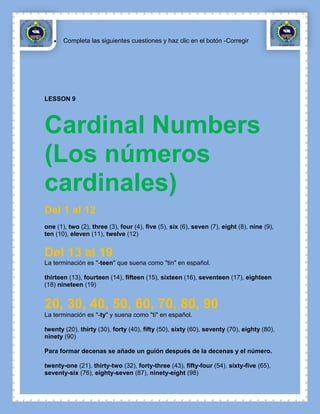
LESSON 9


Cardinal Numbers
(Los números
cardinales)
Del 1 al 12
one (1), two (2), three (3), four (4), five (5), six (6), seven (7), eight (8), nine (9),
ten (10), eleven (11), twelve (12)


Del 13 al 19
La terminación es "-teen" que suena como "tin" en español.

thirteen (13), fourteen (14), fifteen (15), sixteen (16), seventeen (17), eighteen
(18) nineteen (19)


20, 30, 40, 50, 60, 70, 80, 90
La terminación es "-ty" y suena como "ti" en español.

twenty (20), thirty (30), forty (40), fifty (50), sixty (60), seventy (70), eighty (80),
ninety (90)

Para formar decenas se añade un guión después de la decenas y el número.

twenty-one (21), thirty-two (32), forty-three (43), fifty-four (54), sixty-five (65),
seventy-six (76), eighty-seven (87), ninety-eight (98)
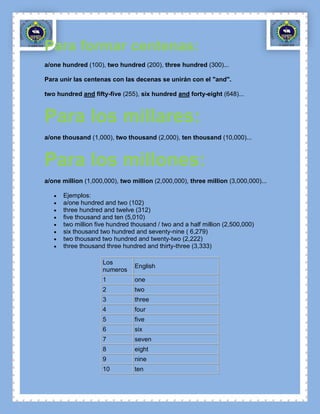
Para formar centenas:
a/one hundred (100), two hundred (200), three hundred (300)...

Para unir las centenas con las decenas se unirán con el "and".

two hundred and fifty-five (255), six hundred and forty-eight (648)...


Para los millares:
a/one thousand (1,000), two thousand (2,000), ten thousand (10,000)...


Para los millones:
a/one million (1,000,000), two million (2,000,000), three million (3,000,000)...

      Ejemplos:
      a/one hundred and two (102)
      three hundred and twelve (312)
      five thousand and ten (5,010)
      two million five hundred thousand / two and a half million (2,500,000)
      six thousand two hundred and seventy-nine ( 6,279)
      two thousand two hundred and twenty-two (2,222)
      three thousand three hundred and thirty-three (3,333)

                    Los
                                English
                    numeros
                    1           one
                    2           two
                    3           three
                    4           four
                    5           five
                    6           six
                    7           seven
                    8           eight
                    9           nine
                    10          ten
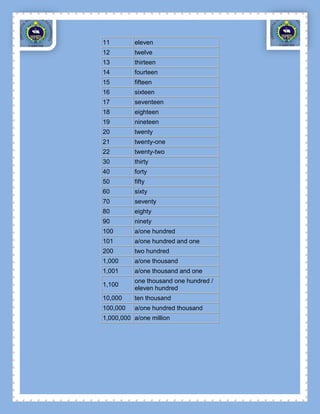
11        eleven
12        twelve
13        thirteen
14        fourteen
15        fifteen
16        sixteen
17        seventeen
18        eighteen
19        nineteen
20        twenty
21        twenty-one
22        twenty-two
30        thirty
40        forty
50        fifty
60        sixty
70        seventy
80        eighty
90        ninety
100       a/one hundred
101       a/one hundred and one
200       two hundred
1,000     a/one thousand
1,001     a/one thousand and one
          one thousand one hundred /
1,100
          eleven hundred
10,000    ten thousand
100,000   a/one hundred thousand
1,000,000 a/one million
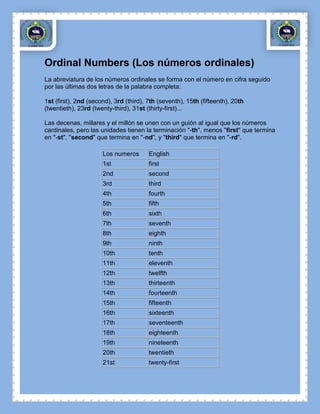
Ordinal Numbers (Los números ordinales)
La abreviatura de los números ordinales se forma con el número en cifra seguido
por las últimas dos letras de la palabra completa:

1st (first), 2nd (second), 3rd (third), 7th (seventh), 15th (fifteenth), 20th
(twentieth), 23rd (twenty-third), 31st (thirty-first)...

Las decenas, millares y el millón se unen con un guión al igual que los números
cardinales, pero las unidades tienen la terminación "-th", menos "first" que termina
en "-st", "second" que termina en "-nd", y "third" que termina en "-rd".

                      Los numeros       English
                      1st               first
                      2nd               second
                      3rd               third
                      4th               fourth
                      5th               fifth
                      6th               sixth
                      7th               seventh
                      8th               eighth
                      9th               ninth
                      10th              tenth
                      11th              eleventh
                      12th              twelfth
                      13th              thirteenth
                      14th              fourteenth
                      15th              fifteenth
                      16th              sixteenth
                      17th              seventeenth
                      18th              eighteenth
                      19th              nineteenth
                      20th              twentieth
                      21st              twenty-first
22nd          twenty-second
                  30th          thirtieth
                  40th          fortieth
                  50th          fiftieth
                  60th          sixtieth
                  70th          seventieth
                  80th          eightieth
                  90th          ninetieth
                  100th         hundredth
                  101st         hundred and first
                  200th         two hundredth
                  1,000th       thousandth
                  10,000th      ten thousandth
                  100,000th     hundred thousandth
                  1,000,000th   millionth


The Date (La fecha)
Vocaulary (Vocabulario)

                  English                    Español
                  day                        día
                  daily                      diario
                  today                      hoy
                  tonight                    esta noche
                  yesterday                  ayer
                  tomorrow                   manaña
                  week                       semana
                  weekly                     semanal
                                             fin de
                  weekend
                                             semana
                  month                      mes
                  monthly                    mensual
                  year                       año
                  yearly                     anual
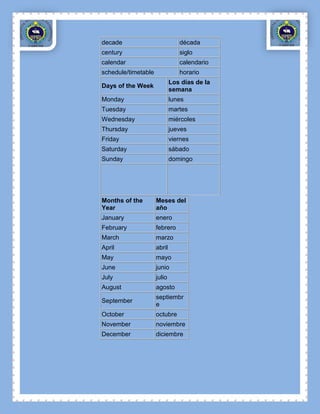
decade                          década
century                         siglo
calendar                        calendario
schedule/timetable              horario
                             Los días de la
Days of the Week
                             semana
Monday                       lunes
Tuesday                      martes
Wednesday                    miércoles
Thursday                     jueves
Friday                       viernes
Saturday                     sábado
Sunday                       domingo


Months of the        Meses del
Year                 año
January              enero
February             febrero
March                marzo
April                abril
May                  mayo
June                 junio
July                 julio
August               agosto
                     septiembr
September
                     e
October              octubre
November             noviembre
December             diciembre
The Seasons         Estaciones del año
                     winter              invierno
                     spring              primivera
                     summer              verano
                     autumn, fall (US)   otoño


            Holidays             Días festivos
            Easter               Pascua
                                 Víspera de Todos los Santos/
            Halloween
                                 Noche de Brujas
            Christmas            Navidad
            New Year's day       Día de año nuevo (Año nuevo)
                                 Víspera de año nuevo (Noche
            New Year's eve
                                 vieja)


Grammatical Rules
(Reglas grammaticales)
  1. Los meses y los días se escriben en mayúscula.

Ejemplos:
        o   July (julio)
        o   Thursday (jueves)
  2. Las fechas se expresan con números ordinales:

Ejemplos:
        o   Today is the 1st [first] of April. (Hoy es el primero de abril.)
        o   His birthday is the 14th [fourteenth] of October. (Su compleanos es el
            14 de octubre.)
3. Formato de fechas:

Ejemplos:
         o   June, 30 2006 (30 de junio de 2006)
         o   November 10, 1968 (10 de noviembre de 1968)
         o   Formato US: mes/día/año
         o   04/18/2010
         o   Formato UK: día/mes/año
         o   18/04/2010

Time (La hora)
Hay muchas maneras para decir la hora en inglés.

   1. Podemos decir los números tal cual:

Ejemplos:
         o   ten twenty

             ten twenty (10:20)

         o   two fifteen

             two fifteen (2:15)

         o   five forty-five

             five forty-five(5:45)

   2. Para decir las horas en punto podemos decir:

Ejemplos:
         o   nine or nine o'clock

             nine or nine o'clock (nueve en punto)

         o   twelve or twelve o'clock

             twelve or twelve o'clock (doce en punto)

         3. Pero no podemos decir:
o   six-thirty o'clock


4. No se utiliza oralmente el reloj de 24 horas. Para diferenciar la mañana de
   la tarde podemos decir si es la mañana o la tarde o se emplea "am" y "pm".
       o Ejemplos:
       o Four o'clock in the morning. 4 am

          Four [o'clock] in the morning / 4am (4:00)

      o   Five o'clock in the afternoon. 5 pm

          Five [o'clock] in the afternoon / 5pm (17:00)


5. Otra maneras de decir la hora son las siguientes:
      o Ejemplos:
      o one o'clock

          one o'clock (1:00)

      o   7am

          7am (7:00)

      o   3pm

          3pm (15:00)

      o   ten past after five

          ten past [after] five (5:10/17:10)

      o   quarter past after six

          quarter past [after] six (6:15/18:15)

      o   half past eight. eight thirty

          half past eight / eight thirty (8:30/20:30)
o   twenty to eleven

               twenty to eleven (10:40/22:40)

           o   quarter to twelve

               quarter to twelve (11:45/23:45)


       Nota: En inglés británico se dice "quarter past" o "half past" y en inglés
       americano "quarter after" o "thirty" (no se dice "half after").

   6. Preguntar y decir la hora:
         o Question (pregunta)
         o What time is it?

               What time is it? (¿Qué hora es?)

           o   What's the time?

               What's the time? (¿Qué hora es?)

           o   Answer (respuesta)
           o   It's ...

               It's ... (Es la... /Son las...)


LESSON 10


Christmas in New York City
(Navidad en Nueva York)
The weeks between Thanksgiving and the new year are perhaps the best time to
visit New York City. It is certainly the most magical time in this incredible city, as it
is transformed into a Christmas wonderland.
Department store windows are decorated with marvelous holiday scenes and the
sound of Christmas carols and jingling bells spill out into the streets. Christmas
trees and wreaths are sold on street corners, filling the city with the smell of
Christmas.

There are many holiday related activities to do as well. Whether its going to see the
famous Rockettes at the Radio City Music Hall's Christmas Spectacular or to any
one of the many productions of "The Nutcracker" ballet with music by Tchaikovsky,
you are sure to get into the holiday spirit.

Other possibilities include the lighting of the Rockefeller Center Christmas tree, ice
skating in Central park, visiting the holiday lights display at the Bronx Zoo or the
annual holiday train show at the New York Botanical Gardens.

With so many things to do, there is sure to be something for everyone in the family
to enjoy. A visit to New York City at Christmas could possibly be the best present
ever. And if you are lucky, it might even snow!


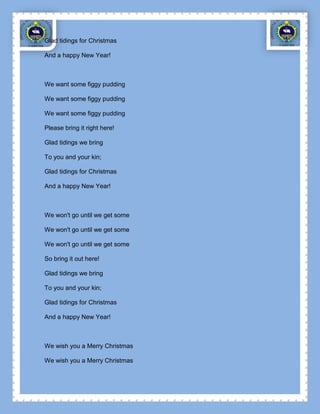
We wish you a merry Christmas

We wish you a merry Christmas

We wish you a merry Christmas

And a happy New Year.

Glad tidings we bring

To you and your kin;
Glad tidings for Christmas

And a happy New Year!


We want some figgy pudding

We want some figgy pudding

We want some figgy pudding

Please bring it right here!

Glad tidings we bring

To you and your kin;

Glad tidings for Christmas

And a happy New Year!


We won't go until we get some

We won't go until we get some

We won't go until we get some

So bring it out here!

Glad tidings we bring

To you and your kin;

Glad tidings for Christmas

And a happy New Year!


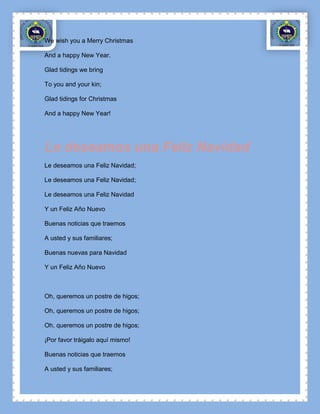
We wish you a Merry Christmas

We wish you a Merry Christmas

And a happy New Year.

Glad tidings we bring

To you and your kin;

Glad tidings for Christmas

And a happy New Year!


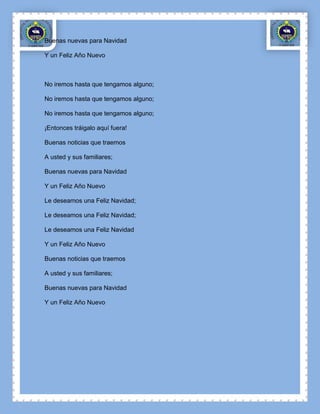
Le deseamos una Feliz Navidad
Le deseamos una Feliz Navidad;

Le deseamos una Feliz Navidad;

Le deseamos una Feliz Navidad

Y un Feliz Año Nuevo

Buenas noticias que traemos

A usted y sus familiares;

Buenas nuevas para Navidad

Y un Feliz Año Nuevo


Oh, queremos un postre de higos;

Oh, queremos un postre de higos;

Oh, queremos un postre de higos;

¡Por favor tráigalo aquí mismo!

Buenas noticias que traemos

A usted y sus familiares;
Buenas nuevas para Navidad

Y un Feliz Año Nuevo


No iremos hasta que tengamos alguno;

No iremos hasta que tengamos alguno;

No iremos hasta que tengamos alguno;

¡Entonces tráigalo aquí fuera!

Buenas noticias que traemos

A usted y sus familiares;

Buenas nuevas para Navidad

Y un Feliz Año Nuevo

Le deseamos una Feliz Navidad;

Le deseamos una Feliz Navidad;

Le deseamos una Feliz Navidad

Y un Feliz Año Nuevo

Buenas noticias que traemos

A usted y sus familiares;

Buenas nuevas para Navidad

Y un Feliz Año Nuevo
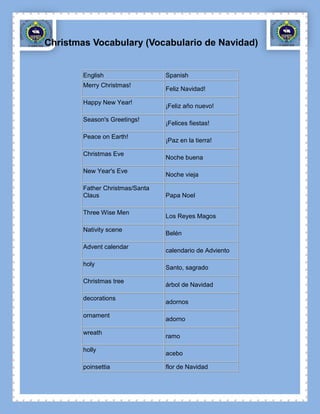
Christmas Vocabulary (Vocabulario de Navidad)


        English                  Spanish
        Merry Christmas!
                                 Feliz Navidad!

        Happy New Year!
                                 ¡Feliz año nuevo!

        Season's Greetings!
                                 ¡Felices fiestas!

        Peace on Earth!
                                 ¡Paz en la tierra!

        Christmas Eve
                                 Noche buena

        New Year's Eve
                                 Noche vieja

        Father Christmas/Santa
        Claus                    Papa Noel

        Three Wise Men
                                 Los Reyes Magos

        Nativity scene
                                 Belén

        Advent calendar
                                 calendario de Adviento

        holy
                                 Santo, sagrado

        Christmas tree
                                 árbol de Navidad

        decorations
                                 adornos

        ornament
                                 adorno

        wreath
                                 ramo

        holly
                                 acebo

        poinsettia               flor de Navidad
tinsel
                  espumillón

snowman
                  muñeco de nieve

snowflake
                  copo de nieve

snowy
                  nevado

snowball
                  bola de nieve

bells
                  campanas

jingle
                  tintinear

carol
                  villancico

Christmas cards
                  trajetas de Navidad

gifts/presents
                  regalos

gift giving
                  intercambio de regalos

toy
                  juguete

feast
                  banquete

eggnog
                  ponche de huevo

chimney
                  chimenea

reindeer
                  reno

sleigh
                  trineo
TASK
Examples of Personal Pronouns
   You can hear it.
    Usted puede oírlo.
   You can feel it.
    Usted puede sentirlo
   You can make it.
    Usted puede hacerlo.
   You can create it.

Usted puede crearlo.

   I was at home yesterday.
    Yo estaba en casa ayer.
   Alonso, you have already eaten enough chocolates.

Alonso, usted ya ha comido bastantes chocolates.

   Pedro is Spanish; he is from Seville.

Pedro es español; él es de Sevilla.

   Lucia is my sister; she is 19 years old.

Lucía es mi hermana; ella tiene 19 años.

   Is teacher you?

¿Maestro es usted?
 Carlos and I went to the cinema last night; we watched an
    Argentinean movie.

Carlos y yo fuimos anoche al cine; nosotros miramos una película
Argentina.

   We are Isabel and Carmen; we are from Mexico.

Nosotros somos Isabel y Carmen; nosotros somos de México.

   Ignacio and Eugenio, are you from Spain?

¿Ignacio y Eugenio, usted es de España?

   Paula and Cristina, don't you have vosotras the exercises?

¿Paula y Cristina, usted no tiene el vosotras los ejercicios?

   The boys played in the garden; now they are very dirty.

Los muchachos jugaron en el jardín; ahora ellos están muy sucios.

   Begoña and Ana are Navarrese; they are of Pamplona.

Begoña y Ana son navarras; ellos son de Pamplona.

   Are you clever?

¿Usted es diestro?

   It finds to be a lie.

Encuentra para ser una mentira.


Examples of possessivePRONOUNS
 This is their book.
  Éste es su libro.
 This is my house.

Ésta es mi casa.

 These are their shirts
  Éstas son sus camisas
 This computer is mine.
  Esta computadora es mía.
 Yesterday was with your brother in the cinema
  Ayer estaba con su hermano en el cine
 This table is small
  Esta mesa es pequeña
 That is big
  Eso es grande
 Those children are educated
  Esos niños son educados
 Those are educated
  Aquéllos son educados
 That is my friend
  Ése es mi amigo
 These are my partners
  Éstos son mis compañeros
 I didn't like that anything
  No me gustó eso algo
 This pen is mine
  Esta pluma es mía
 These chromiums are our
  Estos cromos son nuestro
 These chromiums are yours
    Estos cromos son suyos
   This dog is yours
    Este perro es suyo
   Mine is this notebook
    El mío es este cuaderno
   That it is your cat
    Que es su gato
   That ball is green
    Esa pelota es verde

Examples of
DemonstrativePRONOUNS
   This magazine that I have in the hands
    Esta revista que yo tengo en las manos
   That exam was more difficult than this of today

Ese examen era más difícil que esto de hoy

   Those soldiers were an example of value
    Esos soldados eran un ejemplo de valor
   This car is new
         Este automóvil es nuevo
   That school is closed

Esa escuela está cerrada
Examples OF REFLEXIVE PRONOUNS
    They are very selfish. They only think of them
Ellos son muy egoístas. Ellos sólo piensan en ellos


    If they want something more than food, serve you
     yourselves
       Si ellos quieren algo más de la comida, lo sirve
    We have a good time in the cinema
       Nosotros tenemos un tiempo bueno en el cine
    Do you sometimes speak with yourself when you are
     alone?
       Usted a veces habla con usted cuándo usted está solo?
    He/she fell of the bicycle but he/she didn't injure
       Él/ella se cayó de la bicicleta pero el/ella no dañe
    Juan was hit with a hammer.

Juan se pegó con un martillo


Example OF definite article
    El perro se murió

Thedog died

   
       La niña es muy linda

The girlis very pretty
 Los jóvenes están mojados

Youngwet


    La cinta está sucia

The tapeis dirty

   
       Las mesas son muy pequeñas

The tables arevery small


    La silla esta abajo

The chairis down


    El sillón en muy cómodo

Thecomfortablearmchair

   
       Maria y Pedro se fueron en el carro pequeño

Mariaand Peterwere in thesmall car


    Nelson utilizo el esfero

Nelsonuse thepen


    Paco está en la cima de la montaña

Pacois at the topof the mountain
 Sofía y su mamá están en el dormitorio

Sophia and hermom arein the bedroom


   Teresa se fue al pregón
Teresa went to cry
Mi mamá llego del mercado
My mom came on the market


   Paul esta al costado de la cama

     Paul is at the side of the bed


   Mi muñeca se cayó del sillón
     My wrist fell off the couch


   Ramiro y Jaime están dentro del club
     Jaime and Ramiro are within the club.


   Me descalificaron del concurso
     I was disqualified from the contest


   Jairo viajo en el carro de pablo al anochecer
Jairo car travel in the evening pablo


   Jacqueline sigue dentro del dormitorio
     Jacqueline is in the bedroom


   Me fui al coro de la capilla
  I went to the chapel choir

   Estoy en la ventana del piso catorce.
  I'm on the fourteenth floor window


   ¿Cómo se llama el colegio que estudia tu hija?
    What do you call the school your daughter studying?


   ¿Cuál es el nombre del cantante?
    What is the name of the singer?


   ¿Recuerdas cuando fuimos a las piscinas?


Do you remember when we went to the pools?


   ¿el profesor es muy bueno?
    Does the teacher is very good?
 El jugador esta lesionado

  The player is injured


 El carpintero esta enfermo
  The carpenter is ill


 La maleta esta muy sucia
  The case is very dirty

 Los lápices de paco se perdieron
  paco pencils were lost


 El deber de pamela esta incompleto
  The duty is incomplete pamela


 El cabello de anita es muy corto
  anita's hair is very short


 Los estados unidos están en crisis
  The United States is in crisis

 Las cordilleras de los andes son muy hermosas
The ranges of the Andes are very beautiful

   Los habitantes de mexico tienen una cultura inigualable
    The people of Mexico have a unique culture

   La mitad del mundo es un lugar turístico

Half the world is a tourist

   El rio guayas es muy extenso
    the Guayas River is extensive

   Paola estudio en Londres
    Paola studio in London

   Sandra vive en canada
    Sandra lives in canada

   Jose esta trabajando en la china
    Jose is working in China

   Lucas viaja mucho a colombia
     Lucas travels a lot to Colombia


   Nancy tiene familia en los estados unidos
    Nancy has family in the U.S.


   Encima de la mesa esta el lápiz
    On the table is the pencil

   Debajo de la cama están los zapatos
    write the name to the right of the sheet
 En la parte superior del libro está la palabra que buscamos
   At the top of the book is the word that we

  Debajo de la silla esta los juguetes de sebastian
   Under the chair is sebastian toys

  Paula viaja al sur de quito

 Paula travels south of Quito


  Maria tiene que presentarse al norte de la ciudad
   Maria has to go north of the city

  Juan viaja al centro de tulcan

 John travels to the center of Tulcan


  Amanda sigue la ruta del bus que esta a la derecha del carril

 Amanda bus follows the route of this rail right


  Andres juega con su mamá encima de la cama
 Andres plays with his mother on the bed


CUANDO NO USAMOS EL ARTÍCULO
DETERMINADO
  Me gusta la materia de ingles
I like the stuff of English

   No me gusta el arroz
I do not like rice


   Me gustan los cantantes
    I like singers

   No me gustan las moras
    I do not like blackberries

   El helado es muy rico

      The ice cream is very rich


   La sandia me gusta mas

The more I love watermelon


   Los profesores son muy bravos
    The teachers are very brave

   No me gusta las personas corruptas
    I do not like corrupt people

   Me gustan los zapatos
    I like shoes

   Me gusta el helado

   I like ice cream
Example OF indefinite article
   Mi hermana va a un baile
My sister goes to a dance

   Tengo una manzana
I havean apple
   Me fui a un baile
I wentto a dance
   Pedro encontró una moneda
Peter founda coin
   Marco y Andrés se llevaron un carro y dos bicicletas
Mark and Andrew took a car and two bicycles

   Andrea tiene una mochila nueva
Andrea has a new backpack

   Paola se compro una lavadora pequeña
Paolabought asmall washer

   Laura tiene unas frutas muy jugosas
Laura has a very juicy fruit

   Leonardo patea una pelota
  Leonardo kicks a ball
 Norma compra una casa muy linda


                         CON VOCAL
           Carlais a magister
Carla es magister


    Pepe compra un avión para su hijo Tomas
Pepe buys a plane for his son Tomas

    Carmen va a su casa
        Carmen goes home


    Jenny juega a las escondidas

        Jenny plays hide and seek


    Hugo viaja a la ciudad de Quito

         Hugo traveled to Quito


    Felipe no va a la fiesta
Felipe is not going to the party


    Bolívar come a la hora indicada
         Bolivar eat on time
 Karla escucha a su tía cantar

Listens to her aunt Karla singing


    Leticia corre a su casa muy rápido
  Leticia home runs very fast

    Nubia camina a mucha prisa
         Nubia hurry walks


Prepositions Of Time
(Preposiciones de tiempo)
BEFORE
    Mi blusa esta dentro el armario

My shirt is inside the closet

    El carro esta en el garaje

The car is in the garage

    Pola se quedo dentro de la casa

Polish stayed indoors
 Cesar puso el lápiz dentro de su mochila

Cesar put the pencil in his backpack


    Pedro seta en una reunión

Pedro mushroom in a meeting


    Los carros están en la lubricadora

The cars are in the lubricating


    La ropa esta dentro la lavadora

         Clothes washer is inside


    Mi cuaderno se quedo en el curso

My notebook was left in the course


    Tu libro esta en el anaquel

Your book is on the shelf


    Rocio se fue en el trolebús

Rocio left in the trolley
BETWEEN
    En a al cerca de tocando

in close touch with the


    Laura se fue el carro
     Laura left the car


    María viaja en avión

        María travels by plane

    Paco se fue al mercado

       Paco went to market


    Mi lápiz esta cerca de la silla
     My pencil is close to the chair

    El bebe esta tocando la silla

The baby is touching the chair


    Teresa esta subiendo al tercer piso
Teresa is up to the third floor


    Andrés esta cerca del ciprés

         Andrew is near Cypress


    Aníbal esta tocando la guitarra

Aníbal is playing the guitar

    Fabricio se va en el autobús

Fabricio is going on the bus

BY
    Las flores están sobre la mesa

The flowers are on the table


    El cuaderno esta sobre la mochila

The book is on the bag


    La silla esta encima de la mesa

The chair is on the table


    Los zapatos están sobre el anaquel

The shoes are on the shelf
 La televisión este sobre la mesa

The television is on the table

    Tu pantalón esta encima de la cómoda

Your pants are on the dresser

    El vaso esta sobre la silla

The glass is on the chair


    Mi libro esta encima del armario

My book is on top of the closet


    Darío quedo sobre las flores

Darius stayed on flowers


NEXT TO (BESIDE)
    Mi casa esta cerca del mercado

My house is near the market

    Anita vive junto a Lucas

         Anita lives with Lucas


    Pedro esta cerca la librería

         Peter is near the library
 María juega a lado del parque

Maria plays next to the park


    Carlos esta junto a la bandera

Carlos is beside the flag


    El auto esta cerca de la laguna

The car is near the lagoon


    Cristofer baila al lado de su mama

Cristofer dancing next to her mother


    Patricio come junto a su familia

Patrick eat with his family


Prepositions (Las
preposiciones)
    Jairo escucha música durante el viaje

Jairo listen to music while traveling

    Omar come durante la hora indicada
Omar eat during that hour


    Tito juega durante los tiempos libres

Tito played during free time


    Wendy patea la pelota durante el campeonato

Wendy kicks the ball during the championship

    Emily fabrica ropa durante las vacaciones

Emily makes clothes for the holidays

    Diana camina durante tres horas

Diana for three hours target


    Felipe juega durante sus tiempos libres

Felipe played during their free time


    Sarita trabaja durante la tarde

         Sarita working in the afternoon


    Pepe salta durante seis minutos

         Pepe jump for six minutes
Examples
Nouns (Los nombres)
Casa       home

Árbol tree


Letra letter


Niñochild


Jarrajar


Yuca yucca

Ovalooval
Computadorcomputer


Zapatoshoe

Blusablouse


Examples
Plural Nouns (Los nombres plurales)
Frutas        fruits


Camas          beds


Casas          homes


Coches         car


Libros         books
Escuelas        schools


Escobas          brooms


Palos         sticks


Palabras que terminan en consonante + "y": la "y"
cambia a "i" y añadimos "es"

To dry                     para secar

To deny                     para negar

Happy                      feliz

Funny                      gracioso

Lorry                   camión

Country                   país

to fly                    para volar

To cry                    a llorar

Morosely               morosamente

securely               de forma segura

probably               probablemente
understandably                 comprensiblemente


Palabras que terminan en vocal + "y":
añadimos una "s".
Day                              día, días

To employ                      para emplear

To convey                      para transmitir

Call and buy         Llamada ycomprar


Palabras que terminan en "s", "ss", "sh",
"ch", "x", "o": añadimos "es"

count, countess,         conde, condesa;


prince, princess,        príncipe, princesa;


poet, poetess,          poeta, poetisa;


author, authoress,      autor, autora;


actor, actress,         actor, actriz;
emperor, empress,   emperador, emperatriz;


tiger, tigress,     tigre, tigresa;


hero, heroine,      héroe, heroína;


Palabras que terminan en "f" o "fe": cambiamos la "f" o "fe"
por "ves"


If                          si


Reef Oaf                   zoquete


Leaf                        arrecife


Half                       hoja


Scarf                        mitad


Barf                       bufanda
NAME: GABRIELA MONTENEGRO
    FOURTH LEVEL “B”
TECHNOLOGIST. Gary Jacome


         YEAR:
        2011-2012
Adverbs: Form and Function
(Los adverbios: La forma y el
funcionamiento)
Un adverbio es una palabra que acompaña al verbo para modificar su significado. Un
adverbio también puede modificar a los adjetivos, a los nombres o a otros adverbios.

EJEMPLO:
       She speaks quickly. (Habla rápido.)

En este ejemplo "quickly" es un adverbio de modo que modifica al verbo "to speak" para
expresar como habla.


Grammatical Rules (Reglas gramaticales)
   1. La regla general para formar adverbios es añadir la terminación "-ly" a un adjetivo,
      que equivale a la terminación en castellano de "-mente."

EJEMPLOS:
          o   quick → quickly (rápido → rápidamente)
          o   honest → honestly (honrado → honradamente)


   2. Para los adjetivos que terminan en consonante "-y," cambian la terminación "-y" por
      la de "-ily."

EJEMPLOS:
          o   easy → easily (fácil → fácilmente)
          o   happy → happily (alegre → alegremente)
3. Adjetivos terminados en "-ic" se cambia la terminación "-ic" por "-ically."

EJEMPLOS:
           o   automatic → automatically (automático → automáticamente)
           o   tragic → tragically (trágico → trágicamente)


   4. Adjetivos terminados en "-le," se cambia la terminación "-le" por "-ly."

EJEMPLOS:
           o   terrible → terribly (terrible → terriblemente)
           o   true → truly (verdad → verdaderamente)


   5. Algunos adverbios no terminan en "-ly."

EJEMPLOS:
           o   hard (difícil, duro o fuerte)
           o   fast (rápido)


Function of Adverbs
(La función de los adverbios)
Como hemos visto,los adjetivos nos dicen algo sobre un nombre (una persona, una cosa, un
lugar, etc.). Los adverbios por otro lado, nos dicen algo sobre el modo de hacer una acción.
Pueden modificar a los verbos, a los adjetivos o a otros adverbios.

EJEMPLOS:
Verbo
   Miguel runs fast. (Miguel corre rápido.)
   You speak loudly. (Hablas alto.)

TAREA
   Maria walks slow ( Maria camina lento)
   Pedro travels soon      (Pedro viaja pronto)
   Lucas anything quick (Lucas nada rápido)
   Juan sings well (Juan canta bien)
   Gabriela dances very well (Gabriela baila bien)


   Adverbio
   Miguel runs really fast. (Miguel corre muy rápido.)
   You speak very loudly. (Hablas muy alto.)


TAREA
   Maria walks very slow       ( Maria camina bien lento)
   Pedro travels verysoon      (Pedro viaja bien pronto)
   Lucas anything very quick (Lucas nada bien rápido)
   Juan sings verywell    (Juan canta bien)
   Gabriela dances very well (Gabriela baila bien)
Adjetivo
   I am very happy. (Estoy muy contenta.)
   She is really nice. (Ella es muy simpática.)


TAREA
   her this very pretty one     (ella esta muy linda)
   the food this very rich one       ( la comida esta muy rica)
   the one is very beautiful         ( el es muy hermoso)
   I am very well              (estoy muy bien)
   she is very intelligent           (ella es muy inteligente)
RESERVE YASUNÍ
On November 20, 1979 was declared the Yasuni National
Park. This statement makes it to exist within a natural
resource         that         must         be        preserved.
In 1989 the Yasuni National Park becomes part of the World
Biosphere Reserve under the program of Man and the
Biosphere Programme of UNESCO. Following this
statement the park management should be subject to
strategies of Seville, issued at the Conference of Experts held
in Spain in March 1995. They determined that in any
Biosphere Reserve the only activities that can be developed
to ensure balance and no pollution, are "cooperative
activities compatible with sound ecological practices, such as
education on the environment, recreation, ecotourism basic
and applied research."
Conjunctions
   (Conjunciones)
   Las conjunciones son empleadas para enlazar entre sí las palabras y/o
   oraciones. Hay dos tipos de conjunciones y la posición que tiene dentro de una
   oración depende del tipo. Además, hay tres formas de conjunciones.
   Las conjunciones más comunes son "and," "but" y "or".

   Ejemplos:
   She works at a bank and goes to university. (Trabaja en un banco y va a la
   universidad.)
   I like to swim in the ocean, but only if the water is warm. (Me gusta nadar en el
   océano, pero sólo si el agua es caliente.)
   We can study now or later. (Podemos estudiar ahora o más tarde.)


   Types of Conjunctions (Los tipos de conjunciones)

1. Conjunciones coordinantes: Este tipo de conjunción se utiliza cuando
   queremos enlazar dos frases que tienen el mismo valor.


   Ejemplos:
   She likes to sing and dance. (Le gusta cantar y bailar.)
   I want to move to London so I am studying English. (Quiero mudarme a Londres,
   por lo tanto estoy estudiando inglés.)
   They are moving to Barcelona, however they really like Madrid. (Se mudan a
   Barcelona sin embargo les gusta mucho Madrid.)

                   and, but, however, or, so, then, therefore, yet....

   Posición: Siempre van entre las frases o palabras.


2. Conjunciones subordinantes: Se utiliza este tipo de conjunción cuando una
   de las frases depende de la otra (frase subordinada). La frase subordinada no
   tiene sentido sin la otra. La mayoria de conjunciones son subordinantes.
Ejemplos:
I have been working at the bank since 2005. (Llevo trabajando en el banco desde
2005.)
She is studying English so that she can move to London. (Está estudiando inglés
para que pueda mudarse a Londres.)
They went to the beach although it was raining. (Fueron a la playa aunque estaba
lloviendo.)


     although, as, after, before, if, since, so
               that, until, when...
Posición: En general van adelante de la frase subordenada.
Nota: Hay tres formas de conjunciones: simple (de una sola una palabra),
compleja (más de una palabra y generalmente seguido por "as" o "that") o
correlativa (rodean a un adjetivo o a un adverbio, tales como "if...then").
     Inglés            Español        Coordinante            Subordinante
      after          después de                                       X
    although           aunque                                         X
       and                 y                  X
                   como, cuando,
         as                                                           X
                      mientras
      as...as        tan...como                                       X
                    siempre que,
   as long as                                                         X
                   con tal de que
                   en cuanto, tan
   as soon as                                                         X
                   pronto... como
                   además de, así
   as well as                                 X
                   como, también
    because             porque                                        X
     before            antes de                                       X
                    no sólo, sino
   both...and         también,                X
                    tanto...como
but          pero, sino    X
 either...or          o...o     X
   even if          aunque          X
even though         aunque          X
  however       sin embargo     X
      if               si           X
                 en caso de
  in case                           X
                 que, por si
                  para, con
in order to                         X
                  objeto de
 moreover          además       X
neither...nor        ni...ni    X
                sin embargo,
nevertheless                    X
                 no obstante
    nor                ni       X
 now that         ahora que         X
     or                o        X
   once         una vez que         X
   since          desde que         X
     so             así que     X
  so that          para que         X
   then           entonces      X
                por lo tanto,
 therefore            por       X
                consiguiente
  though            aunque          X
   unless       a menos que         X
    until         hasta que         X
   when             cuando          X
whereas          mientras que                                      X
  whether                si                                          X
 whether...or          si...o                                        X
                   sin embargo,
      yet                                      X
                    no obstante


Comparatives and Superlatives
 (Los comparativos y superlativos)
Al igual que en español, cuando queremos hacer comparaciones contrastamos
cualidades o atributos por medio de adjetivos en sus diversos grados.

Grades of Adjectives (Grados de adjetivos)
   1. El grado positivo es la cualidad en el grado más simple.

Ejemplos:
             Juan runs fast. (Juan corre rápido.)

             Angela's room is clean. (La habitación de Angela está limpia.)

             I am tall. (Soy alto.)

             New York is big. (Nueva York es grande.)

      fast, hard, smart, pretty, clean, large, small, old, easy...


   2. El grado comparativo puede ser de superioridad, inferioridad o
      igualidad. Para comparativos de superioridad o inferioridad, el adjetivo
es seguido por "than". Para comparativos de inferioridad, usamos "not
   as...as" o "less" delante del adjetivo. Y para comparativos de igualidad,
   el adjetivo va entre "as...as".

Ejemplos:
      o   Comparativos de superioridad

          Juan runs faster than Mark. (Juan corre más rápido que Mark.)

          Angela's room is cleaner than Sue's. (La habitación de Angela
          está más limpia que la de Sue.)

          I am taller than Beth. (Soy más alto que Beth.)

          New York is bigger than Los Angeles. (Nueva York es más
          grandeque Los Angeles.)

      o   Comparativos de inferioridad

          Mark doesn't run as fast (slower) as Juan. (Mark no corre tan
          rápido como Juan.)

          Sue's room is not as clean (dirtier) as Angela's. (La habitación de
          Sue no es tan limpia como la de Angela.)

          Beth is not as tall (shorter) as me. (Beth no es tan alta como yo.)

          Los Angeles is not as big (smaller) as New York. (Los Angeles
          no es tan grande como Nueva York.)

      o   Comparativos de igualidad

          Mark is as fast as Juan. (Mark corre tan rápido como Juan.)

          Sue's room is as clean as Angela's. (La habitación de Sue es tan
          limpia como la de Angela.)

          Beth is as tall as I am. (Beth es tan alta como yo.)

          Los Angeles is as big as New York. (Los Angeles es tan grande
          como Nueva York.)
Nota: Podemos modificar un comparativo con un cuantificador
          (much, a lot, a little, slightly...).

                Ejemplos:

                 Juan runs a lot faster than Mark. (Juan corre mucho más
                 rápido que Mark.)

                 I am slightly taller than Beth. (Soy un poco más alta que
                 Beth.)


3. El grado superlativo denota la calidad en el grado más alto y como
   espanol, se usa "the" delante del adjetivo.

      Ejemplos:
          Juan is the fastest. (Juan es el más rápido.)

          Angela'a room is the cleanest. (La habitación de Angela es la más
          limpia.)

          I am the tallest. (Soy el más alto.)

          New York is the biggest city in the United States. (Nueva York
          en la ciudad más grande de los Estados Unidos.)

      o   Ejemplos:

          His smartest student is Lisa. (Su estudiante más lista es Lisa.)

          New York is coldest in January. (Nueva York es más frio en
          enero.)

   Nota: Si el adjetivo es posesivo, no se usa "the". Además no se usa
   "the" si comparamos algo con si mismo.
Form (Forma)
Hay unas reglas para formar el comparativo y superlativo.

   1. Para adjetivos de una sílaba:
               Comparativo              Superlativo
               añade: "-er" (           añade: "-est" (
               faster)                  fastest)

   2. Para adjetivos de una sílaba que terminan en
      "e":
               Comparativo                Superlativo
               añade: "-r"                añade: "-st"
               (nicer)                     (nicest)

   3. Para adjetivos de una sílaba que terminan en
      constanante + vocal + constanante:
        Comparativo                     Superlativo
        añade: constanante + "er"       añade: constanante + "-est"
         (hotter)                       (hottest)

   4. Para adjetivos de dos silabas que terminan
      en "y":
        Comparativo                     Superlativo
        sustituye "y" por: "-ier"       sustituye "y" por: "-iest"
        (funnier)                        (funniest)

   5.   Para adjetivos de dos o más silabas:
Comparativo                         Superlativo
añade: "more"/"less"
                                    añade "the most"/"the least":
 (more beautiful)
                                     (the most beautiful


   6. Adjetivos irregulares:
              Adjetivo     Comparativo           Superlativo
              good         better                Best
              bad          worse                 Worst
              far          further               furthest


List of Comparatives and
Superlatives (Lista de comparativos
y superlativos)
Lista de los adjetivos más comunes, con su forma comparativa y superlativa.

ADJETIVO COMPARATIVO SUPERLATIVO ESPAÑOL
                                                                     enfadado,
     angry               angrier                 angriest
                                                                      enojado
     bad                  worse                   Worst                 malo
      big                bigger                  biggest               grande
                                                                      amargo,
     bitter              bitterer                bitterest           resentido,
                                                                       agrio
     black               blacker                 blackest              negro
     bland               blander                 blandest               soso
    bloody               bloodier               bloodiest           sanguinolento
     blue                 bluer                   Bluest             deprimido
     bold                bolder                  boldest               audaz
     bossy               bossier                 bossiest             mandón
brave     braver      bravest       valiente
 brief     briefer     briefest        breve
                                     brillante,
bright    brighter    brightest
                                     luminoso
 broad    broader     broadest     ancho, amplio
                                     ocupado,
 busy      busier      busiest
                                     ajetreado
 calm      calmer      calmest       tranquilo
cheap      cheap       cheaper        barato
                                     correoso,
chewy     chewier     chewiest
                                      gomoso
chubby    chubbier    chubbiest     rechoncho
classy    classier    classiest      elegante
 clean     cleaner     cleanest    limpio, sano
                                      claro,
 clear      clear      clearest
                                    despejado
                                       listo,
clever    cleverer    cleverest
                                     ingenioso
 close     closer      closest         cerca
cloudy    cloudier    cloudiest      nubiado
clumsy    clumsier    clumsiest        torpe
                                      áspero,
coarse     coarser     coarsest
                                      grosero
 cold      colder      coldest          frío
 cool      cooler      coolest        fresco
 crazy     crazier     craziest        loco
creamy    creamier    creamiest      cremoso
                                   espeluznante,
creepy    creepier    creepiest
                                    repugnante
crispy    crispier    crispiest      crujiente
 cruel     crueler     cruelest        cruel
crunchy   crunchier   crunchiest     crujiente
rizado, crespo,
curly        curly             curliest
                                                  quebrado
curvy       curvier            curviest            curvo
 cute        cuter              Cutest             mono
damp        damper             dampest            húmedo
                                                  oscuro,
dark         darker            darkest
                                                  moreno
                                                  mortal,
deadly      deadlier          deadliest
                                                 mortífero
deep        deeper             deepest           profundo
dense        denser            densest             denso
dirty        dirtier           dirtiest            sucio
 dry          drier             Driest              seco
                                               aburrido, soso,
 dull        duller            dullest
                                                tonto, romo
dumb        dumber            dumbest             estúpido
dusty       dustier            dustiest         polvoriento
                                                  pronto,
early        earlier           earliest
                                                 temprano
easy         easier            Easiest              facíl
                                                leve, tenue,
faint        fainter           faintest
                                                vago, ligero
                                               claro, sereno,
 fair        fairer            Fairest
                                                recto, justo
fancy       fancier            fanciest            lujoso
 far     further/farther   furthest/farthest   lejos, distante
 fast        faster            Fastest             rápido
  fat        fatter            Fattest             gordo
 few         fewer             Fewest              pocos
                                                   fiero,
fierce       fiercer           fiercest
                                                encarnizado
filthy      filthier           filthiest         aaqueroso,
obsceno
  fine       finer        Finest           fino
 firm       firmer       firmest      firme, estricto
  fit        fitter       Fittest     apto, en forma
 flaky      flakier      flakiest     desconchado
                                       llano, liso,
  flat      flatter      flattest
                                          plano
                                      fresco, nuevo,
 fresh      fresher      freshest
                                         original
                                        agradable,
friendly   friendlier   friendliest      amable,
                                         amistoso
                                          lleno,
  full       fuller      Fullest
                                        completo
                                        gracioso,
 funny      funnier      funniest
                                      curioso, raro
                                          tierno,
gentle      gentler      gentlest       afectuoso,
                                           suave
                                         oscuro,
gloomy     gloomier     gloomiest        abatido,
                                         decaído
 good       better         Best           bueno
                                       grandioso,
 grand     grander      grandest       ambicioso,
                                       impotente
 grave      graver       gravest          grave
greasy     greasier     greasiest       grasiento
 great      greater      greatest     grande, genial
                                         goloso,
greedy     greedier     greediest       codicioso,
                                          ávido
                                       asqueroso,
 gross      grosser      grossest
                                      grosero, craso
guilty     guilter    guiltiest       culpable
                                      velludo,
 hairy     hairier     hairiest
                                       peludo
                                   práctivo, útil,
handy     handier     handiest      habilidoso,
                                      mañoso
                                   feliz, contento,
happy     happier     happiest
                                        alegre
hard       harder      hardest      duro, difícil
harsh     harsher     harshest      áspero, duro
                                       sano,
healthy   healthier   healthiest
                                     saludable
                                      pesado,
heavy     heavier     heaviest     grueso, fuerte,
                                       duro
                                   alto, elevado,
 high      higher      highest
                                       agudo
 hip       hipper      hippest        moderno
                                      caliente,
 hot       hotter      hottest        caluroso,
                                       picante
humble    humbler     humblest        humilde
hungry    hungrier    hungriest     hambriento
  icy       icier       Iciest      helado, frío
 itchy     itchier     itchiest         pica
                                       jugoso,
 juicy     juicier     juiciest       zumoso,
                                     suculento
                                      amable,
 kind      kinder      kindest       benévolo,
                                      cariñoso
large      larger      largest         grande
                                        tarde,
 late       later       latest
                                     restrasado,
reciente
 lazy      lazier      Laziest        perezoso
 light     lighter     lightest     ligero, claro
 likely    likelier    likeliest      probable
 little    littler     littlest    pequeño, poco
 lively    livelier    liveliest   animado, vivo
lonely     lonlier     lonliest       solitario
 long      longer      longest          largo
 loud      louder      loudest       fuerte, alto
                                     precioso,
lovely    lovelier    loveliest
                                    bello, lindo
  low      lower       lowest           bajo
                                     enfadado,
 mad      madder      maddest
                                   enojado, loco
                                       malo,
 mean     meaner       meanest       mezquino,
                                      tacaño
                                      sucio,
messy     messier     messiest     desordenado,
                                    desastroso
                                   afable, suave,
 mild      milder      mildest
                                        leve
 moist    moister     moistest        húmedo
                                      estrecho,
narrow    narrower    narrowest
                                       escaso
                                    asqueroso,
 nasty     nastier     nastiest
                                   desagradable
                                   malo, travieso,
naughty   naughtier   naughtiest
                                      picante
                                      cercano,
 near      nearer      nearest
                                      próximo
                                     ordenado,
 neat      neater      neatest
                                   aseado, pulcro
needy     needier        neediest        necesitado
                                       nuevo, fresco,
new        newer         newest          reciente,
                                         moderno
                                         simpatico,
nice       nicer          nicest         agradable,
                                           bueno
                                          ruidoso,
noisy      noisier       noisiest
                                         clamaroso
 odd       odder          oddest       raro, extraño
                                         grasiento,
oily       oilier         oiliest
                                          aceitoso
                                       viejo, anciano,
 old     older/elder   oldest/eldest
                                           antiguo
plain     plainer        plainest      claro, sencillo
                                         educado,
polite     politer       politest
                                          cortés
poor       poorer        poorest           pobre
                                       bonito, lindo,
pretty    prettier       prettiest
                                         hermoso
                                         orgulloso,
proud     prouder        proudest        soberbio,
                                           digno
pure       purer          purest            puro
quick     quicker        quickest          rápido
                                         tranquillo,
quiet     quieter        quietest
                                         silencioso
 rare       rarer         rarest            raro
                                          crudo,
 raw       rawer          rawest
                                         agrietado
                                           rico,
 rich      richer         richest
                                         abundante
                                          maduro,
 ripe       riper         ripest
                                          curado
arriesgado,
 risky     riskier     riskiest
                                     peligroso
roomy     roomier     roomiest       espacioso
                                   áspero, tosco,
rough     rougher     roughest
                                    bruto, ronco
                                    maleducado,
 rude       ruder       rudest
                                   grosero, tosco
 rusty     rustier     rustiest       oxidado
                                       triste,
 sad       sadder      saddest      lamentable,
                                      penoso
 safe       safer       safest         seguro
 salty     saltier     saltiest        salado
                                      cuerdo,
 sane       saner       sanest
                                      sensato
                                     espantoso,
 scary     scarier     scariest
                                     asustadizo
                                    superficial,
shallow   shallower   shallowest
                                   poco profundo
                                       afilado,
 sharp     sharper     sharpest
                                   cerrado, agudo
                                      brillante,
 shiny     shinier     shiniest
                                     reluciente
                                    corto, bajo,
 short     shorter     shortest
                                     chaparro
 shy       shyer        shyest         tímido
 silly     sillier     silliest        tonto
                                      sencillo,
simple     simpler     simplest
                                    simple, facíl
                                      sincero,
sincere   sincerer    sincerest
                                      genuino
skinny    skinnier    skinniest        flaco
sleepy    sleepier    sleepiest     adormilado,
soñoliento
 slim     slimmer     slimmest     delgado, fino
                                      viscoso,
slimy      slimier     slimiest      pegajoso,
                                    empalagoso
 slow      slower      slowest          lento
small     smaller     smallest        pequeño
                                        listo,
smart     smarter     smartest      inteligente,
                                       agudo
smelly    smellier    smelliest       apestoso
                                     humeante,
smoky     smokier     smokiest
                                     ahumado
                                     liso, suave,
smooth    smoother    smoothest
                                    llano, fluido
 soft      softer      softest     blando, suave
 soon      sooner      soonest         pronto
 sore       sorer       sorest        dolorido
sorry      sorrier     sorriest     lamentable
 sour      sourer      sourest      agrio, ácido
                                       picante,
spicy      spicier     spiciest      especiado,
                                      sazonado
                                     empinado,
steep     steeper     steepest
                                    pronunciado
                                       tacaño,
stingy    stingier    stingiest        rácano,
                                      raquítico
                                   raro, extraño,
strange   stranger    strangest
                                    desconocido
 strict    stricter    strictest   estricto, rígido
                                   fuerte, sólido,
strong    stronger    strongest
                                      intenso,
marcado
                                     soleado,
sunny     sunnier     sunniest
                                     radiante
sweaty    sweatier    sweatiest      sudoroso
sweet     sweeter     sweetest         dulce
  tall      taller      tallest         alto
                                    bronceado,
  tan      tanner      tannest
                                      moreno
                                   rico, sabroso,
 tasty     tastier     tastiest
                                      apetitoso
                                   grueso, denso,
 thick     thicker     thickest       espeso,
                                      poblado
 thin      thinner     thinnest    delgado, fino
thirsty   thirstier   thirstiest     sediento
                                    diminuto,
 tiny      tinier      tiniest
                                    minúsculo
                                       fuerte,
tough     tougher     toughest       resistente,
                                    duro, difícil
                                      cierto,
 true       truer       truest      verdadero,
                                     leal, fiel
 ugly      uglier      ugliest          feo
                                      caliente,
warm      warmer      warmest        templado,
                                       cálido
 weak     weaker       weakest      débil, flojo
wealthy   wealthier   wealthiest   rico, pudiente
weird     weirder     weirdest     raro, extraño
                                     mojado,
 wet       wetter      wettest       húmedo,
                                     lluvioso
ancho, amplio,
     wide                   wider                     widest
                                                                          extenso
                                                                           salvaje,
     wild                  wilder                     wildest             silvestre,
                                                                        descontrolado
    windy                 windier                    windiest              ventoso
                                                                       sabio, sensato,
     wise                   wiser                     wisest
                                                                          prudente
                                                                          mundano,
    worldly               worldlier                 worldliest
                                                                           terreno
                                                                           virtuoso,
    worthy                worthier                  worthiest
                                                                            digno
    young                 younger                    younges                joven


Like / as (Como)
"Like" y "as" a menudo se confunden en inglés. Ambos se pueden utilizar
para hacer comparaciones o hablar de similitudes. Es muy común en inglés
americano utilizar "like" en lugar de "as". Sin embargo, es generalmente
considerado informal utilizarlo en esta forma. La siguiente es una explicación
de los diversos usos de estas dos palabras.

Like (Como)
Uses (Usos)

   1. "Like" es una preposición" que significa "parecido a" o "lo mismo de". No se puede
      utilizar "as" de este modo. Como una preposición, "like" está seguida por un
      sustantivo o un pronombre.

      Estructura verbo + "like" + sustantivo/pronombre
Ejemplos:
             She dances like a professional. (Baila como una profesional.)

             Like me, my friend John loves the cinema. (Como yo, a mi amigo John le
             encanta el cine.)

             Michael speaks English like a native. (Michael habla inglés como un nativo.)

  2. También, se utiliza "like" para decir que algo es típico de alguien.


Ejemplos:
             It's so like Ben to be late. (Es tan típico de Ben llegar tarde.)

             It's just like Helen to laugh in uncomfortable situations. (Es tan típico de
             Helen reír en situaciones incómodas.)

  3. Cuando utiliza "like" con el verbo "look" significa "parecer" or "parecerse".


Ejemplos:
             I look like my mother.(Me parezco a mi madre.)

             It looks like it is going to rain. (Parece que va a llover.)

             He looks like he hasn't slept in weeks. (Él parece como que no ha dormido
             en semanas.)

  4. También utilizamos "like" para presentar ejemplos.


Ejemplos:
             I play many sports like football, basketball and tennis. (Juego muchos
             deportes como fútbol, baloncesto y tenis.)

             There are many things we can do to protect the environment, like recycling
             or using renewable energy sources. (Hay muchas cosas que podemos hacer
             para proteger el medio ambiente, como reciclar o utilizar fuentes de
             energía renovables.)
Some people, like my friend Carol, don't like to travel. (Algunas personas,
              como mi amiga Carol, no le gusta viajar.)


As (Como)
Uses (Usos)

   1. "As" significa "en la misma manera" o "en la
      misma condición de". Al diferencia de "like", "as"
      está seguido por un sujeto y un verbo.
Ejemplos:
              She worked hard on the project, as she always does. (Trabajó duramente
              en el proyecto, como lo hace siempre.)

              Nobody paints as Picasso did. (Nadie pinta como Picasso lo hizo.)

      Estructura "as" + sujeto + verbo


   2. Se utiliza "as" en frases comparativas.

Ejemplos:
              John can run as fast as Peter. (John puede correr tan rápido como Peter.)

              My dad doesn't have as much energy as he used to have. (Mi padre no
              tiene tanta energía como solía tener.)
3. Como "like", se usa "such as" para presentar ejemplos.

Ejemplos:
            I play many sports, such as football, basketball and tennis. (Juego a muchos
            deportes como el fútbol, baloncesto y tenis.)

            There are many things we can do to protect the environment, such as
            recycling or using renewable energy sources. (Hay muchas cosas que
            podemos hacer para proteger el medio ambiente, como reciclar o utilizar
            fuentes de energía renovables.)

            Some people, such as my friend Carol, don't like to travel. (Algunas
            personas, como a mi amiga Carol, no les gusta viajar.)


  4.   Cuando sea una preposición, "as" significa el papel o
       profesión de algo o alguien.

Ejemplos:
            She started working as a teacher 5 years ago. (Empezó a trabajar como
            profesor hace 5 años.)

            We used to live here, but now we are using the apartment as a painting
            studio. (Vivíamos aquí antes, pero ahora estamos utilizando el piso como
            un estudio de pintura.)

            "As" can be used as a conjunction or a preposition. ("Como" puede ser
            usado como una conjunción o una preposición.)


  5.   Nota: Ten cuidado, el uso de uno sobre otro
       puede cambiar el sentido.
Ejemplos:
            As your teacher, I suggest you study more. [Significa: I am your teacher]
Like your teacher, I suggest you study more. [Significa: I agree with your
                     teacher, we have a similar opinion]


        6. Se utiliza "as" en algunas expresiones.
    Ejemplos:
                     As you know, this is not the first time your son has been a problem in class.
                     (Como ya sabe, esto no es la primera vez que su hijo ha sido un problema
                     en clase.)

                     As expected, Ben was late for class again today. (Como se esperaba, Ben
                     llegó de nuevo tarde a clase hoy.)

                     As I said, I hope this is the last time you are late. (Como ya he dicho, espero
                     que esta sea la última vez que llegas tarde.)

                     Here is the report, as requested. (Aquí está el informe, como solicitó.


    Gerund (Gerundio)
    El gerundio y el infinitivo son formas de los verbos que actuan como nombres. El gerundio se forma con "-
    ing" (walking, eating, etc.). Como hemos visto en la lección sobre los verbos, el infinitivo se forma con la
    preposición "to" (to walk, to eat, etc.).


    Grammatical Rules (Reglas gramaticales)
1. Podemos usar el gerundio o el infinitivo como objeto, sujeto o complemento de una frase,pero en
   general, es mucho más común usar el gerundio como sujeto.


    Ejemplos:
o   Objeto
    I like cooking./I like to cook. (Me gusta cocinar.)
    She continued working./She continued to work. (Continuó trabajando.)
o   Sujeto
Swimming is good exercise. (Nadar es un buen ejercicio.)
    Drinking and driving is dangerous. (Beber y conducir es peligroso.)
o   Complemento
    The best thing to do when you are sick is to drink a lot of water. (Lo mejor que puedes hacer cuando estás
    enfermo es beber mucha agua.)
   My favorite exercise is swimming. (Mi ejercicio favorito es la natación.)
2. Cuando un verbo sigue otro verbo, siempre necesitamos usar el infinitivo o el
   gerundio.Normalmente usamos el infinitivo después de algunos verbos y el gerundio después de
   otros. También hay verbos con los que podemos usar el gerundio o el infinitivo.


    Ejemplos:
    I can't afford to buy a new car. (No puede permitirse comprar un coche nuevo.)
    He began to doubt himself./He began doubting himself. (Comenzó a dudar de sí mismo.)
    They decided to move to Australia in May. (Decidieron mudarse a Australia en Mayo.)
    I enjoy listening to music. (Disfruto escuchar música.)

    She hates studying./She hates to study. (Odia estudiar.)
    You love dancing./You love to dance. (Te encanta bailar.)
    He needed to leave class early because he had an appointment. (Tenía que salir de la clase pronto porque
    tenía una cita.)
    She can't tolerate complaining. (No puede tolerar quejas.)
    I tried learning English./I tried to learn English. (He intentado aprender inglés.)


                                 Verbo                    Gerundio                Infinitivo
                                 Afford                                                   X
                                 Agree                                                    X
                                Attempt                                                   X
                                    Begin                      X                          X
                                Choose                                                    X
                               Continue                        X                          X
                                 Decide                                                   X
                                 Detest                        X
                                    Enjoy                      X
                                 Expect                                                   X
                                    Fail                                                  X
Finish     X
   Hate      X   X
   Hope          X
 Imagine     X
  Intend         X
   Keep      X
  Learn          X
   Like      X   X
   Love      X   X
 Manage          X
   Need          X
   Offer         X
   Plan          X
  Prefer     X   X
 Promise         X
   Quit      X
Recommend    X
  Refuse         X
  Regret     X
  Seem           X
   Start     X   X
 Suggest     X
   Tend          X
 Threaten        X
 Tolerate    X
   Try       X   X
Understand   X
   Want          X
   Wish      X   X
3. Con algunos verbos, cuando usamos el gerundio o el infinitivo, el significado
   cambia.

   Ejemplos:
   I forgot writing that email./I forgot to write that email. (Me olvidé escribiendo ese correo electrónico./Me olvidé
   de escribir el correo electrónico.)

   Stop watching the television./Stop to watch the news. (Dejar de ver la televisión./Parar para ver las noticias.)
                                    forget, mean, remember, stop...
4. Se usa el infinitivo después de adjetivos.


   Ejemplos:
   I'm glad to see you. (Me alegro de verte.)


   She was surprised to find the door unlocked. (Se sorprendió al encontrar la puerta abierta.)
                   disappointed, glad, happy, pleased, relieved, sad, surprised...
5. Después de preposiciones solo podemos usar el gerundio.
   Ejemplos:
   He's good at listening. (Escucha bien.)

   I always read before going to bed. (Siempre leo antes de acostarme.)

   You can't leave without saying goodbye. (No puedes salir sin despedirte.)
                            about, against, at, after, before, by, on, without...
6. Se usa el gerundio después de unos nombres.


   Ejemplos:

   What is the advantage of waiting? (¿Cuál es la ventaja de esperar?)

   I am interested in taking an English class. (Estoy interesado en tomar una clase de inglés.)
His problem finding a new job was his lack of experience. (Su problema para encontrar un nuevo empleo era
    su falta de experiencia.)
    advantage/disadvantage of, danger of, experience in, interested in, opportunity of, reason for,
                                          problem, use...
7. Se usa el gerundio después de unas expresiones o verbos frasales.
                  to look forward to, to be worth, can't help, don't mind, feel like...

    Ejemplos:
    We're really looking forward to seeing you. (Tenemos muchas ganas de verte.)

    That movie was not worth seeing. (No vale la pena ver esa película.)

    I can't help falling in love. (No puedo evitar enamorarme.)

    Task 6
    Constructing Questions (Construir preguntas)
                                  PRONOMBRE
     QUESTION WORD                                       EXAMPLE                          EJEMPLO
                                INTERROGATIVO
    What...?                    ¿Qué...?           What do you want? ¿Qué quieres?
    Where...?                   ¿Dónde...?         Where do they live? ¿Dónde viven?
                                                   When do you go to
    When...?                    ¿Cuándo...?                          ¿Cuándo te vas a trabajo?
                                                   work?
    Who...?                     ¿Quién...?         Who's he?               ¿Quién es?

    Whose...?                   ¿De quién...?                              ¿De quién es este bolso?
                                                   Whose bag is this?
    How...?                     ¿Cómo...?          How are you?            ¿Cómo estas?
                                                   How much does it
    How much...?                ¿Cuánto...?                                ¿Cuánto cuesta?
                                                   cost?
    Why...?                     ¿Por qué...?       Why are they here? ¿Por qué están aquí?
    Which...?                   ¿Cuál...?          Which car is his?       ¿Cuál es su coche?


    Como hemos visto en la lección anterior, hay dos maneras para hacer frases interogativas.


1. Con los verbos "to be" (ser/estar) y "have got" (tener).
Ejemplos:
   What's the time? (¿Qué hora es?)

   Where are you? (¿Dónde estas?)

   When's he available? (¿Cuándo está disponsible?)

   How are the cookies? (¿Cómo estan las galletas?)

   Why are they tired? (¿Por qué estan cansados?)
              EstructuraPronombre interogativo + verbo + sujeto + nombre, adjetivo...


2. El resto de verbos.
   Ejemplos:
   What do you like to eat? (¿Qué te gusta comer?)

   Where does she work? (¿Dónde trabaja?)

   When do they go on vacation? (¿Cuándo van de vacaciones?)

   How do you use this machine? (¿Cómo usas esta máquina?)

   Why do you study English? (¿Por qué estudias inglés?)
     EstructuraPronombre interogativo + verbo auxiliar ("to do") + sujeto + verbo + nombre,
                                                 adjetivo...
Grammatical Rules (Reglas gramaticales)
"Who" y "what" pueden actuar como objeto o como sujeto en una oración interrogativa. Si actúan
como sujeto no utilizarán auxiliar (do, be...) para preguntar. En cambio, si actúan como objeto
deberán preguntar con el auxiliar.
Cuando actúan como objeto:
           EstructuraPronombre interrogativo+ auxilar + sujeto + verbo en infinitivo
Cuando actúan como sujeto:
                  EstructuraPronombre interrogativo + verbo + objeto


Ejemplo 1:

Oración principal:

Danny asks the teacher. (Dani pregunta al profesor.)
Preguntamos por el sujeto:

Who asks the teacher? Danny. (¿Quién pregunta al profesor? Dani.)
Preguntamos por el objeto

Who did Danny ask? The teacher. (¿A quién preguntó Dani? Al profesor.)


Ejemplo 2:
Oración principal:

Something happens. (Algo pasa.)
Preguntamos por el sujeto:

What happens? Something. (¿Qué pasa?Algo.)
Ejemplo 3:
Oración principal:

Maria says "hello." (Maria dice "hola.")
Preguntamos por el objeto

What does Maria say? Hello. (¿Qué dice Maria? Hola.)


Nota sobre preposiciones: Generalmente ponemos las preposiciones al final de las oraciones
interrogativas.

Ejemplos:
Where's she driving to? (¿Hacia dónde está conduciendo?)

Who are they laughing at? (¿De quién se están reiendo?)


What vs. Which
(Cuál - Qué)

What
Se utiliza "what" para hacer una pregunta cuando hay un número desconocido o infinitas
posibilidades de respuestas/opciones. Se usa para preguntar en general .


Ejemplos:
What is your favorite food? (¿Cuál es tu comida favorita?)

What did you do yesterday? (¿Qué hiciste ayer?)

What type of music do you like? (¿Qué tipo de música te gusta?)

What would you like to drink? (¿Qué te gustaría beber?)
Which
En contraste con "what", usamos "which" cuando las opciones posibles son limitadas a un pequeño
número (quizás 2, 3 o 4) y hay que seleccionar una entre ellas. Se puede utilizar tanto con cosas
como con personas.

Ejemplos:
Which jacket should I buy, the brown one or the black one? (¿Qué chaqueta debería
comprar, la marrón o la negra?)


Which of you would like to help me? (¿A cuál de vosotros le gustaría ayudarme?)

Which would you like, wine or beer? (¿Qué quieres, vino o cerveza?)

Nota: El uso de "what" y "which" en inglés está determinado por las respuestas
posibles al diferencia del español donde las reglas del uso de "¿qué?" y "¿cuál?"
están determinadas por la sintaxis.


What vs. Which
(Cuál - Qué)

What
Se utiliza "what" para hacer una pregunta cuando hay un número desconocido o infinitas
posibilidades de respuestas/opciones. Se usa para preguntar en general.

Ejemplos:
What is your favorite food? (¿Cuál es tu comida favorita?)

What did you do yesterday? (¿Qué hiciste ayer?)

What type of music do you like? (¿Qué tipo de música te gusta?)
What would you like to drink? (¿Qué te gustaría beber?)


Which
En contraste con "what", usamos "which" cuando las opciones posibles son limitadas a un pequeño
número (quizás 2, 3 o 4) y hay que seleccionar una entre ellas. Se puede utilizar tanto con cosas
como con personas.
Ejemplos:
Which jacket should I buy, the brown one or the black one? (¿Qué chaqueta
debería comprar, la marrón o la negra?)


Which of you would like to help me? (¿A cuál de vosotros le gustaría ayudarme?)

Which would you like, wine or beer? (¿Qué quieres, vino o cerveza?)
Nota: El uso de "what" y "which" en inglés está determinado por las respuestas posibles al
diferencia del español donde las reglas del uso de "¿qué?" y "¿cuál?" están determinadas por la
sintaxis.


TASK 7


Past Simple
(Pasado simple)
El pasado simple en inglés es equivalente al pretérito imperfecto y pretérito indefinido del español.
Usamos el pasado simple para acciones completas en el pasado. El período de tiempo de estas
acciones no es importante como en el español.
Grammatical Rules (Reglas gramaticales)
   Form (Forma)

   Para formar el pasado simple con verbos regulares, usamos el infinitivo y añadimos la terminación "-
   ed". La forma es la misma para todas personas (I, you, he, she, it, we, they).
   Ejemplos:
   want →
   wanted
   learn →
   learned
   stay →
   stayed
   walk →
   walked
   show →
   showed


       Excepciones:
1. Para verbos que terminan en una "e", sólo añadimos "-d.


   Ejemplos:
   change →
   changed
    believe →
   believed
2. Si el verbo termina en una vocal corta y una consonante (excepto "y" o "w"), doblamos la
   consonante final.

    Ejemplos:
    stop →
    stopped
    commit →
    committed
3. Con verbos que terminan en una consonante y una "y", se cambia la "y" para una "i".
    Ejemplos:
    study →
    studied
    try →
    tried


    Nota: Hay muchos verbos irregulares en inglés. Desafortunadamente, no hay reglas fijadas para
    formarlos. A continuación tienes los tres verbos irregulares más comunes y los que actúan como
    verbos auxiliares.


                              VERB                           PAST SIMPLE

                                 be               was (I, he, she, it) / were (you, we, they)

                                 do                                  did

                                have                                 had


    Pronunciation (Pronunciación)


   Pronunciamos la terminación "-ed" de forma diferente dependiendo de la letra que va al final del
   infinitivo. En general la "e" es muda.
1. Con los infinitivos que terminan en "p", "f", "k" o "s" (consonantes sordas, excepto "t") pronunciamos
   la terminación" "-ed" como una "t".
Ejemplos:
o   looked

    [lukt]
o   kissed
     [kisst]
2. Con los infinitivos que terminan en "b", "g", "l", "m", "n", "v", "z" (consonantes sonoras, excepto "d") o
   una vocal, pronunciamos sólo la "d".
    Ejemplos:
o   yelled
     [jeld]
o   cleaned
     [klind]
3. Con los infinitivos que terminan en "d" o "t", pronunciamos la "e" como una "i".
    Ejemplos:
o   ended
     [endid]
o   waited
    [weitid]


    Structure (Estructura)

1. Affirmative Sentences (Frases afirmativas)

    Ejemplos:
o   I wanted to dance. (Quería bailar.)
o   She was a doctor. (Era doctora.)
o   They learned English. (Aprendieron inglés.)
o   We believed him. (Le creímos.)
                                           Sujeto + verbo principal.
2.   Negative Sentences (Frases negativas)

     Ejemplos
o    I didn't want to dance. (No quería bailar.)
o    She wasn't a doctor. (No era doctora.)
o    They didn't learn English. (No aprendieron inglés)
o    We didn't believe him. (No le creímos.)
                         Sujeto + verbo auxiliar ("to do") + "not" + verbo principal.
     Nota: En frases negativas, el verbo auxiliar va en el pasado ("did") y el verbo principal se queda en
     el infinitivo.


3. Interrogative Sentences (Frases interrogativas)
     Ejemplos:
o    Did you want to dance? (¿Querías bailar?)
o    Was she a doctor? (¿Era doctora?)
o    Did they learn English? (¿Aprendieron ingles?)
o    Did you believe him? (¿Le creíste?)
                            Verbo auxiliar ("to do") + sujeto + verbo principal?
     Nota: Como en frases negativas, el verbo auxiliar va en el pasado ("did") y el verbo principal se
     queda en el infinitivo.


     Uses (Usos)
1. El pasado simple se utiliza para hablar de una acción concreta que comenzó y acabó en el
   pasado. En este caso equivale al pretérito indefinido español. Generalmente, lo usamos con
   adverbios del tiempo como "last year", "yesterday", "last night"...
     Ejemplos:
o    Tom stayed at home last night. (Tom se quedó en casa anoche.)
o    Kate worked last Saturday. (Kate trabajó el sábado pasado.)
o    I didn't go to the party yesterday. (No fui a la fiesta ayer.)
o    Did they walk to school this morning? (¿Andaron a la escuela esta mañana?)


2. Se usa el pasado simple para un serie de acciones en el pasado.

     Ejemplos:
o    I received the good news and immediately called my husband. (Recibí la buena noticia y llamé de
     inmediato a mi marido.)
o   He studied for an hour in the morning, worked all afternoon and didn't return home until 10 at
    night. (Estudió durante una hora por la mañana, trabajó toda la tarde y no regresó a casa hasta las 10 de la noche.)


3. También lo usamos para acciones repetidas o habituales en el pasado, como se usa el pretérito
   imperfecto español.


    Ejemplos:
o   We always traveled to Cancun for vacation when we were young. (Siempre viajábamos a Cancun durante
    las vacaciones cuando éramos jóvenes.)
o   He walked 5 kilometers every day to work. (Caminaba 5 kilómetros hasta el trabajo cada día.)


4. Lo usamos para narraciones o acciones de períodos de largo tiempo en el pasado, como el
   pretérito imperfecto español.

    Ejemplos:
o   I worked for many years in a museum. (Trabajaba en un museo durante muchos años.)
o   She didn't eat meat for years. (No comía carne durante años.)


5. Se utiliza para hablar de generalidades o hechos del pasado.
    Ejemplos:
o   The Aztec lived in Mexico. (Los aztecas vivían en México)
o   I played the guitar when I was a child. (Tocaba la guitarra cuando era niño.)
Past Continuous
    (Pasado continuo)

    Grammatical Rules (Reglas gramaticales)

    Form (Forma)
    Para formar el pasado continuo se utiliza el verbo auxiliar "to be" y el gerundio (infinitivo + "-ing")
    del verbo. El verbo auxiliar "to be" está en el pasado simple, pero ten en cuenta que "to be" es un
    verbo irregular.


                         Sujeto                   Auxiliar (to be)              Gerundio
                                                                                  talking, eating,
                         I, He, She, It                      was                 learning, doing,
                                                                                      going...

                                                                                  talking, eating,
                       You, We, They                        were                 learning, doing,
                                                                                      going...


    Structure (Estructura)

1. Affirmative Sentences (Frases afirmativas)
    Ejemplos:
o   I was talking. (Estaba hablando.)
o   He was eating. (Estaba comiendo.)
o   They were learning. (Estaban aprendiendo.)
                            EstructuraSujeto + verbo auxiliar ("to be") + gerundio.
2. Negative Sentences (Frases negativas)


    Ejemplos:
o   I was not [wasn't] talking. (No estaba hablando.)
o   He was not [wasn't] eating. (No estaba comiendo.)
o   They were not [weren't] learning. (No estaban aprendiendo.)
                                EstructuraSujeto + verbo auxiliar ("to be") + "not" + gerundio.


3. Interrogative Sentences (Frases interrogativas)
    Ejemplos:
o   Were you talking? (¿Estabas hablando?)
o   Was he eating? (¿Estaba comiendo?)
o   Were they learning? (¿Estaban aprendiendo?)
                         EstructuraVerbo auxiliar ("to be") + sujeto + gerundio?


    Uses (Usos)
1. El pasado continuo lo utilizamos para una acción larga que ya en el pasado fue
   interrumpido. La acción que se interrumpe está en pasado continuo y la acción que provoca la
   interrupción está en pasado simple. "When" y "while" señalan el uso del pasado simple y continuo.
   En general, usamos el pasado simple directamente después de "when" y el pasado continuo
   después de "while."


    Ejemplos:
o   Jose called while I was watching the news. (Jose llamó mientras estaba mirando las noticias.)
o   He was walking to work when he fell. (Estaba caminando hacia su trabajo cuando se cayó.)
o   Was it raining when you left? (¿Estaba lloviendo cuando te fuiste?)


2. Se usa el pasado continuo para hablar sobre acciones en un tiempo específico en el pasado.

    Ejemplos
o   Paula wasn't living in Spain in 2005. (Paula no estaba viviendo en España en el 2005.)
o   We were still working at 10 o'clock last night. (Todavía estabamos trabajando a las 10 de la noche. )
3. Se usa el pasado continuo para dos acciones que estaban ocurriendo al mismo tiempo en el
   pasado.


    Ejemplos
o   My son was reading while I was cooking. (Mi hijo estaba leyendo mientras que yo estaba cocinando.)
o   They were talking very loudly while we were trying to watch the movie. (Estaban hablando muy alto
    mientras nosotros estábamos intentando mirar la pelicula.)


    Nota: Hay unos verbos que no solemos usar en los tiempos continuos. Ver una lista y
    explicación aqui.


    TASK 8
    Future Simple
    (Futuro simple)
    Hay dos formas principales para expresar el futuro. A veces son intercambiables, pero a menudo
    pueden tener significados diferentes.


    Future: "Will"
    Structure (Estructura)

    Nota: Existe una forma corta del verbo auxiliar "will".


       AFIRMATIVO                FORMA CORTA                     NEGATIVO        FORMA CORTA

             I will                       I'll                    I will not       I won't (I'll not)


                                        You'll                   You will not   You won't (you'll not)
           You will

            He will                                                              He won't (He'll not)
He'll                   He will not


          She will                    She'll                                      She won't (She'll not)
                                                              She will not


            It will                     It'll                                       It won't (It'll not)
                                                                It will not

           We will                     We'll                   We will not        We won't (We'll not)

          They will                   They'll                 They will not    They won't (They'll not)


1. Affirmative Sentences (Frases afirmativas)
   Ejemplos:
   I will [I'll] ring (call) you tonight. (Te llamaré esta noche.)
   She will [She'll] arrive late. (Llegará tarde.)
   They will [They'll] be happy to see you. (Estarán felices de verte.)
                                   EstructuraSujeto + "will" + verbo principal.


2. Negative Sentences (Frases negativas)

   Ejemplos:
   I will not [won't] ring (call) you tonight. (No te llamaré esta noche.)
   She will not [won't] arrive late. (No llegará tarde.)
   They will not [won't] be happy to see you. (No estarán felices de verte.)
                              EstructuraSujeto + "will" + "not" + verbo principal.
3. Interrogative Sentences (Frases interrogativas)
   Ejemplos:
   Will you ring (call) me tonight? (¿Me llamarás esta noche?)
Will she arrive late? (¿Llegará tarde?)
   Will they be happy to see you? (¿Estarán felices de verte.)
                                 Estructura"Will" + sujeto + verbo principal.


   Future: "Going to"
   "Going   to" se equivale a "ir a" en español.

   Structure (Estructura)

1. Affirmative Sentences (Frases afirmativas)


   Ejemplos:

   I'm going to ring (call) you tonight. (Voy a llamarte esta noche.)
   She's going to arrive late. (Va a llegar tarde.)
   They're going to be happy to see you. (Van a estar felices de verte.)
                EstructuraSujeto + verbo auxiliar ("to be") + "going to" + verbo principal.


2. Negative Sentences (Frases negativas)

   Ejemplos:
   I'm not going to ring (call) you tonight. (No voy a llamarte esta noche.)
   She's not going to arrive late. (No va a llegar tarde.)
   They're not going to be happy to see you. (No van a estar felices de verte.)
            EstructuraSujeto + verbo auxiliar ("to be") + "not" + "going to" + verbo principal.


3. Interrogative Sentences (Frases interrogativas)

   Ejemplos:
Are you going to ring (call) me tonight? (¿Vas a llamarme esta noche?)
     Is she going to arrive late? (¿Va a llegar tarde?)
     Are they going to be happy to see you? (¿Van a estar felices de verte?)
                 EstructuraVerbo auxiliar ("to be") + sujeto + "going to" + verbo principal.
     Nota: Para acciones o eventos inminentes, podemos decir "about to" (a punto de). La estructura es
     el mismo de "going to."

     Ejemplos:
     I'm about to leave. (Estoy a punto de irme.)
     The concert is about to begin. (El concierto está a punto de comenzar.


     Uses (Usos)
     Las formas "will" y "going to" se utilizan para el futuro, pero el uso de uno sobre el otro significa que
     la probabilidad de la accion futura pasará. El aspecto que lo diferencia del futuro "going to" con
     "will" es el sentido de "planificación". En general, se usa "going to" para planes concretos, cuando
     tenemos la seguridad de que algo va a suceder.


1.   Se usa "will" con acciones voluntarias.
     Ejemplos:
     Will you help me move? (¿Me ayudarás a mudarme?)
     They will clean their rooms. (Limpiarán sus habitaciones.)
     She won't work with Paul. (No trabajará con Paul.)


2. Se utiliza "will" para expresar una promesa.
     Ejemplos:
     When I am president, I will lower taxes. (Cuando sea presidente, bajaré los impuestos.)
     He promises he will call when he arrives. (Le prometio llamar cuando llegue.)
3. Se usa "going to" para planes. Se indica la intención a hacer algo.
   Ejemplos:
   We're going to have a party tonight. (Vamos a dar una fiesta esta noche.)
   Richard's going to take an English class. (Richard va a realizar un clase de inglés.)
   Are Peter and you going to play football later? (¿Vas a jugar futbol luego?)


4. Se puede usar "will" o "going to" para predicciones porque el hablante no tiene control sobre el
   futuro.

   Ejemplos:
   It will be a great party. / It's going to be a great party. (Será una fiesta genial.)
   It won't rain. / It's not going to rain. (No va a llover.)
   Nota: Existen algunas situaciones en las que usamos el presente continuo o el presente simple para
   expresar acciones en el futuro.


1. Se puede usar el presente continuo para acciones en el futuro cercano.
   Ejemplos:
   Sarah is arriving tonight. (Sarah llega esta noche.)
   I'm going to the doctor this afternoon. (Voy al médico esta tarde.)
2. Se usa el presente simple para eventos programados en un futuro próximo.
   Ejemplos:
   The party starts at 9pm. (La fiesta empieza a las 21h.)


   The train leaves at 10am. (El tren sale a las 10h.)
Future Continuous
   (Futuro continuo)

   Grammatical Rules (Reglas gramaticales)
   Form (Forma)

   Para formar el futuro continuo se utiliza los verbos auxiliares "will" y "to be" y el gerundio (infinitivo
   + "-ing") del verbo principal o se puede utilizar el verbo auxiliar "to be" y "going to be".


            SUJETO                         AUXILIARES                              GERUNDIO
   I                                  will be / am going to be        talking, eating, learning, doing, going...

   He, She, It                        will be / is going to be        talking, eating, learning, doing, going...

   You, We, They                      will be / are going to be       talking, eating, learning, doing, going...


   Structure (Estructura)

1. Affirmative Sentences (Frases afirmativas)
   Ejemplos:
   I will be talking. / I'm going to be talking. (Estaré hablando.)
   He will be eating. / He's going to be eating. (Estará comiendo.)
   They will be learning. / They're going to be learning. (Estarán aprendiendo.)
                                   Estructura 1Sujeto + "will be" + gerundio.
Estructura 2Sujeto + verbo auxiliar ("to be") + "going to be" + gerundio.


2. Negative Sentences (Frases negativas)
   Ejemplos:
   I will not [won't] be talking. / I'm not going to be talking. (No estaré hablando.)
   He will not [won't] be eating./ He's not going to be eating. (No estará comiendo.)
   They will not [won't] be learning. / They're not going to be learning. (No estarán aprendiendo.)
                              Estructura 1Sujeto + "will be" + "not" + gerundio.


            Estructura 2Sujeto + verbo auxiliar ("to be") + "not" + "going to be" + gerundio.


3. Interrogative Sentences (Frases interrogativas)

   Ejemplos:
   Will you be talking? / Are you going to be talking? (¿Estarás hablando?)
   Will he be eating? / Is he going to be eating? (¿Estará comiendo?)
   Will they be learning? / Are they going to be learning? (¿Estarán aprendiendo?)
                        Estructura 1Verbo auxiliar "will" + sujeto + "be"+ gerundio?
                Estructura 2Verbo auxiliar ("to be") + sujeto + "going to be" + gerundio?
   Nota: En las frases interrogativas el sujeto va entre los verbos auxiliares "will" y "be" o entre "to be"
   y "going to be".


   Uses (Usos)
   Al diferencia del futuro simple, las dos formas del futuro continuo significan casi lo mismo y son
   intercambiables. También, los usos del futuro continuo son los mismos del pasado continuo, pero en
   el futuro.
1. El futuro continuo lo utilizamos para una acción larga que pasará en el futuro y estará
   interrumpido.
Ejemplos:
     Jose will be [Jose's going to be] watching the news when you call. (Jose estará mirando las noticias
     cuando le llames.)

     Will it be [Is it going to be] raining when l leave? (¿Estará lloviendo cuando salga?)


2.   Se usa el futuro continuo para hablar sobre acciones en un tiempo específico en el futuro .
     Ejemplos
     Paula will be [Paula's going to be] living in Spain next April. (Paula estará viviendo en España el próximo
     abril.)

     We'll still be working [We're still going to be working] at 10 o'clock tomorrow night.(Todavía
     estaremos trabajando a las 10 mañana por la noche.)


3. Se usa el futuro continuo para dos acciones que estarán al mismo tiempo en el futuro.

     Ejemplos
     My son will be [is going to be] reading while I will be [I'm going to be] cooking. (Mi hijo estará leyendo mientras
     que yo estaré cocinando.)

     Nota: Ten en cuenta que hay verbos que no solemos usar en los tiempos continuos. Ver una lista y
     explicación.

Cuaderno ingles

  • 1.
    PRONOUNS NAME: GABRIELA MONTENEGRO THIRD LEVEL “B” TECHNOLOGIST: Gary Jacome YEAR: 2011-2012
  • 2.
    Personal Pronouns (Pronombres personales) En inglés no existe la forma "usted" o "ustedes" formal. Por lo tanto los nativos de la lengua ni siquiera lo tienen conceptualizado como una forma aquí llamada "formal". Se tiene que entender entonces que la forma masculina, femenina y neutra es lo mismo, lo único que les diferencia es el género. Además, ten en cuenta que en inglés sólo existe una forma para "tu" y "vosotros" - "you," excepto en la forma reflexiva que distingue entre el singular (yourself) y plural (yourselves). PRONOMBRES PERSONALES Traducción Ejemplo (función de sujeto) ejemplo Yo estoy I yo I am ill. enfermo. Tú eres alto. / You tú, usted You are tall. Usted es alto. He is He él Él es guapo. handsome. She ella She is pretty. Ella es guapa. It is cold It ello (neutro) Hoy hace frío. today. Nosotros estamos We nosotros We are tired. cansados.
  • 3.
    Vosotros estáis vosotros, You are enfadados. You ustedes angry. Ustedes están enfadados. Ellos están en el They ellos, ellas They are at cine. the cinema. PRONOMBRES PERSONALES Traducción Ejemplo (función de objeto) ejemplo Can you help ¿Puedes Me mí me? ayudarme? I can help Puedo ayudarte. / You a tí, a usted you. Puedo ayudarse. Can you see Him a él ¿Le puedes ver? him? Her a ella Give it to her. Dáselo a ella. It a ello Give it a kick. Dale una patada. Can you see Us a nosotros ¿Nos puedes ver? us? a vosotros, a You I see you. Os veo. / Les veo. ustedes He can help Them a ellos them. Les puede ayudar.
  • 4.
    PRONOMBRES POSESIVOS Traducción Ejemplo (en función de ejemplo determinante de sujeto) This is my My mi, mis Ésta es mi casa. house. tu, tus (de tú) / This is your Éste es tu libro. / Your su, sus (de book. Éste es su libro. usted) This is his Ésta es su His su, sus (de él) bicycle. bicicleta. su, sus (de This is her Her Éste es su vestido. ella) dress. This is its (the Ésta es su casa. Its su, sus cat's) home. (del gato) nuestro/a These are our Éstas son nuestras Our nuestros/as suitcases. maletas. vuestro/a, Éstos son vuestros vuestros/as, These are Your asientos. Éstos su, sus (de your seats. son sus asientos. ustedes) su, sus (de These are Éstos son sus Their ellos) their books. libros.
  • 5.
    PRONOMBRES POSESIVOS (en función de Ejemplo Traducción pronombre) ejemplo This book is Mine mío/s, mía/s Este libro es mío. mine ¿Este libro es tuyo/s, tuya/s, Is this book Yours tuyo? / ¿Este libro suyo/s, suya/s yours? es suyo? suyo/s, suya/s This bicycle is Esta bicicleta es His (de él) his. de él. suyo/s, suya/s The dress is El vestido es de Hers (de ella) hers. ella. Its su, sus nuestro/s, The suitcases Las maletas son Ours nuestra/s are ours. nuestras. Estos asientos son vuestro/a, These seats vuestros. Estos Yours vuestros/as, are yours. asientos son suyo/s, suya/s suyos. suyo/a, This book is Este libro es de suyos/as (de Theirs theirs. ellos. ellos)
  • 6.
    PRONOMBRES REFLEXIVOS (en función de Traducción Ejemplo pronombre) ejemplo yo mismo, a I saw it for Myself Yo mismo lo ví. mi myself. tú mismo (a ti), usted Don't burn ¡No te quemes! / Yourself mismo (a yourself! ¡No se queme! usted) él mismo, a si He hurt Himself Se hizo daño. mismo himself. ella misma, aShe did it Lo hizo ella Herself si misma herself. misma. The cat él mismo, así Itself scratched El gato se rascó. mismo itself. nosotros We made it Lo hemos hecho Ourselves mismos ourselves. nosotros mismos. vosotros ¿Pintásteis la casa Did you paint mismos, vosotros mismos? Yourselves the house ustedes / ¿Pintaron la casa yourselves? mismos ustedes mismos? Themselves ellos mismos They were Ellos hablaban
  • 7.
    speaking to consigo mismos. themselves. Possessive Pronouns (Pronombres posesivos) PRONOMBRES POSESIVOS (en función de determinante del Ejemplo Traducción ejemplo sujeto) This is my My mi, mis Ésta es mi casa. house. tu, tus (de tú) / This is your Éste es tu libro. / Éste Your su, sus (de usted) book. es su libro. This is his His su, sus (de él) Ésta es su bicicleta. bicycle. This is her Her su, sus (de ella) Éste es su vestido. dress. This is its Ésta es su casa. (la Its su, sus (the cat's) casa del gato) home. These are nuestro/a Éstas son nuestras Our our nuestros/as maletas. suitcases. vuestro/a, Éstos son vuestros These are Your vuestros/as, su, asientos. Éstos son your seats. sus (de ustedes) sus asientos.
  • 8.
    These are Their su,sus (de ellos) their books. Éstos son sus libros. PRONOMBRES POSESIVOS (en función de Ejemplo Traducción ejemplo pronombre) This book is Mine mío/s, mía/s Éste libro es mío. mine tuyo/s, tuya/s, Is this book ¿Este libro es tuyo? / Yours suyo/s, suya/s yours? ¿Este libro es suyo? suyo/s, suya/s This bicycle Esta bicicleta es de His (de él) is his. él. suyo/s, suya/s The dress is Hers El vestido es de ella. (de ella) hers. Its su, sus nuestro/s, The suitcases Las maletas son Ours nuestra/s are ours. nuestras. vuestro/a, Estos asientos son These seats Yours vuestros/as, vuestros. Estos are yours. suyo/s, suya/s asientos son suyos. suyo/a, suyos/as This book is Theirs Este libro es de ellos. (de ellos) theirs.
  • 9.
    Los pronombres posesivosvarían según el que posee y no según la cantidad poseida: my book, your book, his book, our book, my books, your books, his books... Ejemplos: His bike is red. (Su bicicleta es roja.) My house is small. (Mi casa es pequeño.) Function (Función) Los pronombres posesivos: hay de dos tipos según su función en la oración: En función de artículo determinativo del sujeto: Gramaticalmente funciona como un artículo determinativo del sustantivo al que acompaña, por lo tanto siempre va en primera posición dentro de la oración: Ejemplos: My car is blue. (Mi coche es azul.) His house is big. (Su casa es grande.) En función de pronombre: Gramaticalmente funciona como un pronombre en función de complemento directo. Siempre va al final de la oración.
  • 10.
    Possessive vs. GenitivePronouns (Pronombres posesivos y el genitivo) El genitivo "-s" no se ha de confundir con los pronombres posesivos. Así podemos decir: Her dress... (Su vestido...[de ella]) O podemos decir: Andrea's dress... (El vestido de Andrea...) En ambos casos expresamos un poseedor y un poseído, en este caso el vestido. En la primera frase, el pronombre posesivo femenino "her" indica que tanto el hablante como el oyente acaban de hacer referencia a la misma persona. En cambio en el segundo caso, el hablante quiere dar a conocer el nombre del poseedor. Siempre utilizamos el genitivo para referirnos a personas: Paul's house... (La casa de Paul...) Mary's bike... (La bicicleta de Maria...) Cuando nos referimos a cosas o lugares utilizaremos la preposición "of": The wheel of the bike... (La rueda de la bicicleta...) Washington is the capital of the United States. (Washington es la capital de los Estados Unidos.)
  • 11.
    También podemos utilizarel genitivo a final de la oración que acostumbra a ser la respuesta a una pregunta anterior. En estes casos no necesitamos el nombre. Question (pregunta): Where is your sister? (¿Dónde está tu hermana?) Answer (repuesta): She is at my parent's. (Está en la casa de mis padres.) Question (pregunta): Whose house is this? (¿De quién es esta casa?) Answer (repuesta): It is Michael's. (Es de Miguel.) WARNING! Cuando el nombre de el poseedor termina en una "s", el genitivo se añade a final del poseedor pero sólo añadiendo el apostrofe "-‘" y no la "-s" del genitivo. Luis' house... (La casa de Luis....) Ejemplos: This house is mine. (Esta casa es mía.) This dress is hers. (Este vestido es suyo.) Nota: Estas frases contestan a la pregunta "Whose is this?" (¿De quién es?)
  • 12.
    Demonstrative Pronouns (Pronombres demostrativos) Esimportante comenzar señalando que los pronombres pueden estar en singular o plural y que pueden hacer referencia a la distancia: This (Este/a/o) That (Ese/a/o, aquél, aquello/a) These (Estos/as) Those (Esos/as, aquéllos/as) EJEMPLOS Singular and here (singular y aquí): I like this car. (Me gusta este coche.) Plural and here (plural y aquí): I like these cars. (Me gustan estos coches.) Singular and there (singular y allí): I like that car. (Me gusta ese coche.) Plural and there (plural y allí): I like those cars. (Me gustan aquellos coches.) Los pronombres demostrativos pueden ir acompañados de un nombre como vemos en los ejemplos anteriores, o pueden ir solos como en los siguientes ejemplos: This is a good book. (Este es un buen libro.)
  • 13.
    What is that?(¿Qué es eso?) Other Uses of Demonstrative Pronouns (Otros usos de los demostrativos) 1. Podemos utilizarlos cuando nos presentamos a otra persona al otro lado de la línea telefónica: o Hello. This is Alicia. (Hola. Soy Alicia.) 2. O cuando no estamos seguros de con quién estamos hablando al otro lado de la línea o a alguien que no vemos por que estamos en un sitio oscuro o en otra habitación: o Peter, is that you? (¿Eres tu, Peter?) 3. "This": También lo podemos utilizar cuando presentamos a personas: o Lucy, this is my friend Jill. (Lucy, esta es mi amiga Jill.) 4. "That": También lo podemos utilizar para referirnos a algo del pasado: o That pizza was delicious. (Aquella pizza estaba riquísima.) Nota: Tanto puede ser una pizza que acabamos de comer como una pizza que comimos en las vacaciones del año pasado.
  • 14.
    Reflexive Pronouns (Pronombres reflexivos) PRONOMBRES REFLEXIVOS (ENFUNCIÓN DE TRADUCCIÓN PRONOMBRE) EJEMPLO EJEMPLO yo mismo, I saw it for Myself Yo mismo lo ví. a mi myself. tú mismo (a ti), Don't burn ¡No te quemes! / ¡No Yourself usted yourself! se queme! mismo (a usted) él mismo, He hurt Himself Se hizo daño. a si mismo himself. ella She did it Herself misma, a Lo hizo ella misma. herself. si misma The cat él mismo, Itself scratched El gato se rascó. así mismo itself.
  • 15.
    nosotros We made it Lo hemos hecho Ourselves mismos ourselves. nosotros mismos. vosotros ¿Pintásteis la casa Did you paint mismos, vosotros mismos? / Yourselves the house ustedes ¿Pintaron la casa yourselves? mismos ustedes mismos? They were ellos Ellos hablaban Themselves speaking to mismos consigo mismos. themselves. Los pronombres reflexivos se usan cuando el sujeto y el complemento del verbo son la misma cosa: EJEMPLOS I did it myself. (Lo hice a mi mismo.) She talks to herself. (Habla a si misma.) We painted the house ourselves. (Pintamos la casa nosotros mismos.) Reciprocal Pronouns (Pronombres recíprocos) Los pronombres recíprocos se forman con las partículas "each other." Esta forma no es reflexiva sino es una forma recíproca. A diferencia del reflexivo, tenemos dos sujetos diferentes que hablan el uno al otro, se miran el uno al otro, etc.…. Nunca puede haber más de dos personas.
  • 16.
    John and Peterspeak to each other every day. (John y Peter se hablan cada día.) Pronouns Table (Tabla de los pronombres) En inglés no existe la forma "usted" o "ustedes" formal. Por lo tanto los nativos de la lengua ni siquiera lo tienen conceptualizado como una forma aquí llamada "formal". Se tiene que entender entonces que la forma masculina, femenina y neutra son lo mismo, lo único que les diferencia es el género. Además, ten en cuenta que en inglés sólo existe una forma para "tu" y "vosotros" - "you," excepto en la forma reflexiva que distingue entre el singular (yourself) y plural (yourselves). PRONOMBRES PERSONALES (función de sujeto) Traducción Ejemplo ejemplo Yo estoy I yo I am ill. enfermo. Tú eres alto. / You tú, usted You are tall. Usted es alto.
  • 17.
    He is He él Él es guapo. handsome. She ella She is pretty. Ella es guapa. It is cold It ello (neutro) Hoy hace frío. today. Nosotros estamos We nosotros We are tired. cansados. Vosotros estáis vosotros, You are enfadados. You ustedes angry. Ustedes están enfadados. They are at Ellos están en el They ellos, ellas the cinema. cine. PRONOMBRES PERSONALES (función de objeto) Ejemplo Traducción ejemplo Can you help ¿Puedes Me mí me? ayudarme? I can help Puedo ayudarte. / You a tí, a usted you. Puedo ayudarse. Can you see Him a él ¿Le puedes ver? him?
  • 18.
    Her a ella Give it to her. Dáselo a ella. It a ello Give it a kick. Dale una patada. Can you see Us a nosotros ¿Nos puedes ver? us? a vosotros, a You I see you. Os veo. / Les veo. ustedes He can help Them a ellos Les puede ayudar. them. PRONOMBRES POSESIVOS (en función de Traducción Ejemplo determinante de sujeto) ejemplo This is my My mi, mis Ésta es mi casa. house. tu, tus (de tú) / This is your Éste es tu libro. / Your su, sus (de book. Éste es su libro. usted) This is his Ésta es su His su, sus (de él) bicycle. bicicleta. su, sus (de This is her Her Éste es su vestido. ella) dress. This is its (the Ésta es su casa. Its su, sus cat's) home. (del gato) nuestro/a These are our Éstas son nuestras Our nuestros/as suitcases. maletas.
  • 19.
    vuestro/a, Éstos son vuestros vuestros/as, These are Your asientos. Éstos su, sus (de your seats. son sus asientos. ustedes) su, sus (de These are Éstos son sus Their ellos) their books. libros. PRONOMBRES POSESIVOS (en función de Traducción Ejemplo pronombre) ejemplo This book is Mine mío/s, mía/s Este libro es mío. mine ¿Este libro es tuyo/s, tuya/s, Is this book Yours tuyo? / ¿Este libro suyo/s, suya/s yours? es suyo? suyo/s, suya/s This bicycle is Esta bicicleta es His (de él) his. de él. suyo/s, suya/s The dress is El vestido es de Hers (de ella) hers. ella. Its su, sus nuestro/s, The suitcases Las maletas son Ours nuestra/s are ours. nuestras. vuestro/a, Estos asientos son These seats Yours vuestros/as, vuestros. Estos are yours. suyo/s, suya/s asientos son
  • 20.
    suyos. suyo/a, This book is Este libro es de suyos/as (de theirs. ellos. ellos) Theirs PRONOMBRES REFLEXIVOS (en función de Traducción Ejemplo pronombre) ejemplo yo mismo, a I saw it for Myself Yo mismo lo ví. mi myself. tú mismo (a ti), usted Don't burn ¡No te quemes! / Yourself mismo (a yourself! ¡No se queme! usted) él mismo, a si He hurt Himself Se hizo daño. mismo himself. ella misma, a She did it Lo hizo ella Herself si misma herself. misma. él mismo, así The cat Itself El gato se rascó. mismo scratched
  • 21.
    itself. nosotros We made it Lo hemos hecho Ourselves mismos ourselves. nosotros mismos. vosotros ¿Pintásteis la casa Did you paint mismos, vosotros mismos? Yourselves the house ustedes / ¿Pintaron la casa yourselves? mismos ustedes mismos? They were Ellos hablaban Themselves ellos mismos speaking to consigo mismos. themselves.
  • 22.
    The Definite Article(El artículo determinado) Los artículos definen a un nombre y siempre están situados delante del nombre. En inglés, a diferencia del castellano, no tienen género ni forma plural. En castellano decimos "el coche" (género masculino, singular) o "las casas" (género femenino, plural) y en inglés es "the car" y "the houses" (género neutro: it). "The" corresponde a los siguientes artículos en español: él, la, los, las. EJEMPLOS: Masculino/singular The boy (el niño) The book (el libro) Masculino/plural The boys (los niños) The books (los libros) Femenino/singular The girl (la niña) The table (la mesa) Femenino/plural The girls (las niñas) The tables (las mesas) Este artículo puede ir precedido de las preposiciones "of" o "to". En inglés no hay contracción de preposición y artícula ("Del" = "of the" y "al" = "to the").
  • 23.
    EJEMPLOS: The days of the week. (Los días de la semana) I am going to the garden. (Me voy al jardín.) Uses Of The Definite Article (Usos del artículo determinado) 1. Cuando sabemos de quién o de qué estamos hablando. Utilizamos "the" para indicar algo o alguien en particular, por ello se llama definido. Hablamos de algo o alguien concreto que tanto el emisor como el receptor del mensaje conocen porque ya ha salido anteriormente en la conversación o porque los dos lo conocen previamente. EJEMPLOS: o What is the name of the restaurant? (¿Cuál es el nombre del restaurante?) o Do you remember the day we went to New York? (¿Recuerdas el día que fuimos a Nueva York?)
  • 24.
    o Who is the president of the United States? (¿Quién es el presidente de los Estados Unidos?) o The doctor is very good. (El médico es muy bueno.) 2. Con los nombres de regiones geológicas, cadenas de montañas, mares, océanos, grupos de islas, ríos y países en plural. EJEMPLOS: o The United States (Los Estados Unidos) o The Netherlands (Los Países Bajos) o The Andes (Las montañas Andes) o The Atlantic Ocean (El océano Atlántico) o The Canary Islands (Las islas Canarias) o The Nile River (El río Nilo) 3. Para hacer referencia a direcciones (right, left, top, bottom) y a los puntos cardinales (north, south, east, west). EJMEPLOS: o the south of France (el sur de Francia) o the house on the left (la casa de la izquierda) o the top of the page (arriba de la página/la parte superior de la página)
  • 25.
    4. Con losadjetivos en grado superlativo y números ordinales: EJEMPLOS: o the tallest building (el edificio más alto) o the strongest man (el hombre más fuerte) o the first time (la primera vez) o the second floor (la segunda planta) When Not To Use The Definite Article (Cuando no usamos el artículo DETERMINADO) 1. Cuando hablamos de algo en general. EJEMPLOS: o I like ice cream. (Me gusta el helado.) o Math is difficult. (Las matemáticas son difíciles.) 2. Nunca utilizaremos "the" cuando nos referimos a la television, o cuando nos referimos a las horas de las comidas, los días de la semana, los meses del año, las estaciones, los años o la hora. EJEMPLOS:
  • 26.
    o Ido not like to watch television [TV]. (No me gusta ver la televisión [tele].) o I have an appointment on Monday. (Tengo una cita el lunes.) o We eat breakfast at 9:00. (Comemos el desayuno [Desayunamos] a las 9:00.) 3. Con instituciones y modos de transporte cuando estamos hablando en general. EJEMPLOS: o We like school. (Nos gusta la escuela.) o I go to work by train. (Voy a trabajo en tren.) o They go to church on Sundays. (Van a la iglesia los domingos.) 4. No se utiliza el artículo con nombres de ciudades ni nombres de lugares en general, aunque hay algunas excepciones como hemos visto en el apartado anterior. Además, no se utiliza el artículo con lagos o calles. EJEMPLOS: o I went to Lake Titicaca. (Fui al lago Titicaca.) o She lives on Flores Street. (Vive en la calle Flores.)
  • 27.
    The Indefinite Article(El artículo indeterminado) El significado de "a" o "an" es el mismo y se utilizan para indicar algo o alguien en singular. Nunca lo utilizaremos para referirnos a más de una cosa. "A" o "an", corresponde a los siguientes artículos en español: un, una. Grammatical Rules (Reglas Gramaticales) 1. "A" se utiliza con nombres que comienzan por consonante. EJEMPLOS: o abook (un libro) o apen (un bolígrafo) o achair (una silla) o agirl (una chica) 2. "An" se usa con nombres que comienzan por vocal. EJEMPLOS: o ananimal (un animal) o anice cream (un helado)
  • 28.
    o anexample (un ejemplo) o anorange (una naranja) o anumbrella (un paraguas) Excepciones: Usamos "a" antes de las palabras que comienzan por la letras "u" o "eu" cuando estas son pronunciadas como el sonido figurado "yu". o Ejemplos: o auniversity (una universidad) o aeuro (un euro) "An" se usa con palabras que comienzan por "h", pero sólo cuando esta no se pronuncia. EJEMPLOS: o anhour (una hora) o ahospital (un hospital) Uses Of The Indefinite Article (Usos del artículo indeterminado) 1. Se utiliza para hablar de algo en general. EJEMPLOS: o He has acomputer. (El tiene un ordenador.) o We work in aschool. (Trabajamos en una escuela.) o I want anorange. (Quiero una naranja.)
  • 29.
    2. También puedesusarlo en vez de "1". EJEMPLOS: o I want anapple and two oranges. (Quiero una manzana y dos naranjas.) o There are ahundred students in the school. (Hay cien estudiantes en la escuela.) 3. Se usa para referirnos a una cosa por primera vez. La próxima vez que nos referimos a esta cosa, utilizaremos el artículo determinado. EJEMPLO: o I live in anapartment. The apartment is big. (Vivo en un piso. El piso es amplio.) 4. Se usa para hablar del oficio de alguien o de afiliación política. EJEMPLOS: o Maria is adoctor. (María es médico.) o Juan is anarchitect. (Juan es arquitecto.) o I am ademocrat. (Soy demócrata.)
  • 30.
    Prepositions (Las preposiciones) Las preposicionesson una de las partes de la lengua inglesa que más cuesta aprender a los hablantes de lengua española. Por ello es recomendable memorizar las diferentes variaciones y usos dependiendo de si hablamos de preposiciones de lugar, movimiento o tiempo. Veremos que muchas de las preposiciones se repiten en los diferentes apartados. Por ello se recomienda hacer ejercicios prácticos que sean variados y que nos ayuden a ver la diferencia entre ellos. En otros casos veremos que habrá expresiones que simplemente tendremos que memorizar. Es altamente recomendable que el alumno lea diferentes textos de diferentes fuentes para facilitar el aprendizaje. In / At / On Son unas de las preposiciones más comunes que se pueden usar para indicar lugar o tiempo: in, at and on. IN Significado: en, dentro, dentro de Uso (lugar): Se usa para indicar tanto espacios cerrados como espacios abiertos. Lo utilizamos para indicar que algo está dentro de una cosa, en un lugar cerrado, o en el interior de algo físicamente. Sin embargo, como vemos en los ejemplos también se utiliza para indicar que se está en un lugar geográfico.
  • 31.
    Ejemplos: I live in Brighton. (Vivo en Brighton.) The cat is in the box. (El gato está dentro la caja.) I found your address in the phone book. (He encontrado tu dirección en la guía telefónica.) My parents arrive in France on Monday. (Mis padres llegan a Francia el lunes.) Uso (tiempo): Lo utilizamos con meses, años, épocas, partes del día, y períodos de tiempo (duración). Ejemplos: We went to Mexico in May. (Fuimos a Méjico en mayo.) I always run in the mornings. (Siempre corro por las mañanas.) I will see him in a week. (Le veré en una semana.) She was born in 1976. (Nació en 1976.) AT Significado: en, a, al, cerca de, tocando Uso (lugar): Se usa delante de edificios como casas, aeropuertos, universidades (para indicar que estamos dentro), antes de "top" (parte superior), "bottom" (parte inferior), "the end of" (al final de), para indicar acontecimientos como reuniones, fiestas, conciertos, deportes, etc..., detrás de "arrive" (llegar) cuando nos referimos a lugares que no sean ciudades o países.
  • 32.
    Ejemplos: He is at home. (Él está en casa.) I always visit my sister at work. (Siempre visito a mi hermana en el trabajo.) We eat at the table. (Comemos en la mesa.) I will see him at the theatre. (Le veré en el teatro.) Her name is at the bottom of the page. (Su nombre está en la parte inferior de la página.) When did you arrive at the airport? (¿Cuándo llegaste al aeropuerto?) Uso (tiempo): Lo utilizamos delante de la hora y de fiestas. Ejemplos: He runs every morning at 6. (Él corre cada mañana a las 6.) I will see them at Christmas. (Les veré en Navidad.) ON Significado: sobre, encima de algo, tocando Uso (lugar): Se coloca delante de nombres de lugares con base como mesas, suelos, etc…, cuando nos referimos a lugares de una habitación como techo o pared y para indicar que alguien está dentro de un transporte público o en una planta de un edificio. Ejemplos: The pen is on the table. (El bolígrafo está sobre la mesa.) They have a photograph of Paris on the wall. (Tienen una foto de París en la pared.) I am on the bus. (Estoy en el autobús.) Her apartment is on the second floor. (Su piso está en la segunda planta.)
  • 33.
    Uso (tiempo): Loutilizamos con días de la semana, fechas y fiestas. Ejemplos: We went to Mexico on the first of May. (Fuimos a Méjico a primeros de mayo.) He runs on Mondays and Fridays. (Él corre los lunes y los viernes.) I will see Luis on his birthday. (Veré a Luis en su cumpleaños.) Prepositions Of Place (Preposiciones de lugar) Las preposiciones de lugar se colocan detrás del verbo principal, que suele ser el verbo "to be" (estar, ser) en cualquiera de los tiempos pasados, presentes o futuros y en sus formas tanto simples como compuestas. NEXT TO (BESIDE) Significado: al lado de, junto a Uso: Tanto "next to" como "beside" se pueden utilizar indistintamente. Utilizar una forma u otra dependerá del hablante y del contexto. Ejemplos: The supermarket is next to (beside) the bank. (El supermercado está junto al banco.) Sit next to (beside) me. (Siéntate a mi lado.)
  • 34.
    BY Significado: cerca, allado de, junto a Uso: Se puede utilizar en los mismos contextos que "next to" pero el significado de "by" es más como "cerca" en castellano. Ejemplos: I sit by the window. (Me siento a lado de la ventana.) Our house is by the river. (Nuestra casa está cerca del rio.) BETWEEN Significado: entre Ejemplos: The shop is between the bank and the train station. (La tienda está entre el banco y la estación de tren.) She is standing between Peter and John. (Permanece de pie entre Pedro y Juan.) BEHIND Significado: detrás de Ejemplos: The church is behind the school. (La iglesia está detrás de la escuela.) He is standing behind you. (Está de pie detrás de ti.)
  • 35.
    IN FRONT OFvs. OPPOSITE Significado: contrario, en frente de, opuesto, delante de Usos: La diferencia entre ellos es cuando estamos hablando de personas, "in front of" no implica estar delante y cara a cara, en cambio "opposite" significa delante y cara a cara. Ejemplos: The hotel is in front of the station. (El hotel está en frente de la estación.) The bank is opposite the market. (El banco está delante del mercado.) He is standing in front of you. (Está de pie delante de ti.) She is sitting opposite me. (Está sentando en frente mío.) UNDER Significado: debajo de Ejemplos: The ball is under the chair. (La pelota está debajo la silla.) The dog is under the tree. (El perro está debajo del árbol.) ABOVE Significado: por encima sin tocar Ejemplo:
  • 36.
    The clock isabove the table. (El reloj está por encima de la mesa.) Nota: La traducción literal puede llevar a confusión cuando la traducimos al castellano, ya que en castellano diríamos: "el reloj está colgado en la pared." Si quisiéramos especificar diríamos: "y por debajo en la misma pared está apoyada la mesa." BELOW Significado: por debajo sin tocar Ejemplo: The table is below the clock. (La mesa está por debajo del reloj.) Nota: Como en el caso anterior, la traducción literal de "below" puede llevar a confusión. En este caso diríamos que la mesa está apoyada en la misma pared en la que se encuentra el reloj colgado un poco más arriba. Prepositions Of Time (Preposiciones de tiempo) BEFORE Significado: antes, antes de Uso: Se coloca detrás de verbos y nombres o sustantivos. Ejemplos:
  • 37.
    Ring [call] mebefore one. (Llámame antes de la una.) They arrived before me. (Llegaron antes que yo.) AFTER Significado: después, después de, tras Uso: Se coloca tras verbos y nombres o sustantivos. Ejemplos: We will see you after the movie. (Te veremos después de la película.) I arrived after them. (Llegue después de ellos.) DURING Significado: durante Uso: Puede ir seguido de verbos y nombres o sustantivos. Ejemplos: Don’t talk during the movie. (No hables durante la película.) I don’t like to watch television during the day. (No me gusta ver la televisión durante el día.) FOR Significado: durante Uso: Se coloca detrás de verbos y nombres o sustantivos. Aunque signifique lo mismo que "during" no tienen exactamente el mismo matiz. Este se utiliza para expresar un período de tiempo ya sean días, horas, meses o años.
  • 38.
    Ejemplos: I lived in England for three years. (Viví en Inglaterra durante tres años.) He studied for the exam for one week. (Estudié para el examen durante una semana. WHILE Significado: mientras Uso: Se coloca tras verbos y nombres o sustantivos. Ejemplos: I will work while I can. (Trabajaré mientras pueda.) He called while we were out. (Llamó mientras estábamos fuera.) Prepositions of Direction/Movement (Preposiciones de direccion/movimiento) TO Significado: hacia, dirección a (siempre indica movimiento) Uso: Se coloca detrás de los verbos de movimiento como ir, venir, volver, caminar, volar, etc…
  • 39.
    Ejemplos: They came to the wedding. (Vinieron a la boda.) Sofia flew to Canada. (Sofia voló a Canadá.) Nota: Existen más preposiciones de cada grupo que estudiáremos en próximas lecciones. Nouns (Los nombres) Los nombres se usan para referirse a personas, animales, cosas y objetos, eventos, lugares o ideas abstractas. Como hemos visto en la lección sobre los artículos, los nombres no tienen género. EJEMPLOS: teacher (profesor) dog (perro) ball (pelota) table (mesa) party (fiesta) house (casa) happiness (felicidad)
  • 40.
    Plural Nouns (Losnombres plurales) A la mayoría de nombres se les agrega una "-s" al final para formar el plural. Ejemplos: camera / cameras (cámara/s) pen / pens (bolígrafo/s) house / houses (casa/s) car / cars (coche/s) Excepciones: 1. Palabras que terminan en consonante + "y": la "y" cambia a "i" y añadimos "es" Ejemplos: o party / parties (fiesta/s) o city / cities (cuidad/es) 2. Palabras que terminan en vocal + "y": añadimos una "s". o Ejemplos: o boy / boys (chico/s) o toy / toys (juguete/s)
  • 41.
    3. Palabras queterminan en "s", "ss", "sh", "ch", "x", "o": añadimos "es" Ejemplos: o bus / buses (bus/es) o glass / glasses (copa/s) o brush / brushes (cepillo/s) o watch / watches (reloj/es) o box / boxes (caja/s) o tomato / tomatoes (tomate/s) 4. Palabras que terminan en "f" o "fe": cambiamos la "f" o "fe" por "ves" Ejemplos: o leaf / leaves (hoja/s) o wife / wives (esposa/s) Irregular Plural Nouns (Plurales irregulares) Muchos sustantivos se pluralizan de un modo irregular. Existen dos casos: 1. Cuando el singular y plural no cambian. EJEMPLOS:
  • 42.
    Singular o fish (pez o pescado) o sheep (oveja) Plural o fish (peces o pescados) o fishes o sheep (ovejas) o sheeps 2. Cuando el plural varía de modo irregular. Por lo tanto, no existe regla la cual se pueda seguir y hay que aprenderse las formas irregulares de cada uno. SINGULAR SIGNIFICADO PLURAL SIGNIFICADO man hombre men hombres woman mujer women mujeres child niño children niños person persona people personas/gente tooth diente teeth dientes foot pie feet pies mouse ratón mice ratones
  • 43.
    Verbs (Los verbos) Losverbos son palabras que indican acciones, existencia (ser/estar), posesión (tener) o ánimo. En inglés, usamos la preposición "to" para formar el infinitivo, por ejemplo: "to talk" (hablar), "to eat" (comer), "to change" (cambiar), etc. Los verbos son la parte de la oración más complicada. Hay muchos tipos de verbos. El verbo puede indicar la acción principal. Un verbo auxiliar añade detalle a la acción o ayuda el verbo principal (también se llaman "verbos complementarios"). Los verbos modales añaden modalidad. Los verbos transitivos conectan un sujeto con un objeto. Otros verbos sólo necesitan un sujeto (verbos intransitivos). Hay verbos que están compuestos de más de una palabra (verbos frasales). Los verbos pueden ser activos o pasivos. Por ahora y en este nivel, nos concentraremos en los usos de los verbos principales y auxiliares. Además de los muchos tipos y usos de los verbos, necesitamos conjugar verbos. La conjugación de los verbos depende del sujeto y del tiempo. En las siguientes lecciones y niveles, hay explicaciones para las conjugaciones del tiempo. En este nivel, sólo vamos a estudiar el tiempopresente simple de los verbos. Algunos de los verbos más comunes en inglés: To be (ser/estar) To have (tener/haber) To do (hacer) To make (hacer) To take (tomar/coger) To get (conseguir) To go (ir) To come (venir) To leave (salir/irse) To know (saber/conocer) To like (gustar) To want (querer) To feel (sentirse) To begin (empezar) To end, finish (acabar/terminar) To stay (quedarse) To change (cambiar) To wait (esperar) To put (poner) To be able (poder) To think (pensar) To believe (creer)
  • 44.
    To hope, wish(esperar) To look (mirar) To see (ver) To call (US) / To ring (UK) (llamar) To read (leer) To write (escribir) To listen (escuchar) To eat (comer) To drink (beber) To learn (aprender) To teach (enseñar) EJEMPLOS Auxiliary Verbs (Verbos auxiliares) Hay tres verbos importantes en inglés que se pueden usar como verbos principales o verbos auxiliares: "to be", "to have" y "to do". Dependiendo del uso, el significado cambia pero la conjugación es siempre la misma. To be (ser/estar) Como en español, este verbo es muy importante y lo usamos mucho. Al mismo tiempo, es un verbo irregular en todos los tiempos. Además, la construcción de frases negativas e interrogativas es diferente a como construimos las de los otros verbos, como veremos en la lección de construir frases. También, usamos este verbo para construir el presente continuo, como veremos luego. Por lo tanto, es importante entender bien la conjugación de este verbo. Sujeto Presente simple I am You, We, They are He, She, It is To have (haber) Este verbo significa "tener" cuando lo usamos como verbo principal y significa "haber" cuando se usa como verbo auxiliar. Aprenderemos más sobre el uso del verbo "to have" como auxiliar en la lección sobre pretérito perfecto. Por ahora es importante tener en cuenta que se puede usar este verbo en las dos situaciones y es un verbo irregular
  • 45.
    Sujeto Presente simple Afirmativo Forma corta Negativo Forma corta I am I'm I am not I'm not You are You're You are not You're not/You aren't He is He's He is not He's not/He isn't She is She's She is not She's not/She isn't I, You, We, They have He, She, It has To do Este verbo significa "hacer" cuando lo usamos como verbo principal. No hay una traducción directa en español para este verbo cuando se usa como verbo auxiliar. Este verbo auxiliar además es necesario para construir las frases negativas e interrogativas. También se puede usar en frases afirmativas para dar énfasis. Sujeto Presente simple I, You, We, They do He, She, It does Short forms (Formas cortas) En inglés, el uso de las formas cortas es muy común, en particular se utilizan en el lenguaje coloquial y en situaciones informales. Los verbos en el presente que tienen formas cortas son "to be" (ser/estar) y "to have"/"have got" (tener). "To do" (forma auxiliar) tiene una forma corta, pero sólo en el negativo. 1. To be
  • 46.
    It is It's It is not It's not/It isn't We are We're We are not We're not/We aren't They are They're They are not They're not/They aren't Ejemplos: o I'm happy. I'm happy. (Estoy contento.) o You're tall. You're tall. (Eres alto.) o She's pretty. She's pretty. (Es guapa.) o It's 10:00. It's 10:00. (Son las 10h.) o He's not here. He isn't here. He's not here./He isn't here. (No está aqui.) o They're not Spanish. They aren't Spanish. They're not Spanish./They aren't Spanish. (No son españoles.)
  • 47.
    2. To have/have got Afirmativo Forma corta Negativo Forma corta I have I've I have not I've not/I haven't You have You've You have not You've not/You haven't He has He's He has not He's not/He hasn't She has She's She has not She's not/She hasn't It has It's It has not It's not/It hasn't We have We've We have not We've not/We haven't They have They've They have not They've not/They haven't Ejemplos: o I've got a car. I've got a car.(Tengo un coche.) o You've got blue eyes. You've got blue eyes. (Tienes ojos azules.) o He's got big feet. He's got big feet. (Tiene pies grandes.) o It's not got a home. It hasn't got a home. It's [the cat] not got a home./It hasn't got a home. (No tiene casa.) o They've not got children. They haven't got children. They've not got children./They haven't got children. (No tienen hijos.) 3. Nota: Para "have got" solemos usar la forma corta en el presente en vez de la forma larga. No usamos la forma corta de "to have" para indicar posesión. Veremos ejemplos del uso de la forma corta de "to have" en la lección del presente perfecto. o Para indicar posesión, no podemos decir:
  • 48.
    o I've car. o He's blue eyes. 4. To do Negativo Forma corta I do not I don't You do not You don't He does not He doesn't She does not She doesn't It does not It doesn't We do not We don't They do not They don't Ejemplos: I don't know. I don't know.(No sé.) o She doesn't like ice cream. She doesn't like ice cream. (No le gusta el helado.) o It doesn't snow here. It doesn't snow here. (No nieva aquí.) o We don't have children. We don't have children.(No tenemos hijos.) 5. Nota: Hay más información sobre el uso del auxiliar en las lecciones sobre construir frases y los verbos 6. Además de los pronombres personales, podemos usar formas cortas con pronombres interrogativos y las palabras "here" (aquí), "there" (allí) y "that" (eso).
  • 49.
    Ejemplos: o Where's the concert? Where's the concert? (¿Dónde es el concierto?) o Who's that? Who's that? (¿Quién es?) o How's your father? How's your father? (¿Cómo está tu padre?) o Here's the book. Here's the book. (Aquí está el libro.) o That's mine. That's mine. (Eso es mío.) Forma larga Forma corta What is What's Who is Who's When is When's Where is Where's How is How's Here is Here's There is There's That is That's Nota: Existen más formas cortas con otros tiempos verbales. Las veremos en las lecciones correspondientes.
  • 50.
    Continuous Verb Tenses (Tiemposcontinuos de los verbos) A continuación tenemos la lista de los verbos que no podemos usar en los tiempos continuos. La lista se encuentra clasificada en grupos según el tipo. En general, son verbos estáticos y no de actividad (dinámicos). Algunos de estos verbos pueden tener dos significados, uno de acción y otro estático. Si hay más de un significado para un mismo verbo, encontrarás el significado que no podemos usar en los tiempos continuos con la traducción al español. 1. Los verbos de sentido: Ejemplos: o Involuntaria: o I (can) see you. (Te veo.) o I am seeing you. o It smells like you are cooking something. (Huele como que estás cocinando algo.) o It is smelling like you are cooking something. o Voluntaria: o I am seeing you later, right? (¿Te veré luego, no?) o I see you later, right? o I am tasting the soup to see if it is as good as it smells. (Estoy probando la sopa para ver si es tan buena como huele. ) o I taste the soup right now. feel (el tacto), hear, see (ver o entender), smell (tener un olor), taste (tener un sabor) Si la percepción es voluntaria, se puede usar la forma continua. Nota: Usamos el verbo "to listen" para oir de forma voluntaria.
  • 51.
    2. Verbos emotivos: Ejemplos: o You're lying. I don't believe you! o You're lying. I am not believing you! o Don't worry, he understands you. o Don't worry, he is understanding you. o You think there is something wrong? o You are thinking there is something wrong? believe (creer), dislike (no gustar), doubt (dudar), imagine (imaginar), hate (odiar), know (saber, conocer), like (gustar), love (encantar, amar, querer), prefer (preferir), realize (dar cuenta), recognize (reconocer), remember (recordar, acordarse), suppose (suponer), think (creer), understand (entender, comprender), want (querer), wish (esperar) 3. Verbos de estado o verbos abstractos: Ejemplos: o I am ill. o I am being ill. o You are silly. (*Significa que "eres tonto.") o You are being silly. (*Significa que "ahora te estás portando como un tonto.") o Otros ejemplos: o David needs a new car. o David is needing a new car. o Cigarettes cost 5 euros now. o Cigarettes are costing 5 euros now. o I don't care if you don't like it, you are going to eat it! o I'm not caring if you are not liking it, you are going to eat it! be (ser, estar), cost (costar), seem (parecer), need (necesitar), care (importar), contain (contener), exist (existir) Normalmente, "to be" es un verbo estático pero podemos usarlo también para hablar del comportamiento. Entonces, si lo usamos para referirnos a la conducta de alguien, podemos usar el tiempo continuo.
  • 52.
    4. Verbos de posesión: Ejemplos: o I have [I've got] a car. o I am having a car. o I am having dinner right now. o I have dinner right now. o Otros ejemplos: o Ann owned a house when she lived in New York. o Ann was owning a house when she lived in New York. o That belongs to me! o That is belonging to me! belong (pertenecer), have (poseer), possess (poseer), own (poseer) Cuando usamos "to have" para refirirnos a algo que poseemos (una cosa, una cantidad, etc.), no podemos usarlo en el tiempo continuo. Pero si es parte de una expresión, podemos usarlo en el continuo. 5. Verbos de comunicación: agree (acordar), astonish (asombrar), deny (negar), disagree (no estar de acuerdo), impress (impresionar), mean (significar), please (agradar), promise (prometer), satisfy (satisfacer), surprise (sorprender) Ejemplos: I disagree, I think it's a great idea. I am disagreeing, I am thinking it's a great idea. You suprised me! You were surprising me! Constructing Sentences (Construir frases) Hay tres tipos de frases: afirmativas, negativas e interrogativas. La estructura de estas frases es diferente.
  • 53.
    Affirmative Sentences (Frasesafirmativas) Estructura Sujeto + verbo + nombre, adjetivo... Ejemplos: I'm happy. (Estoy contento.) She likes ice cream. (Le gusta el helado.) We live in Madrid. (Vivimos en Madrid.) They have [they've got] a car. (Tienen un coche.) Negative Sentences (Frases negativas) Dependiendo del verbo, hay dos formas para construir frases negativas: 1. Como regla general, para construir frases negativas necesitamos el verbo auxiliar "to do". Conjugamos el verbo auxiliar ("to do") en frases negativas. El verbo principal es en la forma infinitiva. Estructura Sujeto + verbo auxiliar ("to do") + auxiliar negativo + verbo principal + nombre, adjetivo... Ejemplos o She doesn't like ice cream. (No le gusta el helado.) o We don't live in Madrid. (No vivimos en Madrid.) o They don't have [haven't got] a car. (No tienen un coche.) Nota a tener en cuenta con los verbos "have" y "have got". Los dos verbos significan "tener". La única diferencia está en el uso del auxiliar en el momento de hacer frases interrogativas o frases negativas. En la forma "have got" el verbo "have" ya hace de auxiliar, pero el verbo "have" sí necesita el auxiliar "to do" para construir la frase negativa e interrogativa. 2. Con los verbos "to be" (ser/estar) y "have got" (tener) no necesitamos un auxiliar adicional para hacer negaciones. Ten en cuenta que con el verbo "have got" la partícula negativa se coloca entre "have" y "got". EstructuraSujeto + verbo + auxiliar negativo + nombre, adjetivo... Ejemplos o I'm not happy. (No estoy contento.)
  • 54.
    o They've not [they haven't] got a car. (No tienen un coche.) Interrogative Sentences (Frases interogativas) Como en las frases negativas, hay dos formas de frases interrogativas. 1. Como regla general, necesitamos el verbo auxiliar ("to do") para construir frases interrogativas. Como con las frases negativas, conjugamos el verbo auxiliar ("to do") y el verbo principal es en la forma infinitiva. Estructura Verbo auxiliar ("to do") + sujeto + verbo + nombre, adjetivo... Ejemplos o Does she like ice cream? (¿Le gusta el helado?) o Do you live in Madrid? (¿Vives en Madrid?) o Do they have a car? (¿Tienen un coche?) 2. Con los verbos "to be" (ser/estar) y "have got" (tener). Estructura Verbo + sujeto + nombre, adjetivo... o Ejemplos o Is he happy? (¿Está contento?) o Have they got a car? (¿Tienen un coche?) Imperative Sentences (Frases imperativas) Imperative Sentences (Frases imperativas) En inglés no se usa el imperativo tanto como en el español. En general, se usa para dar órdenes, instrucciones o advertencias. Las frases imperativas se construyen de manera diferente a las afirmativas: no se utiliza un sujeto porque se supone que el sujeto es siempre "you" y el verbo principal es en la forma infinitiva.
  • 55.
    1. El imperativoafirmativo Ejemplos: o Do your homework!Do your homework! (¡Haz los deberes!) o Wash your hands!Wash your hands! (¡Lavaros las manos!) o Tell me the truth!Tell me the truth! (¡Dime la verdad!) Estructura Verbo + nombre, adjetivo... 2. El imperativo negativo o Do not lie to me!Do not lie to me! (¡No me mientas!) o Do not wash in the washing machine.Do not wash in the washing machine. (No lo lave en la lavadora.) o Don't hit your sister!Don't hit your sister! (¡No le pegues a tu hermana!) Estructura Verbo auxiliar ("to do") + auxiliar negativo ("not") + verbo + nombre, adjetivo... Si queremos incluirnos a nosotros mismos, usamos "let's". Ejemplos: Let's go! Let's go! (¡Nos vamos!)
  • 56.
    Let's not fight.Let's not fight. (No nos peleemos.) 3. Constructing Sentences (Construir frases) 4. Lección gramática: Constructing Sentences 5. Completa las siguientes cuestiones y haz clic en el botón -Corregir 6. Ejercicio- para obtener la corrección de este ejercicio. 8. Q1 of 12: happy/you/are 9. 10. Q2 of 12: lives/she/New York/in 11. 12. Q3 of 12: don't/like/I/ice cream 13. 14. Q4 of 12: a/they/dog/got/have 15. 16. Q5 of 12: not/is/tired/he 17. 18. Q6 of 12: we/Spain/don't/live/in 19. 20. Q7 of 12: got/car/has/he/a/? 21. 22. Q8 of 12: are/happy/?/they 23. 24. Q9 of 12: hands/your/wash/! 25. 26. Q10 of 12: does/like/he/?/dogs 27. 28. Q11 of 12: lie/me/!/don't/to 29. 30. Q12 of 12: go/cinema/the/let's/to
  • 57.
    Present Simple (Presentesimple) Ver tabla de conjugacion: Present Simple Grammatical Rules (Reglas gramaticales) Form (Forma) Para conjugar el presente simple usamos el inifinitivo para los sujetos "I", "you", "we" y "they" y para las terceras personas "he", "she" y "it", añadimos un "-s" al final del verbo. Nota: Ten en cuenta que los verbos que terminen en "-o" añadimos "-es". Sujeto Conjugación I, You, We, They talk, eat, learn, do, go... talks, eats, learns, does, He, She, It goes... Structure (Estructura) 1. Affirmative Sentences (Frases afirmativas) Ejemplos: o I talk I talk. (Yo hablo.) o He eats He eats. (Él come.) o They learn.
  • 58.
    They learn. (Ellosaprenden.) Estructura Sujeto + verbo principal. 2. Negative Sentences (Frases negativas) Estructura Sujeto + verbo auxiliar ("to do") + auxiliar negativo ("not") + verbo principal. Ejemplos: o I do not talk. I do not [don't] talk. (Yo no hablo.) o He does not eat. He does not [doesn't] eat. (Él no come.) o They do not learn. They do not [don't] learn. (Ellos no aprenden.) Nota: En frases negativas, el verbo auxiliar ("to do") cambia y el verbo principal es en el infinitivo. 3. Interrogative Sentences (Frases interagotivas) Ejemplos: o Do you talk? Do you talk? (¿Hablas tú?) o Does he eat? Does he eat? (¿Come él?) o Do they learn?
  • 59.
    Do they learn?(¿Aprenden ellos?) Estructura Verbo auxiliar ("to do") + sujeto + verbo principal? Nota: Como en frases negativas, en frases interrogativas el verbo auxiliar ("to do") cambia y el verbo principal es en el infinitivo. Uses (Usos) 1. El presente simple se utiliza para hablar de cosas que suceden habitualmente. A diferencia a español, no se usa el presente simple para hablar sobre algo que está pasando en el momento en el que hablamos. Ejemplos: o I always talk to my mother on Sunday. I always talk to my mother on Sunday. (Siempre hablo con mi madre el domingo.) o He never eats vegetables. He never eats vegetables. (Nunca come las verduras.) o They learn something new in class.They usually learn something new in class. (Normalmente aprenden algo nuevo en la clase.) Se suele utilizar el presente simple con adverbios de tiempo: Always (siempre), everyday (cada día), usually (normalmente), often (a menudo), sometimes (a veces), rarely (raramente), hardly ever (casi nunca), never (nunca)... Excepción: Los adverbios de tiempo van delante del verbo, excepto el verbo "to be" (ser/estar). Cuando se usa "to be" el verbo va delante del adverbio. Ejemplos: o I am always happy. I am always happy. (Siempre estoy contento.)
  • 60.
    o He is often sick. He is often sick. (A menudo él está enfermo.) o They are rarely late. They are rarely late. (En raras ocasiones llegan tarde.) 2. Se utiliza para hablar de generalidades o hechos científicos. Ejemplos: o He does not eat vegetables. He does not [doesn't] eat vegetables. (Él no come verduras.) o She works in a hospital. She works in a hospital. (Ella trabaja en una hospital.) o Elephants live in Africa. Elephants live in Africa. (Los elefantes viven en África.) o Bogata is in Columbia Bogata is in Columbia. (Bogotà está en Colombia.) o Do children like animals? Do children like animals? (¿Les gustan a los niños los animales?) o Adults do not know everything. Adults do not [don't] know everything. (Los adultos no lo saben todo.) 3. Se usa para eventos programados en el futuro próximo. Ejemplos:
  • 61.
    o The train leaves at 10:00. The train leaves at 10:00. (El tren sale a las 10h.) o The party is tonight. The party is tonight. (La fiesta es esta noche.) o Does the festival start tomorrow? Does the festival start tomorrow? (¿Empieza el festival mañana?) o The plane does not arrive today. The plane does not [doesn't] arrive today. (El avión no llega hoy.) 4. Se usa para instruciones (el imperativo). Ejemplos: o Open the window. Open the window. (Abre la ventana.) o Eat the vegetables. Eat the vegetables. (Come las verduras.) o Don't cry. Don't cry. (No llores.) o Do your homework. Do your homework. (Haz los deberes.) o Call your mother. Call your mother. (Llama a tu madre.)
  • 62.
    Present Continuous (Presente continuo) Ver tabla de conjugacion: Present Continuous Grammatical Rules (Reglas gramaticales) Form (Forma) Para formar el presente continuo se utiliza el verbo auxiliar "to be" y el gerundio (infinitivo + "-ing") del verbo. Sujeto Auxiliar (to be) Gerundio talking, eating, I am learning, doing, going... talking, eating, He, She, It is learning, doing, going... talking, eating, You, We, They are learning, doing, going...
  • 63.
    Structure (Estructura) 1. Affirmative Sentences (Frases afirmativas) Ejemplos: o I'm talking. (Estoy hablando.) o He's eating. (Está comiendo.) o They're learning. (Están aprendiendo.) Estructura Sujeto + verbo auxiliar ("to be") + gerundio. 2. Negative Sentences (Frases negativas) Ejemplos: o I'm not talking. (No estoy hablando.) o He's not [He isn't] eating. (No está comiendo.) o They're not [They aren't] learning. (No están aprendiendo.) Estructura Sujeto + verbo auxiliar ("to be") + auxiliar negativo ("not") + gerundio. 3. Interrogative Sentences (Frases interrogativas) Ejemplos: o Are you talking? (¿Estás hablando?) o Is he eating? (¿Está comiendo?) o Are they learning? (¿Están aprendiendo?) Verbo auxiliar ("to be") + sujeto + gerundio? Uses (Usos) 1. El presente continuo se utiliza para hablar sobre algo que está pasando en el momento en el que hablamos.
  • 64.
    Ejemplos: o I'm studying now. (Estoy estudiando ahora.) o He's eating at the moment. (Está comiendo en este momento.) o Is it raining? (¿Está lloviendo?) 2. También lo usamos para hablar de algo que está sucediendo en la actualidad pero no necesariamente cuando hablamos. Ejemplos: o They're learning English. (Están aprendiendo inglés.) o She's currently looking for a job. (Actualmente está buscando un trabajo.) o Are you working? (¿Estás trabajando?) 3. Usamos el presente continuo para hablar de algo que está ya decidido que se hará en el futuro próximo. Ejemplos: o I'm going to the party tonight. (Voy a la fiesta esta noche.) o He's not [He isn't] coming to class tomorrow. (No viene a la clase manaña.) o Are you working next week? (¿Trabajas la semana que viene?) Nota: Hay unos verbos que no solemos usar en los tiempos continuos. Hay excepciones, depende en que sentido estamos usando el verbo. Puedes consultar la lista de verbos de tiempos continuos y su explicación. be, want, need, know, prefer, remember, understand, care, see, hear, smell, believe, belong, cost, seem, exist, own, belong, like, dislike, love, hate, fear, envy, mind... Ejemplos David is needing a new car. David needs a new car. Present Simple (Presente simple) Lección gramática: Present Simple
  • 65.
    Completa las siguientescuestiones y haz clic en el botón -Corregir LESSON 9 Cardinal Numbers (Los números cardinales) Del 1 al 12 one (1), two (2), three (3), four (4), five (5), six (6), seven (7), eight (8), nine (9), ten (10), eleven (11), twelve (12) Del 13 al 19 La terminación es "-teen" que suena como "tin" en español. thirteen (13), fourteen (14), fifteen (15), sixteen (16), seventeen (17), eighteen (18) nineteen (19) 20, 30, 40, 50, 60, 70, 80, 90 La terminación es "-ty" y suena como "ti" en español. twenty (20), thirty (30), forty (40), fifty (50), sixty (60), seventy (70), eighty (80), ninety (90) Para formar decenas se añade un guión después de la decenas y el número. twenty-one (21), thirty-two (32), forty-three (43), fifty-four (54), sixty-five (65), seventy-six (76), eighty-seven (87), ninety-eight (98)
  • 66.
    Para formar centenas: a/onehundred (100), two hundred (200), three hundred (300)... Para unir las centenas con las decenas se unirán con el "and". two hundred and fifty-five (255), six hundred and forty-eight (648)... Para los millares: a/one thousand (1,000), two thousand (2,000), ten thousand (10,000)... Para los millones: a/one million (1,000,000), two million (2,000,000), three million (3,000,000)... Ejemplos: a/one hundred and two (102) three hundred and twelve (312) five thousand and ten (5,010) two million five hundred thousand / two and a half million (2,500,000) six thousand two hundred and seventy-nine ( 6,279) two thousand two hundred and twenty-two (2,222) three thousand three hundred and thirty-three (3,333) Los English numeros 1 one 2 two 3 three 4 four 5 five 6 six 7 seven 8 eight 9 nine 10 ten
  • 67.
    11 eleven 12 twelve 13 thirteen 14 fourteen 15 fifteen 16 sixteen 17 seventeen 18 eighteen 19 nineteen 20 twenty 21 twenty-one 22 twenty-two 30 thirty 40 forty 50 fifty 60 sixty 70 seventy 80 eighty 90 ninety 100 a/one hundred 101 a/one hundred and one 200 two hundred 1,000 a/one thousand 1,001 a/one thousand and one one thousand one hundred / 1,100 eleven hundred 10,000 ten thousand 100,000 a/one hundred thousand 1,000,000 a/one million
  • 68.
    Ordinal Numbers (Losnúmeros ordinales) La abreviatura de los números ordinales se forma con el número en cifra seguido por las últimas dos letras de la palabra completa: 1st (first), 2nd (second), 3rd (third), 7th (seventh), 15th (fifteenth), 20th (twentieth), 23rd (twenty-third), 31st (thirty-first)... Las decenas, millares y el millón se unen con un guión al igual que los números cardinales, pero las unidades tienen la terminación "-th", menos "first" que termina en "-st", "second" que termina en "-nd", y "third" que termina en "-rd". Los numeros English 1st first 2nd second 3rd third 4th fourth 5th fifth 6th sixth 7th seventh 8th eighth 9th ninth 10th tenth 11th eleventh 12th twelfth 13th thirteenth 14th fourteenth 15th fifteenth 16th sixteenth 17th seventeenth 18th eighteenth 19th nineteenth 20th twentieth 21st twenty-first
  • 69.
    22nd twenty-second 30th thirtieth 40th fortieth 50th fiftieth 60th sixtieth 70th seventieth 80th eightieth 90th ninetieth 100th hundredth 101st hundred and first 200th two hundredth 1,000th thousandth 10,000th ten thousandth 100,000th hundred thousandth 1,000,000th millionth The Date (La fecha) Vocaulary (Vocabulario) English Español day día daily diario today hoy tonight esta noche yesterday ayer tomorrow manaña week semana weekly semanal fin de weekend semana month mes monthly mensual year año yearly anual
  • 70.
    decade década century siglo calendar calendario schedule/timetable horario Los días de la Days of the Week semana Monday lunes Tuesday martes Wednesday miércoles Thursday jueves Friday viernes Saturday sábado Sunday domingo Months of the Meses del Year año January enero February febrero March marzo April abril May mayo June junio July julio August agosto septiembr September e October octubre November noviembre December diciembre
  • 71.
    The Seasons Estaciones del año winter invierno spring primivera summer verano autumn, fall (US) otoño Holidays Días festivos Easter Pascua Víspera de Todos los Santos/ Halloween Noche de Brujas Christmas Navidad New Year's day Día de año nuevo (Año nuevo) Víspera de año nuevo (Noche New Year's eve vieja) Grammatical Rules (Reglas grammaticales) 1. Los meses y los días se escriben en mayúscula. Ejemplos: o July (julio) o Thursday (jueves) 2. Las fechas se expresan con números ordinales: Ejemplos: o Today is the 1st [first] of April. (Hoy es el primero de abril.) o His birthday is the 14th [fourteenth] of October. (Su compleanos es el 14 de octubre.)
  • 72.
    3. Formato defechas: Ejemplos: o June, 30 2006 (30 de junio de 2006) o November 10, 1968 (10 de noviembre de 1968) o Formato US: mes/día/año o 04/18/2010 o Formato UK: día/mes/año o 18/04/2010 Time (La hora) Hay muchas maneras para decir la hora en inglés. 1. Podemos decir los números tal cual: Ejemplos: o ten twenty ten twenty (10:20) o two fifteen two fifteen (2:15) o five forty-five five forty-five(5:45) 2. Para decir las horas en punto podemos decir: Ejemplos: o nine or nine o'clock nine or nine o'clock (nueve en punto) o twelve or twelve o'clock twelve or twelve o'clock (doce en punto) 3. Pero no podemos decir:
  • 73.
    o six-thirty o'clock 4. No se utiliza oralmente el reloj de 24 horas. Para diferenciar la mañana de la tarde podemos decir si es la mañana o la tarde o se emplea "am" y "pm". o Ejemplos: o Four o'clock in the morning. 4 am Four [o'clock] in the morning / 4am (4:00) o Five o'clock in the afternoon. 5 pm Five [o'clock] in the afternoon / 5pm (17:00) 5. Otra maneras de decir la hora son las siguientes: o Ejemplos: o one o'clock one o'clock (1:00) o 7am 7am (7:00) o 3pm 3pm (15:00) o ten past after five ten past [after] five (5:10/17:10) o quarter past after six quarter past [after] six (6:15/18:15) o half past eight. eight thirty half past eight / eight thirty (8:30/20:30)
  • 74.
    o twenty to eleven twenty to eleven (10:40/22:40) o quarter to twelve quarter to twelve (11:45/23:45) Nota: En inglés británico se dice "quarter past" o "half past" y en inglés americano "quarter after" o "thirty" (no se dice "half after"). 6. Preguntar y decir la hora: o Question (pregunta) o What time is it? What time is it? (¿Qué hora es?) o What's the time? What's the time? (¿Qué hora es?) o Answer (respuesta) o It's ... It's ... (Es la... /Son las...) LESSON 10 Christmas in New York City (Navidad en Nueva York) The weeks between Thanksgiving and the new year are perhaps the best time to visit New York City. It is certainly the most magical time in this incredible city, as it is transformed into a Christmas wonderland.
  • 75.
    Department store windowsare decorated with marvelous holiday scenes and the sound of Christmas carols and jingling bells spill out into the streets. Christmas trees and wreaths are sold on street corners, filling the city with the smell of Christmas. There are many holiday related activities to do as well. Whether its going to see the famous Rockettes at the Radio City Music Hall's Christmas Spectacular or to any one of the many productions of "The Nutcracker" ballet with music by Tchaikovsky, you are sure to get into the holiday spirit. Other possibilities include the lighting of the Rockefeller Center Christmas tree, ice skating in Central park, visiting the holiday lights display at the Bronx Zoo or the annual holiday train show at the New York Botanical Gardens. With so many things to do, there is sure to be something for everyone in the family to enjoy. A visit to New York City at Christmas could possibly be the best present ever. And if you are lucky, it might even snow! We wish you a merry Christmas We wish you a merry Christmas We wish you a merry Christmas And a happy New Year. Glad tidings we bring To you and your kin;
  • 76.
    Glad tidings forChristmas And a happy New Year! We want some figgy pudding We want some figgy pudding We want some figgy pudding Please bring it right here! Glad tidings we bring To you and your kin; Glad tidings for Christmas And a happy New Year! We won't go until we get some We won't go until we get some We won't go until we get some So bring it out here! Glad tidings we bring To you and your kin; Glad tidings for Christmas And a happy New Year! We wish you a Merry Christmas We wish you a Merry Christmas
  • 77.
    We wish youa Merry Christmas And a happy New Year. Glad tidings we bring To you and your kin; Glad tidings for Christmas And a happy New Year! Le deseamos una Feliz Navidad Le deseamos una Feliz Navidad; Le deseamos una Feliz Navidad; Le deseamos una Feliz Navidad Y un Feliz Año Nuevo Buenas noticias que traemos A usted y sus familiares; Buenas nuevas para Navidad Y un Feliz Año Nuevo Oh, queremos un postre de higos; Oh, queremos un postre de higos; Oh, queremos un postre de higos; ¡Por favor tráigalo aquí mismo! Buenas noticias que traemos A usted y sus familiares;
  • 78.
    Buenas nuevas paraNavidad Y un Feliz Año Nuevo No iremos hasta que tengamos alguno; No iremos hasta que tengamos alguno; No iremos hasta que tengamos alguno; ¡Entonces tráigalo aquí fuera! Buenas noticias que traemos A usted y sus familiares; Buenas nuevas para Navidad Y un Feliz Año Nuevo Le deseamos una Feliz Navidad; Le deseamos una Feliz Navidad; Le deseamos una Feliz Navidad Y un Feliz Año Nuevo Buenas noticias que traemos A usted y sus familiares; Buenas nuevas para Navidad Y un Feliz Año Nuevo
  • 79.
    Christmas Vocabulary (Vocabulariode Navidad) English Spanish Merry Christmas! Feliz Navidad! Happy New Year! ¡Feliz año nuevo! Season's Greetings! ¡Felices fiestas! Peace on Earth! ¡Paz en la tierra! Christmas Eve Noche buena New Year's Eve Noche vieja Father Christmas/Santa Claus Papa Noel Three Wise Men Los Reyes Magos Nativity scene Belén Advent calendar calendario de Adviento holy Santo, sagrado Christmas tree árbol de Navidad decorations adornos ornament adorno wreath ramo holly acebo poinsettia flor de Navidad
  • 80.
    tinsel espumillón snowman muñeco de nieve snowflake copo de nieve snowy nevado snowball bola de nieve bells campanas jingle tintinear carol villancico Christmas cards trajetas de Navidad gifts/presents regalos gift giving intercambio de regalos toy juguete feast banquete eggnog ponche de huevo chimney chimenea reindeer reno sleigh trineo
  • 81.
    TASK Examples of PersonalPronouns  You can hear it. Usted puede oírlo.  You can feel it. Usted puede sentirlo  You can make it. Usted puede hacerlo.  You can create it. Usted puede crearlo.  I was at home yesterday. Yo estaba en casa ayer.  Alonso, you have already eaten enough chocolates. Alonso, usted ya ha comido bastantes chocolates.  Pedro is Spanish; he is from Seville. Pedro es español; él es de Sevilla.  Lucia is my sister; she is 19 years old. Lucía es mi hermana; ella tiene 19 años.  Is teacher you? ¿Maestro es usted?
  • 82.
     Carlos andI went to the cinema last night; we watched an Argentinean movie. Carlos y yo fuimos anoche al cine; nosotros miramos una película Argentina.  We are Isabel and Carmen; we are from Mexico. Nosotros somos Isabel y Carmen; nosotros somos de México.  Ignacio and Eugenio, are you from Spain? ¿Ignacio y Eugenio, usted es de España?  Paula and Cristina, don't you have vosotras the exercises? ¿Paula y Cristina, usted no tiene el vosotras los ejercicios?  The boys played in the garden; now they are very dirty. Los muchachos jugaron en el jardín; ahora ellos están muy sucios.  Begoña and Ana are Navarrese; they are of Pamplona. Begoña y Ana son navarras; ellos son de Pamplona.  Are you clever? ¿Usted es diestro?  It finds to be a lie. Encuentra para ser una mentira. Examples of possessivePRONOUNS
  • 83.
     This istheir book. Éste es su libro.  This is my house. Ésta es mi casa.  These are their shirts Éstas son sus camisas  This computer is mine. Esta computadora es mía.  Yesterday was with your brother in the cinema Ayer estaba con su hermano en el cine  This table is small Esta mesa es pequeña  That is big Eso es grande  Those children are educated Esos niños son educados  Those are educated Aquéllos son educados  That is my friend Ése es mi amigo  These are my partners Éstos son mis compañeros  I didn't like that anything No me gustó eso algo  This pen is mine Esta pluma es mía  These chromiums are our Estos cromos son nuestro
  • 84.
     These chromiumsare yours Estos cromos son suyos  This dog is yours Este perro es suyo  Mine is this notebook El mío es este cuaderno  That it is your cat Que es su gato  That ball is green Esa pelota es verde Examples of DemonstrativePRONOUNS  This magazine that I have in the hands Esta revista que yo tengo en las manos  That exam was more difficult than this of today Ese examen era más difícil que esto de hoy  Those soldiers were an example of value Esos soldados eran un ejemplo de valor  This car is new Este automóvil es nuevo  That school is closed Esa escuela está cerrada
  • 85.
    Examples OF REFLEXIVEPRONOUNS  They are very selfish. They only think of them Ellos son muy egoístas. Ellos sólo piensan en ellos  If they want something more than food, serve you yourselves Si ellos quieren algo más de la comida, lo sirve  We have a good time in the cinema Nosotros tenemos un tiempo bueno en el cine  Do you sometimes speak with yourself when you are alone? Usted a veces habla con usted cuándo usted está solo?  He/she fell of the bicycle but he/she didn't injure Él/ella se cayó de la bicicleta pero el/ella no dañe  Juan was hit with a hammer. Juan se pegó con un martillo Example OF definite article  El perro se murió Thedog died  La niña es muy linda The girlis very pretty
  • 86.
     Los jóvenesestán mojados Youngwet  La cinta está sucia The tapeis dirty  Las mesas son muy pequeñas The tables arevery small  La silla esta abajo The chairis down  El sillón en muy cómodo Thecomfortablearmchair  Maria y Pedro se fueron en el carro pequeño Mariaand Peterwere in thesmall car  Nelson utilizo el esfero Nelsonuse thepen  Paco está en la cima de la montaña Pacois at the topof the mountain
  • 87.
     Sofía ysu mamá están en el dormitorio Sophia and hermom arein the bedroom  Teresa se fue al pregón Teresa went to cry Mi mamá llego del mercado My mom came on the market  Paul esta al costado de la cama Paul is at the side of the bed  Mi muñeca se cayó del sillón My wrist fell off the couch  Ramiro y Jaime están dentro del club Jaime and Ramiro are within the club.  Me descalificaron del concurso I was disqualified from the contest  Jairo viajo en el carro de pablo al anochecer
  • 88.
    Jairo car travelin the evening pablo  Jacqueline sigue dentro del dormitorio Jacqueline is in the bedroom  Me fui al coro de la capilla I went to the chapel choir  Estoy en la ventana del piso catorce. I'm on the fourteenth floor window  ¿Cómo se llama el colegio que estudia tu hija? What do you call the school your daughter studying?  ¿Cuál es el nombre del cantante? What is the name of the singer?  ¿Recuerdas cuando fuimos a las piscinas? Do you remember when we went to the pools?  ¿el profesor es muy bueno? Does the teacher is very good?
  • 89.
     El jugadoresta lesionado The player is injured  El carpintero esta enfermo The carpenter is ill  La maleta esta muy sucia The case is very dirty  Los lápices de paco se perdieron paco pencils were lost  El deber de pamela esta incompleto The duty is incomplete pamela  El cabello de anita es muy corto anita's hair is very short  Los estados unidos están en crisis The United States is in crisis  Las cordilleras de los andes son muy hermosas
  • 90.
    The ranges ofthe Andes are very beautiful  Los habitantes de mexico tienen una cultura inigualable The people of Mexico have a unique culture  La mitad del mundo es un lugar turístico Half the world is a tourist  El rio guayas es muy extenso the Guayas River is extensive  Paola estudio en Londres Paola studio in London  Sandra vive en canada Sandra lives in canada  Jose esta trabajando en la china Jose is working in China  Lucas viaja mucho a colombia Lucas travels a lot to Colombia  Nancy tiene familia en los estados unidos Nancy has family in the U.S.  Encima de la mesa esta el lápiz On the table is the pencil  Debajo de la cama están los zapatos write the name to the right of the sheet
  • 91.
     En laparte superior del libro está la palabra que buscamos At the top of the book is the word that we  Debajo de la silla esta los juguetes de sebastian Under the chair is sebastian toys  Paula viaja al sur de quito Paula travels south of Quito  Maria tiene que presentarse al norte de la ciudad Maria has to go north of the city  Juan viaja al centro de tulcan John travels to the center of Tulcan  Amanda sigue la ruta del bus que esta a la derecha del carril Amanda bus follows the route of this rail right  Andres juega con su mamá encima de la cama Andres plays with his mother on the bed CUANDO NO USAMOS EL ARTÍCULO DETERMINADO  Me gusta la materia de ingles
  • 92.
    I like thestuff of English  No me gusta el arroz I do not like rice  Me gustan los cantantes I like singers  No me gustan las moras I do not like blackberries  El helado es muy rico The ice cream is very rich  La sandia me gusta mas The more I love watermelon  Los profesores son muy bravos The teachers are very brave  No me gusta las personas corruptas I do not like corrupt people  Me gustan los zapatos I like shoes  Me gusta el helado I like ice cream
  • 93.
    Example OF indefinitearticle  Mi hermana va a un baile My sister goes to a dance  Tengo una manzana I havean apple  Me fui a un baile I wentto a dance  Pedro encontró una moneda Peter founda coin  Marco y Andrés se llevaron un carro y dos bicicletas Mark and Andrew took a car and two bicycles  Andrea tiene una mochila nueva Andrea has a new backpack  Paola se compro una lavadora pequeña Paolabought asmall washer  Laura tiene unas frutas muy jugosas Laura has a very juicy fruit  Leonardo patea una pelota Leonardo kicks a ball
  • 94.
     Norma comprauna casa muy linda CON VOCAL  Carlais a magister Carla es magister  Pepe compra un avión para su hijo Tomas Pepe buys a plane for his son Tomas  Carmen va a su casa Carmen goes home  Jenny juega a las escondidas Jenny plays hide and seek  Hugo viaja a la ciudad de Quito Hugo traveled to Quito  Felipe no va a la fiesta Felipe is not going to the party  Bolívar come a la hora indicada Bolivar eat on time
  • 95.
     Karla escuchaa su tía cantar Listens to her aunt Karla singing  Leticia corre a su casa muy rápido Leticia home runs very fast  Nubia camina a mucha prisa Nubia hurry walks Prepositions Of Time (Preposiciones de tiempo) BEFORE  Mi blusa esta dentro el armario My shirt is inside the closet  El carro esta en el garaje The car is in the garage  Pola se quedo dentro de la casa Polish stayed indoors
  • 96.
     Cesar pusoel lápiz dentro de su mochila Cesar put the pencil in his backpack  Pedro seta en una reunión Pedro mushroom in a meeting  Los carros están en la lubricadora The cars are in the lubricating  La ropa esta dentro la lavadora Clothes washer is inside  Mi cuaderno se quedo en el curso My notebook was left in the course  Tu libro esta en el anaquel Your book is on the shelf  Rocio se fue en el trolebús Rocio left in the trolley
  • 97.
    BETWEEN  En a al cerca de tocando in close touch with the  Laura se fue el carro Laura left the car  María viaja en avión María travels by plane  Paco se fue al mercado Paco went to market  Mi lápiz esta cerca de la silla My pencil is close to the chair  El bebe esta tocando la silla The baby is touching the chair  Teresa esta subiendo al tercer piso
  • 98.
    Teresa is upto the third floor  Andrés esta cerca del ciprés Andrew is near Cypress  Aníbal esta tocando la guitarra Aníbal is playing the guitar  Fabricio se va en el autobús Fabricio is going on the bus BY  Las flores están sobre la mesa The flowers are on the table  El cuaderno esta sobre la mochila The book is on the bag  La silla esta encima de la mesa The chair is on the table  Los zapatos están sobre el anaquel The shoes are on the shelf
  • 99.
     La televisióneste sobre la mesa The television is on the table  Tu pantalón esta encima de la cómoda Your pants are on the dresser  El vaso esta sobre la silla The glass is on the chair  Mi libro esta encima del armario My book is on top of the closet  Darío quedo sobre las flores Darius stayed on flowers NEXT TO (BESIDE)  Mi casa esta cerca del mercado My house is near the market  Anita vive junto a Lucas Anita lives with Lucas  Pedro esta cerca la librería Peter is near the library
  • 100.
     María juegaa lado del parque Maria plays next to the park  Carlos esta junto a la bandera Carlos is beside the flag  El auto esta cerca de la laguna The car is near the lagoon  Cristofer baila al lado de su mama Cristofer dancing next to her mother  Patricio come junto a su familia Patrick eat with his family Prepositions (Las preposiciones)  Jairo escucha música durante el viaje Jairo listen to music while traveling  Omar come durante la hora indicada
  • 101.
    Omar eat duringthat hour  Tito juega durante los tiempos libres Tito played during free time  Wendy patea la pelota durante el campeonato Wendy kicks the ball during the championship  Emily fabrica ropa durante las vacaciones Emily makes clothes for the holidays  Diana camina durante tres horas Diana for three hours target  Felipe juega durante sus tiempos libres Felipe played during their free time  Sarita trabaja durante la tarde Sarita working in the afternoon  Pepe salta durante seis minutos Pepe jump for six minutes
  • 102.
    Examples Nouns (Los nombres) Casa home Árbol tree Letra letter Niñochild Jarrajar Yuca yucca Ovalooval
  • 103.
    Computadorcomputer Zapatoshoe Blusablouse Examples Plural Nouns (Losnombres plurales) Frutas fruits Camas beds Casas homes Coches car Libros books
  • 104.
    Escuelas schools Escobas brooms Palos sticks Palabras que terminan en consonante + "y": la "y" cambia a "i" y añadimos "es" To dry para secar To deny para negar Happy feliz Funny gracioso Lorry camión Country país to fly para volar To cry a llorar Morosely morosamente securely de forma segura probably probablemente
  • 105.
    understandably comprensiblemente Palabras que terminan en vocal + "y": añadimos una "s". Day día, días To employ para emplear To convey para transmitir Call and buy Llamada ycomprar Palabras que terminan en "s", "ss", "sh", "ch", "x", "o": añadimos "es" count, countess, conde, condesa; prince, princess, príncipe, princesa; poet, poetess, poeta, poetisa; author, authoress, autor, autora; actor, actress, actor, actriz;
  • 106.
    emperor, empress, emperador, emperatriz; tiger, tigress, tigre, tigresa; hero, heroine, héroe, heroína; Palabras que terminan en "f" o "fe": cambiamos la "f" o "fe" por "ves" If si Reef Oaf zoquete Leaf arrecife Half hoja Scarf mitad Barf bufanda
  • 107.
    NAME: GABRIELA MONTENEGRO FOURTH LEVEL “B” TECHNOLOGIST. Gary Jacome YEAR: 2011-2012
  • 108.
    Adverbs: Form andFunction (Los adverbios: La forma y el funcionamiento) Un adverbio es una palabra que acompaña al verbo para modificar su significado. Un adverbio también puede modificar a los adjetivos, a los nombres o a otros adverbios. EJEMPLO: She speaks quickly. (Habla rápido.) En este ejemplo "quickly" es un adverbio de modo que modifica al verbo "to speak" para expresar como habla. Grammatical Rules (Reglas gramaticales) 1. La regla general para formar adverbios es añadir la terminación "-ly" a un adjetivo, que equivale a la terminación en castellano de "-mente." EJEMPLOS: o quick → quickly (rápido → rápidamente) o honest → honestly (honrado → honradamente) 2. Para los adjetivos que terminan en consonante "-y," cambian la terminación "-y" por la de "-ily." EJEMPLOS: o easy → easily (fácil → fácilmente) o happy → happily (alegre → alegremente)
  • 109.
    3. Adjetivos terminadosen "-ic" se cambia la terminación "-ic" por "-ically." EJEMPLOS: o automatic → automatically (automático → automáticamente) o tragic → tragically (trágico → trágicamente) 4. Adjetivos terminados en "-le," se cambia la terminación "-le" por "-ly." EJEMPLOS: o terrible → terribly (terrible → terriblemente) o true → truly (verdad → verdaderamente) 5. Algunos adverbios no terminan en "-ly." EJEMPLOS: o hard (difícil, duro o fuerte) o fast (rápido) Function of Adverbs (La función de los adverbios) Como hemos visto,los adjetivos nos dicen algo sobre un nombre (una persona, una cosa, un lugar, etc.). Los adverbios por otro lado, nos dicen algo sobre el modo de hacer una acción. Pueden modificar a los verbos, a los adjetivos o a otros adverbios. EJEMPLOS:
  • 110.
    Verbo Miguel runs fast. (Miguel corre rápido.) You speak loudly. (Hablas alto.) TAREA Maria walks slow ( Maria camina lento) Pedro travels soon (Pedro viaja pronto) Lucas anything quick (Lucas nada rápido) Juan sings well (Juan canta bien) Gabriela dances very well (Gabriela baila bien) Adverbio Miguel runs really fast. (Miguel corre muy rápido.) You speak very loudly. (Hablas muy alto.) TAREA Maria walks very slow ( Maria camina bien lento) Pedro travels verysoon (Pedro viaja bien pronto) Lucas anything very quick (Lucas nada bien rápido) Juan sings verywell (Juan canta bien) Gabriela dances very well (Gabriela baila bien)
  • 111.
    Adjetivo I am very happy. (Estoy muy contenta.) She is really nice. (Ella es muy simpática.) TAREA her this very pretty one (ella esta muy linda) the food this very rich one ( la comida esta muy rica) the one is very beautiful ( el es muy hermoso) I am very well (estoy muy bien) she is very intelligent (ella es muy inteligente)
  • 112.
    RESERVE YASUNÍ On November20, 1979 was declared the Yasuni National Park. This statement makes it to exist within a natural resource that must be preserved. In 1989 the Yasuni National Park becomes part of the World Biosphere Reserve under the program of Man and the Biosphere Programme of UNESCO. Following this statement the park management should be subject to strategies of Seville, issued at the Conference of Experts held in Spain in March 1995. They determined that in any Biosphere Reserve the only activities that can be developed to ensure balance and no pollution, are "cooperative activities compatible with sound ecological practices, such as education on the environment, recreation, ecotourism basic and applied research."
  • 113.
    Conjunctions (Conjunciones) Las conjunciones son empleadas para enlazar entre sí las palabras y/o oraciones. Hay dos tipos de conjunciones y la posición que tiene dentro de una oración depende del tipo. Además, hay tres formas de conjunciones. Las conjunciones más comunes son "and," "but" y "or". Ejemplos: She works at a bank and goes to university. (Trabaja en un banco y va a la universidad.) I like to swim in the ocean, but only if the water is warm. (Me gusta nadar en el océano, pero sólo si el agua es caliente.) We can study now or later. (Podemos estudiar ahora o más tarde.) Types of Conjunctions (Los tipos de conjunciones) 1. Conjunciones coordinantes: Este tipo de conjunción se utiliza cuando queremos enlazar dos frases que tienen el mismo valor. Ejemplos: She likes to sing and dance. (Le gusta cantar y bailar.) I want to move to London so I am studying English. (Quiero mudarme a Londres, por lo tanto estoy estudiando inglés.) They are moving to Barcelona, however they really like Madrid. (Se mudan a Barcelona sin embargo les gusta mucho Madrid.) and, but, however, or, so, then, therefore, yet.... Posición: Siempre van entre las frases o palabras. 2. Conjunciones subordinantes: Se utiliza este tipo de conjunción cuando una de las frases depende de la otra (frase subordinada). La frase subordinada no tiene sentido sin la otra. La mayoria de conjunciones son subordinantes.
  • 114.
    Ejemplos: I have beenworking at the bank since 2005. (Llevo trabajando en el banco desde 2005.) She is studying English so that she can move to London. (Está estudiando inglés para que pueda mudarse a Londres.) They went to the beach although it was raining. (Fueron a la playa aunque estaba lloviendo.) although, as, after, before, if, since, so that, until, when... Posición: En general van adelante de la frase subordenada. Nota: Hay tres formas de conjunciones: simple (de una sola una palabra), compleja (más de una palabra y generalmente seguido por "as" o "that") o correlativa (rodean a un adjetivo o a un adverbio, tales como "if...then"). Inglés Español Coordinante Subordinante after después de X although aunque X and y X como, cuando, as X mientras as...as tan...como X siempre que, as long as X con tal de que en cuanto, tan as soon as X pronto... como además de, así as well as X como, también because porque X before antes de X no sólo, sino both...and también, X tanto...como
  • 115.
    but pero, sino X either...or o...o X even if aunque X even though aunque X however sin embargo X if si X en caso de in case X que, por si para, con in order to X objeto de moreover además X neither...nor ni...ni X sin embargo, nevertheless X no obstante nor ni X now that ahora que X or o X once una vez que X since desde que X so así que X so that para que X then entonces X por lo tanto, therefore por X consiguiente though aunque X unless a menos que X until hasta que X when cuando X
  • 116.
    whereas mientras que X whether si X whether...or si...o X sin embargo, yet X no obstante Comparatives and Superlatives (Los comparativos y superlativos) Al igual que en español, cuando queremos hacer comparaciones contrastamos cualidades o atributos por medio de adjetivos en sus diversos grados. Grades of Adjectives (Grados de adjetivos) 1. El grado positivo es la cualidad en el grado más simple. Ejemplos: Juan runs fast. (Juan corre rápido.) Angela's room is clean. (La habitación de Angela está limpia.) I am tall. (Soy alto.) New York is big. (Nueva York es grande.) fast, hard, smart, pretty, clean, large, small, old, easy... 2. El grado comparativo puede ser de superioridad, inferioridad o igualidad. Para comparativos de superioridad o inferioridad, el adjetivo
  • 117.
    es seguido por"than". Para comparativos de inferioridad, usamos "not as...as" o "less" delante del adjetivo. Y para comparativos de igualidad, el adjetivo va entre "as...as". Ejemplos: o Comparativos de superioridad Juan runs faster than Mark. (Juan corre más rápido que Mark.) Angela's room is cleaner than Sue's. (La habitación de Angela está más limpia que la de Sue.) I am taller than Beth. (Soy más alto que Beth.) New York is bigger than Los Angeles. (Nueva York es más grandeque Los Angeles.) o Comparativos de inferioridad Mark doesn't run as fast (slower) as Juan. (Mark no corre tan rápido como Juan.) Sue's room is not as clean (dirtier) as Angela's. (La habitación de Sue no es tan limpia como la de Angela.) Beth is not as tall (shorter) as me. (Beth no es tan alta como yo.) Los Angeles is not as big (smaller) as New York. (Los Angeles no es tan grande como Nueva York.) o Comparativos de igualidad Mark is as fast as Juan. (Mark corre tan rápido como Juan.) Sue's room is as clean as Angela's. (La habitación de Sue es tan limpia como la de Angela.) Beth is as tall as I am. (Beth es tan alta como yo.) Los Angeles is as big as New York. (Los Angeles es tan grande como Nueva York.)
  • 118.
    Nota: Podemos modificarun comparativo con un cuantificador (much, a lot, a little, slightly...).  Ejemplos: Juan runs a lot faster than Mark. (Juan corre mucho más rápido que Mark.) I am slightly taller than Beth. (Soy un poco más alta que Beth.) 3. El grado superlativo denota la calidad en el grado más alto y como espanol, se usa "the" delante del adjetivo. Ejemplos: Juan is the fastest. (Juan es el más rápido.) Angela'a room is the cleanest. (La habitación de Angela es la más limpia.) I am the tallest. (Soy el más alto.) New York is the biggest city in the United States. (Nueva York en la ciudad más grande de los Estados Unidos.) o Ejemplos: His smartest student is Lisa. (Su estudiante más lista es Lisa.) New York is coldest in January. (Nueva York es más frio en enero.) Nota: Si el adjetivo es posesivo, no se usa "the". Además no se usa "the" si comparamos algo con si mismo.
  • 119.
    Form (Forma) Hay unasreglas para formar el comparativo y superlativo. 1. Para adjetivos de una sílaba: Comparativo Superlativo añade: "-er" ( añade: "-est" ( faster) fastest) 2. Para adjetivos de una sílaba que terminan en "e": Comparativo Superlativo añade: "-r" añade: "-st" (nicer) (nicest) 3. Para adjetivos de una sílaba que terminan en constanante + vocal + constanante: Comparativo Superlativo añade: constanante + "er" añade: constanante + "-est" (hotter) (hottest) 4. Para adjetivos de dos silabas que terminan en "y": Comparativo Superlativo sustituye "y" por: "-ier" sustituye "y" por: "-iest" (funnier) (funniest) 5. Para adjetivos de dos o más silabas: Comparativo Superlativo
  • 120.
    añade: "more"/"less" añade "the most"/"the least": (more beautiful) (the most beautiful 6. Adjetivos irregulares: Adjetivo Comparativo Superlativo good better Best bad worse Worst far further furthest List of Comparatives and Superlatives (Lista de comparativos y superlativos) Lista de los adjetivos más comunes, con su forma comparativa y superlativa. ADJETIVO COMPARATIVO SUPERLATIVO ESPAÑOL enfadado, angry angrier angriest enojado bad worse Worst malo big bigger biggest grande amargo, bitter bitterer bitterest resentido, agrio black blacker blackest negro bland blander blandest soso bloody bloodier bloodiest sanguinolento blue bluer Bluest deprimido bold bolder boldest audaz bossy bossier bossiest mandón
  • 121.
    brave braver bravest valiente brief briefer briefest breve brillante, bright brighter brightest luminoso broad broader broadest ancho, amplio ocupado, busy busier busiest ajetreado calm calmer calmest tranquilo cheap cheap cheaper barato correoso, chewy chewier chewiest gomoso chubby chubbier chubbiest rechoncho classy classier classiest elegante clean cleaner cleanest limpio, sano claro, clear clear clearest despejado listo, clever cleverer cleverest ingenioso close closer closest cerca cloudy cloudier cloudiest nubiado clumsy clumsier clumsiest torpe áspero, coarse coarser coarsest grosero cold colder coldest frío cool cooler coolest fresco crazy crazier craziest loco creamy creamier creamiest cremoso espeluznante, creepy creepier creepiest repugnante crispy crispier crispiest crujiente cruel crueler cruelest cruel crunchy crunchier crunchiest crujiente
  • 122.
    rizado, crespo, curly curly curliest quebrado curvy curvier curviest curvo cute cuter Cutest mono damp damper dampest húmedo oscuro, dark darker darkest moreno mortal, deadly deadlier deadliest mortífero deep deeper deepest profundo dense denser densest denso dirty dirtier dirtiest sucio dry drier Driest seco aburrido, soso, dull duller dullest tonto, romo dumb dumber dumbest estúpido dusty dustier dustiest polvoriento pronto, early earlier earliest temprano easy easier Easiest facíl leve, tenue, faint fainter faintest vago, ligero claro, sereno, fair fairer Fairest recto, justo fancy fancier fanciest lujoso far further/farther furthest/farthest lejos, distante fast faster Fastest rápido fat fatter Fattest gordo few fewer Fewest pocos fiero, fierce fiercer fiercest encarnizado filthy filthier filthiest aaqueroso,
  • 123.
    obsceno fine finer Finest fino firm firmer firmest firme, estricto fit fitter Fittest apto, en forma flaky flakier flakiest desconchado llano, liso, flat flatter flattest plano fresco, nuevo, fresh fresher freshest original agradable, friendly friendlier friendliest amable, amistoso lleno, full fuller Fullest completo gracioso, funny funnier funniest curioso, raro tierno, gentle gentler gentlest afectuoso, suave oscuro, gloomy gloomier gloomiest abatido, decaído good better Best bueno grandioso, grand grander grandest ambicioso, impotente grave graver gravest grave greasy greasier greasiest grasiento great greater greatest grande, genial goloso, greedy greedier greediest codicioso, ávido asqueroso, gross grosser grossest grosero, craso
  • 124.
    guilty guilter guiltiest culpable velludo, hairy hairier hairiest peludo práctivo, útil, handy handier handiest habilidoso, mañoso feliz, contento, happy happier happiest alegre hard harder hardest duro, difícil harsh harsher harshest áspero, duro sano, healthy healthier healthiest saludable pesado, heavy heavier heaviest grueso, fuerte, duro alto, elevado, high higher highest agudo hip hipper hippest moderno caliente, hot hotter hottest caluroso, picante humble humbler humblest humilde hungry hungrier hungriest hambriento icy icier Iciest helado, frío itchy itchier itchiest pica jugoso, juicy juicier juiciest zumoso, suculento amable, kind kinder kindest benévolo, cariñoso large larger largest grande tarde, late later latest restrasado,
  • 125.
    reciente lazy lazier Laziest perezoso light lighter lightest ligero, claro likely likelier likeliest probable little littler littlest pequeño, poco lively livelier liveliest animado, vivo lonely lonlier lonliest solitario long longer longest largo loud louder loudest fuerte, alto precioso, lovely lovelier loveliest bello, lindo low lower lowest bajo enfadado, mad madder maddest enojado, loco malo, mean meaner meanest mezquino, tacaño sucio, messy messier messiest desordenado, desastroso afable, suave, mild milder mildest leve moist moister moistest húmedo estrecho, narrow narrower narrowest escaso asqueroso, nasty nastier nastiest desagradable malo, travieso, naughty naughtier naughtiest picante cercano, near nearer nearest próximo ordenado, neat neater neatest aseado, pulcro
  • 126.
    needy needier neediest necesitado nuevo, fresco, new newer newest reciente, moderno simpatico, nice nicer nicest agradable, bueno ruidoso, noisy noisier noisiest clamaroso odd odder oddest raro, extraño grasiento, oily oilier oiliest aceitoso viejo, anciano, old older/elder oldest/eldest antiguo plain plainer plainest claro, sencillo educado, polite politer politest cortés poor poorer poorest pobre bonito, lindo, pretty prettier prettiest hermoso orgulloso, proud prouder proudest soberbio, digno pure purer purest puro quick quicker quickest rápido tranquillo, quiet quieter quietest silencioso rare rarer rarest raro crudo, raw rawer rawest agrietado rico, rich richer richest abundante maduro, ripe riper ripest curado
  • 127.
    arriesgado, risky riskier riskiest peligroso roomy roomier roomiest espacioso áspero, tosco, rough rougher roughest bruto, ronco maleducado, rude ruder rudest grosero, tosco rusty rustier rustiest oxidado triste, sad sadder saddest lamentable, penoso safe safer safest seguro salty saltier saltiest salado cuerdo, sane saner sanest sensato espantoso, scary scarier scariest asustadizo superficial, shallow shallower shallowest poco profundo afilado, sharp sharper sharpest cerrado, agudo brillante, shiny shinier shiniest reluciente corto, bajo, short shorter shortest chaparro shy shyer shyest tímido silly sillier silliest tonto sencillo, simple simpler simplest simple, facíl sincero, sincere sincerer sincerest genuino skinny skinnier skinniest flaco sleepy sleepier sleepiest adormilado,
  • 128.
    soñoliento slim slimmer slimmest delgado, fino viscoso, slimy slimier slimiest pegajoso, empalagoso slow slower slowest lento small smaller smallest pequeño listo, smart smarter smartest inteligente, agudo smelly smellier smelliest apestoso humeante, smoky smokier smokiest ahumado liso, suave, smooth smoother smoothest llano, fluido soft softer softest blando, suave soon sooner soonest pronto sore sorer sorest dolorido sorry sorrier sorriest lamentable sour sourer sourest agrio, ácido picante, spicy spicier spiciest especiado, sazonado empinado, steep steeper steepest pronunciado tacaño, stingy stingier stingiest rácano, raquítico raro, extraño, strange stranger strangest desconocido strict stricter strictest estricto, rígido fuerte, sólido, strong stronger strongest intenso,
  • 129.
    marcado soleado, sunny sunnier sunniest radiante sweaty sweatier sweatiest sudoroso sweet sweeter sweetest dulce tall taller tallest alto bronceado, tan tanner tannest moreno rico, sabroso, tasty tastier tastiest apetitoso grueso, denso, thick thicker thickest espeso, poblado thin thinner thinnest delgado, fino thirsty thirstier thirstiest sediento diminuto, tiny tinier tiniest minúsculo fuerte, tough tougher toughest resistente, duro, difícil cierto, true truer truest verdadero, leal, fiel ugly uglier ugliest feo caliente, warm warmer warmest templado, cálido weak weaker weakest débil, flojo wealthy wealthier wealthiest rico, pudiente weird weirder weirdest raro, extraño mojado, wet wetter wettest húmedo, lluvioso
  • 130.
    ancho, amplio, wide wider widest extenso salvaje, wild wilder wildest silvestre, descontrolado windy windier windiest ventoso sabio, sensato, wise wiser wisest prudente mundano, worldly worldlier worldliest terreno virtuoso, worthy worthier worthiest digno young younger younges joven Like / as (Como) "Like" y "as" a menudo se confunden en inglés. Ambos se pueden utilizar para hacer comparaciones o hablar de similitudes. Es muy común en inglés americano utilizar "like" en lugar de "as". Sin embargo, es generalmente considerado informal utilizarlo en esta forma. La siguiente es una explicación de los diversos usos de estas dos palabras. Like (Como) Uses (Usos) 1. "Like" es una preposición" que significa "parecido a" o "lo mismo de". No se puede utilizar "as" de este modo. Como una preposición, "like" está seguida por un sustantivo o un pronombre. Estructura verbo + "like" + sustantivo/pronombre
  • 131.
    Ejemplos: She dances like a professional. (Baila como una profesional.) Like me, my friend John loves the cinema. (Como yo, a mi amigo John le encanta el cine.) Michael speaks English like a native. (Michael habla inglés como un nativo.) 2. También, se utiliza "like" para decir que algo es típico de alguien. Ejemplos: It's so like Ben to be late. (Es tan típico de Ben llegar tarde.) It's just like Helen to laugh in uncomfortable situations. (Es tan típico de Helen reír en situaciones incómodas.) 3. Cuando utiliza "like" con el verbo "look" significa "parecer" or "parecerse". Ejemplos: I look like my mother.(Me parezco a mi madre.) It looks like it is going to rain. (Parece que va a llover.) He looks like he hasn't slept in weeks. (Él parece como que no ha dormido en semanas.) 4. También utilizamos "like" para presentar ejemplos. Ejemplos: I play many sports like football, basketball and tennis. (Juego muchos deportes como fútbol, baloncesto y tenis.) There are many things we can do to protect the environment, like recycling or using renewable energy sources. (Hay muchas cosas que podemos hacer para proteger el medio ambiente, como reciclar o utilizar fuentes de energía renovables.)
  • 132.
    Some people, likemy friend Carol, don't like to travel. (Algunas personas, como mi amiga Carol, no le gusta viajar.) As (Como) Uses (Usos) 1. "As" significa "en la misma manera" o "en la misma condición de". Al diferencia de "like", "as" está seguido por un sujeto y un verbo. Ejemplos: She worked hard on the project, as she always does. (Trabajó duramente en el proyecto, como lo hace siempre.) Nobody paints as Picasso did. (Nadie pinta como Picasso lo hizo.) Estructura "as" + sujeto + verbo 2. Se utiliza "as" en frases comparativas. Ejemplos: John can run as fast as Peter. (John puede correr tan rápido como Peter.) My dad doesn't have as much energy as he used to have. (Mi padre no tiene tanta energía como solía tener.)
  • 133.
    3. Como "like",se usa "such as" para presentar ejemplos. Ejemplos: I play many sports, such as football, basketball and tennis. (Juego a muchos deportes como el fútbol, baloncesto y tenis.) There are many things we can do to protect the environment, such as recycling or using renewable energy sources. (Hay muchas cosas que podemos hacer para proteger el medio ambiente, como reciclar o utilizar fuentes de energía renovables.) Some people, such as my friend Carol, don't like to travel. (Algunas personas, como a mi amiga Carol, no les gusta viajar.) 4. Cuando sea una preposición, "as" significa el papel o profesión de algo o alguien. Ejemplos: She started working as a teacher 5 years ago. (Empezó a trabajar como profesor hace 5 años.) We used to live here, but now we are using the apartment as a painting studio. (Vivíamos aquí antes, pero ahora estamos utilizando el piso como un estudio de pintura.) "As" can be used as a conjunction or a preposition. ("Como" puede ser usado como una conjunción o una preposición.) 5. Nota: Ten cuidado, el uso de uno sobre otro puede cambiar el sentido. Ejemplos: As your teacher, I suggest you study more. [Significa: I am your teacher]
  • 134.
    Like your teacher,I suggest you study more. [Significa: I agree with your teacher, we have a similar opinion] 6. Se utiliza "as" en algunas expresiones. Ejemplos: As you know, this is not the first time your son has been a problem in class. (Como ya sabe, esto no es la primera vez que su hijo ha sido un problema en clase.) As expected, Ben was late for class again today. (Como se esperaba, Ben llegó de nuevo tarde a clase hoy.) As I said, I hope this is the last time you are late. (Como ya he dicho, espero que esta sea la última vez que llegas tarde.) Here is the report, as requested. (Aquí está el informe, como solicitó. Gerund (Gerundio) El gerundio y el infinitivo son formas de los verbos que actuan como nombres. El gerundio se forma con "- ing" (walking, eating, etc.). Como hemos visto en la lección sobre los verbos, el infinitivo se forma con la preposición "to" (to walk, to eat, etc.). Grammatical Rules (Reglas gramaticales) 1. Podemos usar el gerundio o el infinitivo como objeto, sujeto o complemento de una frase,pero en general, es mucho más común usar el gerundio como sujeto. Ejemplos: o Objeto I like cooking./I like to cook. (Me gusta cocinar.) She continued working./She continued to work. (Continuó trabajando.) o Sujeto
  • 135.
    Swimming is goodexercise. (Nadar es un buen ejercicio.) Drinking and driving is dangerous. (Beber y conducir es peligroso.) o Complemento The best thing to do when you are sick is to drink a lot of water. (Lo mejor que puedes hacer cuando estás enfermo es beber mucha agua.) My favorite exercise is swimming. (Mi ejercicio favorito es la natación.) 2. Cuando un verbo sigue otro verbo, siempre necesitamos usar el infinitivo o el gerundio.Normalmente usamos el infinitivo después de algunos verbos y el gerundio después de otros. También hay verbos con los que podemos usar el gerundio o el infinitivo. Ejemplos: I can't afford to buy a new car. (No puede permitirse comprar un coche nuevo.) He began to doubt himself./He began doubting himself. (Comenzó a dudar de sí mismo.) They decided to move to Australia in May. (Decidieron mudarse a Australia en Mayo.) I enjoy listening to music. (Disfruto escuchar música.) She hates studying./She hates to study. (Odia estudiar.) You love dancing./You love to dance. (Te encanta bailar.) He needed to leave class early because he had an appointment. (Tenía que salir de la clase pronto porque tenía una cita.) She can't tolerate complaining. (No puede tolerar quejas.) I tried learning English./I tried to learn English. (He intentado aprender inglés.) Verbo Gerundio Infinitivo Afford X Agree X Attempt X Begin X X Choose X Continue X X Decide X Detest X Enjoy X Expect X Fail X
  • 136.
    Finish X Hate X X Hope X Imagine X Intend X Keep X Learn X Like X X Love X X Manage X Need X Offer X Plan X Prefer X X Promise X Quit X Recommend X Refuse X Regret X Seem X Start X X Suggest X Tend X Threaten X Tolerate X Try X X Understand X Want X Wish X X
  • 137.
    3. Con algunosverbos, cuando usamos el gerundio o el infinitivo, el significado cambia. Ejemplos: I forgot writing that email./I forgot to write that email. (Me olvidé escribiendo ese correo electrónico./Me olvidé de escribir el correo electrónico.) Stop watching the television./Stop to watch the news. (Dejar de ver la televisión./Parar para ver las noticias.) forget, mean, remember, stop... 4. Se usa el infinitivo después de adjetivos. Ejemplos: I'm glad to see you. (Me alegro de verte.) She was surprised to find the door unlocked. (Se sorprendió al encontrar la puerta abierta.) disappointed, glad, happy, pleased, relieved, sad, surprised... 5. Después de preposiciones solo podemos usar el gerundio. Ejemplos: He's good at listening. (Escucha bien.) I always read before going to bed. (Siempre leo antes de acostarme.) You can't leave without saying goodbye. (No puedes salir sin despedirte.) about, against, at, after, before, by, on, without... 6. Se usa el gerundio después de unos nombres. Ejemplos: What is the advantage of waiting? (¿Cuál es la ventaja de esperar?) I am interested in taking an English class. (Estoy interesado en tomar una clase de inglés.)
  • 138.
    His problem findinga new job was his lack of experience. (Su problema para encontrar un nuevo empleo era su falta de experiencia.) advantage/disadvantage of, danger of, experience in, interested in, opportunity of, reason for, problem, use... 7. Se usa el gerundio después de unas expresiones o verbos frasales. to look forward to, to be worth, can't help, don't mind, feel like... Ejemplos: We're really looking forward to seeing you. (Tenemos muchas ganas de verte.) That movie was not worth seeing. (No vale la pena ver esa película.) I can't help falling in love. (No puedo evitar enamorarme.) Task 6 Constructing Questions (Construir preguntas) PRONOMBRE QUESTION WORD EXAMPLE EJEMPLO INTERROGATIVO What...? ¿Qué...? What do you want? ¿Qué quieres? Where...? ¿Dónde...? Where do they live? ¿Dónde viven? When do you go to When...? ¿Cuándo...? ¿Cuándo te vas a trabajo? work? Who...? ¿Quién...? Who's he? ¿Quién es? Whose...? ¿De quién...? ¿De quién es este bolso? Whose bag is this? How...? ¿Cómo...? How are you? ¿Cómo estas? How much does it How much...? ¿Cuánto...? ¿Cuánto cuesta? cost? Why...? ¿Por qué...? Why are they here? ¿Por qué están aquí? Which...? ¿Cuál...? Which car is his? ¿Cuál es su coche? Como hemos visto en la lección anterior, hay dos maneras para hacer frases interogativas. 1. Con los verbos "to be" (ser/estar) y "have got" (tener).
  • 139.
    Ejemplos: What's the time? (¿Qué hora es?) Where are you? (¿Dónde estas?) When's he available? (¿Cuándo está disponsible?) How are the cookies? (¿Cómo estan las galletas?) Why are they tired? (¿Por qué estan cansados?) EstructuraPronombre interogativo + verbo + sujeto + nombre, adjetivo... 2. El resto de verbos. Ejemplos: What do you like to eat? (¿Qué te gusta comer?) Where does she work? (¿Dónde trabaja?) When do they go on vacation? (¿Cuándo van de vacaciones?) How do you use this machine? (¿Cómo usas esta máquina?) Why do you study English? (¿Por qué estudias inglés?) EstructuraPronombre interogativo + verbo auxiliar ("to do") + sujeto + verbo + nombre, adjetivo...
  • 140.
    Grammatical Rules (Reglasgramaticales) "Who" y "what" pueden actuar como objeto o como sujeto en una oración interrogativa. Si actúan como sujeto no utilizarán auxiliar (do, be...) para preguntar. En cambio, si actúan como objeto deberán preguntar con el auxiliar. Cuando actúan como objeto: EstructuraPronombre interrogativo+ auxilar + sujeto + verbo en infinitivo Cuando actúan como sujeto: EstructuraPronombre interrogativo + verbo + objeto Ejemplo 1: Oración principal: Danny asks the teacher. (Dani pregunta al profesor.) Preguntamos por el sujeto: Who asks the teacher? Danny. (¿Quién pregunta al profesor? Dani.) Preguntamos por el objeto Who did Danny ask? The teacher. (¿A quién preguntó Dani? Al profesor.) Ejemplo 2: Oración principal: Something happens. (Algo pasa.) Preguntamos por el sujeto: What happens? Something. (¿Qué pasa?Algo.)
  • 141.
    Ejemplo 3: Oración principal: Mariasays "hello." (Maria dice "hola.") Preguntamos por el objeto What does Maria say? Hello. (¿Qué dice Maria? Hola.) Nota sobre preposiciones: Generalmente ponemos las preposiciones al final de las oraciones interrogativas. Ejemplos: Where's she driving to? (¿Hacia dónde está conduciendo?) Who are they laughing at? (¿De quién se están reiendo?) What vs. Which (Cuál - Qué) What Se utiliza "what" para hacer una pregunta cuando hay un número desconocido o infinitas posibilidades de respuestas/opciones. Se usa para preguntar en general . Ejemplos: What is your favorite food? (¿Cuál es tu comida favorita?) What did you do yesterday? (¿Qué hiciste ayer?) What type of music do you like? (¿Qué tipo de música te gusta?) What would you like to drink? (¿Qué te gustaría beber?)
  • 142.
    Which En contraste con"what", usamos "which" cuando las opciones posibles son limitadas a un pequeño número (quizás 2, 3 o 4) y hay que seleccionar una entre ellas. Se puede utilizar tanto con cosas como con personas. Ejemplos: Which jacket should I buy, the brown one or the black one? (¿Qué chaqueta debería comprar, la marrón o la negra?) Which of you would like to help me? (¿A cuál de vosotros le gustaría ayudarme?) Which would you like, wine or beer? (¿Qué quieres, vino o cerveza?) Nota: El uso de "what" y "which" en inglés está determinado por las respuestas posibles al diferencia del español donde las reglas del uso de "¿qué?" y "¿cuál?" están determinadas por la sintaxis. What vs. Which (Cuál - Qué) What Se utiliza "what" para hacer una pregunta cuando hay un número desconocido o infinitas posibilidades de respuestas/opciones. Se usa para preguntar en general. Ejemplos: What is your favorite food? (¿Cuál es tu comida favorita?) What did you do yesterday? (¿Qué hiciste ayer?) What type of music do you like? (¿Qué tipo de música te gusta?)
  • 143.
    What would youlike to drink? (¿Qué te gustaría beber?) Which En contraste con "what", usamos "which" cuando las opciones posibles son limitadas a un pequeño número (quizás 2, 3 o 4) y hay que seleccionar una entre ellas. Se puede utilizar tanto con cosas como con personas. Ejemplos: Which jacket should I buy, the brown one or the black one? (¿Qué chaqueta debería comprar, la marrón o la negra?) Which of you would like to help me? (¿A cuál de vosotros le gustaría ayudarme?) Which would you like, wine or beer? (¿Qué quieres, vino o cerveza?) Nota: El uso de "what" y "which" en inglés está determinado por las respuestas posibles al diferencia del español donde las reglas del uso de "¿qué?" y "¿cuál?" están determinadas por la sintaxis. TASK 7 Past Simple (Pasado simple) El pasado simple en inglés es equivalente al pretérito imperfecto y pretérito indefinido del español. Usamos el pasado simple para acciones completas en el pasado. El período de tiempo de estas acciones no es importante como en el español.
  • 144.
    Grammatical Rules (Reglasgramaticales) Form (Forma) Para formar el pasado simple con verbos regulares, usamos el infinitivo y añadimos la terminación "- ed". La forma es la misma para todas personas (I, you, he, she, it, we, they). Ejemplos: want → wanted learn → learned stay → stayed walk → walked show → showed Excepciones: 1. Para verbos que terminan en una "e", sólo añadimos "-d. Ejemplos: change → changed believe → believed
  • 145.
    2. Si elverbo termina en una vocal corta y una consonante (excepto "y" o "w"), doblamos la consonante final. Ejemplos: stop → stopped commit → committed 3. Con verbos que terminan en una consonante y una "y", se cambia la "y" para una "i". Ejemplos: study → studied try → tried Nota: Hay muchos verbos irregulares en inglés. Desafortunadamente, no hay reglas fijadas para formarlos. A continuación tienes los tres verbos irregulares más comunes y los que actúan como verbos auxiliares. VERB PAST SIMPLE be was (I, he, she, it) / were (you, we, they) do did have had Pronunciation (Pronunciación) Pronunciamos la terminación "-ed" de forma diferente dependiendo de la letra que va al final del infinitivo. En general la "e" es muda. 1. Con los infinitivos que terminan en "p", "f", "k" o "s" (consonantes sordas, excepto "t") pronunciamos la terminación" "-ed" como una "t".
  • 146.
    Ejemplos: o looked [lukt] o kissed [kisst] 2. Con los infinitivos que terminan en "b", "g", "l", "m", "n", "v", "z" (consonantes sonoras, excepto "d") o una vocal, pronunciamos sólo la "d". Ejemplos: o yelled [jeld] o cleaned [klind] 3. Con los infinitivos que terminan en "d" o "t", pronunciamos la "e" como una "i". Ejemplos: o ended [endid] o waited [weitid] Structure (Estructura) 1. Affirmative Sentences (Frases afirmativas) Ejemplos: o I wanted to dance. (Quería bailar.) o She was a doctor. (Era doctora.) o They learned English. (Aprendieron inglés.) o We believed him. (Le creímos.) Sujeto + verbo principal.
  • 147.
    2. Negative Sentences (Frases negativas) Ejemplos o I didn't want to dance. (No quería bailar.) o She wasn't a doctor. (No era doctora.) o They didn't learn English. (No aprendieron inglés) o We didn't believe him. (No le creímos.) Sujeto + verbo auxiliar ("to do") + "not" + verbo principal. Nota: En frases negativas, el verbo auxiliar va en el pasado ("did") y el verbo principal se queda en el infinitivo. 3. Interrogative Sentences (Frases interrogativas) Ejemplos: o Did you want to dance? (¿Querías bailar?) o Was she a doctor? (¿Era doctora?) o Did they learn English? (¿Aprendieron ingles?) o Did you believe him? (¿Le creíste?) Verbo auxiliar ("to do") + sujeto + verbo principal? Nota: Como en frases negativas, el verbo auxiliar va en el pasado ("did") y el verbo principal se queda en el infinitivo. Uses (Usos) 1. El pasado simple se utiliza para hablar de una acción concreta que comenzó y acabó en el pasado. En este caso equivale al pretérito indefinido español. Generalmente, lo usamos con adverbios del tiempo como "last year", "yesterday", "last night"... Ejemplos: o Tom stayed at home last night. (Tom se quedó en casa anoche.) o Kate worked last Saturday. (Kate trabajó el sábado pasado.) o I didn't go to the party yesterday. (No fui a la fiesta ayer.) o Did they walk to school this morning? (¿Andaron a la escuela esta mañana?) 2. Se usa el pasado simple para un serie de acciones en el pasado. Ejemplos: o I received the good news and immediately called my husband. (Recibí la buena noticia y llamé de inmediato a mi marido.)
  • 148.
    o He studied for an hour in the morning, worked all afternoon and didn't return home until 10 at night. (Estudió durante una hora por la mañana, trabajó toda la tarde y no regresó a casa hasta las 10 de la noche.) 3. También lo usamos para acciones repetidas o habituales en el pasado, como se usa el pretérito imperfecto español. Ejemplos: o We always traveled to Cancun for vacation when we were young. (Siempre viajábamos a Cancun durante las vacaciones cuando éramos jóvenes.) o He walked 5 kilometers every day to work. (Caminaba 5 kilómetros hasta el trabajo cada día.) 4. Lo usamos para narraciones o acciones de períodos de largo tiempo en el pasado, como el pretérito imperfecto español. Ejemplos: o I worked for many years in a museum. (Trabajaba en un museo durante muchos años.) o She didn't eat meat for years. (No comía carne durante años.) 5. Se utiliza para hablar de generalidades o hechos del pasado. Ejemplos: o The Aztec lived in Mexico. (Los aztecas vivían en México) o I played the guitar when I was a child. (Tocaba la guitarra cuando era niño.)
  • 149.
    Past Continuous (Pasado continuo) Grammatical Rules (Reglas gramaticales) Form (Forma) Para formar el pasado continuo se utiliza el verbo auxiliar "to be" y el gerundio (infinitivo + "-ing") del verbo. El verbo auxiliar "to be" está en el pasado simple, pero ten en cuenta que "to be" es un verbo irregular. Sujeto Auxiliar (to be) Gerundio talking, eating, I, He, She, It was learning, doing, going... talking, eating, You, We, They were learning, doing, going... Structure (Estructura) 1. Affirmative Sentences (Frases afirmativas) Ejemplos: o I was talking. (Estaba hablando.) o He was eating. (Estaba comiendo.) o They were learning. (Estaban aprendiendo.) EstructuraSujeto + verbo auxiliar ("to be") + gerundio.
  • 150.
    2. Negative Sentences(Frases negativas) Ejemplos: o I was not [wasn't] talking. (No estaba hablando.) o He was not [wasn't] eating. (No estaba comiendo.) o They were not [weren't] learning. (No estaban aprendiendo.) EstructuraSujeto + verbo auxiliar ("to be") + "not" + gerundio. 3. Interrogative Sentences (Frases interrogativas) Ejemplos: o Were you talking? (¿Estabas hablando?) o Was he eating? (¿Estaba comiendo?) o Were they learning? (¿Estaban aprendiendo?) EstructuraVerbo auxiliar ("to be") + sujeto + gerundio? Uses (Usos) 1. El pasado continuo lo utilizamos para una acción larga que ya en el pasado fue interrumpido. La acción que se interrumpe está en pasado continuo y la acción que provoca la interrupción está en pasado simple. "When" y "while" señalan el uso del pasado simple y continuo. En general, usamos el pasado simple directamente después de "when" y el pasado continuo después de "while." Ejemplos: o Jose called while I was watching the news. (Jose llamó mientras estaba mirando las noticias.) o He was walking to work when he fell. (Estaba caminando hacia su trabajo cuando se cayó.) o Was it raining when you left? (¿Estaba lloviendo cuando te fuiste?) 2. Se usa el pasado continuo para hablar sobre acciones en un tiempo específico en el pasado. Ejemplos o Paula wasn't living in Spain in 2005. (Paula no estaba viviendo en España en el 2005.) o We were still working at 10 o'clock last night. (Todavía estabamos trabajando a las 10 de la noche. )
  • 151.
    3. Se usael pasado continuo para dos acciones que estaban ocurriendo al mismo tiempo en el pasado. Ejemplos o My son was reading while I was cooking. (Mi hijo estaba leyendo mientras que yo estaba cocinando.) o They were talking very loudly while we were trying to watch the movie. (Estaban hablando muy alto mientras nosotros estábamos intentando mirar la pelicula.) Nota: Hay unos verbos que no solemos usar en los tiempos continuos. Ver una lista y explicación aqui. TASK 8 Future Simple (Futuro simple) Hay dos formas principales para expresar el futuro. A veces son intercambiables, pero a menudo pueden tener significados diferentes. Future: "Will" Structure (Estructura) Nota: Existe una forma corta del verbo auxiliar "will". AFIRMATIVO FORMA CORTA NEGATIVO FORMA CORTA I will I'll I will not I won't (I'll not) You'll You will not You won't (you'll not) You will He will He won't (He'll not)
  • 152.
    He'll He will not She will She'll She won't (She'll not) She will not It will It'll It won't (It'll not) It will not We will We'll We will not We won't (We'll not) They will They'll They will not They won't (They'll not) 1. Affirmative Sentences (Frases afirmativas) Ejemplos: I will [I'll] ring (call) you tonight. (Te llamaré esta noche.) She will [She'll] arrive late. (Llegará tarde.) They will [They'll] be happy to see you. (Estarán felices de verte.) EstructuraSujeto + "will" + verbo principal. 2. Negative Sentences (Frases negativas) Ejemplos: I will not [won't] ring (call) you tonight. (No te llamaré esta noche.) She will not [won't] arrive late. (No llegará tarde.) They will not [won't] be happy to see you. (No estarán felices de verte.) EstructuraSujeto + "will" + "not" + verbo principal. 3. Interrogative Sentences (Frases interrogativas) Ejemplos: Will you ring (call) me tonight? (¿Me llamarás esta noche?)
  • 153.
    Will she arrivelate? (¿Llegará tarde?) Will they be happy to see you? (¿Estarán felices de verte.) Estructura"Will" + sujeto + verbo principal. Future: "Going to" "Going to" se equivale a "ir a" en español. Structure (Estructura) 1. Affirmative Sentences (Frases afirmativas) Ejemplos: I'm going to ring (call) you tonight. (Voy a llamarte esta noche.) She's going to arrive late. (Va a llegar tarde.) They're going to be happy to see you. (Van a estar felices de verte.) EstructuraSujeto + verbo auxiliar ("to be") + "going to" + verbo principal. 2. Negative Sentences (Frases negativas) Ejemplos: I'm not going to ring (call) you tonight. (No voy a llamarte esta noche.) She's not going to arrive late. (No va a llegar tarde.) They're not going to be happy to see you. (No van a estar felices de verte.) EstructuraSujeto + verbo auxiliar ("to be") + "not" + "going to" + verbo principal. 3. Interrogative Sentences (Frases interrogativas) Ejemplos:
  • 154.
    Are you goingto ring (call) me tonight? (¿Vas a llamarme esta noche?) Is she going to arrive late? (¿Va a llegar tarde?) Are they going to be happy to see you? (¿Van a estar felices de verte?) EstructuraVerbo auxiliar ("to be") + sujeto + "going to" + verbo principal. Nota: Para acciones o eventos inminentes, podemos decir "about to" (a punto de). La estructura es el mismo de "going to." Ejemplos: I'm about to leave. (Estoy a punto de irme.) The concert is about to begin. (El concierto está a punto de comenzar. Uses (Usos) Las formas "will" y "going to" se utilizan para el futuro, pero el uso de uno sobre el otro significa que la probabilidad de la accion futura pasará. El aspecto que lo diferencia del futuro "going to" con "will" es el sentido de "planificación". En general, se usa "going to" para planes concretos, cuando tenemos la seguridad de que algo va a suceder. 1. Se usa "will" con acciones voluntarias. Ejemplos: Will you help me move? (¿Me ayudarás a mudarme?) They will clean their rooms. (Limpiarán sus habitaciones.) She won't work with Paul. (No trabajará con Paul.) 2. Se utiliza "will" para expresar una promesa. Ejemplos: When I am president, I will lower taxes. (Cuando sea presidente, bajaré los impuestos.) He promises he will call when he arrives. (Le prometio llamar cuando llegue.)
  • 155.
    3. Se usa"going to" para planes. Se indica la intención a hacer algo. Ejemplos: We're going to have a party tonight. (Vamos a dar una fiesta esta noche.) Richard's going to take an English class. (Richard va a realizar un clase de inglés.) Are Peter and you going to play football later? (¿Vas a jugar futbol luego?) 4. Se puede usar "will" o "going to" para predicciones porque el hablante no tiene control sobre el futuro. Ejemplos: It will be a great party. / It's going to be a great party. (Será una fiesta genial.) It won't rain. / It's not going to rain. (No va a llover.) Nota: Existen algunas situaciones en las que usamos el presente continuo o el presente simple para expresar acciones en el futuro. 1. Se puede usar el presente continuo para acciones en el futuro cercano. Ejemplos: Sarah is arriving tonight. (Sarah llega esta noche.) I'm going to the doctor this afternoon. (Voy al médico esta tarde.) 2. Se usa el presente simple para eventos programados en un futuro próximo. Ejemplos: The party starts at 9pm. (La fiesta empieza a las 21h.) The train leaves at 10am. (El tren sale a las 10h.)
  • 156.
    Future Continuous (Futuro continuo) Grammatical Rules (Reglas gramaticales) Form (Forma) Para formar el futuro continuo se utiliza los verbos auxiliares "will" y "to be" y el gerundio (infinitivo + "-ing") del verbo principal o se puede utilizar el verbo auxiliar "to be" y "going to be". SUJETO AUXILIARES GERUNDIO I will be / am going to be talking, eating, learning, doing, going... He, She, It will be / is going to be talking, eating, learning, doing, going... You, We, They will be / are going to be talking, eating, learning, doing, going... Structure (Estructura) 1. Affirmative Sentences (Frases afirmativas) Ejemplos: I will be talking. / I'm going to be talking. (Estaré hablando.) He will be eating. / He's going to be eating. (Estará comiendo.) They will be learning. / They're going to be learning. (Estarán aprendiendo.) Estructura 1Sujeto + "will be" + gerundio.
  • 157.
    Estructura 2Sujeto +verbo auxiliar ("to be") + "going to be" + gerundio. 2. Negative Sentences (Frases negativas) Ejemplos: I will not [won't] be talking. / I'm not going to be talking. (No estaré hablando.) He will not [won't] be eating./ He's not going to be eating. (No estará comiendo.) They will not [won't] be learning. / They're not going to be learning. (No estarán aprendiendo.) Estructura 1Sujeto + "will be" + "not" + gerundio. Estructura 2Sujeto + verbo auxiliar ("to be") + "not" + "going to be" + gerundio. 3. Interrogative Sentences (Frases interrogativas) Ejemplos: Will you be talking? / Are you going to be talking? (¿Estarás hablando?) Will he be eating? / Is he going to be eating? (¿Estará comiendo?) Will they be learning? / Are they going to be learning? (¿Estarán aprendiendo?) Estructura 1Verbo auxiliar "will" + sujeto + "be"+ gerundio? Estructura 2Verbo auxiliar ("to be") + sujeto + "going to be" + gerundio? Nota: En las frases interrogativas el sujeto va entre los verbos auxiliares "will" y "be" o entre "to be" y "going to be". Uses (Usos) Al diferencia del futuro simple, las dos formas del futuro continuo significan casi lo mismo y son intercambiables. También, los usos del futuro continuo son los mismos del pasado continuo, pero en el futuro. 1. El futuro continuo lo utilizamos para una acción larga que pasará en el futuro y estará interrumpido.
  • 158.
    Ejemplos: Jose will be [Jose's going to be] watching the news when you call. (Jose estará mirando las noticias cuando le llames.) Will it be [Is it going to be] raining when l leave? (¿Estará lloviendo cuando salga?) 2. Se usa el futuro continuo para hablar sobre acciones en un tiempo específico en el futuro . Ejemplos Paula will be [Paula's going to be] living in Spain next April. (Paula estará viviendo en España el próximo abril.) We'll still be working [We're still going to be working] at 10 o'clock tomorrow night.(Todavía estaremos trabajando a las 10 mañana por la noche.) 3. Se usa el futuro continuo para dos acciones que estarán al mismo tiempo en el futuro. Ejemplos My son will be [is going to be] reading while I will be [I'm going to be] cooking. (Mi hijo estará leyendo mientras que yo estaré cocinando.) Nota: Ten en cuenta que hay verbos que no solemos usar en los tiempos continuos. Ver una lista y explicación.