Universidad Yacambu
Facultad de ciencias jurídicas y políticas
Realizado
Vanessa carmona CJP-153-00135
Idioma básico
intensivo
SIMPLE FUTURE
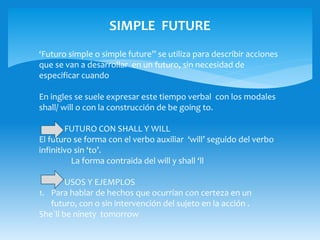
‘Futuro simple o simple future’’ se utiliza para describir acciones
que se van a desarrollar en un futuro, sin necesidad de
especificar cuando
En ingles se suele expresar este tiempo verbal con los modales
shall/ will o con la construcción de be going to.
FUTURO CON SHALL Y WILL
El futuro se forma con el verbo auxiliar ‘will’ seguido del verbo
infinitivo sin ‘to’.
La forma contraida del will y shall ‘ll
USOS Y EJEMPLOS
1. Para hablar de hechos que ocurrían con certeza en un
futuro, con o sin intervención del sujeto en la acción .
She`ll be ninety tomorrow
Simple future
2. Para expresar decisiones tomadas por
el hablante en el momento del habla, sin
tenerlo previsto previamente.
I will phone her tonight
3. Para expresar predicciones,
suposiciones o deducciones del hablante
sobre un hecho del futuro.
It will snow tomoro (predicción)
She will like our present (suposición)
He`ll be rich one day (deducción)
4.Cuando expresas ordenes, peticiones y
promesas.
You will do you homework (orden)
Will you open the door (petición)
I `ll do you best to help her (promesa)
Simple future
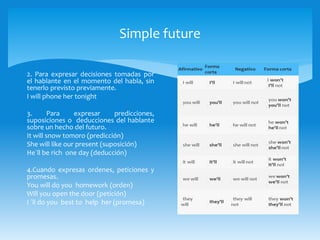
Affirmative Sentences (Sujeto + “will” + verbo
principal.)
I will [I’ll] call you tonight (Te llamaré esta noche.)
She will [She’ll] arrive late (Llegará tarde.)
Negative Sentences (Sujeto + “will” + “not” + verbo
principal)
I will not [won’t] call you tonight. (No te llamaré esta noche.)
She will not [won’t] arrive late. (No llegará tarde.)
Interrogative Sentences (“Will” + sujeto + verbo
principal)
Will you call me tonight? (¿Me llamarás esta noche?)
Will she arrive late? (¿Llegará tarde?)
Simple future
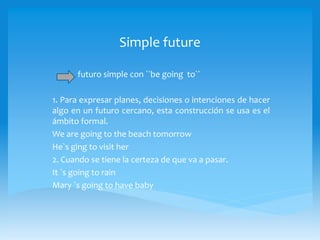
futuro simple con ``be going to``
1. Para expresar planes, decisiones o intenciones de hacer
algo en un futuro cercano, esta construcción se usa es el
ámbito formal.
We are going to the beach tomorrow
He`s ging to visit her
2. Cuando se tiene la certeza de que va a pasar.
It `s going to rain
Mary `s going to have baby
Continuous Present
El present progressive o present continuous (presente
continuo) es la forma continua del presente. En inglés se
utiliza principalmente para acciones que están teniendo
lugar en el momento en que se habla o que solo están
sucediendo temporalmente.
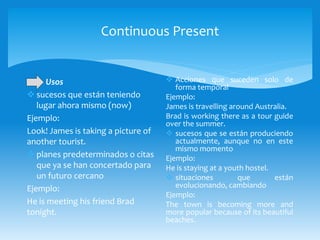
Continuous Present
Usos
 sucesos que están teniendo
lugar ahora mismo (now)
Ejemplo:
Look! James is taking a picture of
another tourist.
 planes predeterminados o citas
que ya se han concertado para
un futuro cercano
Ejemplo:
He is meeting his friend Brad
tonight.
 Acciones que suceden solo de
forma temporal
Ejemplo:
James is travelling around Australia.
Brad is working there as a tour guide
over the summer.
 sucesos que se están produciendo
actualmente, aunque no en este
mismo momento
Ejemplo:
He is staying at a youth hostel.
 situaciones que están
evolucionando, cambiando
Ejemplo:
The town is becoming more and
more popular because of its beautiful
beaches.
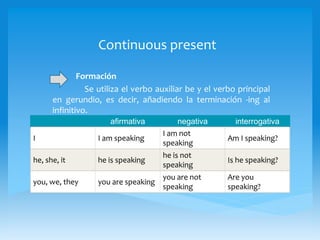
Continuous present
Formación
Se utiliza el verbo auxiliar be y el verbo principal
en gerundio, es decir, añadiendo la terminación -ing al
infinitivo.
afirmativa negativa interrogativa
I I am speaking
I am not
speaking
Am I speaking?
he, she, it he is speaking
he is not
speaking
Is he speaking?
you, we, they you are speaking
you are not
speaking
Are you
speaking?
idioma básico intensivo

idioma básico intensivo

  • 1.
    Universidad Yacambu Facultad deciencias jurídicas y políticas Realizado Vanessa carmona CJP-153-00135 Idioma básico intensivo
  • 2.
    SIMPLE FUTURE ‘Futuro simpleo simple future’’ se utiliza para describir acciones que se van a desarrollar en un futuro, sin necesidad de especificar cuando En ingles se suele expresar este tiempo verbal con los modales shall/ will o con la construcción de be going to. FUTURO CON SHALL Y WILL El futuro se forma con el verbo auxiliar ‘will’ seguido del verbo infinitivo sin ‘to’. La forma contraida del will y shall ‘ll USOS Y EJEMPLOS 1. Para hablar de hechos que ocurrían con certeza en un futuro, con o sin intervención del sujeto en la acción . She`ll be ninety tomorrow
  • 3.
    Simple future 2. Paraexpresar decisiones tomadas por el hablante en el momento del habla, sin tenerlo previsto previamente. I will phone her tonight 3. Para expresar predicciones, suposiciones o deducciones del hablante sobre un hecho del futuro. It will snow tomoro (predicción) She will like our present (suposición) He`ll be rich one day (deducción) 4.Cuando expresas ordenes, peticiones y promesas. You will do you homework (orden) Will you open the door (petición) I `ll do you best to help her (promesa)
  • 4.
    Simple future Affirmative Sentences(Sujeto + “will” + verbo principal.) I will [I’ll] call you tonight (Te llamaré esta noche.) She will [She’ll] arrive late (Llegará tarde.) Negative Sentences (Sujeto + “will” + “not” + verbo principal) I will not [won’t] call you tonight. (No te llamaré esta noche.) She will not [won’t] arrive late. (No llegará tarde.) Interrogative Sentences (“Will” + sujeto + verbo principal) Will you call me tonight? (¿Me llamarás esta noche?) Will she arrive late? (¿Llegará tarde?)
  • 5.
    Simple future futuro simplecon ``be going to`` 1. Para expresar planes, decisiones o intenciones de hacer algo en un futuro cercano, esta construcción se usa es el ámbito formal. We are going to the beach tomorrow He`s ging to visit her 2. Cuando se tiene la certeza de que va a pasar. It `s going to rain Mary `s going to have baby
  • 6.
    Continuous Present El presentprogressive o present continuous (presente continuo) es la forma continua del presente. En inglés se utiliza principalmente para acciones que están teniendo lugar en el momento en que se habla o que solo están sucediendo temporalmente.
  • 7.
    Continuous Present Usos  sucesosque están teniendo lugar ahora mismo (now) Ejemplo: Look! James is taking a picture of another tourist.  planes predeterminados o citas que ya se han concertado para un futuro cercano Ejemplo: He is meeting his friend Brad tonight.  Acciones que suceden solo de forma temporal Ejemplo: James is travelling around Australia. Brad is working there as a tour guide over the summer.  sucesos que se están produciendo actualmente, aunque no en este mismo momento Ejemplo: He is staying at a youth hostel.  situaciones que están evolucionando, cambiando Ejemplo: The town is becoming more and more popular because of its beautiful beaches.
  • 8.
    Continuous present Formación Se utilizael verbo auxiliar be y el verbo principal en gerundio, es decir, añadiendo la terminación -ing al infinitivo. afirmativa negativa interrogativa I I am speaking I am not speaking Am I speaking? he, she, it he is speaking he is not speaking Is he speaking? you, we, they you are speaking you are not speaking Are you speaking?