-ING FORM OR INFINITIVEBACHILLERATO
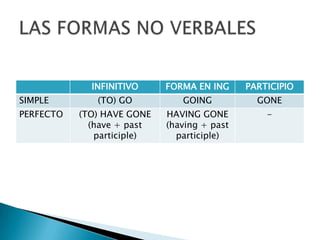
LAS FORMAS NO VERBALES
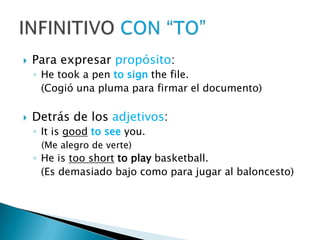
Para expresar propósito:He took a pentosignthefile.	(Cogió una pluma para firmar el documento)Detrás de los adjetivos:Itisgoodtoseeyou.(Me alegro de verte)He istoo shorttoplaybasketball.	(Es demasiado bajo como para jugar al baloncesto)INFINITIVO CON “TO”
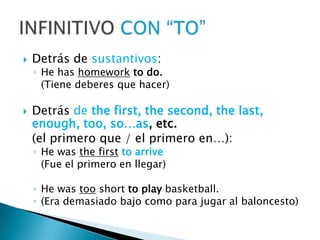
Detrás de sustantivos:He has homeworkto do.(Tiene deberes que hacer)Detrás de thefirst, thesecond, thelast, enough, too, so…as, etc. (el primero que / el primero en…):He wasthefirsttoarrive(Fue el primero en llegar)He wastoo short toplaybasketball.(Era demasiado bajo como para jugar al baloncesto)INFINITIVO CON “TO”
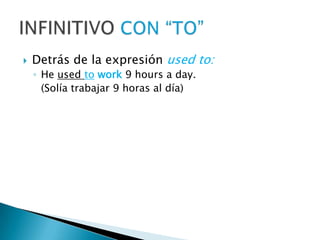
Detrás de la expresión usedto:He usedtowork9 hours a day.	(Solía trabajar 9 horas al día)INFINITIVO CON “TO”
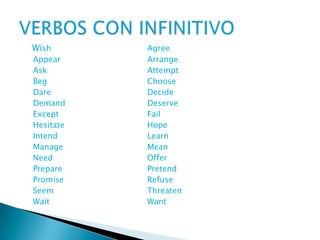
WishAgreeAppearArrangeAsk				AttemptBegChooseDare				DecideDemandDeserveExceptFailHesitate			HopeIntendLearnManage			MeanNeedOfferPrepare			PretendPromiseRefuseSeemThreatenWaitWantVERBOS CON INFINITIVO
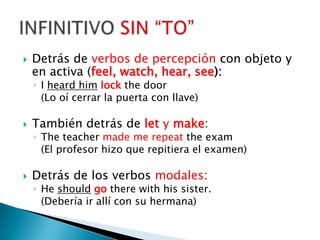
Detrás de verbos de percepción con objeto y en activa (feel, watch, hear, see):I heardhimlockthedoor	(Lo oí cerrar la puerta con llave)También detrás de lety make:Theteachermade me repeattheexam	(El profesor hizo que repitiera el examen)Detrás de los verbos modales:He shouldgotherewithhissister.	(Debería ir allí con su hermana)INFINITIVO SIN “TO”
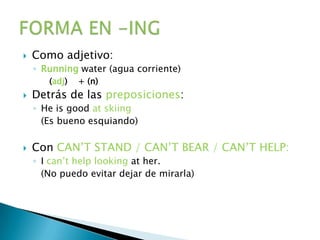
Como adjetivo:Runningwater (agua corriente)	(adj)    + (n)Detrás de las preposiciones:He isgoodat skiing	(Es bueno esquiando)Con CAN’T STAND / CAN’T BEAR / CAN’T HELP:I can’thelplookingat her.	(No puedo evitar dejar de mirarla)FORMAEN -ING
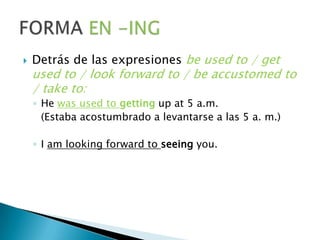
Detrás de las expresiones beusedto / getusedto / look forward to / beaccustomedto / taketo:He wasusedtogettingup at 5 a.m. 		(Estaba acostumbrado a levantarse a las 5 a. m.)I am looking forward toseeingyou.FORMA EN -ING
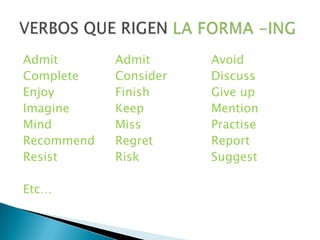
AdmitAdmitAvoidComplete		ConsiderDiscussEnjoyFinishGive upImagine		KeepMentionMind		Miss			PractiseRecommendRegretReportResistRiskSuggestEtc…VERBOS QUE RIGEN LA FORMA -ING
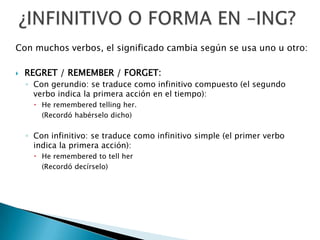
¿INFINITIVO O FORMA EN –ING?Con muchos verbos, el significado cambia según se usa uno u otro:REGRET / REMEMBER / FORGET:Con gerundio: se traduce como infinitivo compuesto (el segundo verbo indica la primera acción en el tiempo):He rememberedtellingher.	(Recordó habérselo dicho)Con infinitivo: se traduce como infinitivo simple (el primer verbo indica la primera acción):He rememberedtotellher	(Recordó decírselo)
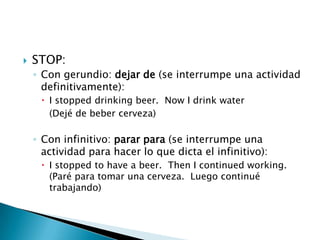
STOP:Con gerundio: dejar de (se interrumpe una actividad definitivamente):I stoppeddrinkingbeer.  Now I drinkwater	(Dejé de beber cerveza)Con infinitivo: parar para (se interrumpe una actividad para hacer lo que dicta el infinitivo):I stoppedtohave a beer.  Then I continuedworking. (Paré para tomar una cerveza.  Luego continué trabajando)
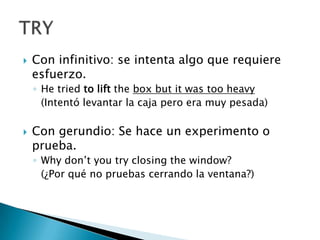
Con infinitivo: se intenta algo que requiere esfuerzo.He triedtoliftthebox butitwastoo heavy	(Intentó levantar la caja pero era muy pesada)Con gerundio: Se hace un experimento o prueba.Whydon’tyou try closingthewindow?	(¿Por qué no pruebas cerrando la ventana?)TRY
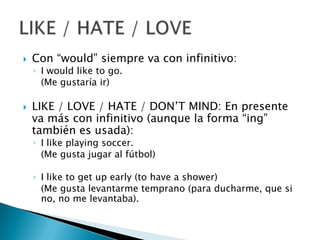
Con “would” siempre va con infinitivo:I wouldliketogo.	(Me gustaría ir)LIKE / LOVE / HATE / DON’T MIND: En presente va más con infinitivo (aunque la forma “ing” también es usada):I likeplaying soccer.	(Me gusta jugar al fútbol)I liketoget up early (tohave a shower)	(Me gusta levantarme temprano (para ducharme, que si no, no me levantaba).LIKE / HATE / LOVE
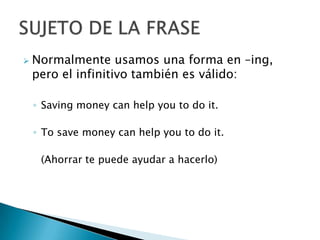
Normalmente usamos una forma en –ing, pero el infinitivo también es válido:Savingmoney can helpyouto do it.Tosavemoney can helpyouto do it.	(Ahorrar te puede ayudar a hacerlo)SUJETO DE LA FRASE
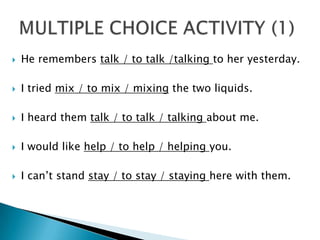
He rememberstalk / totalk /talkingtoheryesterday.I triedmix / tomix / mixingthetwoliquids.I heardthemtalk / totalk / talkingabout me.I wouldlikehelp / tohelp / helpingyou.I can’t stand stay / tostay / stayingherewiththem.MULTIPLE CHOICE ACTIVITY (1)
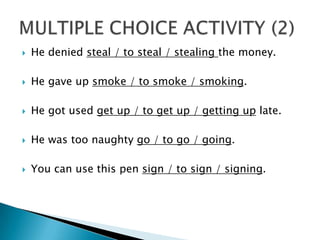
He deniedsteal / tosteal / stealingthemoney.He gave up smoke / tosmoke / smoking.He gotusedget up / toget up / getting up late.He wastoonaughtygo / togo / going.You can use thispensign / tosign / signing.MULTIPLE CHOICE ACTIVITY (2)

Ing form or infinitive

  • 1.
    -ING FORM ORINFINITIVEBACHILLERATO
  • 2.
  • 3.
    Para expresar propósito:Hetook a pentosignthefile. (Cogió una pluma para firmar el documento)Detrás de los adjetivos:Itisgoodtoseeyou.(Me alegro de verte)He istoo shorttoplaybasketball. (Es demasiado bajo como para jugar al baloncesto)INFINITIVO CON “TO”
  • 4.
    Detrás de sustantivos:Hehas homeworkto do.(Tiene deberes que hacer)Detrás de thefirst, thesecond, thelast, enough, too, so…as, etc. (el primero que / el primero en…):He wasthefirsttoarrive(Fue el primero en llegar)He wastoo short toplaybasketball.(Era demasiado bajo como para jugar al baloncesto)INFINITIVO CON “TO”
  • 5.
    Detrás de laexpresión usedto:He usedtowork9 hours a day. (Solía trabajar 9 horas al día)INFINITIVO CON “TO”
  • 6.
  • 7.
    Detrás de verbosde percepción con objeto y en activa (feel, watch, hear, see):I heardhimlockthedoor (Lo oí cerrar la puerta con llave)También detrás de lety make:Theteachermade me repeattheexam (El profesor hizo que repitiera el examen)Detrás de los verbos modales:He shouldgotherewithhissister. (Debería ir allí con su hermana)INFINITIVO SIN “TO”
  • 8.
    Como adjetivo:Runningwater (aguacorriente) (adj) + (n)Detrás de las preposiciones:He isgoodat skiing (Es bueno esquiando)Con CAN’T STAND / CAN’T BEAR / CAN’T HELP:I can’thelplookingat her. (No puedo evitar dejar de mirarla)FORMAEN -ING
  • 9.
    Detrás de lasexpresiones beusedto / getusedto / look forward to / beaccustomedto / taketo:He wasusedtogettingup at 5 a.m. (Estaba acostumbrado a levantarse a las 5 a. m.)I am looking forward toseeingyou.FORMA EN -ING
  • 10.
  • 11.
    ¿INFINITIVO O FORMAEN –ING?Con muchos verbos, el significado cambia según se usa uno u otro:REGRET / REMEMBER / FORGET:Con gerundio: se traduce como infinitivo compuesto (el segundo verbo indica la primera acción en el tiempo):He rememberedtellingher. (Recordó habérselo dicho)Con infinitivo: se traduce como infinitivo simple (el primer verbo indica la primera acción):He rememberedtotellher (Recordó decírselo)
  • 12.
    STOP:Con gerundio: dejarde (se interrumpe una actividad definitivamente):I stoppeddrinkingbeer. Now I drinkwater (Dejé de beber cerveza)Con infinitivo: parar para (se interrumpe una actividad para hacer lo que dicta el infinitivo):I stoppedtohave a beer. Then I continuedworking. (Paré para tomar una cerveza. Luego continué trabajando)
  • 13.
    Con infinitivo: seintenta algo que requiere esfuerzo.He triedtoliftthebox butitwastoo heavy (Intentó levantar la caja pero era muy pesada)Con gerundio: Se hace un experimento o prueba.Whydon’tyou try closingthewindow? (¿Por qué no pruebas cerrando la ventana?)TRY
  • 14.
    Con “would” siempreva con infinitivo:I wouldliketogo. (Me gustaría ir)LIKE / LOVE / HATE / DON’T MIND: En presente va más con infinitivo (aunque la forma “ing” también es usada):I likeplaying soccer. (Me gusta jugar al fútbol)I liketoget up early (tohave a shower) (Me gusta levantarme temprano (para ducharme, que si no, no me levantaba).LIKE / HATE / LOVE
  • 15.
    Normalmente usamos unaforma en –ing, pero el infinitivo también es válido:Savingmoney can helpyouto do it.Tosavemoney can helpyouto do it. (Ahorrar te puede ayudar a hacerlo)SUJETO DE LA FRASE
  • 16.
    He rememberstalk /totalk /talkingtoheryesterday.I triedmix / tomix / mixingthetwoliquids.I heardthemtalk / totalk / talkingabout me.I wouldlikehelp / tohelp / helpingyou.I can’t stand stay / tostay / stayingherewiththem.MULTIPLE CHOICE ACTIVITY (1)
  • 17.
    He deniedsteal /tosteal / stealingthemoney.He gave up smoke / tosmoke / smoking.He gotusedget up / toget up / getting up late.He wastoonaughtygo / togo / going.You can use thispensign / tosign / signing.MULTIPLE CHOICE ACTIVITY (2)