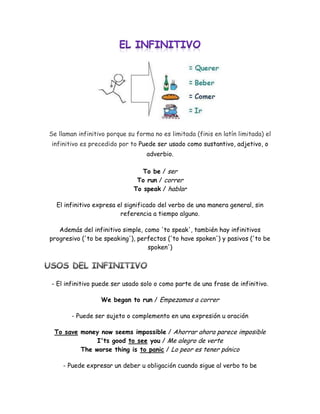
Se llaman infinitivo porque su forma no es limitada (finis en latín limitada) el
infinitivo es precedido por to Puede ser usado como sustantivo, adjetivo, o
                                   adverbio.

                                 To be / ser
                               To run / correr
                              To speak / hablar

  El infinitivo expresa el significado del verbo de una manera general, sin
                         referencia a tiempo alguno.

   Además del infinitivo simple, como 'to speak', también hay infinitivos
progresivo ('to be speaking'), perfectos ('to have spoken') y pasivos ('to be
                                  spoken')


- El infinitivo puede ser usado solo o como parte de una frase de infinitivo.

                  We began to run / Empezamos a correr

        - Puede ser sujeto o complemento en una expresión u oración

 To save money now seems impossible / Ahorrar ahora parece imposible
              I'ts good to see you / Me alegro de verte
         The worse thing is to panic / Lo peor es tener pánico

     - Puede expresar un deber u obligación cuando sigue al verbo to be
You are not to smoke here / No debe fumar aquí

     - Puede expresar un propósito o la razón por la que alguien hace algo.

He went to England to learn English / Fueron a Inglaterra a aprender inglés.
         Craig went to the supermarket to buy some chocolate.
               Craig fue al supermercado a comprar chocolate.
                   NOT ( for to buy / for buying / for buy )

    - Puede ser el complemento u objeto de un verbo, nombre o adjectivo.

                    She wants to pay / Ella quiere pagar
  His plan is to keep us in suspense / Su plan es mantenernos en suspense
   I had the privilege to work with Mr. Taggart / Tuve el privilegio de
                       trabajar con el señor Taggart
          I'm very pleased to meet you / Encantado de conocerle
Craig's very fortunate to have such good friends / Craig tiene mucha suerte
                        de tener tan buenos amigos

- Puede ser usado (sin 'to') después de 'do' o de un verbo modal auxiliar como
                          'must', 'may', 'might', etc.

                     Do you live alone? / ¿Vives solo?
 I might go to the pub after dinner / Quizás vaya al pub después de la cena

 - Hay verbos en inglés que pueden tener detrás el objeto y luego un verbo en
                              infinitivo (con ‘to’).

                                      Tell
  I told you to wash your hands. NOT I told you that you wash your hands.
                                    Invite
She invited me to go to her party. NOT She invited me that I go to her party.
                                     Allow
 They didn’t allow us to smoke in their office. NOT They didn’t allow that we
                            smoke in their office.

 A continuación os indicamos algunos de los verbos y expresiones que utilizan
                                 este patrón:
advise / ask can’t bear / cause / encourage / expect / forbid / force / get /
                               help / leave / need
  order / persuade / remind / teach / warn / beg / would like / would prefer

Los participios y gerundios son dos tipos verbales diferentes. Elinfinitivo es un
 tercer tipo. Un infinitivo es formado con la palabra "to" y la forma básica del
                                     verbo.

                                        Many people love to ski.
                                         To skate is also fun.


   Un infinitivo usado como sustantivo puede ser un sujeto, objeto directo,
                  predicado nominal, u objeto de preposición.

                           Sujeto: To ski takes some training.
                      Objeto Directo: I want to skate this winter
                 Objeto de Preposición: He wanted nothing except to eat.

    Un infinitivo usado como adjetivo modifica un sustantivo o pronombre

                                A good place to visit is a ski resort.
                                  I do not know anyone to race.


      Un infinitivo usado como adverbio modifica un verbo o un adjetivo

                                 To learn, listen to the instructor
                                  This game will be easy to beat


 En un infinitivo, "to" es seguido por la forma básica del verbo. En una frase
preposicional, "to" es seguido por un sustantivo o pronombre que es el objeto
                                 de preposición.

                            Infinitivo: Is this the way to ski?
                             
                  Frase Preposicional: Is this the way to the ski slope?

El infinitivo

  • 1.
    Se llaman infinitivoporque su forma no es limitada (finis en latín limitada) el infinitivo es precedido por to Puede ser usado como sustantivo, adjetivo, o adverbio. To be / ser To run / correr To speak / hablar El infinitivo expresa el significado del verbo de una manera general, sin referencia a tiempo alguno. Además del infinitivo simple, como 'to speak', también hay infinitivos progresivo ('to be speaking'), perfectos ('to have spoken') y pasivos ('to be spoken') - El infinitivo puede ser usado solo o como parte de una frase de infinitivo. We began to run / Empezamos a correr - Puede ser sujeto o complemento en una expresión u oración To save money now seems impossible / Ahorrar ahora parece imposible I'ts good to see you / Me alegro de verte The worse thing is to panic / Lo peor es tener pánico - Puede expresar un deber u obligación cuando sigue al verbo to be
  • 2.
    You are notto smoke here / No debe fumar aquí - Puede expresar un propósito o la razón por la que alguien hace algo. He went to England to learn English / Fueron a Inglaterra a aprender inglés. Craig went to the supermarket to buy some chocolate. Craig fue al supermercado a comprar chocolate. NOT ( for to buy / for buying / for buy ) - Puede ser el complemento u objeto de un verbo, nombre o adjectivo. She wants to pay / Ella quiere pagar His plan is to keep us in suspense / Su plan es mantenernos en suspense I had the privilege to work with Mr. Taggart / Tuve el privilegio de trabajar con el señor Taggart I'm very pleased to meet you / Encantado de conocerle Craig's very fortunate to have such good friends / Craig tiene mucha suerte de tener tan buenos amigos - Puede ser usado (sin 'to') después de 'do' o de un verbo modal auxiliar como 'must', 'may', 'might', etc. Do you live alone? / ¿Vives solo? I might go to the pub after dinner / Quizás vaya al pub después de la cena - Hay verbos en inglés que pueden tener detrás el objeto y luego un verbo en infinitivo (con ‘to’). Tell I told you to wash your hands. NOT I told you that you wash your hands. Invite She invited me to go to her party. NOT She invited me that I go to her party. Allow They didn’t allow us to smoke in their office. NOT They didn’t allow that we smoke in their office. A continuación os indicamos algunos de los verbos y expresiones que utilizan este patrón:
  • 3.
    advise / askcan’t bear / cause / encourage / expect / forbid / force / get / help / leave / need order / persuade / remind / teach / warn / beg / would like / would prefer Los participios y gerundios son dos tipos verbales diferentes. Elinfinitivo es un tercer tipo. Un infinitivo es formado con la palabra "to" y la forma básica del verbo.  Many people love to ski.  To skate is also fun. Un infinitivo usado como sustantivo puede ser un sujeto, objeto directo, predicado nominal, u objeto de preposición.  Sujeto: To ski takes some training.  Objeto Directo: I want to skate this winter  Objeto de Preposición: He wanted nothing except to eat. Un infinitivo usado como adjetivo modifica un sustantivo o pronombre  A good place to visit is a ski resort.  I do not know anyone to race. Un infinitivo usado como adverbio modifica un verbo o un adjetivo  To learn, listen to the instructor  This game will be easy to beat En un infinitivo, "to" es seguido por la forma básica del verbo. En una frase preposicional, "to" es seguido por un sustantivo o pronombre que es el objeto de preposición. Infinitivo: Is this the way to ski?   Frase Preposicional: Is this the way to the ski slope?