Republica Bolivariana de Venezuela
Ministerio del Poder Popular Para la
Educación
Instituto Universitario Politécnico Santiago
Mariño.
Condicionales.
ALUMNO
SAMUEL GONZALEZ CI
26385103
Los condicionales son ciertas
estructuras del inglés en las
cuales, si cierta condición,
situación o circunstancia es
verdadera, entonces sucede un
resultado específico.
Condicionales.
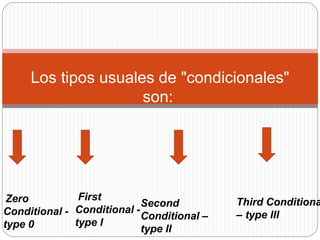
Los tipos usuales de "condicionales"
son:
Zero
Conditional -
type 0
First
Conditional -
type I
Second
Conditional –
type II
Third Conditiona
– type III
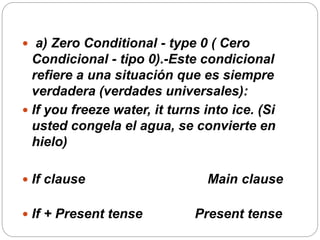
 a) Zero Conditional - type 0 ( Cero
Condicional - tipo 0).-Este condicional
refiere a una situación que es siempre
verdadera (verdades universales):
 If you freeze water, it turns into ice. (Si
usted congela el agua, se convierte en
hielo)
 If clause Main clause
 If + Present tense Present tense
 b) First Conditional - type I (Primer
Condicional - type I).- Se forma con if +
simple present + simple future. Se emplea
cuando una situación es real o posible:
 If it rains today, I'll stay at home. Si llueve
hoy, me quedaré en casa
 If clause Main clause
 If + Present tens will / can / may / must +
verb
 If it rains today, I'll stay at home
 c) Second Conditional – type II (Segundo
Condicional - type II).- Refiere a una situación
hipotética y se forma según la estructura if +
simple past + simple condicional. Aquí tienes
algunos ejemplos traducidos.
If I won the lothery I would travel around the
world
 If clause Main clause
 If + Past Simple would / could
/ might + verb
 If I won the lottery, I would travel
around the world.
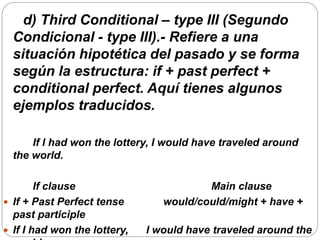
d) Third Conditional – type III (Segundo
Condicional - type III).- Refiere a una
situación hipotética del pasado y se forma
según la estructura: if + past perfect +
conditional perfect. Aquí tienes algunos
ejemplos traducidos.
If I had won the lottery, I would have traveled around
the world.
If clause Main clause
 If + Past Perfect tense would/could/might + have +
past participle
 If I had won the lottery, I would have traveled around the

Ingles ii

  • 1.
    Republica Bolivariana deVenezuela Ministerio del Poder Popular Para la Educación Instituto Universitario Politécnico Santiago Mariño. Condicionales. ALUMNO SAMUEL GONZALEZ CI 26385103
  • 2.
    Los condicionales sonciertas estructuras del inglés en las cuales, si cierta condición, situación o circunstancia es verdadera, entonces sucede un resultado específico. Condicionales.
  • 3.
    Los tipos usualesde "condicionales" son: Zero Conditional - type 0 First Conditional - type I Second Conditional – type II Third Conditiona – type III
  • 4.
     a) ZeroConditional - type 0 ( Cero Condicional - tipo 0).-Este condicional refiere a una situación que es siempre verdadera (verdades universales):  If you freeze water, it turns into ice. (Si usted congela el agua, se convierte en hielo)  If clause Main clause  If + Present tense Present tense
  • 5.
     b) FirstConditional - type I (Primer Condicional - type I).- Se forma con if + simple present + simple future. Se emplea cuando una situación es real o posible:  If it rains today, I'll stay at home. Si llueve hoy, me quedaré en casa  If clause Main clause  If + Present tens will / can / may / must + verb  If it rains today, I'll stay at home
  • 6.
     c) SecondConditional – type II (Segundo Condicional - type II).- Refiere a una situación hipotética y se forma según la estructura if + simple past + simple condicional. Aquí tienes algunos ejemplos traducidos. If I won the lothery I would travel around the world  If clause Main clause  If + Past Simple would / could / might + verb  If I won the lottery, I would travel around the world.
  • 7.
    d) Third Conditional– type III (Segundo Condicional - type III).- Refiere a una situación hipotética del pasado y se forma según la estructura: if + past perfect + conditional perfect. Aquí tienes algunos ejemplos traducidos. If I had won the lottery, I would have traveled around the world. If clause Main clause  If + Past Perfect tense would/could/might + have + past participle  If I had won the lottery, I would have traveled around the