INSTITUTO UNIVERSITARIO POLITÉCNICO
“SANTIAGO MARIÑO”
SEDE BARCELONA
ESCUELA DE INGENIERÍA EN MTTO MECANICO
CONDICIONALES
Bachiller:
Aurelio Martínez
C.I: 26.706.551
DEFINICIÓN
 El uso del condicional significa que una
acción depende de otra. Los condicionales
se utilizan para hablar sobre situaciones
reales o irreales. En general, las frases
condicionales llevan la palabra “if” (si).
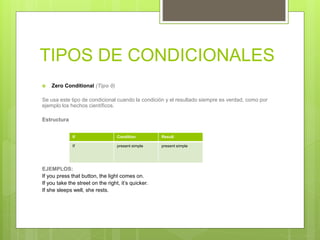
TIPOS DE CONDICIONALES
 Zero Conditional (Tipo 0)
Se usa este tipo de condicional cuando la condición y el resultado siempre es verdad, como por
ejemplo los hechos científicos.
Estructura
EJEMPLOS:
If you press that button, the light comes on.
If you take the street on the right, it’s quicker.
If she sleeps well, she rests.
If Condition Result
If present simple present simple
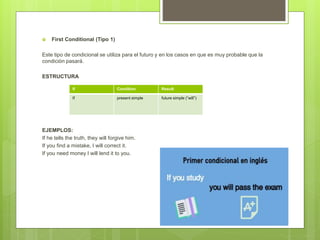
 First Conditional (Tipo 1)
Este tipo de condicional se utiliza para el futuro y en los casos en que es muy probable que la
condición pasará.
ESTRUCTURA
EJEMPLOS:
If he tells the truth, they will forgive him.
If you find a mistake, I will correct it.
If you need money I will lend it to you.
If Condition Result
If present simple future simple (“will”)
 Second Conditional (Tipo 2)
Se utiliza el tipo 2 para expresar una posibilidad irreal en el presente, como un deseo o un
sueño, o para una acción en el futuro no tan probable.
ESTRUCTURA
EJEMPLOS:
If she fell, she would hurt herself.
If you went to bed earlier you wouldn't be so tired.
If it rained, you would get wet.
If Condition Result
If past simple “would” + infinitivo
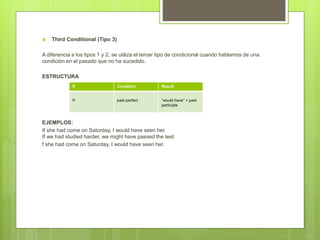
 Third Conditional (Tipo 3)
A diferencia a los tipos 1 y 2, se utiliza el tercer tipo de condicional cuando hablamos de una
condición en el pasado que no ha sucedido.
ESTRUCTURA
EJEMPLOS:
If she had come on Saturday, I would have seen her.
If we had studied harder, we might have passed the test.
f she had come on Saturday, I would have seen her.
If Condition Result
If past perfect “would have” + past
participle

Condicionales aurelio m

  • 1.
    INSTITUTO UNIVERSITARIO POLITÉCNICO “SANTIAGOMARIÑO” SEDE BARCELONA ESCUELA DE INGENIERÍA EN MTTO MECANICO CONDICIONALES Bachiller: Aurelio Martínez C.I: 26.706.551
  • 2.
    DEFINICIÓN  El usodel condicional significa que una acción depende de otra. Los condicionales se utilizan para hablar sobre situaciones reales o irreales. En general, las frases condicionales llevan la palabra “if” (si).
  • 3.
    TIPOS DE CONDICIONALES Zero Conditional (Tipo 0) Se usa este tipo de condicional cuando la condición y el resultado siempre es verdad, como por ejemplo los hechos científicos. Estructura EJEMPLOS: If you press that button, the light comes on. If you take the street on the right, it’s quicker. If she sleeps well, she rests. If Condition Result If present simple present simple
  • 4.
     First Conditional(Tipo 1) Este tipo de condicional se utiliza para el futuro y en los casos en que es muy probable que la condición pasará. ESTRUCTURA EJEMPLOS: If he tells the truth, they will forgive him. If you find a mistake, I will correct it. If you need money I will lend it to you. If Condition Result If present simple future simple (“will”)
  • 5.
     Second Conditional(Tipo 2) Se utiliza el tipo 2 para expresar una posibilidad irreal en el presente, como un deseo o un sueño, o para una acción en el futuro no tan probable. ESTRUCTURA EJEMPLOS: If she fell, she would hurt herself. If you went to bed earlier you wouldn't be so tired. If it rained, you would get wet. If Condition Result If past simple “would” + infinitivo
  • 6.
     Third Conditional(Tipo 3) A diferencia a los tipos 1 y 2, se utiliza el tercer tipo de condicional cuando hablamos de una condición en el pasado que no ha sucedido. ESTRUCTURA EJEMPLOS: If she had come on Saturday, I would have seen her. If we had studied harder, we might have passed the test. f she had come on Saturday, I would have seen her. If Condition Result If past perfect “would have” + past participle