Republica Bolivariana de Venezuela
Ministerio del Poder Popular para la Educación
Instituto Universitario Politécnico
“Santiago Mariño”
Sede Barcelona
Profesora: Alumno:
Rosa Contramaestre Anderson Cevallos
Ingles II C.I.: 25.360.563
Barcelona. Marzo 2018
El uso del condicional significa que una acción depende de otra. Los
condicionales se utilizan para hablar sobre situaciones reales o irreales. En general, las frases
condicionales llevan la palabra “if” (si).
Ten en cuenta que no existe un tiempo verbal para el condicional en inglés
como existe en español. A la vez, se usa el verbo auxiliar “would” para formar el condicional
en inglés.
Se usa este tipo de condicional cuando la condición y el resultado siempre es verdad, como por ejemplo los
hechos científicos.
Proposición “if” (condition) Proposición principal (Resultado)
“if” + “simple present” “simple present”
 If you heat ice, it melts.
 Ice melts if you heat it.
 When you heat ice, it melts.
 Ice melts when you heat it.
 If it rains, the grass gets wet.
IF Condition Result
If present simple future simple (“will”)
Este tipo de condicional se utiliza para el futuro y en los casos en que es muy probable que la condición pasará.
El "type 1 conditional" se refiere a una condición posible y su resultado probable. Estas oraciones se basan en hechos y se utilizan para
hacer afirmaciones sobre la realidad y sobre situaciones particulares; solemos emplearlas para hacer advertencias. El marco temporal de las oraciones
condicionales de tipo 1 es el presente o el futuro y la situación es real.
 If it rains, you will get wet.
 You will get wet if it rains.
 If Sally is late again I will be mad.
 I will be mad if Sally is late again.
 If you don't hurry, you will miss the bus.
.
Se utiliza el tipo 2 para expresar una posibilidad irreal en el presente, como un deseo o un sueño, o para una acción en
el futuro no tan probable.
IF Condition Result
If past simple “would” + infinitivo
 If it rained, you would get wet.
 You would get wet if it rained.
 If you went to bed earlier you wouldn't be so tired.
 You wouldn't be so tired if you went to bed earlier.
 If she fell, she would hurt herself.
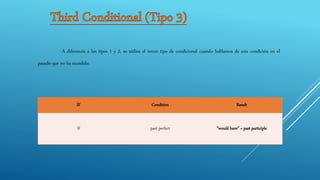
A diferencia a los tipos 1 y 2, se utiliza el tercer tipo de condicional cuando hablamos de una condición en el
pasado que no ha sucedido.
IF Condition Result
If past perfect “would have” + past participle
 If it had rained, you would have gotten wet.
 You would have gotten wet if it had rained.
 You would have passed your exam if you had worked harder.
 If you had worked harder, you would have passed your exam.
 I would have believed you if you hadn't lied to me before.
En este tipo de oración condicional mixta, el tiempo verbal de la proposición "if" es el "past perfect"
y el verbo de la cláusula principal va en "present conditional".
Proposición "if" (condición) Proposición principal (resultado)
If + past perfect present conditional
 If I had worked harder at school, I would have a better job now.
 I would have a better job now if I had worked harder at school.
 If we had looked at the map we wouldn't be lost.
 We wouldn't be lost if we had looked at the map.
 If you had caught that plane you would be dead now.

Conditional Verbs

  • 1.
    Republica Bolivariana deVenezuela Ministerio del Poder Popular para la Educación Instituto Universitario Politécnico “Santiago Mariño” Sede Barcelona Profesora: Alumno: Rosa Contramaestre Anderson Cevallos Ingles II C.I.: 25.360.563 Barcelona. Marzo 2018
  • 2.
    El uso delcondicional significa que una acción depende de otra. Los condicionales se utilizan para hablar sobre situaciones reales o irreales. En general, las frases condicionales llevan la palabra “if” (si). Ten en cuenta que no existe un tiempo verbal para el condicional en inglés como existe en español. A la vez, se usa el verbo auxiliar “would” para formar el condicional en inglés.
  • 3.
    Se usa estetipo de condicional cuando la condición y el resultado siempre es verdad, como por ejemplo los hechos científicos. Proposición “if” (condition) Proposición principal (Resultado) “if” + “simple present” “simple present”
  • 4.
     If youheat ice, it melts.  Ice melts if you heat it.  When you heat ice, it melts.  Ice melts when you heat it.  If it rains, the grass gets wet.
  • 5.
    IF Condition Result Ifpresent simple future simple (“will”) Este tipo de condicional se utiliza para el futuro y en los casos en que es muy probable que la condición pasará.
  • 6.
    El "type 1conditional" se refiere a una condición posible y su resultado probable. Estas oraciones se basan en hechos y se utilizan para hacer afirmaciones sobre la realidad y sobre situaciones particulares; solemos emplearlas para hacer advertencias. El marco temporal de las oraciones condicionales de tipo 1 es el presente o el futuro y la situación es real.  If it rains, you will get wet.  You will get wet if it rains.  If Sally is late again I will be mad.  I will be mad if Sally is late again.  If you don't hurry, you will miss the bus. .
  • 7.
    Se utiliza eltipo 2 para expresar una posibilidad irreal en el presente, como un deseo o un sueño, o para una acción en el futuro no tan probable. IF Condition Result If past simple “would” + infinitivo
  • 8.
     If itrained, you would get wet.  You would get wet if it rained.  If you went to bed earlier you wouldn't be so tired.  You wouldn't be so tired if you went to bed earlier.  If she fell, she would hurt herself.
  • 9.
    A diferencia alos tipos 1 y 2, se utiliza el tercer tipo de condicional cuando hablamos de una condición en el pasado que no ha sucedido. IF Condition Result If past perfect “would have” + past participle
  • 10.
     If ithad rained, you would have gotten wet.  You would have gotten wet if it had rained.  You would have passed your exam if you had worked harder.  If you had worked harder, you would have passed your exam.  I would have believed you if you hadn't lied to me before.
  • 11.
    En este tipode oración condicional mixta, el tiempo verbal de la proposición "if" es el "past perfect" y el verbo de la cláusula principal va en "present conditional". Proposición "if" (condición) Proposición principal (resultado) If + past perfect present conditional
  • 12.
     If Ihad worked harder at school, I would have a better job now.  I would have a better job now if I had worked harder at school.  If we had looked at the map we wouldn't be lost.  We wouldn't be lost if we had looked at the map.  If you had caught that plane you would be dead now.