http://SolEpcc.unex.es
@SolEpccSaltar a Arduino 
Saltar a instalación 
Saltar a programación 
Saltar a presentación 
http://SolEpcc.unex.es
@SolEpcc
http://SolEpcc.unex.es
@SolEpcc
http://SolEpcc.unex.es
@SolEpcc
http://SolEpcc.unex.es
@SolEpcc
http://SolEpcc.unex.es
@SolEpcc
http://SolEpcc.unex.es
@SolEpcc
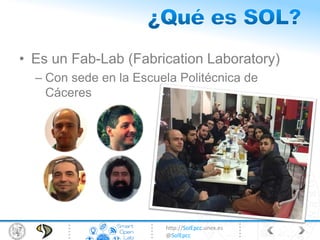
• Es un Fab-Lab (Fabrication Laboratory)
– Con sede en la Escuela Politécnica de
Cáceres
http://SolEpcc.unex.es
@SolEpcc
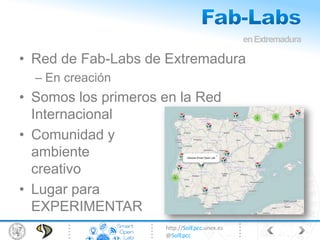
• Red de Fab-Labs de Extremadura
– En creación
• Somos los primeros en la Red
Internacional
• Comunidad y
ambiente
creativo
• Lugar para
EXPERIMENTAR
enExtremadura
http://SolEpcc.unex.es
@SolEpcc
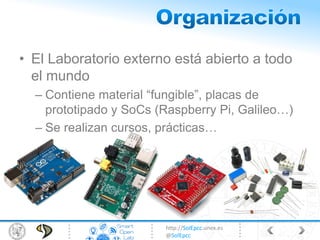
• El Laboratorio externo está abierto a todo
el mundo
– Contiene material “fungible”, placas de
prototipado y SoCs (Raspberry Pi, Galileo…)
– Se realizan cursos, prácticas…
http://SolEpcc.unex.es
@SolEpcc
• El laboratorio interno contiene material
que requiere conocimientos previos
– Taladros, rotaflex, grabadora, impresión 3D…
http://SolEpcc.unex.es
@SolEpcc
• Es un espacio abierto a TODOS
– Estudiantes, profesores, PAS,…
– Y ¡Gente de fuera de la Universidad!
• Respetar el código de convivencia y ser participativo
– El aprendizaje es colaborativo
– Los proyectos son compartidos al menos con el resto de
miembros
• Cada cual elige cómo compartirlo fuera de SOL
• Asociación creada (no universitaria)
– Acceso preferente a cursos/talleres
– Taller siempre disponible (llave)
– 10€/año
¿CÓMO?
http://SolEpcc.unex.es
@SolEpcc
principales
http://SolEpcc.unex.es
@SolEpcc
• Algunos presentados como candidatos
para creación de empresas y torneos
mundiales de ingeniería
http://SolEpcc.unex.es
@SolEpcc
http://SolEpcc.unex.es
@SolEpcc
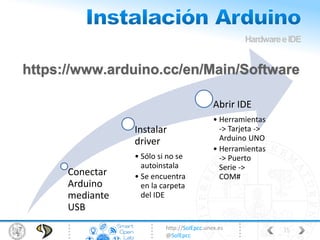
Conectar
Arduino
mediante
USB
Instalar
driver
• Sólo si no se
autoinstala
• Se encuentra
en la carpeta
del IDE
Abrir IDE
• Herramientas
-> Tarjeta ->
Arduino UNO
• Herramientas
-> Puerto
Serie ->
COM#
HardwareeIDE
15
http://SolEpcc.unex.es
@SolEpcc
• Estructura del código:
setup{
//código que se ejecuta
//una vez al inicio
}
loop{
//código que se ejecuta
//repetidamente
}
http://SolEpcc.unex.es
@SolEpcc
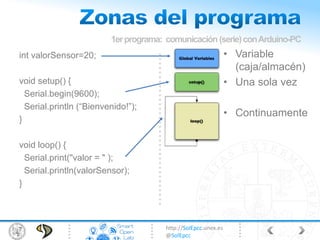
int valorSensor=20;
void setup() {
Serial.begin(9600);
Serial.println (“Bienvenido!”);
}
void loop() {
Serial.print("valor = " );
Serial.println(valorSensor);
}
• Variable
(caja/almacén)
• Una sola vez
• Continuamente
1erprograma: comunicación(serie)conArduino-PC
http://SolEpcc.unex.es
@SolEpcc
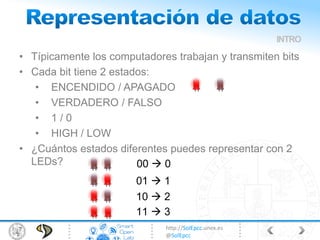
• Típicamente los computadores trabajan y transmiten bits
• Cada bit tiene 2 estados:
• ENCENDIDO / APAGADO
• VERDADERO / FALSO
• 1 / 0
• HIGH / LOW
• ¿Cuántos estados diferentes puedes representar con 2
LEDs?
INTRO
00  0
01  1
10  2
11  3
http://SolEpcc.unex.es
@SolEpcc
• ¿Y dónde se almacenan estos datos?¡variables!
– boolean  true o false, 0 ó 1 (1 bit  1 byte)
– byte, char, unsigned char  del 0 al 255
– int, unsigned int  del 0 al 65535
– long, unsigned long, double, float  32 bits
TIPOSdeDATOS
8 bits 16 bits 32 bits
char int, unsigned int long, unsigned long
float
http://SolEpcc.unex.es
@SolEpcc
• Y en el programa: ¿Cómo se especifica?
– variables (son cajas que almacenan bits)
tipo nombre;
tipo nombre = valor;
tipo nombre1, nombre2,…;
int x;
float voltage = 5.0;
bool mivar1, mivar2;
const int LEDPIN = 7;
TIPOSdeDATOS
http://SolEpcc.unex.es
@SolEpcc
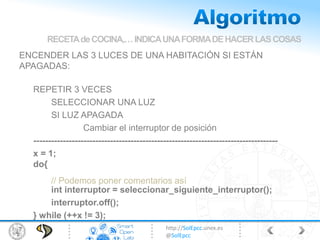
ENCENDER LAS 3 LUCES DE UNA HABITACIÓN SI ESTÁN
APAGADAS:
REPETIR 3 VECES
SELECCIONAR UNA LUZ
SI LUZ APAGADA
Cambiar el interruptor de posición
-----------------------------------------------------------------------------------
x = 1;
do{
int interruptor = seleccionar_siguiente_interruptor();
interruptor.off();
} while (++x != 3);
RECETAdeCOCINA,…INDICAUNAFORMADEHACERLASCOSAS
// Podemos poner comentarios así
http://SolEpcc.unex.es
@SolEpcc
• Cada línea de un
algoritmo se llama
sentencia
– Asignación: da valor a
una variable
• b = 3;
– Operadores
matemáticos
• a = b + 1;
• +, -, *, /, % (modulo),
++, --
int mi_var;
void setup() {
Serial.begin(9600);
mi_var = 2;
}
void loop() {
Serial.print("t valor = " );
Serial.println(mi_var);
mi_var = mi_var + 1;
}
//probar a cambiar por: mi_var++;
//probar a cambiar por: mi_var *= 2;
2doprograma,asignación yop.matemáticos
http://SolEpcc.unex.es
@SolEpcc
• Sentencias:
– Operadores relacionales
>, <, ==, >=, <=, !=
– Operadores lógicos
• &&, ||, !(not)
– Operadores lógicos de bit
• &, |, ^(xor), ~(negación)
• <<(desplaz. left), >>(desplaz. right)
operadoresrelacionalesylógicos
http://SolEpcc.unex.es
@SolEpcc
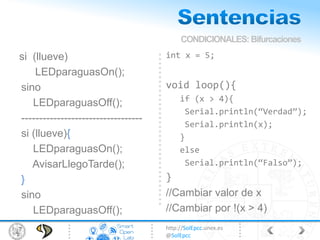
si (llueve)
LEDparaguasOn();
sino
LEDparaguasOff();
----------------------------------
si (llueve){
LEDparaguasOn();
AvisarLlegoTarde();
}
sino
LEDparaguasOff();
int x = 5;
void loop(){
if (x > 4){
Serial.println(“Verdad”);
Serial.println(x);
}
else
Serial.println(“Falso”);
}
//Cambiar valor de x
//Cambiar por !(x > 4)
CONDICIONALES: Bifurcaciones
http://SolEpcc.unex.es
@SolEpcc
En base al valor de tiempo
llueve:
EncenderLED;
RecogerToldo;
nieva:
RecogerToldo;
MandarMensajeMovil;
por defecto:
RecogerTemperatura;
si (Temperatura>28)
int selector = 1;
void loop(){
switch (selector){
case 1:
Serial.println(“1”);
break;
case 2:
Serial.println(“2”);
break;
default:
Serial.println(“otro”);
break;
selector++;
}
CONDICIONALES:switch-case
http://SolEpcc.unex.es
@SolEpcc
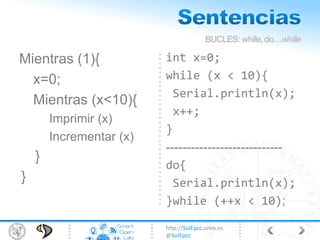
Mientras (1){
x=0;
Mientras (x<10){
Imprimir (x)
Incrementar (x)
}
}
int x=0;
while (x < 10){
Serial.println(x);
x++;
}
----------------------------
do{
Serial.println(x);
}while (++x < 10);
BUCLES:while,do…while
http://SolEpcc.unex.es
@SolEpcc
Repetir acciones x
veces:
Para (x=0) hasta
(x<10) (x++)
{
Imprimir(x);
}
int i=0;
void loop(){
for (i=0; i<10; i++){
Serial.println(i);
}
BUCLES:for
http://SolEpcc.unex.es
@SolEpcc
num sumaNumeros(num1,
num2)
{
num = num1+num2;
}
------------------------------------
int mediaNumeros (int a, int b){
int c;
c = a+b;
c /=2;
return c;
}
void setup() {
Serial.begin(9600);
}
int valor1, valor2;
void loop() {
Serial.print("Introduce un valor:");
valor1 = Serial.read();
Serial.print("Introduce otro valor:");
valor2 = Serial.read();
Serial.print("La media es ");
Serial.println (mediaNumeros(valor1, valor2) );
}
Agrupandosentencias
•Serial.read();
//reads first byte from buffer
•Serial.available();
// returns the number of
bytes in the buffer
•Serial.flush();
// clears the buffer
http://SolEpcc.unex.es
@SolEpcc
Marino Linaje
http://SolEpcc.unex.es
@SolEpcc
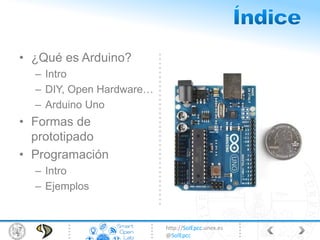
• ¿Qué es Arduino?
– Intro
– DIY, Open Hardware…
– Arduino Uno
• Formas de
prototipado
• Programación
– Intro
– Ejemplos
http://SolEpcc.unex.es
@SolEpcc
openPicus
Arduino
Seeeduino
Netduino
IOIO
Raspberry Pi
LilyPad
Etc.
PlataformasPrototipadoHW(microcontrontrolador)
31
http://SolEpcc.unex.es
@SolEpcc
• Multiplatforma (Windows, Linux, Mac)
• Energía via USB o externo
– (Adaptador AC/DC o batería)
• Muchas alternativas
Intro
Arduino Mega 2560
Arduino Ethernet
Arduino Pro Mini
http://www.arduino.cc/
http://SolEpcc.unex.es
@SolEpcc
OpenSoftware/Hardware,DIY
33
Arduino board
Arduino IDE
http://SolEpcc.unex.es
@SolEpcc
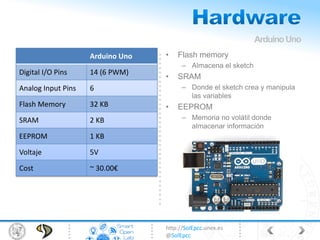
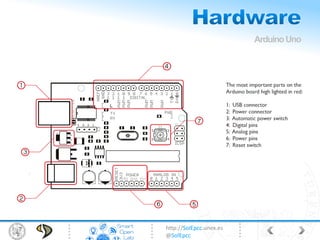
Arduino Uno
Digital I/O Pins 14 (6 PWM)
Analog Input Pins 6
Flash Memory 32 KB
SRAM 2 KB
EEPROM 1 KB
Voltaje 5V
Cost ~ 30.00€
• Flash memory
– Almacena el sketch
• SRAM
– Donde el sketch crea y manipula
las variables
• EEPROM
– Memoria no volátil donde
almacenar información
ArduinoUno
http://SolEpcc.unex.es
@SolEpcc
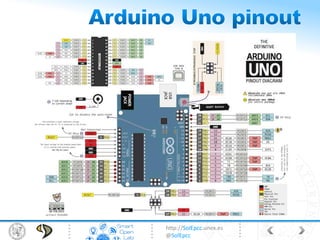
ArduinoUno
http://SolEpcc.unex.es
@SolEpcc
http://SolEpcc.unex.es
@SolEpcc
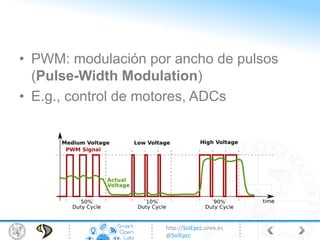
• PWM: modulación por ancho de pulsos
(Pulse-Width Modulation)
• E.g., control de motores, ADCs
http://SolEpcc.unex.es
@SolEpcc
Directa
http://SolEpcc.unex.es
@SolEpcc
Breadboard(Tablerodecircuitos)
http://SolEpcc.unex.es
@SolEpcc
Problemas:Requiereciertosconocimientosyhabilidades
http://SolEpcc.unex.es
@SolEpcc
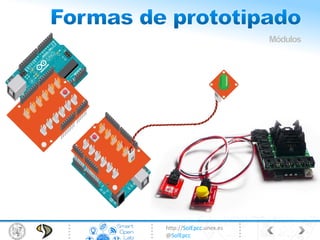
Módulos
http://SolEpcc.unex.es
@SolEpcc
• Lenguaje propio basado en “wiring”
– Parecido a C
• Ejemplos de sentencias:
– digitalWrite(pin#, HIGH or LOW);
– digitalRead(pin#);
– Serial.println(“hola”);
http://SolEpcc.unex.es
@SolEpcc
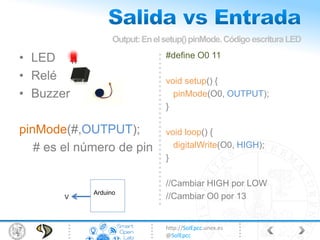
• LED
• Relé
• Buzzer
pinMode(#,OUTPUT);
# es el número de pin
#define O0 11
void setup() {
pinMode(O0, OUTPUT);
}
void loop() {
digitalWrite(O0, HIGH);
}
//Cambiar HIGH por LOW
//Cambiar O0 por 13
Output:Enelsetup()pinMode.CódigoescrituraLED
Arduino
V
http://SolEpcc.unex.es
@SolEpcc
• Botón
• Potenciómetro
• LDR
pinMode(#,INPUT);
# es el número de pin
#define I0 A0
int valor_boton;
void setup() {
Serial.begin (9600);
pinMode(I0,INPUT);
}
void loop() {
valor_boton = digitalRead(I0);
Serial.println (valor_boton);
}
Input:Enelsetup()pinMode.Códigolecturadebotón
Arduino
V
High(5V)
1KΩ
INPUT_PULLUP
Si el PIN no se conecta
toma valor 1
http://SolEpcc.unex.es
@SolEpcc
• Toma valores discretos:
– 0 ó 1, LOW ó HIGH,…
– Realmente es un voltaje:
• HIGH (~ 2.7V-5V)
• LOW (~ 1.2V-0V)
var = digitalRead(#);
//devuelve el valor leído
digitalWrite(#, value);
//value debe ser HIGH o LOW
• Toma valores continuos:
– Teóricamente infinitos
– Al tratarlos con un micro
controlador/procesador
• 0,1,2,3,4,5,6… (no solo
enteros)  son voltajes
var = analogRead(#);
analogWrite(#, value);
//value es valor discreto (0-255)
5 V
0 V
5 V
0 V
http://SolEpcc.unex.es
@SolEpcc
analogWrite(pin, val);
46C Programming
analogWrite(pin, valor);
pin – pin de salida
valor – valor de 8 bit
0 => 0V
…
255 => 5V
http://SolEpcc.unex.es
@SolEpcc
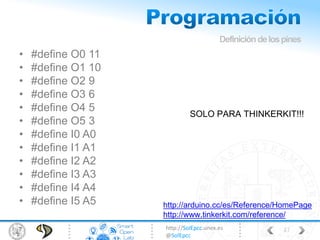
• #define O0 11
• #define O1 10
• #define O2 9
• #define O3 6
• #define O4 5
• #define O5 3
• #define I0 A0
• #define I1 A1
• #define I2 A2
• #define I3 A3
• #define I4 A4
• #define I5 A5
Definicióndelospines
47
SOLO PARA THINKERKIT!!!
http://arduino.cc/es/Reference/HomePage
http://www.tinkerkit.com/reference/
http://SolEpcc.unex.es
@SolEpcc
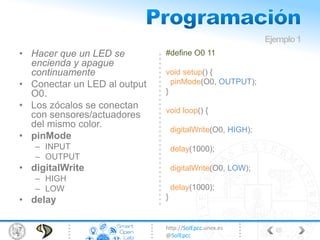
• Hacer que un LED se
encienda y apague
continuamente
• Conectar un LED al output
O0.
• Los zócalos se conectan
con sensores/actuadores
del mismo color.
• pinMode
– INPUT
– OUTPUT
• digitalWrite
– HIGH
– LOW
• delay
#define O0 11
void setup() {
pinMode(O0, OUTPUT);
}
void loop() {
digitalWrite(O0, HIGH);
delay(1000);
digitalWrite(O0, LOW);
delay(1000);
}
Ejemplo1
48
http://SolEpcc.unex.es
@SolEpcc
• Hacer que el LED se
encienda cuando
toquemos un
pulsador
• Conectar el pulsador
o el sensor táctil a I0
(#define I0 A0)
• digitalRead
– True
– False
#define O0 11
#define I0 A0
void setup() {
pinMode(O0,OUTPUT);
pinMode(I0,INPUT);
}
void loop() {
if(digitalRead(I0)){
digitalWrite(O0, HIGH);
}else{
digitalWrite(O0, LOW);
}
delay(10);
}
Ejemplo2
49
http://SolEpcc.unex.es
@SolEpcc
• Controlar la potencia de luz de
un LED con un eje de un
joystick
• Conectar a I0 uno de los
zócalos del joystick
• analogRead
• map
– Re-mapea un número de un
rango a otro
– y=map(x,1,150,0,20);
– 1,150rango original de x
– 0,20rango destino de y
• analogWrite
#define O0 11
#define I0 A0
int analogInputValue = 0;
int analogOutputValue = 0;
void setup() {
pinMode(O0,OUTPUT);
pinMode(I0,INPUT);
}
void loop() {
analogInputValue = analogRead(I0);
analogOutputValue =
map(analogInputValue,0,1023,0,255);
analogWrite(O0,analogOutputValue);
delay(10);
}
Ejemplo3
50
http://SolEpcc.unex.es
@SolEpcc
• Controlar la potencia de
luz de dos LEDs con los
dos ejes de un joystick
• Pines O0 y O1
configurados como
salidas analógicas
(conectar dos LEDs)
• Pines I0 e I1
configurados como
entradas analógicas
(conectar los dos zócalos
del joystick)
• Mapear las entradas con
las salidas
• #define O0 11
• #define O1 10
• #define O2 9
• #define O3 6
• #define O4 5
• #define O5 3
• #define I0 A0
• #define I1 A1
• #define I2 A2
• #define I3 A3
• #define I4 A4
• #define I5 A5
Ejemplo4
51
http://SolEpcc.unex.es
@SolEpcc
#define O0 11
#define O1 10
#define I0 A0
#define I1 A1
int analogSensorValue1 = 0;
int analogSensorValue2 = 0;
int analogOutputValue1 = 0;
int analogOutputValue2 = 0;
int digitalOutputValue1 = LOW;
void setup() {
Serial.begin(9600);
pinMode(O0,OUTPUT);
pinMode(O1,OUTPUT);
pinMode(I0, INPUT);
pinMode(I1,INPUT);
}
void loop() {
analogSensorValue1 = analogRead(I0);
analogSensorValue2 = analogRead(I1);
analogOutputValue1 =
map(analogSensorValue1, 0, 1023, 0, 255);
analogOutputValue2 =
map(analogSensorValue2, 0, 1023, 0, 255);
analogWrite(O0, analogOutputValue1);
analogWrite(O1, analogOutputValue2);
Serial.print("sensor = " );
Serial.print(analogSensorValue1);
Serial.print("t output = ");
Serial.println(analogOutputValue1);
delay(10);
}
Ejemplo4
52
http://SolEpcc.unex.es
@SolEpcc
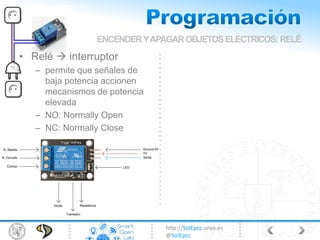
• Relé  interruptor
– permite que señales de
baja potencia accionen
mecanismos de potencia
elevada
– NO: Normally Open
– NC: Normally Close
ENCENDERYAPAGAROBJETOSELECTRICOS: RELÉ
http://SolEpcc.unex.es
@SolEpcc
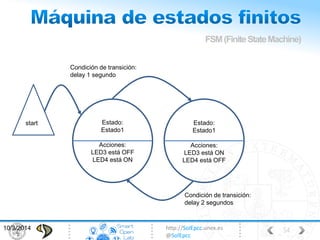
FSM(FiniteStateMachine)
5410/3/2014
Condición de transición:
delay 1 segundo
Estado:
Estado1
Acciones:
LED3 está OFF
LED4 está ON
Estado:
Estado1
Acciones:
LED3 está ON
LED4 está OFF
Condición de transición:
delay 2 segundos
start
http://SolEpcc.unex.es
@SolEpcc
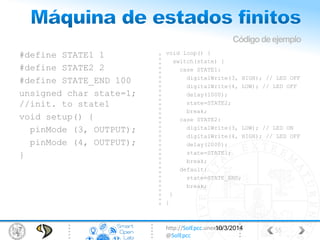
#define STATE1 1
#define STATE2 2
#define STATE_END 100
unsigned char state=1;
//init. to state1
void setup() {
pinMode (3, OUTPUT);
pinMode (4, OUTPUT);
}
void loop() {
switch(state) {
case STATE1:
digitalWrite(3, HIGH); // LED OFF
digitalWrite(4, LOW); // LED OFF
delay(1000);
state=STATE2;
break;
case STATE2:
digitalWrite(3, LOW); // LED ON
digitalWrite(4, HIGH); // LED OFF
delay(2000);
state=STATE1;
break;
default:
state=STATE_END;
break;
}
}
Códigodeejemplo
5510/3/2014
http://SolEpcc.unex.es
@SolEpcc
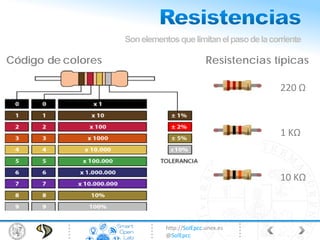
220 Ω
1 KΩ
Resistencias típicas
10 KΩ
Sonelementosquelimitanelpasodelacorriente
Código de colores
http://SolEpcc.unex.es
@SolEpcc
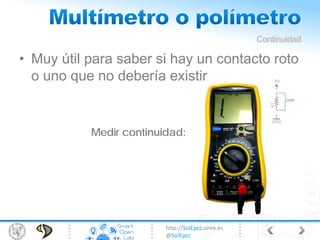
Medir continuidad:
• Muy útil para saber si hay un contacto roto
o uno que no debería existir
Continuidad
http://SolEpcc.unex.es
@SolEpcc
Medir tensión:
Tensióneintensidad
http://SolEpcc.unex.es
@SolEpcc

Intro arduino r3