1 terminales
Sinápticos: traen
señales de otras
neuronas.
2 Dendritas: Reciben
señales de otras neuronas.
3 Cuerpo celular:
Integra señales;
coordina actividades
metabólicas.
4 Potencial de acción
inicia aqui.
5 Axón: Transmite el
potencial de acción.
6 Mielina: aisla al axon,
acelera la conducción.
8 Dendritas (de otras
neuronas)
7 Synaptic terminals:traen
señales de otras neuronas.
1 terminales
Sinápticos:
traen señales
de otras
neuronas.
3 Cuerpo celular:
Integra señales;
coordina actividades
metabólicas.
.
4 Action potential starts
here.
2 Dendritas:
Reciben señales
de otras
neuronas.
5 Axon: Transmits the
action potential.
6 Mielina: aisla al
axon, acelera la
conducción
8 Dendrites
(of other neurons)
7 Synaptic terminals:
Transmit signals to other
neurons.
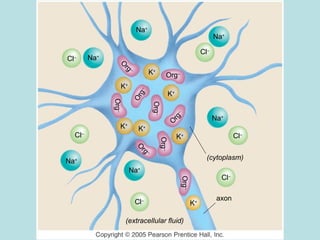
Na+
Cl–
Na+
Na+
Cl–
Cl–
Cl–
Cl–
Cl–
Na+
Na+
Na+
K+
K+
K+
K+
K+K+
K+
Org–
Org–
Org–
Org–
O
rg
–
O
rg
–
Org–
O
rg–
Org–
(extracellular fluid)
(cytoplasm)
axon
Na+
Cl–
Org–
Na+
Na+
Org–
Org–
Org–
Na+
Cl–
Cl–
Cl–
Org–
K+
K+ K+
K+
K+
(extracellular fluid)
(neuron cytoplasm; negatively charged)
Na+
Cl–
Org–
Na+
Org–
Org–
Na+
Cl–
Cl–
K+
K+
K+
K+
(extracellular fluid)
(neuron
cytoplasm;
positively charged)
action potential
K+
K+
K+ K+
K+
Org–
K+
Na+
Na+
Na+
Na+
Na+
Na+
(negatively charged)
1 2
action potentialNa+
(axon)
(extracellular fluid)
+ +
action potentialNa+
(axon)
(extracellular fluid)
K+
synaptic
vesicle synaptic
terminal
espacio
neurotransmitter
ion
channel
closed dendrite of
postsynaptic
neuron
http://www.youtube.com/watch?v=iNnMXwaNX5g
http://www.youtube.com/watch?v=MK8fxmgrwp4
http://www.youtube.com/watch?v=vwk5OutMq80

Neuronas estructura y funcion

Notas del editor

  • #3 Figure: 34-1 Title: A nerve cell, showing its specialized parts and their functions
  • #4 Figure: 34-1 top Title: A nerve cell, showing its specialized parts and their functions top
  • #5 Figure: 34-1 bottom Title: A nerve cell, showing its specialized parts and their function bottom
  • #6 Figure: E34-1Title:The neuron maintains ionic gradientsCaption:The ionic composition of a neuron's cytoplasm is significantly different from that of the extracellular fluid. The neuron maintains high concentrations of K+ and large organic ions (Org–); the extracellular fluid is high in Na+ and Cl–.
  • #7 Figure: 34-UN1Title:Resting potential
  • #8 Figure: 34-UN2Title:Action potential/resting potential restored
  • #9 Figure: 34-UN3Title:Beginning of action potential
  • #10 Figure: 34-UN4Title:End of action potential
  • #11 Figure: 34-3 Title: The structure and operation of the synapse Caption: The synaptic terminal contains numerous neurotransmitter-filled vesicles. When an action potential enters the synaptic terminal, the vesicles release their neurotransmitter into the space between the neurons. The neurotransmitter diffuses rapidly across the gap, binds to postsynaptic receptors, and causes ion channels to open. Ions flow through these open channels, causing a postsynaptic potential in the postsynaptic cell. Question Imagine an experiment in which the neurons pictured here are bathed in a solution containing a nerve poison. The presynaptic neuron is stimulated and produces an action potential, but this does not result in an action potential in the postsynaptic neuron. When the experimenter adds some neurotransmitter to the synapse, the postsynaptic neuron still produces no action potential. How does the poison act to disrupt nerve function?