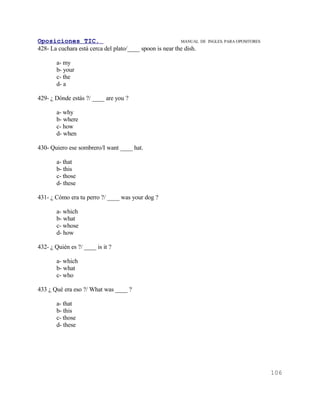
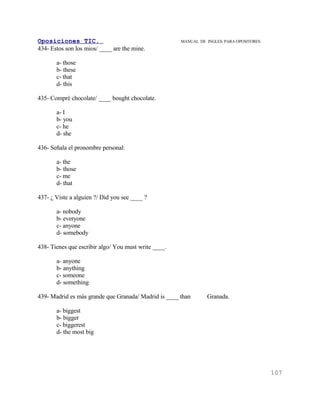
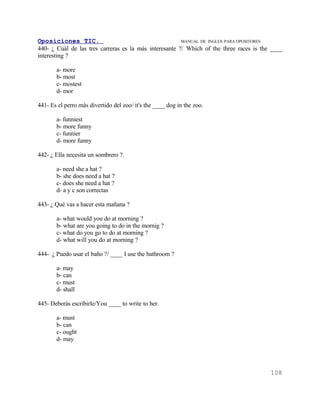
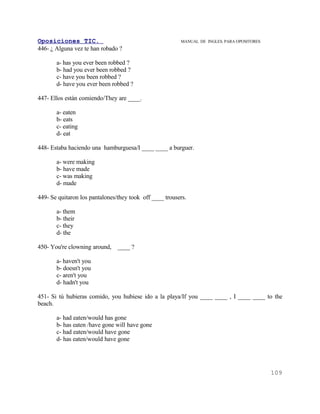
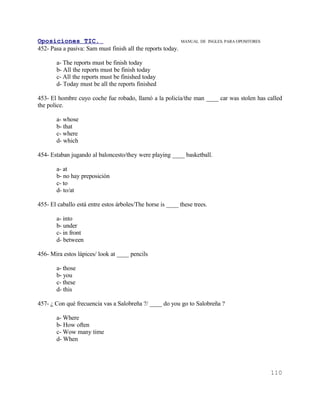
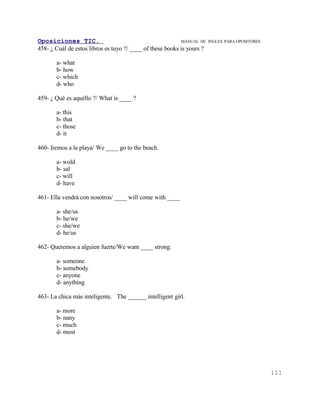
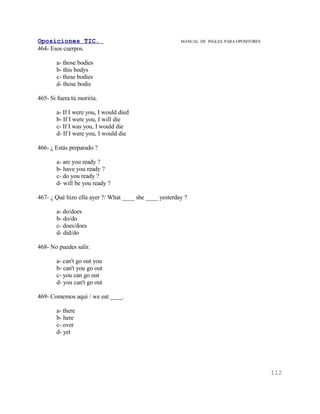
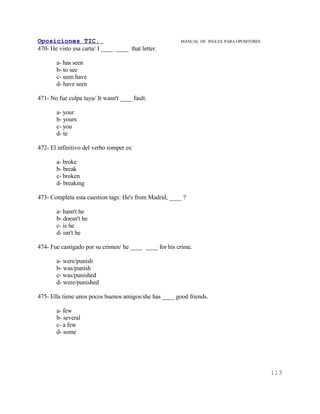
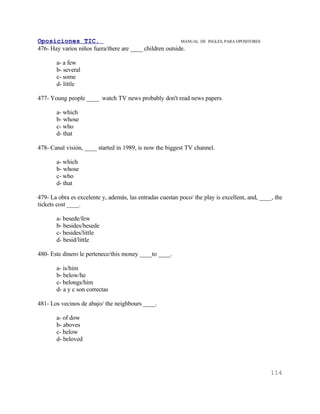
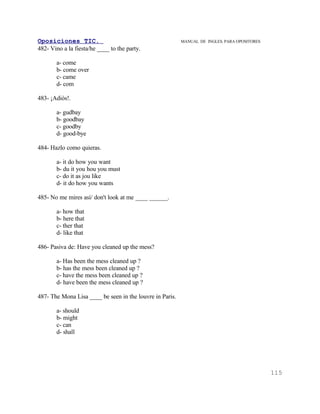
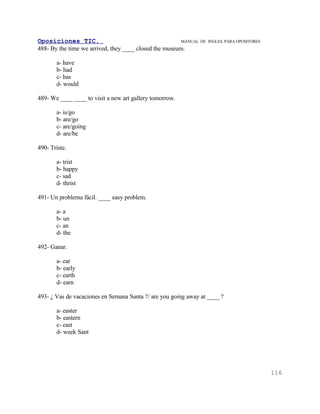
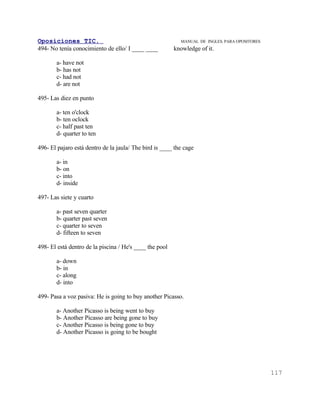
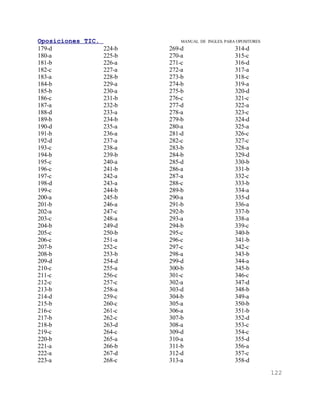
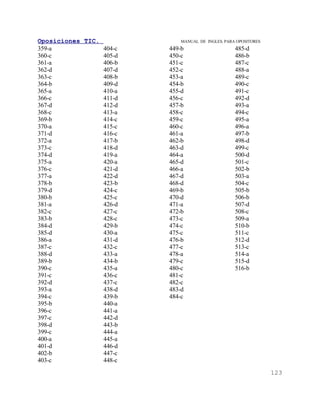
Oposiciones TIC.                                                          MANUAL DE INGLES. PARA OPOSITORES


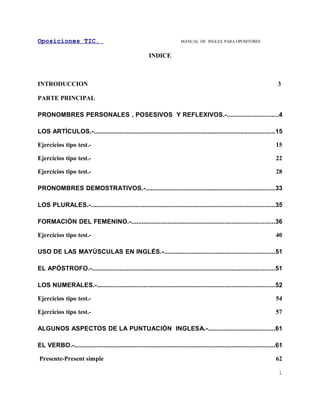
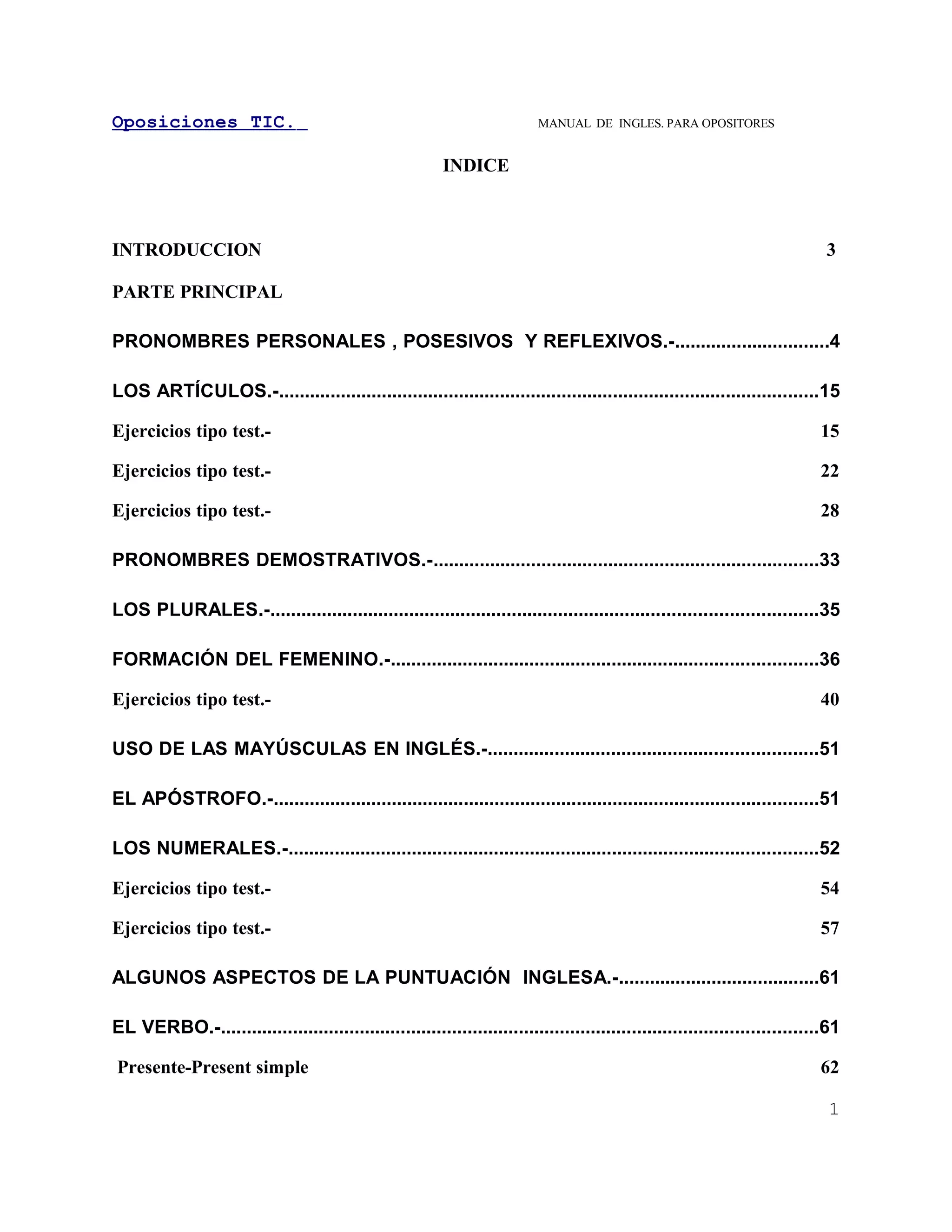
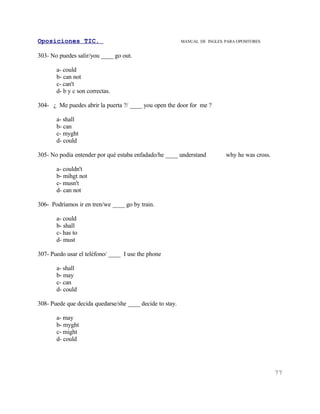
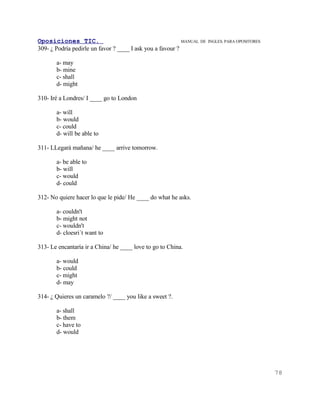
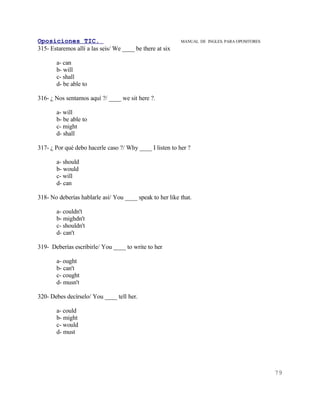
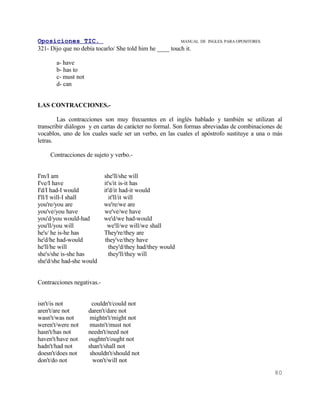
                                                          INDICE


INTRODUCCION                                                                                                                 3

PARTE PRINCIPAL

PRONOMBRES PERSONALES , POSESIVOS Y REFLEXIVOS.-..............................4

LOS ARTÍCULOS.-.........................................................................................................15

Ejercicios tipo test.-                                                                                                      15

Ejercicios tipo test.-                                                                                                      22

Ejercicios tipo test.-                                                                                                      28

PRONOMBRES DEMOSTRATIVOS.-...........................................................................33

LOS PLURALES.-..........................................................................................................35

FORMACIÓN DEL FEMENINO.-...................................................................................36

Ejercicios tipo test.-                                                                                                      40

USO DE LAS MAYÚSCULAS EN INGLÉS.-................................................................51

EL APÓSTROFO.-..........................................................................................................51

LOS NUMERALES.-.......................................................................................................52

Ejercicios tipo test.-                                                                                                      54

Ejercicios tipo test.-                                                                                                      57

ALGUNOS ASPECTOS DE LA PUNTUACIÓN INGLESA.-.......................................61

EL VERBO.-....................................................................................................................61

Presente-Present simple                                                                                                     62

                                                                                                                             1
Oposiciones TIC.                                                 MANUAL DE INGLES. PARA OPOSITORES
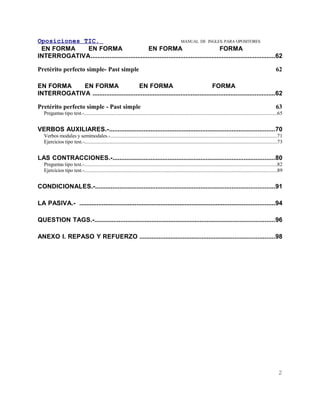
 EN FORMA    EN FORMA                          EN FORMA                                 FORMA
INTERROGATIVA...........................................................................................................62

Pretérito perfecto simple- Past simple                                                                                                                                   62

EN FORMA    EN FORMA                     EN FORMA                                  FORMA
INTERROGATIVA ..........................................................................................................62

Pretérito perfecto simple - Past simple                                                                                                                                  63
   Preguntas tipo test.-...................................................................................................................................................65


VERBOS AUXILIARES.-................................................................................................70
   Verbos modales y semimodales.-................................................................................................................................71
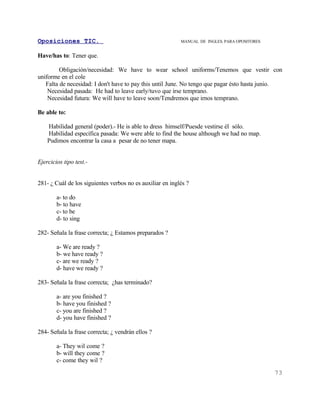
   Ejercicios tipo test.-...................................................................................................................................................73


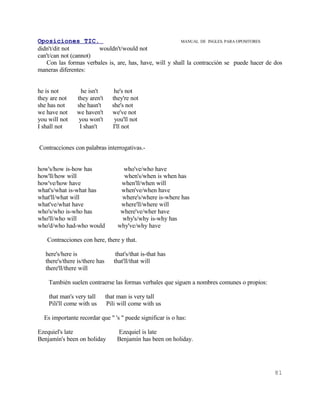
LAS CONTRACCIONES.-..............................................................................................80
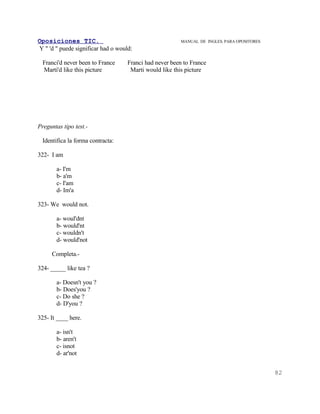
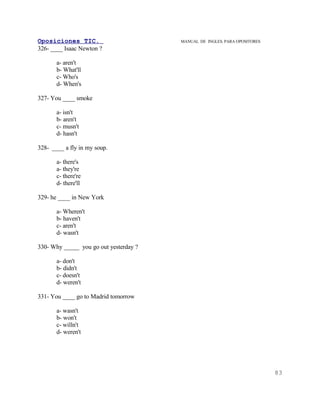
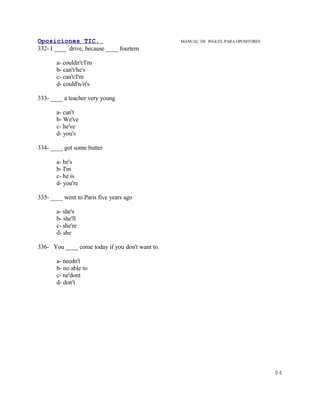
   Preguntas tipo test.-...................................................................................................................................................82
   Ejercicios tipo test.-...................................................................................................................................................89


CONDICIONALES.-........................................................................................................91

LA PASIVA.- .................................................................................................................94

QUESTION TAGS.-........................................................................................................96

ANEXO I. REPASO Y REFUERZO ..............................................................................98


                                                                                                                                                                           2
Oposiciones TIC.                                           MANUAL DE INGLES. PARA OPOSITORES
INTRODUCCIÓN


       El presente manual ha sido elaborado con la pretensión de contribuir a que conozcas, de
forma sistemática, la gramática inglesa; el tratamiento de sus contenidos se ha realizado teniendo
en cuenta el objetivo que persigues, que no es otro que el de superar una oposición.


        En este sentido, pretende ser un manual de fácil comprensión, con un claro enfoque
práctico y, sobre todo, absolutamente adaptado a las exigencias reales de la oposición que preparas.
Para ello, la secuenciación de la información es presentada en base a un orden lógico de menor a
mayor dificultad.


      Cada aspecto gramatical se aborda desde dos              fases o vertientes     absolutamente
complementarias y necesarias:


    En primer lugar, se hace una breve y clara presentación: (definiciones, clasificaciones, tipos de
palabras, aclaraciones de vocablos. etc...); este primer apartado, de marcado carácter teórico debe
ser memorizado, para lograr el éxito, previamente a la realización de los ejercicios tipo test, los
cuales, constituyen la segunda parte de tu trabajo; se trata aquí de poner en práctica los contenidos
conceptuales adquiridos en la primera fase.


        En todas las preguntas, cada frase ha sido traducida al español para facilitar la comprensión
y agilizar tus avances.


        Incluimos, así mismo, dos anexos a la parte principal; en el primero se recogen 130 items
que favorecerán el repaso y refuerzo de los distintos conceptos presentados. En el segundo anexo
(solucionario) aparecerán las soluciones a todas las preguntas, tanto de la parte principal como del
anexo número 1 de resumen y repaso.


                                                                                                   3
Oposiciones TIC.                                             MANUAL DE INGLES. PARA OPOSITORES

PARTE                                                                               PRINCIPAL
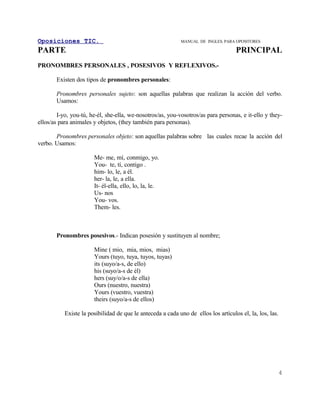
PRONOMBRES PERSONALES , POSESIVOS Y REFLEXIVOS.-

       Existen dos tipos de pronombres personales:

       Pronombres personales sujeto: son aquellas palabras que realizan la acción del verbo.
       Usamos:

        I-yo, you-tú, he-él, she-ella, we-nosotros/as, you-vosotros/as para personas, e it-ello y they-
ellos/as para animales y objetos, (they también para personas).

       Pronombres personales objeto: son aquellas palabras sobre las cuales recae la acción del
verbo. Usamos:

                       Me- me, mí, conmigo, yo.
                       You- te, tí, contigo .
                       him- lo, le, a él.
                       her- la, le, a ella.
                       It- él-ella, ello, lo, la, le.
                       Us- nos
                       You- vos.
                       Them- les.


       Pronombres posesivos.- Indican posesión y sustituyen al nombre;

                       Mine ( mio, mia, mios, mias)
                       Yours (tuyo, tuya, tuyos, tuyas)
                       its (suyo/a-s, de ello)
                       his (suyo/a-s de él)
                       hers (suy/o/a-s de ella)
                       Ours (nuestro, nuestra)
                       Yours (vuestro, vuestra)
                       theirs (suyo/a-s de ellos)

           Existe la posibilidad de que le anteceda a cada uno de ellos los artículos el, la, los, las.


                                                                                                          4
Oposiciones TIC.                                            MANUAL DE INGLES. PARA OPOSITORES


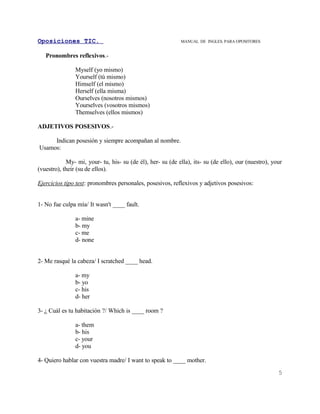
   Pronombres reflexivos.-

                Myself (yo mismo)
                Yourself (tú mismo)
                Himself (el mismo)
                Herself (ella misma)
                Ourselves (nosotros mismos)
                Yourselves (vosotros mismos)
                Themselves (ellos mismos)

ADJETIVOS POSESIVOS.-

     Indican posesión y siempre acompañan al nombre.
Usamos:

            My- mi, your- tu, his- su (de él), her- su (de ella), its- su (de ello), our (nuestro), your
(vuestro), their (su de ellos).

Ejercicios tipo test: pronombres personales, posesivos, reflexivos y adjetivos posesivos:


1- No fue culpa mía/ It wasn't ____ fault.

                a- mine
                b- my
                c- me
                d- none


2- Me rasqué la cabeza/ I scratched ____ head.

                a- my
                b- yo
                c- his
                d- her

3- ¿ Cuál es tu habitación ?/ Which is ____ room ?

                a- them
                b- his
                c- your
                d- you

4- Quiero hablar con vuestra madre/ I want to speak to ____ mother.
                                                                                                      5
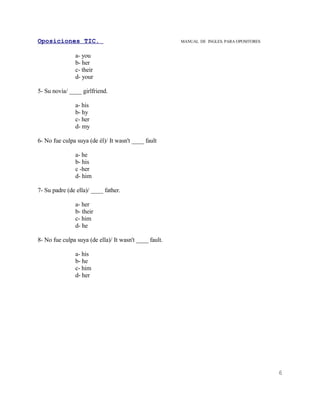
Oposiciones TIC.                                        MANUAL DE INGLES. PARA OPOSITORES


               a- you
               b- her
               c- their
               d- your

5- Su novia/ ____ girlfriend.

               a- his
               b- hy
               c- her
               d- my

6- No fue culpa suya (de él)/ It wasn't ____ fault

               a- he
               b- his
               c -her
               d- him

7- Su padre (de ella)/ ____ father.

               a- her
               b- their
               c- him
               d- he

8- No fue culpa suya (de ella)/ It wasn't ____ fault.

               a- his
               b- he
               c- him
               d- her


                                                                                            6
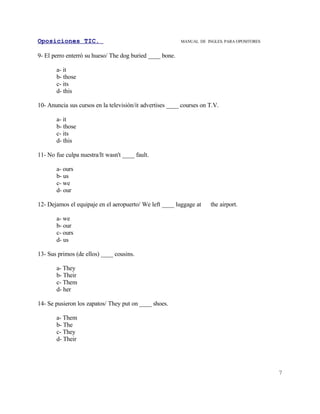
Oposiciones TIC.                                          MANUAL DE INGLES. PARA OPOSITORES


9- El perro enterró su hueso/ The dog buried ____ bone.

       a- it
       b- those
       c- its
       d- this

10- Anuncia sus cursos en la televisión/it advertises ____ courses on T.V.

       a- it
       b- those
       c- its
       d- this

11- No fue culpa nuestra/It wasn't ____ fault.

       a- ours
       b- us
       c- we
       d- our

12- Dejamos el equipaje en el aeropuerto/ We left ____ luggage at     the airport.

       a- we
       b- our
       c- ours
       d- us

13- Sus primos (de ellos) ____ cousins.

       a- They
       b- Their
       c- Them
       d- her

14- Se pusieron los zapatos/ They put on ____ shoes.

       a- Them
       b- The
       c- They
       d- Their


                                                                                              7
Oposiciones TIC.                                         MANUAL DE INGLES. PARA OPOSITORES


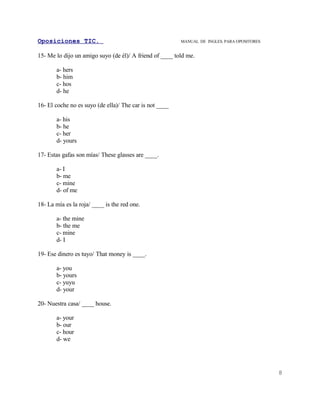
15- Me lo dijo un amigo suyo (de él)/ A friend of ____ told me.

       a- hers
       b- him
       c- hos
       d- he

16- El coche no es suyo (de ella)/ The car is not ____

       a- his
       b- he
       c- her
       d- yours

17- Estas gafas son mías/ These glasses are ____.

       a- I
       b- me
       c- mine
       d- of me

18- La mía es la roja/ ____ is the red one.

       a- the mine
       b- the me
       c- mine
       d- I

19- Ese dinero es tuyo/ That money is ____.

       a- you
       b- yours
       c- yuyu
       d- your

20- Nuestra casa/ ____ house.

       a- your
       b- our
       c- hour
       d- we


                                                                                             8
Oposiciones TIC.                                          MANUAL DE INGLES. PARA OPOSITORES


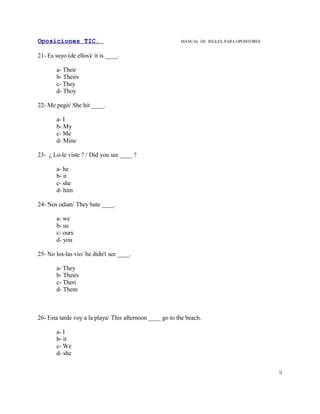
21- Es suyo (de ellos)/ it is ____.

        a- Their
        b- Theirs
        c- They
        d- Thoy

22- Me pegó/ She hit ____.

        a- I
        b- My
        c- Me
        d- Mine

23- ¿ Lo-le viste ? / Did you see ____ ?

        a- he
        b- it
        c- she
        d- him

24- Nos odian/ They hate ____.

        a- we
        b- us
        c- ours
        d- you

25- No los-las vio/ he didn't see ____.

        a- They
        b- Theirs
        c- Theri
        d- Them


26- Esta tarde voy a la playa/ This afternoon ____ go to the beach.

        a- I
        b- it
        c- We
        d- she


                                                                                              9
Oposiciones TIC.                                          MANUAL DE INGLES. PARA OPOSITORES


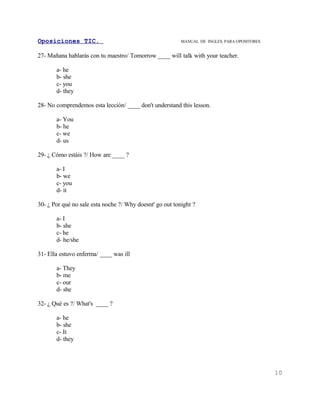
27- Mañana hablarás con tu maestro/ Tomorrow ____ will talk with your teacher.

       a- he
       b- she
       c- you
       d- they

28- No comprendemos esta lección/ ____ don't understand this lesson.

       a- You
       b- he
       c- we
       d- us

29- ¿ Cómo estáis ?/ How are ____ ?

       a- I
       b- we
       c- you
       d- it

30- ¿ Por qué no sale esta noche ?/ Why doesnt' go out tonight ?

       a- I
       b- she
       c- he
       d- he/she

31- Ella estuvo enferma/ ____ was ill

       a- They
       b- me
       c- our
       d- she

32- ¿ Qué es ?/ What's ____ ?

       a- he
       b- she
       c- It
       d- they


                                                                                              10
Oposiciones TIC.                                          MANUAL DE INGLES. PARA OPOSITORES


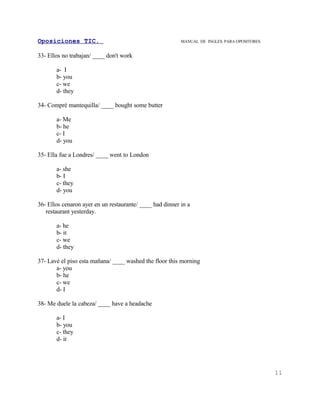
33- Ellos no trabajan/ ____ don't work

       a- I
       b- you
       c- we
       d- they

34- Compré mantequilla/ ____ bought some butter

       a- Me
       b- he
       c- I
       d- you

35- Ella fue a Londres/ ____ went to London

       a- she
       b- I
       c- they
       d- you

36- Ellos cenaron ayer en un restaurante/ ____ had dinner in a
   restaurant yesterday.

       a- he
       b- it
       c- we
       d- they

37- Lavé el piso esta mañana/ ____ washed the floor this morning
       a- you
       b- he
       c- we
       d- I

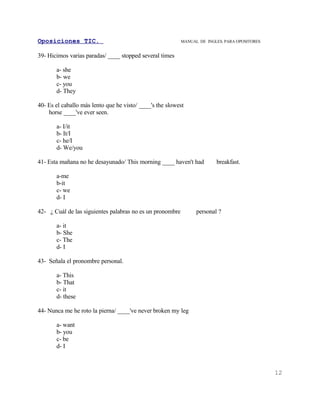
38- Me duele la cabeza/ ____ have a headache

       a- I
       b- you
       c- they
       d- it


                                                                                              11
Oposiciones TIC.                                           MANUAL DE INGLES. PARA OPOSITORES


39- Hicimos varias paradas/ ____ stopped several times

       a- she
       b- we
       c- you
       d- They

40- Es el caballo más lento que he visto/ ____'s the slowest
    horse ____'ve ever seen.

       a- I/it
       b- It/I
       c- he/I
       d- We/you

41- Esta mañana no he desayunado/ This morning ____ haven't had          breakfast.

       a-me
       b-it
       c- we
       d- I

42- ¿ Cuál de las siguientes palabras no es un pronombre         personal ?

       a- it
       b- She
       c- The
       d- I

43- Señala el pronombre personal.

       a- This
       b- That
       c- it
       d- these

44- Nunca me he roto la pierna/ ____'ve never broken my leg

       a- want
       b- you
       c- be
       d- I


                                                                                               12
Oposiciones TIC.                                           MANUAL DE INGLES. PARA OPOSITORES


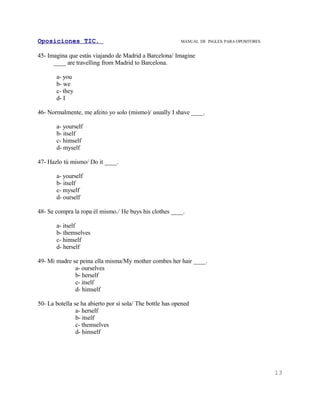
45- Imagina que estás viajando de Madrid a Barcelona/ Imagine
      ____ are travelling from Madrid to Barcelona.

       a- you
       b- we
       c- they
       d- I

46- Normalmente, me afeito yo solo (mismo)/ usually I shave ____.

       a- yourself
       b- itself
       c- himself
       d- myself

47- Hazlo tú mismo/ Do it ____.

       a- yourself
       b- itself
       c- myself
       d- ourself

48- Se compra la ropa él mismo./ He buys his clothes ____.

       a- itself
       b- themselves
       c- himself
       d- herself

49- Mi madre se peina ella misma/My mother combes her hair ____.
              a- ourselves
              b- herself
              c- itself
              d- himself

50- La botella se ha abierto por sí sola/ The bottle has opened
                a- herself
                b- itself
                c- themselves
                d- himself


                                                                                               13
Oposiciones TIC.                                        MANUAL DE INGLES. PARA OPOSITORES


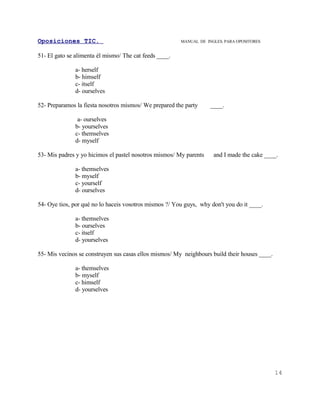
51- El gato se alimenta él mismo/ The cat feeds ____.

               a- herself
               b- himself
               c- itself
               d- ourselves

52- Preparamos la fiesta nosotros mismos/ We prepared the party     ____.

                a- ourselves
               b- yourselves
               c- themselves
               d- myself

53- Mis padres y yo hicimos el pastel nosotros mismos/ My parents    and I made the cake ____.

               a- themselves
               b- myself
               c- yourself
               d- ourselves

54- Oye tios, por qué no lo haceis vosotros mismos ?/ You guys, why don't you do it ____.

               a- themselves
               b- ourselves
               c- itself
               d- yourselves

55- Mis vecinos se construyen sus casas ellos mismos/ My neighbours build their houses ____.

               a- themselves
               b- myself
               c- himself
               d- yourselves


                                                                                               14
Oposiciones TIC.                                         MANUAL DE INGLES. PARA OPOSITORES


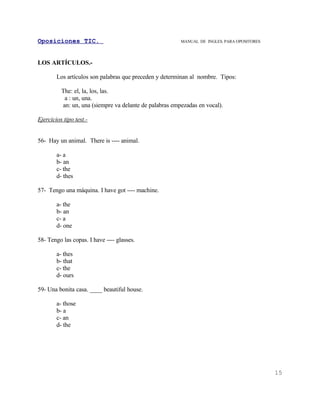
LOS ARTÍCULOS.-

        Los artículos son palabras que preceden y determinan al nombre. Tipos:

          The: el, la, los, las.
           a : un, una.
          an: un, una (siempre va delante de palabras empezadas en vocal).

Ejercicios tipo test.-


56- Hay un animal. There is ---- animal.

        a- a
        b- an
        c- the
        d- thes

57- Tengo una máquina. I have got ---- machine.

        a- the
        b- an
        c- a
        d- one

58- Tengo las copas. I have ---- glasses.

        a- thes
        b- that
        c- the
        d- ours

59- Una bonita casa. ____ beautiful house.

        a- those
        b- a
        c- an
        d- the


                                                                                             15
Oposiciones TIC.                                              MANUAL DE INGLES. PARA OPOSITORES


60- El jabón está cerca del baño/ ____ soap is near the bath.

        a- your
        b- my
        c- a
        d- the

61- Ten cuidado con las escaleras./ Be careful with ____ stairs.

        a- this
        b- thes
        c- the
        d- ninguna es correcta

62- Este es el sofá para el gato./ This is the sofa for ____ cats.

        a- the
        b- one
        c- whit
        d- by

63- Es una máquina./ It's ____ machine.

        a- an
        b- one
        c- a
        d- the

64- Escucha el diálogo./ Listen to ____ dialogue.

        a- your
        b- a
        c- the
        d- ninguna es correcta.

65- ¿ Quieres el rojo o el azul ?./ Do you want ____ red one           or ____ blue one?

        a- those/the
        b- these/this
        c- that/ those
        d- the/the


                                                                                                  16
Oposiciones TIC.                                           MANUAL DE INGLES. PARA OPOSITORES


66- Los ingleses./ ____ English.

        a- they
        b- the
        c- les
        d- ninguna es correcta

LAS PREPOSICIONES.

  En la mayoría de los casos, la traducción de una preposición está determinada por el vocablo al
cual acompaña en la oración.Observa los siguientes ejemplos:

     * Depende del precio/ It depends on the price.
     * Soñé con María/ I dreamt about Maria.
     * Insistió en pagar/ he insisted on paying.

       A veces se usa una preposición en español pero no en inglés:
   * Se va a casar con mi hermana/ he is going to marry my          sister.
       O al contrario: * Mira esta foto/ look at this fotograph.

      Clases de preposiciones.-

De lugar                                              De movimiento

   On- en                                         along- a través de...
   in- en                                          down- debajo de...
   under- debajo de...                             into- dentro de...
   above- encima de...                             out of- fuera de...
   behind- detrás de...                           over- sobre...
   in front of- frente a...                       past- pasadas las...
   next to- cerca de...                           thought- a través de.../ por.
   between- entre                                 below- debajo de...
   by- por                                        up- encima de...

    De tiempo:


       in- en; * In 1994, In may, In the morning.
   (Esta preposición se usa para años, meses, mañana, tarde y         noche.

        on- On sunday, On friday evening, On 12 th july.
       (Se usa para referirse a los dias de la semana)
        at- At eight o` clock, at the week end.


                                                                                               17
Oposiciones TIC.                                          MANUAL DE INGLES. PARA OPOSITORES
       since- Desde. Se usa en pretéritos perfectos, indica la acción desde un momento de tiempo
determinado:
     * Desde ayer/ Since yesterday.
     * Desde abril/ Since april. Significa también desde, pero refiriéndose a un tiempo más lejano.
Siempre se coloca al final de la frase a la que modifica:
     * Hace tres días/three days ago.
     * Hace un cuarto de hora/ A quarter an hour ago.
       For- Tiene dos significados: durante/desde hace.
       * Durante dos semanas/For two weeks
       * Tengo este bolígrafo desde hace un mes/ I've this pen for one month.


Ejercicios tipo test.-


67- El está debajo de la mesa/ he's ____ the table.

        a- between
        b- behind
        c- under
        d- nex to

68- Estaremos allí a las ocho en punto/ We will be there ____      eight o'clock.
       a- in
       b- from
       c- behind
       d- at

69- El ratón está entre estas lamparas/ The mouse is ____the       lamps.

        a- in front of
        b- into
        c- between
        d- under

70- Estamos a sábado/ We are ____ Saturday.

        a- on
        b- in
        c- at
        d- from


71- Yo estuve allí en 1994/ I was there ____ 1994.


                                                                                                18
Oposiciones TIC.                                             MANUAL DE INGLES. PARA OPOSITORES
     a- on
     b- at
     c- in
     d- since

72- ¿ De qué color es tu bici ?/ ____ What colour is your bike?

        a- of
        b- no lleva preposición
        c- in
        d- on


73- Tú eres responsable de lo que pasó/ You are responsible ____ what happened.

        a- of
        b- five
        c- from
        d- for

74- El libro está dentro de la caja/ The book is ____ the box.

        a- from
        b- next
        c- in
        d- at

75- El gato está bajo la silla/ The cat is ____ the chair.

        a- in
        b- by
        c- under
        d- no lleva preposición

76- Estaban jugando al futbol/ They were playing ____ soccer.

        a- at
        b- next
        c- in
        d- no lleva

- Yo viajé en autobús/ I travelled ____ bus.

        a- in
        b- on
                                                                                                 19
Oposiciones TIC.                                           MANUAL DE INGLES. PARA OPOSITORES
     c- by
     d- to

78- Son las ocho de la tarde/ It's eight o´clock ____ the evening.

       a- on
       b- in
       c- no lleva preposición
       d- of

79- El tren a Londres/ The train ____ London.

       a- from
       b- to
       c- The
       d- at

80- Es hora de las noticias/ It's time ____ the news.

        a- of
       b- for
       c- to
       d- from

81- El autobús de Madrid/ The bus ____ Madrid.

       a- by
       b- behind
       c- on
       d- from

82- Llegamos a Madrid a las nueve/ We arrived ____ Madrid at         nine.

       a- on
       b- in
       c- to
       d- at


                                                                                               20
Oposiciones TIC.                                               MANUAL DE INGLES. PARA OPOSITORES


83- Me ofrecí para ayudar/ I offered ____ help.

        a- by
        b- under
        c- at
        d- to

84- Le agradecí el regalo/ I thanked him ____ the present.

        a- to
        b- above
        c- in
        d- for

85- Sabe a queso/ It tastes ____cheese.

        a- of
        b- for
        c- at
        d- to

86- Pinté la pared de azul/ I painted the wall ____ blue.

        a- of
        b- in
        c- no lleva
        d- a

EL ADVERBIO.-

               Los adverbios son palabras que hacen referencia a las circunstancias o estados en las
que se encuentran las cosas o personas de las que hablamos.

         Los adverbios de modo se forman generalmente añadiendo "ly" al adjetivo (slow/slowly),
ello trae consigo las siguientes modificaciones ortográficas:

                   - los adjetivos terminados en "le", cambian la "e" en "y" (confortable/confortably)
                   - Los acabados en "ll" sólo añaden una "y" (full/fully);
                   - Los terminados en "y" sustituyen esta letra por una "i" antes del sufijo "ly"
(noisy/noisily);
                   - Los acabados en "ue" pierden la "e" (true/truly)

        Algunos adjetivos se usan como adverbios (fast, straight, tight, etc...).


                                                                                                   21
Oposiciones TIC.                                          MANUAL DE INGLES. PARA OPOSITORES
       Los principales adverbios de cantidad son: "little/poco, much/más, almost/casi, rather/más
bien,bastante, un poco, quite/completamente, very/muy, too/demasiado, enough/bastante, etc...

         Los adverbios de lugar más usados son: "above/arriba, across/a través, along/por,
around/por aquí, alrededor, away/fuera, back/detrás, behind/detrás de, below/abajo, down/debajo,
far/lejos, here/aquí, in/dentro, near/cercano, off/fuera, there/allí, up/arriba, where/dónde, beside/al
lado de, junto a, etc..

       Los adverbios de tiempo más comúnmente empleados son after/después, again/de nuevo,
ago/hace,    already/ya,    always/siempre,    before/antes,  early/temprano,    ever/siempre,
formerly/anteriormente, late/tarde, never/nunca, now/ahora, often/a menudo, once/una vez,
seldom/raramente, sometimes/a veces, soon/temprano, still/todavía, aún, then/luego, today/hoy,
when/cuando, yesterday/ayer, yet, etc...

        Los adverbios de negación más frecuentemente utilizados son:
no, not, never/nunca, not at all/de nada. Los comparativos y los superlativos de los adverbios
siguen las mismas reglas que la de los adjetivos (esto lo veremos más adelante).

Ejercicios tipo test.-

87- ¿ Cuál de los siguientes adverbios no es de lugar ?:

        a- across
        b- near
        c- there
        d- too


88- ¿ Cuál de los siguientes adverbios es de cantidad?

        a- already
        b- formerly
        c- once
        d- almost


                                                                                                   22
Oposiciones TIC.                                        MANUAL DE INGLES. PARA OPOSITORES


89- ¿ Cuál de los siguientes adverbios es de modo ?:

       a- up
       b- never
       c- slowly
       d- quite

90- Los adverbios de modo se forman generalmente añadiendo:

       a- uli
       b- luy
       c- ly
       d- yl

91- Los adverbios son palabras que:

       a- sustituyen al nombre
       b- se refieren a circunstancias del nombre
       c- califican al nombre
       d- siempre llevan tilde en la última sílaba

92- ¿ Qué palabras se usan como adverbios en inglés ?

       a- los nombres
       b- los adjetivos
       c- los pronombres
       d- los artículos

93- Early es un adverbio de:

       a- modo
       b- cantidad
       c- lugar
       d- tiempo

94- Near es un adverbio de:

       a- negación
       b- cantidad
       c- lugar
       d- modo


                                                                                            23
Oposiciones TIC.                                   MANUAL DE INGLES. PARA OPOSITORES


95- ¿ Cuál de estas palabras no es un adverbio ?

       a- not
       b- ago
       c- now
       d- man


96- ¿ Cuál de estas palabras es un adverbio ?

       a- before
       b- befool
       c- befog
       d- befit

97- ¿ Qué significa el adverbio "seldom":

       a- a veces
       b- quizá
       c- raramente
       d- puramente

98- ¿ Qué significa el adverbio "formerly" ? :

       a- formalmente
       b- afortunadamente
       c- anteriormente
       d- tranquilamente

99- Un sinónimo del adverbio "ever" es:

       a- away
       b- again
       c- above
       d- always

100- Already significa:

       a- preparado
       b- ya
       c- ayer
       d- a menudo


                                                                                       24
Oposiciones TIC.                                         MANUAL DE INGLES. PARA OPOSITORES


101- Yet significa:

       a- ya
       b- ayer
       c- todavía
       d- ninguna es correcta


102- En inglés el adverbio "casi" se traduce:

       a- enough
       b- soon
       c- almost
       d- rather


103- Uno de estos significados no corresponde al adverbio "rather":

       a- más bien
       b- bastante
       c- sólamente
       d- un poco

104- Un sinónimo del adverbio dowr es:

       a- below
       b- bellow
       c- often
       d- never

105- El adverbio enough significa ____ y es de ____.

       a- nunca/tiempo
       b- poco/cantidad
       c- bastante/cantidad
       d- raramente/tiempo

106- Los adverbios de negación son:

       a- ago, now, nothing
       b- no, not, never, not at all
       c- go, gonot, nun
       d- no existen los adverbios de negación


                                                                                             25
Oposiciones TIC.                                       MANUAL DE INGLES. PARA OPOSITORES


ADJETIVOS DEMOSTRATIVOS.-

       Recuerda que los adjetivos demostrativos siempre acompañan a un nombre. Ej. Este niño.
       Estas son sus formas:

          This- este/esta
          That- ese, esa, aquel, aquella
          those- esos, esas
          these- estos, estas

   Ejercicios tipo test.-

107- En aquella época/ at ____ time.

       a- this
       b- those
       c- that
       d- these

108- ¿ Es este libro ?/ Is ____ book ?

       a- that
       b- this
       c- those
       d- these

109- Mira estos dibujos/ look at ____ pictures.

       a- This
       b- these
       c- that
       d- those

110- ¿ Son esos libros ?/ Are ____ books ?

       a- those
       b- its
       c- that
       d- whose

111- Esta niña habla ruso/ ____ girl speaks Russian.
                                                                                           26
Oposiciones TIC.                                          MANUAL DE INGLES. PARA OPOSITORES


       a- that
       b- these
       c- that/this
       d- this

112- Aquella casa es la de Sonia/ ____ house over there is Sonia's
       a- those
       b- this
       c- that
       d- these

113- Cómete este plátano/ eat ____ banana.

       a- those
       b- thes
       c- this
       d- the


114- Prefiero este sombrero/ I prefer ____ hat.

       a- these
       b- that
       c- this
       d- those

115- Son estos libros ?/ Are ____ books ?

       a- this
       b- these
       c- that
       d- those

116- Es aquel muchacho ?/ Is ____ boy ?

       a- that
       b- this
       c- those
       d- these


                                                                                              27
Oposiciones TIC.                                            MANUAL DE INGLES. PARA OPOSITORES


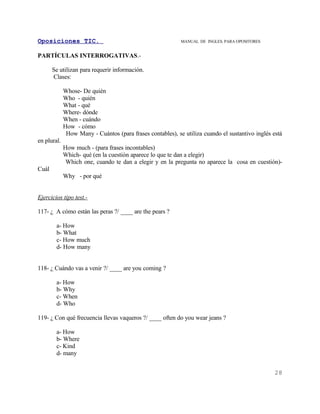
PARTÍCULAS INTERROGATIVAS.-

       Se utilizan para requerir información.
       Clases:

             Whose- De quién
             Who - quién
             What - qué
             Where- dónde
             When - cuándo
             How - cómo
              How Many - Cuántos (para frases contables), se utiliza cuando el sustantivo inglés está
en plural.
             How much - (para frases incontables)
             Which- qué (en la cuestión aparece lo que te dan a elegir)
              Which one, cuando te dan a elegir y en la pregunta no aparece la cosa en cuestión)-
Cuál
             Why - por qué


Ejercicios tipo test.-

117- ¿ A cómo están las peras ?/ ____ are the pears ?

        a- How
        b- What
        c- How much
        d- How many


118- ¿ Cuándo vas a venir ?/ ____ are you coming ?

        a- How
        b- Why
        c- When
        d- Who

119- ¿ Con qué frecuencia llevas vaqueros ?/ ____ often do you wear jeans ?

        a- How
        b- Where
        c- Kind
        d- many


                                                                                                  28
Oposiciones TIC.                                      MANUAL DE INGLES. PARA OPOSITORES
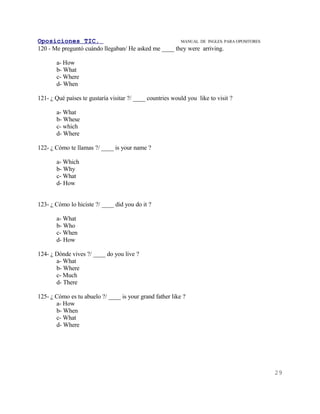
120 - Me preguntó cuándo llegaban/ He asked me ____ they were arriving.

       a- How
       b- What
       c- Where
       d- When

121- ¿ Qué países te gustaría visitar ?/ ____ countries would you like to visit ?

       a- What
       b- Whese
       c- which
       d- Where

122- ¿ Cómo te llamas ?/ ____ is your name ?

       a- Which
       b- Why
       c- What
       d- How


123- ¿ Cómo lo hiciste ?/ ____ did you do it ?

       a- What
       b- Who
       c- When
       d- How

124- ¿ Dónde vives ?/ ____ do you live ?
       a- What
       b- Where
       c- Much
       d- There

125- ¿ Cómo es tu abuelo ?/ ____ is your grand father like ?
       a- How
       b- When
       c- What
       d- Where


                                                                                          29
Oposiciones TIC.                                          MANUAL DE INGLES. PARA OPOSITORES


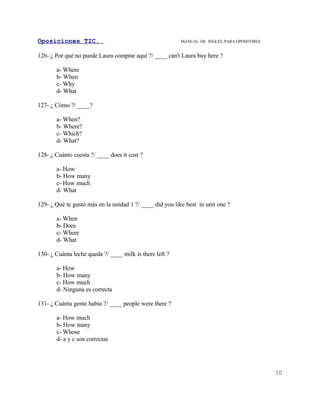
126- ¿ Por qué no puede Laura comprar aquí ?/ ____ can't Laura buy here ?

       a- Where
       b- When
       c- Why
       d- What

127- ¿ Cómo ?/ ____?

       a- When?
       b- Where?
       c- Which?
       d- What?

128- ¿ Cuánto cuesta ?/ ____ does it cost ?

       a- How
       b- How many
       c- How much
       d- What

129- ¿ Qué te gustó más en la unidad 1 ?/ ____ did you like best in unit one ?

       a- When
       b- Does
       c- Where
       d- What

130- ¿ Cuánta leche queda ?/ ____ milk is there left ?

       a- How
       b- How many
       c- How much
       d- Ninguna es correcta

131- ¿ Cuánta gente había ?/ ____ people were there ?

       a- How much
       b- How many
       c- Whose
       d- a y c son correctas


                                                                                              30
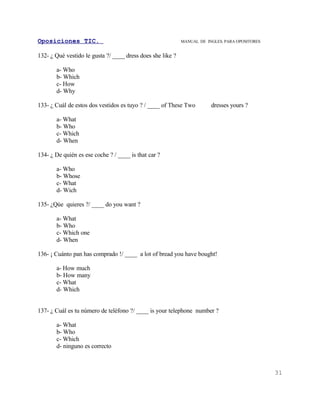
Oposiciones TIC.                                            MANUAL DE INGLES. PARA OPOSITORES


132- ¿ Qué vestido le gusta ?/ ____ dress does she like ?

       a- Who
       b- Which
       c- How
       d- Why

133- ¿ Cuál de estos dos vestidos es tuyo ? / ____ of These Two         dresses yours ?

       a- What
       b- Who
       c- Which
       d- When

134- ¿ De quién es ese coche ? / ____ is that car ?

       a- Who
       b- Whose
       c- What
       d- Wich

135- ¿Qúe quieres ?/ ____ do you want ?

       a- What
       b- Who
       c- Which one
       d- When

136- ¡ Cuánto pan has comprado !/ ____ a lot of bread you have bought!

       a- How much
       b- How many
       c- What
       d- Which


137- ¿ Cuál es tu número de teléfono ?/ ____ is your telephone number ?

       a- What
       b- Who
       c- Which
       d- ninguno es correcto


                                                                                                31
Oposiciones TIC.                                         MANUAL DE INGLES. PARA OPOSITORES


138- ¿ Quién es ? ____ is it ?

       a- Which
       b- What
       c- Who
       d- When

139- ¿ Cuántos hermanos tienes ? / ____ brothers have you got ?

       a- How much
       b- How many
       c- Ho
       d- Which one

140- ¿ Dónde vas ?/ ____ are you going ?

       a- What
       b- did
       c- Where
       d-There

141- ¿ A qué hora te acuestas ? / ____ time do you usually go to bed ?

       a- For
       b- What
       c- When
       d- at

142- ¿ Cómo lo sabe ?/ ____ does he know ?

       a- When
       b- How
       c- Which
       d- Who


                                                                                             32
Oposiciones TIC.                                              MANUAL DE INGLES. PARA OPOSITORES


PRONOMBRES DEMOSTRATIVOS.-

      No olvides que los pronombres son palabras que sustituyen al nombre; estos tienen la misma
forma que los adjetivos demostrativos.

       Tipos:
               El pronombre "This" y la frase "This one" equivalen a éste, ésta o ésto, según indique
el contexto. Su plural es These.
              "This", también se utiliza en la expresión "like this ", que significa "así". Ej. Do it like
this/ hazlo así.
                 El pronombre "that" y la frase "that one" equivalen a ése, ésa, eso, aquél, aquella y
aquello. Sólo a través del contexto podemos saber cual de ellas es la traducción apropiada. Su
plural es "those".


       That" también se usa en la expresión "like that", que significa así. Ej. Don't do it like that/
No lo hagas así.


Ejercicios tipo test.-


143- Ésta es la bolsa más grande/ ____ is the biggest bag.

        a- Those
        b- That
        c- This
        d- these

144- ¿ Qué es ésto ?/ What is ____ ?

        a- that
        b- those
        c- this
        d- these


                                                                                                      33
Oposiciones TIC.                                 MANUAL DE INGLES. PARA OPOSITORES


145- Me gustan aquéllos/ I like ____

       a- this
       b- that
       c- those
       d- these

146- Quiere ésos/ He wants ____

       a- these
       b- this one
       c- those
       d- that

147- ¿ Qué es eso ?/ What is ____ ?

       a- this
       b- thos
       c- these
       d- that

148- ¿ Quién te dijo eso ?/ Who told you ____?

       a- these
       b- this
       c- that
       d- those

149- Prueba uno de ésos/ Try one of ____

       a- those
       b- these
       c- this
       d- that

150- Prefiero ése/ I prefer ____

       a- this
       b- that
       c- that one
       d- these


                                                                                     34
Oposiciones TIC.                                         MANUAL DE INGLES. PARA OPOSITORES


151- ¿ Quién es ése ?/ Who is ____

       a- this
       b- that
       c- those
       d- Ninguna es correcta

152- ¿ Quién son ésos ?/ Who are ____

       a- this
       b- the
       c- those
       d- that

153- Los pantalones que me gustan son éstos/ The trousers that I    like are ____

       a- this
       b- these
       c- they
       d- that

154- Iré esta mañana/ I will go ____ morning

       a- that
       b- these
       c- this
       d- those


LOS PLURALES.-

       El plural de los nombres se forma, en general, añadiendo una "S".
       Ej. book-books, shop-shops.

       Los nombres que terminan en "s, ss, sh, ch, o, x , z"; forman el plural añadiendo la
terminación "es".
       Ej. glass-glasses, box-boxes.

      Palabras terminadas en "Y". Cuando la "Y" va precedida de consonante, el plural se forma
cambiándola por "i", y añadiendo "es".
      Ej: Lady-Ladies, body-bodies


                                                                                             35
Oposiciones TIC.                                        MANUAL DE      INGLES. PARA OPOSITORES
     Si la "Y" va precedida de vocal, sigue la regla general.
     Ej: boy-boys, day-days.

       Las palabras terminadas en "f" cambian la "f" por una "v" y añaden "es".
       Ej: Thief-Thieves, scarf-scarves.

       Las palabras terminadas en "fe", cambian la "f" por "v", mantienen la "e" y añaden "s".
       Ej: wife-wives, life-lives.

       Plurales irregulares (es decir, no cumplen las reglas arriba esplicadas)
                               Singular ____ Plural

                                Man        Men
                               woman        women
                               child       children
                               foot        feet
                               tooth       theeth
                               mouse       mice
                               sheep       sheep
                               fish        fish


FORMACIÓN DEL FEMENINO.-


       El femenino se forma de las tres maneras siguientes:

       a- Con la terminación "ess": heir/heiress, lion/lioness.
       b- Con una palabra distinta: boy/girl, cock/hen.
       c- Con un sustantivo compuesto: milkman/milkmaid, manservant/maidservant, he-goat,
she-goat.
       d- Con el adjetivo female: male friend, female friend. Existe también el sufijo "ine" pero su
uso es menos frecuente.


                                                                                                 36
Oposiciones TIC.                                          MANUAL DE INGLES. PARA OPOSITORES


Preguntas tipo test.


155- Pregúntale a esas mujeres/ Ask Those ____ .

       a- woman
       b- womens
       c- womans
       d- women

156- Hay dos ratones en la habitación/ There are two ____ in the room.

       a- mice
       b- mices
       c- mouse
       d- mouses

157- Tengo dos ovejas en el jardín/ I've two ____ in the garden

       a- sheeps
       b- sheepes
       c- sheep
       d- sheepease

158- Esos cuerpos son lo mejor del verano/ Those ____ are the best of the summer.

       a- bodies
       b- bodis
       c- bodys
       d- body

159- Te daré tres gatos/ I will give you three ____

       a- cats
       b- cuts
       c- caties
       d- catss


                                                                                              37
Oposiciones TIC.                                         MANUAL DE INGLES. PARA OPOSITORES


160- Tendré este invierno muchas bufandas/ I will have this winter many ____.

       a- scarf
       b- scarfs
       c- scarfves
       d- scarves

161- En esos cajones están los libros/ In Those ____ are the books.

       a- boxs
       b- boxes
       c- boss
       d- boxses

162- En mis fábricas no hay hombres/ There aren't men in my ____

       a- factories
       b- factorys
       c- factoris
       d- factors

163- Yo tuve nueve mujeres/ I had nine ____

       a- wives
       b- wifeys
       c- wifees
       d- wifes

164- Hay pantanos en Granada/ There are ____ in Granada

       a- marsh
       b- marshs
       c- marshees
       d- marshes


                                                                                             38
Oposiciones TIC.                                            MANUAL DE INGLES. PARA OPOSITORES


ADJETIVOS Y PRONOMBRES INDEFINIDOS.-


        Los adjetivos y pronombres indefinidos los utilizamos para referirnos a personas, animales
o cosas no determinadas.

       Los principales adjetivos y pronombres indefinidos son each/cada, either/cualquiera(de
dos), neither/ninguno de los dos, every/cada, several/varios, distintos, respectivos, all/todo-a,
some/algunos-as, any/alguno-na, little/poco, few/pocos-as, much/mucho-a, many/muchos-as,
enough/bastante, no, not any/ninguno-a, none/nadie-ninguno-a, other/otro-a, another/otro-a.

        - No y every sólo son adjetivos y none pronombre.
        - Either significa una de dos personas o cosas.
        - Each tiene un sentido individual y every expresa una idea de colectividad (on each side/
de cada lado; on every side / por todos los lados).
        - Some se emplea siempre en oraciones afirmativas, (leave us some oranges/ déjanos
algunas naranjas) y a veces en frases interrogativas cuya contestación será afirmativa o cuando
ofrecemos algo.
        - Any se usa en oraciones interrogativas y negativas (do you take any sugar ?/¿ tomas
azúcar?

       - Los pronombres compuestos derivados de some, any no y every son respectivamente :

               - Someone/Somebody- Alguien
               - Everyone/Everybody- Todos/as

       Estas formas se utilizan en oraciones afirmativas.

               - Anyone/Anybody- Alguien (esta forma se usa en oraciones interrogativas,
               negativas y condicionales).
               - Nobody/no one- Nadie (se usa en frases afirmativas)
               - Algo- Se usa something en oraciones afirmativas, y, anything, en oraciones
               interrogatias o condicionales.
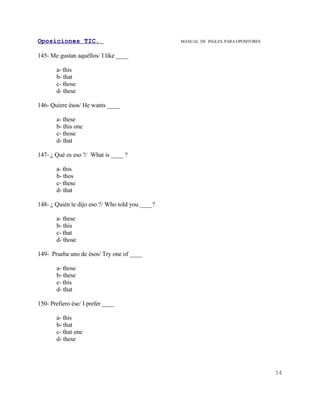
               - Nada- Empleamos nothing en caso de que no haya otra partícula negativa en la
               oración inglesa. Ej. Nothing suits him. Si hubiese otra partícula negativa, se utiliza
               anythine. Ej. No ha hecho nada:

       She has done nothing (sin otra negación)
       She has not done anything (con otra negación "not")


       - Little y much se aplican a cantidades que no se pueden contar (he made little
progress/hizo pocos progresos).
                                                                                                 39
Oposiciones TIC.                                          MANUAL DE INGLES. PARA OPOSITORES
        - Few y many se emplean con cantidades numerables; he ate many cakes/comió muchos
pasteles.
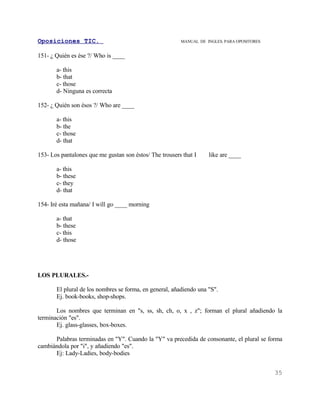
        - Other es invariable cuando es adjetivo y variable como pronombre (other examples/otros
ejemplos; show me the others/muéstrame los otros).
        - Each other y one another se utilizan después de un verbo para expresar reciprocidad. La
primera forma si se habla de dos personas únicamente y la segunda si hay más de dos ( The two
cousins love each other/las dos primas se quieren; the three cousins love one another/ las tres
primas se quieren).


Ejercicios tipo test.-


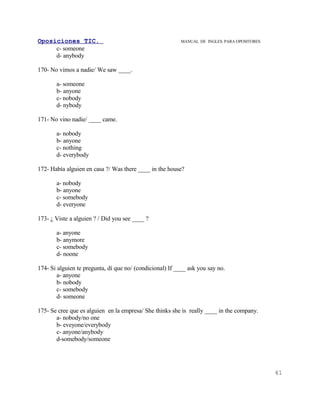
165- Alguien se ha llevado mi paraguas/ ____ has taken my umbrella.

        a- Anyone
        b- Anybody
        c- Somebody
        d- everybody

166- Necesitamos alguien fuerte para levantar esta caja/ We need ____ strong to lift this box.

        a- Somebody
        b- everybody
        c- Anyone
        d- Anybody

167- ¿ Hay alguien en casa ? / Is ____ at home ?

        a- Someone
        b- anybody
        c- anyone/anybody
        d- anyone

168- No hay nadie aquí / There isn't ____ here.

        a- somebody
        b- someone
        c- anybody
        d- everybody

169- ¿ Alguien ha visto a María últimamente ? / Has ____ seen María lately ?

        a- anyone
        b- everybody
                                                                                                 40
Oposiciones TIC.                                          MANUAL DE INGLES. PARA OPOSITORES
     c- someone
     d- anybody

170- No vimos a nadie/ We saw ____.

       a- someone
       b- anyone
       c- nobody
       d- nybody

171- No vino nadie/ ____ came.

       a- nobody
       b- anyone
       c- nothing
       d- everybody

172- Había alguien en casa ?/ Was there ____ in the house?

       a- nobody
       b- anyone
       c- somebody
       d- everyone

173- ¿ Viste a alguien ? / Did you see ____ ?

       a- anyone
       b- anymore
       c- somebody
       d- noone

174- Si alguien te pregunta, dí que no/ (condicional) If ____ ask you say no.
        a- anyone
        b- nobody
        c- somebody
        d- someone

175- Se cree que es alguien en la empresa/ She thinks she is really ____ in the company.
       a- nobody/no one
       b- eveyone/everybody
       c- anyone/anybody
       d-somebody/someone


                                                                                              41
Oposiciones TIC.                                         MANUAL DE INGLES. PARA OPOSITORES


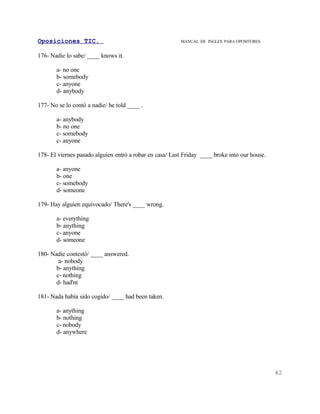
176- Nadie lo sabe/ ____ knows it.

       a- no one
       b- somebody
       c- anyone
       d- anybody

177- No se lo contó a nadie/ he told ____ .

       a- anybody
       b- no one
       c- somebody
       c- anyone

178- El viernes pasado alguien entró a robar en casa/ Last Friday ____ broke into our house.

       a- anyone
       b- one
       c- somebody
       d- someone

179- Hay alguien equivocado/ There's ____ wrong.

       a- everything
       b- anything
       c- anyone
       d- someone

180- Nadie contestó/ ____ answered.
        a- nobody
       b- anything
       c- nothing
       d- had'nt

181- Nada había sido cogido/ ____ had been taken.

       a- anything
       b- nothing
       c- nobody
       d- anywhere


                                                                                               42
Oposiciones TIC.                                          MANUAL DE INGLES. PARA OPOSITORES
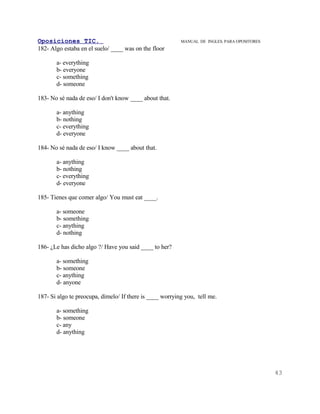
182- Algo estaba en el suelo/ ____ was on the floor

       a- everything
       b- everyone
       c- something
       d- someone

183- No sé nada de eso/ I don't know ____ about that.

       a- anything
       b- nothing
       c- everything
       d- everyone

184- No sé nada de eso/ I know ____ about that.

       a- anything
       b- nothing
       c- everything
       d- everyone

185- Tienes que comer algo/ You must eat ____.

       a- someone
       b- something
       c- anything
       d- nothing

186- ¿Le has dicho algo ?/ Have you said ____ to her?

       a- something
       b- someone
       c- anything
       d- anyone

187- Si algo te preocupa, dímelo/ If there is ____ worrying you, tell me.

       a- something
       b- someone
       c- any
       d- anything


                                                                                              43
Oposiciones TIC.                                          MANUAL DE INGLES. PARA OPOSITORES
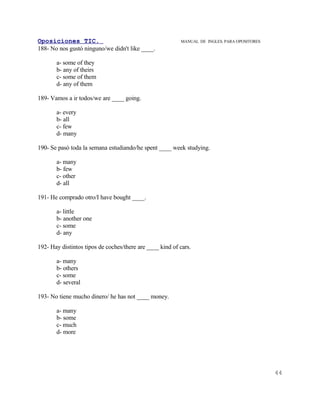
188- No nos gustó ninguno/we didn't like ____.

       a- some of they
       b- any of theirs
       c- some of them
       d- any of them

189- Vamos a ir todos/we are ____ going.

       a- every
       b- all
       c- few
       d- many

190- Se pasó toda la semana estudiando/he spent ____ week studying.

       a- many
       b- few
       c- other
       d- all

191- He comprado otro/I have bought ____.

       a- little
       b- another one
       c- some
       d- any

192- Hay distintos tipos de coches/there are ____ kind of cars.

       a- many
       b- others
       c- some
       d- several

193- No tiene mucho dinero/ he has not ____ money.

       a- many
       b- some
       c- much
       d- more


                                                                                              44
Oposiciones TIC.                                             MANUAL DE INGLES. PARA OPOSITORES
194- Un poco más.

       a- a few more
       b- a little much
       c- a little more
       d- a little few

195- Bastante rápido/ fast ____.

       a- more
       b- much
       c- enough
       d- many

196- Nadie sino él, lo puede hacer/ ____ but he can do it.

       a- nothing
       b- no one
       c- none
       d- no person

197- Demasiado.

       a- two many
       b- two much
       c- too much
       d- too more

198- No me gustó ninguno de los dos conciertos/ ____ concert pleased me.

       a- nothing
       b- no one
       c- either
       d- neither

199- Nos dio un Euro a cada uno/he gave us a Euro ____.

       a- either
       b- neither
       c- each
       d- other


                                                                                                 45
Oposiciones TIC.                                       MANUAL DE INGLES. PARA OPOSITORES
200- Había coches aparcados en ambos lados de la calle/ There were cars parked on ____ side of
the    street.

       a- either
       b- neither
       c- several
       d- enought


ADJETIVOS COMPARATIVOS Y SUPERLATIVOS.-


      La formación del comparativo y el superlativo de los adjetivos en inglés depende del
número de sílabas de la palabra.

       Los adjetivos de una sílaba, excepto aquellos que terminan en -ed (bored, scared), forman
el comparativo agregando -er, y el superlativo agregando -est.

               Ej: Tall (alto), taller (más alto que),tallest (el más alto).
               Big (grande), bigger (más grande que), biggest (el más grande) .

        A los adjetivos que terminan en -e sólo se les agrega una "r" para formar el comparativo y
"st" para el superlativo.
                Ej: wise (Sabio), wiser (más sabio que), wisest (el más sabio).

        La mayoría de los adjetivos de dos sílabas y los de una sílaba como bored ( aburrido ) o
scared ( asustado ), forman el comparativo usando la partícula "more" y el superlativo con la
palabra "most"; Ej:

       Famous           more famous          most famous
       careful          more careful         most careful


        Los adjetivos terminados en -y, -le o -ow, forman el comparativo agregando -er y el
superlativo agregando -est.

       Ej:
               heavy        heavier        heaviest
               simple       simpler        simplest
               hollow       hollower        hollowest

       Algunos adjetivos pueden formar el comparativo y el superlativo de ambas maneras; Ej:
                                                                                               46
Oposiciones TIC.                                                MANUAL DE INGLES. PARA OPOSITORES


         (común)       common: commoner/ more common (comparativo)
                          commonest/ most common (superlativo)

         (listo)
               clever: cleverer/ more clever (comparativo)
                       cleverest/ most clever (superlativo).
       Los adjetivos de más de dos sílabas forman el comparativo usando more y el superlativo
usando most; Ej:

         interesting      more interesting        most interesting

        Algunos adjetivos de uso frecuente (good, bad, far, etc...) tienen comparativos y
superlativos irregulares, (good-better-best, bad-worse-worst, far-farther-farthest, etc.)

        Cambios ortográficos: Al agregar los sufijos -er y -est a algunos adjetivos, cambia la
ortografía. Si se trata de un monosílabo que termina en consonante + vocal + consonante, se dobla
la consonante final.

                   Ej.:    big       bigger   biggest
                          thin      thinner   thinnest

         En el inglés británico la -l final siempre se dobla al agregarle un sufijo:

                   Ej.:     cruel      crueller   cruellest

         Si una palabra termina en -y precedida de consonante, la -y se sustituye por -i al aregar -er
o est.

                   Ej.:    early earlier earliest
                           happy happier happiest


Ejercicios tipo test.-


201- Manuel es más alto que Mónica/ Manuel's ____ than Mónica.

         a- tall
         b- taller
         c- tallest
         c- most tall


                                                                                                    47
Oposiciones TIC.                                              MANUAL DE INGLES. PARA OPOSITORES
202 - Joaquín es el más alto/ Joaquín's the ____.

       a- tallest
       b- taller
       c- tall
       d- tallyer

203- Londrés es más grande que París/ London is ____ than Paris.

       a- biggest
       b- biggerest
       c- bigger
       d- the most big

204- Hay más turistas que el año pasado/ There are ____ tourists ____ last year.

       a- more/in
       b- more/than
       c- more/the
       d-ninguna es correcta

205- Es más alta que yo/ She is ____ tham I am.

       a- more tall
       b- tall
       c- taller
       d- taltest

206- Éste es más interesante/ This one is ____ interesting.

       a- Tham
       b- mor
       c- more
       d- moltest

207- El que tenga más puntos/ The one who has the ____ points.

       a- more
       b- most
       c- plus
       d- mostest


                                                                                                  48
Oposiciones TIC.                                           MANUAL DE   INGLES. PARA OPOSITORES
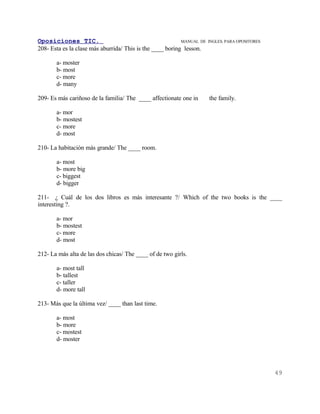
208- Esta es la clase más aburrida/ This is the ____ boring lesson.

       a- moster
       b- most
       c- more
       d- many

209- Es más cariñoso de la familia/ The ____ affectionate one in       the family.

       a- mor
       b- mostest
       c- more
       d- most

210- La habitación más grande/ The ____ room.

       a- most
       b- more big
       c- biggest
       d- bigger

211- ¿ Cuál de los dos libros es más interesante ?/ Which of the two books is the ____
interesting ?.

       a- mor
       b- mostest
       c- more
       d- most

212- La más alta de las dos chicas/ The ____ of de two girls.

       a- most tall
       b- tallest
       c- taller
       d- more tall

213- Más que la última vez/ ____ than last time.

       a- most
       b- more
       c- mostest
       d- moster


                                                                                                 49
Oposiciones TIC.                                             MANUAL DE INGLES. PARA OPOSITORES
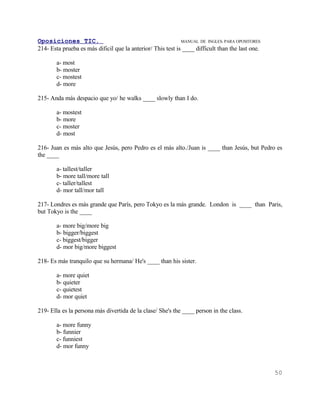
214- Esta prueba es más dificil que la anterior/ This test is ____ difficult than the last one.

        a- most
        b- moster
        c- mostest
        d- more

215- Anda más despacio que yo/ he walks ____ slowly than I do.

        a- mostest
        b- more
        c- moster
        d- most

216- Juan es más alto que Jesús, pero Pedro es el más alto./Juan is ____ than Jesús, but Pedro es
the ____

        a- tallest/taller
        b- more tall/more tall
        c- taller/tallest
        d- mor tall/mor tall

217- Londres es más grande que París, pero Tokyo es la más grande. London is ____ than Paris,
but Tokyo is the ____

        a- more big/more big
        b- bigger/biggest
        c- biggest/bigger
        d- mor big/more biggest

218- Es más tranquilo que su hermana/ He's ____ than his sister.

        a- more quiet
        b- quieter
        c- quietest
        d- mor quiet

219- Ella es la persona más divertida de la clase/ She's the ____ person in the class.

        a- more funny
        b- funnier
        c- funniest
        d- mor funny


                                                                                                  50
Oposiciones TIC.                                        MANUAL DE INGLES. PARA OPOSITORES
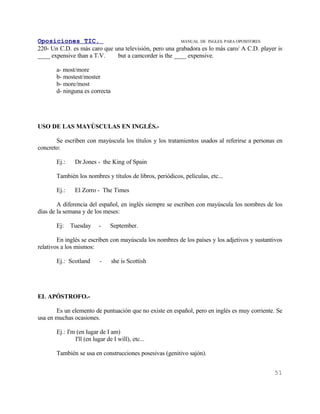
220- Un C.D. es más caro que una televisión, pero una grabadora es lo más caro/ A C.D. player is
____ expensive than a T.V.    but a camcorder is the ____ expensive.

       a- most/more
       b- mostest/moster
       b- more/most
       d- ninguna es correcta


USO DE LAS MAYÚSCULAS EN INGLÉS.-

       Se escriben con mayúscula los títulos y los tratamientos usados al referirse a personas en
concreto:

       Ej.:    Dr.Jones - the King of Spain

       También los nombres y títulos de libros, periódicos, películas, etc...

       Ej.:    El Zorro - The Times

        A diferencia del español, en inglés siempre se escriben con mayúscula los nombres de los
días de la semana y de los meses:

       Ej:    Tuesday     -     September.

        En inglés se escriben con mayúscula los nombres de los países y los adjetivos y sustantivos
relativos a los mismos:

       Ej.: Scotland       -    she is Scottish


EL APÓSTROFO.-

       Es un elemento de puntuación que no existe en español, pero en inglés es muy corriente. Se
usa en muchas ocasiones.
       Ej.: I'm (en lugar de I am)
               I'll (en lugar de I will), etc...

       También se usa en construcciones posesivas (genitivo sajón).


                                                                                               51
Oposiciones TIC.                                        MANUAL DE         INGLES. PARA OPOSITORES
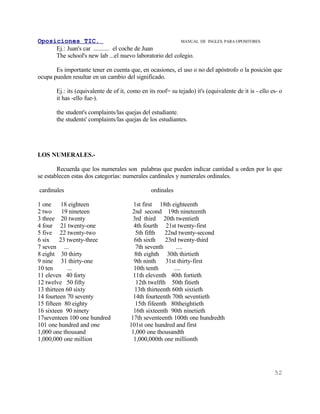
     Ej.: Juan's car .......... el coche de Juan
     The school's new lab ...el nuevo laboratorio del colegio.

       Es importante tener en cuenta que, en ocasiones, el uso o no del apóstrofo o la posición que
ocupa pueden resultar en un cambio del significado.

       Ej.: its (equivalente de of it, como en its roof= su tejado) it's (equivalente de it is - ello es- o
       it has -ello fue-).

       the student's complaints/las quejas del estudiante.
       the students' complaints/las quejas de los estudiantes.


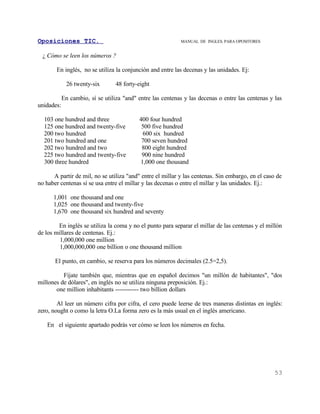
LOS NUMERALES.-

        Recuerda que los numerales son palabras que pueden indicar cantidad u orden por lo que
se establecen estas dos categorías: numerales cardinales y numerales ordinales.
cardinales                                      ordinales

1 one 18 eighteen                        1st first 18th eighteenth
2 two     19 nineteen                   2nd second 19th nineteenth
3 three 20 twenty                       3rd third 20th twentieth
4 four 21 twenty-one                     4th fourth 21st twenty-first
5 five 22 twenty-two                      5th fifth   22nd twenty-second
6 six    23 twenty-three                 6th sixth     23rd twenty-third
7 seven ...                               7th seventh      ....
8 eight 30 thirty                        8th eighth 30th thirtieth
9 nine 31 thirty-one                     9th ninth     31st thirty-first
10 ten      ...                          10th tenth       ....
11 eleven 40 forty                       11th eleventh 40th fortieth
12 twelve 50 fifty                        12th twelfth 50th fitieth
13 thirteen 60 sixty                     13th thirteenth 60th sixtieth
14 fourteen 70 seventy                   14th fourteenth 70th seventieth
15 fifteen 80 eighty                      15th fifeenth 80theightieth
16 sixteen 90 ninety                     16th sixteenth 90th ninetieth
17seventeen 100 one hundred            17th seventeenth 100th one hundredth
101 one hundred and one                101st one hundred and first
1,000 one thousand                      1,000 one thousandth
1,000,000 one million                    1,000,000th one millionth


                                                                                                       52
Oposiciones TIC.                                            MANUAL DE INGLES. PARA OPOSITORES


  ¿ Cómo se leen los números ?

       En inglés, no se utiliza la conjunción and entre las decenas y las unidades. Ej:

             26 twenty-six        48 forty-eight

            En cambio, sí se utiliza "and" entre las centenas y las decenas o entre las centenas y las
unidades:

  103 one hundred and three                400 four hundred
  125 one hundred and twenty-five           500 five hundred
  200 two hundred                           600 six hundred
  201 two hundred and one                   700 seven hundred
  202 two hundred and two                   800 eight hundred
  225 two hundred and twenty-five           900 nine hundred
  300 three hundred                        1,000 one thousand

      A partir de mil, no se utiliza "and" entre el millar y las centenas. Sin embargo, en el caso de
no haber centenas sí se usa entre el millar y las decenas o entre el millar y las unidades. Ej.:

      1,001 one thousand and one
      1,025 one thousand and twenty-five
      1,670 one thousand six hundred and seventy

        En inglés se utiliza la coma y no el punto para separar el millar de las centenas y el millón
de los millares de centenas. Ej.:
         1,000,000 one million
         1,000,000,000 one billion o one thousand million

       El punto, en cambio, se reserva para los números decimales (2.5=2,5).

          Fíjate también que, mientras que en español decimos "un millón de habitantes", "dos
millones de dólares", en inglés no se utiliza ninguna preposición. Ej.:
       one million inhabitants ------------ two billion dollars

        Al leer un número cifra por cifra, el cero puede leerse de tres maneras distintas en inglés:
zero, nought o como la letra O.La forma zero es la más usual en el inglés americano.

   En el siguiente apartado podrás ver cómo se leen los números en fecha.


                                                                                                   53
Oposiciones TIC.                   MANUAL DE INGLES. PARA OPOSITORES


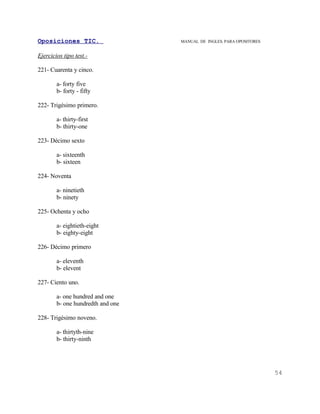
Ejercicios tipo test.-

221- Cuarenta y cinco.

        a- forty five
        b- forty - fifty

222- Trigésimo primero.

        a- thirty-first
        b- thirty-one

223- Décimo sexto

        a- sixteenth
        b- sixteen

224- Noventa

        a- ninetieth
        b- ninety

225- Ochenta y ocho

        a- eightieth-eight
        b- eighty-eight

226- Décimo primero

        a- eleventh
        b- elevent

227- Ciento uno.

        a- one hundred and one
        b- one hundredth and one

228- Trigésimo noveno.

        a- thirtyth-nine
        b- thirty-ninth


                                                                       54
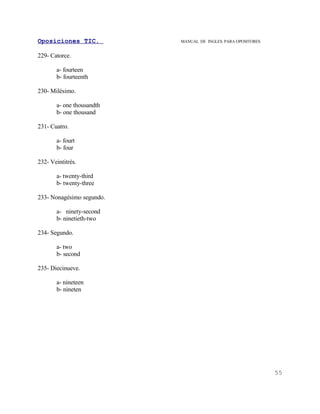
Oposiciones TIC.           MANUAL DE INGLES. PARA OPOSITORES


229- Catorce.

       a- fourteen
       b- fourteenth

230- Milésimo.

       a- one thousandth
       b- one thousand

231- Cuatro.

       a- fourt
       b- four

232- Veintitrés.

       a- twenty-third
       b- twenty-three

233- Nonagésimo segundo.

       a- ninety-second
       b- ninetieth-two

234- Segundo.

       a- two
       b- second

235- Diecinueve.

       a- nineteen
       b- nineten


                                                               55
Oposiciones TIC.                                           MANUAL DE INGLES. PARA OPOSITORES
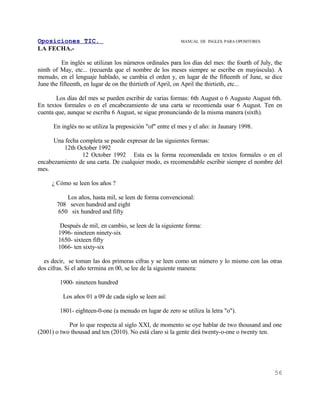
LA FECHA.-

          En inglés se utilizan los números ordinales para los días del mes: the fourth of July, the
ninth of May, etc... (recuerda que el nombre de los meses siempre se escribe en mayúscula). A
menudo, en el lenguaje hablado, se cambia el orden y, en lugar de the fifteenth of June, se dice
June the fifteenth, en lugar de on the thirtieth of April, on April the thirtieth, etc...

       Los días del mes se pueden escribir de varias formas: 6th August o 6 Augusto August 6th.
En textos formales o en el encabezamiento de una carta se recomienda usar 6 August. Ten en
cuenta que, aunque se escriba 6 August, se sigue pronunciando de la misma manera (sixth).

      En inglés no se utiliza la preposición "of" entre el mes y el año: in Jaunary 1998.

      Una fecha completa se puede expresar de las siguientes formas:
         12th October 1992
                 12 October 1992 Esta es la forma recomendada en textos formales o en el
encabezamiento de una carta. De cualquier modo, es recomendable escribir siempre el nombre del
mes.

     ¿ Cómo se leen los años ?

          Los años, hasta mil, se leen de forma convencional:
       708 seven hundred and eight
       650 six hundred and fifty

         Después de mil, en cambio, se leen de la siguiente forma:
        1996- nineteen ninety-six
        1650- sixteen fifty
        1066- ten sixty-six

  es decir, se toman las dos primeras cifras y se leen como un número y lo mismo con las otras
dos cifras. Si el año termina en 00, se lee de la siguiente manera:

         1900- nineteen hundred

          Los años 01 a 09 de cada siglo se leen así:

         1801- eighteen-0-one (a menudo en lugar de zero se utiliza la letra "o").

            Por lo que respecta al siglo XXI, de momento se oye hablar de two thousand and one
(2001) o two thousad and ten (2010). No está claro si la gente dirá twenty-o-one o twenty ten.


                                                                                                56
Oposiciones TIC.                      MANUAL DE INGLES. PARA OPOSITORES
Ejercicios tipo test.-


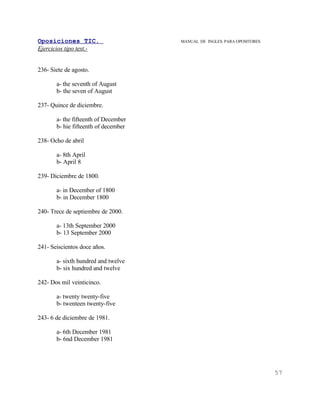
236- Siete de agosto.

       a- the seventh of August
       b- the seven of August

237- Quince de diciembre.

       a- the fifteenth of December
       b- hie fifteenth of december

238- Ocho de abril

       a- 8th April
       b- April 8

239- Diciembre de 1800.

       a- in December of 1800
       b- in December 1800

240- Trece de septiembre de 2000.

       a- 13th September 2000
       b- 13 September 2000

241- Seiscientos doce años.

       a- sixth hundred and twelve
       b- six hundred and twelve

242- Dos mil veinticinco.

       a- twenty twenty-five
       b- twenteen twenty-five

243- 6 de diciembre de 1981.

       a- 6th December 1981
       b- 6nd December 1981


                                                                          57
Oposiciones TIC.                                            MANUAL DE INGLES. PARA OPOSITORES


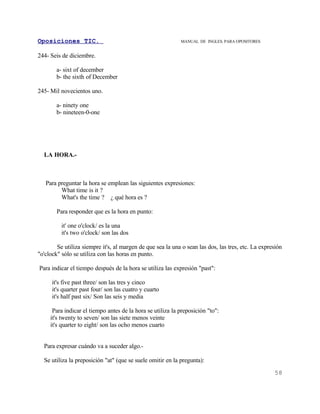
244- Seis de diciembre.

        a- sixt of december
        b- the sixth of December

245- Mil novecientos uno.

        a- ninety one
        b- nineteen-0-one


  LA HORA.-


   Para preguntar la hora se emplean las siguientes expresiones:
         What time is it ?
         What's the time ? ¿ qué hora es ?

        Para responder que es la hora en punto:

          it' one o'clock/ es la una
          it's two o'clock/ son las dos

        Se utiliza siempre it's, al margen de que sea la una o sean las dos, las tres, etc. La expresión
"o'clock" sólo se utiliza con las horas en punto.

Para indicar el tiempo después de la hora se utiliza las expresión "past":

      it's five past three/ son las tres y cinco
      it's quarter past four/ son las cuatro y cuarto
      it's half past six/ Son las seis y media

      Para indicar el tiempo antes de la hora se utiliza la preposición "to":
     it's twenty to seven/ son las siete menos veinte
     it's quarter to eight/ son las ocho menos cuarto


  Para expresar cuándo va a suceder algo.-

  Se utiliza la preposición "at" (que se suele omitir en la pregunta):
                                                                                                    58
Oposiciones TIC.                                               MANUAL DE INGLES. PARA OPOSITORES


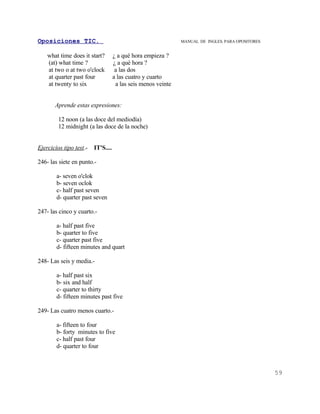
    what time does it start?        ¿ a qué hora empieza ?
    (at) what time ?                ¿ a qué hora ?
    at two o at two o'clock          a las dos
    at quarter past four            a las cuatro y cuarto
    at twenty to six                 a las seis menos veinte


       Aprende estas expresiones:

         12 noon (a las doce del mediodía)
         12 midnight (a las doce de la noche)


Ejercicios tipo test.-   IT'S....

246- las siete en punto.-

        a- seven o'clok
        b- seven oclok
        c- half past seven
        d- quarter past seven

247- las cinco y cuarto.-

        a- half past five
        b- quarter to five
        c- quarter past five
        d- fifteen minutes and quart

248- Las seis y media.-

        a- half past six
        b- six and half
        c- quarter to thirty
        d- fifteen minutes past five

249- Las cuatro menos cuarto.-

        a- fifteen to four
        b- forty minutes to five
        c- half past four
        d- quarter to four


                                                                                                   59
Oposiciones TIC.                    MANUAL DE INGLES. PARA OPOSITORES
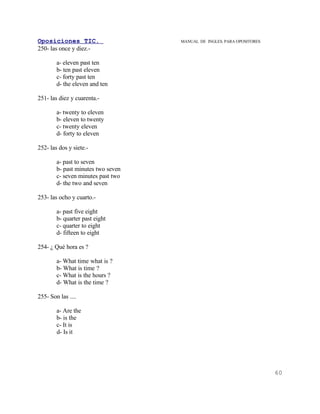
250- las once y diez.-

        a- eleven past ten
        b- ten past eleven
        c- forty past ten
        d- the eleven and ten

251- las diez y cuarenta.-

        a- twenty to eleven
        b- eleven to twenty
        c- twenty eleven
        d- forty to eleven

252- las dos y siete.-

        a- past to seven
        b- past minutes two seven
        c- seven minutes past two
        d- the two and seven

253- las ocho y cuarto.-

        a- past five eight
        b- quarter past eight
        c- quarter to eight
        d- fifteen to eight

254- ¿ Qué hora es ?

        a- What time what is ?
        b- What is time ?
        c- What is the hours ?
        d- What is the time ?

255- Son las ....

        a- Are the
        b- is the
        c- It is
        d- Is it


                                                                        60
Oposiciones TIC.                                           MANUAL DE INGLES. PARA OPOSITORES


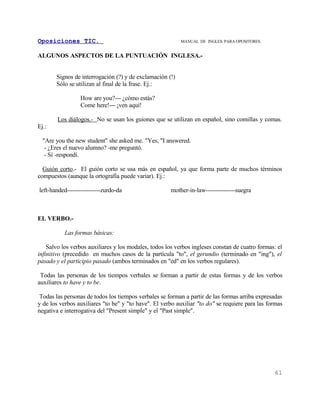
ALGUNOS ASPECTOS DE LA PUNTUACIÓN INGLESA.-


       Signos de interrogación (?) y de exclamación (!)
       Sólo se utilizan al final de la frase. Ej.:

                 How are you?--- ¿cómo estás?
                 Come here!--- ¡ven aquí!

        Los diálogos.- No se usan los guiones que se utilizan en español, sino comillas y comas.
Ej.:

  "Are you the new student" she asked me. "Yes, "I answered.
   - ¿Eres el nuevo alumno? -me preguntó.
   - Sí -respondí.

  Guión corto.- El guión corto se usa más en español, ya que forma parte de muchos términos
compuestos (aunque la ortografía puede variar). Ej.:

left-handed-----------------zurdo-da                  mother-in-law---------------suegra


EL VERBO.-

           Las formas básicas:

    Salvo los verbos auxiliares y los modales, todos los verbos ingleses constan de cuatro formas: el
infinitivo (precedido en muchos casos de la partícula "to", el gerundio (terminado en "ing"), el
pasado y el participio pasado (ambos terminados en "ed" en los verbos regulares).

 Todas las personas de los tiempos verbales se forman a partir de estas formas y de los verbos
auxiliares to have y to be.

 Todas las personas de todos los tiempos verbales se forman a partir de las formas arriba expresadas
y de los verbos auxiliares "to be" y "to have". El verbo auxiliar "to do" se requiere para las formas
negativa e interrogativa del "Present simple" y el "Past simple".


                                                                                                 61
Oposiciones TIC.                                    MANUAL DE INGLES. PARA OPOSITORES
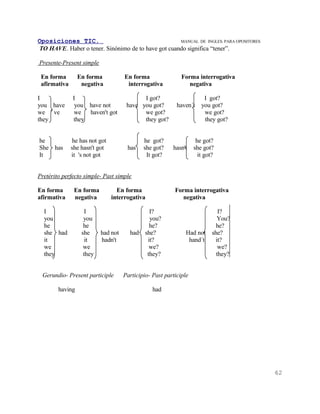
TO HAVE. Haber o tener. Sinónimo de to have got cuando significa “tener”.

Presente-Present simple

 En forma        En forma           En forma                Forma interrogativa
 afirmativa       negativa           interrogativa             negativa

I             I                            I got?                     I got?
you have       you have not          have you got?        haven´t    you got?
we ' ve       we   haven't got             we got?                    we got?
they          they                         they got?                  they got?


he            he has not got                he got?                he got?
She has       she hasn't got         has    she got?    hasn't    she got?
It            it 's not got                  It got?                it got?


Pretérito perfecto simple- Past simple

En forma       En forma          En forma                Forma interrogativa
afirmativa     negativa        interrogativa                negativa

  I                 I                       I?                               I?
  you              you                      you?                            You?
  he               he                       he?                            he?
  she had         she     had not     had she?                Had not     she?
  it                it    hadn't           it?                 hand´t      it?
  we               we                       we?                              we?
  they             they                    they?                            they?


 Gerundio- Present participle       Participio- Past participle

        having                                  had


                                                                                        62
Oposiciones TIC.                                              MANUAL DE INGLES. PARA OPOSITORES
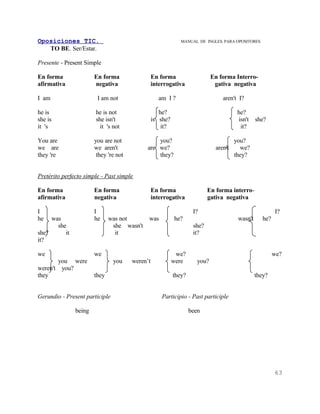
   TO BE. Ser/Estar.

Presente - Present Simple

En forma               En forma                  En forma                    En forma Interro-
afirmativa             negativa                  interrogativa                gativa negativa

I am                    I am not                    am I ?                       aren't I?

he is                  he is not                    he?                                 he?
she is                 she isn't                 is she?                                isn't    she?
it 's                    it 's not                   it?                                 it?

You are                you are not              you?                                   you?
we are                 we aren't            are we?                           aren't     we?
they 're                they 're not            they?                                  they?


Pretérito perfecto simple - Past simple

En forma               En forma                  En forma                  En forma interro-
afirmativa             negativa                  interrogativa             gativa negativa

I                      I                                            I?                                    I?
he   was               he     was not        was           he?                          wasn't      he?
       she                     she wasn't                           she?
she?      it                    it                                  it?
it?

we                     we                                   we?                                           we?
       you were                 you    weren’t             were       you?
weren't you?
they                   they                                they?                                 they?


Gerundio - Present participle                        Participio - Past participle

               being                                               been


                                                                                                          63
Oposiciones TIC.                                           MANUAL DE INGLES. PARA OPOSITORES
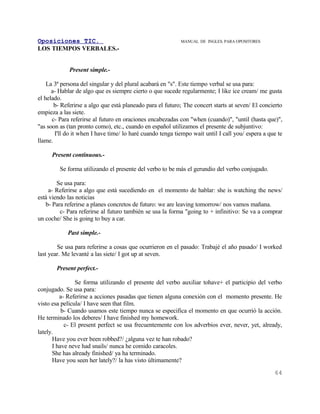
LOS TIEMPOS VERBALES.-


             Present simple.-

    La 3ª persona del singular y del plural acabará en "s". Este tiempo verbal se usa para:
      a- Hablar de algo que es siempre cierto o que sucede regularmente; I like ice cream/ me gusta
el helado.
       b- Referirse a algo que está planeado para el futuro; The concert starts at seven/ El concierto
empieza a las siete.
      c- Para referirse al futuro en oraciones encabezadas con "when (cuando)", "until (hasta que)",
"as soon as (tan pronto como), etc., cuando en español utilizamos el presente de subjuntivo:
       I'll do it when I have time/ lo haré cuando tenga tiempo wait until I call you/ espera a que te
llame.

     Present continuous.-

         Se forma utilizando el presente del verbo to be más el gerundio del verbo conjugado.

        Se usa para:
     a- Referirse a algo que está sucediendo en el momento de hablar: she is watching the news/
está viendo las noticias
   b- Para referirse a planes concretos de futuro: we are leaving tomorrow/ nos vamos mañana.
         c- Para referirse al futuro también se usa la forma "going to + infinitivo: Se va a comprar
un coche/ She is going to buy a car.

            Past simple.-

        Se usa para referirse a cosas que ocurrieron en el pasado: Trabajé el año pasado/ I worked
last year. Me levanté a las siete/ I got up at seven.

       Present perfect.-

                Se forma utilizando el presente del verbo auxiliar tohave+ el participio del verbo
conjugado. Se usa para:
         a- Referirse a acciones pasadas que tienen alguna conexión con el momento presente. He
visto esa película/ I have seen that film.
          b- Cuando usamos este tiempo nunca se especifica el momento en que ocurrió la acción.
He terminado los deberes/ I have finished my homework.
           c- El present perfect se usa frecuentemente con los adverbios ever, never, yet, already,
lately.
      Have you ever been robbed?/ ¿alguna vez te han robado?
      I have neve had snails/ nunca he comido caracoles.
      She has already finished/ ya ha terminado.
      Have you seen her lately?/ la has visto últimamente?
                                                                                                  64
Oposiciones TIC.                                          MANUAL DE INGLES. PARA OPOSITORES


        Past perfect.-

                     Es el equivalente pasado del present perfect. Se forma con el pasado de los
auxiliares "to have: had" y "to be: was" más el participio del verbo conjugado.
          Se usa para referirse a acciones anteriores a determinado momento en el pasado.
   Ya había visto la película/ I had already seen the film

      A diferencia del Present perfect, con este tiempo se puede especificar el momento en el que
había ocurrido la acción.

Estaba cansado porque me había levantado a las seis /I was tired because I had got up at six.

        Futuro simple.-

                  Se usa para referirse a lo que creemos que ocurrirá en el futuro, utilizamos para
formarlo la partícula "will":
       I will (shall) work/ Trabajaré.
       It will be cold tomorrow/ Hará frio mañana.

        El condicional es un tiempo que abordaremos más adelante.


Preguntas tipo test.-

256- Señala el gerundio del verbo trabajar.-

        a- to work
        b- worked
        c- working
        d- work

257- Señala el infinitivo del verbo cerrar.-

        a- closed
        b- closing
        c- to close
        d- close

258- Señala el participio del verbo cerrar.-

        a- closed
        b- closing
        c- to close
        d- close
                                                                                                65
Oposiciones TIC.                                           MANUAL DE INGLES. PARA OPOSITORES


259- Señala la tercera persona del singular del presente del verbo trabajar.-

       a- worked
       b- work
       c- works
       d- working

260- Yo vivo en Madrid/ I ____ in Madrid.

       a- lives
       b- liv
       c- live
       d- living

261- Salen para Italia mañana/ They ____ for Italy tomorrow.

       a- leaves
       b- leaf
       c- leave
       d- leaving

262- Estoy aprendiendo a jugar al ajedrez/ ____ how to play chess.
       a- I'lear
       b- I'learned
       c- I'm learning
       d- I am lear

263- Ella llega el miércoles/ She ____ on Wednesday.

       a- are arriving
       b- is arrived
       c- is arrive
       d- is arriving

264- ¿ Qué vas a hacer ?/ What ____ to do ?.

       a- you are going
       b- are you
       c- are you going
       d- he's to do


                                                                                               66
Oposiciones TIC.                                        MANUAL DE INGLES. PARA OPOSITORES


265- Ellos están trabajando/ They are ____

       a- working
       b- met
       c- meeting
       d- to meet

266- La conocí el año pasado/ I ____ her last year.

       a- meets
       b- met
       c- meeting
       d- to meet

267- Sólamente pregunté si estaba casado/ I merely ____ if he was married.

       a- asks
       b- asking
       c- to inquire
       d- asked

268- Han marcado otro gol/ They ____ ____ another goal.
       a- has scored
       b- have scor
       c- have scored
       d- having scored

269- He visto esa película/ I ____ that film

       a- has seen
       b- to see
       c- see
       d- have seen

270- Cuando María había cenado vio un video/ When María ____ her supper, she ____ a video.

       a- had finished/ watched
       b- have finis/ watchs
       c- finis/ watchs
       d- was finished/ Watched


                                                                                             67
Oposiciones TIC.                                       MANUAL DE INGLES. PARA OPOSITORES
271- Estuvo en Florida durante dos semanas/ She ____ in Florida for Two weeks.

       a- have
       b- been
       c- has been
       d- having been

272- Hemos tenido un desacuerdo/ We ____ a disagreement.
       a- have had
       b- has had
       c- having had
       d- had had

273- Estaba haciendo un pastel/ I ____ a cake.

       a- have making
       b- was making
       c- made
       d- have made

274- Ojalá no hubiera dicho nada/ I wish ____ said anything.

       a- hasn'nt
       b- hadn't
       c- have not
       d- hav'not

275- Señala el present simple en los siguientes tiempos verbales.
       a- I working
       b- I work
       c- I worked
       d- I am working

276- Señala ahora el Present continuous.

       a- I write
       b- I writed
       c- I am writing
       d- I have writed


                                                                                           68
Oposiciones TIC.                                           MANUAL DE INGLES. PARA OPOSITORES
277- Señala la expresión que corresponda al past simple.

        a- I work
        b- I working
        c- I works
        d- I worked

278- Identifica el Present perfect.

        a- I have finished
        b- I am finished
        c- I had finished
        d- I has finished

279- Señala el Past perfect.

        a- You are worked
        b- You had worked
        c- you has worked
        d- You are working

280- Identifica el futuro simple.

        a- You will work
        b- You work
        c- You worked
        d- You are working


LAS ORACIONES CONDICIONALES


           Las oraciones condicionales constan de dos partes, la parte que establece la condición,
que va encabezada por "if" (o unless, etc.) y la oración principal. Pueden dividirse en tres tipos
básicos:

       if + present, future

          if she takes a taxi, she will be here in ten
minutes. En este caso es posible que se cumpla la condición expresada.

       if + past, conditional


                                                                                               69
Oposiciones TIC.                                            MANUAL DE INGLES. PARA OPOSITORES
            if she took a taxi, she would be here in ten
minutes/ si coge un taxi, estará aquí en diez minutos.
        En este caso es menos probable que se cumpla la
condición expresada. Este tipo también puede expresar algo contrario a la realidad:
       If I had any money, I would lend it to you
       Si tuviera dinero, te lo prestaría (pero no tengo dinero).
      If + past perfect, conditional perfect.

       If she had taken a taxi, she would have been here in ten minutes/ Si hubiera cogido un taxi,
habría estado aquí en diez minutos. Expresa una condición que ya no se puede cumplir: ella no
cogió un taxi, vino en el autobús, o a pie, etc.

     En las oraciones condicionales a menudo se utiliza "were" en lugar de "was", sobre todo en la
expresión "if I were you (yo que tú):
      if I were you, I would buy the red one/ yo que tú compraría la roja.


VERBOS AUXILIARES.-


        Los verbos auxiliares nos ayudan a conformar y expresar correctamente los tiempos y
distintas formas de los verbos principales. En inglés tenemos los verbos "to be" (ser o estar), "to
have" (haber o tener) - ambos explicados anteriormente - y "to do" (en su forma auxiliar no tiene
traducción, sí tiene, no obstante, en su forma original: hacer).
 Así mismo, tenemos los verbos auxiliares modales.
       Los verbos auxiliares forman el negativo y el interrogativo sin el uso del auxiliar "to do".
El negativo se forma agregando "not" al verbo, el interrogativo, invirtiendo el orden del sujeto y el
verbo.

        Los verbos to be y to have intervienen en la formación de los tiempos verbales compuestos
de otros verbos.
        El verbo to do es necesario para formar el negativo y el interrogativo de los tiempos
simples. En el presente se utiliza la forma "do" para todas las personas excepto la tercera del
singular, que requiere la forma "does". El verbo principal va en infinitivo. En el pasado se utiliza la
forma "did" en todas las personas con el verbo principal en infinitivo.


      be                  do                  have
      is/are             does/do             has/have
      was/were           did                  had
                                                                                                   70
Oposiciones TIC.                                           MANUAL DE INGLES. PARA OPOSITORES


Verbos modales y semimodales.-

       Además de las características generales de los verbos auxiliares señaladas más arriba, los
verbos modales (can, could, may, might, must, need, ought to, shall, should, used to, will y
would ) no tienen infinitivo con "to" participio ni gerundio, no agregan "s" en la tercera persona del
presente, van seguidos de un infinitivo sin "to" y sólo pueden usarse en un número limitado de
tiempos verbales.

      Cada uno de ellos expresa:
Can- poder;

       Habilidad: I can speak Spanish/Puedo ayudarte
       Requerimiento: Can I use your car?/ Puedo usar tu coche?
       Imposibilidad: You can't see the dentist now/ No puedes ver al dentista ahora.
       Permiso: You can take the car tomorrow/Puedes coger el
          coche mañana.


Could- podía, podías, pude, pudiste, podría, podrías.

       habilidad: She could swim well at the age of four/Podrá nadar mejor cuando tenga 4 años.
       Posibilidad: The keys could be in the car/ Las llaves podrían estar en el coche.
       Petición: Could I have a word with you ?/ Podría hablar contigo ?
       Imposibilidad: I couldn't open the door/no podía abrir la puerta.
       Sugerencia: You could get advice from you doctor/Podrías ser aconsejado por tu doctor.

May- Equivale al presente del verbo poder. Le sigue un infinitivo sin "to".

       Posibilidad en el futuro: It may rain tomorrow/puede que llueva mañana.
       Posibilidad negativa: He may not arrive tonight/puede que no venga esta noche.
       Petición formal: May I call you later ?/te puedo llamar tarde?
       Permiso: You may take the car/ puedes coger el coche.
       Prohibición: You may not smoke in the library/ No debes fumar en la librería.

Might- Es una forma equivalente a "may". Puede equivaler a podía, podías, etc. o a podrías,
podría, etc. Su uso es más formal que el de may. También le sigue un verbo en infinitivo sin "to".

       Posibilidad: It might rain tomorrow/puede que llueva mañana.
       Posibilidad negativa: Tom might not be tire today/puede que tom no esté hoy cansado.


                                                                                                  71
Oposiciones TIC.                                          MANUAL DE INGLES. PARA OPOSITORES
Will- Se usa para formar el futuro. La contracción 'll, que va unida al pronombre o nombre que le
precede, se usa muy a menudo en lugar de will. La forma negativa de will es "won't, pero en
contextos más formales se usa "will not".

       Certeza y predicción: He will arrive at six o'clok/llegará a las seis en punto.
       Buena voluntad o decisión expontánea: I'll - go to help you/Iré a ayudarte.
       Petición formal: Will you pass the sugar?/me pasa el azúcar?

Would: Querría. Condicional. La contracción es " 'd ", que va unida al pronombre o al nombre
que le precede, se usa a menudo en lugar de would. La forma negativa de would es wouldn't, pero
en contextos formales se suele usar "would not".

        Petición formal: Would you move you car, please ?/podría mover su coche ?
        Acción repetida en el pasado: I would walk on the beach every morning/solía andar
por la playa cada mañana.
        Preferencia: I would rather have tea/preferiría tomar té.

Shall: Se utiliza a veces en lugar de will para formar el futuro con las primeras personas. Su uso es
más formal que will.
        La forma negativa de shall es "shan't", pero en contextos más formales se suele usar shall
not.

       Petición formal u oferta de ayuda: Shall I carry this bag?/ puedo llevar esta bolsa?

Should y ought to: Se usan para expresar lo que se debe hacer; equivalen a debería, deberías, etc.
La forma negativa de should es shouldn't, en contextos más formales se usa "should not". La forma
negativa de ought to es "ought not to".

       Dando consejo: You should (ought to) see a doctor/deberías ver a un doctor.
       Aconsejar en comportamiento: You should'nt lose your temper with people/No deberías de
       perder la compostura con la gente.
       Sugerencia: Should I put the bags here ?/Puedo poner las bolsas aquí ?.


Must: Deber. (to have to). Su forma negativa es mustn't, pero en contextos más formales se usa
"must not".
       You must go and see that film/debes ir y ver esta película.

       Prohibición: You mustn't smoke in this hospital/no puedes fumar en este hospital.


Needn't: (don't have to) (no hay que).

 You needn't come today if you don't want to/no tienes que venir hoy si no quieres.


                                                                                                 72
Oposiciones TIC.                                           MANUAL DE INGLES. PARA OPOSITORES


Have/has to: Tener que.

         Obligación/necesidad: We have to wear school uniforms/Tenemos que vestir con
uniforme en el cole
   Falta de necesidad: I don't have to pay this until June. No tengo que pagar ésto hasta junio.
    Necesidad pasada: He had to leave early/tuvo que irse temprano.
    Necesidad futura: We will have to leave soon/Tendremos que irnos temprano.

Be able to:

    Habilidad general (poder).- He is able to dress himself/Puesde vestirse él sólo.
    Habilidad específica pasada: We were able to find the house although we had no map.
    Pudimos encontrar la casa a pesar de no tener mapa.


Ejercicios tipo test.-


281- ¿ Cuál de los siguientes verbos no es auxiliar en inglés ?

        a- to do
        b- to have
        c- to be
        d- to sing

282- Señala la frase correcta; ¿ Estamos preparados ?

        a- We are ready ?
        b- we have ready ?
        c- are we ready ?
        d- have we ready ?

283- Señala la frase correcta; ¿has terminado?

        a- are you finished ?
        b- have you finished ?
        c- you are finished ?
        d- you have finished ?

284- Señala la frase correcta; ¿ vendrán ellos ?

        a- They wil come ?
        b- will they come ?
        c- come they wil ?
                                                                                               73
Oposiciones TIC.                                        MANUAL DE INGLES. PARA OPOSITORES
     d- they come wil ?

285- Señala la frase correcta; ¿ puedes hacerlo ?

       a- do you can it ?
       b- you do can it ?
       c- you can do it ?
       d- can you do it ?

286- Señala la frase correcta; No estamos preparados.

       a- We are not ready
       b- not are we ready
       c- Are we not ready
       d- ready not we are

287- Ella no puede hacerlo.

       a- She can't do it
       b- can't she do it
       c- do not can she it
       d- not can do she it

288- ¿ Necesitas un abrigo ?

       a- you need a coat ?
       b- you do need a coat ?
       c- do you need a coat ?
       d- need you a coat ?

289- No necesitas un abrigo.
       a- Does you not need a coat
       b- You do not need a coat
       c- not need you a coat
       d- not you need a coat

290- Necesita él un abrigo ?

       a- Does he need a coat ?
       b- She does need a coat ?
       b- Does she need a coat ?
       d- a y b son correctas.


                                                                                            74
Oposiciones TIC.                                     MANUAL DE INGLES. PARA OPOSITORES
291- Se hace chocolate en Suiza

       a- Chocolate be made in Suiza
       b- Chocolate is made in Suiza
       c- Chocolate does made in Suiza
       d- Chocolate are made in Suiza

292- ¿ Dónde ibas cuando te telefoneé ?

       a- Where did you going when I telephoned ?
       b- Where was you going when I telephoned ?
       c- Where have you going when I telephoned ?
       d- Where were you going when I telephoned ?

293- ¿ Sales todas las noches ?

       a- Do you go out every night ?
       b- Did you go out every night ?
       c- Where do you go every night ?
       d- What are you doing every night ?

294- No tiene tiempo.

       a- He didn't had time
       b- He doesn't have time
       c- He don't have time
       d- He has have time

295- ¿Qué hiciste ayer?

       a- What do you do yesterday ?
       b- What will you do yesterdy ?
       c- What did you do yesterday ?
       d- What would you do yesterday ?

296- ¿ Has estado alguna vez en París ?

       a- Had you ever been to París ?
       b- Have you ever been to París ?
       c- Have you ever been in París ?
       d- Has you ever been to París ?


                                                                                         75
Oposiciones TIC.                                MANUAL DE INGLES. PARA OPOSITORES
297- Juan ha hecho la compra.

       a- Juan had done the shopping
       b- Juan has done shopping
       c- Juan has done the shopping
       d- Juan have done the shopping

298- María va a hacer la compra.

       a- María is going to do the shopping
       b- María are going to do the shopping
       c- María will go to do the shopping
       d- María would go to do the shopping

299- ¿ Qué vas a hacer esta noche ?

       a- What would you do at night ?
       b- What will you do at night ?
       c- What do you go to do at night ?
       d- What are you going to do at night ?

300- Yo no necesitaba éso.

       a- I don't need that
       b- I didn't need that
       c- I won't need that
       d- I want that

301- ¿ Echamos la carta al correo ?

       a- We don't past the letter ?
       b- We did the letter post ?
       c- Did we post the letter ?
       d- We didn't post the letter

302- Te puede ayudar/he ____ help you.

       a- can
       b- might
       c- could
       d- must


                                                                                    76
Oposiciones TIC.                                          MANUAL DE INGLES. PARA OPOSITORES


303- No puedes salir/you ____ go out.

       a- could
       b- can not
       c- can't
       d- b y c son correctas.

304- ¿ Me puedes abrir la puerta ?/ ____ you open the door for me ?

       a- shall
       b- can
       c- myght
       d- could

305- No podía entender por qué estaba enfadado/he ____ understand           why he was cross.

       a- couldn't
       b- mihgt not
       c- musn't
       d- can not

306- Podríamos ir en tren/we ____ go by train.

       a- could
       b- shall
       c- has to
       d- must

307- Puedo usar el teléfono/ ____ I use the phone

       a- shall
       b- may
       c- can
       d- could

308- Puede que decida quedarse/she ____ decide to stay.

       a- may
       b- myght
       c- might
       d- could


                                                                                                77
Oposiciones TIC.                                           MANUAL DE   INGLES. PARA OPOSITORES
309- ¿ Podría pedirle un favor ? ____ I ask you a favour ?

       a- may
       b- mine
       c- shall
       d- might

310- Iré a Londres/ I ____ go to London

       a- will
       b- would
       c- could
       d- will be able to

311- LLegará mañana/ he ____ arrive tomorrow.

       a- be able to
       b- will
       c- would
       d- could

312- No quiere hacer lo que le pide/ He ____ do what he asks.

       a- couldn't
       b- might not
       c- wouldn't
       d- cloesri´t want to

313- Le encantaría ir a China/ he ____ love to go to China.

       a- would
       b- could
       c- might
       d- may

314- ¿ Quieres un caramelo ?/ ____ you like a sweet ?.

       a- shall
       b- them
       c- have to
       d- would


                                                                                                 78
Oposiciones TIC.                                          MANUAL DE INGLES. PARA OPOSITORES
315- Estaremos allí a las seis/ We ____ be there at six

       a- can
       b- will
       c- shall
       d- be able to

316- ¿ Nos sentamos aquí ?/ ____ we sit here ?.

       a- will
       b- be able to
       c- might
       d- shall

317- ¿ Por qué debo hacerle caso ?/ Why ____ I listen to her ?

       a- should
       b- would
       c- will
       d- can

318- No deberías hablarle así/ You ____ speak to her like that.

       a- couldn't
       b- mighdn't
       c- shouldn't
       d- can't

319- Deberías escribirle/ You ____ to write to her

       a- ought
       b- can't
       c- cought
       d- musn't

320- Debes decírselo/ You ____ tell her.

       a- could
       b- might
       c- would
       d- must


                                                                                              79
Oposiciones TIC.                                         MANUAL DE   INGLES. PARA OPOSITORES
321- Dijo que no debía tocarlo/ She told him he ____ touch it.

       a- have
       b- has to
       c- must not
       d- can


LAS CONTRACCIONES.-

        Las contracciones son muy frecuentes en el inglés hablado y también se utilizan al
transcribir diálogos y en cartas de carácter no formal. Son formas abreviadas de combinaciones de
vocablos, uno de los cuales suele ser un verbo, en las cuales el apóstrofo sustituye a una o más
letras.

     Contracciones de sujeto y verbo.-


I'm/I am                    she'll/she will
I've/I have                 it's/it is-it has
I'd/I had-I would           it'd/it had-it would
I'll/I will-I shall            it'll/it will
you're/you are              we're/we are
you've/you have             we've/we have
you'd/you would-had         we'd/we had-would
you'll/you will               we'll/we will/we shall
he's/ he is-he has          They're/they are
he'd/he had-would            they've/they have
he'll/he will                  they'd/they had/they would
she's/she is-she has          they'll/they will
she'd/she had-she would


Contracciones negativas.-


isn't/is not           couldn't/could not
aren't/are not       daren't/dare not
wasn't/was not        mightn't/might not
weren't/were not      mustn't/must not
hasn't/has not       needn't/need not
haven't/have not     oughtn't/ought not
hadn't/had not       shan't/shall not
doesn't/does not      shouldn't/should not
don't/do not           won't/will not
                                                                                               80
Oposiciones TIC.                                         MANUAL DE INGLES. PARA OPOSITORES
didn't/dit not         wouldn't/would not
can't/can not (cannot)
   Con las formas verbales is, are, has, have, will y shall la contracción se puede hacer de dos
maneras diferentes:


he is not         he isn't         he's not
they are not    they aren't       they're not
she has not     she hasn't        she's not
we have not     we haven't        we've not
you will not     you won't         you'll not
I shall not      I shan't         I'll not


Contracciones con palabras interrogativas.-


how's/how is-how has                   who've/who have
how'll/how will                        when's/when is when has
how've/how have                       when'll/when will
what's/what is-what has               when've/when have
what'll/what will                     where's/where is-where has
what've/what have                     where'll/where will
who's/who is-who has                  where've/wher have
who'll/who will                       why's/why is-why has
who'd/who had-who would              why've/why have

   Contracciones con here, there y that.

   here's/here is                   that's/that is-that has
   there's/there is/there has      that'll/that will
   there'll/there will

    También suelen contraerse las formas verbales que siguen a nombres comunes o propios:

    that man's very tall        that man is very tall
    Pili'll come with us         Pili will come with us

  Es importante recordar que " 's " puede significar is o has:

Ezequiel's late                     Ezequiel is late
Benjamín's been on holiday          Benjamín has been on holiday.


                                                                                             81
Oposiciones TIC.                                         MANUAL DE INGLES. PARA OPOSITORES
Y " 'd " puede significar had o would:

  Franci'd never been to France     Franci had never been to France
  Marti'd like this picture          Marti would like this picture


Preguntas tipo test.-

 Identifica la forma contracta:

322- I am

       a- I'm
       b- a'm
       c- I'am
       d- Im'a

323- We would not.

       a- woul'dnt
       b- would'nt
       c- wouldn't
       d- would'not

     Completa.-

324- _____ like tea ?

       a- Doesn't you ?
       b- Does'you ?
       c- Do she ?
       d- D'you ?

325- It ____ here.

       a- isn't
       b- aren't
       c- isnot
       d- ar'not


                                                                                             82
Oposiciones TIC.                        MANUAL DE INGLES. PARA OPOSITORES
326- ____ Isaac Newton ?

       a- aren't
       b- What'll
       c- Who's
       d- When's

327- You ____ smoke

       a- isn't
       b- aren't
       c- musn't
       d- hasn't

328- ____ a fly in my soup.

       a- there's
       a- they're
       c- there're
       d- there'll

329- he ____ in New York

       a- Wheren't
       b- haven't
       c- aren't
       d- wasn't

330- Why _____ you go out yesterday ?

       a- don't
       b- didn't
       c- doesn't
       d- weren't

331- You ____ go to Madrid tomorrow

       a- wasn't
       b- won't
       c- willn't
       d- weren't


                                                                            83
Oposiciones TIC.                                 MANUAL DE INGLES. PARA OPOSITORES
332- I ____ drive, because ____ fourtem

       a- couldn't/I'm
       b- can't/he's
       c- can't/I'm
       d- could'n/it's

333- ____ a teacher very young

       a- can't
       b- We've
       c- he've
       d- you's

334- ____ got some butter

       a- he's
       b- I'm
       c- he is
       d- you're

335- ____ went to Paris five years ago

       a- she's
       b- she'll
       c- she're
       d- she

336- You ____ come today if you don't want to.

       a- needn't
       b- no able to
       c- ne'dont
       d- don't


                                                                                     84
Oposiciones TIC.                        MANUAL DE INGLES. PARA OPOSITORES


VERBOS IRREGULARES.


INFINITIVO   PAST SIMPLE      PAST PARTICIPLE       MEANING

1-    BE         WAS/WERE      BEEN               SER/ESTAR
2-    BEAT       BEAT          BEATEN             GOLPEAR
3-    BECOME     BECAME        BECAME             LLEGAR A SER
4-    BEGIN           BEGAN          BEGUN              EMPEZAR
5-    BEND       BENT          BENT               DOBLAR
6-    BET        BET           BET                APOSTAR
7-    BITE       BIT           BITTEN             MORDER
8-    BLOW       BLEW          BLOW               SOPLAR
9-    BREAK      BROKE         BROKEN             ROMPER
10-   BRING      BROUGH        BROUGHT            TRAER
11-   BUILD           BUILT         BUILT               CONSTRUIR
12-   BURST      BURST         BURST              ESTALLAR
13-   BUY        BOUGHT        BOUGHT             COMPRAR
14-   CATCH      CAUGHT        CAUGHT             COGER
15-   CHOOSE     CHOSE         CHOSEN             ELEGIR
16-   COME       CAME          COME               VENIR
17-   COST      COST           COST               COSTAR
18-   CUT        CUT           CUT                CORTAR
19-   DEAL       DEALT         DEALT              TRATAR
20-   DIG        DUG           DUG                CAVAR
21-   DO         DID           DONE               HACER
22-   DRAW       DREW          DRAW               PINTAR
23-   DRINK      DRANK         DRUNK              BEBER
24-   DRIVE           DROVE         DRIVEN              CONDUCIR
25-   EAT        ATE           EATEN              COMER
26-   FALL       FELL          FALLEN             CAER
27-   FEED       FED           FED                ALIMENTAR
28-   FEEL       FELT          FELT               CAER
29-   FIGHT      FOUGHT        FOUGHT             LUCHAR
30-   FIND       FOUND         FOUND              ENCONTRAR
31-   FLY        FLEW          FLOWN              VOLAR
32-   FORBID     FORBADE       FORBIDDEN          PROHIBIR
33-   FORGET     FORGOT        FORGOTTEN          OLVIDAR
34-   FORGIVE    FORGAVE       FORGIVEN           PERDONAR
35-   FREEZE     FROZE         FROZEN             HELAR
36-   GET        GOT           GOT                CONSEGUIR
37-   GIVE       GAVE          GIVEN                    DAR
38- GO      WENT      GONE     IR
                                                                            85
Oposiciones TIC.                       MANUAL DE INGLES. PARA OPOSITORES
39- GROW GREW         GROWN    CULTIVAR/CRECER
40- HANG HUNG         HUNG     COLGAR
41- HAVE HAD          HAD      HABER/TENER
42- HEAR   HEARD      HEARD    OIR
43- HIDE   HID        HIDDEN   ESCONDER
44- HIT    HIT        HIT      GOLPEAR
45- HOLD HELD         HELD     SOSTENER
46- HURT   HURT       HURT     LASTIMAR/HERIR
47- KEEP   KEPT       KEPT     GUARDAR
48- KNOW KNEW         KNOWN    SABER
49- LAY    LAID       LAID     PONER/COLOCAR
50- LEAD   LED        LED      GUIAR
51- LEAVE LEFT        LEFT     ABANDONAR/DEJAR
52- LEND   LENT       LENT     PRESTAR
53- LET    LET        LET      PERMITIR/DEJAR
54- LIE    LAY        LAIN     TUMBARSE/YACER
55- LIGHT LIT         LIT      ENCENDER
56- LOSE   LOST       LOST     PERDER
57- MAKE MADE         MADE     HACER/FABRICAR
58- MEAN MEANT        MEANT    SIGNIFICAR
59- MEET   MET        MET      ENCONTRARSE CON
60- PAY    PAID       PAID     PAGAR
61- PUT    PUT        PUT      PONER
62- READ   READ       READ     LEER
63- RIDE   RODE       RIDDEN   MONTAR
64- RING   RANG       RUNG     SONAR
65- RISE   ROSE       RISEN    AMANECER
66- RUN    RAN        RUN      CORRER
67- SAY    SAID       SAID     DECIR
68- SEE    SAW        SEEN     VER
69- SEEK   SAUGHT     SAUGHT   BUSCAR
70- SELL   SOLD       SOLD     VENDER
71- SEND   SENT       SENT     ENVIAR
72- SET    SET        SET      ESTABLECER/FIJAR
73- SEW    SEWED      SEWN     COSER
74- SHAKE SHOOK       SHAKEN   SACUDIR
75- SHINE SHONE       SHONE    BRILLAR
76- SHOOT SHOT        SHOT     DISPARAR
77- SHOW SHOWED       SHOWN    MOSTRAR
78- SHRINK SHRANK     SHRUNK   ENCOGER
79- SHUT   SHUT       SHUT     CERRAR
80- SING   SANG       SUNG     CANTAR
81- SINK   SANK       SUNK     HUNDIR
82- SIT         SAT            SAT             SENTARSE
83- SLEEP       SLEPT          SLEPT           DORMIR
                                                                           86
Oposiciones TIC.                                       MANUAL DE INGLES. PARA OPOSITORES
84- SLIDE       SLID                            SLID             DESLIZARSE
85- SPEAK       SPOKE                           SPOKEN           HABLAR
86- SPEND       SPENT                           SPENT            GASTAR
87- SPLIT       SPLIT                           SPLIT            PARTIR
88- SPREAD      SPREAD                          SPREAD           EXTENDER
89- SPRING      SPRANG                          SPRUNG           SALTAR/BROTAR
90- STAND       STOOD                           STOOD            PONERSE DE PIE
91- STEAL       STOLE                           STOLEN           ROBAR
92- STICK       STUCK                           STUCK            PEGAR
93- STING       STUNG                           STUNG            PICAR
94- STINK       STANK                           STUNK            APESTAR
95- STRIKE      STRUCK                          STRUCK           DAR LA HORA
96- SWEAR       SWORE                           SWORN            JURAR
97- SWEEP       SWEPT                           SWEPT            BARRER
98- SWIM              SWAM                            SWUM             NADAR
99- SWING       SWUNG                           SWUNG            BALANCEAR
100- TAKE       TOOK                            TAKEN            TOMAR/COGER
101- TEACH      TAUGHT                          TAUGHT           ENSEÑAR
102- TEAR       TORE                            TORN             RASGAR
103- TELL       TOLD                            TOLD             DECIR/CONTAR
104- THINK      THOUGHT                         THOUGHT          PENSAR/CREER
105- THROW      THREW                           THROWN           TIRAR, ARROJAR
106- UNDERSTAND UNDERSTOOD                      UNDERSTOOD       ENTENDER
107- WAKE        WOKE                           WOKEN            DESPERTAR
108- WEAR       WORE                            WORN             LLEVAR PUESTO
109- WIN        WON                             WON              GANAR
110- WRITE      WROTE                           WRITTEN          ESCRIBIR

Ejercicios tipo test.-
IDENTIFICA EL:

337- Participio pasado del verbo "To Forbid".

        a- forbid
        b- forbidden
        c- forbade

338- Infinitivo del verbo conseguir.

        a- To get
        b- to got
        c- to gotten

339- Significado del verbo "to fall".


                                                                                           87
Oposiciones TIC.                         MANUAL DE INGLES. PARA OPOSITORES
     a- fallar
     b- faltar
     c- caer

340- Pasado simple del verbo sostener.

       a- hold
       b- held
       c- helded

341- Infinitivo del verbo coser.

       a- to shake
       b- to sew
       c- to sewn

342- Significado del verbo "to meet".

       a- mover
       b- mecer
       c- encontrar

343- Infinitivo del verbo rasgar.

       a- to sween
       b- to tear
       c- to torn

344- Infinitivo del verbo doblar.
        a- to bend
        b- to bent
        c- to burst

345- Forma o tiempo del verbo "flew".

       a- Infinitive
       b- past simple
       c- past participle


                                                                             88
Oposiciones TIC.                                             MANUAL DE INGLES. PARA OPOSITORES
346- Traducción del verbo apostar:

            a- to apost
            b- to bot
            c- to bet


PARTÍCULAS RELATIVAS.-

       Un relativo da información sobre el sujeto o el objeto de una sentencia u oración; en la
oración siempre va detrás del nombre al que hace referencia.
       Tipos:

            Who: Se usa para personas: Mr. Collins, who lives next door to me/ Mr. Collins, que
vive ....

            Which: Se usa para animales y cosas: Madrid, which is in central Spain/ Madrid, el cual
está....

        Whom: Se usa en un inglés formal para personas: This is the boy whom I met on the
train/este es el chico que conocí....

            That: Here's the boy that broke our window/aquí está el chico que rompió...

        Where: Se usa para lugares. The school where I studied has been closed/ el colegio en el
cual (donde) yo estudié ha sido cerrado.

        Whose: Se usa para indicar posesión: The man whose car was stolen has called the
police/el hombre cuyo coche fue robado le ha llamado la policía.

       When: Se usa para indicar tiempo: I remember when we first met/recuerdo cuando nos
conocimos por primera vez.


Ejercicios tipo test.-


347-Do you know the man ____ did the research on illegal aliens ?

            a- which
            b- where
            c- that
                                                                                                 89
Oposiciones TIC.                                         MANUAL DE INGLES. PARA OPOSITORES
     d- who

348- The Rock of Gibraltar, ____ is at the southern tip ofs spain, was the end of the world for
ancient navigators.

       a- which
       b- that
       c- who
       d- when

349- My cousin Andrés, ____ works at home, has recently hooked up to internet.

       a- who
       b- that
       c- whom
       d- How

350- It was early in the morning ____ I heard someone knock on the door.

       a- where
       b- when
       c- whose
       d- whom

351- Conchita Martínez, ____ name has been in the news recently, is world famous.

       a- whom
       b- whose
       c- who
       d- how


352- The library ____ I found this information lets you access books on a computer.

       a- who
       b- whose
       c- that
       d- where

353- Internet is a computer network ____ isn't controlled or owned by any company.

       a- where
       b- when
       c- that
       d- whom
                                                                                             90
Oposiciones TIC.                                           MANUAL DE INGLES. PARA OPOSITORES


354- The internet, ____ has 25 million users, is the world's largest computer network.

       a- who
       b- that
       c- which
       d- whose

355- Do you remenber the time ____ we on the beach ?

       a- which
       b- whose
       c- where
       d- when

356- This woman, ____ hair is green, is quite a celebrity in Spain.

       a- whose
       b- which
       c- that
       d- who


CONDICIONALES.-


       The first conditional:

               Es usado para hablar sobre el futuro de los hechos, situaciones las cuales son verdad
o bastante probables en el presente y el futuro.


        "If(si)/unless( a no ser que...) + present"; se emplean la forma modal "will", tambien se usa
el presente imperativo.

Ej.: If you exercise, you will feel better./ Si practicaras te encontrarías mejor.
        Unless you change your diet, you can't lose weight/ A no ser que cambies tu dieta no
podrás perder peso.
        If you eat less, you lose weight/ Si comes menos pierdes peso.
        If you want it, take it./ Si lo quieres, cógelo.


                                                                                                 91
Oposiciones TIC.                                           MANUAL DE INGLES. PARA OPOSITORES


The second conditional:

                Se refiere a hipotéticas situaciones bastante improbables en función de la situación
actual imperante. También es usado para dar consejo y expresar esperanza o ambiciones.
        "If + past" Se utiliza acompañado de las formas modales: would, could, might + la raiz del
verbo.

Ej.:   If I were you, I would eat less./Yo de ti comería menos.
       If I went on a diet, I would/could lose weight./ Si hubiese seguido una dieta podría haber
perdido peso.


The third conditional:

                Siempre se refiere a aspectos imposibles en el pasado, contrarios a lo que realmente
ocurrió.
        "If + Past Perfect" se utiliza acompañado de las formas modales would, could, might +
have + past participle.

Ej.: If you had asked me, I would have cooked you a meal./ Si me hubieras llamado te podría haber
cocinado una comida.
         If you had followed a diet, you could/might have lost weight./ Si hubieras seguido una
dieta, podrías haber perdido peso.

Además de las partículas if y unless, otras palabras pueden introducir una condición: before, after,
when/whenever, until/till, by the time, once, the moment that, as soon as, as long as. Estas palabras
van seguidas por el presente simple incluso cuando hablamos sobre el futuro.


Ejercicios tipo test.- (Señala la frase correcta)


357- Si viene mañana, avísame.

        a- if he come tomorrow, let me know.
        b- He comes tomorrow, lets me know.
        c- if he comes tomorrow, let me know.
        d- If he comes tomorrow, lets me know.


                                                                                                 92
Oposiciones TIC.                                           MANUAL DE INGLES. PARA OPOSITORES
358- if it weren't raining we would go for a walk.

       a- Si lloviera saldríamos a pasear.
       b- Si hubiera llovido cogeríamos caracoles.
       c- Si no llueve saldremos a pasear.
       d- Si no lloviera saldríamos a pasear.

359- Before you leave, could you tidy your room?

       a- Antes de irte, ¿ podrías ordenar tu habitación ?.
       b- Después de irte, ¿ podrías dejar limpia tu habitación ?
       c- Antes de irme dejaré limpia mi habitación.
       d- Si me voy antes, ¿ podrías limpiarme mi habitación ?

360- If you ____ exercise twice a week, your general fitness level ____./ Si haces ejercicio dos
veces a la semana tu condición física mejorará.

       a- took/improve
       b- took/will improve
       c- take/will improve
       d- take/ would improve

361- If you ____ the grilled chichen, I think you ____ it./ Si pruebas el pollo a la parrilla, pienso
que te podría gustar.

       a- tried/would like
       b- tried/will like
       c- tried/wuld have like
       d- tried/would has like

362- Unless you ____ soon, you ____ be late./ A no ser que vayas temprano, llegarás tarde.

       a- went/would
       b- went/will
       c- go/ would
       d- go/will

363- If he ____ here last night, he ____ us prepare the meal./ Si él hubiera estado aquí la última
noche, nos podría haber ayudado a preparar la comida.

       a- was/would help
       b- will be/has helped
       c- had been/would have helped
       d- have been/would have helped


                                                                                                 93
Oposiciones TIC.                                       MANUAL DE INGLES. PARA OPOSITORES
364. If I ____ use a computer, I ____ find a better job./ Si pudiera usar un ordenador, podría
encontra un trabajo mejor.

       a- would/could
       b- could/would
       c- could/might
       d- can/may

LA PASIVA.-

       Los tiempos de la voz pasiva se forman con el auxiliar "to be" y el participio pasivo del
verbo conjugado.

       Ej.: This picture was painted by Turner/ este cuadro fue pintado por Turner.


Ejemplos.

TIEMPO (TENSE)                 ACTIVE                PASSIVE (be+past participle)

Pres.simple. She types the letters/The letters are typed
Pres.contin. She is typing ..../The letters are being typed
Pres.perf.sim.She has typed.../The letters have been typed . Past simple. She typed the.../The
letters were typed for...
Past continu. She was typing../The letters were being typed
Past perf.sim.She had typed../The letters had been typed
Future Simp. She will Type../ The letters will be typed Be going to. She is going to type../The l.
are going to be typed
Modals/semimod. She has to/can type../The l. have to/can be typed

Los siguientes tiempos no tienen forma pasiva: Present perfect continuous, Past perfect continuous,
future Continuous and future perfect continuous.


Ejercicios tipo test.- Cambia de activa a pasiva.

365- Los perros comen carne/ The dogs eat meat.

       a- Meat is eaten by the dogs
       b- Meat are eaten by the dogs
       c- Meat is eat by the dogs
       d- Meat be eat by the dogs

366- Ellos están haciendo la comida/ They are doing the meal


                                                                                               94
Oposiciones TIC.                                             MANUAL DE INGLES. PARA OPOSITORES
     a- The meal is being done by they
     b- The meal be done by them
     c- The meal is being done by them
     d- The meal are being done by them

367- Ha hecho los deberes/He has made the homework

       a- The homework has been made by he
       b- The homework has been made by him
       c- The homework have been may by him
       d- The homework have been made by him

368- Mr. Bean dibujó un cuadro./Mr Bean drew a picture.

       a- A picture were draw by Mr. Bean
       b- Pictures were draw by Mr. Bean
       c- A picture was drawn by Mr. Bean
       d- It picture was drawn by Mr. Bean

369- Nosotros habíamos corrido esas carreras/ We had run those races.

       a- Those racers had been run by we.
       b- Those racers had been run by us
       c- Those racers have been run by us.
       d- Those racers has been run by us.

370- Yo estuve escribiendo cartas./ I was writing letters.

       a- letters were being written by me.
       b- letters are being written by me.
       c- letters were being wrote by me.
       d- letters were being written by I.

371- Sara traerá el coche./Sara will bring the car.

       a- The car would be bring by Sara.
       b- The car will be bring by Sara.
       c- The car would be brouht by Sara.
       d- The car will be brought by Sara.


                                                                                                 95
Oposiciones TIC.                                         MANUAL DE     INGLES. PARA OPOSITORES
372- Él habrá prohibido las drogas/He will have forbidden drugs.

       a- Drugs will have been forbidden by him.
       b- Drugs would have forbidden by her.
       c- Drugs will have been forbid by him.
       d- Drugs will have been forbidden by he.

373- Voy a romper el teléfono./ I'm going to break the telephone.

       a- The telephone is going to be broken by I.
       b- The telephone is being to go broken by me.
       c- The telephone is going to be br oken by me.
       d- The telephone go to be broken by me.

374- El sol puede destruir la tierra/ The sun can destroy the earth.

       a- The earth can be destroy by the sun.
       b- The earth can be destroyed by the sun.
       c- The earth could be destroyed by the sun.
       d- The earth could be destroy by the sun.


QUESTION TAGS.-


       Se usan para conseguir información que creemos correcta.
       Cuando el verbo principal es negativo la "question tags es positiva.
       Ej.: You haven't got two dogs, have you ?

       Cuando el verbo principal es positivo la "question tags es negativa.
       Ej.: Aleck didn't stay up all night, did he ?

       Si el verbo principal es "to be", "to have", "can" o "to do", se repite en la "question tag".

       Ej.: You like ice-cream, don't you ?


                                                                                                       96
Oposiciones TIC.                             MANUAL DE INGLES. PARA OPOSITORES
Preguntas tipo test.-

375- Lisa likes pop music, ____ ?.

       a- doesn't she
       b- hasn't she
       c- isn't she
       d- didn't she

376- Ruben's fifteen, ____ ?

       a- has he
       b- hasn't he
       c- isn't he
       d- be she

377- Joe hasn't got a pet snake, ____ ?

       a- had he
       b- has he
       c- isn't he
       d- was he

378- Alec didn't stay up all night, ____ ?

       a- had he
       b- did he
       c- have he
       d- was he


379- You have got two dogs, ____ ?

       a- were you
       b- hasn't you
       c- don't you
       d- haven't you

380- You are studying Japanese, ____ ?

       a- haven't you
       b- aren't you
       c- Doesn't you
       d- hadn't you


                                                                                 97
Oposiciones TIC.                                         MANUAL DE       INGLES. PARA OPOSITORES
381- They weren't playing football in the classroom, ____ ?

        a- were they
        b- was they
        c- had they
        d- did they

382- She's from Poland, ____ ?

        a- is she
        b- hasn't she
        c- isn't she
        d- doesn't she

383- He hasn't arrived yet, ____ ?

        a- had he
        b- has he
        c- is he
        d- does he

384- You met the president, ____ ?

        a- had you
        b- were you
        c- did you
        d- didn't you


ANEXO I. Repaso y refuerzo

Ejercicios tipo test. Identifica la traducción correcta de las siguientes palabras:


385- Tío.

        a- father
        b- cousin
        c- daugter
        d- uncle

386- Libro.

                                                                                                   98
Oposiciones TIC.          MANUAL DE INGLES. PARA OPOSITORES
     a- book
     b- block
     c- homebook
     d- note book

387- Mujeres.

        a- man
        b- woman
        c- women
        d- child

388- Niños.

        a- baby
        b- kid
        c- child
        d- children

389- Biblioteca.

        a- biblioty
        b- library
        c- book's house
        d- byblioteque

390- Librería.

        a- library
        b- lybreri
        c- bookshop
        d- shop'book

391- Silla.

        a- table
        b- carpet
        c- chair
        d- sillable


                                                              99
Oposiciones TIC.        MANUAL DE INGLES. PARA OPOSITORES
392- Abrir.

        a- close
        b- take
        c- be
        d- open

393- Venir

        a- come
        b- comes
        c- comen
        d- comens

394- hecho.

        a- do
        b- make
        c- made
        d- does

395- verde.

        a- yellow
        b- green
        c- blue
        d- pink

396- comida.

        a- eat
        b- drink
        c- food
        d- hood

397- llegar.

        a- arriver
        b- to arriver
        c- to arrive
        d- go


                                                            100
Oposiciones TIC.        MANUAL DE INGLES. PARA OPOSITORES
398- llevar.

       a- to take
       b- to bring
       c- to try
       d- to carry

399- hundir.

       a- to hund
       b- to sunk
       c- to sink
       d- to kill

400- barco.

       a- ship
       b- sheep
       c- board
       d- trasantlant

401- Traer.

       a- to tray
       b- to bring
       c- to come
       d- to work

402- Palabra.

       a- work
       b- word
       c- world
       d- worst

403- Mundo.

       a- work
       b- worth
       c- world
       d- word


                                                            101
Oposiciones TIC.                    MANUAL DE INGLES. PARA OPOSITORES
404- Trabajo.

       a- world
       b- word
       c- work
       d- worth

405- Entender.

       a- to know
       b- to lear
       c- to teach
       d- to understand

406- Enseñar.

       a- to lear
       b- to teach
       c- to know
       d- to ensk

407- Entrar.

       a- to in
       b- to come
       c- to go
       d- to go in

408- Dejar.

       a- to consecrate
       b- to leave
       c- to seize
       d- to deform

409- Cuidar.

       a- to look after
       b- to care for
       c- to nurse
       d - a, b y c son correctas


                                                                        102
Oposiciones TIC.                                         MANUAL DE INGLES. PARA OPOSITORES
410- Contar.

       a- to count
       b- to contradict
       c- to swagger
       d- ninguna es correcta

411- Bajar.

       a- to go down
       b- to descend
       c- to sink
       d- a, b y c son correctas

412- ocupar.

       a- to trouble
       b- to purify
       c- to prop
       d- to take

413- Aplazar.

       a- to put off
       b- to get worm-eatem
       c- to lean
       d- to tomorrow

414- Anular.

       a- to add
       b- to put out
       c- to repeal
       d- to appear

415- La lámpara está sobre la mesa/the lamp is ____ the table.

       a- above
       b- under
       c- on
       d- in


                                                                                             103
Oposiciones TIC.                                         MANUAL DE   INGLES. PARA OPOSITORES
416- la comida está en la mesa/The meat is ____ the table.

       a- across
       b- around
       c- on
       d- in

417- El camión está en frente del coche/The lorry is ____ the car.

       a- between
       b- in front of
       c- nex to
       d- against

418- El perro está debajo del coche/The dog is ____ the car.

       a- along
       b- in
       c- out of
       d- under

419- Pedro está entre Carlos y Juan/Pedro is ____ Carlos and Juan.

       a- between
       b- above
       c- into
       d- against

420- Sube la escalera/____ the ladder.

       a- up
       b- on
       c- above
       d- below

421- Pedro está al lado de Soler/Pedro is ____ Soler.

       a- off
       b- in
       c- under
       d- beside


                                                                                               104
Oposiciones TIC.                                          MANUAL DE   INGLES. PARA OPOSITORES
422- El perro está dentro del cajón/The dog is ____ the box.

       a- on
       b- under
       c- dow
       d- inside

423- Sobre el muro/ ____ the wall.

       a- above
       b- over
       c- on
       d- dow

424- Alrededor de la ciudad/ ____ the town.

       a- along
       b- across
       c- round
       d- towards

425- En dirección contraria/in the ____ direction.

       a- front
       b- next
       c- opposite
       d- other

426- Ella está dentro del parque/she is ____ the park.

       a- dow
       b- in
       c- along
       d- into

427- Está pasando por el tunel/ he is going ____ the tunnel.

       a- behind
       b- over
       c- throught
       d- towards


                                                                                                105
Oposiciones TIC.                                          MANUAL DE   INGLES. PARA OPOSITORES
428- La cuchara está cerca del plato/____ spoon is near the dish.

       a- my
       b- your
       c- the
       d- a

429- ¿ Dónde estás ?/ ____ are you ?

       a- why
       b- where
       c- how
       d- when

430- Quiero ese sombrero/I want ____ hat.

       a- that
       b- this
       c- those
       d- these

431- ¿ Cómo era tu perro ?/ ____ was your dog ?

       a- which
       b- what
       c- whose
       d- how

432- ¿ Quién es ?/ ____ is it ?

       a- which
       b- what
       c- who

433 ¿ Qué era eso ?/ What was ____ ?

       a- that
       b- this
       c- those
       d- these


                                                                                                106
Oposiciones TIC.                                      MANUAL DE INGLES. PARA OPOSITORES
434- Estos son los mios/ ____ are the mine.

       a- those
       b- these
       c- that
       d- this

435- Compré chocolate/ ____ bought chocolate.

       a- I
       b- you
       c- he
       d- she

436- Señala el pronombre personal:

       a- the
       b- those
       c- me
       d- that

437- ¿ Viste a alguien ?/ Did you see ____ ?

       a- nobody
       b- everyone
       c- anyone
       d- somebody

438- Tienes que escribir algo/ You must write ____.

       a- anyone
       b- anything
       c- someone
       d- something

439- Madrid es más grande que Granada/ Madrid is ____ than      Granada.

       a- biggest
       b- bigger
       c- biggerest
       d- the most big


                                                                                          107
Oposiciones TIC.                                        MANUAL DE INGLES. PARA OPOSITORES
440- ¿ Cuál de las tres carreras es la más interesante ?/ Which of the three races is the ____
interesting ?

       a- more
       b- most
       c- mostest
       d- mor

441- Es el perro más divertido del zoo/ it's the ____ dog in the zoo.

       a- funniest
       b- more funny
       c- funnier
       d- more funny

442- ¿ Ella necesita un sombrero ?.

       a- need she a hat ?
       b- she does need a hat ?
       c- does she need a hat ?
       d- a y c son correctas

443- ¿ Qué vas a hacer esta mañana ?

       a- what would you do at morning ?
       b- what are you going to do in the mornig ?
       c- what do you go to do at morning ?
       d- what will you do at morning ?

444- ¿ Puedo usar el baño ?/ ____ I use the bathroom ?

       a- may
       b- can
       c- must
       d- shall

445- Deberás escribirle/You ____ to write to her.

       a- must
       b- can
       c- ought
       d- may


                                                                                         108
Oposiciones TIC.                                         MANUAL DE INGLES. PARA OPOSITORES
446- ¿ Alguna vez te han robado ?

       a- has you ever been robbed ?
       b- had you ever been robbed ?
       c- have you been robbed ?
       d- have you ever been robbed ?

447- Ellos están comiendo/They are ____.

       a- eaten
       b- eats
       c- eating
       d- eat

448- Estaba haciendo una hamburguesa/I ____ ____ a burguer.

       a- were making
       b- have made
       c- was making
       d- made

449- Se quitaron los pantalones/they took off ____ trousers.

       a- them
       b- their
       c- they
       d- the

450- You're clowning around,    ____ ?

       a- haven't you
       b- doesn't you
       c- aren't you
       d- hadn't you

451- Si tú hubieras comido, you hubiese ido a la playa/If you ____ ____ , I ____ ____ to the
beach.

       a- had eaten/would has gone
       b- has eaten /have gone will have gone
       c- had eaten/would have gone
       d- has eaten/would have gone


                                                                                             109
Oposiciones TIC.                                             MANUAL DE INGLES. PARA OPOSITORES
452- Pasa a pasiva: Sam must finish all the reports today.

       a- The reports must be finish today
       b- All the reports must be finish today
       c- All the reports must be finished today
       d- Today must be all the reports finished

453- El hombre cuyo coche fue robado, llamó a la policía/the man ____ car was stolen has called
the police.

       a- whose
       b- that
       c- where
       d- which

454- Estaban jugando al baloncesto/they were playing ____ basketball.

       a- at
       b- no hay preposición
       c- to
       d- to/at

455- El caballo está entre estos árboles/The horse is ____ these trees.

       a- into
       b- under
       c- in front
       d- between

456- Mira estos lápices/ look at ____ pencils

       a- those
       b- you
       c- these
       d- this

457- ¿ Con qué frecuencia vas a Salobreña ?/ ____ do you go to Salobreña ?

       a- Where
       b- How often
       c- Wow many time
       d- When


                                                                                                 110
Oposiciones TIC.                                           MANUAL DE    INGLES. PARA OPOSITORES
458- ¿ Cuál de estos libros es tuyo ?/ ____ of these books is yours ?

       a- what
       b- how
       c- which
       d- who

459- ¿ Qué es aquéllo ?/ What is ____ ?

       a- this
       b- that
       c- those
       d- it

460- Iremos a la playa/ We ____ go to the beach.

       a- wold
       b- sal
       c- will
       d- have

461- Ella vendrá con nosotros/ ____ will come with ____

       a- she/us
       b- he/we
       c- she/we
       d- he/us

462- Queremos a alguien fuerte/We want ____ strong.

       a- someone
       b- somebody
       c- anyone
       d- anything

463- La chica más inteligente. The ______ intelligent girl.

       a- more
       b- nany
       c- much
       d- most


                                                                                                  111
Oposiciones TIC.                                        MANUAL DE INGLES. PARA OPOSITORES
464- Esos cuerpos.

       a- those bodies
       b- this bodys
       c- these bodies
       d- those bodis

465- Si fuera tú moriría.

       a- If I were you, I would died
       b- If I were you, I will die
       c- If I was you, I would die
       d- If I were you, I would die

466- ¿ Estás preparado ?

       a- are you ready ?
       b- have you ready ?
       c- do you ready ?
       d- will be you ready ?

467- ¿ Qué hizo ella ayer ?/ What ____ she ____ yesterday ?

       a- do/does
       b- do/do
       c- does/does
       d- did/do

468- No puedes salir.

       a- can't go out you
       b- can't you go out
       c- you can go out
       d- you can't go out

469- Comemos aquí / we eat ____.

       a- there
       b- here
       c- over
       d- yet


                                                                                            112
Oposiciones TIC.                                        MANUAL DE INGLES. PARA OPOSITORES
470- He visto esa carta/ I ____ ____ that letter.

       a- has seen
       b- to see
       c- seen have
       d- have seen

471- No fue culpa tuya/ It wasn't ____ fault.

       a- your
       b- yours
       c- you
       d- te

472- El infinitivo del verbo romper es:

       a- broke
       b- break
       c- broken
       d- breaking

473- Completa esta cuestion tags: He's from Madrid, ____ ?

       a- hasn't he
       b- doesn't he
       c- is he
       d- isn't he

474- Fue castigado por su crimen/ he ____ ____ for his crime.

       a- were/punish
       b- was/punish
       c- was/punished
       d- were/punished

475- Ella tiene unos pocos buenos amigos/she has ____ good friends.

       a- few
       b- several
       c- a few
       d- some


                                                                                            113
Oposiciones TIC.                                          MANUAL DE   INGLES. PARA OPOSITORES
476- Hay varios niños fuera/there are ____ children outside.

       a- a few
       b- several
       c- some
       d- little

477- Young people ____ watch TV news probably don't read news papers.

       a- which
       b- whose
       c- who
       d- that

478- Canal visión, ____ started in 1989, is now the biggest TV channel.

       a- which
       b- whose
       c- who
       d- that

479- La obra es excelente y, además, las entradas cuestan poco/ the play is excellent, and, ____, the
tickets cost ____.

       a- besede/few
       b- besides/besede
       c- besides/little
       d- besid/little

480- Este dinero le pertenece/this money ____to ____.

       a- is/him
       b- below/he
       c- belongs/him
       d- a y c son correctas

481- Los vecinos de abajo/ the neighbours ____.

       a- of dow
       b- aboves
       c- below
       d- beloved


                                                                                                114
Oposiciones TIC.                                          MANUAL DE INGLES. PARA OPOSITORES
482- Vino a la fiesta/he ____ to the party.

       a- come
       b- come over
       c- came
       d- com

483- ¡Adiós!.

       a- gudbay
       b- goodbay
       c- goodby
       d- good-bye

484- Hazlo como quieras.

       a- it do how you want
       b- du it you hou you must
       c- do it as jou like
       d- it do how you wants

485- No me mires así/ don't look at me ____ ______.

       a- how that
       b- here that
       c- ther that
       d- like that

486- Pasiva de: Have you cleaned up the mess?

       a- Has been the mess cleaned up ?
       b- has the mess been cleaned up ?
       c- have the mess been cleaned up ?
       d- have been the mess cleaned up ?

487- The Mona Lisa ____ be seen in the louvre in Paris.

       a- should
       b- might
       c- can
       d- shall


                                                                                              115
Oposiciones TIC.                                        MANUAL DE   INGLES. PARA OPOSITORES
488- By the time we arrived, they ____ closed the museum.

       a- have
       b- had
       c- has
       d- would

489- We ____ ____ to visit a new art gallery tomorrow.

       a- is/go
       b- are/go
       c- are/going
       d- are/be

490- Triste.

       a- trist
       b- happy
       c- sad
       d- thrist

491- Un problema fácil. ____ easy problem.

       a- a
       b- un
       c- an
       d- the

492- Ganar.

       a- ear
       b- early
       c- earth
       d- earn

493- ¿ Vas de vacaciones en Semana Santa ?/ are you going away at ____ ?

       a- easter
       b- eastern
       c- east
       d- week Sant


                                                                                              116
Oposiciones TIC.                                           MANUAL DE INGLES. PARA OPOSITORES
494- No tenía conocimiento de ello/ I ____ ____          knowledge of it.

       a- have not
       b- has not
       c- had not
       d- are not

495- Las diez en punto

       a- ten o'clock
       b- ten oclock
       c- half past ten
       d- quarter to ten

496- El pajaro está dentro de la jaula/ The bird is ____ the cage

       a- in
       b- on
       c- into
       d- inside

497- Las siete y cuarto

       a- past seven quarter
       b- quarter past seven
       c- quarter to seven
       d- fifteen to seven

498- El está dentro de la piscina / He's ____ the pool

       a- down
       b- in
       c- along
       d- into

499- Pasa a voz pasiva: He is going to buy another Picasso.

       a- Another Picasso is being went to buy
       b- Another Picasso are being gone to buy
       c- Another Picasso is being gone to buy
       d- Another Picasso is going to be bought


                                                                                               117
Oposiciones TIC.                                         MANUAL DE     INGLES. PARA OPOSITORES
500- Ellos no fueron a Liverpool / They ____ go to Liverpool

       a- not
       b- didn't
       c- would
       d- will

501- ¿Me telefoneó alguien? / Did ____ phone me?

       a- someone
       b- anything
       c- anyone
       d- something

502- Jane me dijo que su cumpleaños fue el quince / Jane ____ me that her birthday was on the
fifteen.

       a- tell
       b- told
       c- telled
       d- had told


503- Ella dijo que iba a tener una gran fiesta. / She ____ that she was going to have a big party.

       a- said
       b- say
       c- would say
       d- had said

504- Mis padres se casaron hace veinte años. / My parents got married twenty years ____

       a- since
       b- before
       c- ago
       d- pass

505- pero mi padre se había comprometido a mi madre tres años antes. / but my father had engaged
to my mother three years ____

       a- since
       b- before
       c- ago
       d- pass


                                                                                                 118
Oposiciones TIC.                                            MANUAL DE INGLES. PARA OPOSITORES


        Pon las siguientes frases en estilo indirecto. / Pass the following sentences in indirect
speech.
506- "Susan, don't close the window, please", Tom said.

        a- Tom asked Susan don't close the window
        b- Tom asked Susan not to close the window
        c- Tom asked Susan didn't close the window
        d- Tom asked to Susan not to close the window

507- "Can you let me use your car, please?" Jane asked her mother

        a- Jane asked his mother to let her use her car
        b- Jane asked her mother let her use her car
        c- Jane asked her mother to let him use her car
        d- Jane asked her mother to let use her car

508- "I can't see you tomorrow", he said to her

        a- He said he can't see her the following day
        b- He said he can't saw her the following day
        c- He said he couldn't see her the following day
        d- He said he couldn't saw her the following day

509- "I will call you next week", she said to him

        a- She told him she would call him the following week
        b- She told him she would call him the week before
        c- She tell him she would call him the following week
        d- She told him she would call him the next week

510- "I used to go to the scouts as a child", he said

        a- He said he used to go the scouts as a child
        b- He said he used to go to the scouts as a child
        c- He say he used to go to the scouts as a child
        d- He said he uses to go to the scouts as a child

511- Cambia a pasiva: Nine students passed the first test
       a- The first test were passed by nine students
       b- First test was passed by nine students
       c- The first test was passed by nine students
       d- The first test was pased by nine students


                                                                                                119
Oposiciones TIC.                                         MANUAL DE    INGLES. PARA OPOSITORES
512- ¿Cuándo vas a visitarnos? / When are you goins to visit ____ ?

       a- your
       b- we
       c- our
       d- us

513- Las siete y media

       a- Half past six
       b- Six thirty
       c- Half past seven
       d- Thirty to seven

514- Las once y cuarenta

       a- Twenty to twelve
       b- Twenty eleven
       c- Eleven to twenty
       d- Forty to eleven

515- Hay ratones en el cajón

       a- There are mouses in the box
       b- There is mouses in the box
       c- There is mice in the box
       d- There are mice in the box

516- Hay hombres y mujeres

       a- There are man and woman
       b- There are men and women
       c- There are mans and womans
       d- There are mens and womens


                                                                                                120
Oposiciones TIC.              MANUAL DE INGLES. PARA OPOSITORES
SOLUCIONARI0       44-d   89-c                      134-b
Anexo II           45-a   90-c                      135-a
1-b                46-d   91-b                      136-c
2-a                47-a   92-b                      137-a
3-c                48-c   93-d                      138-c
4-d                49-b   94-c                      139-b
5-a                50-b   95-d                      140-c
6-b                51-c   96-a                      141-b
7-a                52-a   97-c                      142-b
8-d                53-d   98-c                      143-c
9-c                54-d   99-d                      144-c
10-c               55-a   100-b                     145-c
11-d               56-b   101-c                     146-c
12-b               57-c   102-c                     147-d
13-b               58-c   103-c                     148-c
14-d               59-b   104-a                     149-a
15-b               60-d   105-c                     150-c
16-c               61-c   106-b                     151-b
17-c               62-a   107-c                     152-c
18-c               63-c   108-b                     153-b
19-b               64-d   109-b                     154-c
20-b               65-d   110-a                     155-d
21-b               66-b   111-d                     156-a
22-c               67-c   112-c                     157-c
23-d               68-d   113-c                     158-a
24-b               69-c   114-c                     159-a
25-d               70-a   115-b                     160-d
26-a               71-c   116-a                     161-b
27-c               72-b   117-c                     162-a
28-c               73-d   118-c                     163-a
29-c               74-c   119-a                     164-d
30-d               75-c   120-d                     165-c
31-d               76-d   121-c                     166-a
32-c               77-c   122-c                     167-c
33-d               78-b   123-d                     168-c
34-c               79-b   124-b                     169-d
35-a               80-b   125-c                     170-c
36-d               81-d   126-c                     171-a
37-d               82-c   127-b                     172-d
38-a               83-d   128-c                     173-a
39-b               84-d   129-d                     174-a
40-b               85-d   130-b                     175-d
41-d               86-c   131-b                     176-a
42-c               87-d   132-b                     177-b
43-c               88-d   133-c                     178-d
                                                                  121
Oposiciones TIC.             MANUAL DE INGLES. PARA OPOSITORES
179-d            224-b   269-d                     314-d
180-a            225-b   270-a                     315-c
181-b            226-a   271-c                     316-d
182-c            227-a   272-a                     317-a
183-a            228-b   273-b                     318-c
184-b            229-a   274-b                     319-a
185-b            230-a   275-b                     320-d
186-c            231-b   276-c                     321-c
187-a            232-b   277-d                     322-a
188-d            233-a   278-a                     323-c
189-b            234-b   279-b                     324-d
190-d            235-a   280-a                     325-a
191-b            236-a   281-d                     326-c
192-d            237-a   282-c                     327-c
193-c            238-a   283-b                     328-a
194-b            239-b   284-b                     329-d
195-c            240-a   285-d                     330-b
196-c            241-b   286-a                     331-b
197-c            242-a   287-a                     332-c
198-d            243-a   288-c                     333-b
199-c            244-b   289-b                     334-a
200-a            245-b   290-a                     335-d
201-b            246-a   291-b                     336-a
202-a            247-c   292-b                     337-b
203-c            248-a   293-a                     338-a
204-b            249-d   294-b                     339-c
205-c            250-b   295-c                     340-b
206-c            251-a   296-c                     341-b
207-b            252-c   297-c                     342-c
208-b            253-b   298-a                     343-b
209-d            254-d   299-d                     344-a
210-c            255-a   300-b                     345-b
211-c            256-c   301-c                     346-c
212-c            257-c   302-a                     347-d
213-b            258-a   303-d                     348-b
214-d            259-c   304-b                     349-a
215-b            260-c   305-a                     350-b
216-c            261-c   306-a                     351-b
217-b            262-c   307-b                     352-d
218-b            263-d   308-a                     353-c
219-c            264-c   309-d                     354-c
220-b            265-a   310-a                     355-d
221-a            266-b   311-b                     356-a
222-a            267-d   312-d                     357-c
223-a            268-c   313-a                     358-d
                                                                 122
Oposiciones TIC.             MANUAL DE INGLES. PARA OPOSITORES
359-a            404-c   449-b                     485-d
360-c            405-d   450-c                     486-b
361-a            406-b   451-c                     487-c
362-d            407-d   452-c                     488-a
363-c            408-b   453-a                     489-c
364-b            409-d   454-b                     490-c
365-a            410-a   455-d                     491-c
366-c            411-d   456-c                     492-d
367-d            412-d   457-b                     493-a
368-c            413-a   458-c                     494-c
369-b            414-c   459-c                     495-a
370-a            415-c   460-c                     496-a
371-d            416-c   461-a                     497-b
372-a            417-b   462-b                     498-d
373-c            418-d   463-d                     499-c
374-d            419-a   464-a                     500-d
375-a            420-a   465-d                     501-c
376-c            421-d   466-a                     502-b
377-a            422-d   467-d                     503-a
378-b            423-b   468-d                     504-c
379-d            424-c   469-b                     505-b
380-b            425-c   470-d                     506-b
381-a            426-d   471-a                     507-d
382-c            427-c   472-b                     508-c
383-b            428-c   473-c                     509-a
384-d            429-b   474-c                     510-b
385-d            430-a   475-c                     511-c
386-a            431-d   476-b                     512-d
387-c            432-c   477-c                     513-c
388-d            433-a   478-a                     514-a
389-b            434-b   479-c                     515-d
390-c            435-a   480-c                     516-b
391-c            436-c   481-c
392-d            437-c   482-c
393-a            438-d   483-d
394-c            439-b   484-c
395-b            440-a
396-c            441-a
397-c            442-d
398-d            443-b
399-c            444-a
400-a            445-a
401-d            446-d
402-b            447-c
403-c            448-c
                                                                 123

Oposiciones tic manual-de-ingles-preparacion-examen-ingles-oposiciones

  • 1.
    Oposiciones TIC. MANUAL DE INGLES. PARA OPOSITORES INDICE INTRODUCCION 3 PARTE PRINCIPAL PRONOMBRES PERSONALES , POSESIVOS Y REFLEXIVOS.-..............................4 LOS ARTÍCULOS.-.........................................................................................................15 Ejercicios tipo test.- 15 Ejercicios tipo test.- 22 Ejercicios tipo test.- 28 PRONOMBRES DEMOSTRATIVOS.-...........................................................................33 LOS PLURALES.-..........................................................................................................35 FORMACIÓN DEL FEMENINO.-...................................................................................36 Ejercicios tipo test.- 40 USO DE LAS MAYÚSCULAS EN INGLÉS.-................................................................51 EL APÓSTROFO.-..........................................................................................................51 LOS NUMERALES.-.......................................................................................................52 Ejercicios tipo test.- 54 Ejercicios tipo test.- 57 ALGUNOS ASPECTOS DE LA PUNTUACIÓN INGLESA.-.......................................61 EL VERBO.-....................................................................................................................61 Presente-Present simple 62 1
  • 2.
    Oposiciones TIC. MANUAL DE INGLES. PARA OPOSITORES EN FORMA EN FORMA EN FORMA FORMA INTERROGATIVA...........................................................................................................62 Pretérito perfecto simple- Past simple 62 EN FORMA EN FORMA EN FORMA FORMA INTERROGATIVA ..........................................................................................................62 Pretérito perfecto simple - Past simple 63 Preguntas tipo test.-...................................................................................................................................................65 VERBOS AUXILIARES.-................................................................................................70 Verbos modales y semimodales.-................................................................................................................................71 Ejercicios tipo test.-...................................................................................................................................................73 LAS CONTRACCIONES.-..............................................................................................80 Preguntas tipo test.-...................................................................................................................................................82 Ejercicios tipo test.-...................................................................................................................................................89 CONDICIONALES.-........................................................................................................91 LA PASIVA.- .................................................................................................................94 QUESTION TAGS.-........................................................................................................96 ANEXO I. REPASO Y REFUERZO ..............................................................................98 2
  • 3.
    Oposiciones TIC. MANUAL DE INGLES. PARA OPOSITORES INTRODUCCIÓN El presente manual ha sido elaborado con la pretensión de contribuir a que conozcas, de forma sistemática, la gramática inglesa; el tratamiento de sus contenidos se ha realizado teniendo en cuenta el objetivo que persigues, que no es otro que el de superar una oposición. En este sentido, pretende ser un manual de fácil comprensión, con un claro enfoque práctico y, sobre todo, absolutamente adaptado a las exigencias reales de la oposición que preparas. Para ello, la secuenciación de la información es presentada en base a un orden lógico de menor a mayor dificultad. Cada aspecto gramatical se aborda desde dos fases o vertientes absolutamente complementarias y necesarias: En primer lugar, se hace una breve y clara presentación: (definiciones, clasificaciones, tipos de palabras, aclaraciones de vocablos. etc...); este primer apartado, de marcado carácter teórico debe ser memorizado, para lograr el éxito, previamente a la realización de los ejercicios tipo test, los cuales, constituyen la segunda parte de tu trabajo; se trata aquí de poner en práctica los contenidos conceptuales adquiridos en la primera fase. En todas las preguntas, cada frase ha sido traducida al español para facilitar la comprensión y agilizar tus avances. Incluimos, así mismo, dos anexos a la parte principal; en el primero se recogen 130 items que favorecerán el repaso y refuerzo de los distintos conceptos presentados. En el segundo anexo (solucionario) aparecerán las soluciones a todas las preguntas, tanto de la parte principal como del anexo número 1 de resumen y repaso. 3
  • 4.
    Oposiciones TIC. MANUAL DE INGLES. PARA OPOSITORES PARTE PRINCIPAL PRONOMBRES PERSONALES , POSESIVOS Y REFLEXIVOS.- Existen dos tipos de pronombres personales: Pronombres personales sujeto: son aquellas palabras que realizan la acción del verbo. Usamos: I-yo, you-tú, he-él, she-ella, we-nosotros/as, you-vosotros/as para personas, e it-ello y they- ellos/as para animales y objetos, (they también para personas). Pronombres personales objeto: son aquellas palabras sobre las cuales recae la acción del verbo. Usamos: Me- me, mí, conmigo, yo. You- te, tí, contigo . him- lo, le, a él. her- la, le, a ella. It- él-ella, ello, lo, la, le. Us- nos You- vos. Them- les. Pronombres posesivos.- Indican posesión y sustituyen al nombre; Mine ( mio, mia, mios, mias) Yours (tuyo, tuya, tuyos, tuyas) its (suyo/a-s, de ello) his (suyo/a-s de él) hers (suy/o/a-s de ella) Ours (nuestro, nuestra) Yours (vuestro, vuestra) theirs (suyo/a-s de ellos) Existe la posibilidad de que le anteceda a cada uno de ellos los artículos el, la, los, las. 4
  • 5.
    Oposiciones TIC. MANUAL DE INGLES. PARA OPOSITORES Pronombres reflexivos.- Myself (yo mismo) Yourself (tú mismo) Himself (el mismo) Herself (ella misma) Ourselves (nosotros mismos) Yourselves (vosotros mismos) Themselves (ellos mismos) ADJETIVOS POSESIVOS.- Indican posesión y siempre acompañan al nombre. Usamos: My- mi, your- tu, his- su (de él), her- su (de ella), its- su (de ello), our (nuestro), your (vuestro), their (su de ellos). Ejercicios tipo test: pronombres personales, posesivos, reflexivos y adjetivos posesivos: 1- No fue culpa mía/ It wasn't ____ fault. a- mine b- my c- me d- none 2- Me rasqué la cabeza/ I scratched ____ head. a- my b- yo c- his d- her 3- ¿ Cuál es tu habitación ?/ Which is ____ room ? a- them b- his c- your d- you 4- Quiero hablar con vuestra madre/ I want to speak to ____ mother. 5
  • 6.
    Oposiciones TIC. MANUAL DE INGLES. PARA OPOSITORES a- you b- her c- their d- your 5- Su novia/ ____ girlfriend. a- his b- hy c- her d- my 6- No fue culpa suya (de él)/ It wasn't ____ fault a- he b- his c -her d- him 7- Su padre (de ella)/ ____ father. a- her b- their c- him d- he 8- No fue culpa suya (de ella)/ It wasn't ____ fault. a- his b- he c- him d- her 6
  • 7.
    Oposiciones TIC. MANUAL DE INGLES. PARA OPOSITORES 9- El perro enterró su hueso/ The dog buried ____ bone. a- it b- those c- its d- this 10- Anuncia sus cursos en la televisión/it advertises ____ courses on T.V. a- it b- those c- its d- this 11- No fue culpa nuestra/It wasn't ____ fault. a- ours b- us c- we d- our 12- Dejamos el equipaje en el aeropuerto/ We left ____ luggage at the airport. a- we b- our c- ours d- us 13- Sus primos (de ellos) ____ cousins. a- They b- Their c- Them d- her 14- Se pusieron los zapatos/ They put on ____ shoes. a- Them b- The c- They d- Their 7
  • 8.
    Oposiciones TIC. MANUAL DE INGLES. PARA OPOSITORES 15- Me lo dijo un amigo suyo (de él)/ A friend of ____ told me. a- hers b- him c- hos d- he 16- El coche no es suyo (de ella)/ The car is not ____ a- his b- he c- her d- yours 17- Estas gafas son mías/ These glasses are ____. a- I b- me c- mine d- of me 18- La mía es la roja/ ____ is the red one. a- the mine b- the me c- mine d- I 19- Ese dinero es tuyo/ That money is ____. a- you b- yours c- yuyu d- your 20- Nuestra casa/ ____ house. a- your b- our c- hour d- we 8
  • 9.
    Oposiciones TIC. MANUAL DE INGLES. PARA OPOSITORES 21- Es suyo (de ellos)/ it is ____. a- Their b- Theirs c- They d- Thoy 22- Me pegó/ She hit ____. a- I b- My c- Me d- Mine 23- ¿ Lo-le viste ? / Did you see ____ ? a- he b- it c- she d- him 24- Nos odian/ They hate ____. a- we b- us c- ours d- you 25- No los-las vio/ he didn't see ____. a- They b- Theirs c- Theri d- Them 26- Esta tarde voy a la playa/ This afternoon ____ go to the beach. a- I b- it c- We d- she 9
  • 10.
    Oposiciones TIC. MANUAL DE INGLES. PARA OPOSITORES 27- Mañana hablarás con tu maestro/ Tomorrow ____ will talk with your teacher. a- he b- she c- you d- they 28- No comprendemos esta lección/ ____ don't understand this lesson. a- You b- he c- we d- us 29- ¿ Cómo estáis ?/ How are ____ ? a- I b- we c- you d- it 30- ¿ Por qué no sale esta noche ?/ Why doesnt' go out tonight ? a- I b- she c- he d- he/she 31- Ella estuvo enferma/ ____ was ill a- They b- me c- our d- she 32- ¿ Qué es ?/ What's ____ ? a- he b- she c- It d- they 10
  • 11.
    Oposiciones TIC. MANUAL DE INGLES. PARA OPOSITORES 33- Ellos no trabajan/ ____ don't work a- I b- you c- we d- they 34- Compré mantequilla/ ____ bought some butter a- Me b- he c- I d- you 35- Ella fue a Londres/ ____ went to London a- she b- I c- they d- you 36- Ellos cenaron ayer en un restaurante/ ____ had dinner in a restaurant yesterday. a- he b- it c- we d- they 37- Lavé el piso esta mañana/ ____ washed the floor this morning a- you b- he c- we d- I 38- Me duele la cabeza/ ____ have a headache a- I b- you c- they d- it 11
  • 12.
    Oposiciones TIC. MANUAL DE INGLES. PARA OPOSITORES 39- Hicimos varias paradas/ ____ stopped several times a- she b- we c- you d- They 40- Es el caballo más lento que he visto/ ____'s the slowest horse ____'ve ever seen. a- I/it b- It/I c- he/I d- We/you 41- Esta mañana no he desayunado/ This morning ____ haven't had breakfast. a-me b-it c- we d- I 42- ¿ Cuál de las siguientes palabras no es un pronombre personal ? a- it b- She c- The d- I 43- Señala el pronombre personal. a- This b- That c- it d- these 44- Nunca me he roto la pierna/ ____'ve never broken my leg a- want b- you c- be d- I 12
  • 13.
    Oposiciones TIC. MANUAL DE INGLES. PARA OPOSITORES 45- Imagina que estás viajando de Madrid a Barcelona/ Imagine ____ are travelling from Madrid to Barcelona. a- you b- we c- they d- I 46- Normalmente, me afeito yo solo (mismo)/ usually I shave ____. a- yourself b- itself c- himself d- myself 47- Hazlo tú mismo/ Do it ____. a- yourself b- itself c- myself d- ourself 48- Se compra la ropa él mismo./ He buys his clothes ____. a- itself b- themselves c- himself d- herself 49- Mi madre se peina ella misma/My mother combes her hair ____. a- ourselves b- herself c- itself d- himself 50- La botella se ha abierto por sí sola/ The bottle has opened a- herself b- itself c- themselves d- himself 13
  • 14.
    Oposiciones TIC. MANUAL DE INGLES. PARA OPOSITORES 51- El gato se alimenta él mismo/ The cat feeds ____. a- herself b- himself c- itself d- ourselves 52- Preparamos la fiesta nosotros mismos/ We prepared the party ____. a- ourselves b- yourselves c- themselves d- myself 53- Mis padres y yo hicimos el pastel nosotros mismos/ My parents and I made the cake ____. a- themselves b- myself c- yourself d- ourselves 54- Oye tios, por qué no lo haceis vosotros mismos ?/ You guys, why don't you do it ____. a- themselves b- ourselves c- itself d- yourselves 55- Mis vecinos se construyen sus casas ellos mismos/ My neighbours build their houses ____. a- themselves b- myself c- himself d- yourselves 14
  • 15.
    Oposiciones TIC. MANUAL DE INGLES. PARA OPOSITORES LOS ARTÍCULOS.- Los artículos son palabras que preceden y determinan al nombre. Tipos: The: el, la, los, las. a : un, una. an: un, una (siempre va delante de palabras empezadas en vocal). Ejercicios tipo test.- 56- Hay un animal. There is ---- animal. a- a b- an c- the d- thes 57- Tengo una máquina. I have got ---- machine. a- the b- an c- a d- one 58- Tengo las copas. I have ---- glasses. a- thes b- that c- the d- ours 59- Una bonita casa. ____ beautiful house. a- those b- a c- an d- the 15
  • 16.
    Oposiciones TIC. MANUAL DE INGLES. PARA OPOSITORES 60- El jabón está cerca del baño/ ____ soap is near the bath. a- your b- my c- a d- the 61- Ten cuidado con las escaleras./ Be careful with ____ stairs. a- this b- thes c- the d- ninguna es correcta 62- Este es el sofá para el gato./ This is the sofa for ____ cats. a- the b- one c- whit d- by 63- Es una máquina./ It's ____ machine. a- an b- one c- a d- the 64- Escucha el diálogo./ Listen to ____ dialogue. a- your b- a c- the d- ninguna es correcta. 65- ¿ Quieres el rojo o el azul ?./ Do you want ____ red one or ____ blue one? a- those/the b- these/this c- that/ those d- the/the 16
  • 17.
    Oposiciones TIC. MANUAL DE INGLES. PARA OPOSITORES 66- Los ingleses./ ____ English. a- they b- the c- les d- ninguna es correcta LAS PREPOSICIONES. En la mayoría de los casos, la traducción de una preposición está determinada por el vocablo al cual acompaña en la oración.Observa los siguientes ejemplos: * Depende del precio/ It depends on the price. * Soñé con María/ I dreamt about Maria. * Insistió en pagar/ he insisted on paying. A veces se usa una preposición en español pero no en inglés: * Se va a casar con mi hermana/ he is going to marry my sister. O al contrario: * Mira esta foto/ look at this fotograph. Clases de preposiciones.- De lugar De movimiento On- en along- a través de... in- en down- debajo de... under- debajo de... into- dentro de... above- encima de... out of- fuera de... behind- detrás de... over- sobre... in front of- frente a... past- pasadas las... next to- cerca de... thought- a través de.../ por. between- entre below- debajo de... by- por up- encima de... De tiempo: in- en; * In 1994, In may, In the morning. (Esta preposición se usa para años, meses, mañana, tarde y noche. on- On sunday, On friday evening, On 12 th july. (Se usa para referirse a los dias de la semana) at- At eight o` clock, at the week end. 17
  • 18.
    Oposiciones TIC. MANUAL DE INGLES. PARA OPOSITORES since- Desde. Se usa en pretéritos perfectos, indica la acción desde un momento de tiempo determinado: * Desde ayer/ Since yesterday. * Desde abril/ Since april. Significa también desde, pero refiriéndose a un tiempo más lejano. Siempre se coloca al final de la frase a la que modifica: * Hace tres días/three days ago. * Hace un cuarto de hora/ A quarter an hour ago. For- Tiene dos significados: durante/desde hace. * Durante dos semanas/For two weeks * Tengo este bolígrafo desde hace un mes/ I've this pen for one month. Ejercicios tipo test.- 67- El está debajo de la mesa/ he's ____ the table. a- between b- behind c- under d- nex to 68- Estaremos allí a las ocho en punto/ We will be there ____ eight o'clock. a- in b- from c- behind d- at 69- El ratón está entre estas lamparas/ The mouse is ____the lamps. a- in front of b- into c- between d- under 70- Estamos a sábado/ We are ____ Saturday. a- on b- in c- at d- from 71- Yo estuve allí en 1994/ I was there ____ 1994. 18
  • 19.
    Oposiciones TIC. MANUAL DE INGLES. PARA OPOSITORES a- on b- at c- in d- since 72- ¿ De qué color es tu bici ?/ ____ What colour is your bike? a- of b- no lleva preposición c- in d- on 73- Tú eres responsable de lo que pasó/ You are responsible ____ what happened. a- of b- five c- from d- for 74- El libro está dentro de la caja/ The book is ____ the box. a- from b- next c- in d- at 75- El gato está bajo la silla/ The cat is ____ the chair. a- in b- by c- under d- no lleva preposición 76- Estaban jugando al futbol/ They were playing ____ soccer. a- at b- next c- in d- no lleva - Yo viajé en autobús/ I travelled ____ bus. a- in b- on 19
  • 20.
    Oposiciones TIC. MANUAL DE INGLES. PARA OPOSITORES c- by d- to 78- Son las ocho de la tarde/ It's eight o´clock ____ the evening. a- on b- in c- no lleva preposición d- of 79- El tren a Londres/ The train ____ London. a- from b- to c- The d- at 80- Es hora de las noticias/ It's time ____ the news. a- of b- for c- to d- from 81- El autobús de Madrid/ The bus ____ Madrid. a- by b- behind c- on d- from 82- Llegamos a Madrid a las nueve/ We arrived ____ Madrid at nine. a- on b- in c- to d- at 20
  • 21.
    Oposiciones TIC. MANUAL DE INGLES. PARA OPOSITORES 83- Me ofrecí para ayudar/ I offered ____ help. a- by b- under c- at d- to 84- Le agradecí el regalo/ I thanked him ____ the present. a- to b- above c- in d- for 85- Sabe a queso/ It tastes ____cheese. a- of b- for c- at d- to 86- Pinté la pared de azul/ I painted the wall ____ blue. a- of b- in c- no lleva d- a EL ADVERBIO.- Los adverbios son palabras que hacen referencia a las circunstancias o estados en las que se encuentran las cosas o personas de las que hablamos. Los adverbios de modo se forman generalmente añadiendo "ly" al adjetivo (slow/slowly), ello trae consigo las siguientes modificaciones ortográficas: - los adjetivos terminados en "le", cambian la "e" en "y" (confortable/confortably) - Los acabados en "ll" sólo añaden una "y" (full/fully); - Los terminados en "y" sustituyen esta letra por una "i" antes del sufijo "ly" (noisy/noisily); - Los acabados en "ue" pierden la "e" (true/truly) Algunos adjetivos se usan como adverbios (fast, straight, tight, etc...). 21
  • 22.
    Oposiciones TIC. MANUAL DE INGLES. PARA OPOSITORES Los principales adverbios de cantidad son: "little/poco, much/más, almost/casi, rather/más bien,bastante, un poco, quite/completamente, very/muy, too/demasiado, enough/bastante, etc... Los adverbios de lugar más usados son: "above/arriba, across/a través, along/por, around/por aquí, alrededor, away/fuera, back/detrás, behind/detrás de, below/abajo, down/debajo, far/lejos, here/aquí, in/dentro, near/cercano, off/fuera, there/allí, up/arriba, where/dónde, beside/al lado de, junto a, etc.. Los adverbios de tiempo más comúnmente empleados son after/después, again/de nuevo, ago/hace, already/ya, always/siempre, before/antes, early/temprano, ever/siempre, formerly/anteriormente, late/tarde, never/nunca, now/ahora, often/a menudo, once/una vez, seldom/raramente, sometimes/a veces, soon/temprano, still/todavía, aún, then/luego, today/hoy, when/cuando, yesterday/ayer, yet, etc... Los adverbios de negación más frecuentemente utilizados son: no, not, never/nunca, not at all/de nada. Los comparativos y los superlativos de los adverbios siguen las mismas reglas que la de los adjetivos (esto lo veremos más adelante). Ejercicios tipo test.- 87- ¿ Cuál de los siguientes adverbios no es de lugar ?: a- across b- near c- there d- too 88- ¿ Cuál de los siguientes adverbios es de cantidad? a- already b- formerly c- once d- almost 22
  • 23.
    Oposiciones TIC. MANUAL DE INGLES. PARA OPOSITORES 89- ¿ Cuál de los siguientes adverbios es de modo ?: a- up b- never c- slowly d- quite 90- Los adverbios de modo se forman generalmente añadiendo: a- uli b- luy c- ly d- yl 91- Los adverbios son palabras que: a- sustituyen al nombre b- se refieren a circunstancias del nombre c- califican al nombre d- siempre llevan tilde en la última sílaba 92- ¿ Qué palabras se usan como adverbios en inglés ? a- los nombres b- los adjetivos c- los pronombres d- los artículos 93- Early es un adverbio de: a- modo b- cantidad c- lugar d- tiempo 94- Near es un adverbio de: a- negación b- cantidad c- lugar d- modo 23
  • 24.
    Oposiciones TIC. MANUAL DE INGLES. PARA OPOSITORES 95- ¿ Cuál de estas palabras no es un adverbio ? a- not b- ago c- now d- man 96- ¿ Cuál de estas palabras es un adverbio ? a- before b- befool c- befog d- befit 97- ¿ Qué significa el adverbio "seldom": a- a veces b- quizá c- raramente d- puramente 98- ¿ Qué significa el adverbio "formerly" ? : a- formalmente b- afortunadamente c- anteriormente d- tranquilamente 99- Un sinónimo del adverbio "ever" es: a- away b- again c- above d- always 100- Already significa: a- preparado b- ya c- ayer d- a menudo 24
  • 25.
    Oposiciones TIC. MANUAL DE INGLES. PARA OPOSITORES 101- Yet significa: a- ya b- ayer c- todavía d- ninguna es correcta 102- En inglés el adverbio "casi" se traduce: a- enough b- soon c- almost d- rather 103- Uno de estos significados no corresponde al adverbio "rather": a- más bien b- bastante c- sólamente d- un poco 104- Un sinónimo del adverbio dowr es: a- below b- bellow c- often d- never 105- El adverbio enough significa ____ y es de ____. a- nunca/tiempo b- poco/cantidad c- bastante/cantidad d- raramente/tiempo 106- Los adverbios de negación son: a- ago, now, nothing b- no, not, never, not at all c- go, gonot, nun d- no existen los adverbios de negación 25
  • 26.
    Oposiciones TIC. MANUAL DE INGLES. PARA OPOSITORES ADJETIVOS DEMOSTRATIVOS.- Recuerda que los adjetivos demostrativos siempre acompañan a un nombre. Ej. Este niño. Estas son sus formas: This- este/esta That- ese, esa, aquel, aquella those- esos, esas these- estos, estas Ejercicios tipo test.- 107- En aquella época/ at ____ time. a- this b- those c- that d- these 108- ¿ Es este libro ?/ Is ____ book ? a- that b- this c- those d- these 109- Mira estos dibujos/ look at ____ pictures. a- This b- these c- that d- those 110- ¿ Son esos libros ?/ Are ____ books ? a- those b- its c- that d- whose 111- Esta niña habla ruso/ ____ girl speaks Russian. 26
  • 27.
    Oposiciones TIC. MANUAL DE INGLES. PARA OPOSITORES a- that b- these c- that/this d- this 112- Aquella casa es la de Sonia/ ____ house over there is Sonia's a- those b- this c- that d- these 113- Cómete este plátano/ eat ____ banana. a- those b- thes c- this d- the 114- Prefiero este sombrero/ I prefer ____ hat. a- these b- that c- this d- those 115- Son estos libros ?/ Are ____ books ? a- this b- these c- that d- those 116- Es aquel muchacho ?/ Is ____ boy ? a- that b- this c- those d- these 27
  • 28.
    Oposiciones TIC. MANUAL DE INGLES. PARA OPOSITORES PARTÍCULAS INTERROGATIVAS.- Se utilizan para requerir información. Clases: Whose- De quién Who - quién What - qué Where- dónde When - cuándo How - cómo How Many - Cuántos (para frases contables), se utiliza cuando el sustantivo inglés está en plural. How much - (para frases incontables) Which- qué (en la cuestión aparece lo que te dan a elegir) Which one, cuando te dan a elegir y en la pregunta no aparece la cosa en cuestión)- Cuál Why - por qué Ejercicios tipo test.- 117- ¿ A cómo están las peras ?/ ____ are the pears ? a- How b- What c- How much d- How many 118- ¿ Cuándo vas a venir ?/ ____ are you coming ? a- How b- Why c- When d- Who 119- ¿ Con qué frecuencia llevas vaqueros ?/ ____ often do you wear jeans ? a- How b- Where c- Kind d- many 28
  • 29.
    Oposiciones TIC. MANUAL DE INGLES. PARA OPOSITORES 120 - Me preguntó cuándo llegaban/ He asked me ____ they were arriving. a- How b- What c- Where d- When 121- ¿ Qué países te gustaría visitar ?/ ____ countries would you like to visit ? a- What b- Whese c- which d- Where 122- ¿ Cómo te llamas ?/ ____ is your name ? a- Which b- Why c- What d- How 123- ¿ Cómo lo hiciste ?/ ____ did you do it ? a- What b- Who c- When d- How 124- ¿ Dónde vives ?/ ____ do you live ? a- What b- Where c- Much d- There 125- ¿ Cómo es tu abuelo ?/ ____ is your grand father like ? a- How b- When c- What d- Where 29
  • 30.
    Oposiciones TIC. MANUAL DE INGLES. PARA OPOSITORES 126- ¿ Por qué no puede Laura comprar aquí ?/ ____ can't Laura buy here ? a- Where b- When c- Why d- What 127- ¿ Cómo ?/ ____? a- When? b- Where? c- Which? d- What? 128- ¿ Cuánto cuesta ?/ ____ does it cost ? a- How b- How many c- How much d- What 129- ¿ Qué te gustó más en la unidad 1 ?/ ____ did you like best in unit one ? a- When b- Does c- Where d- What 130- ¿ Cuánta leche queda ?/ ____ milk is there left ? a- How b- How many c- How much d- Ninguna es correcta 131- ¿ Cuánta gente había ?/ ____ people were there ? a- How much b- How many c- Whose d- a y c son correctas 30
  • 31.
    Oposiciones TIC. MANUAL DE INGLES. PARA OPOSITORES 132- ¿ Qué vestido le gusta ?/ ____ dress does she like ? a- Who b- Which c- How d- Why 133- ¿ Cuál de estos dos vestidos es tuyo ? / ____ of These Two dresses yours ? a- What b- Who c- Which d- When 134- ¿ De quién es ese coche ? / ____ is that car ? a- Who b- Whose c- What d- Wich 135- ¿Qúe quieres ?/ ____ do you want ? a- What b- Who c- Which one d- When 136- ¡ Cuánto pan has comprado !/ ____ a lot of bread you have bought! a- How much b- How many c- What d- Which 137- ¿ Cuál es tu número de teléfono ?/ ____ is your telephone number ? a- What b- Who c- Which d- ninguno es correcto 31
  • 32.
    Oposiciones TIC. MANUAL DE INGLES. PARA OPOSITORES 138- ¿ Quién es ? ____ is it ? a- Which b- What c- Who d- When 139- ¿ Cuántos hermanos tienes ? / ____ brothers have you got ? a- How much b- How many c- Ho d- Which one 140- ¿ Dónde vas ?/ ____ are you going ? a- What b- did c- Where d-There 141- ¿ A qué hora te acuestas ? / ____ time do you usually go to bed ? a- For b- What c- When d- at 142- ¿ Cómo lo sabe ?/ ____ does he know ? a- When b- How c- Which d- Who 32
  • 33.
    Oposiciones TIC. MANUAL DE INGLES. PARA OPOSITORES PRONOMBRES DEMOSTRATIVOS.- No olvides que los pronombres son palabras que sustituyen al nombre; estos tienen la misma forma que los adjetivos demostrativos. Tipos: El pronombre "This" y la frase "This one" equivalen a éste, ésta o ésto, según indique el contexto. Su plural es These. "This", también se utiliza en la expresión "like this ", que significa "así". Ej. Do it like this/ hazlo así. El pronombre "that" y la frase "that one" equivalen a ése, ésa, eso, aquél, aquella y aquello. Sólo a través del contexto podemos saber cual de ellas es la traducción apropiada. Su plural es "those". That" también se usa en la expresión "like that", que significa así. Ej. Don't do it like that/ No lo hagas así. Ejercicios tipo test.- 143- Ésta es la bolsa más grande/ ____ is the biggest bag. a- Those b- That c- This d- these 144- ¿ Qué es ésto ?/ What is ____ ? a- that b- those c- this d- these 33
  • 34.
    Oposiciones TIC. MANUAL DE INGLES. PARA OPOSITORES 145- Me gustan aquéllos/ I like ____ a- this b- that c- those d- these 146- Quiere ésos/ He wants ____ a- these b- this one c- those d- that 147- ¿ Qué es eso ?/ What is ____ ? a- this b- thos c- these d- that 148- ¿ Quién te dijo eso ?/ Who told you ____? a- these b- this c- that d- those 149- Prueba uno de ésos/ Try one of ____ a- those b- these c- this d- that 150- Prefiero ése/ I prefer ____ a- this b- that c- that one d- these 34
  • 35.
    Oposiciones TIC. MANUAL DE INGLES. PARA OPOSITORES 151- ¿ Quién es ése ?/ Who is ____ a- this b- that c- those d- Ninguna es correcta 152- ¿ Quién son ésos ?/ Who are ____ a- this b- the c- those d- that 153- Los pantalones que me gustan son éstos/ The trousers that I like are ____ a- this b- these c- they d- that 154- Iré esta mañana/ I will go ____ morning a- that b- these c- this d- those LOS PLURALES.- El plural de los nombres se forma, en general, añadiendo una "S". Ej. book-books, shop-shops. Los nombres que terminan en "s, ss, sh, ch, o, x , z"; forman el plural añadiendo la terminación "es". Ej. glass-glasses, box-boxes. Palabras terminadas en "Y". Cuando la "Y" va precedida de consonante, el plural se forma cambiándola por "i", y añadiendo "es". Ej: Lady-Ladies, body-bodies 35
  • 36.
    Oposiciones TIC. MANUAL DE INGLES. PARA OPOSITORES Si la "Y" va precedida de vocal, sigue la regla general. Ej: boy-boys, day-days. Las palabras terminadas en "f" cambian la "f" por una "v" y añaden "es". Ej: Thief-Thieves, scarf-scarves. Las palabras terminadas en "fe", cambian la "f" por "v", mantienen la "e" y añaden "s". Ej: wife-wives, life-lives. Plurales irregulares (es decir, no cumplen las reglas arriba esplicadas) Singular ____ Plural Man Men woman women child children foot feet tooth theeth mouse mice sheep sheep fish fish FORMACIÓN DEL FEMENINO.- El femenino se forma de las tres maneras siguientes: a- Con la terminación "ess": heir/heiress, lion/lioness. b- Con una palabra distinta: boy/girl, cock/hen. c- Con un sustantivo compuesto: milkman/milkmaid, manservant/maidservant, he-goat, she-goat. d- Con el adjetivo female: male friend, female friend. Existe también el sufijo "ine" pero su uso es menos frecuente. 36
  • 37.
    Oposiciones TIC. MANUAL DE INGLES. PARA OPOSITORES Preguntas tipo test. 155- Pregúntale a esas mujeres/ Ask Those ____ . a- woman b- womens c- womans d- women 156- Hay dos ratones en la habitación/ There are two ____ in the room. a- mice b- mices c- mouse d- mouses 157- Tengo dos ovejas en el jardín/ I've two ____ in the garden a- sheeps b- sheepes c- sheep d- sheepease 158- Esos cuerpos son lo mejor del verano/ Those ____ are the best of the summer. a- bodies b- bodis c- bodys d- body 159- Te daré tres gatos/ I will give you three ____ a- cats b- cuts c- caties d- catss 37
  • 38.
    Oposiciones TIC. MANUAL DE INGLES. PARA OPOSITORES 160- Tendré este invierno muchas bufandas/ I will have this winter many ____. a- scarf b- scarfs c- scarfves d- scarves 161- En esos cajones están los libros/ In Those ____ are the books. a- boxs b- boxes c- boss d- boxses 162- En mis fábricas no hay hombres/ There aren't men in my ____ a- factories b- factorys c- factoris d- factors 163- Yo tuve nueve mujeres/ I had nine ____ a- wives b- wifeys c- wifees d- wifes 164- Hay pantanos en Granada/ There are ____ in Granada a- marsh b- marshs c- marshees d- marshes 38
  • 39.
    Oposiciones TIC. MANUAL DE INGLES. PARA OPOSITORES ADJETIVOS Y PRONOMBRES INDEFINIDOS.- Los adjetivos y pronombres indefinidos los utilizamos para referirnos a personas, animales o cosas no determinadas. Los principales adjetivos y pronombres indefinidos son each/cada, either/cualquiera(de dos), neither/ninguno de los dos, every/cada, several/varios, distintos, respectivos, all/todo-a, some/algunos-as, any/alguno-na, little/poco, few/pocos-as, much/mucho-a, many/muchos-as, enough/bastante, no, not any/ninguno-a, none/nadie-ninguno-a, other/otro-a, another/otro-a. - No y every sólo son adjetivos y none pronombre. - Either significa una de dos personas o cosas. - Each tiene un sentido individual y every expresa una idea de colectividad (on each side/ de cada lado; on every side / por todos los lados). - Some se emplea siempre en oraciones afirmativas, (leave us some oranges/ déjanos algunas naranjas) y a veces en frases interrogativas cuya contestación será afirmativa o cuando ofrecemos algo. - Any se usa en oraciones interrogativas y negativas (do you take any sugar ?/¿ tomas azúcar? - Los pronombres compuestos derivados de some, any no y every son respectivamente : - Someone/Somebody- Alguien - Everyone/Everybody- Todos/as Estas formas se utilizan en oraciones afirmativas. - Anyone/Anybody- Alguien (esta forma se usa en oraciones interrogativas, negativas y condicionales). - Nobody/no one- Nadie (se usa en frases afirmativas) - Algo- Se usa something en oraciones afirmativas, y, anything, en oraciones interrogatias o condicionales. - Nada- Empleamos nothing en caso de que no haya otra partícula negativa en la oración inglesa. Ej. Nothing suits him. Si hubiese otra partícula negativa, se utiliza anythine. Ej. No ha hecho nada: She has done nothing (sin otra negación) She has not done anything (con otra negación "not") - Little y much se aplican a cantidades que no se pueden contar (he made little progress/hizo pocos progresos). 39
  • 40.
    Oposiciones TIC. MANUAL DE INGLES. PARA OPOSITORES - Few y many se emplean con cantidades numerables; he ate many cakes/comió muchos pasteles. - Other es invariable cuando es adjetivo y variable como pronombre (other examples/otros ejemplos; show me the others/muéstrame los otros). - Each other y one another se utilizan después de un verbo para expresar reciprocidad. La primera forma si se habla de dos personas únicamente y la segunda si hay más de dos ( The two cousins love each other/las dos primas se quieren; the three cousins love one another/ las tres primas se quieren). Ejercicios tipo test.- 165- Alguien se ha llevado mi paraguas/ ____ has taken my umbrella. a- Anyone b- Anybody c- Somebody d- everybody 166- Necesitamos alguien fuerte para levantar esta caja/ We need ____ strong to lift this box. a- Somebody b- everybody c- Anyone d- Anybody 167- ¿ Hay alguien en casa ? / Is ____ at home ? a- Someone b- anybody c- anyone/anybody d- anyone 168- No hay nadie aquí / There isn't ____ here. a- somebody b- someone c- anybody d- everybody 169- ¿ Alguien ha visto a María últimamente ? / Has ____ seen María lately ? a- anyone b- everybody 40
  • 41.
    Oposiciones TIC. MANUAL DE INGLES. PARA OPOSITORES c- someone d- anybody 170- No vimos a nadie/ We saw ____. a- someone b- anyone c- nobody d- nybody 171- No vino nadie/ ____ came. a- nobody b- anyone c- nothing d- everybody 172- Había alguien en casa ?/ Was there ____ in the house? a- nobody b- anyone c- somebody d- everyone 173- ¿ Viste a alguien ? / Did you see ____ ? a- anyone b- anymore c- somebody d- noone 174- Si alguien te pregunta, dí que no/ (condicional) If ____ ask you say no. a- anyone b- nobody c- somebody d- someone 175- Se cree que es alguien en la empresa/ She thinks she is really ____ in the company. a- nobody/no one b- eveyone/everybody c- anyone/anybody d-somebody/someone 41
  • 42.
    Oposiciones TIC. MANUAL DE INGLES. PARA OPOSITORES 176- Nadie lo sabe/ ____ knows it. a- no one b- somebody c- anyone d- anybody 177- No se lo contó a nadie/ he told ____ . a- anybody b- no one c- somebody c- anyone 178- El viernes pasado alguien entró a robar en casa/ Last Friday ____ broke into our house. a- anyone b- one c- somebody d- someone 179- Hay alguien equivocado/ There's ____ wrong. a- everything b- anything c- anyone d- someone 180- Nadie contestó/ ____ answered. a- nobody b- anything c- nothing d- had'nt 181- Nada había sido cogido/ ____ had been taken. a- anything b- nothing c- nobody d- anywhere 42
  • 43.
    Oposiciones TIC. MANUAL DE INGLES. PARA OPOSITORES 182- Algo estaba en el suelo/ ____ was on the floor a- everything b- everyone c- something d- someone 183- No sé nada de eso/ I don't know ____ about that. a- anything b- nothing c- everything d- everyone 184- No sé nada de eso/ I know ____ about that. a- anything b- nothing c- everything d- everyone 185- Tienes que comer algo/ You must eat ____. a- someone b- something c- anything d- nothing 186- ¿Le has dicho algo ?/ Have you said ____ to her? a- something b- someone c- anything d- anyone 187- Si algo te preocupa, dímelo/ If there is ____ worrying you, tell me. a- something b- someone c- any d- anything 43
  • 44.
    Oposiciones TIC. MANUAL DE INGLES. PARA OPOSITORES 188- No nos gustó ninguno/we didn't like ____. a- some of they b- any of theirs c- some of them d- any of them 189- Vamos a ir todos/we are ____ going. a- every b- all c- few d- many 190- Se pasó toda la semana estudiando/he spent ____ week studying. a- many b- few c- other d- all 191- He comprado otro/I have bought ____. a- little b- another one c- some d- any 192- Hay distintos tipos de coches/there are ____ kind of cars. a- many b- others c- some d- several 193- No tiene mucho dinero/ he has not ____ money. a- many b- some c- much d- more 44
  • 45.
    Oposiciones TIC. MANUAL DE INGLES. PARA OPOSITORES 194- Un poco más. a- a few more b- a little much c- a little more d- a little few 195- Bastante rápido/ fast ____. a- more b- much c- enough d- many 196- Nadie sino él, lo puede hacer/ ____ but he can do it. a- nothing b- no one c- none d- no person 197- Demasiado. a- two many b- two much c- too much d- too more 198- No me gustó ninguno de los dos conciertos/ ____ concert pleased me. a- nothing b- no one c- either d- neither 199- Nos dio un Euro a cada uno/he gave us a Euro ____. a- either b- neither c- each d- other 45
  • 46.
    Oposiciones TIC. MANUAL DE INGLES. PARA OPOSITORES 200- Había coches aparcados en ambos lados de la calle/ There were cars parked on ____ side of the street. a- either b- neither c- several d- enought ADJETIVOS COMPARATIVOS Y SUPERLATIVOS.- La formación del comparativo y el superlativo de los adjetivos en inglés depende del número de sílabas de la palabra. Los adjetivos de una sílaba, excepto aquellos que terminan en -ed (bored, scared), forman el comparativo agregando -er, y el superlativo agregando -est. Ej: Tall (alto), taller (más alto que),tallest (el más alto). Big (grande), bigger (más grande que), biggest (el más grande) . A los adjetivos que terminan en -e sólo se les agrega una "r" para formar el comparativo y "st" para el superlativo. Ej: wise (Sabio), wiser (más sabio que), wisest (el más sabio). La mayoría de los adjetivos de dos sílabas y los de una sílaba como bored ( aburrido ) o scared ( asustado ), forman el comparativo usando la partícula "more" y el superlativo con la palabra "most"; Ej: Famous more famous most famous careful more careful most careful Los adjetivos terminados en -y, -le o -ow, forman el comparativo agregando -er y el superlativo agregando -est. Ej: heavy heavier heaviest simple simpler simplest hollow hollower hollowest Algunos adjetivos pueden formar el comparativo y el superlativo de ambas maneras; Ej: 46
  • 47.
    Oposiciones TIC. MANUAL DE INGLES. PARA OPOSITORES (común) common: commoner/ more common (comparativo) commonest/ most common (superlativo) (listo) clever: cleverer/ more clever (comparativo) cleverest/ most clever (superlativo). Los adjetivos de más de dos sílabas forman el comparativo usando more y el superlativo usando most; Ej: interesting more interesting most interesting Algunos adjetivos de uso frecuente (good, bad, far, etc...) tienen comparativos y superlativos irregulares, (good-better-best, bad-worse-worst, far-farther-farthest, etc.) Cambios ortográficos: Al agregar los sufijos -er y -est a algunos adjetivos, cambia la ortografía. Si se trata de un monosílabo que termina en consonante + vocal + consonante, se dobla la consonante final. Ej.: big bigger biggest thin thinner thinnest En el inglés británico la -l final siempre se dobla al agregarle un sufijo: Ej.: cruel crueller cruellest Si una palabra termina en -y precedida de consonante, la -y se sustituye por -i al aregar -er o est. Ej.: early earlier earliest happy happier happiest Ejercicios tipo test.- 201- Manuel es más alto que Mónica/ Manuel's ____ than Mónica. a- tall b- taller c- tallest c- most tall 47
  • 48.
    Oposiciones TIC. MANUAL DE INGLES. PARA OPOSITORES 202 - Joaquín es el más alto/ Joaquín's the ____. a- tallest b- taller c- tall d- tallyer 203- Londrés es más grande que París/ London is ____ than Paris. a- biggest b- biggerest c- bigger d- the most big 204- Hay más turistas que el año pasado/ There are ____ tourists ____ last year. a- more/in b- more/than c- more/the d-ninguna es correcta 205- Es más alta que yo/ She is ____ tham I am. a- more tall b- tall c- taller d- taltest 206- Éste es más interesante/ This one is ____ interesting. a- Tham b- mor c- more d- moltest 207- El que tenga más puntos/ The one who has the ____ points. a- more b- most c- plus d- mostest 48
  • 49.
    Oposiciones TIC. MANUAL DE INGLES. PARA OPOSITORES 208- Esta es la clase más aburrida/ This is the ____ boring lesson. a- moster b- most c- more d- many 209- Es más cariñoso de la familia/ The ____ affectionate one in the family. a- mor b- mostest c- more d- most 210- La habitación más grande/ The ____ room. a- most b- more big c- biggest d- bigger 211- ¿ Cuál de los dos libros es más interesante ?/ Which of the two books is the ____ interesting ?. a- mor b- mostest c- more d- most 212- La más alta de las dos chicas/ The ____ of de two girls. a- most tall b- tallest c- taller d- more tall 213- Más que la última vez/ ____ than last time. a- most b- more c- mostest d- moster 49
  • 50.
    Oposiciones TIC. MANUAL DE INGLES. PARA OPOSITORES 214- Esta prueba es más dificil que la anterior/ This test is ____ difficult than the last one. a- most b- moster c- mostest d- more 215- Anda más despacio que yo/ he walks ____ slowly than I do. a- mostest b- more c- moster d- most 216- Juan es más alto que Jesús, pero Pedro es el más alto./Juan is ____ than Jesús, but Pedro es the ____ a- tallest/taller b- more tall/more tall c- taller/tallest d- mor tall/mor tall 217- Londres es más grande que París, pero Tokyo es la más grande. London is ____ than Paris, but Tokyo is the ____ a- more big/more big b- bigger/biggest c- biggest/bigger d- mor big/more biggest 218- Es más tranquilo que su hermana/ He's ____ than his sister. a- more quiet b- quieter c- quietest d- mor quiet 219- Ella es la persona más divertida de la clase/ She's the ____ person in the class. a- more funny b- funnier c- funniest d- mor funny 50
  • 51.
    Oposiciones TIC. MANUAL DE INGLES. PARA OPOSITORES 220- Un C.D. es más caro que una televisión, pero una grabadora es lo más caro/ A C.D. player is ____ expensive than a T.V. but a camcorder is the ____ expensive. a- most/more b- mostest/moster b- more/most d- ninguna es correcta USO DE LAS MAYÚSCULAS EN INGLÉS.- Se escriben con mayúscula los títulos y los tratamientos usados al referirse a personas en concreto: Ej.: Dr.Jones - the King of Spain También los nombres y títulos de libros, periódicos, películas, etc... Ej.: El Zorro - The Times A diferencia del español, en inglés siempre se escriben con mayúscula los nombres de los días de la semana y de los meses: Ej: Tuesday - September. En inglés se escriben con mayúscula los nombres de los países y los adjetivos y sustantivos relativos a los mismos: Ej.: Scotland - she is Scottish EL APÓSTROFO.- Es un elemento de puntuación que no existe en español, pero en inglés es muy corriente. Se usa en muchas ocasiones. Ej.: I'm (en lugar de I am) I'll (en lugar de I will), etc... También se usa en construcciones posesivas (genitivo sajón). 51
  • 52.
    Oposiciones TIC. MANUAL DE INGLES. PARA OPOSITORES Ej.: Juan's car .......... el coche de Juan The school's new lab ...el nuevo laboratorio del colegio. Es importante tener en cuenta que, en ocasiones, el uso o no del apóstrofo o la posición que ocupa pueden resultar en un cambio del significado. Ej.: its (equivalente de of it, como en its roof= su tejado) it's (equivalente de it is - ello es- o it has -ello fue-). the student's complaints/las quejas del estudiante. the students' complaints/las quejas de los estudiantes. LOS NUMERALES.- Recuerda que los numerales son palabras que pueden indicar cantidad u orden por lo que se establecen estas dos categorías: numerales cardinales y numerales ordinales. cardinales ordinales 1 one 18 eighteen 1st first 18th eighteenth 2 two 19 nineteen 2nd second 19th nineteenth 3 three 20 twenty 3rd third 20th twentieth 4 four 21 twenty-one 4th fourth 21st twenty-first 5 five 22 twenty-two 5th fifth 22nd twenty-second 6 six 23 twenty-three 6th sixth 23rd twenty-third 7 seven ... 7th seventh .... 8 eight 30 thirty 8th eighth 30th thirtieth 9 nine 31 thirty-one 9th ninth 31st thirty-first 10 ten ... 10th tenth .... 11 eleven 40 forty 11th eleventh 40th fortieth 12 twelve 50 fifty 12th twelfth 50th fitieth 13 thirteen 60 sixty 13th thirteenth 60th sixtieth 14 fourteen 70 seventy 14th fourteenth 70th seventieth 15 fifteen 80 eighty 15th fifeenth 80theightieth 16 sixteen 90 ninety 16th sixteenth 90th ninetieth 17seventeen 100 one hundred 17th seventeenth 100th one hundredth 101 one hundred and one 101st one hundred and first 1,000 one thousand 1,000 one thousandth 1,000,000 one million 1,000,000th one millionth 52
  • 53.
    Oposiciones TIC. MANUAL DE INGLES. PARA OPOSITORES ¿ Cómo se leen los números ? En inglés, no se utiliza la conjunción and entre las decenas y las unidades. Ej: 26 twenty-six 48 forty-eight En cambio, sí se utiliza "and" entre las centenas y las decenas o entre las centenas y las unidades: 103 one hundred and three 400 four hundred 125 one hundred and twenty-five 500 five hundred 200 two hundred 600 six hundred 201 two hundred and one 700 seven hundred 202 two hundred and two 800 eight hundred 225 two hundred and twenty-five 900 nine hundred 300 three hundred 1,000 one thousand A partir de mil, no se utiliza "and" entre el millar y las centenas. Sin embargo, en el caso de no haber centenas sí se usa entre el millar y las decenas o entre el millar y las unidades. Ej.: 1,001 one thousand and one 1,025 one thousand and twenty-five 1,670 one thousand six hundred and seventy En inglés se utiliza la coma y no el punto para separar el millar de las centenas y el millón de los millares de centenas. Ej.: 1,000,000 one million 1,000,000,000 one billion o one thousand million El punto, en cambio, se reserva para los números decimales (2.5=2,5). Fíjate también que, mientras que en español decimos "un millón de habitantes", "dos millones de dólares", en inglés no se utiliza ninguna preposición. Ej.: one million inhabitants ------------ two billion dollars Al leer un número cifra por cifra, el cero puede leerse de tres maneras distintas en inglés: zero, nought o como la letra O.La forma zero es la más usual en el inglés americano. En el siguiente apartado podrás ver cómo se leen los números en fecha. 53
  • 54.
    Oposiciones TIC. MANUAL DE INGLES. PARA OPOSITORES Ejercicios tipo test.- 221- Cuarenta y cinco. a- forty five b- forty - fifty 222- Trigésimo primero. a- thirty-first b- thirty-one 223- Décimo sexto a- sixteenth b- sixteen 224- Noventa a- ninetieth b- ninety 225- Ochenta y ocho a- eightieth-eight b- eighty-eight 226- Décimo primero a- eleventh b- elevent 227- Ciento uno. a- one hundred and one b- one hundredth and one 228- Trigésimo noveno. a- thirtyth-nine b- thirty-ninth 54
  • 55.
    Oposiciones TIC. MANUAL DE INGLES. PARA OPOSITORES 229- Catorce. a- fourteen b- fourteenth 230- Milésimo. a- one thousandth b- one thousand 231- Cuatro. a- fourt b- four 232- Veintitrés. a- twenty-third b- twenty-three 233- Nonagésimo segundo. a- ninety-second b- ninetieth-two 234- Segundo. a- two b- second 235- Diecinueve. a- nineteen b- nineten 55
  • 56.
    Oposiciones TIC. MANUAL DE INGLES. PARA OPOSITORES LA FECHA.- En inglés se utilizan los números ordinales para los días del mes: the fourth of July, the ninth of May, etc... (recuerda que el nombre de los meses siempre se escribe en mayúscula). A menudo, en el lenguaje hablado, se cambia el orden y, en lugar de the fifteenth of June, se dice June the fifteenth, en lugar de on the thirtieth of April, on April the thirtieth, etc... Los días del mes se pueden escribir de varias formas: 6th August o 6 Augusto August 6th. En textos formales o en el encabezamiento de una carta se recomienda usar 6 August. Ten en cuenta que, aunque se escriba 6 August, se sigue pronunciando de la misma manera (sixth). En inglés no se utiliza la preposición "of" entre el mes y el año: in Jaunary 1998. Una fecha completa se puede expresar de las siguientes formas: 12th October 1992 12 October 1992 Esta es la forma recomendada en textos formales o en el encabezamiento de una carta. De cualquier modo, es recomendable escribir siempre el nombre del mes. ¿ Cómo se leen los años ? Los años, hasta mil, se leen de forma convencional: 708 seven hundred and eight 650 six hundred and fifty Después de mil, en cambio, se leen de la siguiente forma: 1996- nineteen ninety-six 1650- sixteen fifty 1066- ten sixty-six es decir, se toman las dos primeras cifras y se leen como un número y lo mismo con las otras dos cifras. Si el año termina en 00, se lee de la siguiente manera: 1900- nineteen hundred Los años 01 a 09 de cada siglo se leen así: 1801- eighteen-0-one (a menudo en lugar de zero se utiliza la letra "o"). Por lo que respecta al siglo XXI, de momento se oye hablar de two thousand and one (2001) o two thousad and ten (2010). No está claro si la gente dirá twenty-o-one o twenty ten. 56
  • 57.
    Oposiciones TIC. MANUAL DE INGLES. PARA OPOSITORES Ejercicios tipo test.- 236- Siete de agosto. a- the seventh of August b- the seven of August 237- Quince de diciembre. a- the fifteenth of December b- hie fifteenth of december 238- Ocho de abril a- 8th April b- April 8 239- Diciembre de 1800. a- in December of 1800 b- in December 1800 240- Trece de septiembre de 2000. a- 13th September 2000 b- 13 September 2000 241- Seiscientos doce años. a- sixth hundred and twelve b- six hundred and twelve 242- Dos mil veinticinco. a- twenty twenty-five b- twenteen twenty-five 243- 6 de diciembre de 1981. a- 6th December 1981 b- 6nd December 1981 57
  • 58.
    Oposiciones TIC. MANUAL DE INGLES. PARA OPOSITORES 244- Seis de diciembre. a- sixt of december b- the sixth of December 245- Mil novecientos uno. a- ninety one b- nineteen-0-one LA HORA.- Para preguntar la hora se emplean las siguientes expresiones: What time is it ? What's the time ? ¿ qué hora es ? Para responder que es la hora en punto: it' one o'clock/ es la una it's two o'clock/ son las dos Se utiliza siempre it's, al margen de que sea la una o sean las dos, las tres, etc. La expresión "o'clock" sólo se utiliza con las horas en punto. Para indicar el tiempo después de la hora se utiliza las expresión "past": it's five past three/ son las tres y cinco it's quarter past four/ son las cuatro y cuarto it's half past six/ Son las seis y media Para indicar el tiempo antes de la hora se utiliza la preposición "to": it's twenty to seven/ son las siete menos veinte it's quarter to eight/ son las ocho menos cuarto Para expresar cuándo va a suceder algo.- Se utiliza la preposición "at" (que se suele omitir en la pregunta): 58
  • 59.
    Oposiciones TIC. MANUAL DE INGLES. PARA OPOSITORES what time does it start? ¿ a qué hora empieza ? (at) what time ? ¿ a qué hora ? at two o at two o'clock a las dos at quarter past four a las cuatro y cuarto at twenty to six a las seis menos veinte Aprende estas expresiones: 12 noon (a las doce del mediodía) 12 midnight (a las doce de la noche) Ejercicios tipo test.- IT'S.... 246- las siete en punto.- a- seven o'clok b- seven oclok c- half past seven d- quarter past seven 247- las cinco y cuarto.- a- half past five b- quarter to five c- quarter past five d- fifteen minutes and quart 248- Las seis y media.- a- half past six b- six and half c- quarter to thirty d- fifteen minutes past five 249- Las cuatro menos cuarto.- a- fifteen to four b- forty minutes to five c- half past four d- quarter to four 59
  • 60.
    Oposiciones TIC. MANUAL DE INGLES. PARA OPOSITORES 250- las once y diez.- a- eleven past ten b- ten past eleven c- forty past ten d- the eleven and ten 251- las diez y cuarenta.- a- twenty to eleven b- eleven to twenty c- twenty eleven d- forty to eleven 252- las dos y siete.- a- past to seven b- past minutes two seven c- seven minutes past two d- the two and seven 253- las ocho y cuarto.- a- past five eight b- quarter past eight c- quarter to eight d- fifteen to eight 254- ¿ Qué hora es ? a- What time what is ? b- What is time ? c- What is the hours ? d- What is the time ? 255- Son las .... a- Are the b- is the c- It is d- Is it 60
  • 61.
    Oposiciones TIC. MANUAL DE INGLES. PARA OPOSITORES ALGUNOS ASPECTOS DE LA PUNTUACIÓN INGLESA.- Signos de interrogación (?) y de exclamación (!) Sólo se utilizan al final de la frase. Ej.: How are you?--- ¿cómo estás? Come here!--- ¡ven aquí! Los diálogos.- No se usan los guiones que se utilizan en español, sino comillas y comas. Ej.: "Are you the new student" she asked me. "Yes, "I answered. - ¿Eres el nuevo alumno? -me preguntó. - Sí -respondí. Guión corto.- El guión corto se usa más en español, ya que forma parte de muchos términos compuestos (aunque la ortografía puede variar). Ej.: left-handed-----------------zurdo-da mother-in-law---------------suegra EL VERBO.- Las formas básicas: Salvo los verbos auxiliares y los modales, todos los verbos ingleses constan de cuatro formas: el infinitivo (precedido en muchos casos de la partícula "to", el gerundio (terminado en "ing"), el pasado y el participio pasado (ambos terminados en "ed" en los verbos regulares). Todas las personas de los tiempos verbales se forman a partir de estas formas y de los verbos auxiliares to have y to be. Todas las personas de todos los tiempos verbales se forman a partir de las formas arriba expresadas y de los verbos auxiliares "to be" y "to have". El verbo auxiliar "to do" se requiere para las formas negativa e interrogativa del "Present simple" y el "Past simple". 61
  • 62.
    Oposiciones TIC. MANUAL DE INGLES. PARA OPOSITORES TO HAVE. Haber o tener. Sinónimo de to have got cuando significa “tener”. Presente-Present simple En forma En forma En forma Forma interrogativa afirmativa negativa interrogativa negativa I I I got? I got? you have you have not have you got? haven´t you got? we ' ve we haven't got we got? we got? they they they got? they got? he he has not got he got? he got? She has she hasn't got has she got? hasn't she got? It it 's not got It got? it got? Pretérito perfecto simple- Past simple En forma En forma En forma Forma interrogativa afirmativa negativa interrogativa negativa I I I? I? you you you? You? he he he? he? she had she had not had she? Had not she? it it hadn't it? hand´t it? we we we? we? they they they? they? Gerundio- Present participle Participio- Past participle having had 62
  • 63.
    Oposiciones TIC. MANUAL DE INGLES. PARA OPOSITORES TO BE. Ser/Estar. Presente - Present Simple En forma En forma En forma En forma Interro- afirmativa negativa interrogativa gativa negativa I am I am not am I ? aren't I? he is he is not he? he? she is she isn't is she? isn't she? it 's it 's not it? it? You are you are not you? you? we are we aren't are we? aren't we? they 're they 're not they? they? Pretérito perfecto simple - Past simple En forma En forma En forma En forma interro- afirmativa negativa interrogativa gativa negativa I I I? I? he was he was not was he? wasn't he? she she wasn't she? she? it it it? it? we we we? we? you were you weren’t were you? weren't you? they they they? they? Gerundio - Present participle Participio - Past participle being been 63
  • 64.
    Oposiciones TIC. MANUAL DE INGLES. PARA OPOSITORES LOS TIEMPOS VERBALES.- Present simple.- La 3ª persona del singular y del plural acabará en "s". Este tiempo verbal se usa para: a- Hablar de algo que es siempre cierto o que sucede regularmente; I like ice cream/ me gusta el helado. b- Referirse a algo que está planeado para el futuro; The concert starts at seven/ El concierto empieza a las siete. c- Para referirse al futuro en oraciones encabezadas con "when (cuando)", "until (hasta que)", "as soon as (tan pronto como), etc., cuando en español utilizamos el presente de subjuntivo: I'll do it when I have time/ lo haré cuando tenga tiempo wait until I call you/ espera a que te llame. Present continuous.- Se forma utilizando el presente del verbo to be más el gerundio del verbo conjugado. Se usa para: a- Referirse a algo que está sucediendo en el momento de hablar: she is watching the news/ está viendo las noticias b- Para referirse a planes concretos de futuro: we are leaving tomorrow/ nos vamos mañana. c- Para referirse al futuro también se usa la forma "going to + infinitivo: Se va a comprar un coche/ She is going to buy a car. Past simple.- Se usa para referirse a cosas que ocurrieron en el pasado: Trabajé el año pasado/ I worked last year. Me levanté a las siete/ I got up at seven. Present perfect.- Se forma utilizando el presente del verbo auxiliar tohave+ el participio del verbo conjugado. Se usa para: a- Referirse a acciones pasadas que tienen alguna conexión con el momento presente. He visto esa película/ I have seen that film. b- Cuando usamos este tiempo nunca se especifica el momento en que ocurrió la acción. He terminado los deberes/ I have finished my homework. c- El present perfect se usa frecuentemente con los adverbios ever, never, yet, already, lately. Have you ever been robbed?/ ¿alguna vez te han robado? I have neve had snails/ nunca he comido caracoles. She has already finished/ ya ha terminado. Have you seen her lately?/ la has visto últimamente? 64
  • 65.
    Oposiciones TIC. MANUAL DE INGLES. PARA OPOSITORES Past perfect.- Es el equivalente pasado del present perfect. Se forma con el pasado de los auxiliares "to have: had" y "to be: was" más el participio del verbo conjugado. Se usa para referirse a acciones anteriores a determinado momento en el pasado. Ya había visto la película/ I had already seen the film A diferencia del Present perfect, con este tiempo se puede especificar el momento en el que había ocurrido la acción. Estaba cansado porque me había levantado a las seis /I was tired because I had got up at six. Futuro simple.- Se usa para referirse a lo que creemos que ocurrirá en el futuro, utilizamos para formarlo la partícula "will": I will (shall) work/ Trabajaré. It will be cold tomorrow/ Hará frio mañana. El condicional es un tiempo que abordaremos más adelante. Preguntas tipo test.- 256- Señala el gerundio del verbo trabajar.- a- to work b- worked c- working d- work 257- Señala el infinitivo del verbo cerrar.- a- closed b- closing c- to close d- close 258- Señala el participio del verbo cerrar.- a- closed b- closing c- to close d- close 65
  • 66.
    Oposiciones TIC. MANUAL DE INGLES. PARA OPOSITORES 259- Señala la tercera persona del singular del presente del verbo trabajar.- a- worked b- work c- works d- working 260- Yo vivo en Madrid/ I ____ in Madrid. a- lives b- liv c- live d- living 261- Salen para Italia mañana/ They ____ for Italy tomorrow. a- leaves b- leaf c- leave d- leaving 262- Estoy aprendiendo a jugar al ajedrez/ ____ how to play chess. a- I'lear b- I'learned c- I'm learning d- I am lear 263- Ella llega el miércoles/ She ____ on Wednesday. a- are arriving b- is arrived c- is arrive d- is arriving 264- ¿ Qué vas a hacer ?/ What ____ to do ?. a- you are going b- are you c- are you going d- he's to do 66
  • 67.
    Oposiciones TIC. MANUAL DE INGLES. PARA OPOSITORES 265- Ellos están trabajando/ They are ____ a- working b- met c- meeting d- to meet 266- La conocí el año pasado/ I ____ her last year. a- meets b- met c- meeting d- to meet 267- Sólamente pregunté si estaba casado/ I merely ____ if he was married. a- asks b- asking c- to inquire d- asked 268- Han marcado otro gol/ They ____ ____ another goal. a- has scored b- have scor c- have scored d- having scored 269- He visto esa película/ I ____ that film a- has seen b- to see c- see d- have seen 270- Cuando María había cenado vio un video/ When María ____ her supper, she ____ a video. a- had finished/ watched b- have finis/ watchs c- finis/ watchs d- was finished/ Watched 67
  • 68.
    Oposiciones TIC. MANUAL DE INGLES. PARA OPOSITORES 271- Estuvo en Florida durante dos semanas/ She ____ in Florida for Two weeks. a- have b- been c- has been d- having been 272- Hemos tenido un desacuerdo/ We ____ a disagreement. a- have had b- has had c- having had d- had had 273- Estaba haciendo un pastel/ I ____ a cake. a- have making b- was making c- made d- have made 274- Ojalá no hubiera dicho nada/ I wish ____ said anything. a- hasn'nt b- hadn't c- have not d- hav'not 275- Señala el present simple en los siguientes tiempos verbales. a- I working b- I work c- I worked d- I am working 276- Señala ahora el Present continuous. a- I write b- I writed c- I am writing d- I have writed 68
  • 69.
    Oposiciones TIC. MANUAL DE INGLES. PARA OPOSITORES 277- Señala la expresión que corresponda al past simple. a- I work b- I working c- I works d- I worked 278- Identifica el Present perfect. a- I have finished b- I am finished c- I had finished d- I has finished 279- Señala el Past perfect. a- You are worked b- You had worked c- you has worked d- You are working 280- Identifica el futuro simple. a- You will work b- You work c- You worked d- You are working LAS ORACIONES CONDICIONALES Las oraciones condicionales constan de dos partes, la parte que establece la condición, que va encabezada por "if" (o unless, etc.) y la oración principal. Pueden dividirse en tres tipos básicos: if + present, future if she takes a taxi, she will be here in ten minutes. En este caso es posible que se cumpla la condición expresada. if + past, conditional 69
  • 70.
    Oposiciones TIC. MANUAL DE INGLES. PARA OPOSITORES if she took a taxi, she would be here in ten minutes/ si coge un taxi, estará aquí en diez minutos. En este caso es menos probable que se cumpla la condición expresada. Este tipo también puede expresar algo contrario a la realidad: If I had any money, I would lend it to you Si tuviera dinero, te lo prestaría (pero no tengo dinero). If + past perfect, conditional perfect. If she had taken a taxi, she would have been here in ten minutes/ Si hubiera cogido un taxi, habría estado aquí en diez minutos. Expresa una condición que ya no se puede cumplir: ella no cogió un taxi, vino en el autobús, o a pie, etc. En las oraciones condicionales a menudo se utiliza "were" en lugar de "was", sobre todo en la expresión "if I were you (yo que tú): if I were you, I would buy the red one/ yo que tú compraría la roja. VERBOS AUXILIARES.- Los verbos auxiliares nos ayudan a conformar y expresar correctamente los tiempos y distintas formas de los verbos principales. En inglés tenemos los verbos "to be" (ser o estar), "to have" (haber o tener) - ambos explicados anteriormente - y "to do" (en su forma auxiliar no tiene traducción, sí tiene, no obstante, en su forma original: hacer). Así mismo, tenemos los verbos auxiliares modales. Los verbos auxiliares forman el negativo y el interrogativo sin el uso del auxiliar "to do". El negativo se forma agregando "not" al verbo, el interrogativo, invirtiendo el orden del sujeto y el verbo. Los verbos to be y to have intervienen en la formación de los tiempos verbales compuestos de otros verbos. El verbo to do es necesario para formar el negativo y el interrogativo de los tiempos simples. En el presente se utiliza la forma "do" para todas las personas excepto la tercera del singular, que requiere la forma "does". El verbo principal va en infinitivo. En el pasado se utiliza la forma "did" en todas las personas con el verbo principal en infinitivo. be do have is/are does/do has/have was/were did had 70
  • 71.
    Oposiciones TIC. MANUAL DE INGLES. PARA OPOSITORES Verbos modales y semimodales.- Además de las características generales de los verbos auxiliares señaladas más arriba, los verbos modales (can, could, may, might, must, need, ought to, shall, should, used to, will y would ) no tienen infinitivo con "to" participio ni gerundio, no agregan "s" en la tercera persona del presente, van seguidos de un infinitivo sin "to" y sólo pueden usarse en un número limitado de tiempos verbales. Cada uno de ellos expresa: Can- poder; Habilidad: I can speak Spanish/Puedo ayudarte Requerimiento: Can I use your car?/ Puedo usar tu coche? Imposibilidad: You can't see the dentist now/ No puedes ver al dentista ahora. Permiso: You can take the car tomorrow/Puedes coger el coche mañana. Could- podía, podías, pude, pudiste, podría, podrías. habilidad: She could swim well at the age of four/Podrá nadar mejor cuando tenga 4 años. Posibilidad: The keys could be in the car/ Las llaves podrían estar en el coche. Petición: Could I have a word with you ?/ Podría hablar contigo ? Imposibilidad: I couldn't open the door/no podía abrir la puerta. Sugerencia: You could get advice from you doctor/Podrías ser aconsejado por tu doctor. May- Equivale al presente del verbo poder. Le sigue un infinitivo sin "to". Posibilidad en el futuro: It may rain tomorrow/puede que llueva mañana. Posibilidad negativa: He may not arrive tonight/puede que no venga esta noche. Petición formal: May I call you later ?/te puedo llamar tarde? Permiso: You may take the car/ puedes coger el coche. Prohibición: You may not smoke in the library/ No debes fumar en la librería. Might- Es una forma equivalente a "may". Puede equivaler a podía, podías, etc. o a podrías, podría, etc. Su uso es más formal que el de may. También le sigue un verbo en infinitivo sin "to". Posibilidad: It might rain tomorrow/puede que llueva mañana. Posibilidad negativa: Tom might not be tire today/puede que tom no esté hoy cansado. 71
  • 72.
    Oposiciones TIC. MANUAL DE INGLES. PARA OPOSITORES Will- Se usa para formar el futuro. La contracción 'll, que va unida al pronombre o nombre que le precede, se usa muy a menudo en lugar de will. La forma negativa de will es "won't, pero en contextos más formales se usa "will not". Certeza y predicción: He will arrive at six o'clok/llegará a las seis en punto. Buena voluntad o decisión expontánea: I'll - go to help you/Iré a ayudarte. Petición formal: Will you pass the sugar?/me pasa el azúcar? Would: Querría. Condicional. La contracción es " 'd ", que va unida al pronombre o al nombre que le precede, se usa a menudo en lugar de would. La forma negativa de would es wouldn't, pero en contextos formales se suele usar "would not". Petición formal: Would you move you car, please ?/podría mover su coche ? Acción repetida en el pasado: I would walk on the beach every morning/solía andar por la playa cada mañana. Preferencia: I would rather have tea/preferiría tomar té. Shall: Se utiliza a veces en lugar de will para formar el futuro con las primeras personas. Su uso es más formal que will. La forma negativa de shall es "shan't", pero en contextos más formales se suele usar shall not. Petición formal u oferta de ayuda: Shall I carry this bag?/ puedo llevar esta bolsa? Should y ought to: Se usan para expresar lo que se debe hacer; equivalen a debería, deberías, etc. La forma negativa de should es shouldn't, en contextos más formales se usa "should not". La forma negativa de ought to es "ought not to". Dando consejo: You should (ought to) see a doctor/deberías ver a un doctor. Aconsejar en comportamiento: You should'nt lose your temper with people/No deberías de perder la compostura con la gente. Sugerencia: Should I put the bags here ?/Puedo poner las bolsas aquí ?. Must: Deber. (to have to). Su forma negativa es mustn't, pero en contextos más formales se usa "must not". You must go and see that film/debes ir y ver esta película. Prohibición: You mustn't smoke in this hospital/no puedes fumar en este hospital. Needn't: (don't have to) (no hay que). You needn't come today if you don't want to/no tienes que venir hoy si no quieres. 72
  • 73.
    Oposiciones TIC. MANUAL DE INGLES. PARA OPOSITORES Have/has to: Tener que. Obligación/necesidad: We have to wear school uniforms/Tenemos que vestir con uniforme en el cole Falta de necesidad: I don't have to pay this until June. No tengo que pagar ésto hasta junio. Necesidad pasada: He had to leave early/tuvo que irse temprano. Necesidad futura: We will have to leave soon/Tendremos que irnos temprano. Be able to: Habilidad general (poder).- He is able to dress himself/Puesde vestirse él sólo. Habilidad específica pasada: We were able to find the house although we had no map. Pudimos encontrar la casa a pesar de no tener mapa. Ejercicios tipo test.- 281- ¿ Cuál de los siguientes verbos no es auxiliar en inglés ? a- to do b- to have c- to be d- to sing 282- Señala la frase correcta; ¿ Estamos preparados ? a- We are ready ? b- we have ready ? c- are we ready ? d- have we ready ? 283- Señala la frase correcta; ¿has terminado? a- are you finished ? b- have you finished ? c- you are finished ? d- you have finished ? 284- Señala la frase correcta; ¿ vendrán ellos ? a- They wil come ? b- will they come ? c- come they wil ? 73
  • 74.
    Oposiciones TIC. MANUAL DE INGLES. PARA OPOSITORES d- they come wil ? 285- Señala la frase correcta; ¿ puedes hacerlo ? a- do you can it ? b- you do can it ? c- you can do it ? d- can you do it ? 286- Señala la frase correcta; No estamos preparados. a- We are not ready b- not are we ready c- Are we not ready d- ready not we are 287- Ella no puede hacerlo. a- She can't do it b- can't she do it c- do not can she it d- not can do she it 288- ¿ Necesitas un abrigo ? a- you need a coat ? b- you do need a coat ? c- do you need a coat ? d- need you a coat ? 289- No necesitas un abrigo. a- Does you not need a coat b- You do not need a coat c- not need you a coat d- not you need a coat 290- Necesita él un abrigo ? a- Does he need a coat ? b- She does need a coat ? b- Does she need a coat ? d- a y b son correctas. 74
  • 75.
    Oposiciones TIC. MANUAL DE INGLES. PARA OPOSITORES 291- Se hace chocolate en Suiza a- Chocolate be made in Suiza b- Chocolate is made in Suiza c- Chocolate does made in Suiza d- Chocolate are made in Suiza 292- ¿ Dónde ibas cuando te telefoneé ? a- Where did you going when I telephoned ? b- Where was you going when I telephoned ? c- Where have you going when I telephoned ? d- Where were you going when I telephoned ? 293- ¿ Sales todas las noches ? a- Do you go out every night ? b- Did you go out every night ? c- Where do you go every night ? d- What are you doing every night ? 294- No tiene tiempo. a- He didn't had time b- He doesn't have time c- He don't have time d- He has have time 295- ¿Qué hiciste ayer? a- What do you do yesterday ? b- What will you do yesterdy ? c- What did you do yesterday ? d- What would you do yesterday ? 296- ¿ Has estado alguna vez en París ? a- Had you ever been to París ? b- Have you ever been to París ? c- Have you ever been in París ? d- Has you ever been to París ? 75
  • 76.
    Oposiciones TIC. MANUAL DE INGLES. PARA OPOSITORES 297- Juan ha hecho la compra. a- Juan had done the shopping b- Juan has done shopping c- Juan has done the shopping d- Juan have done the shopping 298- María va a hacer la compra. a- María is going to do the shopping b- María are going to do the shopping c- María will go to do the shopping d- María would go to do the shopping 299- ¿ Qué vas a hacer esta noche ? a- What would you do at night ? b- What will you do at night ? c- What do you go to do at night ? d- What are you going to do at night ? 300- Yo no necesitaba éso. a- I don't need that b- I didn't need that c- I won't need that d- I want that 301- ¿ Echamos la carta al correo ? a- We don't past the letter ? b- We did the letter post ? c- Did we post the letter ? d- We didn't post the letter 302- Te puede ayudar/he ____ help you. a- can b- might c- could d- must 76
  • 77.
    Oposiciones TIC. MANUAL DE INGLES. PARA OPOSITORES 303- No puedes salir/you ____ go out. a- could b- can not c- can't d- b y c son correctas. 304- ¿ Me puedes abrir la puerta ?/ ____ you open the door for me ? a- shall b- can c- myght d- could 305- No podía entender por qué estaba enfadado/he ____ understand why he was cross. a- couldn't b- mihgt not c- musn't d- can not 306- Podríamos ir en tren/we ____ go by train. a- could b- shall c- has to d- must 307- Puedo usar el teléfono/ ____ I use the phone a- shall b- may c- can d- could 308- Puede que decida quedarse/she ____ decide to stay. a- may b- myght c- might d- could 77
  • 78.
    Oposiciones TIC. MANUAL DE INGLES. PARA OPOSITORES 309- ¿ Podría pedirle un favor ? ____ I ask you a favour ? a- may b- mine c- shall d- might 310- Iré a Londres/ I ____ go to London a- will b- would c- could d- will be able to 311- LLegará mañana/ he ____ arrive tomorrow. a- be able to b- will c- would d- could 312- No quiere hacer lo que le pide/ He ____ do what he asks. a- couldn't b- might not c- wouldn't d- cloesri´t want to 313- Le encantaría ir a China/ he ____ love to go to China. a- would b- could c- might d- may 314- ¿ Quieres un caramelo ?/ ____ you like a sweet ?. a- shall b- them c- have to d- would 78
  • 79.
    Oposiciones TIC. MANUAL DE INGLES. PARA OPOSITORES 315- Estaremos allí a las seis/ We ____ be there at six a- can b- will c- shall d- be able to 316- ¿ Nos sentamos aquí ?/ ____ we sit here ?. a- will b- be able to c- might d- shall 317- ¿ Por qué debo hacerle caso ?/ Why ____ I listen to her ? a- should b- would c- will d- can 318- No deberías hablarle así/ You ____ speak to her like that. a- couldn't b- mighdn't c- shouldn't d- can't 319- Deberías escribirle/ You ____ to write to her a- ought b- can't c- cought d- musn't 320- Debes decírselo/ You ____ tell her. a- could b- might c- would d- must 79
  • 80.
    Oposiciones TIC. MANUAL DE INGLES. PARA OPOSITORES 321- Dijo que no debía tocarlo/ She told him he ____ touch it. a- have b- has to c- must not d- can LAS CONTRACCIONES.- Las contracciones son muy frecuentes en el inglés hablado y también se utilizan al transcribir diálogos y en cartas de carácter no formal. Son formas abreviadas de combinaciones de vocablos, uno de los cuales suele ser un verbo, en las cuales el apóstrofo sustituye a una o más letras. Contracciones de sujeto y verbo.- I'm/I am she'll/she will I've/I have it's/it is-it has I'd/I had-I would it'd/it had-it would I'll/I will-I shall it'll/it will you're/you are we're/we are you've/you have we've/we have you'd/you would-had we'd/we had-would you'll/you will we'll/we will/we shall he's/ he is-he has They're/they are he'd/he had-would they've/they have he'll/he will they'd/they had/they would she's/she is-she has they'll/they will she'd/she had-she would Contracciones negativas.- isn't/is not couldn't/could not aren't/are not daren't/dare not wasn't/was not mightn't/might not weren't/were not mustn't/must not hasn't/has not needn't/need not haven't/have not oughtn't/ought not hadn't/had not shan't/shall not doesn't/does not shouldn't/should not don't/do not won't/will not 80
  • 81.
    Oposiciones TIC. MANUAL DE INGLES. PARA OPOSITORES didn't/dit not wouldn't/would not can't/can not (cannot) Con las formas verbales is, are, has, have, will y shall la contracción se puede hacer de dos maneras diferentes: he is not he isn't he's not they are not they aren't they're not she has not she hasn't she's not we have not we haven't we've not you will not you won't you'll not I shall not I shan't I'll not Contracciones con palabras interrogativas.- how's/how is-how has who've/who have how'll/how will when's/when is when has how've/how have when'll/when will what's/what is-what has when've/when have what'll/what will where's/where is-where has what've/what have where'll/where will who's/who is-who has where've/wher have who'll/who will why's/why is-why has who'd/who had-who would why've/why have Contracciones con here, there y that. here's/here is that's/that is-that has there's/there is/there has that'll/that will there'll/there will También suelen contraerse las formas verbales que siguen a nombres comunes o propios: that man's very tall that man is very tall Pili'll come with us Pili will come with us Es importante recordar que " 's " puede significar is o has: Ezequiel's late Ezequiel is late Benjamín's been on holiday Benjamín has been on holiday. 81
  • 82.
    Oposiciones TIC. MANUAL DE INGLES. PARA OPOSITORES Y " 'd " puede significar had o would: Franci'd never been to France Franci had never been to France Marti'd like this picture Marti would like this picture Preguntas tipo test.- Identifica la forma contracta: 322- I am a- I'm b- a'm c- I'am d- Im'a 323- We would not. a- woul'dnt b- would'nt c- wouldn't d- would'not Completa.- 324- _____ like tea ? a- Doesn't you ? b- Does'you ? c- Do she ? d- D'you ? 325- It ____ here. a- isn't b- aren't c- isnot d- ar'not 82
  • 83.
    Oposiciones TIC. MANUAL DE INGLES. PARA OPOSITORES 326- ____ Isaac Newton ? a- aren't b- What'll c- Who's d- When's 327- You ____ smoke a- isn't b- aren't c- musn't d- hasn't 328- ____ a fly in my soup. a- there's a- they're c- there're d- there'll 329- he ____ in New York a- Wheren't b- haven't c- aren't d- wasn't 330- Why _____ you go out yesterday ? a- don't b- didn't c- doesn't d- weren't 331- You ____ go to Madrid tomorrow a- wasn't b- won't c- willn't d- weren't 83
  • 84.
    Oposiciones TIC. MANUAL DE INGLES. PARA OPOSITORES 332- I ____ drive, because ____ fourtem a- couldn't/I'm b- can't/he's c- can't/I'm d- could'n/it's 333- ____ a teacher very young a- can't b- We've c- he've d- you's 334- ____ got some butter a- he's b- I'm c- he is d- you're 335- ____ went to Paris five years ago a- she's b- she'll c- she're d- she 336- You ____ come today if you don't want to. a- needn't b- no able to c- ne'dont d- don't 84
  • 85.
    Oposiciones TIC. MANUAL DE INGLES. PARA OPOSITORES VERBOS IRREGULARES. INFINITIVO PAST SIMPLE PAST PARTICIPLE MEANING 1- BE WAS/WERE BEEN SER/ESTAR 2- BEAT BEAT BEATEN GOLPEAR 3- BECOME BECAME BECAME LLEGAR A SER 4- BEGIN BEGAN BEGUN EMPEZAR 5- BEND BENT BENT DOBLAR 6- BET BET BET APOSTAR 7- BITE BIT BITTEN MORDER 8- BLOW BLEW BLOW SOPLAR 9- BREAK BROKE BROKEN ROMPER 10- BRING BROUGH BROUGHT TRAER 11- BUILD BUILT BUILT CONSTRUIR 12- BURST BURST BURST ESTALLAR 13- BUY BOUGHT BOUGHT COMPRAR 14- CATCH CAUGHT CAUGHT COGER 15- CHOOSE CHOSE CHOSEN ELEGIR 16- COME CAME COME VENIR 17- COST COST COST COSTAR 18- CUT CUT CUT CORTAR 19- DEAL DEALT DEALT TRATAR 20- DIG DUG DUG CAVAR 21- DO DID DONE HACER 22- DRAW DREW DRAW PINTAR 23- DRINK DRANK DRUNK BEBER 24- DRIVE DROVE DRIVEN CONDUCIR 25- EAT ATE EATEN COMER 26- FALL FELL FALLEN CAER 27- FEED FED FED ALIMENTAR 28- FEEL FELT FELT CAER 29- FIGHT FOUGHT FOUGHT LUCHAR 30- FIND FOUND FOUND ENCONTRAR 31- FLY FLEW FLOWN VOLAR 32- FORBID FORBADE FORBIDDEN PROHIBIR 33- FORGET FORGOT FORGOTTEN OLVIDAR 34- FORGIVE FORGAVE FORGIVEN PERDONAR 35- FREEZE FROZE FROZEN HELAR 36- GET GOT GOT CONSEGUIR 37- GIVE GAVE GIVEN DAR 38- GO WENT GONE IR 85
  • 86.
    Oposiciones TIC. MANUAL DE INGLES. PARA OPOSITORES 39- GROW GREW GROWN CULTIVAR/CRECER 40- HANG HUNG HUNG COLGAR 41- HAVE HAD HAD HABER/TENER 42- HEAR HEARD HEARD OIR 43- HIDE HID HIDDEN ESCONDER 44- HIT HIT HIT GOLPEAR 45- HOLD HELD HELD SOSTENER 46- HURT HURT HURT LASTIMAR/HERIR 47- KEEP KEPT KEPT GUARDAR 48- KNOW KNEW KNOWN SABER 49- LAY LAID LAID PONER/COLOCAR 50- LEAD LED LED GUIAR 51- LEAVE LEFT LEFT ABANDONAR/DEJAR 52- LEND LENT LENT PRESTAR 53- LET LET LET PERMITIR/DEJAR 54- LIE LAY LAIN TUMBARSE/YACER 55- LIGHT LIT LIT ENCENDER 56- LOSE LOST LOST PERDER 57- MAKE MADE MADE HACER/FABRICAR 58- MEAN MEANT MEANT SIGNIFICAR 59- MEET MET MET ENCONTRARSE CON 60- PAY PAID PAID PAGAR 61- PUT PUT PUT PONER 62- READ READ READ LEER 63- RIDE RODE RIDDEN MONTAR 64- RING RANG RUNG SONAR 65- RISE ROSE RISEN AMANECER 66- RUN RAN RUN CORRER 67- SAY SAID SAID DECIR 68- SEE SAW SEEN VER 69- SEEK SAUGHT SAUGHT BUSCAR 70- SELL SOLD SOLD VENDER 71- SEND SENT SENT ENVIAR 72- SET SET SET ESTABLECER/FIJAR 73- SEW SEWED SEWN COSER 74- SHAKE SHOOK SHAKEN SACUDIR 75- SHINE SHONE SHONE BRILLAR 76- SHOOT SHOT SHOT DISPARAR 77- SHOW SHOWED SHOWN MOSTRAR 78- SHRINK SHRANK SHRUNK ENCOGER 79- SHUT SHUT SHUT CERRAR 80- SING SANG SUNG CANTAR 81- SINK SANK SUNK HUNDIR 82- SIT SAT SAT SENTARSE 83- SLEEP SLEPT SLEPT DORMIR 86
  • 87.
    Oposiciones TIC. MANUAL DE INGLES. PARA OPOSITORES 84- SLIDE SLID SLID DESLIZARSE 85- SPEAK SPOKE SPOKEN HABLAR 86- SPEND SPENT SPENT GASTAR 87- SPLIT SPLIT SPLIT PARTIR 88- SPREAD SPREAD SPREAD EXTENDER 89- SPRING SPRANG SPRUNG SALTAR/BROTAR 90- STAND STOOD STOOD PONERSE DE PIE 91- STEAL STOLE STOLEN ROBAR 92- STICK STUCK STUCK PEGAR 93- STING STUNG STUNG PICAR 94- STINK STANK STUNK APESTAR 95- STRIKE STRUCK STRUCK DAR LA HORA 96- SWEAR SWORE SWORN JURAR 97- SWEEP SWEPT SWEPT BARRER 98- SWIM SWAM SWUM NADAR 99- SWING SWUNG SWUNG BALANCEAR 100- TAKE TOOK TAKEN TOMAR/COGER 101- TEACH TAUGHT TAUGHT ENSEÑAR 102- TEAR TORE TORN RASGAR 103- TELL TOLD TOLD DECIR/CONTAR 104- THINK THOUGHT THOUGHT PENSAR/CREER 105- THROW THREW THROWN TIRAR, ARROJAR 106- UNDERSTAND UNDERSTOOD UNDERSTOOD ENTENDER 107- WAKE WOKE WOKEN DESPERTAR 108- WEAR WORE WORN LLEVAR PUESTO 109- WIN WON WON GANAR 110- WRITE WROTE WRITTEN ESCRIBIR Ejercicios tipo test.- IDENTIFICA EL: 337- Participio pasado del verbo "To Forbid". a- forbid b- forbidden c- forbade 338- Infinitivo del verbo conseguir. a- To get b- to got c- to gotten 339- Significado del verbo "to fall". 87
  • 88.
    Oposiciones TIC. MANUAL DE INGLES. PARA OPOSITORES a- fallar b- faltar c- caer 340- Pasado simple del verbo sostener. a- hold b- held c- helded 341- Infinitivo del verbo coser. a- to shake b- to sew c- to sewn 342- Significado del verbo "to meet". a- mover b- mecer c- encontrar 343- Infinitivo del verbo rasgar. a- to sween b- to tear c- to torn 344- Infinitivo del verbo doblar. a- to bend b- to bent c- to burst 345- Forma o tiempo del verbo "flew". a- Infinitive b- past simple c- past participle 88
  • 89.
    Oposiciones TIC. MANUAL DE INGLES. PARA OPOSITORES 346- Traducción del verbo apostar: a- to apost b- to bot c- to bet PARTÍCULAS RELATIVAS.- Un relativo da información sobre el sujeto o el objeto de una sentencia u oración; en la oración siempre va detrás del nombre al que hace referencia. Tipos: Who: Se usa para personas: Mr. Collins, who lives next door to me/ Mr. Collins, que vive .... Which: Se usa para animales y cosas: Madrid, which is in central Spain/ Madrid, el cual está.... Whom: Se usa en un inglés formal para personas: This is the boy whom I met on the train/este es el chico que conocí.... That: Here's the boy that broke our window/aquí está el chico que rompió... Where: Se usa para lugares. The school where I studied has been closed/ el colegio en el cual (donde) yo estudié ha sido cerrado. Whose: Se usa para indicar posesión: The man whose car was stolen has called the police/el hombre cuyo coche fue robado le ha llamado la policía. When: Se usa para indicar tiempo: I remember when we first met/recuerdo cuando nos conocimos por primera vez. Ejercicios tipo test.- 347-Do you know the man ____ did the research on illegal aliens ? a- which b- where c- that 89
  • 90.
    Oposiciones TIC. MANUAL DE INGLES. PARA OPOSITORES d- who 348- The Rock of Gibraltar, ____ is at the southern tip ofs spain, was the end of the world for ancient navigators. a- which b- that c- who d- when 349- My cousin Andrés, ____ works at home, has recently hooked up to internet. a- who b- that c- whom d- How 350- It was early in the morning ____ I heard someone knock on the door. a- where b- when c- whose d- whom 351- Conchita Martínez, ____ name has been in the news recently, is world famous. a- whom b- whose c- who d- how 352- The library ____ I found this information lets you access books on a computer. a- who b- whose c- that d- where 353- Internet is a computer network ____ isn't controlled or owned by any company. a- where b- when c- that d- whom 90
  • 91.
    Oposiciones TIC. MANUAL DE INGLES. PARA OPOSITORES 354- The internet, ____ has 25 million users, is the world's largest computer network. a- who b- that c- which d- whose 355- Do you remenber the time ____ we on the beach ? a- which b- whose c- where d- when 356- This woman, ____ hair is green, is quite a celebrity in Spain. a- whose b- which c- that d- who CONDICIONALES.- The first conditional: Es usado para hablar sobre el futuro de los hechos, situaciones las cuales son verdad o bastante probables en el presente y el futuro. "If(si)/unless( a no ser que...) + present"; se emplean la forma modal "will", tambien se usa el presente imperativo. Ej.: If you exercise, you will feel better./ Si practicaras te encontrarías mejor. Unless you change your diet, you can't lose weight/ A no ser que cambies tu dieta no podrás perder peso. If you eat less, you lose weight/ Si comes menos pierdes peso. If you want it, take it./ Si lo quieres, cógelo. 91
  • 92.
    Oposiciones TIC. MANUAL DE INGLES. PARA OPOSITORES The second conditional: Se refiere a hipotéticas situaciones bastante improbables en función de la situación actual imperante. También es usado para dar consejo y expresar esperanza o ambiciones. "If + past" Se utiliza acompañado de las formas modales: would, could, might + la raiz del verbo. Ej.: If I were you, I would eat less./Yo de ti comería menos. If I went on a diet, I would/could lose weight./ Si hubiese seguido una dieta podría haber perdido peso. The third conditional: Siempre se refiere a aspectos imposibles en el pasado, contrarios a lo que realmente ocurrió. "If + Past Perfect" se utiliza acompañado de las formas modales would, could, might + have + past participle. Ej.: If you had asked me, I would have cooked you a meal./ Si me hubieras llamado te podría haber cocinado una comida. If you had followed a diet, you could/might have lost weight./ Si hubieras seguido una dieta, podrías haber perdido peso. Además de las partículas if y unless, otras palabras pueden introducir una condición: before, after, when/whenever, until/till, by the time, once, the moment that, as soon as, as long as. Estas palabras van seguidas por el presente simple incluso cuando hablamos sobre el futuro. Ejercicios tipo test.- (Señala la frase correcta) 357- Si viene mañana, avísame. a- if he come tomorrow, let me know. b- He comes tomorrow, lets me know. c- if he comes tomorrow, let me know. d- If he comes tomorrow, lets me know. 92
  • 93.
    Oposiciones TIC. MANUAL DE INGLES. PARA OPOSITORES 358- if it weren't raining we would go for a walk. a- Si lloviera saldríamos a pasear. b- Si hubiera llovido cogeríamos caracoles. c- Si no llueve saldremos a pasear. d- Si no lloviera saldríamos a pasear. 359- Before you leave, could you tidy your room? a- Antes de irte, ¿ podrías ordenar tu habitación ?. b- Después de irte, ¿ podrías dejar limpia tu habitación ? c- Antes de irme dejaré limpia mi habitación. d- Si me voy antes, ¿ podrías limpiarme mi habitación ? 360- If you ____ exercise twice a week, your general fitness level ____./ Si haces ejercicio dos veces a la semana tu condición física mejorará. a- took/improve b- took/will improve c- take/will improve d- take/ would improve 361- If you ____ the grilled chichen, I think you ____ it./ Si pruebas el pollo a la parrilla, pienso que te podría gustar. a- tried/would like b- tried/will like c- tried/wuld have like d- tried/would has like 362- Unless you ____ soon, you ____ be late./ A no ser que vayas temprano, llegarás tarde. a- went/would b- went/will c- go/ would d- go/will 363- If he ____ here last night, he ____ us prepare the meal./ Si él hubiera estado aquí la última noche, nos podría haber ayudado a preparar la comida. a- was/would help b- will be/has helped c- had been/would have helped d- have been/would have helped 93
  • 94.
    Oposiciones TIC. MANUAL DE INGLES. PARA OPOSITORES 364. If I ____ use a computer, I ____ find a better job./ Si pudiera usar un ordenador, podría encontra un trabajo mejor. a- would/could b- could/would c- could/might d- can/may LA PASIVA.- Los tiempos de la voz pasiva se forman con el auxiliar "to be" y el participio pasivo del verbo conjugado. Ej.: This picture was painted by Turner/ este cuadro fue pintado por Turner. Ejemplos. TIEMPO (TENSE) ACTIVE PASSIVE (be+past participle) Pres.simple. She types the letters/The letters are typed Pres.contin. She is typing ..../The letters are being typed Pres.perf.sim.She has typed.../The letters have been typed . Past simple. She typed the.../The letters were typed for... Past continu. She was typing../The letters were being typed Past perf.sim.She had typed../The letters had been typed Future Simp. She will Type../ The letters will be typed Be going to. She is going to type../The l. are going to be typed Modals/semimod. She has to/can type../The l. have to/can be typed Los siguientes tiempos no tienen forma pasiva: Present perfect continuous, Past perfect continuous, future Continuous and future perfect continuous. Ejercicios tipo test.- Cambia de activa a pasiva. 365- Los perros comen carne/ The dogs eat meat. a- Meat is eaten by the dogs b- Meat are eaten by the dogs c- Meat is eat by the dogs d- Meat be eat by the dogs 366- Ellos están haciendo la comida/ They are doing the meal 94
  • 95.
    Oposiciones TIC. MANUAL DE INGLES. PARA OPOSITORES a- The meal is being done by they b- The meal be done by them c- The meal is being done by them d- The meal are being done by them 367- Ha hecho los deberes/He has made the homework a- The homework has been made by he b- The homework has been made by him c- The homework have been may by him d- The homework have been made by him 368- Mr. Bean dibujó un cuadro./Mr Bean drew a picture. a- A picture were draw by Mr. Bean b- Pictures were draw by Mr. Bean c- A picture was drawn by Mr. Bean d- It picture was drawn by Mr. Bean 369- Nosotros habíamos corrido esas carreras/ We had run those races. a- Those racers had been run by we. b- Those racers had been run by us c- Those racers have been run by us. d- Those racers has been run by us. 370- Yo estuve escribiendo cartas./ I was writing letters. a- letters were being written by me. b- letters are being written by me. c- letters were being wrote by me. d- letters were being written by I. 371- Sara traerá el coche./Sara will bring the car. a- The car would be bring by Sara. b- The car will be bring by Sara. c- The car would be brouht by Sara. d- The car will be brought by Sara. 95
  • 96.
    Oposiciones TIC. MANUAL DE INGLES. PARA OPOSITORES 372- Él habrá prohibido las drogas/He will have forbidden drugs. a- Drugs will have been forbidden by him. b- Drugs would have forbidden by her. c- Drugs will have been forbid by him. d- Drugs will have been forbidden by he. 373- Voy a romper el teléfono./ I'm going to break the telephone. a- The telephone is going to be broken by I. b- The telephone is being to go broken by me. c- The telephone is going to be br oken by me. d- The telephone go to be broken by me. 374- El sol puede destruir la tierra/ The sun can destroy the earth. a- The earth can be destroy by the sun. b- The earth can be destroyed by the sun. c- The earth could be destroyed by the sun. d- The earth could be destroy by the sun. QUESTION TAGS.- Se usan para conseguir información que creemos correcta. Cuando el verbo principal es negativo la "question tags es positiva. Ej.: You haven't got two dogs, have you ? Cuando el verbo principal es positivo la "question tags es negativa. Ej.: Aleck didn't stay up all night, did he ? Si el verbo principal es "to be", "to have", "can" o "to do", se repite en la "question tag". Ej.: You like ice-cream, don't you ? 96
  • 97.
    Oposiciones TIC. MANUAL DE INGLES. PARA OPOSITORES Preguntas tipo test.- 375- Lisa likes pop music, ____ ?. a- doesn't she b- hasn't she c- isn't she d- didn't she 376- Ruben's fifteen, ____ ? a- has he b- hasn't he c- isn't he d- be she 377- Joe hasn't got a pet snake, ____ ? a- had he b- has he c- isn't he d- was he 378- Alec didn't stay up all night, ____ ? a- had he b- did he c- have he d- was he 379- You have got two dogs, ____ ? a- were you b- hasn't you c- don't you d- haven't you 380- You are studying Japanese, ____ ? a- haven't you b- aren't you c- Doesn't you d- hadn't you 97
  • 98.
    Oposiciones TIC. MANUAL DE INGLES. PARA OPOSITORES 381- They weren't playing football in the classroom, ____ ? a- were they b- was they c- had they d- did they 382- She's from Poland, ____ ? a- is she b- hasn't she c- isn't she d- doesn't she 383- He hasn't arrived yet, ____ ? a- had he b- has he c- is he d- does he 384- You met the president, ____ ? a- had you b- were you c- did you d- didn't you ANEXO I. Repaso y refuerzo Ejercicios tipo test. Identifica la traducción correcta de las siguientes palabras: 385- Tío. a- father b- cousin c- daugter d- uncle 386- Libro. 98
  • 99.
    Oposiciones TIC. MANUAL DE INGLES. PARA OPOSITORES a- book b- block c- homebook d- note book 387- Mujeres. a- man b- woman c- women d- child 388- Niños. a- baby b- kid c- child d- children 389- Biblioteca. a- biblioty b- library c- book's house d- byblioteque 390- Librería. a- library b- lybreri c- bookshop d- shop'book 391- Silla. a- table b- carpet c- chair d- sillable 99
  • 100.
    Oposiciones TIC. MANUAL DE INGLES. PARA OPOSITORES 392- Abrir. a- close b- take c- be d- open 393- Venir a- come b- comes c- comen d- comens 394- hecho. a- do b- make c- made d- does 395- verde. a- yellow b- green c- blue d- pink 396- comida. a- eat b- drink c- food d- hood 397- llegar. a- arriver b- to arriver c- to arrive d- go 100
  • 101.
    Oposiciones TIC. MANUAL DE INGLES. PARA OPOSITORES 398- llevar. a- to take b- to bring c- to try d- to carry 399- hundir. a- to hund b- to sunk c- to sink d- to kill 400- barco. a- ship b- sheep c- board d- trasantlant 401- Traer. a- to tray b- to bring c- to come d- to work 402- Palabra. a- work b- word c- world d- worst 403- Mundo. a- work b- worth c- world d- word 101
  • 102.
    Oposiciones TIC. MANUAL DE INGLES. PARA OPOSITORES 404- Trabajo. a- world b- word c- work d- worth 405- Entender. a- to know b- to lear c- to teach d- to understand 406- Enseñar. a- to lear b- to teach c- to know d- to ensk 407- Entrar. a- to in b- to come c- to go d- to go in 408- Dejar. a- to consecrate b- to leave c- to seize d- to deform 409- Cuidar. a- to look after b- to care for c- to nurse d - a, b y c son correctas 102
  • 103.
    Oposiciones TIC. MANUAL DE INGLES. PARA OPOSITORES 410- Contar. a- to count b- to contradict c- to swagger d- ninguna es correcta 411- Bajar. a- to go down b- to descend c- to sink d- a, b y c son correctas 412- ocupar. a- to trouble b- to purify c- to prop d- to take 413- Aplazar. a- to put off b- to get worm-eatem c- to lean d- to tomorrow 414- Anular. a- to add b- to put out c- to repeal d- to appear 415- La lámpara está sobre la mesa/the lamp is ____ the table. a- above b- under c- on d- in 103
  • 104.
    Oposiciones TIC. MANUAL DE INGLES. PARA OPOSITORES 416- la comida está en la mesa/The meat is ____ the table. a- across b- around c- on d- in 417- El camión está en frente del coche/The lorry is ____ the car. a- between b- in front of c- nex to d- against 418- El perro está debajo del coche/The dog is ____ the car. a- along b- in c- out of d- under 419- Pedro está entre Carlos y Juan/Pedro is ____ Carlos and Juan. a- between b- above c- into d- against 420- Sube la escalera/____ the ladder. a- up b- on c- above d- below 421- Pedro está al lado de Soler/Pedro is ____ Soler. a- off b- in c- under d- beside 104
  • 105.
    Oposiciones TIC. MANUAL DE INGLES. PARA OPOSITORES 422- El perro está dentro del cajón/The dog is ____ the box. a- on b- under c- dow d- inside 423- Sobre el muro/ ____ the wall. a- above b- over c- on d- dow 424- Alrededor de la ciudad/ ____ the town. a- along b- across c- round d- towards 425- En dirección contraria/in the ____ direction. a- front b- next c- opposite d- other 426- Ella está dentro del parque/she is ____ the park. a- dow b- in c- along d- into 427- Está pasando por el tunel/ he is going ____ the tunnel. a- behind b- over c- throught d- towards 105
  • 106.
    Oposiciones TIC. MANUAL DE INGLES. PARA OPOSITORES 428- La cuchara está cerca del plato/____ spoon is near the dish. a- my b- your c- the d- a 429- ¿ Dónde estás ?/ ____ are you ? a- why b- where c- how d- when 430- Quiero ese sombrero/I want ____ hat. a- that b- this c- those d- these 431- ¿ Cómo era tu perro ?/ ____ was your dog ? a- which b- what c- whose d- how 432- ¿ Quién es ?/ ____ is it ? a- which b- what c- who 433 ¿ Qué era eso ?/ What was ____ ? a- that b- this c- those d- these 106
  • 107.
    Oposiciones TIC. MANUAL DE INGLES. PARA OPOSITORES 434- Estos son los mios/ ____ are the mine. a- those b- these c- that d- this 435- Compré chocolate/ ____ bought chocolate. a- I b- you c- he d- she 436- Señala el pronombre personal: a- the b- those c- me d- that 437- ¿ Viste a alguien ?/ Did you see ____ ? a- nobody b- everyone c- anyone d- somebody 438- Tienes que escribir algo/ You must write ____. a- anyone b- anything c- someone d- something 439- Madrid es más grande que Granada/ Madrid is ____ than Granada. a- biggest b- bigger c- biggerest d- the most big 107
  • 108.
    Oposiciones TIC. MANUAL DE INGLES. PARA OPOSITORES 440- ¿ Cuál de las tres carreras es la más interesante ?/ Which of the three races is the ____ interesting ? a- more b- most c- mostest d- mor 441- Es el perro más divertido del zoo/ it's the ____ dog in the zoo. a- funniest b- more funny c- funnier d- more funny 442- ¿ Ella necesita un sombrero ?. a- need she a hat ? b- she does need a hat ? c- does she need a hat ? d- a y c son correctas 443- ¿ Qué vas a hacer esta mañana ? a- what would you do at morning ? b- what are you going to do in the mornig ? c- what do you go to do at morning ? d- what will you do at morning ? 444- ¿ Puedo usar el baño ?/ ____ I use the bathroom ? a- may b- can c- must d- shall 445- Deberás escribirle/You ____ to write to her. a- must b- can c- ought d- may 108
  • 109.
    Oposiciones TIC. MANUAL DE INGLES. PARA OPOSITORES 446- ¿ Alguna vez te han robado ? a- has you ever been robbed ? b- had you ever been robbed ? c- have you been robbed ? d- have you ever been robbed ? 447- Ellos están comiendo/They are ____. a- eaten b- eats c- eating d- eat 448- Estaba haciendo una hamburguesa/I ____ ____ a burguer. a- were making b- have made c- was making d- made 449- Se quitaron los pantalones/they took off ____ trousers. a- them b- their c- they d- the 450- You're clowning around, ____ ? a- haven't you b- doesn't you c- aren't you d- hadn't you 451- Si tú hubieras comido, you hubiese ido a la playa/If you ____ ____ , I ____ ____ to the beach. a- had eaten/would has gone b- has eaten /have gone will have gone c- had eaten/would have gone d- has eaten/would have gone 109
  • 110.
    Oposiciones TIC. MANUAL DE INGLES. PARA OPOSITORES 452- Pasa a pasiva: Sam must finish all the reports today. a- The reports must be finish today b- All the reports must be finish today c- All the reports must be finished today d- Today must be all the reports finished 453- El hombre cuyo coche fue robado, llamó a la policía/the man ____ car was stolen has called the police. a- whose b- that c- where d- which 454- Estaban jugando al baloncesto/they were playing ____ basketball. a- at b- no hay preposición c- to d- to/at 455- El caballo está entre estos árboles/The horse is ____ these trees. a- into b- under c- in front d- between 456- Mira estos lápices/ look at ____ pencils a- those b- you c- these d- this 457- ¿ Con qué frecuencia vas a Salobreña ?/ ____ do you go to Salobreña ? a- Where b- How often c- Wow many time d- When 110
  • 111.
    Oposiciones TIC. MANUAL DE INGLES. PARA OPOSITORES 458- ¿ Cuál de estos libros es tuyo ?/ ____ of these books is yours ? a- what b- how c- which d- who 459- ¿ Qué es aquéllo ?/ What is ____ ? a- this b- that c- those d- it 460- Iremos a la playa/ We ____ go to the beach. a- wold b- sal c- will d- have 461- Ella vendrá con nosotros/ ____ will come with ____ a- she/us b- he/we c- she/we d- he/us 462- Queremos a alguien fuerte/We want ____ strong. a- someone b- somebody c- anyone d- anything 463- La chica más inteligente. The ______ intelligent girl. a- more b- nany c- much d- most 111
  • 112.
    Oposiciones TIC. MANUAL DE INGLES. PARA OPOSITORES 464- Esos cuerpos. a- those bodies b- this bodys c- these bodies d- those bodis 465- Si fuera tú moriría. a- If I were you, I would died b- If I were you, I will die c- If I was you, I would die d- If I were you, I would die 466- ¿ Estás preparado ? a- are you ready ? b- have you ready ? c- do you ready ? d- will be you ready ? 467- ¿ Qué hizo ella ayer ?/ What ____ she ____ yesterday ? a- do/does b- do/do c- does/does d- did/do 468- No puedes salir. a- can't go out you b- can't you go out c- you can go out d- you can't go out 469- Comemos aquí / we eat ____. a- there b- here c- over d- yet 112
  • 113.
    Oposiciones TIC. MANUAL DE INGLES. PARA OPOSITORES 470- He visto esa carta/ I ____ ____ that letter. a- has seen b- to see c- seen have d- have seen 471- No fue culpa tuya/ It wasn't ____ fault. a- your b- yours c- you d- te 472- El infinitivo del verbo romper es: a- broke b- break c- broken d- breaking 473- Completa esta cuestion tags: He's from Madrid, ____ ? a- hasn't he b- doesn't he c- is he d- isn't he 474- Fue castigado por su crimen/ he ____ ____ for his crime. a- were/punish b- was/punish c- was/punished d- were/punished 475- Ella tiene unos pocos buenos amigos/she has ____ good friends. a- few b- several c- a few d- some 113
  • 114.
    Oposiciones TIC. MANUAL DE INGLES. PARA OPOSITORES 476- Hay varios niños fuera/there are ____ children outside. a- a few b- several c- some d- little 477- Young people ____ watch TV news probably don't read news papers. a- which b- whose c- who d- that 478- Canal visión, ____ started in 1989, is now the biggest TV channel. a- which b- whose c- who d- that 479- La obra es excelente y, además, las entradas cuestan poco/ the play is excellent, and, ____, the tickets cost ____. a- besede/few b- besides/besede c- besides/little d- besid/little 480- Este dinero le pertenece/this money ____to ____. a- is/him b- below/he c- belongs/him d- a y c son correctas 481- Los vecinos de abajo/ the neighbours ____. a- of dow b- aboves c- below d- beloved 114
  • 115.
    Oposiciones TIC. MANUAL DE INGLES. PARA OPOSITORES 482- Vino a la fiesta/he ____ to the party. a- come b- come over c- came d- com 483- ¡Adiós!. a- gudbay b- goodbay c- goodby d- good-bye 484- Hazlo como quieras. a- it do how you want b- du it you hou you must c- do it as jou like d- it do how you wants 485- No me mires así/ don't look at me ____ ______. a- how that b- here that c- ther that d- like that 486- Pasiva de: Have you cleaned up the mess? a- Has been the mess cleaned up ? b- has the mess been cleaned up ? c- have the mess been cleaned up ? d- have been the mess cleaned up ? 487- The Mona Lisa ____ be seen in the louvre in Paris. a- should b- might c- can d- shall 115
  • 116.
    Oposiciones TIC. MANUAL DE INGLES. PARA OPOSITORES 488- By the time we arrived, they ____ closed the museum. a- have b- had c- has d- would 489- We ____ ____ to visit a new art gallery tomorrow. a- is/go b- are/go c- are/going d- are/be 490- Triste. a- trist b- happy c- sad d- thrist 491- Un problema fácil. ____ easy problem. a- a b- un c- an d- the 492- Ganar. a- ear b- early c- earth d- earn 493- ¿ Vas de vacaciones en Semana Santa ?/ are you going away at ____ ? a- easter b- eastern c- east d- week Sant 116
  • 117.
    Oposiciones TIC. MANUAL DE INGLES. PARA OPOSITORES 494- No tenía conocimiento de ello/ I ____ ____ knowledge of it. a- have not b- has not c- had not d- are not 495- Las diez en punto a- ten o'clock b- ten oclock c- half past ten d- quarter to ten 496- El pajaro está dentro de la jaula/ The bird is ____ the cage a- in b- on c- into d- inside 497- Las siete y cuarto a- past seven quarter b- quarter past seven c- quarter to seven d- fifteen to seven 498- El está dentro de la piscina / He's ____ the pool a- down b- in c- along d- into 499- Pasa a voz pasiva: He is going to buy another Picasso. a- Another Picasso is being went to buy b- Another Picasso are being gone to buy c- Another Picasso is being gone to buy d- Another Picasso is going to be bought 117
  • 118.
    Oposiciones TIC. MANUAL DE INGLES. PARA OPOSITORES 500- Ellos no fueron a Liverpool / They ____ go to Liverpool a- not b- didn't c- would d- will 501- ¿Me telefoneó alguien? / Did ____ phone me? a- someone b- anything c- anyone d- something 502- Jane me dijo que su cumpleaños fue el quince / Jane ____ me that her birthday was on the fifteen. a- tell b- told c- telled d- had told 503- Ella dijo que iba a tener una gran fiesta. / She ____ that she was going to have a big party. a- said b- say c- would say d- had said 504- Mis padres se casaron hace veinte años. / My parents got married twenty years ____ a- since b- before c- ago d- pass 505- pero mi padre se había comprometido a mi madre tres años antes. / but my father had engaged to my mother three years ____ a- since b- before c- ago d- pass 118
  • 119.
    Oposiciones TIC. MANUAL DE INGLES. PARA OPOSITORES Pon las siguientes frases en estilo indirecto. / Pass the following sentences in indirect speech. 506- "Susan, don't close the window, please", Tom said. a- Tom asked Susan don't close the window b- Tom asked Susan not to close the window c- Tom asked Susan didn't close the window d- Tom asked to Susan not to close the window 507- "Can you let me use your car, please?" Jane asked her mother a- Jane asked his mother to let her use her car b- Jane asked her mother let her use her car c- Jane asked her mother to let him use her car d- Jane asked her mother to let use her car 508- "I can't see you tomorrow", he said to her a- He said he can't see her the following day b- He said he can't saw her the following day c- He said he couldn't see her the following day d- He said he couldn't saw her the following day 509- "I will call you next week", she said to him a- She told him she would call him the following week b- She told him she would call him the week before c- She tell him she would call him the following week d- She told him she would call him the next week 510- "I used to go to the scouts as a child", he said a- He said he used to go the scouts as a child b- He said he used to go to the scouts as a child c- He say he used to go to the scouts as a child d- He said he uses to go to the scouts as a child 511- Cambia a pasiva: Nine students passed the first test a- The first test were passed by nine students b- First test was passed by nine students c- The first test was passed by nine students d- The first test was pased by nine students 119
  • 120.
    Oposiciones TIC. MANUAL DE INGLES. PARA OPOSITORES 512- ¿Cuándo vas a visitarnos? / When are you goins to visit ____ ? a- your b- we c- our d- us 513- Las siete y media a- Half past six b- Six thirty c- Half past seven d- Thirty to seven 514- Las once y cuarenta a- Twenty to twelve b- Twenty eleven c- Eleven to twenty d- Forty to eleven 515- Hay ratones en el cajón a- There are mouses in the box b- There is mouses in the box c- There is mice in the box d- There are mice in the box 516- Hay hombres y mujeres a- There are man and woman b- There are men and women c- There are mans and womans d- There are mens and womens 120
  • 121.
    Oposiciones TIC. MANUAL DE INGLES. PARA OPOSITORES SOLUCIONARI0 44-d 89-c 134-b Anexo II 45-a 90-c 135-a 1-b 46-d 91-b 136-c 2-a 47-a 92-b 137-a 3-c 48-c 93-d 138-c 4-d 49-b 94-c 139-b 5-a 50-b 95-d 140-c 6-b 51-c 96-a 141-b 7-a 52-a 97-c 142-b 8-d 53-d 98-c 143-c 9-c 54-d 99-d 144-c 10-c 55-a 100-b 145-c 11-d 56-b 101-c 146-c 12-b 57-c 102-c 147-d 13-b 58-c 103-c 148-c 14-d 59-b 104-a 149-a 15-b 60-d 105-c 150-c 16-c 61-c 106-b 151-b 17-c 62-a 107-c 152-c 18-c 63-c 108-b 153-b 19-b 64-d 109-b 154-c 20-b 65-d 110-a 155-d 21-b 66-b 111-d 156-a 22-c 67-c 112-c 157-c 23-d 68-d 113-c 158-a 24-b 69-c 114-c 159-a 25-d 70-a 115-b 160-d 26-a 71-c 116-a 161-b 27-c 72-b 117-c 162-a 28-c 73-d 118-c 163-a 29-c 74-c 119-a 164-d 30-d 75-c 120-d 165-c 31-d 76-d 121-c 166-a 32-c 77-c 122-c 167-c 33-d 78-b 123-d 168-c 34-c 79-b 124-b 169-d 35-a 80-b 125-c 170-c 36-d 81-d 126-c 171-a 37-d 82-c 127-b 172-d 38-a 83-d 128-c 173-a 39-b 84-d 129-d 174-a 40-b 85-d 130-b 175-d 41-d 86-c 131-b 176-a 42-c 87-d 132-b 177-b 43-c 88-d 133-c 178-d 121
  • 122.
    Oposiciones TIC. MANUAL DE INGLES. PARA OPOSITORES 179-d 224-b 269-d 314-d 180-a 225-b 270-a 315-c 181-b 226-a 271-c 316-d 182-c 227-a 272-a 317-a 183-a 228-b 273-b 318-c 184-b 229-a 274-b 319-a 185-b 230-a 275-b 320-d 186-c 231-b 276-c 321-c 187-a 232-b 277-d 322-a 188-d 233-a 278-a 323-c 189-b 234-b 279-b 324-d 190-d 235-a 280-a 325-a 191-b 236-a 281-d 326-c 192-d 237-a 282-c 327-c 193-c 238-a 283-b 328-a 194-b 239-b 284-b 329-d 195-c 240-a 285-d 330-b 196-c 241-b 286-a 331-b 197-c 242-a 287-a 332-c 198-d 243-a 288-c 333-b 199-c 244-b 289-b 334-a 200-a 245-b 290-a 335-d 201-b 246-a 291-b 336-a 202-a 247-c 292-b 337-b 203-c 248-a 293-a 338-a 204-b 249-d 294-b 339-c 205-c 250-b 295-c 340-b 206-c 251-a 296-c 341-b 207-b 252-c 297-c 342-c 208-b 253-b 298-a 343-b 209-d 254-d 299-d 344-a 210-c 255-a 300-b 345-b 211-c 256-c 301-c 346-c 212-c 257-c 302-a 347-d 213-b 258-a 303-d 348-b 214-d 259-c 304-b 349-a 215-b 260-c 305-a 350-b 216-c 261-c 306-a 351-b 217-b 262-c 307-b 352-d 218-b 263-d 308-a 353-c 219-c 264-c 309-d 354-c 220-b 265-a 310-a 355-d 221-a 266-b 311-b 356-a 222-a 267-d 312-d 357-c 223-a 268-c 313-a 358-d 122
  • 123.
    Oposiciones TIC. MANUAL DE INGLES. PARA OPOSITORES 359-a 404-c 449-b 485-d 360-c 405-d 450-c 486-b 361-a 406-b 451-c 487-c 362-d 407-d 452-c 488-a 363-c 408-b 453-a 489-c 364-b 409-d 454-b 490-c 365-a 410-a 455-d 491-c 366-c 411-d 456-c 492-d 367-d 412-d 457-b 493-a 368-c 413-a 458-c 494-c 369-b 414-c 459-c 495-a 370-a 415-c 460-c 496-a 371-d 416-c 461-a 497-b 372-a 417-b 462-b 498-d 373-c 418-d 463-d 499-c 374-d 419-a 464-a 500-d 375-a 420-a 465-d 501-c 376-c 421-d 466-a 502-b 377-a 422-d 467-d 503-a 378-b 423-b 468-d 504-c 379-d 424-c 469-b 505-b 380-b 425-c 470-d 506-b 381-a 426-d 471-a 507-d 382-c 427-c 472-b 508-c 383-b 428-c 473-c 509-a 384-d 429-b 474-c 510-b 385-d 430-a 475-c 511-c 386-a 431-d 476-b 512-d 387-c 432-c 477-c 513-c 388-d 433-a 478-a 514-a 389-b 434-b 479-c 515-d 390-c 435-a 480-c 516-b 391-c 436-c 481-c 392-d 437-c 482-c 393-a 438-d 483-d 394-c 439-b 484-c 395-b 440-a 396-c 441-a 397-c 442-d 398-d 443-b 399-c 444-a 400-a 445-a 401-d 446-d 402-b 447-c 403-c 448-c 123