2.3.1: Form numbersup to 100
2.3.2: Recognize times of day
2.3.3: Use numbers and time-related vocabulary to tell time
2.3.4: Recognize and understand spoken time
2.3.5: Describe activities on various days and times
Learning Outcomes: ¿A qué hora es tu primera
clase?
4.
• 0 cero
•1 uno
• 2 dos
• 3 tres
• 4 cuatro
• 5 cinco
• 6 seis
• 7 siete
• 8 ocho
• 9 nueve
• 10 diez
• 11 once
• 12 doce
• 13 trece
• 14 catorce
• 15 quince
• 16 dieciséis
• 17 diecisiete
• 18 dieciocho
• 19 diecinueve
• 20 veinte
• 21 veintiuno
• 22 veintidós
• 23 veintitrés
• 24 veinticuatro
• 25 veinticinco
• 26 veintiséis
• 27 veintisiete
• 28 veintiocho
• 29 veintinueve
• 30 treinta
• 31 treinta y uno
• 32 treinta y dos
• 33 treinta y tres
• 34 treinta y cuatro
• 35 treinta y cinco
• 36 treinta y seis
• 37 treinta y siete
• 38 treinta y ocho
• 39 treinta y nueve
• 40 cuarenta
• 43 cuarenta y tres
• 47 cuarenta y siete
• 49 cuarenta y nueve
• 50 cincuenta
• 51 cincuenta y uno
• 55 cincuenta y cinco
• 60 sesenta
• 62 sesenta y dos
• 66 sesenta y seis
• 70 setenta
• 73 setenta y tres
• 77 setenta y siete
• 80 ochenta
• 84 ochenta y cuatro
• 88 ochenta y ocho
• 90 noventa
• 95 noventa y cinco
• 99 noventa y nueve
• 100 cien
Números 0-100
5.
Números 0-100
• Thenumbers 16-19 and 21-29 are most commonly spelled as one word,
however, they can also be written as three words. For
example diecisiete can also be written diez y siete according to the Real
Academia Española.
• However, this does not extend to the numbers from 31 to 99, which *must* be
written as three words. To form the numbers from thirty to one hundred, you
take the multiple of ten below it, then put y, then put the units value:
• 31 treinta y uno
• 54 cincuenta y cuatro
• 72 setenta y dos
• 87 ochenta y siete
6.
Ejercicios
• Which isthe correct written form of the number 26?
• veintiséis
• veintiocho
• veintisiete
• veinticinco
• Which is the correct written form of the number 17?
• diecisiete
• dieciséis
• veintisiete
• veintiséis
7.
Ejercicios
• Which isthe correct written form of the number 95?
• cincuenta y nueve
• sesenta y cinco
• treinta y cuatro
• noventa y cinco
• Which is the correct written form of the number 43?
• cuarenta y tres
• treinta y cuatro
• treinta y tres
• veintitrés
8.
Ejercicios
• Which isthe correct written form of the number 90?
• nonenta
• nivento
• noventa
• nonenti
• Which is the correct written form of the number 30?
• treéncia
• treinta
• tresenta
• triente
Actividad: Hablando delsemestre en la
Universidad
Talk to your partner, guiding your conversation with the following questions; if
the conversation develops further, feel free to talk and practice (usar “yo
también” (me too) o “yo tampoco” (me neither) si es necesario)
• –¿Cómo está tu semestre de otoño/de primavera?
• –Está _______________ (bien/muy ocupado/muy difícil/muy fácil/un
poco complicado/no muy complicado). ¿Y tú?
• –¿Cuántas clases tomas? ¿Cuántos créditos?
• –Tomo _______________ clases, y son _______________ créditos. ¿Y tú?
• –¿Cómo es tu horario cada día de la semana?
• –Los (lunes/martes/etc.) yo tomo ________________. ¿Y tú?
• –¿Cuál es tu clase favorita? ¿En cuál día es esta clase? ¿Cómo se llama
tu profesor/a?
16.
Actividad: Hablando delsemestre en la
Universidad
• –Mi clase favorita es _______________. La clase de _______________
es los _______________. Mi profesor/a se llama _____________. ¿Y tú?
• –¿Trabajas? ¿Dónde? ¿Cuándo (when)?
• –Sí, trabajo en _______________, los (lunes/martes/etc.) / No, no trabajo. ¿Y tú?
• –¿Necesitas trabajar? ¿Necesitas más dinero?
• –Sí, necesito un trabajo y tener más dinero. / No, no necesito
un trabajo, necesito _______________. ¿Y tú?
• –¿Necesitas estudiar más? ¿Para cuál clase necesitas estudiar más?
• –Sí, necesito estudiar más para (matemáticas/biología/etc.). / No, estoy bien,
no necesito estudiar más. ¿Y tú?
17.
La hora encontexto
Joaquín: ¿Me recuerda (remind me) qué hora es allí?
Profesora Lai: Son las doce y veinticinco de la tarde.
Joaquín: Vale, es la una y veinticinco de la mañana aquí.
Profesora Lai: ¡Es muy tarde (late)!
Joaquín: Estoy acostumbrado. Vivo en Manila y todas mis clases son por la
noche. ¡Mi clase de psicología empieza a las dos de la mañana!
Profesora Lai: Podemos encontrarnos más temprano (we could meet earlier) la
semana que viene (next week). Tengo tiempo libre a las diez y media de la
mañana.
Joaquín: (Mira su calendario). Lo siento, no puedo encontrarle a las once y
media. Tengo la clase de biología hasta las once de la noche.
Profesora Lai: Vale, nos encontramos a las once y media. ¡Hasta entonces!
18.
Preguntas de lahora
• Profesora L. is in Chicago. Where is J.?
• What time is it in Chicago (where Profesora L. is)?
• What time is it in Manila?
• How far ahead is the local time in Manila compared to Chicago?
• Profesora L. suggests they meet earlier next week. What time does she
suggest?
• Can J. meet at the time she suggests (11:30 p.m. his time)?
• When telling the time, Profesora L. says “son las doce y veinticinco,” while J.
says “es la una y veinticinco.” Why do you think these formulations look
different?
19.
La hora
Time isconstructed using the following structure:
• Es la/ Son las + (hora) + y/menos + (minutos) + de la mañana/ de la tarde/
de la noche
• 2:20 a.m. –> Son las dos y veinte de la mañana. (It is two twenty in the
morning.)
The word hora is feminine in Spanish, and that is why we use
the article la/las when referring to time.
20.
La hora
Now notethat there are certain times that commonly use fractions of
an hour instead of minutes, and certain hours have special names:
• 5:00 –> Son las cinco en punto. (It’s five o’clock sharp / on the dot.)
• 3:15 –> Son las tres y cuarto. (It’s a quarter past three. – i.e. three
fifteen)
• 4:30 –> Son las cuatro y media. (It’s half past four. – i.e. four thirty)
• 1:40 –> Son las dos menos veinte.*(It’s twenty to/of two. – i.e. one
forty)
• 6:50 –> Son diez para las siete* (It’s ten to seven– more common in
Latin America)
* Note that once the time passes the 30-minute mark, we generally go
up to the next hour and subtract the number of minutes before that
hour.
21.
La hora
• 1:00–> Es la una.** (It’s one o’clock.)
• 12:00 am –> Es medianoche / Es la medianoche. (It’s midnight.)
• 12:00 pm –> Es mediodía / Es el mediodía. (It’s noon / midday.)
** Son means “they are”, so son las… only works for numbers greater
than one. To say “it’s one o’clock”, you have to say Es la una (or Es la
una en punto).
22.
La hora
The question¿Qué hora es? is used when we want to find out what time it is
right now. However, if we want to know at what time something is, the
question is ¿A qué hora es…? (At what time is… / When is ..?)
• Tomás: Cristóbal, ¿a qué hora es tu clase de español?
• Cristóbal: Mi clase de español es a la una y cuarto de la tarde. ¿A qué hora
es tu clase de biología?
• Tomás: Mi clase de biología es a las ocho y media de la mañana.
Many digital clocks and printed schedules in Spanish-speaking countries use a
24-hour time format to avoid the need for “AM” or “PM.”
23.
Actividad: Mi horario
Completethe following statements using time references.
1) Mi clase de español es ______________________________
2) Ahora (now) ______________________________________
3) Nosotros llegamos a la universidad ___________________________________
4) Tú estudias _____________________________________________________
5) Regreso a mi casa _______________________________________________
24.
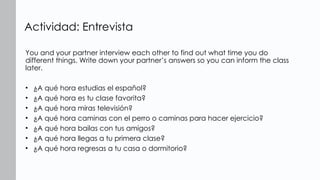
Actividad: Entrevista
You andyour partner interview each other to find out what time you do
different things. Write down your partner’s answers so you can inform the class
later.
• ¿A qué hora estudias el español?
• ¿A qué hora es tu clase favorita?
• ¿A qué hora miras televisión?
• ¿A qué hora caminas con el perro o caminas para hacer ejercicio?
• ¿A qué hora bailas con tus amigos?
• ¿A qué hora llegas a tu primera clase?
• ¿A qué hora regresas a tu casa o dormitorio?
25.
Assignment: Mensaje deteléfono
Record a short message as if it were a voice mail for a friend about an event
you plan to attend together. Say what the event is, what day and date it is,
what time it is, and where it will happen (use “es en” for the location of an
event). Don’t forget to say hello to your friend and who you are at the
beginning of your recording, and “thank you – goodbye” at the end.
26.
What is thewritten form of the number 50?
A. quince
B. cincuenta
C. cinco
D. quiniento
Practice Question 1
27.
What is thewritten form of the number 76?
A. setenta y siete
B. sesenta y siete
C. sesenta y seis
D. setenta y seis
Practice Question 2
28.
What number isveinticuatro?
A. 14
B. 42
C. 24
D. 84
Practice Question 3
29.
What number isnoventa y uno?
A. 91
B. 19
C. 90
D. 9
Practice Question 4
30.
Quick Review
• Whatare the numbers 0-100 in Spanish?
• How do you ask for the time?
• How do you say what the time is?
• How do you say what time something happens?
Notas del editor
#1 All text in these slides is taken from https://courses.lumenlearning.com/wm-spanish1/ where it is published under one or more open licenses.
All images in these slides are attributed in the notes of the slide on which they appear and licensed as indicated.