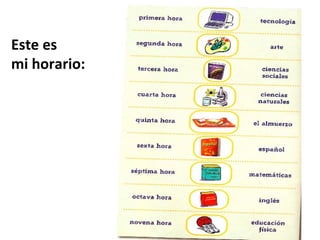

Este es  mi horario:
¿Cómo es tu horario?
Be able to… Talk about school schedules and subjects Discuss what students do during the day Ask and tell who is doing the action Learn subject pronouns Conjugation of regular verbs ending  in -ar Capítulo 2  - La escuela 2A: Tu día en la escuela
 
Más vocabulario :  décimo / décima  ---    tenth
Página setenta y cinco Actividad 1 ¿Sí  o  No?
¿Sabías? Did you know? In most parts of Latin America, students begin classes at 7 am in order to end the day around 1 or 2 pm so they can go home for lunch. Lunch is the main meal of the day, and family members often gather to eat together at home.
Más  práctica More  practice Go to Phschool.com And type the code: Jcd – 0201 Activity 1  &  Activity 2
Ordinal numbers,when they precede a noun, have the function of an adjective. As adjectives, they have to take on the same gender and number as the noun they are modifying: hora  (2 nd ) segunda capítulo (4 th ) cuarto
Ordinal numbers,when they stand by themselves, are always in the singular, masculine form: First , I have technology class Primero , tengo la clase de tecnología Second , I have art class Segundo , tengo la clase de tecnología
— ¿Qué clase  tienes (tú)  en la primera hora? — (Yo)  Tengo  la clase de tecnología en la primera hora. — ¿Tienes (tú) la clase de arte en la cuarta hora? — Si, (yo) tengo la clase de arte en la cuarta hora OR — No, (yo) no tengo la clase de arte en la cuarta hora. En la cuarta hora tengo la clase ciencias naturales.
 
difícil fácil aburrida divertida práctica interesante
ADJETIVOS Interesante Divertido/a Práctico/a Aburrido/a Fácil difícil más que menos Comparisons of inequality La clase de matemáticas  la clase de arte es
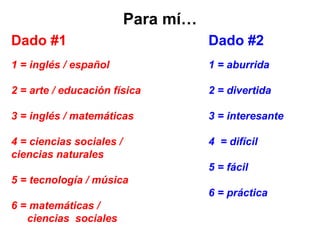
Dado #1 1 = inglés / español 2 = arte / educación física 3 = inglés / matemáticas 4 = ciencias sociales /  ciencias naturales 5 = tecnología / música 6 = matemáticas /  ciencias  sociales Dado #2 1 = aburrida 2 = divertida 3 = interesante 4  = difícil 5 = fácil 6 = práctica Para mí…


Los tres chiflados son hombres graciosos Miley Cyrus y Selena Gomez son chicas famosas La chica es deportista Edward es un chico serio
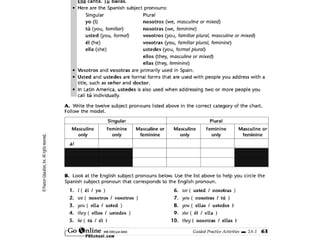
yo tú  usted él ella nosotros/ nosotras ustedes  vosotros Ellos  ellas Los Pronombres Personales (Subject pronouns) ¿Quién? ¿Quiénes?
Subject Pronouns Alejandro and I = Alejandro y yo =  She and Carlos = Ella y Carlos =  Pepe and you = Pepe y tú =  She and Lola = Lola y ella =
 
ESTUDIAR ESTUDI AR ¿Qué es? CANTAR AR CANT
CONJUGACIóN - Presente Verbos regulares  -ar ESTUDIAR
yo tú  usted él ella nosotros/ nosotras ustedes  vosotros ellos  ellas CANT AR
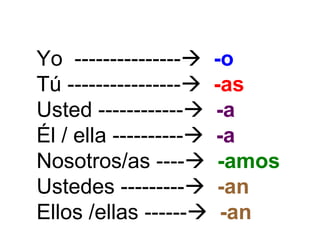
Yo  ---------------    -o Tú ----------------    -as Usted ------------    -a Él / ella ----------    -a Nosotros/as ----    -amos Ustedes ---------    -an Ellos /ellas ------    -an
 
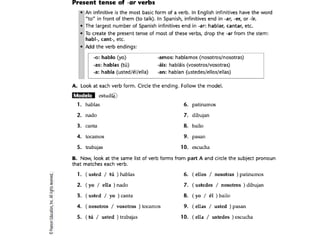
Algunos infinitivos Enseñar Estudiar Hablar Bailar Cantar Dibujar Escuchar Montar Nadar Pasar tiempo Patinar Necesitar Ver http://phschool.com/atschool/realidades/Activities/Chapter2AL1/Chap2AL10204.html
SINGULAR primera   segunda  tercera PLURAL Primera  segunda tercera yo tú usted  él / ella nosotros/nosotras ustedes Ellos / ellas estudiar
ASKING A QUESTION When we ask a question in Spanish, we usually put the  subject   after   the verb  or sometimes  at the end of the sentence.
ASKING A QUESTION ¿Cocina  Juan  en la clase de ciencias? ¿Estudia mucho  Paulina ?
Questions Words Teresa estudia español en la escuela los lunes, miércoles y viernes.

School subjects

  • 1.
    Este es mi horario:
  • 2.
    ¿Cómo es tuhorario?
  • 3.
    Be able to…Talk about school schedules and subjects Discuss what students do during the day Ask and tell who is doing the action Learn subject pronouns Conjugation of regular verbs ending in -ar Capítulo 2 - La escuela 2A: Tu día en la escuela
  • 4.
  • 5.
    Más vocabulario : décimo / décima ---  tenth
  • 6.
    Página setenta ycinco Actividad 1 ¿Sí o No?
  • 7.
    ¿Sabías? Did youknow? In most parts of Latin America, students begin classes at 7 am in order to end the day around 1 or 2 pm so they can go home for lunch. Lunch is the main meal of the day, and family members often gather to eat together at home.
  • 8.
    Más prácticaMore practice Go to Phschool.com And type the code: Jcd – 0201 Activity 1 & Activity 2
  • 9.
    Ordinal numbers,when theyprecede a noun, have the function of an adjective. As adjectives, they have to take on the same gender and number as the noun they are modifying: hora (2 nd ) segunda capítulo (4 th ) cuarto
  • 10.
    Ordinal numbers,when theystand by themselves, are always in the singular, masculine form: First , I have technology class Primero , tengo la clase de tecnología Second , I have art class Segundo , tengo la clase de tecnología
  • 11.
    — ¿Qué clase tienes (tú) en la primera hora? — (Yo) Tengo la clase de tecnología en la primera hora. — ¿Tienes (tú) la clase de arte en la cuarta hora? — Si, (yo) tengo la clase de arte en la cuarta hora OR — No, (yo) no tengo la clase de arte en la cuarta hora. En la cuarta hora tengo la clase ciencias naturales.
  • 12.
  • 13.
    difícil fácil aburridadivertida práctica interesante
  • 14.
    ADJETIVOS Interesante Divertido/aPráctico/a Aburrido/a Fácil difícil más que menos Comparisons of inequality La clase de matemáticas la clase de arte es
  • 15.
    Dado #1 1= inglés / español 2 = arte / educación física 3 = inglés / matemáticas 4 = ciencias sociales / ciencias naturales 5 = tecnología / música 6 = matemáticas / ciencias sociales Dado #2 1 = aburrida 2 = divertida 3 = interesante 4 = difícil 5 = fácil 6 = práctica Para mí…
  • 16.
  • 17.
  • 18.
  • 19.
  • 20.
    Los tres chifladosson hombres graciosos Miley Cyrus y Selena Gomez son chicas famosas La chica es deportista Edward es un chico serio
  • 21.
    yo tú usted él ella nosotros/ nosotras ustedes vosotros Ellos ellas Los Pronombres Personales (Subject pronouns) ¿Quién? ¿Quiénes?
  • 22.
    Subject Pronouns Alejandroand I = Alejandro y yo = She and Carlos = Ella y Carlos = Pepe and you = Pepe y tú = She and Lola = Lola y ella =
  • 23.
  • 24.
    ESTUDIAR ESTUDI AR¿Qué es? CANTAR AR CANT
  • 25.
    CONJUGACIóN - PresenteVerbos regulares -ar ESTUDIAR
  • 26.
    yo tú usted él ella nosotros/ nosotras ustedes vosotros ellos ellas CANT AR
  • 27.
    Yo --------------- -o Tú ----------------  -as Usted ------------  -a Él / ella ----------  -a Nosotros/as ----  -amos Ustedes ---------  -an Ellos /ellas ------  -an
  • 28.
  • 29.
    Algunos infinitivos EnseñarEstudiar Hablar Bailar Cantar Dibujar Escuchar Montar Nadar Pasar tiempo Patinar Necesitar Ver http://phschool.com/atschool/realidades/Activities/Chapter2AL1/Chap2AL10204.html
  • 30.
    SINGULAR primera segunda tercera PLURAL Primera segunda tercera yo tú usted él / ella nosotros/nosotras ustedes Ellos / ellas estudiar
  • 31.
    ASKING A QUESTIONWhen we ask a question in Spanish, we usually put the subject after the verb or sometimes at the end of the sentence.
  • 32.
    ASKING A QUESTION¿Cocina Juan en la clase de ciencias? ¿Estudia mucho Paulina ?
  • 33.
    Questions Words Teresaestudia español en la escuela los lunes, miércoles y viernes.