Computación Física:
Introducción al Arduino
   Programando Arduino /
        Processing
Programación
• Se programa en un dialecto de C
• Se requiere (forzosamente) una función
  setup y una función loop
• Setup es la preparación
• Loop es la ejecución
Referencia - Estructura
•   Control Structures   •   Further Syntax
•   if                   •   ; (semicolon)
•   if...else            •   {} (curly braces)
•   for                  •   // (single line comment)
•   switch case          •   /* */ (multi-line comment)
•   while
•   do... while
•   break
•   continue
•   return
Referencia - Estructura
• Arithmetic           • Comparison
  Operators              Operators
• plus (addition)      • == (equal to)
• - (subtraction)      • != (not equal to)
• * (multiplication)   • < (less than)
• / (division)         • > (greater than)
• % (modulo)           • <= (less than or equal
                         to)
                       • >= (greater than or
                         equal to)
Referencia - Estructura
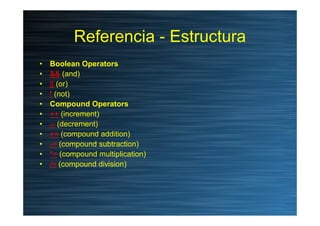
•   Boolean Operators
•   && (and)
•   || (or)
•   ! (not)
•   Compound Operators
•   ++ (increment)
•   -- (decrement)
•   += (compound addition)
•   -= (compound subtraction)
•   *= (compound multiplication)
•   /= (compound division)
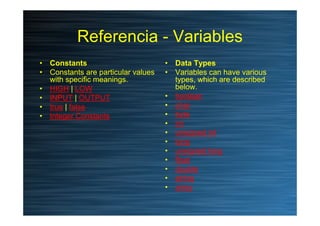
Referencia - Variables
• Constants                         • Data Types
• Constants are particular values   • Variables can have various
  with specific meanings.             types, which are described
• HIGH | LOW                          below.
• INPUT | OUTPUT                    • boolean
• true | false                      • char
• Integer Constants                 • byte
                                    • int
                                    • unsigned int
                                    • long
                                    • unsigned long
                                    • float
                                    • double
                                    • string
                                    • array
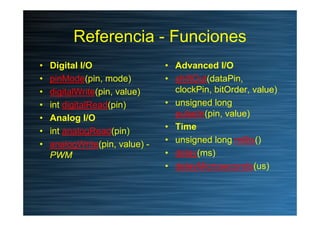
Referencia - Funciones
•   Digital I/O                 • Advanced I/O
•   pinMode(pin, mode)          • shiftOut(dataPin,
•   digitalWrite(pin, value)      clockPin, bitOrder, value)
•   int digitalRead(pin)        • unsigned long
•   Analog I/O                    pulseIn(pin, value)
•   int analogRead(pin)         • Time
•   analogWrite(pin, value) -   • unsigned long millis()
    PWM                         • delay(ms)
                                • delayMicroseconds(us)
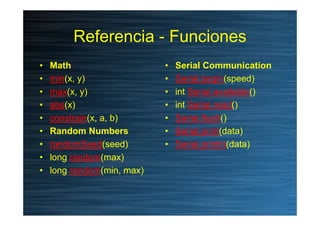
Referencia - Funciones
•   Math                    •   Serial Communication
•   min(x, y)               •   Serial.begin(speed)
•   max(x, y)               •   int Serial.available()
•   abs(x)                  •   int Serial.read()
•   constrain(x, a, b)      •   Serial.flush()
•   Random Numbers          •   Serial.print(data)
•   randomSeed(seed)        •   Serial.println(data)
•   long random(max)
•   long random(min, max)
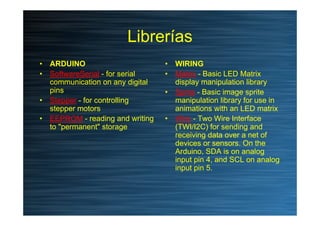
Librerías
• ARDUINO                        • WIRING
• SoftwareSerial - for serial    • Matrix - Basic LED Matrix
  communication on any digital     display manipulation library
  pins                           • Sprite - Basic image sprite
• Stepper - for controlling        manipulation library for use in
  stepper motors                   animations with an LED matrix
• EEPROM - reading and writing   • Wire - Two Wire Interface
  to "permanent" storage           (TWI/I2C) for sending and
                                   receiving data over a net of
                                   devices or sensors. On the
                                   Arduino, SDA is on analog
                                   input pin 4, and SCL on analog
                                   input pin 5.
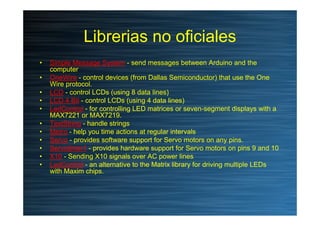
Librerias no oficiales
•   Simple Message System - send messages between Arduino and the
    computer
•   OneWire - control devices (from Dallas Semiconductor) that use the One
    Wire protocol.
•   LCD - control LCDs (using 8 data lines)
•   LCD 4 Bit - control LCDs (using 4 data lines)
•   LedControl - for controlling LED matrices or seven-segment displays with a
    MAX7221 or MAX7219.
•   TextString - handle strings
•   Metro - help you time actions at regular intervals
•   Servo - provides software support for Servo motors on any pins.
•   Servotimer1 - provides hardware support for Servo motors on pins 9 and 10
•   X10 - Sending X10 signals over AC power lines
•   LedControl - an alternative to the Matrix library for driving multiple LEDs
    with Maxim chips.
Ejemplos que veremos
•   Blink, hacer parpadear un LED
•   Ejercicios con LEDs
•   AnalogRead, leer una señal del ADC
•   AnalogWrite, escribir PWM
•   Ejercicios con Processing
•   Sonido piezoeléctrico
•   Display LCD
•   Motor CD
Blink
• Ya hay un LED SMD conectado al pin 13
• También se puede conectar un LED y
  observarlos simultáneamente
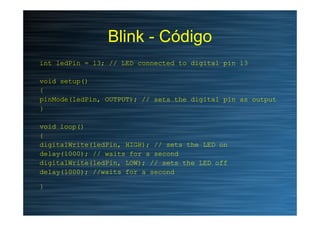
Blink - Código
int ledPin = 13; // LED connected to digital pin 13

void setup()
{
pinMode(ledPin, OUTPUT); // sets the digital pin as output
}

void loop()
{
digitalWrite(ledPin, HIGH); // sets the LED on
delay(1000); // waits for a second
digitalWrite(ledPin, LOW); // sets the LED off
delay(1000); //waits for a second

}
Ejercicio
• Hacerlo parpadear con un tiempo de
  encendido de 500 ms y de apagado de
  2000 ms
Ejercicio 2
• Conectar 2 LEDs y hacer que parpadeen
  simultáneamente
• OJO: utilizando puertos diferentes
• Con esos 2 LEDs hacer que parpadeen
  alternadamente (ambos tiempos de 500
  ms)
• Hacer lo mismo con 3 LEDs (tiempo de
  ms)
AnalogRead
• Conectamos un potenciómetro como
  divisor de voltaje
• Leemos ese voltaje
• Un LED parpadea proporcionalmente al
  voltaje leído
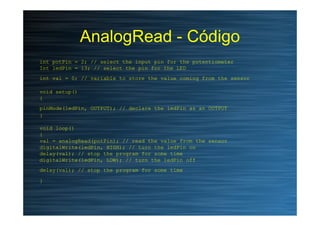
AnalogRead - Código
int potPin = 2; // select the input pin for the potentiometer
Int ledPin = 13; // select the pin for the LED
int val = 0; // variable to store the value coming from the sensor

void setup()
{
pinMode(ledPin, OUTPUT); // declare the ledPin as an OUTPUT
}

void loop()
{
val = analogRead(potPin); // read the value from the sensor
digitalWrite(ledPin, HIGH); // turn the ledPin on
delay(val); // stop the program for some time
digitalWrite(ledPin, LOW); // turn the ledPin off
delay(val); // stop the program for some time

}
Ejercicios
• Invertir el sentido del potenciómetro sin
  cambiar las conexiones eléctricas
• Con Processing graficar el valor leído del
  potenciómetro
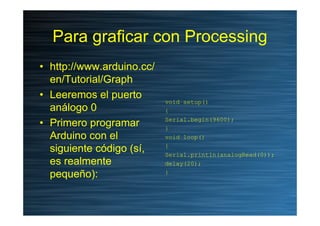
Para graficar con Processing
• http://www.arduino.cc/
  en/Tutorial/Graph
• Leeremos el puerto
                           void setup()
  análogo 0                {
                           Serial.begin(9600);
• Primero programar        }
  Arduino con el           void loop()
                           {
  siguiente código (sí,    Serial.println(analogRead(0));
  es realmente             delay(20);
  pequeño):                }
Para graficar con Processing
• Ahora cerrar la aplicación de Arduino y
  abrir Processing
• Volver a checar en Device Manager qué
  puerto tenemos asignado al COM USB
• Pegar el código de la página poniéndo
  atención en la sección que aparece en
  negrita en la siguiente diapositiva:
import processing.serial.*;
Serial port; String buff = "";
int NEWLINE = 10; // Store the last 64 values received so
   we can graph them.
int[] values = new int[64];
void setup() { size(512, 256);

println("Available serial ports:");
println(Serial.list());

port = new Serial(this, Serial.list()[0], 9600);
// If you know the name of the port used by the Arduino
   board, you
// can specify it directly like this.
//port = new Serial(this, "COM1", 9600); }

void draw() { background(53); stroke(255);
for (int i = 0; i < 63; i++)
line(i * 8, 255 - values[i], (i + 1) * 8, 255 - values[i +
   1]);
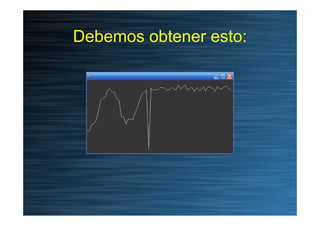
Debemos obtener esto:
Ejercicio
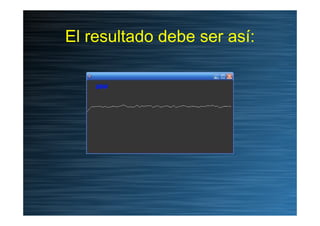
• Lograr escribir en la misma ventana de la
  gráfica el valor de la altura de la línea (el
  rango es de 0 a 255)
• Se sugiere promediar algunos valores
  para que el valor no oscile
• Se sugiere leer y entender el ejemplo
  examples > basics > typography > words
El resultado debe ser así:
Trabajo Independiente
• Investigar e implementar demostraciones
  de las siguientes técnicas:
• Switch debouncing
• Habilitar resistencia de Pull-Up para
  entradas digitales
Ejercicios Sugeridos
• Programar y mostrar un contador binario
  de 4 bits
• Programar secuencias de LED’s
  (incrementos lineales, El Auto Increíble,
  etc.)
• Reducir y aumentar el brillo de un LED
  con PWM
• Programar un vúmetro con una entrada
  análoga y 8 LED’s
Ejercicios Sugeridos
• Cargar la librería LCD para enviar
  mensajes a una pantalla de cristal líquido
• Leer el valor de temperatura de un sensor
  LM35
• Escribir ese valor en el display LCD
Ejercicios Sugeridos
• Utilizando Processing lograr variar la
  intensidad de un LED moviendo el mouse

Tutorial arduino 03 programación

  • 1.
    Computación Física: Introducción alArduino Programando Arduino / Processing
  • 2.
    Programación • Se programaen un dialecto de C • Se requiere (forzosamente) una función setup y una función loop • Setup es la preparación • Loop es la ejecución
  • 3.
    Referencia - Estructura • Control Structures • Further Syntax • if • ; (semicolon) • if...else • {} (curly braces) • for • // (single line comment) • switch case • /* */ (multi-line comment) • while • do... while • break • continue • return
  • 4.
    Referencia - Estructura •Arithmetic • Comparison Operators Operators • plus (addition) • == (equal to) • - (subtraction) • != (not equal to) • * (multiplication) • < (less than) • / (division) • > (greater than) • % (modulo) • <= (less than or equal to) • >= (greater than or equal to)
  • 5.
    Referencia - Estructura • Boolean Operators • && (and) • || (or) • ! (not) • Compound Operators • ++ (increment) • -- (decrement) • += (compound addition) • -= (compound subtraction) • *= (compound multiplication) • /= (compound division)
  • 6.
    Referencia - Variables •Constants • Data Types • Constants are particular values • Variables can have various with specific meanings. types, which are described • HIGH | LOW below. • INPUT | OUTPUT • boolean • true | false • char • Integer Constants • byte • int • unsigned int • long • unsigned long • float • double • string • array
  • 7.
    Referencia - Funciones • Digital I/O • Advanced I/O • pinMode(pin, mode) • shiftOut(dataPin, • digitalWrite(pin, value) clockPin, bitOrder, value) • int digitalRead(pin) • unsigned long • Analog I/O pulseIn(pin, value) • int analogRead(pin) • Time • analogWrite(pin, value) - • unsigned long millis() PWM • delay(ms) • delayMicroseconds(us)
  • 8.
    Referencia - Funciones • Math • Serial Communication • min(x, y) • Serial.begin(speed) • max(x, y) • int Serial.available() • abs(x) • int Serial.read() • constrain(x, a, b) • Serial.flush() • Random Numbers • Serial.print(data) • randomSeed(seed) • Serial.println(data) • long random(max) • long random(min, max)
  • 9.
    Librerías • ARDUINO • WIRING • SoftwareSerial - for serial • Matrix - Basic LED Matrix communication on any digital display manipulation library pins • Sprite - Basic image sprite • Stepper - for controlling manipulation library for use in stepper motors animations with an LED matrix • EEPROM - reading and writing • Wire - Two Wire Interface to "permanent" storage (TWI/I2C) for sending and receiving data over a net of devices or sensors. On the Arduino, SDA is on analog input pin 4, and SCL on analog input pin 5.
  • 10.
    Librerias no oficiales • Simple Message System - send messages between Arduino and the computer • OneWire - control devices (from Dallas Semiconductor) that use the One Wire protocol. • LCD - control LCDs (using 8 data lines) • LCD 4 Bit - control LCDs (using 4 data lines) • LedControl - for controlling LED matrices or seven-segment displays with a MAX7221 or MAX7219. • TextString - handle strings • Metro - help you time actions at regular intervals • Servo - provides software support for Servo motors on any pins. • Servotimer1 - provides hardware support for Servo motors on pins 9 and 10 • X10 - Sending X10 signals over AC power lines • LedControl - an alternative to the Matrix library for driving multiple LEDs with Maxim chips.
  • 11.
    Ejemplos que veremos • Blink, hacer parpadear un LED • Ejercicios con LEDs • AnalogRead, leer una señal del ADC • AnalogWrite, escribir PWM • Ejercicios con Processing • Sonido piezoeléctrico • Display LCD • Motor CD
  • 12.
    Blink • Ya hayun LED SMD conectado al pin 13 • También se puede conectar un LED y observarlos simultáneamente
  • 13.
    Blink - Código intledPin = 13; // LED connected to digital pin 13 void setup() { pinMode(ledPin, OUTPUT); // sets the digital pin as output } void loop() { digitalWrite(ledPin, HIGH); // sets the LED on delay(1000); // waits for a second digitalWrite(ledPin, LOW); // sets the LED off delay(1000); //waits for a second }
  • 14.
    Ejercicio • Hacerlo parpadearcon un tiempo de encendido de 500 ms y de apagado de 2000 ms
  • 15.
    Ejercicio 2 • Conectar2 LEDs y hacer que parpadeen simultáneamente • OJO: utilizando puertos diferentes • Con esos 2 LEDs hacer que parpadeen alternadamente (ambos tiempos de 500 ms) • Hacer lo mismo con 3 LEDs (tiempo de ms)
  • 16.
    AnalogRead • Conectamos unpotenciómetro como divisor de voltaje • Leemos ese voltaje • Un LED parpadea proporcionalmente al voltaje leído
  • 17.
    AnalogRead - Código intpotPin = 2; // select the input pin for the potentiometer Int ledPin = 13; // select the pin for the LED int val = 0; // variable to store the value coming from the sensor void setup() { pinMode(ledPin, OUTPUT); // declare the ledPin as an OUTPUT } void loop() { val = analogRead(potPin); // read the value from the sensor digitalWrite(ledPin, HIGH); // turn the ledPin on delay(val); // stop the program for some time digitalWrite(ledPin, LOW); // turn the ledPin off delay(val); // stop the program for some time }
  • 18.
    Ejercicios • Invertir elsentido del potenciómetro sin cambiar las conexiones eléctricas • Con Processing graficar el valor leído del potenciómetro
  • 19.
    Para graficar conProcessing • http://www.arduino.cc/ en/Tutorial/Graph • Leeremos el puerto void setup() análogo 0 { Serial.begin(9600); • Primero programar } Arduino con el void loop() { siguiente código (sí, Serial.println(analogRead(0)); es realmente delay(20); pequeño): }
  • 20.
    Para graficar conProcessing • Ahora cerrar la aplicación de Arduino y abrir Processing • Volver a checar en Device Manager qué puerto tenemos asignado al COM USB • Pegar el código de la página poniéndo atención en la sección que aparece en negrita en la siguiente diapositiva:
  • 21.
    import processing.serial.*; Serial port;String buff = ""; int NEWLINE = 10; // Store the last 64 values received so we can graph them. int[] values = new int[64]; void setup() { size(512, 256); println("Available serial ports:"); println(Serial.list()); port = new Serial(this, Serial.list()[0], 9600); // If you know the name of the port used by the Arduino board, you // can specify it directly like this. //port = new Serial(this, "COM1", 9600); } void draw() { background(53); stroke(255); for (int i = 0; i < 63; i++) line(i * 8, 255 - values[i], (i + 1) * 8, 255 - values[i + 1]);
  • 22.
  • 23.
    Ejercicio • Lograr escribiren la misma ventana de la gráfica el valor de la altura de la línea (el rango es de 0 a 255) • Se sugiere promediar algunos valores para que el valor no oscile • Se sugiere leer y entender el ejemplo examples > basics > typography > words
  • 24.
  • 25.
    Trabajo Independiente • Investigare implementar demostraciones de las siguientes técnicas: • Switch debouncing • Habilitar resistencia de Pull-Up para entradas digitales
  • 26.
    Ejercicios Sugeridos • Programary mostrar un contador binario de 4 bits • Programar secuencias de LED’s (incrementos lineales, El Auto Increíble, etc.) • Reducir y aumentar el brillo de un LED con PWM • Programar un vúmetro con una entrada análoga y 8 LED’s
  • 27.
    Ejercicios Sugeridos • Cargarla librería LCD para enviar mensajes a una pantalla de cristal líquido • Leer el valor de temperatura de un sensor LM35 • Escribir ese valor en el display LCD
  • 28.
    Ejercicios Sugeridos • UtilizandoProcessing lograr variar la intensidad de un LED moviendo el mouse