UNIT 1

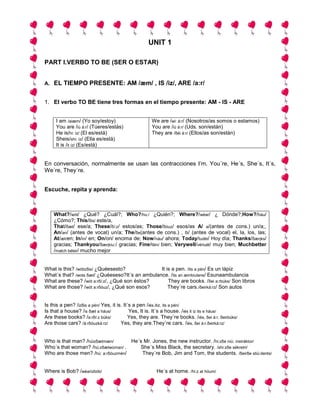
PART I.VERBO TO BE (SER O ESTAR)


A.   EL TIEMPO PRESENTE: AM /æm/ , IS /iz/, ARE /a:r/


1. El verbo TO BE tiene tres formas en el tiempo presente: AM - IS - ARE


      I am /aiæm/ (Yo soy/estoy)                     We are /wi: á:r/ (Nosotros/as somos o estamos)
      You are /iú á:r/ (Túeres/estás)                You are /iú á:r/ (Uds. son/están)
      He is/hi: íz/ (El es/está)                     They are /δéi á:r/ (Ellos/as son/están)
      Sheis/shi: íz/ (Ella es/está)
      It is /it íz/ (Es/está)


En conversación, normalmente se usan las contracciones I’m. You´re, He´s, She´s, It´s,
We´re, They´re.


Escuche, repita y aprenda:


     What?/wót/ ¿Qué? ¿Cuál?; Who?/hu:/ ¿Quién?; Where?/wéar/ ¿ Dónde?;How?/háu/
     ¿Cómo?; This/δis/ este/a,
     That/δæt/ ese/a; These/δí:z/ estos/as; Those/δóuz/ esos/as A/ a/(antes de cons.) un/a;,
     An/an/ (antes de vocal) un/a; The/δe(antes de cons.) , δi/ (antes de vocal) el, la, los, las;
     At/æt/en; In/in/ en; On/on/ encima de; Now/náu/ ahora; Today/tudéi/ Hoy día; Thanks/δæηks/
     gracias; Thankyou/δæηkiu:/ gracias; Fine/fáin/ bien; Verywell/vériuél/ muy bien; Muchbetter
     /match béter/ mucho mejor


What is this? /wótizδis/ ¿Quéesesto?             It is a pen. /its a pén/ Es un lápiz
What´s that? /wots δæt/ ¿Quéeseso?It´s an ambulance. /its an æmbiulans/ Esunaambulancia
What are these? /wót a:rδí:z/, ¿Qué son éstos?       They are books. /δei a:rbúks/ Son libros
What are those? /wót a:rδóuz/, ¿Qué son esos?        They´re cars./δeirká:rz/ Son autos


Is this a pen? /izδis a pén/ Yes, it is. It´s a pen /iés,itiz. its a pén/
Is that a house? /is δæt a háus/            Yes, It is. It´s a house. /iés it iz its e háus/
Are these books? /a:rδí:z búks/            Yes, they are. They´re books. /iés, δei á:r. δeirbúks/
Are those cars? /á:rδóuzká:rz/         Yes, they are.They´re cars. /iés, δei á:r.δeirká:rz/


Who is that man? /húizδætmæn/       He´s Mr. Jones, the new instructor. /hi:zδe niú: instráktor/
Who´s that woman? /hú:zδætwúman/ .     She´s Miss Black, the secretary. /shi:zδe sékretri/
Who are those men? /hú: a:rδóuzmén/     They´re Bob, Jim and Tom, the students. /δeirδe stiú:dents/


Where is Bob? /wéarizbób/                               He´s at home. /hi:z at hóum/
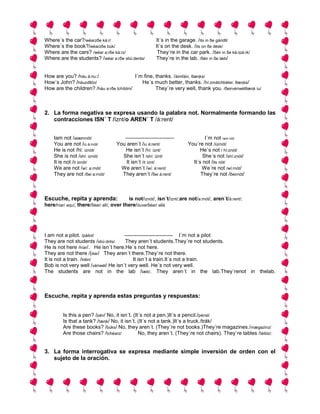
Where´s the car?/wéarzδe ká:r/                           It´s in the garage. /its in δe gáridll/
Where´s the book?/wéarzδe búk/                           It´s on the desk. /its on δe désk/
Where are the cars? /wéar a:rδe ká:rz/                    They´re in the car park. /δéir in δe ká:rpá:rk/
Where are the students? /wéar a:rδe stiú:dents/          They´re in the lab. /δéir in δe læb/


How are you? /háu á:riu:/                  I´m fine, thanks. /áimfáin, θæηks/
How´s John? /háuzdllón/                       He´s much better, thanks. /hí:zmátchbéter, θæηks/
How are the children? /háu a:rδe tchíldrn/           They´re very well, thank you. /δeirvériwélθæηk iu/


2. La forma negativa se expresa usando la palabra not. Normalmente formando las
   contracciones ISN´ T /íznt/o AREN´ T /á:rent/


    Iam not /aiæmnót/                  ----------------------------              I´m not /aim nót/
    You are not /iú á:rnót/         You aren´t /iu á:rent/               You´re not /iúrnót/
    He is not /hi: iznót/              He isn´t /hí: íznt/                     He´s not / hí:znót/
    She is not /shí: iznót/           She isn´t /shí: íznt/                     She´s not /shí:znót/
    It is not /it iznót/                It isn´t /it íznt/                 It´s not /its nót/
    We are not /wí: a:rnót/           We aren´t /wí: á:rent/                    We´re not /wí:rnót/
    They are not /δei a:rnót/         They aren´t /δei á:rent/                 They´re not /δeirnót/


Escuche, repita y aprenda:                is not/iznót/, isn´t/íznt/;are not/a:rnót/, aren´t/á:rent/;
here/híar/ aquí; there/δéar/ allí; over there/óuverδéar/ allá


I am not a pilot. /páilot/            ---------------------------- I´m not a pilot
They are not students /stiú:dnts/.     They aren´t students.They´re not students.
He is not here /híar/. He isn´t here.He´s not here.
They are not there /(éar/ They aren´t there.They´re not there.
It is not a train. /tréin/                 It isn´t a train.It´s not a train.
Bob is not very well /vériwél/ He isn´t very well. He´s not very well.
The students are not in the lab /læb/. They aren´t in the lab.They´renot in thelab.


Escuche, repita y aprenda estas preguntas y respuestas:


         Is this a pen? /pén/ No, it isn´t. (It´s not a pen.)It´s a pencil./pénsl/
         Is that a tank? /tæηk/ No, it isn´t. (It´s not a tank.)It´s a truck./trák/
         Are these books? /búks/ No, they aren´t. (They´re not books.)They´re magazines./mægazinz/
         Are those chairs? /tchéarz/           No, they aren´t. (They´re not chairs). They´re tables /téiblz/.


3. La forma interrogativa se expresa mediante simple inversión de orden con el
   sujeto de la oración.
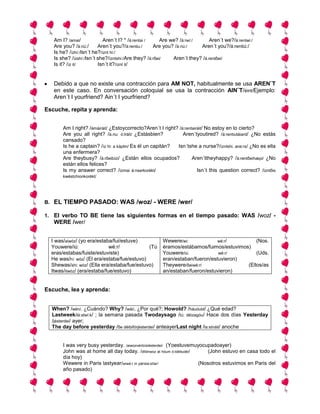
Am I? /amai/             Aren´t I? * /á:rentai /     Are we? /á:rwí:/      Aren´t we?/á:rentwi:/
      Are you? /á:riú:/     Aren´t you?/á:rentiu:/     Are you? /á:riú:/    Aren´t you?/á:rentiú:/
      Is he? /ízhí:/Isn´t he?/íznt hi:/
      Is she? /ízshí:/Isn´t she?/ízntshi:/Are they? /á:rδei/    Aren´t they? /á.rentδei/
      Is it? /íz it/        Isn´t it?/íznt it/


      Debido a que no existe una contracción para AM NOT, habitualmente se usa AREN¨T
      en este caso. En conversación coloquial se usa la contracción AIN¨T/éint/Ejemplo:
      Aren´t I yourfriend? Ain´t I yourfriend?

Escuche, repita y aprenda:


          Am I right? /ámáiráit/ ¿Estoycorrecto?Aren´t I right? /á:rentairáit/ No estoy en lo cierto?
          Are you all right? /á.riu: ó:lráit/ ¿Estásbien?         Aren´tyoutired? /á:rentiutáiard/ ¿No estás
          cansado?
          Is he a captain? /íz hi: a káptin/ Es él un capitán? Isn´tshe a nurse?/ízntshi. ane:rs/ ¿No es ella
          una enfermera?
          Are theybusy? /á:rδeibízi/ ¿Están ellos ocupados?            Aren´ttheyhappy? /á:rentδeihæpi/ ¿No
          están ellos felices?
          Is my answer correct? /ízmai á:nserkorékt/                      Isn´t this question correct? /ízntδis
          kwéstchionkorékt/


B.    EL TIEMPO PASADO: WAS /woz/ - WERE /wer/

1. El verbo TO BE tiene las siguientes formas en el tiempo pasado: WAS /woz/ -
      WERE /wer/


     I was/aiwóz/ (yo era/estaba/fui/estuve)              Wewere/wi:             wé:r/         (Nos.
     Youwere/iú:                wé:r/           (Tú       éramos/estábamos/fuimos/estuvimos)
     eras/estabas/fuiste/estuviste)                       Youwere/iú:            wé:r/         (Uds.
     He was/hí: wóz/ (El era/estaba/fue/estuvo)           eran/estaban/fueron/estuvieron)
     Shewas/shi: wóz/ (Ella era/estaba/fue/estuvo)        Theywere/δeiwé:r/                (Ellos/as
     Itwas/itwóz/ (era/estaba/fue/estuvo)                 an/estaban/fueron/estuvieron)


Escuche, lea y aprenda:


     When? /wén/, ¿Cuándo? Why? /wái/, ¿Por qué?; Howold? /háuóuld/ ¿Qué edad?
     Lastweek/lá:stwí:k/ ; la semana pasada Twodaysago /tú: déizagóu/ Hace dos días Yesterday
     /jésterdei/ ayer;
     The day before yesterday /δe déibifórjésterdei/ anteayerLast night /la:stnáit/ anoche


          I was very busy yesterday. /aiwozvéribíziiésterdei/ (Yoestuvemuyocupadoayer)
          John was at home all day today. /dllónwoz at hóum ó:ldéitudéi/      (John estuvo en casa todo el
          día hoy)
          Wewere in Paris lastyear/wiwé:r in párisla:stíar/               (Nosotros estuvimos en Paris del
          año pasado)
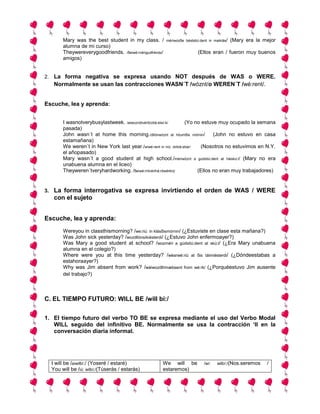
Mary was the best student in my class. /          mériwozδe béststiú:dent in maiklás/   (Mary era la mejor
          alumna de mi curso)
          Theywereverygoodfriends. /δeiwé:rvérigudfréndz/                     (Ellos eran / fueron muy buenos
          amigos)


2. La forma negativa se expresa usando NOT después de WAS o WERE.
      Normalmente se usan las contracciones WASN´T /wóznt/o WEREN´T /wé:rent/.


Escuche, lea y aprenda:


          I wasnotverybusylastweek. /aiwoznótvéribízilá:stwí:k/       (Yo no estuve muy ocupado la semana
          pasada)
          John wasn´t at home this morning./dllónwóznt at hóumδis mórnin/          (John no estuvo en casa
          estamañana)
          We weren´t in New York last year./wiwé:rent in niú: iórklá:stíar/  (Nosotros no estuvimos en N.Y.
          el añopasado)
          Mary wasn´t a good student at high school./mériwóznt a gúdstiú:dent at háiskú:l/ (Mary no era
          unabuena alumna en el liceo)
          Theyweren´tveryhardworking. /δeiwé:rntvérihá:rdwérkiη/            (Ellos no eran muy trabajadores)


3.    La forma interrogativa se expresa invirtiendo el orden de WAS / WERE
      con el sujeto


Escuche, lea y aprenda:
          Wereyou in classthismorning? /we:riú: in klásδismórnin/ (¿Estuviste en clase esta mañana?)
          Was John sick yesterday? /wozdllónsíkiésterdi/ (¿Estuvo John enfermoayer?)
          Was Mary a good student at school? /wozméri a gúdstiú:dent at skú:l/ (¿Era Mary unabuena
          alumna en el colegio?)
          Where were you at this time yesterday? /wéarwé:riú at δis táimiésterdi/ (¿Dóndeestabas a
          estahoraayer?)
          Why was Jim absent from work? /wáiwozdllímæbsent from wé:rk/ (¿Porquéestuvo Jim ausente
          del trabajo?)


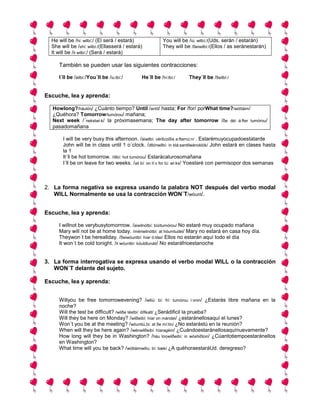
C. EL TIEMPO FUTURO: WILL BE /will bi:/


1. El tiempo futuro del verbo TO BE se expresa mediante el uso del Verbo Modal
   WILL seguido del infinitivo BE. Normalmente se usa la contracción ‘ll en la
   conversación diaria informal.


     I will be /aiwilbí:/ (Yoseré / estaré)             We will be               /wí:    wilbí:/(Nos.seremos    /
     You will be /iú: wilbí:/(Túserás / estarás)        estaremos)
He will be /hi: wilbí:/ (El será / estará)             You will be /iú: wilbí:/(Uds. serán / estarán)
  She will be /shí: wilbí:/(Ellasserá / estará)          They will be /δeiwilbí:/(Ellos / as seránestarán)
  It will be /it wilbí:/ (Será / estará)

     También se pueden usar las siguientes contracciones:

     I´ll be /áilbí:/You´ll be /iu:lbí:/      He´ll be /hí:lbí:/     They´ll be /δeilbí:/


Escuche, lea y aprenda:

  Howlong?/háulóη/ ¿Cuánto tiempo? Until /antíl/ hasta; For /for/ porWhat time?/wóttáim/
  ¿Quéhora? Tomorrow/tumórou/ mañana;
  Next week /´nekstwi:k/ la próximasemana; The day after tomorrow /δe déi á:fter tumórou/
  pasadomañana

       I will be very busy this afternoon. /áiwilbí: véribíziδis a:fternú:n/ . Estarémuyocupadoestatarde
       John will be in class until 1 o´clock. /dllónwilbí: in klá:santilwánoklók/ John estará en clases hasta
       la 1
       It´ll be hot tomorrow. /ítlbí: hot tumórou/ Estarácalurosomañana
       I´ll be on leave for two weeks. /ail bí: on lí:v for tú: wí:ks/ Yoestaré con permisopor dos semanas


2. La forma negativa se expresa usando la palabra NOT después del verbo modal
   WILL Normalmente se usa la contracción WON´T/wóunt/.


Escuche, lea y aprenda:

     I willnot be verybusytomorrrow. /aiwilnótbí: bízitumórou/ No estaré muy ocupado mañana
     Mary will not be at home today. /mériwilnótbí: at hóumtudéi/ Mary no estará en casa hoy día.
     Theywon´t be hereallday. /δeiwóuntbí: híar ó:ldei/ Ellos no estarán aquí todo el día
     It won´t be cold tonight. /it wóuntbí: kóuldtunáit/ No estaráfrioestanoche


3. La forma interrogativa se expresa usando el verbo modal WILL o la contracción
   WON´T delante del sujeto.

Escuche, lea y aprenda:


     Willyou be free tomorrowevening? /wiliú: bí: frí: tumórou í:vnin/ ¿Estarás libre mañana en la
     noche?
     Will the test be difficult? /wilδe téstbí: dífikalt/ ¿Serádificil la prueba?
     Will they be here on Monday? /wilδeibí: híar on mándei/ ¿estaránellosaquí el lunes?
     Won´t you be at the meeting? /wóuntiú.bi: at δe mí:tin/ ¿No estarástú en la reunión?
     When will they be here again? /wénwilδeibí: híaragéin/ ¿Cuándoestaránellosaquínuevamente?
     How long will they be in Washington? /háu loηwilδeibí: in wóshiδton/ ¿Cúantotiempoestaránellos
     en Washington?
     What time will you be back? /wóttáimwiliu: bí: bæk/ ¿A quéhoraestaráUd. deregreso?
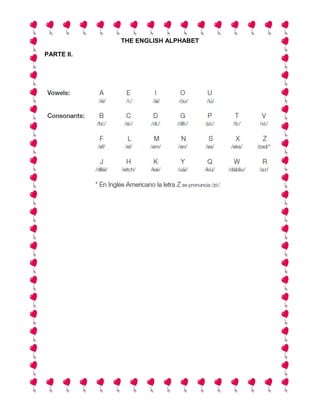
THE ENGLISH ALPHABET

PARTE II.

Unit 1

  • 1.
    UNIT 1 PART I.VERBOTO BE (SER O ESTAR) A. EL TIEMPO PRESENTE: AM /æm/ , IS /iz/, ARE /a:r/ 1. El verbo TO BE tiene tres formas en el tiempo presente: AM - IS - ARE I am /aiæm/ (Yo soy/estoy) We are /wi: á:r/ (Nosotros/as somos o estamos) You are /iú á:r/ (Túeres/estás) You are /iú á:r/ (Uds. son/están) He is/hi: íz/ (El es/está) They are /δéi á:r/ (Ellos/as son/están) Sheis/shi: íz/ (Ella es/está) It is /it íz/ (Es/está) En conversación, normalmente se usan las contracciones I’m. You´re, He´s, She´s, It´s, We´re, They´re. Escuche, repita y aprenda: What?/wót/ ¿Qué? ¿Cuál?; Who?/hu:/ ¿Quién?; Where?/wéar/ ¿ Dónde?;How?/háu/ ¿Cómo?; This/δis/ este/a, That/δæt/ ese/a; These/δí:z/ estos/as; Those/δóuz/ esos/as A/ a/(antes de cons.) un/a;, An/an/ (antes de vocal) un/a; The/δe(antes de cons.) , δi/ (antes de vocal) el, la, los, las; At/æt/en; In/in/ en; On/on/ encima de; Now/náu/ ahora; Today/tudéi/ Hoy día; Thanks/δæηks/ gracias; Thankyou/δæηkiu:/ gracias; Fine/fáin/ bien; Verywell/vériuél/ muy bien; Muchbetter /match béter/ mucho mejor What is this? /wótizδis/ ¿Quéesesto? It is a pen. /its a pén/ Es un lápiz What´s that? /wots δæt/ ¿Quéeseso?It´s an ambulance. /its an æmbiulans/ Esunaambulancia What are these? /wót a:rδí:z/, ¿Qué son éstos? They are books. /δei a:rbúks/ Son libros What are those? /wót a:rδóuz/, ¿Qué son esos? They´re cars./δeirká:rz/ Son autos Is this a pen? /izδis a pén/ Yes, it is. It´s a pen /iés,itiz. its a pén/ Is that a house? /is δæt a háus/ Yes, It is. It´s a house. /iés it iz its e háus/ Are these books? /a:rδí:z búks/ Yes, they are. They´re books. /iés, δei á:r. δeirbúks/ Are those cars? /á:rδóuzká:rz/ Yes, they are.They´re cars. /iés, δei á:r.δeirká:rz/ Who is that man? /húizδætmæn/ He´s Mr. Jones, the new instructor. /hi:zδe niú: instráktor/ Who´s that woman? /hú:zδætwúman/ . She´s Miss Black, the secretary. /shi:zδe sékretri/ Who are those men? /hú: a:rδóuzmén/ They´re Bob, Jim and Tom, the students. /δeirδe stiú:dents/ Where is Bob? /wéarizbób/ He´s at home. /hi:z at hóum/
  • 2.
    Where´s the car?/wéarzδeká:r/ It´s in the garage. /its in δe gáridll/ Where´s the book?/wéarzδe búk/ It´s on the desk. /its on δe désk/ Where are the cars? /wéar a:rδe ká:rz/ They´re in the car park. /δéir in δe ká:rpá:rk/ Where are the students? /wéar a:rδe stiú:dents/ They´re in the lab. /δéir in δe læb/ How are you? /háu á:riu:/ I´m fine, thanks. /áimfáin, θæηks/ How´s John? /háuzdllón/ He´s much better, thanks. /hí:zmátchbéter, θæηks/ How are the children? /háu a:rδe tchíldrn/ They´re very well, thank you. /δeirvériwélθæηk iu/ 2. La forma negativa se expresa usando la palabra not. Normalmente formando las contracciones ISN´ T /íznt/o AREN´ T /á:rent/ Iam not /aiæmnót/ ---------------------------- I´m not /aim nót/ You are not /iú á:rnót/ You aren´t /iu á:rent/ You´re not /iúrnót/ He is not /hi: iznót/ He isn´t /hí: íznt/ He´s not / hí:znót/ She is not /shí: iznót/ She isn´t /shí: íznt/ She´s not /shí:znót/ It is not /it iznót/ It isn´t /it íznt/ It´s not /its nót/ We are not /wí: a:rnót/ We aren´t /wí: á:rent/ We´re not /wí:rnót/ They are not /δei a:rnót/ They aren´t /δei á:rent/ They´re not /δeirnót/ Escuche, repita y aprenda: is not/iznót/, isn´t/íznt/;are not/a:rnót/, aren´t/á:rent/; here/híar/ aquí; there/δéar/ allí; over there/óuverδéar/ allá I am not a pilot. /páilot/ ---------------------------- I´m not a pilot They are not students /stiú:dnts/. They aren´t students.They´re not students. He is not here /híar/. He isn´t here.He´s not here. They are not there /(éar/ They aren´t there.They´re not there. It is not a train. /tréin/ It isn´t a train.It´s not a train. Bob is not very well /vériwél/ He isn´t very well. He´s not very well. The students are not in the lab /læb/. They aren´t in the lab.They´renot in thelab. Escuche, repita y aprenda estas preguntas y respuestas: Is this a pen? /pén/ No, it isn´t. (It´s not a pen.)It´s a pencil./pénsl/ Is that a tank? /tæηk/ No, it isn´t. (It´s not a tank.)It´s a truck./trák/ Are these books? /búks/ No, they aren´t. (They´re not books.)They´re magazines./mægazinz/ Are those chairs? /tchéarz/ No, they aren´t. (They´re not chairs). They´re tables /téiblz/. 3. La forma interrogativa se expresa mediante simple inversión de orden con el sujeto de la oración.
  • 3.
    Am I? /amai/ Aren´t I? * /á:rentai / Are we? /á:rwí:/ Aren´t we?/á:rentwi:/ Are you? /á:riú:/ Aren´t you?/á:rentiu:/ Are you? /á:riú:/ Aren´t you?/á:rentiú:/ Is he? /ízhí:/Isn´t he?/íznt hi:/ Is she? /ízshí:/Isn´t she?/ízntshi:/Are they? /á:rδei/ Aren´t they? /á.rentδei/ Is it? /íz it/ Isn´t it?/íznt it/ Debido a que no existe una contracción para AM NOT, habitualmente se usa AREN¨T en este caso. En conversación coloquial se usa la contracción AIN¨T/éint/Ejemplo: Aren´t I yourfriend? Ain´t I yourfriend? Escuche, repita y aprenda: Am I right? /ámáiráit/ ¿Estoycorrecto?Aren´t I right? /á:rentairáit/ No estoy en lo cierto? Are you all right? /á.riu: ó:lráit/ ¿Estásbien? Aren´tyoutired? /á:rentiutáiard/ ¿No estás cansado? Is he a captain? /íz hi: a káptin/ Es él un capitán? Isn´tshe a nurse?/ízntshi. ane:rs/ ¿No es ella una enfermera? Are theybusy? /á:rδeibízi/ ¿Están ellos ocupados? Aren´ttheyhappy? /á:rentδeihæpi/ ¿No están ellos felices? Is my answer correct? /ízmai á:nserkorékt/ Isn´t this question correct? /ízntδis kwéstchionkorékt/ B. EL TIEMPO PASADO: WAS /woz/ - WERE /wer/ 1. El verbo TO BE tiene las siguientes formas en el tiempo pasado: WAS /woz/ - WERE /wer/ I was/aiwóz/ (yo era/estaba/fui/estuve) Wewere/wi: wé:r/ (Nos. Youwere/iú: wé:r/ (Tú éramos/estábamos/fuimos/estuvimos) eras/estabas/fuiste/estuviste) Youwere/iú: wé:r/ (Uds. He was/hí: wóz/ (El era/estaba/fue/estuvo) eran/estaban/fueron/estuvieron) Shewas/shi: wóz/ (Ella era/estaba/fue/estuvo) Theywere/δeiwé:r/ (Ellos/as Itwas/itwóz/ (era/estaba/fue/estuvo) an/estaban/fueron/estuvieron) Escuche, lea y aprenda: When? /wén/, ¿Cuándo? Why? /wái/, ¿Por qué?; Howold? /háuóuld/ ¿Qué edad? Lastweek/lá:stwí:k/ ; la semana pasada Twodaysago /tú: déizagóu/ Hace dos días Yesterday /jésterdei/ ayer; The day before yesterday /δe déibifórjésterdei/ anteayerLast night /la:stnáit/ anoche I was very busy yesterday. /aiwozvéribíziiésterdei/ (Yoestuvemuyocupadoayer) John was at home all day today. /dllónwoz at hóum ó:ldéitudéi/ (John estuvo en casa todo el día hoy) Wewere in Paris lastyear/wiwé:r in párisla:stíar/ (Nosotros estuvimos en Paris del año pasado)
  • 4.
    Mary was thebest student in my class. / mériwozδe béststiú:dent in maiklás/ (Mary era la mejor alumna de mi curso) Theywereverygoodfriends. /δeiwé:rvérigudfréndz/ (Ellos eran / fueron muy buenos amigos) 2. La forma negativa se expresa usando NOT después de WAS o WERE. Normalmente se usan las contracciones WASN´T /wóznt/o WEREN´T /wé:rent/. Escuche, lea y aprenda: I wasnotverybusylastweek. /aiwoznótvéribízilá:stwí:k/ (Yo no estuve muy ocupado la semana pasada) John wasn´t at home this morning./dllónwóznt at hóumδis mórnin/ (John no estuvo en casa estamañana) We weren´t in New York last year./wiwé:rent in niú: iórklá:stíar/ (Nosotros no estuvimos en N.Y. el añopasado) Mary wasn´t a good student at high school./mériwóznt a gúdstiú:dent at háiskú:l/ (Mary no era unabuena alumna en el liceo) Theyweren´tveryhardworking. /δeiwé:rntvérihá:rdwérkiη/ (Ellos no eran muy trabajadores) 3. La forma interrogativa se expresa invirtiendo el orden de WAS / WERE con el sujeto Escuche, lea y aprenda: Wereyou in classthismorning? /we:riú: in klásδismórnin/ (¿Estuviste en clase esta mañana?) Was John sick yesterday? /wozdllónsíkiésterdi/ (¿Estuvo John enfermoayer?) Was Mary a good student at school? /wozméri a gúdstiú:dent at skú:l/ (¿Era Mary unabuena alumna en el colegio?) Where were you at this time yesterday? /wéarwé:riú at δis táimiésterdi/ (¿Dóndeestabas a estahoraayer?) Why was Jim absent from work? /wáiwozdllímæbsent from wé:rk/ (¿Porquéestuvo Jim ausente del trabajo?) C. EL TIEMPO FUTURO: WILL BE /will bi:/ 1. El tiempo futuro del verbo TO BE se expresa mediante el uso del Verbo Modal WILL seguido del infinitivo BE. Normalmente se usa la contracción ‘ll en la conversación diaria informal. I will be /aiwilbí:/ (Yoseré / estaré) We will be /wí: wilbí:/(Nos.seremos / You will be /iú: wilbí:/(Túserás / estarás) estaremos)
  • 5.
    He will be/hi: wilbí:/ (El será / estará) You will be /iú: wilbí:/(Uds. serán / estarán) She will be /shí: wilbí:/(Ellasserá / estará) They will be /δeiwilbí:/(Ellos / as seránestarán) It will be /it wilbí:/ (Será / estará) También se pueden usar las siguientes contracciones: I´ll be /áilbí:/You´ll be /iu:lbí:/ He´ll be /hí:lbí:/ They´ll be /δeilbí:/ Escuche, lea y aprenda: Howlong?/háulóη/ ¿Cuánto tiempo? Until /antíl/ hasta; For /for/ porWhat time?/wóttáim/ ¿Quéhora? Tomorrow/tumórou/ mañana; Next week /´nekstwi:k/ la próximasemana; The day after tomorrow /δe déi á:fter tumórou/ pasadomañana I will be very busy this afternoon. /áiwilbí: véribíziδis a:fternú:n/ . Estarémuyocupadoestatarde John will be in class until 1 o´clock. /dllónwilbí: in klá:santilwánoklók/ John estará en clases hasta la 1 It´ll be hot tomorrow. /ítlbí: hot tumórou/ Estarácalurosomañana I´ll be on leave for two weeks. /ail bí: on lí:v for tú: wí:ks/ Yoestaré con permisopor dos semanas 2. La forma negativa se expresa usando la palabra NOT después del verbo modal WILL Normalmente se usa la contracción WON´T/wóunt/. Escuche, lea y aprenda: I willnot be verybusytomorrrow. /aiwilnótbí: bízitumórou/ No estaré muy ocupado mañana Mary will not be at home today. /mériwilnótbí: at hóumtudéi/ Mary no estará en casa hoy día. Theywon´t be hereallday. /δeiwóuntbí: híar ó:ldei/ Ellos no estarán aquí todo el día It won´t be cold tonight. /it wóuntbí: kóuldtunáit/ No estaráfrioestanoche 3. La forma interrogativa se expresa usando el verbo modal WILL o la contracción WON´T delante del sujeto. Escuche, lea y aprenda: Willyou be free tomorrowevening? /wiliú: bí: frí: tumórou í:vnin/ ¿Estarás libre mañana en la noche? Will the test be difficult? /wilδe téstbí: dífikalt/ ¿Serádificil la prueba? Will they be here on Monday? /wilδeibí: híar on mándei/ ¿estaránellosaquí el lunes? Won´t you be at the meeting? /wóuntiú.bi: at δe mí:tin/ ¿No estarástú en la reunión? When will they be here again? /wénwilδeibí: híaragéin/ ¿Cuándoestaránellosaquínuevamente? How long will they be in Washington? /háu loηwilδeibí: in wóshiδton/ ¿Cúantotiempoestaránellos en Washington? What time will you be back? /wóttáimwiliu: bí: bæk/ ¿A quéhoraestaráUd. deregreso?
  • 6.