3.2. El afán de expresión: Fauvismo y El Puente. 3.2. Analizar el afán de expresión y la liberación del lenguaje formal en el Fauvismo y El Puente.
FAUVISMO  EL COLOR LIBERADO estilo pictórico CARACTERIZADO POR La utilización subjetiva del color y la simplificación del dibujo
Se desarrolla en Francia durante los años 1903 a 1907. La primera exposición tiene lugar en París en el Salón de Otoño de 1905 y alcanza su climax en 1906 en el "Salon des Indépendants". La denominación deriva de la palabra "fauves" (fieras), término con el que el crítico Louis Vauxcelles denominó a un grupo de pintores, encabezado por  Matisse , que practicaban un estilo vigoroso de pintura alejado de todo principio académico.
Salon de otoño – 1905  (1636 obras) Camille Mauclair ¡Han lanzado un bote de pintura a la cara del público! Louis Vauxcelles ¡ Donatello entre las fieras!
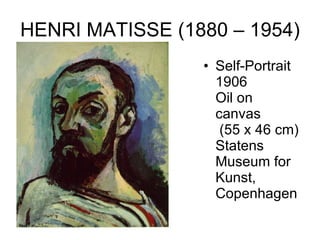
HENRI MATISSE (1880 – 1954) Self-Portrait 1906 Oil on canvas  (55 x 46 cm) Statens Museum for Kunst, Copenhagen
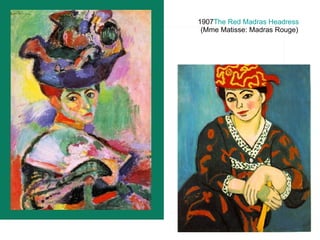
1907 The Red Madras  Headress  (Mme Matisse: Madras Rouge)
 
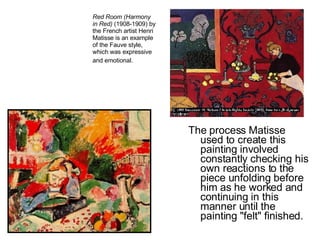
The process Matisse used to create this painting involved constantly checking his own reactions to the piece unfolding before him as he worked and continuing in this manner until the painting "felt" finished.  Red Room (Harmony in Red)  (1908-1909) by the French artist Henri Matisse is an example of the Fauve style, which was expressive and emotional.
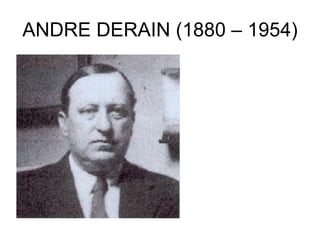
ANDRE DERAIN (1880 – 1954)
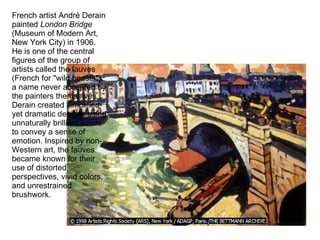
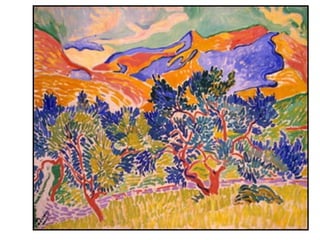
French artist André Derain painted  London Bridge  (Museum of Modern Art, New York City) in 1906. He is one of the central figures of the group of artists called the fauves (French for "wild beasts"), a name never accepted by the painters themselves. Derain created simplified yet dramatic designs using unnaturally brilliant colors to convey a sense of emotion. Inspired by non-Western art, the fauves became known for their use of distorted perspectives, vivid colors, and unrestrained brushwork.
 
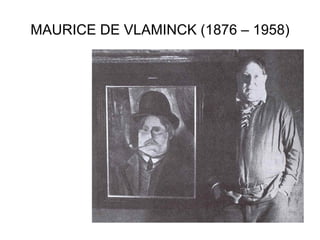
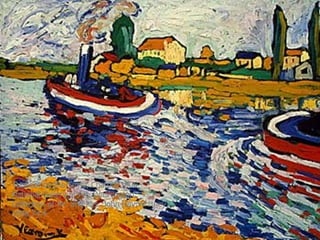
MAURICE DE VLAMINCK (1876 – 1958)
Tugboat on the Seine, Chatou, 1906, National Gallery of Art, Washington, Collection of Mr. and Mrs. John Hay Whitney 1998.74.4

3.2 Fauvismoelpuente

  • 1.
    3.2. El afánde expresión: Fauvismo y El Puente. 3.2. Analizar el afán de expresión y la liberación del lenguaje formal en el Fauvismo y El Puente.
  • 2.
    FAUVISMO ELCOLOR LIBERADO estilo pictórico CARACTERIZADO POR La utilización subjetiva del color y la simplificación del dibujo
  • 3.
    Se desarrolla enFrancia durante los años 1903 a 1907. La primera exposición tiene lugar en París en el Salón de Otoño de 1905 y alcanza su climax en 1906 en el "Salon des Indépendants". La denominación deriva de la palabra "fauves" (fieras), término con el que el crítico Louis Vauxcelles denominó a un grupo de pintores, encabezado por Matisse , que practicaban un estilo vigoroso de pintura alejado de todo principio académico.
  • 4.
    Salon de otoño– 1905 (1636 obras) Camille Mauclair ¡Han lanzado un bote de pintura a la cara del público! Louis Vauxcelles ¡ Donatello entre las fieras!
  • 5.
    HENRI MATISSE (1880– 1954) Self-Portrait 1906 Oil on canvas (55 x 46 cm) Statens Museum for Kunst, Copenhagen
  • 6.
    1907 The RedMadras Headress (Mme Matisse: Madras Rouge)
  • 7.
  • 8.
    The process Matisseused to create this painting involved constantly checking his own reactions to the piece unfolding before him as he worked and continuing in this manner until the painting "felt" finished. Red Room (Harmony in Red) (1908-1909) by the French artist Henri Matisse is an example of the Fauve style, which was expressive and emotional.
  • 9.
  • 10.
    French artist AndréDerain painted London Bridge (Museum of Modern Art, New York City) in 1906. He is one of the central figures of the group of artists called the fauves (French for "wild beasts"), a name never accepted by the painters themselves. Derain created simplified yet dramatic designs using unnaturally brilliant colors to convey a sense of emotion. Inspired by non-Western art, the fauves became known for their use of distorted perspectives, vivid colors, and unrestrained brushwork.
  • 11.
  • 12.
    MAURICE DE VLAMINCK(1876 – 1958)
  • 13.
    Tugboat on theSeine, Chatou, 1906, National Gallery of Art, Washington, Collection of Mr. and Mrs. John Hay Whitney 1998.74.4