¿Qué te gusta hacer?                 Gramática 2

Present tense of regular -ar verbs
Preview
• Verb stems
• Conjugating the verb
• Subject pronouns
¿Qué te gusta hacer?                               Gramática 2

Verb stems

• Every verb has a stem followed by an ending.
• The stem tells the verb’s meaning.
• An infinitive ending doesn’t name a subject.

                         habl -ar
       verb stems        com -er       infinitive endings
                       escrib -ir
¿Qué te gusta hacer?                              Gramática 2

Conjugating the verb

• To give the verb a subject, you conjugate it.
• To conjugate a regular -ar verb in the present tense, drop
  the -ar ending of the infinitive and add these endings.
• Each ending goes with a particular subject.
                            cantar
               yo canto          nosotros(as) cantamos
                tú cantas        vosotros(as) cantáis
     Ud., él, ella canta      Uds., ellos, ellas cantan
¿Qué te gusta hacer?                              Gramática 2

Conjugating the verb

• To give the verb a subject, you conjugate it.
• To conjugate a regular -ar verb in the present tense, drop
  the -ar ending of the infinitive and add these endings.
• Each ending goes with a particular subject.
¿Cantan ustedes mucho?         No, casi nunca cantamos.
Do you sing a lot?             No, we hardly ever sing.
¿Qué te gusta hacer?                               Gramática 2

Subject pronouns

• Since the ending of the verb usually tells the subject, the
  subject pronoun is normally left out.
• Use subject pronouns to add emphasis, or when it
  wouldn’t otherwise be clear who the subject is.
¿Patinan ustedes mucho? Ellos patinan. Yo nunca patino.
Do you skate a lot?     They skate. I never skate.
Present tense conjugations of
             regular –AR verbs


                                 6
(Subject Pronouns)

Singular           Plural

    yo           nosotros


    tú           vosotros


él / ella /    ellos / ellas /
    Ud.             Uds.
                             7
STEM          +        ENDING


Hablar      =   habl-              Mirar        =   mir-
Practicar   =   practi-            Escuchar     =   escuch-
Estudiar    =   estudi-            Jugar        =   jug-
Trabajar    =   trabaj-            Presentar    =   present-
Cocinar     =   cocin-             Comprar      =   compr-

                          +       AR            8
STEM    +   Verb ending


  -o          -amos


  -as          -áis


  -a           -an
                          9
Por ejemplo…:            hablar

        hablar
      hablo     hablamos


      hablas    habláis


      habla     hablan
                          10
Por ejemplo…:        estudiar

       estudiar
     estudi o    estudiamos


     estudi as   estudiáis


     estudi a    estudian
                            11
Por ejemplo…:            nadar

         nadar
      nad o     nadamos


      nad as    nadáis


      nad a     nadan
                         12
Present-tense verbs in Spanish can have several English
equivalents. Each simple expression in Spanish may
convey three different ideas in English:


             (yo) Estudio español.

                I study Spanish.
                     simple statement
              I do study Spanish.
                        emphasis
            I am studying Spanish.
                     action in progress

                                          13
Otros verbos en –AR…:
llorar - to cry
    caminar - to walk
          saludar - to greet
                  contestar - to answer
                        mirar - to look at
                        escuchar - to listen to
                  visitar - to visit
          desear - to desire
    llamar - to call
comprar - to buy
                                       14
   Practicar -   to practice

   Cantar         -   to sing

   Ayudar         -   to help

   Trabajar -    to work

   Imaginar -    to imagine


                                 15
mi amigo y yo
         el estudiante


           hablamos

             habla
hablar
                          16
¿Cuál es la forma correcta?


                  mi padre
                 unos amigos


                   trabaja
                  trabajan
  trabajar
                       17
¿Cuál es la forma correcta?


                     tú
                    ella


                  cocinas
                  cocina
  cocinar
                      18
¿Cuál es la forma correcta?


                Elena y José
                 Laura y yo


                   bailan
                  bailamos
   bailar
                      19
¿Cuál es la forma correcta?


                    yo
                  ¿quién?


                   salto
                   salta
  saltar
                      20
¿Cuál es la forma correcta?


                 mis amigos
                 Ramón y tú


                  compran
                  compráis
  comprar
                      21
¿Cuál es la forma correcta?


                   la clase
               las estudiantes


                    canta
                   cantan
  cantar
                       22
¿Cuál es la forma correcta?


                 ¿quiénes?
                     yo


                 preguntan
                  pregunto
 preguntar
                      23
¿Cuál es la forma correcta?


               los profesores
                    de inglés
                    Ud.

                    tocan
                    toca
   tocar
                       24
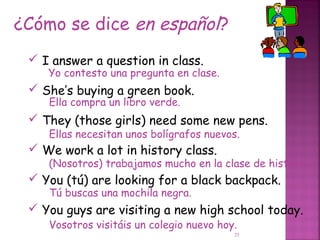
¿Cómo se dice en español?
  I answer a question in class.
    Yo contesto una pregunta en clase.
  She’s buying a green book.
    Ella compra un libro verde.
  They (those girls) need some new pens.
    Ellas necesitan unos bolígrafos nuevos.
  We work a lot in history class.
    (Nosotros) trabajamos mucho en la clase de historia.
  You (tú) are looking for a black backpack.
    Tú buscas una mochila negra.
  You guys are visiting a new high school today.
    Vosotros visitáis un colegio nuevo hoy.
                                          25
¿Cómo se dice en español?
  He enters spanish class at 10 am.
    Él entra la clase de español a las 10 de la mañana.
  Who’s swimming on Saturday?
    ¿Quién nada el sábado?
  Elena cries a lot.
    Elena llora mucho.
  I do prepare the math homework!
    Yo preparo la tarea de matemáticas.
  We are studying lesson 4.
    (Nosotros) estudiamos la lección 4.
  They dance on Sundays.
    Ellos bailan los domingos.
                                           26
27

Arverbs1

  • 1.
    ¿Qué te gustahacer? Gramática 2 Present tense of regular -ar verbs Preview • Verb stems • Conjugating the verb • Subject pronouns
  • 2.
    ¿Qué te gustahacer? Gramática 2 Verb stems • Every verb has a stem followed by an ending. • The stem tells the verb’s meaning. • An infinitive ending doesn’t name a subject. habl -ar verb stems com -er infinitive endings escrib -ir
  • 3.
    ¿Qué te gustahacer? Gramática 2 Conjugating the verb • To give the verb a subject, you conjugate it. • To conjugate a regular -ar verb in the present tense, drop the -ar ending of the infinitive and add these endings. • Each ending goes with a particular subject. cantar yo canto nosotros(as) cantamos tú cantas vosotros(as) cantáis Ud., él, ella canta Uds., ellos, ellas cantan
  • 4.
    ¿Qué te gustahacer? Gramática 2 Conjugating the verb • To give the verb a subject, you conjugate it. • To conjugate a regular -ar verb in the present tense, drop the -ar ending of the infinitive and add these endings. • Each ending goes with a particular subject. ¿Cantan ustedes mucho? No, casi nunca cantamos. Do you sing a lot? No, we hardly ever sing.
  • 5.
    ¿Qué te gustahacer? Gramática 2 Subject pronouns • Since the ending of the verb usually tells the subject, the subject pronoun is normally left out. • Use subject pronouns to add emphasis, or when it wouldn’t otherwise be clear who the subject is. ¿Patinan ustedes mucho? Ellos patinan. Yo nunca patino. Do you skate a lot? They skate. I never skate.
  • 6.
    Present tense conjugationsof regular –AR verbs 6
  • 7.
    (Subject Pronouns) Singular Plural yo nosotros tú vosotros él / ella / ellos / ellas / Ud. Uds. 7
  • 8.
    STEM + ENDING Hablar = habl- Mirar = mir- Practicar = practi- Escuchar = escuch- Estudiar = estudi- Jugar = jug- Trabajar = trabaj- Presentar = present- Cocinar = cocin- Comprar = compr- + AR 8
  • 9.
    STEM + Verb ending -o -amos -as -áis -a -an 9
  • 10.
    Por ejemplo…: hablar hablar hablo hablamos hablas habláis habla hablan 10
  • 11.
    Por ejemplo…: estudiar estudiar estudi o estudiamos estudi as estudiáis estudi a estudian 11
  • 12.
    Por ejemplo…: nadar nadar nad o nadamos nad as nadáis nad a nadan 12
  • 13.
    Present-tense verbs inSpanish can have several English equivalents. Each simple expression in Spanish may convey three different ideas in English: (yo) Estudio español.  I study Spanish. simple statement  I do study Spanish. emphasis  I am studying Spanish. action in progress 13
  • 14.
    Otros verbos en–AR…: llorar - to cry caminar - to walk saludar - to greet contestar - to answer mirar - to look at escuchar - to listen to visitar - to visit desear - to desire llamar - to call comprar - to buy 14
  • 15.
    Practicar - to practice  Cantar - to sing  Ayudar - to help  Trabajar - to work  Imaginar - to imagine 15
  • 16.
    mi amigo yyo el estudiante hablamos habla hablar 16
  • 17.
    ¿Cuál es laforma correcta? mi padre unos amigos trabaja trabajan trabajar 17
  • 18.
    ¿Cuál es laforma correcta? tú ella cocinas cocina cocinar 18
  • 19.
    ¿Cuál es laforma correcta? Elena y José Laura y yo bailan bailamos bailar 19
  • 20.
    ¿Cuál es laforma correcta? yo ¿quién? salto salta saltar 20
  • 21.
    ¿Cuál es laforma correcta? mis amigos Ramón y tú compran compráis comprar 21
  • 22.
    ¿Cuál es laforma correcta? la clase las estudiantes canta cantan cantar 22
  • 23.
    ¿Cuál es laforma correcta? ¿quiénes? yo preguntan pregunto preguntar 23
  • 24.
    ¿Cuál es laforma correcta? los profesores de inglés Ud. tocan toca tocar 24
  • 25.
    ¿Cómo se diceen español?  I answer a question in class. Yo contesto una pregunta en clase.  She’s buying a green book. Ella compra un libro verde.  They (those girls) need some new pens. Ellas necesitan unos bolígrafos nuevos.  We work a lot in history class. (Nosotros) trabajamos mucho en la clase de historia.  You (tú) are looking for a black backpack. Tú buscas una mochila negra.  You guys are visiting a new high school today. Vosotros visitáis un colegio nuevo hoy. 25
  • 26.
    ¿Cómo se diceen español?  He enters spanish class at 10 am. Él entra la clase de español a las 10 de la mañana.  Who’s swimming on Saturday? ¿Quién nada el sábado?  Elena cries a lot. Elena llora mucho.  I do prepare the math homework! Yo preparo la tarea de matemáticas.  We are studying lesson 4. (Nosotros) estudiamos la lección 4.  They dance on Sundays. Ellos bailan los domingos. 26
  • 27.