English for Specific Purposes


 Chosen theme: Funciones de la terminación “ing”
  en un texto de especialidad
 Selected text: Domrose, Cathryn. (2010) “Show the
  love. Theory of Human Caring offers framework for
  hospital cultures”, in Nurse. com. The Magazine.
  Issue: May, 2010, USA.

http://www.nxtbook.com/nxtbooks/gannetthg/nursecom_201
  00512/#/40
Time of year: September


Time alloted: 3 hours


Number of students: about 40
Aims:
To unlock vocabulary before reading;
To help students access background information
that can facilitate subsequent reading;
To stimulate students’ interest;
To set up students’ expectations.


Time allotted: twenty minutes
Type of work: whole class work
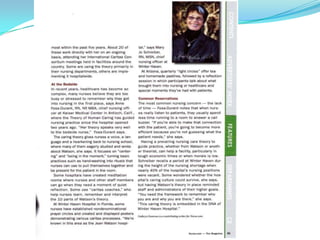
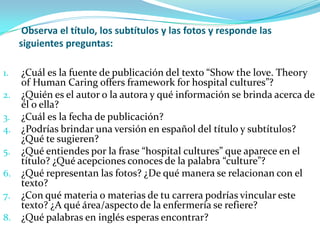
Observa el título, los subtítulos y las fotos y responde las
     siguientes preguntas:

1.   ¿Cuál es la fuente de publicación del texto “Show the love. Theory
     of Human Caring offers framework for hospital cultures”?
2.   ¿Quién es el autor o la autora y qué información se brinda acerca de
     él o ella?
3.   ¿Cuál es la fecha de publicación?
4.   ¿Podrías brindar una versión en español del título y subtítulos?
     ¿Qué te sugieren?
5.   ¿Qué entiendes por la frase “hospital cultures” que aparece en el
     título? ¿Qué acepciones conoces de la palabra “culture”?
6.   ¿Qué representan las fotos? ¿De qué manera se relacionan con el
     texto?
7.   ¿Con qué materia o materias de tu carrera podrías vincular este
     texto? ¿A qué área/aspecto de la enfermería se refiere?
8.   ¿Qué palabras en inglés esperas encontrar?
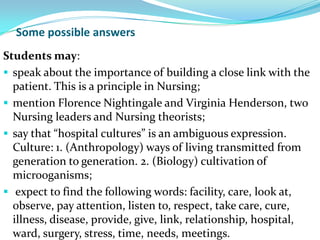
Some possible answers
Students may:
 speak about the importance of building a close link with the
  patient. This is a principle in Nursing;
 mention Florence Nightingale and Virginia Henderson, two
  Nursing leaders and Nursing theorists;
 say that “hospital cultures” is an ambiguous expression.
  Culture: 1. (Anthropology) ways of living transmitted from
  generation to generation. 2. (Biology) cultivation of
  microoganisms;
 expect to find the following words: facility, care, look at,
  observe, pay attention, listen to, respect, take care, cure,
  illness, disease, provide, give, link, relationship, hospital,
  ward, surgery, stress, time, needs, meetings.
While-reading activities
Aims:
 To help students understand the main ideas of the
   texts and the arguments or details that support main
   ideas;

 To help students learn information;

 To activate students’ background knowledge to have
   better comprehension of the text;
 To help students be aware of the different functions
  of –ing;
 To help students be aware of the text organization;
 To help students become strategic readers.


 Time allotted: one hundred and forty minutes
 Type of work: whole class, group and individual work
 Checking: with the whole class
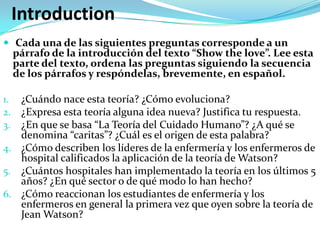
Introduction
 Cada una de las siguientes preguntas corresponde a un
     párrafo de la introducción del texto “Show the love”. Lee esta
     parte del texto, ordena las preguntas siguiendo la secuencia
     de los párrafos y respóndelas, brevemente, en español.

1. ¿Cuándo nace esta teoría? ¿Cómo evoluciona?
2. ¿Expresa esta teoría alguna idea nueva? Justifica tu respuesta.
3. ¿En que se basa “La Teoría del Cuidado Humano”? ¿A qué se
   denomina “caritas”? ¿Cuál es el origen de esta palabra?
4. ¿Cómo describen los líderes de la enfermería y los enfermeros de
   hospital calificados la aplicación de la teoría de Watson?
5. ¿Cuántos hospitales han implementado la teoría en los últimos 5
   años? ¿En qué sector o de qué modo lo han hecho?
6. ¿Cómo reaccionan los estudiantes de enfermería y los
   enfermeros en general la primera vez que oyen sobre la teoría de
   Jean Watson?
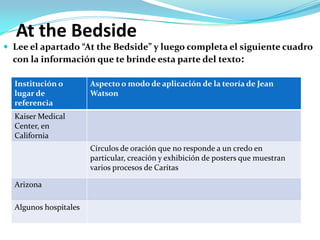
At the Bedside
 Lee el apartado “At the Bedside” y luego completa el siguiente cuadro
  con la información que te brinde esta parte del texto:

  Institución o        Aspecto o modo de aplicación de la teoría de Jean
  lugar de             Watson
  referencia
  Kaiser Medical
  Center, en
  California
                       Círculos de oración que no responde a un credo en
                       particular, creación y exhibición de posters que muestran
                       varios procesos de Caritas

  Arizona

  Algunos hospitales
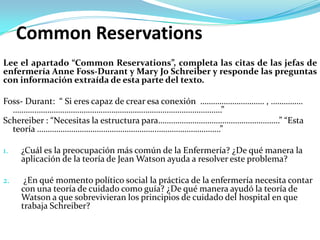
Common Reservations
Lee el apartado “Common Reservations”, completa las citas de las jefas de
enfermería Anne Foss-Durant y Mary Jo Schreiber y responde las preguntas
con información extraída de esta parte del texto.

Foss- Durant: “ Si eres capaz de crear esa conexión ………………………… , ……………
  ………..……………………………………………………………………………”
Schereiber : “Necesitas la estructura para…………………………………………………” “Esta
  teoría ………………………………………………..…………………………”

1.   ¿Cuál es la preocupación más común de la Enfermería? ¿De qué manera la
     aplicación de la teoría de Jean Watson ayuda a resolver este problema?

2.    ¿En qué momento político social la práctica de la enfermería necesita contar
     con una teoría de cuidado como guía? ¿De qué manera ayudó la teoría de
     Watson a que sobrevivieran los principios de cuidado del hospital en que
     trabaja Schreiber?
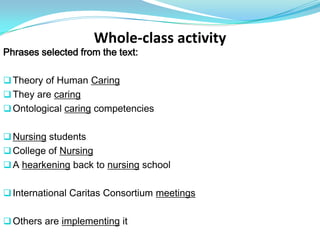
Whole-class activity
Phrases selected from the text:

 Theory of Human Caring
 They are caring
 Ontological caring competencies


 Nursing students
 College of Nursing
 A hearkening back to nursing school


 International Caritas Consortium meetings


 Others are implementing it
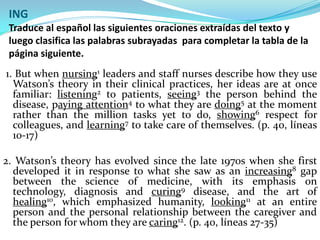
ING
 Traduce al español las siguientes oraciones extraídas del texto y
 luego clasifica las palabras subrayadas para completar la tabla de la
 página siguiente.
1. But when nursing1 leaders and staff nurses describe how they use
  Watson’s theory in their clinical practices, her ideas are at once
  familiar: listening2 to patients, seeing3 the person behind the
  disease, paying attention4 to what they are doing5 at the moment
  rather than the million tasks yet to do, showing6 respect for
  colleagues, and learning7 to take care of themselves. (p. 40, líneas
  10-17)

2. Watson’s theory has evolved since the late 1970s when she first
  developed it in response to what she saw as an increasing8 gap
  between the science of medicine, with its emphasis on
  technology, diagnosis and curing9 disease, and the art of
  healing10, which emphasized humanity, looking11 at an entire
  person and the personal relationship between the caregiver and
  the person for whom they are caring12. (p. 40, líneas 27-35)
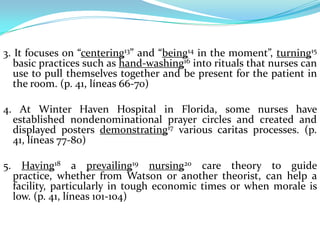
3. It focuses on “centering13” and “being14 in the moment”, turning15
   basic practices such as hand-washing16 into rituals that nurses can
   use to pull themselves together and be present for the patient in
   the room. (p. 41, líneas 66-70)

4. At Winter Haven Hospital in Florida, some nurses have
  established nondenominational prayer circles and created and
  displayed posters demonstrating17 various caritas processes. (p.
  41, líneas 77-80)

5. Having18 a prevailing19 nursing20 care theory to guide
  practice, whether from Watson or another theorist, can help a
  facility, particularly in tough economic times or when morale is
  low. (p. 41, líneas 101-104)
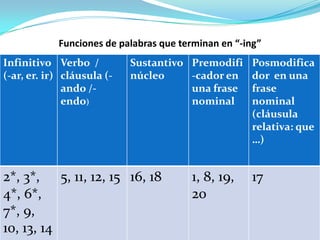
Funciones de palabras que terminan en “-ing”
Infinitivo Verbo /          Sustantivo Premodifi Posmodifica
(-ar, er. ir) cláusula (-   núcleo     -cador en dor en una
              ando /-                  una frase frase
              endo)                    nominal   nominal
                                                 (cláusula
                                                 relativa: que
                                                 …)


2*, 3*, 5, 11, 12, 15 16, 18            1, 8, 19,    17
4*, 6*,                                 20
7*, 9,
10, 13, 14
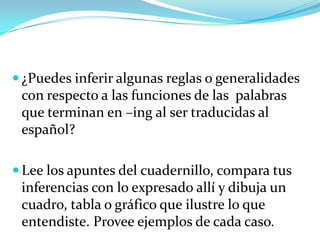
 ¿Puedes inferir algunas reglas o generalidades
 con respecto a las funciones de las palabras
 que terminan en –ing al ser traducidas al
 español?

 Lee los apuntes del cuadernillo, compara tus
 inferencias con lo expresado allí y dibuja un
 cuadro, tabla o gráfico que ilustre lo que
 entendiste. Provee ejemplos de cada caso.
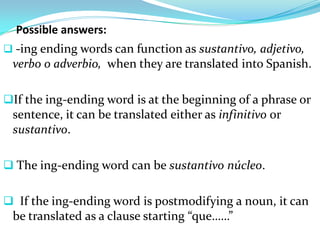
Possible answers:
 -ing ending words can function as sustantivo, adjetivo,
 verbo o adverbio, when they are translated into Spanish.

If the ing-ending word is at the beginning of a phrase or
 sentence, it can be translated either as infinitivo or
 sustantivo.

 The ing-ending word can be sustantivo núcleo.


 If the ing-ending word is postmodifying a noun, it can
 be translated as a clause starting “que……”
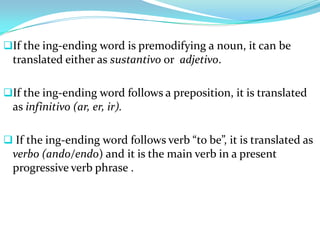
If the ing-ending word is premodifying a noun, it can be
  translated either as sustantivo or adjetivo.

If the ing-ending word follows a preposition, it is translated
  as infinitivo (ar, er, ir).

 If the ing-ending word follows verb “to be”, it is translated as
  verbo (ando/endo) and it is the main verb in a present
  progressive verb phrase .
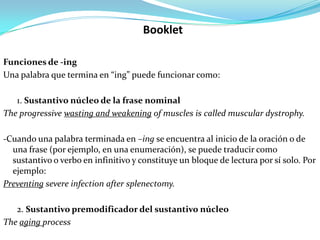
Booklet

Funciones de -ing
Una palabra que termina en “ing” puede funcionar como:

   1. Sustantivo núcleo de la frase nominal
The progressive wasting and weakening of muscles is called muscular dystrophy.

-Cuando una palabra terminada en –ing se encuentra al inicio de la oración o de
  una frase (por ejemplo, en una enumeración), se puede traducir como
  sustantivo o verbo en infinitivo y constituye un bloque de lectura por sí solo. Por
  ejemplo:
Preventing severe infection after splenectomy.

   2. Sustantivo premodificador del sustantivo núcleo
The aging process
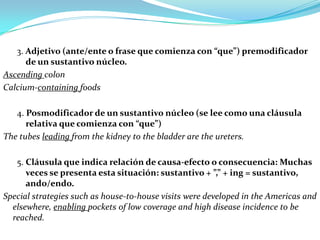
3. Adjetivo (ante/ente o frase que comienza con “que”) premodificador
      de un sustantivo núcleo.
Ascending colon
Calcium-containing foods

   4. Posmodificador de un sustantivo núcleo (se lee como una cláusula
      relativa que comienza con “que”)
The tubes leading from the kidney to the bladder are the ureters.

   5. Cláusula que indica relación de causa-efecto o consecuencia: Muchas
      veces se presenta esta situación: sustantivo + ”,” + ing = sustantivo,
      ando/endo.
Special strategies such as house-to-house visits were developed in the Americas and
  elsewhere, enabling pockets of low coverage and high disease incidence to be
  reached.
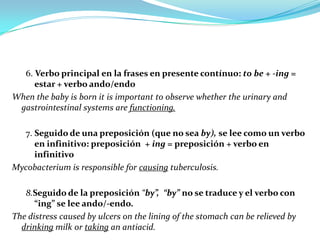
6. Verbo principal en la frases en presente contínuo: to be + -ing =
     estar + verbo ando/endo
When the baby is born it is important to observe whether the urinary and
 gastrointestinal systems are functioning.

  7. Seguido de una preposición (que no sea by), se lee como un verbo
     en infinitivo: preposición + ing = preposición + verbo en
     infinitivo
Mycobacterium is responsible for causing tuberculosis.

   8.Seguido de la preposición “by”, “by” no se traduce y el verbo con
      “ing” se lee ando/-endo.
The distress caused by ulcers on the lining of the stomach can be relieved by
  drinking milk or taking an antiacid.
Post-reading activities
Aims:
To help students extend ideas and information from the text;
To ensure that ideas were well understood.


 Time allotted: 20 minutes
 Type of work: group work
 Checking: with the whole class
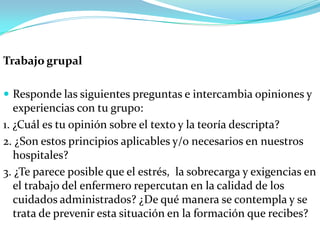
Trabajo grupal

 Responde las siguientes preguntas e intercambia opiniones y
   experiencias con tu grupo:
1. ¿Cuál es tu opinión sobre el texto y la teoría descripta?
2. ¿Son estos principios aplicables y/o necesarios en nuestros
   hospitales?
3. ¿Te parece posible que el estrés, la sobrecarga y exigencias en
   el trabajo del enfermero repercutan en la calidad de los
   cuidados administrados? ¿De qué manera se contempla y se
   trata de prevenir esta situación en la formación que recibes?
Follow-up
Homework aims:
To help students learn more about the carrier
 content;
To reinforce work carried out in the classroom
 while it is still fresh in students’ mind;
To see other functions of “ing”.


 Type of work: individual work
 Checking: in the following lesson
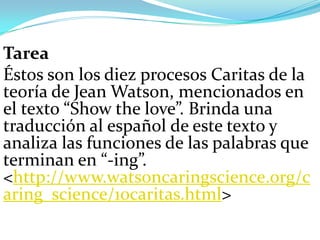
Tarea
Éstos son los diez procesos Caritas de la
teoría de Jean Watson, mencionados en
el texto “Show the love”. Brinda una
traducción al español de este texto y
analiza las funciones de las palabras que
terminan en “-ing”.
<http://www.watsoncaringscience.org/c
aring_science/10caritas.html>
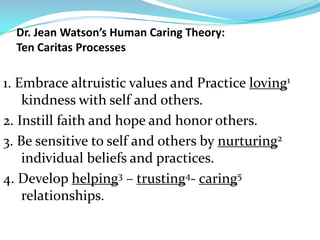
Dr. Jean Watson’s Human Caring Theory:
  Ten Caritas Processes

1. Embrace altruistic values and Practice loving1
    kindness with self and others.
2. Instill faith and hope and honor others.
3. Be sensitive to self and others by nurturing2
    individual beliefs and practices.
4. Develop helping3 – trusting4- caring5
    relationships.
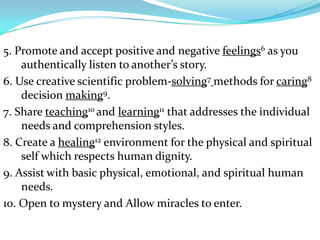
5. Promote and accept positive and negative feelings6 as you
    authentically listen to another’s story.
6. Use creative scientific problem-solving7 methods for caring8
    decision making9.
7. Share teaching10 and learning11 that addresses the individual
    needs and comprehension styles.
8. Create a healing12 environment for the physical and spiritual
    self which respects human dignity.
9. Assist with basic physical, emotional, and spiritual human
    needs.
10. Open to mystery and Allow miracles to enter.
“In academic settings, the careful reading of texts is
a common task, one that requires readers to
demonstrate a good understanding of details in the
text, to learn information from it, and to use that
information for other tasks.”
Grabe, W and Stoller, F. (2001) “Reading for Academic Purposes: Guidelines fro the
ESL/EFL Teacher”, in Teaching English as a Second or Foreign Language. Marianne Celce
Murcia (Ed.), Heinle & Heinle. Thomson Learning, USA.

Clase ing 3 (5)

  • 1.
    English for SpecificPurposes  Chosen theme: Funciones de la terminación “ing” en un texto de especialidad  Selected text: Domrose, Cathryn. (2010) “Show the love. Theory of Human Caring offers framework for hospital cultures”, in Nurse. com. The Magazine. Issue: May, 2010, USA. http://www.nxtbook.com/nxtbooks/gannetthg/nursecom_201 00512/#/40
  • 2.
    Time of year:September Time alloted: 3 hours Number of students: about 40
  • 5.
    Aims: To unlock vocabularybefore reading; To help students access background information that can facilitate subsequent reading; To stimulate students’ interest; To set up students’ expectations. Time allotted: twenty minutes Type of work: whole class work
  • 6.
    Observa el título,los subtítulos y las fotos y responde las siguientes preguntas: 1. ¿Cuál es la fuente de publicación del texto “Show the love. Theory of Human Caring offers framework for hospital cultures”? 2. ¿Quién es el autor o la autora y qué información se brinda acerca de él o ella? 3. ¿Cuál es la fecha de publicación? 4. ¿Podrías brindar una versión en español del título y subtítulos? ¿Qué te sugieren? 5. ¿Qué entiendes por la frase “hospital cultures” que aparece en el título? ¿Qué acepciones conoces de la palabra “culture”? 6. ¿Qué representan las fotos? ¿De qué manera se relacionan con el texto? 7. ¿Con qué materia o materias de tu carrera podrías vincular este texto? ¿A qué área/aspecto de la enfermería se refiere? 8. ¿Qué palabras en inglés esperas encontrar?
  • 7.
    Some possible answers Studentsmay:  speak about the importance of building a close link with the patient. This is a principle in Nursing;  mention Florence Nightingale and Virginia Henderson, two Nursing leaders and Nursing theorists;  say that “hospital cultures” is an ambiguous expression. Culture: 1. (Anthropology) ways of living transmitted from generation to generation. 2. (Biology) cultivation of microoganisms;  expect to find the following words: facility, care, look at, observe, pay attention, listen to, respect, take care, cure, illness, disease, provide, give, link, relationship, hospital, ward, surgery, stress, time, needs, meetings.
  • 8.
    While-reading activities Aims:  Tohelp students understand the main ideas of the texts and the arguments or details that support main ideas;  To help students learn information;  To activate students’ background knowledge to have better comprehension of the text;
  • 9.
     To helpstudents be aware of the different functions of –ing;  To help students be aware of the text organization;  To help students become strategic readers.  Time allotted: one hundred and forty minutes  Type of work: whole class, group and individual work  Checking: with the whole class
  • 10.
    Introduction  Cada unade las siguientes preguntas corresponde a un párrafo de la introducción del texto “Show the love”. Lee esta parte del texto, ordena las preguntas siguiendo la secuencia de los párrafos y respóndelas, brevemente, en español. 1. ¿Cuándo nace esta teoría? ¿Cómo evoluciona? 2. ¿Expresa esta teoría alguna idea nueva? Justifica tu respuesta. 3. ¿En que se basa “La Teoría del Cuidado Humano”? ¿A qué se denomina “caritas”? ¿Cuál es el origen de esta palabra? 4. ¿Cómo describen los líderes de la enfermería y los enfermeros de hospital calificados la aplicación de la teoría de Watson? 5. ¿Cuántos hospitales han implementado la teoría en los últimos 5 años? ¿En qué sector o de qué modo lo han hecho? 6. ¿Cómo reaccionan los estudiantes de enfermería y los enfermeros en general la primera vez que oyen sobre la teoría de Jean Watson?
  • 11.
    At the Bedside Lee el apartado “At the Bedside” y luego completa el siguiente cuadro con la información que te brinde esta parte del texto: Institución o Aspecto o modo de aplicación de la teoría de Jean lugar de Watson referencia Kaiser Medical Center, en California Círculos de oración que no responde a un credo en particular, creación y exhibición de posters que muestran varios procesos de Caritas Arizona Algunos hospitales
  • 12.
    Common Reservations Lee elapartado “Common Reservations”, completa las citas de las jefas de enfermería Anne Foss-Durant y Mary Jo Schreiber y responde las preguntas con información extraída de esta parte del texto. Foss- Durant: “ Si eres capaz de crear esa conexión ………………………… , …………… ………..……………………………………………………………………………” Schereiber : “Necesitas la estructura para…………………………………………………” “Esta teoría ………………………………………………..…………………………” 1. ¿Cuál es la preocupación más común de la Enfermería? ¿De qué manera la aplicación de la teoría de Jean Watson ayuda a resolver este problema? 2. ¿En qué momento político social la práctica de la enfermería necesita contar con una teoría de cuidado como guía? ¿De qué manera ayudó la teoría de Watson a que sobrevivieran los principios de cuidado del hospital en que trabaja Schreiber?
  • 13.
    Whole-class activity Phrases selectedfrom the text:  Theory of Human Caring  They are caring  Ontological caring competencies  Nursing students  College of Nursing  A hearkening back to nursing school  International Caritas Consortium meetings  Others are implementing it
  • 14.
    ING Traduce alespañol las siguientes oraciones extraídas del texto y luego clasifica las palabras subrayadas para completar la tabla de la página siguiente. 1. But when nursing1 leaders and staff nurses describe how they use Watson’s theory in their clinical practices, her ideas are at once familiar: listening2 to patients, seeing3 the person behind the disease, paying attention4 to what they are doing5 at the moment rather than the million tasks yet to do, showing6 respect for colleagues, and learning7 to take care of themselves. (p. 40, líneas 10-17) 2. Watson’s theory has evolved since the late 1970s when she first developed it in response to what she saw as an increasing8 gap between the science of medicine, with its emphasis on technology, diagnosis and curing9 disease, and the art of healing10, which emphasized humanity, looking11 at an entire person and the personal relationship between the caregiver and the person for whom they are caring12. (p. 40, líneas 27-35)
  • 15.
    3. It focuseson “centering13” and “being14 in the moment”, turning15 basic practices such as hand-washing16 into rituals that nurses can use to pull themselves together and be present for the patient in the room. (p. 41, líneas 66-70) 4. At Winter Haven Hospital in Florida, some nurses have established nondenominational prayer circles and created and displayed posters demonstrating17 various caritas processes. (p. 41, líneas 77-80) 5. Having18 a prevailing19 nursing20 care theory to guide practice, whether from Watson or another theorist, can help a facility, particularly in tough economic times or when morale is low. (p. 41, líneas 101-104)
  • 16.
    Funciones de palabrasque terminan en “-ing” Infinitivo Verbo / Sustantivo Premodifi Posmodifica (-ar, er. ir) cláusula (- núcleo -cador en dor en una ando /- una frase frase endo) nominal nominal (cláusula relativa: que …) 2*, 3*, 5, 11, 12, 15 16, 18 1, 8, 19, 17 4*, 6*, 20 7*, 9, 10, 13, 14
  • 17.
     ¿Puedes inferiralgunas reglas o generalidades con respecto a las funciones de las palabras que terminan en –ing al ser traducidas al español?  Lee los apuntes del cuadernillo, compara tus inferencias con lo expresado allí y dibuja un cuadro, tabla o gráfico que ilustre lo que entendiste. Provee ejemplos de cada caso.
  • 18.
    Possible answers:  -ingending words can function as sustantivo, adjetivo, verbo o adverbio, when they are translated into Spanish. If the ing-ending word is at the beginning of a phrase or sentence, it can be translated either as infinitivo or sustantivo.  The ing-ending word can be sustantivo núcleo.  If the ing-ending word is postmodifying a noun, it can be translated as a clause starting “que……”
  • 19.
    If the ing-endingword is premodifying a noun, it can be translated either as sustantivo or adjetivo. If the ing-ending word follows a preposition, it is translated as infinitivo (ar, er, ir).  If the ing-ending word follows verb “to be”, it is translated as verbo (ando/endo) and it is the main verb in a present progressive verb phrase .
  • 20.
    Booklet Funciones de -ing Unapalabra que termina en “ing” puede funcionar como: 1. Sustantivo núcleo de la frase nominal The progressive wasting and weakening of muscles is called muscular dystrophy. -Cuando una palabra terminada en –ing se encuentra al inicio de la oración o de una frase (por ejemplo, en una enumeración), se puede traducir como sustantivo o verbo en infinitivo y constituye un bloque de lectura por sí solo. Por ejemplo: Preventing severe infection after splenectomy. 2. Sustantivo premodificador del sustantivo núcleo The aging process
  • 21.
    3. Adjetivo (ante/enteo frase que comienza con “que”) premodificador de un sustantivo núcleo. Ascending colon Calcium-containing foods 4. Posmodificador de un sustantivo núcleo (se lee como una cláusula relativa que comienza con “que”) The tubes leading from the kidney to the bladder are the ureters. 5. Cláusula que indica relación de causa-efecto o consecuencia: Muchas veces se presenta esta situación: sustantivo + ”,” + ing = sustantivo, ando/endo. Special strategies such as house-to-house visits were developed in the Americas and elsewhere, enabling pockets of low coverage and high disease incidence to be reached.
  • 22.
    6. Verbo principalen la frases en presente contínuo: to be + -ing = estar + verbo ando/endo When the baby is born it is important to observe whether the urinary and gastrointestinal systems are functioning. 7. Seguido de una preposición (que no sea by), se lee como un verbo en infinitivo: preposición + ing = preposición + verbo en infinitivo Mycobacterium is responsible for causing tuberculosis. 8.Seguido de la preposición “by”, “by” no se traduce y el verbo con “ing” se lee ando/-endo. The distress caused by ulcers on the lining of the stomach can be relieved by drinking milk or taking an antiacid.
  • 23.
    Post-reading activities Aims: To helpstudents extend ideas and information from the text; To ensure that ideas were well understood.  Time allotted: 20 minutes  Type of work: group work  Checking: with the whole class
  • 24.
    Trabajo grupal  Respondelas siguientes preguntas e intercambia opiniones y experiencias con tu grupo: 1. ¿Cuál es tu opinión sobre el texto y la teoría descripta? 2. ¿Son estos principios aplicables y/o necesarios en nuestros hospitales? 3. ¿Te parece posible que el estrés, la sobrecarga y exigencias en el trabajo del enfermero repercutan en la calidad de los cuidados administrados? ¿De qué manera se contempla y se trata de prevenir esta situación en la formación que recibes?
  • 25.
    Follow-up Homework aims: To helpstudents learn more about the carrier content; To reinforce work carried out in the classroom while it is still fresh in students’ mind; To see other functions of “ing”.  Type of work: individual work  Checking: in the following lesson
  • 26.
    Tarea Éstos son losdiez procesos Caritas de la teoría de Jean Watson, mencionados en el texto “Show the love”. Brinda una traducción al español de este texto y analiza las funciones de las palabras que terminan en “-ing”. <http://www.watsoncaringscience.org/c aring_science/10caritas.html>
  • 27.
    Dr. Jean Watson’sHuman Caring Theory: Ten Caritas Processes 1. Embrace altruistic values and Practice loving1 kindness with self and others. 2. Instill faith and hope and honor others. 3. Be sensitive to self and others by nurturing2 individual beliefs and practices. 4. Develop helping3 – trusting4- caring5 relationships.
  • 28.
    5. Promote andaccept positive and negative feelings6 as you authentically listen to another’s story. 6. Use creative scientific problem-solving7 methods for caring8 decision making9. 7. Share teaching10 and learning11 that addresses the individual needs and comprehension styles. 8. Create a healing12 environment for the physical and spiritual self which respects human dignity. 9. Assist with basic physical, emotional, and spiritual human needs. 10. Open to mystery and Allow miracles to enter.
  • 29.
    “In academic settings,the careful reading of texts is a common task, one that requires readers to demonstrate a good understanding of details in the text, to learn information from it, and to use that information for other tasks.” Grabe, W and Stoller, F. (2001) “Reading for Academic Purposes: Guidelines fro the ESL/EFL Teacher”, in Teaching English as a Second or Foreign Language. Marianne Celce Murcia (Ed.), Heinle & Heinle. Thomson Learning, USA.