ENGLISH GRAMMAR
THE PASSIVE VOICE
Laura Moya Díaz, 2º Bachillerato de Humanidades y
Ciencias Sociales.
ÍNDICE
1. USOS
2. FORMA DEL VERBO PASIVO
3. PASAR UNA FRASE ACTIVA A PASIVA
4. EJEMPLOS
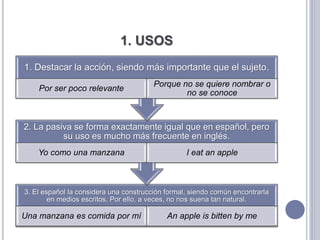
1. USOS
3. El español la considera una construcción formal, siendo común encontrarla
en medios escritos. Por ello, a veces, no nos suena tan natural.
Una manzana es comida por mí An apple is bitten by me
2. La pasiva se forma exactamente igual que en español, pero
su uso es mucho más frecuente en inglés.
Yo como una manzana I eat an apple
1. Destacar la acción, siendo más importante que el sujeto.
Por ser poco relevante
Porque no se quiere nombrar o
no se conoce
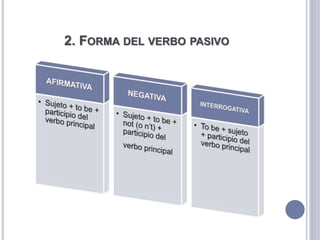
2. FORMA DEL VERBO PASIVO
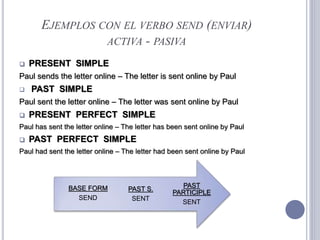
EJEMPLOS CON EL VERBO SEND (ENVIAR)
ACTIVA - PASIVA
 PRESENT SIMPLE
Paul sends the letter online – The letter is sent online by Paul
 PAST SIMPLE
Paul sent the letter online – The letter was sent online by Paul
 PRESENT PERFECT SIMPLE
Paul has sent the letter online – The letter has been sent online by Paul
 PAST PERFECT SIMPLE
Paul had sent the letter online – The letter had been sent online by Paul
PAST
PARTICIPLE
SENT
PAST S.
SENT
BASE FORM
SEND
 FUTURE
Paul will send the letter online – The letter will be sent online by Paul
 GOING TO
Paul is going to send the letter online – The letter is going to be sent by Paul
 MODAL VERB
Paul should send the letter online – The letter should be sent online by Paul
Paul must send the letter online – The letter must be sent online by Paul
Paul can send the letter online – The letter can be sent online by Paul
3. DE ACTIVA A PASIVA
 El objeto directo de la voz activa pasa a ser el
sujeto de la pasiva.
 El sujeto de la pasiva se convertirá en el
complemento agente que realiza la acción.
 La acción está hecha por/by.
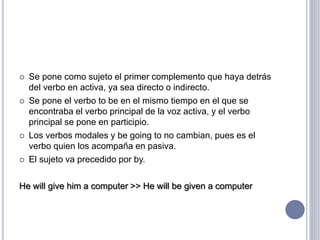
 Se pone como sujeto el primer complemento que haya detrás
del verbo en activa, ya sea directo o indirecto.
 Se pone el verbo to be en el mismo tiempo en el que se
encontraba el verbo principal de la voz activa, y el verbo
principal se pone en participio.
 Los verbos modales y be going to no cambian, pues es el
verbo quien los acompaña en pasiva.
 El sujeto va precedido por by.
He will give him a computer >> He will be given a computer
4. EJEMPLOS
VOZ ACTIVA – VOZ PASIVA
 He writes a book – A book is written
 The technician has fixed the computer – The computer has been
fixed by the technician
 The teacher can use tutorials – Tutorials can be used by the teacher
 Somebody bought my picture – My picture was bought by somebody
 Paul gives me a book – I am given a book

ENGLISH THE PASSIVE VOICE

  • 1.
    ENGLISH GRAMMAR THE PASSIVEVOICE Laura Moya Díaz, 2º Bachillerato de Humanidades y Ciencias Sociales.
  • 2.
    ÍNDICE 1. USOS 2. FORMADEL VERBO PASIVO 3. PASAR UNA FRASE ACTIVA A PASIVA 4. EJEMPLOS
  • 3.
    1. USOS 3. Elespañol la considera una construcción formal, siendo común encontrarla en medios escritos. Por ello, a veces, no nos suena tan natural. Una manzana es comida por mí An apple is bitten by me 2. La pasiva se forma exactamente igual que en español, pero su uso es mucho más frecuente en inglés. Yo como una manzana I eat an apple 1. Destacar la acción, siendo más importante que el sujeto. Por ser poco relevante Porque no se quiere nombrar o no se conoce
  • 4.
    2. FORMA DELVERBO PASIVO
  • 5.
    EJEMPLOS CON ELVERBO SEND (ENVIAR) ACTIVA - PASIVA  PRESENT SIMPLE Paul sends the letter online – The letter is sent online by Paul  PAST SIMPLE Paul sent the letter online – The letter was sent online by Paul  PRESENT PERFECT SIMPLE Paul has sent the letter online – The letter has been sent online by Paul  PAST PERFECT SIMPLE Paul had sent the letter online – The letter had been sent online by Paul PAST PARTICIPLE SENT PAST S. SENT BASE FORM SEND
  • 6.
     FUTURE Paul willsend the letter online – The letter will be sent online by Paul  GOING TO Paul is going to send the letter online – The letter is going to be sent by Paul  MODAL VERB Paul should send the letter online – The letter should be sent online by Paul Paul must send the letter online – The letter must be sent online by Paul Paul can send the letter online – The letter can be sent online by Paul
  • 7.
    3. DE ACTIVAA PASIVA  El objeto directo de la voz activa pasa a ser el sujeto de la pasiva.  El sujeto de la pasiva se convertirá en el complemento agente que realiza la acción.  La acción está hecha por/by.
  • 8.
     Se ponecomo sujeto el primer complemento que haya detrás del verbo en activa, ya sea directo o indirecto.  Se pone el verbo to be en el mismo tiempo en el que se encontraba el verbo principal de la voz activa, y el verbo principal se pone en participio.  Los verbos modales y be going to no cambian, pues es el verbo quien los acompaña en pasiva.  El sujeto va precedido por by. He will give him a computer >> He will be given a computer
  • 9.
    4. EJEMPLOS VOZ ACTIVA– VOZ PASIVA  He writes a book – A book is written  The technician has fixed the computer – The computer has been fixed by the technician  The teacher can use tutorials – Tutorials can be used by the teacher  Somebody bought my picture – My picture was bought by somebody  Paul gives me a book – I am given a book