ÁREA:
TECNOLOGÍAS DE LA INFORMACIÓN Y COMUNICACIÓN III
INSTITUTO DE EDUCACIÓN SUPERIOR
PEDAGÓGICO PÚBLICO
“AREQUIPA”
CARRERA PROFESIONAL: IDIOMAS
SEMESTRE ACADÉMICO: TERCERO
AUTOR(A): MARIBEL LUZ PALLI CALAPUJA
THE GREETINGS
Área: Ingles
Horas: 2 horas
Grado: Primero de Secundaria
Nivel: Secundario
Ciclo: IV
GREETINGS
 Componentes: Expresión y
comprensión oral
 Capacidades:
 Entiende y sigue
instrucciones sencillas y de
uso cotidiano en el aula
 Predice el contenido del
texto teniendo en cuenta los
elementos para textuales.
Para desarrollar
capacidades de
comprensión y producción
de textos orales.
¿Para que?
Mostrando ciertos
ejemplos de palabras o
frases
Dando una pequeña
dinámica para empezar a
dar a conocer por
completo el tema
Pidiendo la participación
de los alumnos
¿Como voy a desarrollar este tema?
 Empezar con el tema
 Comenzar a pasar el
material audio- visual
según sea el caso
The lesson for today is…
THE GREETINGS AND SELF
INTRODUCTIONS
THE GRETTINGS AND SELF INTRODUCTIONS
THE GRETTINGS ARE
A POLITE WAY FOR
STARS A
CONVERSATION.
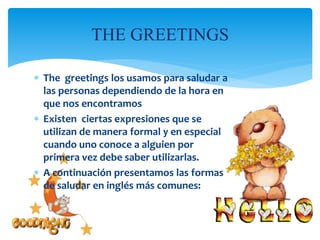
 The greetings los usamos para saludar a
las personas dependiendo de la hora en
que nos encontramos
 Existen ciertas expresiones que se
utilizan de manera formal y en especial
cuando uno conoce a alguien por
primera vez debe saber utilizarlas.
 A continuación presentamos las formas
de saludar en inglés más comunes:
THE GREETINGS
Formal
 HELLO!
 WELCOME!
 GOOD MORNING!
 GOOD AFTERNOON!
 GOOD EVENING!
 GOOD NIGHT!
 GOOD BYE!
 PLEASE
 THANK YOU
 EXCUSE ME
PHRASES OF GREETINGS
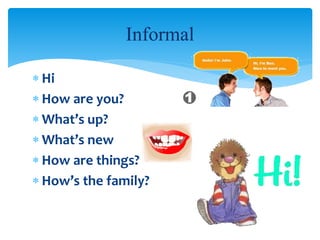
 Hi
 How are you?
 What’s up?
 What’s new
 How are things?
 How’s the family?
Informal
 HELLO O HI
 HOW ARE YOU!
 FINE, THANK YOU
 ADEMAS PODEMOS DECIR
 GREAT
 GOOD
 TERRIFIC
 SO SO
 NOT GOOD
 BAD
 I’m fine
 Everything’s fine
 Everything is going really well
PARA SALUDAR A UNA PERSONA
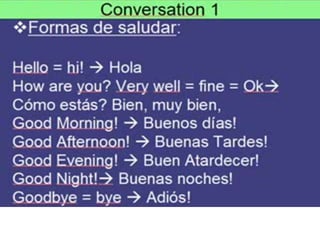
 Good Morning (gud mornin): Buenos Días
 Good Afternoon (gud afternun): Buenas Tardes
 Good Evening (gud ifnin): Buenas Noches
 NOTA: Para decir Buenas Noches cuando
llegamos a un lugar debemos decir Good
Evening. La expresión Good Night (gud
nait) tambien significa Buenas noches pero
cuando nos vamos a dormir o a despedir de una
persona
PARA SALUDAR A UNA PERSONA DEPENDIENDO DE LA
HORA
 Good Bye (gud bai): Adios
 See you later (si yu leirer): Nos vemos luego
 See you soon (si yu sun): Nos vemos pronto
 Have a nice day (jav a nais dei): Que tengas un
buen dia
 Have a great time (jav a greit taim): Que te
vaya bien
PARA DESPEDIRNOS DE UNA PERSONA
 SELF INTRODUCTIONS LO USAMOS PARA DAR
A CONOCER INFORMACION NUESTRA A
OTRAS PERSONAS
 AL MISMO TIEMPO TAMBIEN OBTENER
INFORMACION ACERCA DE OTRAS PERSONAS
 DEPUES SIN DARNOS CUENTA LOGRAMOS
ENTAMBLAR UN DIALOGO SIMPLE Y ASI
INTERCAMBIAR INFORMACION
SELF INTRODUCTIONS
 What is yor name?
 Hello, my name is …
 How are you?
 I’m fine , thank you.
 And you?
 How old are you?
USEFUL PHRASES TO
INTRODUCTIONS
 What's your name Cual es tu nombre o como te llamas
 My name is Terry Mi nombre es Terry o me llamo Terry
 This is my teacher, Sam Este es mi profesor, Sam
 Nice to meet you Un placer conocerte (conocerlo)
 Nice to meet you too Igualmente
 Ademas de decir Nice to meet you, también se pueden
utilizar las siguientes expresiones: Glad to meet you,
Good to meet you, Pleasure to meet you
(pleisur). Tambien se puede decir: Nice meeting you
(nais mirin iu).
SI NO CONOCEMOS A UNA PERSONA
 Grace: Oh, Hello Lou, how are you?
 Lou: Fine, thank you. How are you?
 Grace: Great
 Lou: O.K, Good Bye
 Grace: Bye, see you later
 Lou: Fine, have a nice day
 Grace: You too
 Conversation 2
 John: Hello, I am John Stewart, What´s your name?
 Paul: My name is Paul Roberts. Nice to meet you John
 John: Nice meeting you too.
DIALOGO EJEMPLO
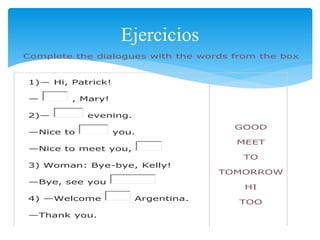
Ejercicios
Complete the dialogues with the words from the box
1)— Hi, Patrick!
— , Mary!
2)— evening.
—Nice to you.
—Nice to meet you,
3) Woman: Bye-bye, Kelly!
—Bye, see you
4) —Welcome Argentina.
—Thank you.
GOOD
MEET
TO
TOMORROW
HI
TOO
. Put the words in the right order to make sentences.
1) to – Nice – too - you, - meet
2) Hi - Angie - everybody! - I’m
3) city - to – the - of – Welcome -
Washington
4) Friday - you – See - next
5) exam - luck – for – Good - the
6) afternoon, - Scott - Good - Mr.
GREETINGS AND INTRODUCTIONS SELF

GREETINGS AND INTRODUCTIONS SELF

  • 1.
    ÁREA: TECNOLOGÍAS DE LAINFORMACIÓN Y COMUNICACIÓN III INSTITUTO DE EDUCACIÓN SUPERIOR PEDAGÓGICO PÚBLICO “AREQUIPA” CARRERA PROFESIONAL: IDIOMAS SEMESTRE ACADÉMICO: TERCERO AUTOR(A): MARIBEL LUZ PALLI CALAPUJA
  • 3.
  • 4.
    Área: Ingles Horas: 2horas Grado: Primero de Secundaria Nivel: Secundario Ciclo: IV GREETINGS
  • 5.
     Componentes: Expresióny comprensión oral  Capacidades:  Entiende y sigue instrucciones sencillas y de uso cotidiano en el aula  Predice el contenido del texto teniendo en cuenta los elementos para textuales.
  • 6.
    Para desarrollar capacidades de comprensióny producción de textos orales. ¿Para que?
  • 7.
    Mostrando ciertos ejemplos depalabras o frases Dando una pequeña dinámica para empezar a dar a conocer por completo el tema Pidiendo la participación de los alumnos ¿Como voy a desarrollar este tema?
  • 8.
     Empezar conel tema  Comenzar a pasar el material audio- visual según sea el caso
  • 9.
    The lesson fortoday is…
  • 10.
    THE GREETINGS ANDSELF INTRODUCTIONS
  • 11.
    THE GRETTINGS ANDSELF INTRODUCTIONS THE GRETTINGS ARE A POLITE WAY FOR STARS A CONVERSATION.
  • 12.
     The greetingslos usamos para saludar a las personas dependiendo de la hora en que nos encontramos  Existen ciertas expresiones que se utilizan de manera formal y en especial cuando uno conoce a alguien por primera vez debe saber utilizarlas.  A continuación presentamos las formas de saludar en inglés más comunes: THE GREETINGS
  • 13.
    Formal  HELLO!  WELCOME! GOOD MORNING!  GOOD AFTERNOON!  GOOD EVENING!  GOOD NIGHT!  GOOD BYE!  PLEASE  THANK YOU  EXCUSE ME PHRASES OF GREETINGS
  • 14.
     Hi  Howare you?  What’s up?  What’s new  How are things?  How’s the family? Informal
  • 15.
     HELLO OHI  HOW ARE YOU!  FINE, THANK YOU  ADEMAS PODEMOS DECIR  GREAT  GOOD  TERRIFIC  SO SO  NOT GOOD  BAD  I’m fine  Everything’s fine  Everything is going really well PARA SALUDAR A UNA PERSONA
  • 16.
     Good Morning(gud mornin): Buenos Días  Good Afternoon (gud afternun): Buenas Tardes  Good Evening (gud ifnin): Buenas Noches  NOTA: Para decir Buenas Noches cuando llegamos a un lugar debemos decir Good Evening. La expresión Good Night (gud nait) tambien significa Buenas noches pero cuando nos vamos a dormir o a despedir de una persona PARA SALUDAR A UNA PERSONA DEPENDIENDO DE LA HORA
  • 17.
     Good Bye(gud bai): Adios  See you later (si yu leirer): Nos vemos luego  See you soon (si yu sun): Nos vemos pronto  Have a nice day (jav a nais dei): Que tengas un buen dia  Have a great time (jav a greit taim): Que te vaya bien PARA DESPEDIRNOS DE UNA PERSONA
  • 19.
     SELF INTRODUCTIONSLO USAMOS PARA DAR A CONOCER INFORMACION NUESTRA A OTRAS PERSONAS  AL MISMO TIEMPO TAMBIEN OBTENER INFORMACION ACERCA DE OTRAS PERSONAS  DEPUES SIN DARNOS CUENTA LOGRAMOS ENTAMBLAR UN DIALOGO SIMPLE Y ASI INTERCAMBIAR INFORMACION SELF INTRODUCTIONS
  • 20.
     What isyor name?  Hello, my name is …  How are you?  I’m fine , thank you.  And you?  How old are you? USEFUL PHRASES TO INTRODUCTIONS
  • 21.
     What's yourname Cual es tu nombre o como te llamas  My name is Terry Mi nombre es Terry o me llamo Terry  This is my teacher, Sam Este es mi profesor, Sam  Nice to meet you Un placer conocerte (conocerlo)  Nice to meet you too Igualmente  Ademas de decir Nice to meet you, también se pueden utilizar las siguientes expresiones: Glad to meet you, Good to meet you, Pleasure to meet you (pleisur). Tambien se puede decir: Nice meeting you (nais mirin iu). SI NO CONOCEMOS A UNA PERSONA
  • 24.
     Grace: Oh,Hello Lou, how are you?  Lou: Fine, thank you. How are you?  Grace: Great  Lou: O.K, Good Bye  Grace: Bye, see you later  Lou: Fine, have a nice day  Grace: You too  Conversation 2  John: Hello, I am John Stewart, What´s your name?  Paul: My name is Paul Roberts. Nice to meet you John  John: Nice meeting you too. DIALOGO EJEMPLO
  • 25.
    Ejercicios Complete the dialogueswith the words from the box 1)— Hi, Patrick! — , Mary! 2)— evening. —Nice to you. —Nice to meet you, 3) Woman: Bye-bye, Kelly! —Bye, see you 4) —Welcome Argentina. —Thank you. GOOD MEET TO TOMORROW HI TOO
  • 27.
    . Put thewords in the right order to make sentences. 1) to – Nice – too - you, - meet 2) Hi - Angie - everybody! - I’m 3) city - to – the - of – Welcome - Washington 4) Friday - you – See - next 5) exam - luck – for – Good - the 6) afternoon, - Scott - Good - Mr.