37-38. Orden DECAPODA
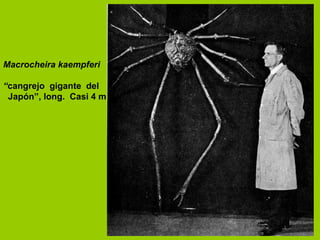
Macrocheira kaempferi
“cangrejo gigante del
Japón”, long. Casi 4 m
Pseudocarcinus gigas
Ancho del cefalotórax 41 cm
Australia
Homarus americanus, long. 60 cm
Nueva Inglaterra y costa Atlántica
De Canadá
DIAGRAMA GENERALIZADO DE UN DECAPODO DEL
Suborden DENDROBRANCHIATA “LANGOSTINO”
DIAGRAMA GENERALIZADO DE UN DECAPODO DEL Infraorden BRACHYURA
MORFOLOGIA
EXTERNA E INTERNA
DE UN DECAPODO
ESTOMAGO DEL CANGREJO DE RIO Astacus sp.
VISTA LATERAL DE UNA DISECCION
Ocypode sp.
“cangrejo carretero”
Playas arenosas
OCYPODIDAE
INFRAORDEN BRACHYURA: GECARCINIDAE
Hyalocarcinus humei, cangrejo terrestre.
P
O
R
T
U
N
I
D
A
E
PORTUNIDAE
Portunus puber, alimentándose. Comestible en Europa.
Uca sp., hembra.
“cangrejo
violinista”
Playas arenofan-
gosas.
OCYPODIDAE
Birgus latro,
“cangrejo ladrón
de los cocoteros”
INFRAORDEN ANOMURA
COENOBITIDAE
Alimentación por filtración en
Emerita
El cangrejo se entierra cara
al mar. Las anténulas
llevan agua a las cámaras
branquiales, y las segundas
antenas filtran el plancton.
Las flechas indican la direc-
ción del agua en la resaca.
Infraorden ANOMURA
HIPPIDAE
Infraorden BRACHYURA
PINNOTHERIDAE
Pinnotheres pisum, long. 5,0 mm. Comensal del “mejillón” europeo.
Reducción progresiva de la en-
trada del agua a las cámaras
branquiales, en Decapoda
Tipos de branquias en
Decapoda: A y B, dendrobranquia;
C y D, tricobranquia; E y F,
filobranquia
Langostino
Camarón
Cangrejo
CORTE TRANSVERSAL DE CEFALOTORAX DE CANGREJO
PARA VER LA POSICION DE LA FILOBRANQUIA EN LA
CAMARA BRANQUIAL
A B
A. Vista anterior de Callinectes
Se observan las aberturas respiratorias inhalante y exhalante
B. Vista anterior de Hepatus
La flecha indica la abertura del sifon izquierdo formada por el
caparazón y el quelípodo
SISTEMA NERVIOSO DE CRUSTACEOS
A. Orden Anostraca, B. Suborden Pleocyemata (“camarón de río”), C. Infraorden
Brachyura (“cangrejos”), D. Suborden Hyperiidea.
ORGANOS DE LOS SENTIDOS EN MALACOSTRACA
Comparación entre el cefalotórax
de un camarón, una langosta y
un cangrejo, y el origen de la
forma corta del cuerpo.
Uca sp., posición de cortejo
CÓPULA EN LANGOSTINOS
“CANGREJO ERMITAÑO”
Eupagurus sp. Fuera de
su concha.
Infraorden ANOMURA
PAGURIDAE
Larvas de Crustacea y etapas de eclosión
Larva phyllosoma de la langosta
Panulirus elephas
Desarrollo del “cangrejo violinista”
Uca pugilator
1,2 primera zoea
3 megalopa
4 cangrejo juvenil
IMPORTANCIA
ECONÓMICA
Durante El Niño 82-83, uno de los recursos
inmigrantes fue Xiphopenaeus riveti. En el
Puerto de Samanco las redes fueron redise-
ñadas rápidamente para la captura de este
nuevo recurso.
En cambio, las poblaciones de cangrejos fue-
ron diezmadas durante El Niño ( en la foto,
Platyhanthus orbignyi), Asia, al Sur de Lima.
• Suborder 1. Dendrobranchiata
• Superfamily Penaeoidea, the penaeid shrimps: Penaeus, Lucifer
• Superfamily Sergestoidea, the sergestids: Sergestes, Sicyona
• Suborder 2. Pleocyemata
• Infraorder Caridea, the true shrimps: Cryphiops, Macrobrachium
• Infraorder Stenopodidea, the boxer shrimps: Stenopus
• Infraorder Astacidea, the clawed lobsters and crayfish: Astacus, Homarus
• Infraorder Thalassinidea, the ghost and mud shrimps: Callichirus, Upogebia
• Infraorder Palinura, the spiny and slipper lobsters: Panulirus, Ibacus
• Infraorder Anomura, the hermit crabs, king crabs, and porcelain crabs:
Birgus, Emerita, Lithodes, Pagurus, Petrolisthes, Peuroncodes
• Infraorder Brachyura, the true crabs: Callinectes, Portunus, Cancer, Grapsus,
Pinnotheres, Hepatus, Uca, Ocypode, Platyxanthus, Ucides
ORDEN DECAPODA: TAXONOMÍA
Suborden DENDROBRANCHIATA
Penaeus californiensis
Long. 90,0 cm
Penaeus stylirostris,
Long. 22,0 cm
Suborden PLEOCYEMATA
PENAEIDAE ALPHEIDAE
Synalpheus digueti,
Long. 20,0 mm, California.
HYPPOLYTIDAE
Lysmata californica,
Lonf. 42,0 mm
PALINURIDAE
Panulirus gracilis,
Long. 30,0cm
SCYLLARIDAE
Evibacus princeps,
Long. 35,0 cm
PAGURIDAE
Dardanus sinistripes,
Long. 25,0 mm
GRAPSIDAE
Grapsus grapsus,
Long. 87,0 mm
OCYPODIDAE
Uca princeps,
Long, 50,0 mm
XANTHIDAE
Eriphia squamata
Long. 50,0 mm
PORTUNIDAE
Callinectes arcuatus,
Long. 125,0 mm
DROMIIDAE
Hypoconcha lowei
Long. 60,0 mm, California a
Ecuador.
PINNOTHERIDAE DEL MAR PERUANO
P
i
Pinnotheres politus, long. 3,6 mm
En la cavidad paleal de Trochita
calyptraeformis y Crepipatella dilatata.
Pinnixa transversalis, long. 7,4 mm
En tubos de poliquetos de fondos
arenosos.
Pinnaxodes chilensis, long. 6,6 mm
En divertículo rectal de Caenocentrotus gibbosus
y Loxechinus albus
Pinnaxodes silvestrii, long. 3,4 mm
En la cloaca de Athyonidium chilensis.
CANCRIDAE Comerciales
XANTHIDAE
OCYPODIDAE
CALAPPIDAE PORCELLANIDAE
PORTUNIDAE
72. ATELECYCLIDAE
73. ALBUNEIDAE
74. HIPPIDAE
75. OCYPODIDAE
Comparación entre
P. laevigata de la
familia Pinnotheridae
y
C. cinereus de la
familia Grapsidae
GRAPSIDAE XANTHIDAE
Conservation status
In the year 2002 there were 176 species of decapods listed by the IUCN. Of
these, 159 were freshwater crayfish; all but two of the remaining species
were shrimps or brachyuran crabs that also live in freshwater. Freshwater
species often have very limited distributions, making them especially
susceptible to habitat destruction or degradation. Only one marine species
was listed, but virtually nothing is known about the populations of most
marine decapods, especially those that are not commercially exploited. Three
species of crayfish and three species of shrimp were listed as threatened in
the United States.
Significance to humans
The order Decapoda encompasses nearly all of the crustaceans that are used for
human consumption, and supports many large and valuable fisheries. In addition,
penaeid shrimps and crayfish are extensively cultured for food in many parts of
the world.
A number of human fatalities have been caused by the consumption of poisonous
crabs. Several reef-dwelling species of Indo-Pacific crabs appear to acquire
toxins from their food; since toxicity varies with the crab’s diet and location, it can
be very difficult to determine whether one of these crabs is safe to eat. In other
areas, decapods are often host to such schistosome parasites as lung flukes,
which can infect humans who eat raw or poorly cooked freshwater crabs or
crayfish.
FILOGENIA DE LOS CRUSTÁCEOS
Dos opiniones contrapuestas sobre la evolución de los crustáceos.
A. Idea tradicional de las relaciones de los crustáceos, representada
en un árbol evolutivo, con los crustáceos filopodiales en la base.
B. Cladograma que representa una opinión alternativa de la filogenia
de los crustáceos.

Inc 37-38-13-i

  • 1.
  • 2.
    Macrocheira kaempferi “cangrejo gigantedel Japón”, long. Casi 4 m
  • 4.
    Pseudocarcinus gigas Ancho delcefalotórax 41 cm Australia Homarus americanus, long. 60 cm Nueva Inglaterra y costa Atlántica De Canadá
  • 5.
    DIAGRAMA GENERALIZADO DEUN DECAPODO DEL Suborden DENDROBRANCHIATA “LANGOSTINO”
  • 6.
    DIAGRAMA GENERALIZADO DEUN DECAPODO DEL Infraorden BRACHYURA
  • 7.
  • 8.
    ESTOMAGO DEL CANGREJODE RIO Astacus sp. VISTA LATERAL DE UNA DISECCION
  • 9.
  • 10.
  • 11.
  • 12.
  • 13.
    Birgus latro, “cangrejo ladrón delos cocoteros” INFRAORDEN ANOMURA COENOBITIDAE
  • 14.
    Alimentación por filtraciónen Emerita El cangrejo se entierra cara al mar. Las anténulas llevan agua a las cámaras branquiales, y las segundas antenas filtran el plancton. Las flechas indican la direc- ción del agua en la resaca. Infraorden ANOMURA HIPPIDAE
  • 15.
    Infraorden BRACHYURA PINNOTHERIDAE Pinnotheres pisum,long. 5,0 mm. Comensal del “mejillón” europeo.
  • 16.
    Reducción progresiva dela en- trada del agua a las cámaras branquiales, en Decapoda Tipos de branquias en Decapoda: A y B, dendrobranquia; C y D, tricobranquia; E y F, filobranquia Langostino Camarón Cangrejo
  • 17.
    CORTE TRANSVERSAL DECEFALOTORAX DE CANGREJO PARA VER LA POSICION DE LA FILOBRANQUIA EN LA CAMARA BRANQUIAL
  • 18.
    A B A. Vistaanterior de Callinectes Se observan las aberturas respiratorias inhalante y exhalante B. Vista anterior de Hepatus La flecha indica la abertura del sifon izquierdo formada por el caparazón y el quelípodo
  • 19.
    SISTEMA NERVIOSO DECRUSTACEOS A. Orden Anostraca, B. Suborden Pleocyemata (“camarón de río”), C. Infraorden Brachyura (“cangrejos”), D. Suborden Hyperiidea.
  • 20.
    ORGANOS DE LOSSENTIDOS EN MALACOSTRACA
  • 21.
    Comparación entre elcefalotórax de un camarón, una langosta y un cangrejo, y el origen de la forma corta del cuerpo.
  • 22.
  • 25.
  • 26.
    “CANGREJO ERMITAÑO” Eupagurus sp.Fuera de su concha. Infraorden ANOMURA PAGURIDAE
  • 27.
    Larvas de Crustaceay etapas de eclosión
  • 28.
    Larva phyllosoma dela langosta Panulirus elephas Desarrollo del “cangrejo violinista” Uca pugilator 1,2 primera zoea 3 megalopa 4 cangrejo juvenil
  • 29.
  • 30.
    Durante El Niño82-83, uno de los recursos inmigrantes fue Xiphopenaeus riveti. En el Puerto de Samanco las redes fueron redise- ñadas rápidamente para la captura de este nuevo recurso. En cambio, las poblaciones de cangrejos fue- ron diezmadas durante El Niño ( en la foto, Platyhanthus orbignyi), Asia, al Sur de Lima.
  • 31.
    • Suborder 1.Dendrobranchiata • Superfamily Penaeoidea, the penaeid shrimps: Penaeus, Lucifer • Superfamily Sergestoidea, the sergestids: Sergestes, Sicyona • Suborder 2. Pleocyemata • Infraorder Caridea, the true shrimps: Cryphiops, Macrobrachium • Infraorder Stenopodidea, the boxer shrimps: Stenopus • Infraorder Astacidea, the clawed lobsters and crayfish: Astacus, Homarus • Infraorder Thalassinidea, the ghost and mud shrimps: Callichirus, Upogebia • Infraorder Palinura, the spiny and slipper lobsters: Panulirus, Ibacus • Infraorder Anomura, the hermit crabs, king crabs, and porcelain crabs: Birgus, Emerita, Lithodes, Pagurus, Petrolisthes, Peuroncodes • Infraorder Brachyura, the true crabs: Callinectes, Portunus, Cancer, Grapsus, Pinnotheres, Hepatus, Uca, Ocypode, Platyxanthus, Ucides ORDEN DECAPODA: TAXONOMÍA
  • 32.
    Suborden DENDROBRANCHIATA Penaeus californiensis Long.90,0 cm Penaeus stylirostris, Long. 22,0 cm Suborden PLEOCYEMATA PENAEIDAE ALPHEIDAE Synalpheus digueti, Long. 20,0 mm, California. HYPPOLYTIDAE Lysmata californica, Lonf. 42,0 mm
  • 33.
    PALINURIDAE Panulirus gracilis, Long. 30,0cm SCYLLARIDAE Evibacusprinceps, Long. 35,0 cm PAGURIDAE Dardanus sinistripes, Long. 25,0 mm GRAPSIDAE Grapsus grapsus, Long. 87,0 mm
  • 34.
    OCYPODIDAE Uca princeps, Long, 50,0mm XANTHIDAE Eriphia squamata Long. 50,0 mm PORTUNIDAE Callinectes arcuatus, Long. 125,0 mm DROMIIDAE Hypoconcha lowei Long. 60,0 mm, California a Ecuador.
  • 36.
    PINNOTHERIDAE DEL MARPERUANO P i Pinnotheres politus, long. 3,6 mm En la cavidad paleal de Trochita calyptraeformis y Crepipatella dilatata. Pinnixa transversalis, long. 7,4 mm En tubos de poliquetos de fondos arenosos. Pinnaxodes chilensis, long. 6,6 mm En divertículo rectal de Caenocentrotus gibbosus y Loxechinus albus Pinnaxodes silvestrii, long. 3,4 mm En la cloaca de Athyonidium chilensis.
  • 37.
  • 38.
  • 39.
    72. ATELECYCLIDAE 73. ALBUNEIDAE 74.HIPPIDAE 75. OCYPODIDAE
  • 40.
    Comparación entre P. laevigatade la familia Pinnotheridae y C. cinereus de la familia Grapsidae
  • 41.
  • 43.
    Conservation status In theyear 2002 there were 176 species of decapods listed by the IUCN. Of these, 159 were freshwater crayfish; all but two of the remaining species were shrimps or brachyuran crabs that also live in freshwater. Freshwater species often have very limited distributions, making them especially susceptible to habitat destruction or degradation. Only one marine species was listed, but virtually nothing is known about the populations of most marine decapods, especially those that are not commercially exploited. Three species of crayfish and three species of shrimp were listed as threatened in the United States.
  • 44.
    Significance to humans Theorder Decapoda encompasses nearly all of the crustaceans that are used for human consumption, and supports many large and valuable fisheries. In addition, penaeid shrimps and crayfish are extensively cultured for food in many parts of the world. A number of human fatalities have been caused by the consumption of poisonous crabs. Several reef-dwelling species of Indo-Pacific crabs appear to acquire toxins from their food; since toxicity varies with the crab’s diet and location, it can be very difficult to determine whether one of these crabs is safe to eat. In other areas, decapods are often host to such schistosome parasites as lung flukes, which can infect humans who eat raw or poorly cooked freshwater crabs or crayfish.
  • 45.
    FILOGENIA DE LOSCRUSTÁCEOS Dos opiniones contrapuestas sobre la evolución de los crustáceos. A. Idea tradicional de las relaciones de los crustáceos, representada en un árbol evolutivo, con los crustáceos filopodiales en la base. B. Cladograma que representa una opinión alternativa de la filogenia de los crustáceos.