CaCa
Copyright © 2012 by John Wiley & Sons, Inc.
De viajeDe viaje
Media-Enriched PPTs
Note: Internet connection required to view videos
via video link button.
DichoyhechoNinthedition
Capítulo 13Capítulo 13 De viaje
Así se dice
 De viaje
 En el hotel y en la estación
Cultura
 Guatemala y El Salvador
 El alojamiento en el mundo hispano
Así se forma
 The subjunctive with impersonal expressions (A summary)
 The subjunctive with indefinite entities
 Hacer in time constructions
Copyright © 2012 by John Wiley & Sons, Inc.
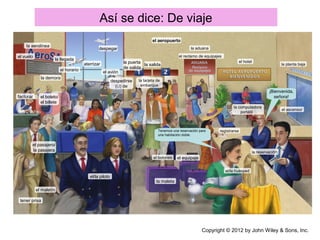
Así se dice: De viaje
la aerolínea
el horario
el vuelo
la llegada
la demora
el boleto/
el billete
facturar
la maleta
el pasajero/
la pasajera
el maletín
el equipaje
la salida
tener prisa
el/la piloto
el avión
despegar
la puerta
de salida
aterrizar
despedirse
(i,i) de
la tarjeta de
embarque
la aduana
el reclamo de equipajes
el hotel
el ascensor
el/la huésped
la planta baja
registrarse
la computadora
portátil
el botones
Tenemos una reservación para
una habitación doble.
el aeropuerto
la reservación
¡Bienvenida,
señora!
Copyright © 2012 by John Wiley & Sons, Inc.
Así se dice: De viaje
Responde a la siguiente pregunta con base en la ilustración.
(Go to section Preguntas de
comprensión in the Instructor’s
Edition for more questions.)
Copyright © 2012 by John Wiley & Sons, Inc.
Modelo: La profesora Falcón y Carmen van a facturar el equipaje en
la misma aerolínea. ¿Cómo se llama la aerolínea?
Se van de viaje
Copyright©2012byJohnWiley&Sons,Inc.
Así se forma 1: The subjunctive with
impersonal expressions
Use the subjunctive in clauses that follow impersonal expressions
formed with the verb ser.
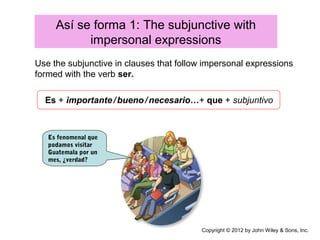
Es + importante/bueno/necesario…+ que + subjuntivo
Es fenomenal que
podamos visitar
Guatemala por un
mes, ¿verdad?
Copyright © 2012 by John Wiley & Sons, Inc.
Así se forma 1: The subjunctive with
impersonal expressions
es bueno/buena idea
es importante
es mejor
es necesario/es preciso
es urgente
it’s good/a good idea
it’s important
it’s better
it’s necessary
it’s urgent
 to express wishes, recommendations, and requests for
someone else to do something or something to happen:
Es importante que hagas la reservación.
It’s important that you make the reservation.
Copyright © 2012 by John Wiley & Sons, Inc.
Así se forma 1: The subjunctive with
impersonal expressions
es extraño
es fantástico
es horrible
es ridículo
es una lástima
no es justo
it’s strange
it’s wonderful
it’s horrible
it’s ridiculous
it’s a shame
it's unfair
 to express emotional reactions to the actions or conditions
of another person or thing:
Es una lástima que te vayas tan temprano.
It’s a shame that you are leaving so early.
Copyright © 2012 by John Wiley & Sons, Inc.
Así se forma 1: The subjunctive with
impersonal expressions
es imposible
es improbable
es posible
es probable
it’s impossible
it’s improbable
it’s possible
it’s likely
 to express doubts and uncertainties:
Es posible que perdamos la conexión en Miami.
It’s possible that we'll miss the connection in Miami.
Copyright © 2012 by John Wiley & Sons, Inc.
Así se forma 1: The subjunctive with
impersonal expressions
 If there is no change of subject after the impersonal expression,
generally the infinitive is used instead of que + subjunctive.
Copyright © 2012 by John Wiley & Sons, Inc.
 Expressions such as es verdad, es cierto, and es obvio used
affirmatively require the indicative as they introduce factual vs.
subjective statements.
Es necesario ir al aeropuerto temprano.
It’s necessary to go to the airport early.
Es verdad/cierto que hace calor en Madrid en el verano.
It’s true that it is hot in Madrid in the summer.
Práctica: The subjunctive with impersonal
expressions
Haz oraciones con estos elementos.
1. es posible / no es verdad → Es posible que eso no sea verdad.
2. es imposible / no ha llegado
3. es probable / llover mañana
4. es improbable / (él) llega pronto
5. es extraño / no te han llamado
6. es una lástima / no están aquí
7. no es justo / no les han invitado
8. es ridículo / (vosotros) preocuparse tanto
9. es fenomenal / (tú) dibujas tan bien
10. es horrible / Alfonso ha perdido su pasaporte
Copyright © 2012 by John Wiley & Sons, Inc.
Cultura: Guatemala y El Salvador
Copyright © 2012 by John Wiley & Sons, Inc.
Cultura: Guatemala y El Salvador
Video Documentales culturales:
Feria de Chichicastenango, Guatemala
Click here to see the video.
¿Qué productos se venden en la feria? Menciona al menos 5.
Video Documentales culturales:
Historia de la moneda, El Salvador
Click here to see the video.
¿Cómo eran los macacos?
Copyright © 2012 by John Wiley & Sons, Inc.
Responde a las siguientes preguntas con oraciones completas.
Note: Internet connection required to view videos
via video link button.
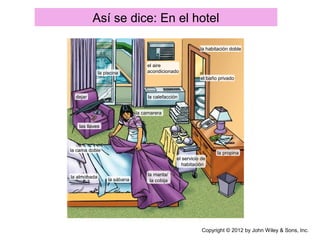
Así se dice: En el hotel
la camarera
la almohada la manta/
la cobijala sábana
el servicio de
habitación
dejar
la propina
el baño privado
la calefacción
las llaves
la cama doble
el aire
acondicionadola piscina
la habitación doble
Copyright © 2012 by John Wiley & Sons, Inc.
Así se dice: En la estación
Copyright©2012byJohnWiley&Sons,Inc.
Cultura: El alojamiento en el mundo hispano
 El mundo hispano les ofrece a todos los viajeros el alojamiento ideal para que su visita
sea memorable.
 Para los empresarios o los turistas exigentes (demanding), todas las ciudades
importantes cuentan con hoteles de calibre excepcional y cadenas reconocidas
mundialmente, como los hoteles Meliá o Hilton.
 Para los trotamundos, los jóvenes con un presupuesto módico (modest) o los viajeros
menos exigentes, hay hostales y pensiones (hoteles modestos, a veces en casas
privadas) que son más “caseros” y económicos. Estos establecimientos no tienen los lujos
o las comodidades de los grandes hoteles, pero en cambio (on the other hand) ofrecen la
oportunidad de conocer mejor a los habitantes del lugar y de estar en un ambiente
amigable.
 Entre los hospedajes más bellos y pintorescos del mundo hispano están los paradores1
nacionales o históricos.
Copyright©2012byJohnWiley&Sons,Inc.
1
Historical buildings transformed into luxurious hotels.
Cultura: El alojamiento en el mundo hispano
 ¿Qué es un parador? Nombra un
parador famoso en España. ¿Qué puedes
decir sobre ese parador?
 ¿Qué ofrecen los paradores que no
tienen los grandes hoteles?
 ¿Qué era anteriormente el Parador de
Granada?
 ¿Te gustaría pasar unos días en uno de
estos paradores? ¿En cuál? ¿Por qué?
 ¿Hay alojamientos similares a los
paradores en tu país? ¿Cómo se llaman?
Video Documentales culturales: Alojamientos en España
Click here to see the video.
Copyright © 2012 by John Wiley & Sons, Inc.
Note: Internet
connection required
to view videos
via video link button.
Así se forma 2: The subjunctive with
indefinite entities
Adjectival clauses are used when an idea cannot be
expressed with just one adjective:
Prefiero una
habitación que
tenga una
cama doble…
Copyright © 2012 by John Wiley & Sons, Inc.
Vamos a un hotel lujoso. Vamos a un hotel que tiene
piscina y gimnasio.
Busco un hotel barato. Busco un hotel que no cueste
más de $100 al día.
Así se forma 2: The subjunctive with
indefinite entities
When a reference to a person or thing is: either non-specific
(unidentified, hypothetical, unknown) or nonexistent in the mind
of the speaker, Spanish uses the subjunctive in the clause
following que.
Copyright © 2012 by John Wiley & Sons, Inc.
Busco un hotel que cueste menos de $100 al día.
I’m looking for a hotel that costs less than $100 per day.
Queremos un guía que pueda ayudarnos.
We want a guide who can help us.
Queremos un botones que pueda ayudarnos.
We need a car that has air-conditioning.
Así se forma 2: The subjunctive with
indefinite entities
However, if the person or thing is known, identified, or definitely
exists in the mind of the speaker, the indicative is used in the
clause following que.
Copyright © 2012 by John Wiley & Sons, Inc.
Hay un agente que puede ayudarle.
There is a bellhop who can help you.
Alquilamos un coche que tiene aire acondicionado.
We rented a car that has air-conditioning.
Me quedo en un hotel que tiene piscina y gimnasio.
I’m staying at a hotel that has a pool and a gym.
Así se forma 2: The subjunctive with
indefinite entities
If we are asking whether someone/something exists or saying that
someone/something does not exist, we also use the subjunctive.
Copyright © 2012 by John Wiley & Sons, Inc.
¿Hay alguien aquí que pueda ayudarnos?
Is there someone here who can help us?
No hay ningún hotel aquí que tenga piscina.
There isn’t any hotel here that has a pool.
Práctica: The subjunctive with
indefinite entities
Haz preguntas con estos elementos.
¿Hay alguien que…?
1. poder ayudarme
2. saber dónde está el banco
3. entender ruso
4. hablar francés
5. tener un billete de $20
¿No hay nada que…?
7. tú puedes hacer
8. él quiere hacer
9. ser más barato aquí
10. te gusta más que los otros
..
Copyright © 2012 by John Wiley & Sons, Inc.
Necesito descansar
¿Qué es necesario, según la pareja, que tenga la
habitación?
¿Qué tiene la habitación?
Video Diálogo: Necesito descansar
Click here to see the video.
Copyright © 2012 by John Wiley & Sons, Inc.
Note: Internet
connection
required to view
videos
via video link
button.
Así se forma 3: Hacer in time constructions
Hacer is used to express an action that has been going on for
a period of time.
hace + time + que + present tense
Hace dos días que están en Guatemala.
They have been in Guatemala for two days.
Copyright © 2012 by John Wiley & Sons, Inc.
Hace veinte minutos que esperamos el tren.
We have been waiting for the train for twenty minutes.
Así se forma 3: Hacer in time constructions
To ask how long an action or condition has been going on, use
the question:
¿Cuánto tiempo hace que + present tense?
¿Cuánto tiempo hace que Esteban estudia en la biblioteca?
How long has Esteban been studying at the library?
Copyright © 2012 by John Wiley & Sons, Inc.
Hace tres horas que está allí.
He has been there for three hours.
Hacer is also used to indicate how long ago an action took place.
preterit tense of the verb + hace + the amount of time
Vi a Greta hace una hora. or Hace una hora que vi a Greta.
I saw Greta an hour ago. I saw Greta an hour ago.
preterit + hace + time or Hace + time + que + preterit
El avión despegó hace diez minutos.
The plane took off ten minutes ago.
Copyright©2012byJohnWiley&Sons,Inc.
Así se forma 3: Hacer to express ago
Statements about how long ago something took place have two
possible word orders.
Práctica: ¿Cuánto tiempo hace…?
Modelo:
Copyright © 2012 by John Wiley & Sons, Inc.
1. pasar la noche estudiando
2. ir al gimnasio
3. salir con amigos
4. llamar a tu mejor amigo/a
5. cenar con un/a amigo/a
6. leer un libro interesante
7. ir al doctor
8. estudiar español
9. tocar un instrumento
10. conocer a tu mejor amigo/a
¿Cuánto tiempo hace que vives en los Estados Unidos?
Hace cinco años que vivo en los Estados Unidos.

Media ppt ch13

  • 1.
    CaCa Copyright © 2012by John Wiley & Sons, Inc. De viajeDe viaje Media-Enriched PPTs Note: Internet connection required to view videos via video link button. DichoyhechoNinthedition
  • 2.
    Capítulo 13Capítulo 13De viaje Así se dice  De viaje  En el hotel y en la estación Cultura  Guatemala y El Salvador  El alojamiento en el mundo hispano Así se forma  The subjunctive with impersonal expressions (A summary)  The subjunctive with indefinite entities  Hacer in time constructions Copyright © 2012 by John Wiley & Sons, Inc.
  • 3.
    Así se dice:De viaje la aerolínea el horario el vuelo la llegada la demora el boleto/ el billete facturar la maleta el pasajero/ la pasajera el maletín el equipaje la salida tener prisa el/la piloto el avión despegar la puerta de salida aterrizar despedirse (i,i) de la tarjeta de embarque la aduana el reclamo de equipajes el hotel el ascensor el/la huésped la planta baja registrarse la computadora portátil el botones Tenemos una reservación para una habitación doble. el aeropuerto la reservación ¡Bienvenida, señora! Copyright © 2012 by John Wiley & Sons, Inc.
  • 4.
    Así se dice:De viaje Responde a la siguiente pregunta con base en la ilustración. (Go to section Preguntas de comprensión in the Instructor’s Edition for more questions.) Copyright © 2012 by John Wiley & Sons, Inc. Modelo: La profesora Falcón y Carmen van a facturar el equipaje en la misma aerolínea. ¿Cómo se llama la aerolínea?
  • 5.
    Se van deviaje Copyright©2012byJohnWiley&Sons,Inc.
  • 6.
    Así se forma1: The subjunctive with impersonal expressions Use the subjunctive in clauses that follow impersonal expressions formed with the verb ser. Es + importante/bueno/necesario…+ que + subjuntivo Es fenomenal que podamos visitar Guatemala por un mes, ¿verdad? Copyright © 2012 by John Wiley & Sons, Inc.
  • 7.
    Así se forma1: The subjunctive with impersonal expressions es bueno/buena idea es importante es mejor es necesario/es preciso es urgente it’s good/a good idea it’s important it’s better it’s necessary it’s urgent  to express wishes, recommendations, and requests for someone else to do something or something to happen: Es importante que hagas la reservación. It’s important that you make the reservation. Copyright © 2012 by John Wiley & Sons, Inc.
  • 8.
    Así se forma1: The subjunctive with impersonal expressions es extraño es fantástico es horrible es ridículo es una lástima no es justo it’s strange it’s wonderful it’s horrible it’s ridiculous it’s a shame it's unfair  to express emotional reactions to the actions or conditions of another person or thing: Es una lástima que te vayas tan temprano. It’s a shame that you are leaving so early. Copyright © 2012 by John Wiley & Sons, Inc.
  • 9.
    Así se forma1: The subjunctive with impersonal expressions es imposible es improbable es posible es probable it’s impossible it’s improbable it’s possible it’s likely  to express doubts and uncertainties: Es posible que perdamos la conexión en Miami. It’s possible that we'll miss the connection in Miami. Copyright © 2012 by John Wiley & Sons, Inc.
  • 10.
    Así se forma1: The subjunctive with impersonal expressions  If there is no change of subject after the impersonal expression, generally the infinitive is used instead of que + subjunctive. Copyright © 2012 by John Wiley & Sons, Inc.  Expressions such as es verdad, es cierto, and es obvio used affirmatively require the indicative as they introduce factual vs. subjective statements. Es necesario ir al aeropuerto temprano. It’s necessary to go to the airport early. Es verdad/cierto que hace calor en Madrid en el verano. It’s true that it is hot in Madrid in the summer.
  • 11.
    Práctica: The subjunctivewith impersonal expressions Haz oraciones con estos elementos. 1. es posible / no es verdad → Es posible que eso no sea verdad. 2. es imposible / no ha llegado 3. es probable / llover mañana 4. es improbable / (él) llega pronto 5. es extraño / no te han llamado 6. es una lástima / no están aquí 7. no es justo / no les han invitado 8. es ridículo / (vosotros) preocuparse tanto 9. es fenomenal / (tú) dibujas tan bien 10. es horrible / Alfonso ha perdido su pasaporte Copyright © 2012 by John Wiley & Sons, Inc.
  • 12.
    Cultura: Guatemala yEl Salvador Copyright © 2012 by John Wiley & Sons, Inc.
  • 13.
    Cultura: Guatemala yEl Salvador Video Documentales culturales: Feria de Chichicastenango, Guatemala Click here to see the video. ¿Qué productos se venden en la feria? Menciona al menos 5. Video Documentales culturales: Historia de la moneda, El Salvador Click here to see the video. ¿Cómo eran los macacos? Copyright © 2012 by John Wiley & Sons, Inc. Responde a las siguientes preguntas con oraciones completas. Note: Internet connection required to view videos via video link button.
  • 14.
    Así se dice:En el hotel la camarera la almohada la manta/ la cobijala sábana el servicio de habitación dejar la propina el baño privado la calefacción las llaves la cama doble el aire acondicionadola piscina la habitación doble Copyright © 2012 by John Wiley & Sons, Inc.
  • 15.
    Así se dice:En la estación Copyright©2012byJohnWiley&Sons,Inc.
  • 16.
    Cultura: El alojamientoen el mundo hispano  El mundo hispano les ofrece a todos los viajeros el alojamiento ideal para que su visita sea memorable.  Para los empresarios o los turistas exigentes (demanding), todas las ciudades importantes cuentan con hoteles de calibre excepcional y cadenas reconocidas mundialmente, como los hoteles Meliá o Hilton.  Para los trotamundos, los jóvenes con un presupuesto módico (modest) o los viajeros menos exigentes, hay hostales y pensiones (hoteles modestos, a veces en casas privadas) que son más “caseros” y económicos. Estos establecimientos no tienen los lujos o las comodidades de los grandes hoteles, pero en cambio (on the other hand) ofrecen la oportunidad de conocer mejor a los habitantes del lugar y de estar en un ambiente amigable.  Entre los hospedajes más bellos y pintorescos del mundo hispano están los paradores1 nacionales o históricos. Copyright©2012byJohnWiley&Sons,Inc. 1 Historical buildings transformed into luxurious hotels.
  • 17.
    Cultura: El alojamientoen el mundo hispano  ¿Qué es un parador? Nombra un parador famoso en España. ¿Qué puedes decir sobre ese parador?  ¿Qué ofrecen los paradores que no tienen los grandes hoteles?  ¿Qué era anteriormente el Parador de Granada?  ¿Te gustaría pasar unos días en uno de estos paradores? ¿En cuál? ¿Por qué?  ¿Hay alojamientos similares a los paradores en tu país? ¿Cómo se llaman? Video Documentales culturales: Alojamientos en España Click here to see the video. Copyright © 2012 by John Wiley & Sons, Inc. Note: Internet connection required to view videos via video link button.
  • 18.
    Así se forma2: The subjunctive with indefinite entities Adjectival clauses are used when an idea cannot be expressed with just one adjective: Prefiero una habitación que tenga una cama doble… Copyright © 2012 by John Wiley & Sons, Inc. Vamos a un hotel lujoso. Vamos a un hotel que tiene piscina y gimnasio. Busco un hotel barato. Busco un hotel que no cueste más de $100 al día.
  • 19.
    Así se forma2: The subjunctive with indefinite entities When a reference to a person or thing is: either non-specific (unidentified, hypothetical, unknown) or nonexistent in the mind of the speaker, Spanish uses the subjunctive in the clause following que. Copyright © 2012 by John Wiley & Sons, Inc. Busco un hotel que cueste menos de $100 al día. I’m looking for a hotel that costs less than $100 per day. Queremos un guía que pueda ayudarnos. We want a guide who can help us. Queremos un botones que pueda ayudarnos. We need a car that has air-conditioning.
  • 20.
    Así se forma2: The subjunctive with indefinite entities However, if the person or thing is known, identified, or definitely exists in the mind of the speaker, the indicative is used in the clause following que. Copyright © 2012 by John Wiley & Sons, Inc. Hay un agente que puede ayudarle. There is a bellhop who can help you. Alquilamos un coche que tiene aire acondicionado. We rented a car that has air-conditioning. Me quedo en un hotel que tiene piscina y gimnasio. I’m staying at a hotel that has a pool and a gym.
  • 21.
    Así se forma2: The subjunctive with indefinite entities If we are asking whether someone/something exists or saying that someone/something does not exist, we also use the subjunctive. Copyright © 2012 by John Wiley & Sons, Inc. ¿Hay alguien aquí que pueda ayudarnos? Is there someone here who can help us? No hay ningún hotel aquí que tenga piscina. There isn’t any hotel here that has a pool.
  • 22.
    Práctica: The subjunctivewith indefinite entities Haz preguntas con estos elementos. ¿Hay alguien que…? 1. poder ayudarme 2. saber dónde está el banco 3. entender ruso 4. hablar francés 5. tener un billete de $20 ¿No hay nada que…? 7. tú puedes hacer 8. él quiere hacer 9. ser más barato aquí 10. te gusta más que los otros .. Copyright © 2012 by John Wiley & Sons, Inc.
  • 23.
    Necesito descansar ¿Qué esnecesario, según la pareja, que tenga la habitación? ¿Qué tiene la habitación? Video Diálogo: Necesito descansar Click here to see the video. Copyright © 2012 by John Wiley & Sons, Inc. Note: Internet connection required to view videos via video link button.
  • 24.
    Así se forma3: Hacer in time constructions Hacer is used to express an action that has been going on for a period of time. hace + time + que + present tense Hace dos días que están en Guatemala. They have been in Guatemala for two days. Copyright © 2012 by John Wiley & Sons, Inc. Hace veinte minutos que esperamos el tren. We have been waiting for the train for twenty minutes.
  • 25.
    Así se forma3: Hacer in time constructions To ask how long an action or condition has been going on, use the question: ¿Cuánto tiempo hace que + present tense? ¿Cuánto tiempo hace que Esteban estudia en la biblioteca? How long has Esteban been studying at the library? Copyright © 2012 by John Wiley & Sons, Inc. Hace tres horas que está allí. He has been there for three hours.
  • 26.
    Hacer is alsoused to indicate how long ago an action took place. preterit tense of the verb + hace + the amount of time Vi a Greta hace una hora. or Hace una hora que vi a Greta. I saw Greta an hour ago. I saw Greta an hour ago. preterit + hace + time or Hace + time + que + preterit El avión despegó hace diez minutos. The plane took off ten minutes ago. Copyright©2012byJohnWiley&Sons,Inc. Así se forma 3: Hacer to express ago Statements about how long ago something took place have two possible word orders.
  • 27.
    Práctica: ¿Cuánto tiempohace…? Modelo: Copyright © 2012 by John Wiley & Sons, Inc. 1. pasar la noche estudiando 2. ir al gimnasio 3. salir con amigos 4. llamar a tu mejor amigo/a 5. cenar con un/a amigo/a 6. leer un libro interesante 7. ir al doctor 8. estudiar español 9. tocar un instrumento 10. conocer a tu mejor amigo/a ¿Cuánto tiempo hace que vives en los Estados Unidos? Hace cinco años que vivo en los Estados Unidos.