La rutina
diaria
CapCap
Copyright © 2008 by John Wiley & Sons, Inc.
Media-Enriched PPTs
Note: Internet connection required to view videos
via video link button.
Copyright © 2008 by John Wiley & Sons, Inc.
Capítulo 6Capítulo 6
La rutina diaria
Así se dice
Así se forma
Cultura
La rutina diaria
El trabajo
Reflexive verbs
Adverbs
The preterit of regular verbs and
ser/ir
Direct-object pronouns
España contemporánea: Herencia y
modernidad
Los días festivos
Artes ornamentales: Los azulejos de España
Copyright © 2008 by John Wiley & Sons, Inc.
Así se dice: La rutina diaria
Por la mañana Por la noche
Copyright © 2008 by John Wiley & Sons, Inc.
Así se dice: La rutina diaria
Por la mañana
Copyright © 2008 by John Wiley & Sons, Inc.
Así se dice: La rutina diaria
Por la mañana
Copyright © 2008 by John Wiley & Sons, Inc.
Así se dice: La rutina diaria
Por la noche
Copyright © 2008 by John Wiley & Sons, Inc.
Así se dice: La rutina diaria
Por la noche
Copyright © 2008 by John Wiley & Sons, Inc.
Así se dice: La rutina diaria
(Go to section ‘Preguntas de comprensión’ on page 580 for more questions)
Answer the questions based on pages 178 and 179.
Modelo:
1. Es por la mañana, ¿dónde está Celia, en la
bañera o en la cama? (…) ¿Suena el teléfono
o suena el despertador? (…) ¿Debe despertarse
o debe dormirse? (…) Y Camila, ¿qué hace? (…)
¿Se levanta o se acuesta?
Así se dice: La rutina diaria
Copyright © 2008 by John Wiley & Sons, Inc.
Cultura: España
Copyright © 2008 by John Wiley & Sons, Inc.
Cultura: España
• ¿Qué opinas de la fiesta de los toros?
• ¿Crees que es un arte?
Video: Documentales culturales:
La tauromaquia cordobesa, España
Video: Documentales culturales:
La tauromaquia cordobesa, España
Copyright © 2008 by John Wiley & Sons, Inc.
Así se forma 1: Reflexive verbs
(Verbs with –se are reflexive verbs. You learn that when you learn the verb.)
Reflexive actions
 are performed by people to themselves
 are often expressed by verbs describing daily routine or personal care
activities
Express reflexive actions in Spanish
 with the reflexive pronouns me, te, se, nos, os, se (myself, yourself,
himself, etc.)
 with a conjugated verb (lavar, bañar, levantar, etc.)
Carlos baña a su hermanito. (nonreflexive)
Carlos bathes his little brother.
Carlos se baña. (reflexive) Carlos bathes himself.
Copyright © 2008 by John Wiley & Sons, Inc.
Conjugation of reflexive verbs
(yo)
(tú)
(usted,
él, ella)
(nosotros/as)
(vosotros/as)
(ustedes,
ellos, ellas)
vist
vist
vist
vest
vest
vist
me
te
se
nos
os
se
vestirse (to get dressed)
o
es
e
imos
ís
en
Copyright © 2008 by John Wiley & Sons, Inc.
Placement of reflexive pronouns
Keep in mind that…
 the reflexive pronoun is placed immediately before the
conjugated verb.
 Me despierto a las seis.
 with an infinitive or present participle (-ando/-iendo),
the reflexive pronoun may be placed before the conjugated verb
or attached to the infinitive or present participle.
 Me tengo que levantar temprano. or
 Tengo que levantarme temprano.
Copyright © 2008 by John Wiley & Sons, Inc.Copyright © 2008 by John Wiley & Sons, Inc.
Reflexive verbs with stem change
Note that some reflexive verbs have a stem change in the present
participle:
e → i: vestirse → vistiéndose divertirse → divirtiéndose
o → u: dormirse → durmiéndose
Copyright © 2008 by John Wiley & Sons, Inc.Copyright © 2008 by John Wiley & Sons, Inc.
La rutina de Alejandra
Talk about Alejandra’s morning routine by describing
what she’s doing in each drawing.
Modelo:
Alejandra se despierta a las
ocho de la mañana.
1.
2.
3. 4. 5.
Así se forma 2: Adverbs
Copyright © 2008 by John Wiley & Sons, Inc.
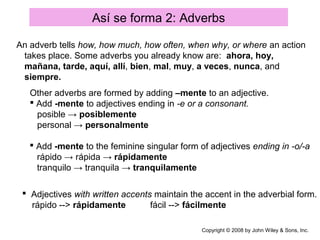
An adverb tells how, how much, how often, when why, or where an action
takes place. Some adverbs you already know are: ahora, hoy,
mañana, tarde, aquí, allí, bien, mal, muy, a veces, nunca, and
siempre.
Other adverbs are formed by adding –mente to an adjective.
 Add -mente to adjectives ending in -e or a consonant.
posible → posiblemente
personal → personalmente
 Add -mente to the feminine singular form of adjectives ending in -o/-a
rápido → rápida → rápidamente
tranquilo → tranquila → tranquilamente
 Adjectives with written accents maintain the accent in the adverbial form.
rápido --> rápidamente fácil --> fácilmente
Así se forma 2: Adverbs
Copyright © 2008 by John Wiley & Sons, Inc.
Some common adverbs:
constantemente constantly
desafortunadamente unfortunately
fácilmente easily
frecuentemente frequently
generalmente generally
inmediatamente immediately
lentamente slowly
normalmente normally
personalmente personally
posiblemente possibly
probablemente probably
rápidamente rapidly
recientemente recently
tranquilamente peacefully
Practice adverbs
Copyright © 2008 by John Wiley & Sons, Inc.
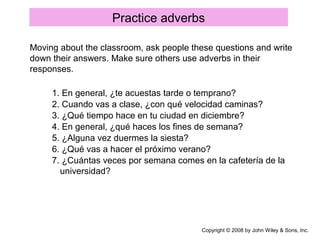
Moving about the classroom, ask people these questions and write
down their answers. Make sure others use adverbs in their
responses.
1. En general, ¿te acuestas tarde o temprano?
2. Cuando vas a clase, ¿con qué velocidad caminas?
3. ¿Qué tiempo hace en tu ciudad en diciembre?
4. En general, ¿qué haces los fines de semana?
5. ¿Alguna vez duermes la siesta?
6. ¿Qué vas a hacer el próximo verano?
7. ¿Cuántas veces por semana comes en la cafetería de la
universidad?
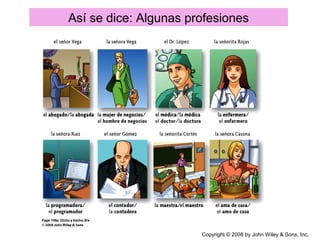
Así se dice: Algunas profesiones
Copyright © 2008 by John Wiley & Sons, Inc.
Así se dice: Algunas profesiones
Copyright © 2008 by John Wiley & Sons, Inc.
Así se forma 3: The preterit of regular verbs
and ser/ir
Copyright © 2008 by John Wiley & Sons, Inc.
The preterit tense is used to talk about actions in the past we
view/perceive as complete,
Me levanté a las ocho y desayuné. I got up at eight and had breakfast.
—¿Cuándo volviste? When did you return?
—Volví a la una. I returned at one.
or past actions with a specific beginning, an end or both.
Estudié en la biblioteca por dos horas. I studied at the library for two hours.
Comencé a estudiar a las tres. I began to study at three.
Terminé a las cinco. I finished at five.
The preterit of regular verbs and ser/ir
Copyright © 2008 by John Wiley & Sons, Inc.

.
(yo)
(tú)
(usted,
él, ella)
(nosotros/as)
(vosotros/as)
(ustedes,
ellos, ellas)
estudi
estudi
estudi
estudi
estudi
estudi
é
aste
ó
amos
asteis
aron
volv
volv
volv
volv
volv
volv
í
iste
ió
imos
isteis
ieron
sal
sal
sal
sal
sal
sal
í
iste
ió
imos
isteis
ieron
estudiar volver salir
Verbs with spelling changes in the preterit
and ser/ir
Copyright © 2008 by John Wiley & Sons, Inc.
fui, fuiste, fue, fuimos, fuisteis, fueron
 Ser and ir have identical but irregular preterit endings; context
clarifies which verb is meant.
ser
ir
 Leer (to read) and oír (to hear) have spelling changes in
the 3rd person forms (i>y).
leer:
oír:
leí, leíste, leyó, leímos, leísteis, leyeron
oí, oíste, oyó, oímos, oísteis, oyeron
Verbs with spelling changes in the preterit
Copyright © 2008 by John Wiley & Sons, Inc.
-gar
-car
-zar
g→gu
c→qu
yo jugué,
yo llegué,
yo toqué,
yo busqué,
z→c
jugar
llegar
tocar
buscar
abrazar
almorzar
yo abracé,
yo almorcé,
tú jugaste,…
tú llegaste,…
tú tocaste,…
tú buscaste,…
tú abrazaste,…
tú almorzaste,…
Verbs ending in -gar, -car, and -zar change spelling only in the yo form
of the preterit.
Practice the preterit of regular verbs and ser/ir
Copyright © 2008 by John Wiley & Sons, Inc.
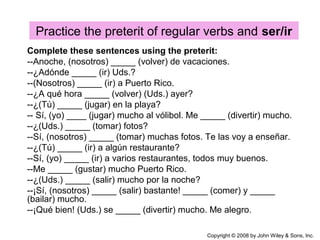
Complete these sentences using the preterit:
--Anoche, (nosotros) _____ (volver) de vacaciones.
--¿Adónde _____ (ir) Uds.?
--(Nosotros) _____ (ir) a Puerto Rico.
--¿A qué hora _____ (volver) (Uds.) ayer?
--¿(Tú) _____ (jugar) en la playa?
-- Sí, (yo) ____ (jugar) mucho al vólibol. Me _____ (divertir) mucho.
--¿(Uds.) _____ (tomar) fotos?
--Sí, (nosotros) _____ (tomar) muchas fotos. Te las voy a enseñar.
--¿(Tú) _____ (ir) a algún restaurante?
--Sí, (yo) _____ (ir) a varios restaurantes, todos muy buenos.
--Me _____ (gustar) mucho Puerto Rico.
--¿(Uds.) _____ (salir) mucho por la noche?
--¡Sí, (nosotros) _____ (salir) bastante! _____ (comer) y _____
(bailar) mucho.
--¡Qué bien! (Uds.) se _____ (divertir) mucho. Me alegro.
Cultura: Los días festivos
Copyright © 2008 by John Wiley & Sons, Inc.
Video: Documental: La feria de San IsidroVideo: Documental: La feria de San Isidro
 ¿Cuándo es la feria de San Isidro?
 ¿Cuántos tipos de rosquillas hay?
Así se forma 4: Direct-object pronouns
Copyright © 2008 by John Wiley & Sons, Inc.
 identify people or things that directly receives the action of the
verb.
 answer the questions who/whom?
Vi a Laurie.
La vi en el gimnasio.
answer the questions what?
Laurie compró el champú.
Lo compró ayer.
Direct object pronouns
Copyright © 2008 by John Wiley & Sons, Inc.
me Carlos no me llamó. Carlos did not call me.
te ¿Te llamó Carlos? Did Carlos call you?
lo No lo conozco. (a Juan/ a Ud., m.)
No lo tengo. (el libro)
I don’t know him/you (m.).
I don’t have it. (m.).
la Juan la conoce. (a Lola / a Ud., f.)
Juan la come. (la fruta)
Juan knows her/you. (f.).
Juan eats it (f.).
nos Laurie nos visitó anoche. Laurie visited us last night.
os ¿Quién os visitó? Who visited you (pl.)?
los Voy a llamarlos. (a ellos/a Uds., m.)
Voy a preparalos. (los cafés)
I am going to call them/you. (m.).
I am going to prepare them. (m.).
las Pedro las admira. (a ellas/a Uds. f.)
Pedro las va a preparar. (las bebidas)
Pedro admires them/you. (f.).
Carlos is going to prepare them (f.).
Direct object pronouns
Copyright © 2008 by John Wiley & Sons, Inc.
Posición de los pronombres de objeto directo
The direct-object pronoun is placed immediately
before a conjugated verb.
Lo compré. I bought it.
If a conjugated verb is followed by an infinitive or
present participle (-ando/-iendo form), place the direct-object
pronoun either immediately before the conjugated verb or after
and attached to the infinitive or present participle. It cannot be placed
between both forms.
Voy a invitarla. o La voy a invitar. I am going to invite her.
Estoy llamándola. o La estoy llamando. I am calling her.
Practice direct-object pronouns
Copyright © 2008 by John Wiley & Sons, Inc.
Complete these dialogues:
--¿Compraste los regalos? --¿Leíste tu libro?
--Sí, ___ compré ayer. --Sí, ___ leí.
--¿Viste a Carlos anoche? --¿Comiste todas las galletas?
--No, no ___ ví. --Sí, ¡___ comí todas!
--¿Preparaste la cena? --¿Pediste el menú?
--Sí, ___ preparé. --Sí, ___ pedí.
--¿Vas a ver a tus amigos? --¿Quieres hacer las compras?
--No, no voy a _____. --No, no quiero _____.
--¿Estás leyendo esta revista? --¿Están haciendo la tarea?
--No, no ___ estoy leyendo. --No, no ___ estamos haciendo.
--¿Te gusta ver ese programa de televisión? --¿Vas a invitar a mis primas?
--Sí, me gusta _____. --Sí, voy a _____.
Diálogo: La rosa sevillana
Copyright © 2008 by John Wiley & Sons, Inc.
Video: Diálogo: La rosa sevillana
Answer the following questions with a
complete sentence.
1. ¿Quién regaló una rosa a
Carmen?
2. Generalmente, ¿qué es parte del
espectáculo en el tablao?

Dicho Chapter 6

  • 1.
    La rutina diaria CapCap Copyright ©2008 by John Wiley & Sons, Inc. Media-Enriched PPTs Note: Internet connection required to view videos via video link button.
  • 2.
    Copyright © 2008by John Wiley & Sons, Inc. Capítulo 6Capítulo 6 La rutina diaria Así se dice Así se forma Cultura La rutina diaria El trabajo Reflexive verbs Adverbs The preterit of regular verbs and ser/ir Direct-object pronouns España contemporánea: Herencia y modernidad Los días festivos Artes ornamentales: Los azulejos de España
  • 3.
    Copyright © 2008by John Wiley & Sons, Inc. Así se dice: La rutina diaria Por la mañana Por la noche
  • 4.
    Copyright © 2008by John Wiley & Sons, Inc. Así se dice: La rutina diaria Por la mañana
  • 5.
    Copyright © 2008by John Wiley & Sons, Inc. Así se dice: La rutina diaria Por la mañana
  • 6.
    Copyright © 2008by John Wiley & Sons, Inc. Así se dice: La rutina diaria Por la noche
  • 7.
    Copyright © 2008by John Wiley & Sons, Inc. Así se dice: La rutina diaria Por la noche
  • 8.
    Copyright © 2008by John Wiley & Sons, Inc. Así se dice: La rutina diaria (Go to section ‘Preguntas de comprensión’ on page 580 for more questions) Answer the questions based on pages 178 and 179. Modelo: 1. Es por la mañana, ¿dónde está Celia, en la bañera o en la cama? (…) ¿Suena el teléfono o suena el despertador? (…) ¿Debe despertarse o debe dormirse? (…) Y Camila, ¿qué hace? (…) ¿Se levanta o se acuesta? Así se dice: La rutina diaria
  • 9.
    Copyright © 2008by John Wiley & Sons, Inc. Cultura: España
  • 10.
    Copyright © 2008by John Wiley & Sons, Inc. Cultura: España • ¿Qué opinas de la fiesta de los toros? • ¿Crees que es un arte? Video: Documentales culturales: La tauromaquia cordobesa, España Video: Documentales culturales: La tauromaquia cordobesa, España
  • 11.
    Copyright © 2008by John Wiley & Sons, Inc. Así se forma 1: Reflexive verbs (Verbs with –se are reflexive verbs. You learn that when you learn the verb.) Reflexive actions  are performed by people to themselves  are often expressed by verbs describing daily routine or personal care activities Express reflexive actions in Spanish  with the reflexive pronouns me, te, se, nos, os, se (myself, yourself, himself, etc.)  with a conjugated verb (lavar, bañar, levantar, etc.) Carlos baña a su hermanito. (nonreflexive) Carlos bathes his little brother. Carlos se baña. (reflexive) Carlos bathes himself.
  • 12.
    Copyright © 2008by John Wiley & Sons, Inc. Conjugation of reflexive verbs (yo) (tú) (usted, él, ella) (nosotros/as) (vosotros/as) (ustedes, ellos, ellas) vist vist vist vest vest vist me te se nos os se vestirse (to get dressed) o es e imos ís en
  • 13.
    Copyright © 2008by John Wiley & Sons, Inc. Placement of reflexive pronouns Keep in mind that…  the reflexive pronoun is placed immediately before the conjugated verb.  Me despierto a las seis.  with an infinitive or present participle (-ando/-iendo), the reflexive pronoun may be placed before the conjugated verb or attached to the infinitive or present participle.  Me tengo que levantar temprano. or  Tengo que levantarme temprano.
  • 14.
    Copyright © 2008by John Wiley & Sons, Inc.Copyright © 2008 by John Wiley & Sons, Inc. Reflexive verbs with stem change Note that some reflexive verbs have a stem change in the present participle: e → i: vestirse → vistiéndose divertirse → divirtiéndose o → u: dormirse → durmiéndose
  • 15.
    Copyright © 2008by John Wiley & Sons, Inc.Copyright © 2008 by John Wiley & Sons, Inc. La rutina de Alejandra Talk about Alejandra’s morning routine by describing what she’s doing in each drawing. Modelo: Alejandra se despierta a las ocho de la mañana. 1. 2. 3. 4. 5.
  • 16.
    Así se forma2: Adverbs Copyright © 2008 by John Wiley & Sons, Inc. An adverb tells how, how much, how often, when why, or where an action takes place. Some adverbs you already know are: ahora, hoy, mañana, tarde, aquí, allí, bien, mal, muy, a veces, nunca, and siempre. Other adverbs are formed by adding –mente to an adjective.  Add -mente to adjectives ending in -e or a consonant. posible → posiblemente personal → personalmente  Add -mente to the feminine singular form of adjectives ending in -o/-a rápido → rápida → rápidamente tranquilo → tranquila → tranquilamente  Adjectives with written accents maintain the accent in the adverbial form. rápido --> rápidamente fácil --> fácilmente
  • 17.
    Así se forma2: Adverbs Copyright © 2008 by John Wiley & Sons, Inc. Some common adverbs: constantemente constantly desafortunadamente unfortunately fácilmente easily frecuentemente frequently generalmente generally inmediatamente immediately lentamente slowly normalmente normally personalmente personally posiblemente possibly probablemente probably rápidamente rapidly recientemente recently tranquilamente peacefully
  • 18.
    Practice adverbs Copyright ©2008 by John Wiley & Sons, Inc. Moving about the classroom, ask people these questions and write down their answers. Make sure others use adverbs in their responses. 1. En general, ¿te acuestas tarde o temprano? 2. Cuando vas a clase, ¿con qué velocidad caminas? 3. ¿Qué tiempo hace en tu ciudad en diciembre? 4. En general, ¿qué haces los fines de semana? 5. ¿Alguna vez duermes la siesta? 6. ¿Qué vas a hacer el próximo verano? 7. ¿Cuántas veces por semana comes en la cafetería de la universidad?
  • 19.
    Así se dice:Algunas profesiones Copyright © 2008 by John Wiley & Sons, Inc.
  • 20.
    Así se dice:Algunas profesiones Copyright © 2008 by John Wiley & Sons, Inc.
  • 21.
    Así se forma3: The preterit of regular verbs and ser/ir Copyright © 2008 by John Wiley & Sons, Inc. The preterit tense is used to talk about actions in the past we view/perceive as complete, Me levanté a las ocho y desayuné. I got up at eight and had breakfast. —¿Cuándo volviste? When did you return? —Volví a la una. I returned at one. or past actions with a specific beginning, an end or both. Estudié en la biblioteca por dos horas. I studied at the library for two hours. Comencé a estudiar a las tres. I began to study at three. Terminé a las cinco. I finished at five.
  • 22.
    The preterit ofregular verbs and ser/ir Copyright © 2008 by John Wiley & Sons, Inc.  . (yo) (tú) (usted, él, ella) (nosotros/as) (vosotros/as) (ustedes, ellos, ellas) estudi estudi estudi estudi estudi estudi é aste ó amos asteis aron volv volv volv volv volv volv í iste ió imos isteis ieron sal sal sal sal sal sal í iste ió imos isteis ieron estudiar volver salir
  • 23.
    Verbs with spellingchanges in the preterit and ser/ir Copyright © 2008 by John Wiley & Sons, Inc. fui, fuiste, fue, fuimos, fuisteis, fueron  Ser and ir have identical but irregular preterit endings; context clarifies which verb is meant. ser ir  Leer (to read) and oír (to hear) have spelling changes in the 3rd person forms (i>y). leer: oír: leí, leíste, leyó, leímos, leísteis, leyeron oí, oíste, oyó, oímos, oísteis, oyeron
  • 24.
    Verbs with spellingchanges in the preterit Copyright © 2008 by John Wiley & Sons, Inc. -gar -car -zar g→gu c→qu yo jugué, yo llegué, yo toqué, yo busqué, z→c jugar llegar tocar buscar abrazar almorzar yo abracé, yo almorcé, tú jugaste,… tú llegaste,… tú tocaste,… tú buscaste,… tú abrazaste,… tú almorzaste,… Verbs ending in -gar, -car, and -zar change spelling only in the yo form of the preterit.
  • 25.
    Practice the preteritof regular verbs and ser/ir Copyright © 2008 by John Wiley & Sons, Inc. Complete these sentences using the preterit: --Anoche, (nosotros) _____ (volver) de vacaciones. --¿Adónde _____ (ir) Uds.? --(Nosotros) _____ (ir) a Puerto Rico. --¿A qué hora _____ (volver) (Uds.) ayer? --¿(Tú) _____ (jugar) en la playa? -- Sí, (yo) ____ (jugar) mucho al vólibol. Me _____ (divertir) mucho. --¿(Uds.) _____ (tomar) fotos? --Sí, (nosotros) _____ (tomar) muchas fotos. Te las voy a enseñar. --¿(Tú) _____ (ir) a algún restaurante? --Sí, (yo) _____ (ir) a varios restaurantes, todos muy buenos. --Me _____ (gustar) mucho Puerto Rico. --¿(Uds.) _____ (salir) mucho por la noche? --¡Sí, (nosotros) _____ (salir) bastante! _____ (comer) y _____ (bailar) mucho. --¡Qué bien! (Uds.) se _____ (divertir) mucho. Me alegro.
  • 26.
    Cultura: Los díasfestivos Copyright © 2008 by John Wiley & Sons, Inc. Video: Documental: La feria de San IsidroVideo: Documental: La feria de San Isidro  ¿Cuándo es la feria de San Isidro?  ¿Cuántos tipos de rosquillas hay?
  • 27.
    Así se forma4: Direct-object pronouns Copyright © 2008 by John Wiley & Sons, Inc.  identify people or things that directly receives the action of the verb.  answer the questions who/whom? Vi a Laurie. La vi en el gimnasio. answer the questions what? Laurie compró el champú. Lo compró ayer.
  • 28.
    Direct object pronouns Copyright© 2008 by John Wiley & Sons, Inc. me Carlos no me llamó. Carlos did not call me. te ¿Te llamó Carlos? Did Carlos call you? lo No lo conozco. (a Juan/ a Ud., m.) No lo tengo. (el libro) I don’t know him/you (m.). I don’t have it. (m.). la Juan la conoce. (a Lola / a Ud., f.) Juan la come. (la fruta) Juan knows her/you. (f.). Juan eats it (f.). nos Laurie nos visitó anoche. Laurie visited us last night. os ¿Quién os visitó? Who visited you (pl.)? los Voy a llamarlos. (a ellos/a Uds., m.) Voy a preparalos. (los cafés) I am going to call them/you. (m.). I am going to prepare them. (m.). las Pedro las admira. (a ellas/a Uds. f.) Pedro las va a preparar. (las bebidas) Pedro admires them/you. (f.). Carlos is going to prepare them (f.).
  • 29.
    Direct object pronouns Copyright© 2008 by John Wiley & Sons, Inc. Posición de los pronombres de objeto directo The direct-object pronoun is placed immediately before a conjugated verb. Lo compré. I bought it. If a conjugated verb is followed by an infinitive or present participle (-ando/-iendo form), place the direct-object pronoun either immediately before the conjugated verb or after and attached to the infinitive or present participle. It cannot be placed between both forms. Voy a invitarla. o La voy a invitar. I am going to invite her. Estoy llamándola. o La estoy llamando. I am calling her.
  • 30.
    Practice direct-object pronouns Copyright© 2008 by John Wiley & Sons, Inc. Complete these dialogues: --¿Compraste los regalos? --¿Leíste tu libro? --Sí, ___ compré ayer. --Sí, ___ leí. --¿Viste a Carlos anoche? --¿Comiste todas las galletas? --No, no ___ ví. --Sí, ¡___ comí todas! --¿Preparaste la cena? --¿Pediste el menú? --Sí, ___ preparé. --Sí, ___ pedí. --¿Vas a ver a tus amigos? --¿Quieres hacer las compras? --No, no voy a _____. --No, no quiero _____. --¿Estás leyendo esta revista? --¿Están haciendo la tarea? --No, no ___ estoy leyendo. --No, no ___ estamos haciendo. --¿Te gusta ver ese programa de televisión? --¿Vas a invitar a mis primas? --Sí, me gusta _____. --Sí, voy a _____.
  • 31.
    Diálogo: La rosasevillana Copyright © 2008 by John Wiley & Sons, Inc. Video: Diálogo: La rosa sevillana Answer the following questions with a complete sentence. 1. ¿Quién regaló una rosa a Carmen? 2. Generalmente, ¿qué es parte del espectáculo en el tablao?