
Uses
 El presente simple se suele utilizar para referirnos a
acciones que tuvieron lugar en un momento
concreto del pasado. En este caso se utilizan
partículas como yesterday (ayer) o last year (el pasado
año).
She finished school last year
Acabó la escuela el año pasado
 También se utiliza el pasado para acciones que
ocurrieron en el pasado y que han finalizado,
aunque no se mencione el momento preciso.
Who wrote that letter?
¿Quién escribió esa carta?
Structures
 Dentro del pasado simple se hace uso del auxiliar Did.
Affirmative
Sujeto + Verbo en pasado + Complemento
Example: I broke the window
Yo rompí la ventana
Negative
Sujeto + Auxiliar Didn’t + Verbo + Complemento
I didn’t play in the Park. I played in the backyard
Yo no jugué en el parque. Yo jugué en el patio trasero.
Interrogative
Auxiliar Did + Sujeto + Verbo + Complemento + ?
Did you play in the park?
Jugaste en el parque?
Para responder a estas cuestiones
lo hacemos de la siguiente manera:
Yes, I Did
No, I Didn’t
Reglas para los verbos regulares
 Los verbos regulares, para pasarlos al pasado, tienen
que acabar en -ed. Esto como regla general.
Listen – Listened
Clean – Cleaned
Deliver – Delivered
Enjoy - Enjoyed
 Solo tenemos que añadir la d cuando el verbo ya acaba
en e.
Change – Changed
Die – Died
Examine – Examined
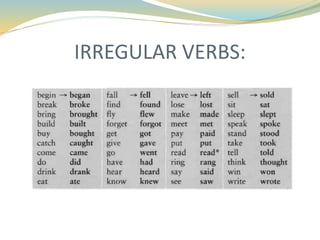
IRREGULAR VERBS:
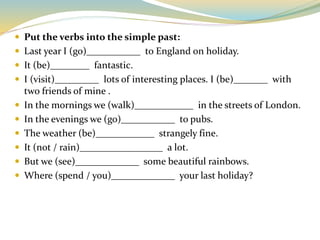
 Put the verbs into the simple past:
 Last year I (go)___________ to England on holiday.
 It (be)________ fantastic.
 I (visit)_________ lots of interesting places. I (be)_______ with
two friends of mine .
 In the mornings we (walk)____________ in the streets of London.
 In the evenings we (go)___________ to pubs.
 The weather (be)____________ strangely fine.
 It (not / rain)_________________ a lot.
 But we (see)_____________ some beautiful rainbows.
 Where (spend / you)_____________ your last holiday?
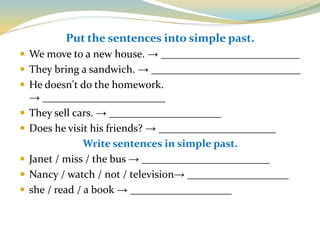
Put the sentences into simple past.
 We move to a new house. → __________________________
 They bring a sandwich. → ____________________________
 He doesn't do the homework.
→ _______________________
 They sell cars. → _____________________
 Does he visit his friends? → ______________________
Write sentences in simple past.
 Janet / miss / the bus → ________________________
 Nancy / watch / not / television→ ___________________
 she / read / a book → ___________________
Affirmative Negative Interrogative
He wrote a book.
He did not sing
Was she pretty?
Complete the table in simple past.
Uses
 Se usa para hablar acerca del desarrollo de una acción
que transcurría en un tiempo determinado, cuyo fin no
conocemos o carece de importancia.
Garfield was running in the court football last weekend.
 Se usa para expresar que una acción tenía lugar cuando
otra la interrumpió.
We were watching TV when Claudia called
Estábamos viendo TV cuando Claudia llamó
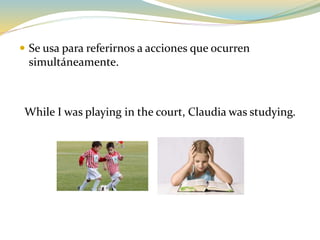
 Se usa para referirnos a acciones que ocurren
simultáneamente.
While I was playing in the court, Claudia was studying.
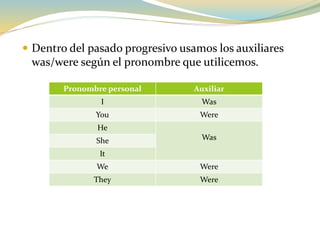
 Dentro del pasado progresivo usamos los auxiliares
was/were según el pronombre que utilicemos.
Pronombre personal Auxiliar
I Was
You Were
He
WasShe
It
We Were
They Were
Structures
Affirmative
Sujeto + was/were + verbo –ing + complemento
Mike was reading a book one hour ago
Mike estaba leyendo un libro hace una hora
Negative
Sujeto + Verbo + Was/Were + not + verbo +
complemento
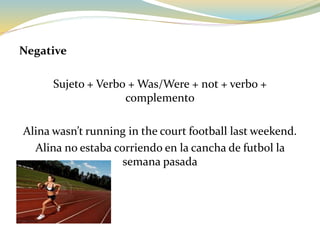
Alina wasn’t running in the court football last weekend.
Alina no estaba corriendo en la cancha de futbol la
semana pasada
Interrogative
Was/Were + Sujeto + Verbo + Complemento + ?
Was you doing your homework last night?
Estabas haciendo tu tarea anoche?
Time expressions
Word Complement
Last Night, Week, Day, Month, Summer,
Spring, Year…
Ago Week, Month, Days...
In Year, Centuries…
Yesterday, at the morning, at night, summer…
Reglas para formar el gerundio
 Como regla general, para formar el gerundio tenemos
que añadir el sufijo -ing a la forma base del
infinitivo (forma infinitiva sin to).
to listen (escuchar) -> listening (escuchando)
to hear (escuchar) -> hearing (escuchando)
 Cuando la palabra acaba en una e donde le antecede
una consonante, hay que sustituir esa e por ing.
to come (venir) -> coming (viniendo)
to write (escribir) -> writing (escribiendo)
 Si el verbo que queremos pasar al gerundio tiene una sola
sílaba, con una única vocal y además finaliza en una sola
consonante; se tiene que doblar la consonante final.
to cut (cortar) -> cutting (viniendo)
to sit (sentarse) -> sitting (escribiendo)
 Existe una regla similar a la anterior; y es que si el verbo
tiene más de una sílaba y el acento recae sobre la última,
tenemos que doblar la última consonante cuando
tengamos una sola vocal y única consonante en la última
sílaba.
to admit (admitir) -> admitting (admitiendo)
to begin (empezar) -> beginning (empezando)
 Por último, si el verbo termina por l, y va detrás de una
única vocal; esta l se tiene que doblar.
to cancel (cancelar) -> cancelling (admitiendo)
to impel (impulsar) -> impelling (impulsando)
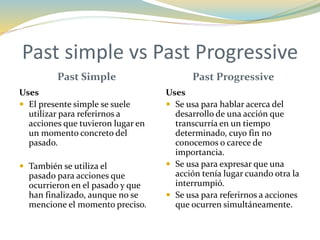
Past simple vs Past Progressive
Past Simple Past Progressive
Uses
 El presente simple se suele
utilizar para referirnos a
acciones que tuvieron lugar en
un momento concreto del
pasado.
 También se utiliza el
pasado para acciones que
ocurrieron en el pasado y que
han finalizado, aunque no se
mencione el momento preciso.
Uses
 Se usa para hablar acerca del
desarrollo de una acción que
transcurría en un tiempo
determinado, cuyo fin no
conocemos o carece de
importancia.
 Se usa para expresar que una
acción tenía lugar cuando otra la
interrumpió.
 Se usa para referirnos a acciones
que ocurren simultáneamente.
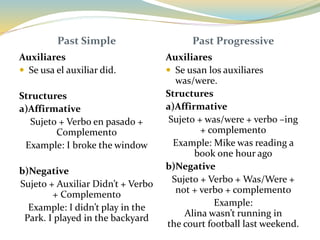
Past Simple Past Progressive
Auxiliares
 Se usa el auxiliar did.
Structures
a)Affirmative
Sujeto + Verbo en pasado +
Complemento
Example: I broke the window
b)Negative
Sujeto + Auxiliar Didn’t + Verbo
+ Complemento
Example: I didn’t play in the
Park. I played in the backyard
Auxiliares
 Se usan los auxiliares
was/were.
Structures
a)Affirmative
Sujeto + was/were + verbo –ing
+ complemento
Example: Mike was reading a
book one hour ago
b)Negative
Sujeto + Verbo + Was/Were +
not + verbo + complemento
Example:
Alina wasn’t running in
the court football last weekend.
Past Simple Past Progressive
c)Interrogative
Auxiliar Did + Sujeto + Verbo +
Complemento + ?
Example: Did you play in the
park?
Reglas para los verbos
regulares
 Los verbos regulares, para
pasarlos al pasado, tienen que
acabar en -ed. Esto como
regla general.
Listen – Listened
c)Interrogative
Was/Were + Sujeto + Verbo +
Complemento + ?
Example: Was you doing your
homework last night?
Reglas para formar el
gerundio
 Como regla general, para
formar el gerundio tenemos
que añadir el sufijo -ing a la
forma base del
infinitivo (forma infinitiva
sin to).
to listen (escuchar) -> listening
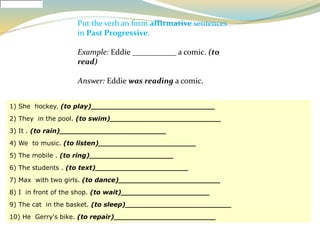
1) She hockey. (to play)____________________________
2) They in the pool. (to swim)_________________________
3) It . (to rain)________________________
4) We to music. (to listen)______________________
5) The mobile . (to ring)___________________
6) The students . (to text)_____________________
7) Max with two girls. (to dance)_______________________
8) I in front of the shop. (to wait)____________________
9) The cat in the basket. (to sleep)________________________
10) He Gerry's bike. (to repair)_______________________
Put the verb an form affirmative sentences
in Past Progressive.
Example: Eddie ___________ a comic. (to
read)
Answer: Eddie was reading a comic.
Write questions in the Past Progressive.
(what/do/you) yesterday at
six?_______________________________
(Jane/practise) the piano when you came
home?______________________________
(who/talk/to you) when I saw you last
night?______________________________
(what/discuss/they) when she went over to
them?_____________________________
(type/she) a message when you interrupted
her?______________________________
NEGATIVE SENTENCES:
1.-Sarah and Luke / not / work ______________________________
2.-Mister Miller / not / teach / chemistry _______________________
3.-Barry / not / drive / a lorry _____________________________
4.-Mandy / not / have / lunch _____________________________
5.-Albert / not / play / tennis __________________________________
6.-Taylor and Bob / not / cycle / home ______________________________
7.-Annie / not / clean / the table _______________________________
8.-Benjamin / not / write / an e-mail ________________________________
9.-Jane / not / exercise / in the gym ____________________________
10.-Robert / not / buy / flowers _____________________________

Presentacion ingles cbtis 103

  • 1.
  • 3.
    Uses  El presentesimple se suele utilizar para referirnos a acciones que tuvieron lugar en un momento concreto del pasado. En este caso se utilizan partículas como yesterday (ayer) o last year (el pasado año). She finished school last year Acabó la escuela el año pasado
  • 4.
     También seutiliza el pasado para acciones que ocurrieron en el pasado y que han finalizado, aunque no se mencione el momento preciso. Who wrote that letter? ¿Quién escribió esa carta?
  • 5.
    Structures  Dentro delpasado simple se hace uso del auxiliar Did. Affirmative Sujeto + Verbo en pasado + Complemento Example: I broke the window Yo rompí la ventana
  • 6.
    Negative Sujeto + AuxiliarDidn’t + Verbo + Complemento I didn’t play in the Park. I played in the backyard Yo no jugué en el parque. Yo jugué en el patio trasero.
  • 7.
    Interrogative Auxiliar Did +Sujeto + Verbo + Complemento + ? Did you play in the park? Jugaste en el parque? Para responder a estas cuestiones lo hacemos de la siguiente manera: Yes, I Did No, I Didn’t
  • 8.
    Reglas para losverbos regulares  Los verbos regulares, para pasarlos al pasado, tienen que acabar en -ed. Esto como regla general. Listen – Listened Clean – Cleaned Deliver – Delivered Enjoy - Enjoyed
  • 9.
     Solo tenemosque añadir la d cuando el verbo ya acaba en e. Change – Changed Die – Died Examine – Examined
  • 10.
  • 11.
     Put theverbs into the simple past:  Last year I (go)___________ to England on holiday.  It (be)________ fantastic.  I (visit)_________ lots of interesting places. I (be)_______ with two friends of mine .  In the mornings we (walk)____________ in the streets of London.  In the evenings we (go)___________ to pubs.  The weather (be)____________ strangely fine.  It (not / rain)_________________ a lot.  But we (see)_____________ some beautiful rainbows.  Where (spend / you)_____________ your last holiday?
  • 12.
    Put the sentencesinto simple past.  We move to a new house. → __________________________  They bring a sandwich. → ____________________________  He doesn't do the homework. → _______________________  They sell cars. → _____________________  Does he visit his friends? → ______________________ Write sentences in simple past.  Janet / miss / the bus → ________________________  Nancy / watch / not / television→ ___________________  she / read / a book → ___________________
  • 13.
    Affirmative Negative Interrogative Hewrote a book. He did not sing Was she pretty? Complete the table in simple past.
  • 15.
    Uses  Se usapara hablar acerca del desarrollo de una acción que transcurría en un tiempo determinado, cuyo fin no conocemos o carece de importancia. Garfield was running in the court football last weekend.
  • 16.
     Se usapara expresar que una acción tenía lugar cuando otra la interrumpió. We were watching TV when Claudia called Estábamos viendo TV cuando Claudia llamó
  • 17.
     Se usapara referirnos a acciones que ocurren simultáneamente. While I was playing in the court, Claudia was studying.
  • 18.
     Dentro delpasado progresivo usamos los auxiliares was/were según el pronombre que utilicemos. Pronombre personal Auxiliar I Was You Were He WasShe It We Were They Were
  • 19.
    Structures Affirmative Sujeto + was/were+ verbo –ing + complemento Mike was reading a book one hour ago Mike estaba leyendo un libro hace una hora
  • 20.
    Negative Sujeto + Verbo+ Was/Were + not + verbo + complemento Alina wasn’t running in the court football last weekend. Alina no estaba corriendo en la cancha de futbol la semana pasada
  • 21.
    Interrogative Was/Were + Sujeto+ Verbo + Complemento + ? Was you doing your homework last night? Estabas haciendo tu tarea anoche?
  • 22.
    Time expressions Word Complement LastNight, Week, Day, Month, Summer, Spring, Year… Ago Week, Month, Days... In Year, Centuries… Yesterday, at the morning, at night, summer…
  • 23.
    Reglas para formarel gerundio  Como regla general, para formar el gerundio tenemos que añadir el sufijo -ing a la forma base del infinitivo (forma infinitiva sin to). to listen (escuchar) -> listening (escuchando) to hear (escuchar) -> hearing (escuchando)  Cuando la palabra acaba en una e donde le antecede una consonante, hay que sustituir esa e por ing. to come (venir) -> coming (viniendo) to write (escribir) -> writing (escribiendo)
  • 24.
     Si elverbo que queremos pasar al gerundio tiene una sola sílaba, con una única vocal y además finaliza en una sola consonante; se tiene que doblar la consonante final. to cut (cortar) -> cutting (viniendo) to sit (sentarse) -> sitting (escribiendo)  Existe una regla similar a la anterior; y es que si el verbo tiene más de una sílaba y el acento recae sobre la última, tenemos que doblar la última consonante cuando tengamos una sola vocal y única consonante en la última sílaba. to admit (admitir) -> admitting (admitiendo) to begin (empezar) -> beginning (empezando)
  • 25.
     Por último,si el verbo termina por l, y va detrás de una única vocal; esta l se tiene que doblar. to cancel (cancelar) -> cancelling (admitiendo) to impel (impulsar) -> impelling (impulsando)
  • 26.
    Past simple vsPast Progressive Past Simple Past Progressive Uses  El presente simple se suele utilizar para referirnos a acciones que tuvieron lugar en un momento concreto del pasado.  También se utiliza el pasado para acciones que ocurrieron en el pasado y que han finalizado, aunque no se mencione el momento preciso. Uses  Se usa para hablar acerca del desarrollo de una acción que transcurría en un tiempo determinado, cuyo fin no conocemos o carece de importancia.  Se usa para expresar que una acción tenía lugar cuando otra la interrumpió.  Se usa para referirnos a acciones que ocurren simultáneamente.
  • 27.
    Past Simple PastProgressive Auxiliares  Se usa el auxiliar did. Structures a)Affirmative Sujeto + Verbo en pasado + Complemento Example: I broke the window b)Negative Sujeto + Auxiliar Didn’t + Verbo + Complemento Example: I didn’t play in the Park. I played in the backyard Auxiliares  Se usan los auxiliares was/were. Structures a)Affirmative Sujeto + was/were + verbo –ing + complemento Example: Mike was reading a book one hour ago b)Negative Sujeto + Verbo + Was/Were + not + verbo + complemento Example: Alina wasn’t running in the court football last weekend.
  • 28.
    Past Simple PastProgressive c)Interrogative Auxiliar Did + Sujeto + Verbo + Complemento + ? Example: Did you play in the park? Reglas para los verbos regulares  Los verbos regulares, para pasarlos al pasado, tienen que acabar en -ed. Esto como regla general. Listen – Listened c)Interrogative Was/Were + Sujeto + Verbo + Complemento + ? Example: Was you doing your homework last night? Reglas para formar el gerundio  Como regla general, para formar el gerundio tenemos que añadir el sufijo -ing a la forma base del infinitivo (forma infinitiva sin to). to listen (escuchar) -> listening
  • 29.
    1) She hockey.(to play)____________________________ 2) They in the pool. (to swim)_________________________ 3) It . (to rain)________________________ 4) We to music. (to listen)______________________ 5) The mobile . (to ring)___________________ 6) The students . (to text)_____________________ 7) Max with two girls. (to dance)_______________________ 8) I in front of the shop. (to wait)____________________ 9) The cat in the basket. (to sleep)________________________ 10) He Gerry's bike. (to repair)_______________________ Put the verb an form affirmative sentences in Past Progressive. Example: Eddie ___________ a comic. (to read) Answer: Eddie was reading a comic.
  • 30.
    Write questions inthe Past Progressive. (what/do/you) yesterday at six?_______________________________ (Jane/practise) the piano when you came home?______________________________ (who/talk/to you) when I saw you last night?______________________________ (what/discuss/they) when she went over to them?_____________________________ (type/she) a message when you interrupted her?______________________________
  • 31.
    NEGATIVE SENTENCES: 1.-Sarah andLuke / not / work ______________________________ 2.-Mister Miller / not / teach / chemistry _______________________ 3.-Barry / not / drive / a lorry _____________________________ 4.-Mandy / not / have / lunch _____________________________ 5.-Albert / not / play / tennis __________________________________ 6.-Taylor and Bob / not / cycle / home ______________________________ 7.-Annie / not / clean / the table _______________________________ 8.-Benjamin / not / write / an e-mail ________________________________ 9.-Jane / not / exercise / in the gym ____________________________ 10.-Robert / not / buy / flowers _____________________________