Libro de Gratimatica Vanesa McCormick 7 th  Period
Tabla de Materias Present  Stem Changers Irregulars *yo Saber Vs. Conocer Reflexives “ se” impersonal Dipthongs  Verbs similar to gustar Irregular verbs ending in Uir/Guir, Cer/Cir, Ger/Gir Hace+__ +que+present pretense Imperfect Preterite Tense Comparatives/Superlatives Future
Present  -ar, er, ir(Endings)   en en an Ellos(as)/ Ustedes imos emos amos Nosotros(as) e e a El/Ella/ Usted es es as T ú  o o o Yo IR ER AR
Stem Changers “ e” se convierte a “ie” - perder “ e” se convierte a “i” - pedir “ o” se convierte a “ue” - dormir “ u” se convierte a “ue” - jugar *It doesn’t change in the nosotros or vosotros form.
Irregulars *yo “ go” verbs: caer, decir, oir, poner, hacer, tener, traer, venir Oigo a me maestra. “ zco” verbs: (-cer/-cir), conocer, producir, conducir Los demas- ser, estar, ir, ver, saber, dar
Saber vs. Conocer   Saber- to know Conocer- to know Which one do you choose? Use Saber to express knowledge or information about a certain thing. Caleb sabe cienca. Use Conocer to show recognizing a person, place, or object. Yo conozco a Claire.
Los Reflexivos Reflexives are what are reflected upon oneself or other Me, te, se, nos, os, se Lavarse (to wash): Me lavo mi cara. Peinarse (to comb): Te peinas pelo. Cepillarse (to brush): Se cepilla mis dientes. Pedirse (to ask): Nos pedimos a maestra. Levantarse (to get up): Os levant íos a mi cama. Rescarse (to stratch): Se rascan los brazos.
“ se” impersonal   “ Se” Impersonal Used to make general statements Passive Voice Reciprocal Action Se + 3 rd  Person Form
Dipthongs with accents Enviar- to send Continuar- to continue Envío Enviamos  Continúo Continuamos  Envías Enviáis  Continúas Continuáis  Envía   Envían   Continúa   Continúan   Esquiar- to ski   Graduarse- to graduate Esquío Esquiamos Me gradúo   Nos graduamos   Esqías Esqui á is Te gradúas Os graduáis   Esquía Esquían Se gradúa   Se gradúan   Estudiar and Limpiar- no accents, stress not “,” E-studio,  Limp-pia-mos
Verbs Like… Uir/Guir Uir/Guir Distinguir (to distinguish) Distingo Distinguimos Distingues Distingu í s Distingue Distinguen Extinguir (to extinguish) Seguir (e->i)(to follow/continue) Conseguir (e->i)(to get, obtain, succeed in) Perseguir (e->i)(to pursue, persecute) Proseguir (e->i)(to continue)
Verbs Like…  Cer/Cir Cer/Cir Cocer (to cook): cuezo Torcer (to twist): tuerzo Mecer (to rock): mezo Ejercer (to practice a profession): ejerzo Vencer (to overcome): venzo Ofrecer (to offer): ofrezo Obedecer (to obey): obedezco
Verbs Like…  Ger/Gir Ger/Gir Coger (to catch, grab) Cojo Cogemos Coges Cog é is Coge Cogen Exiger (to demand) Exijo Exigimos Exiges Exig í s Exige Exgen *Exijo que los estudiantes hablen espa ñ ol.
Verbs Like…  Ger/Gir Ger/Gir  Proteger (to protect): protejo Escoger (to choose): escojo Recoger (to pick up): recojo Encoger (to shrink): encojo Dirigir (to direct): dirijo Fingir (to pretend): finjo Elegir (e->i)(to elect): elijo Corregir (e->i)(to correct): corrijo
Hace+____ +que+present pretense This equation tells how long it has been since the subject has done something. Hace un dia que ducho. Add “no” in front of the verb to make the action negative.  Hace tres dias que no camino mis perros.
Imperfect (irregulars) SER IR VER eran era erias eras éramos era iban  iba ibais ibas ibamos iba veían veía veíais veías veíamos veía
Imperfect (trigger words)  generalmente con frecuencia cada día a veces a menudo todos los días todas las semanas siempre nunca mucho
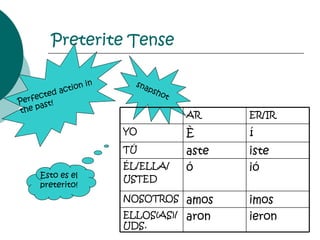
Preterite Tense Perfected action in  the past! snapshot Esto es el preterito! ieron aron ELLOS(AS)/UDS. imos amos NOSOTROS ió ó ÉL/ELLA/ USTED iste aste TÚ í é YO ER/IR AR
Preterite Tense (-car,-gar,-zar  & Snake/Snakey) SNAKE”Y” Verbs such as Leer, Creer,  and Oir change the “i’ to ‘y”  in 3 rd  Person   Stem changers : Dormir Dormí Dormiste Durmio Dormimos Durmieron cé gué qué YO  FORM *only -ZAR -GAR -CAR Leyeron  Leyó Leísteis Leíste Leímos Leí
Preterite Tense (spock)  Fueron  Fuimos Fue Fuiste Fui IR/SER Vieron  Dieron  Vimos Dimos Vio Dio Viste Diste Vi Di VER DAR Hicieron Hicimos Hizo Hiciste Hice HACER
Preterite Tense (La Cucaracha) E Iste O Imos Isteis Ieron Vin- Venir Tuv- Tener Sup- Saber Quis- Querer Pus- Poner Pud- Poder Estuv- Estar Anduv- Andar Traduj- Traducir Produj- Producir Conduj- Conducir Traj- Traer Dij- Decir
Preterite Tense (Trigger Words)  Anteayer, el dia anterior, ayer, la semana pasada, el fin de semana pasado, el mes pasado, ayer por la manana, ayer por la tarde, el otro dia, una vez, esta tarde, esta manana, anoche, esta noche
Comparatives/Superlatives Less than, greater than, equal to Más/Menos +     + que  Verb +  que   Tan +  +como Tantos + (noun)  + como Verb + Tanto como Adjective Adverb Noun  “ de” is used when you have a number instead of “que”  Más/Menos   Adjective Adverb  Single Plural
Future Infinitive +  É Ás Á Emos Án Vivir, comer, hablar (all ar,er,ir verbs) te amare’ -------------------------------------------------------------------------------------- Ir+A+infinitive  (Immediate future) “ WILL” Factor
Future Decir: dir- to say Haber: habr- there to be; to have Hacer: har- to make, do Poder: podr- to be able Poner: pondr- to put, place, set Querer: querr- to want, love Saber: sabr- to know(fact), know how Salir: saldr- to leave, go out Tener: tendr- to have Valer: valdr- to be worth Venir: vendr- to come

Libro de gratimatica vm

  • 1.
    Libro de GratimaticaVanesa McCormick 7 th Period
  • 2.
    Tabla de MateriasPresent Stem Changers Irregulars *yo Saber Vs. Conocer Reflexives “ se” impersonal Dipthongs Verbs similar to gustar Irregular verbs ending in Uir/Guir, Cer/Cir, Ger/Gir Hace+__ +que+present pretense Imperfect Preterite Tense Comparatives/Superlatives Future
  • 3.
    Present -ar,er, ir(Endings) en en an Ellos(as)/ Ustedes imos emos amos Nosotros(as) e e a El/Ella/ Usted es es as T ú o o o Yo IR ER AR
  • 4.
    Stem Changers “e” se convierte a “ie” - perder “ e” se convierte a “i” - pedir “ o” se convierte a “ue” - dormir “ u” se convierte a “ue” - jugar *It doesn’t change in the nosotros or vosotros form.
  • 5.
    Irregulars *yo “go” verbs: caer, decir, oir, poner, hacer, tener, traer, venir Oigo a me maestra. “ zco” verbs: (-cer/-cir), conocer, producir, conducir Los demas- ser, estar, ir, ver, saber, dar
  • 6.
    Saber vs. Conocer Saber- to know Conocer- to know Which one do you choose? Use Saber to express knowledge or information about a certain thing. Caleb sabe cienca. Use Conocer to show recognizing a person, place, or object. Yo conozco a Claire.
  • 7.
    Los Reflexivos Reflexivesare what are reflected upon oneself or other Me, te, se, nos, os, se Lavarse (to wash): Me lavo mi cara. Peinarse (to comb): Te peinas pelo. Cepillarse (to brush): Se cepilla mis dientes. Pedirse (to ask): Nos pedimos a maestra. Levantarse (to get up): Os levant íos a mi cama. Rescarse (to stratch): Se rascan los brazos.
  • 8.
    “ se” impersonal “ Se” Impersonal Used to make general statements Passive Voice Reciprocal Action Se + 3 rd Person Form
  • 9.
    Dipthongs with accentsEnviar- to send Continuar- to continue Envío Enviamos Continúo Continuamos Envías Enviáis Continúas Continuáis Envía Envían Continúa Continúan Esquiar- to ski Graduarse- to graduate Esquío Esquiamos Me gradúo Nos graduamos Esqías Esqui á is Te gradúas Os graduáis Esquía Esquían Se gradúa Se gradúan Estudiar and Limpiar- no accents, stress not “,” E-studio, Limp-pia-mos
  • 10.
    Verbs Like… Uir/GuirUir/Guir Distinguir (to distinguish) Distingo Distinguimos Distingues Distingu í s Distingue Distinguen Extinguir (to extinguish) Seguir (e->i)(to follow/continue) Conseguir (e->i)(to get, obtain, succeed in) Perseguir (e->i)(to pursue, persecute) Proseguir (e->i)(to continue)
  • 11.
    Verbs Like… Cer/Cir Cer/Cir Cocer (to cook): cuezo Torcer (to twist): tuerzo Mecer (to rock): mezo Ejercer (to practice a profession): ejerzo Vencer (to overcome): venzo Ofrecer (to offer): ofrezo Obedecer (to obey): obedezco
  • 12.
    Verbs Like… Ger/Gir Ger/Gir Coger (to catch, grab) Cojo Cogemos Coges Cog é is Coge Cogen Exiger (to demand) Exijo Exigimos Exiges Exig í s Exige Exgen *Exijo que los estudiantes hablen espa ñ ol.
  • 13.
    Verbs Like… Ger/Gir Ger/Gir Proteger (to protect): protejo Escoger (to choose): escojo Recoger (to pick up): recojo Encoger (to shrink): encojo Dirigir (to direct): dirijo Fingir (to pretend): finjo Elegir (e->i)(to elect): elijo Corregir (e->i)(to correct): corrijo
  • 14.
    Hace+____ +que+present pretenseThis equation tells how long it has been since the subject has done something. Hace un dia que ducho. Add “no” in front of the verb to make the action negative. Hace tres dias que no camino mis perros.
  • 15.
    Imperfect (irregulars) SERIR VER eran era erias eras éramos era iban iba ibais ibas ibamos iba veían veía veíais veías veíamos veía
  • 16.
    Imperfect (trigger words) generalmente con frecuencia cada día a veces a menudo todos los días todas las semanas siempre nunca mucho
  • 17.
    Preterite Tense Perfectedaction in the past! snapshot Esto es el preterito! ieron aron ELLOS(AS)/UDS. imos amos NOSOTROS ió ó ÉL/ELLA/ USTED iste aste TÚ í é YO ER/IR AR
  • 18.
    Preterite Tense (-car,-gar,-zar & Snake/Snakey) SNAKE”Y” Verbs such as Leer, Creer, and Oir change the “i’ to ‘y” in 3 rd Person Stem changers : Dormir Dormí Dormiste Durmio Dormimos Durmieron cé gué qué YO FORM *only -ZAR -GAR -CAR Leyeron Leyó Leísteis Leíste Leímos Leí
  • 19.
    Preterite Tense (spock) Fueron Fuimos Fue Fuiste Fui IR/SER Vieron Dieron Vimos Dimos Vio Dio Viste Diste Vi Di VER DAR Hicieron Hicimos Hizo Hiciste Hice HACER
  • 20.
    Preterite Tense (LaCucaracha) E Iste O Imos Isteis Ieron Vin- Venir Tuv- Tener Sup- Saber Quis- Querer Pus- Poner Pud- Poder Estuv- Estar Anduv- Andar Traduj- Traducir Produj- Producir Conduj- Conducir Traj- Traer Dij- Decir
  • 21.
    Preterite Tense (TriggerWords) Anteayer, el dia anterior, ayer, la semana pasada, el fin de semana pasado, el mes pasado, ayer por la manana, ayer por la tarde, el otro dia, una vez, esta tarde, esta manana, anoche, esta noche
  • 22.
    Comparatives/Superlatives Less than,greater than, equal to Más/Menos + + que Verb + que Tan + +como Tantos + (noun) + como Verb + Tanto como Adjective Adverb Noun “ de” is used when you have a number instead of “que” Más/Menos Adjective Adverb Single Plural
  • 23.
    Future Infinitive + É Ás Á Emos Án Vivir, comer, hablar (all ar,er,ir verbs) te amare’ -------------------------------------------------------------------------------------- Ir+A+infinitive (Immediate future) “ WILL” Factor
  • 24.
    Future Decir: dir-to say Haber: habr- there to be; to have Hacer: har- to make, do Poder: podr- to be able Poner: pondr- to put, place, set Querer: querr- to want, love Saber: sabr- to know(fact), know how Salir: saldr- to leave, go out Tener: tendr- to have Valer: valdr- to be worth Venir: vendr- to come