


Authentication protocols based on zero knownledge proof 
Brief introduction 
Israel Buitron Damaso1 
1Computer Science Department 
Centro de Investigacion y de Estudios Avanzados del Instituto Politecnico Nacional 
September 26, 2014
Outline 
Introduction 
Our work
Outline 
Introduction 
Problem statement 
Proposed solution 
Expected contributions 
Concepts
Problem 
I In mobile devices some alternatives to current protocols are required. 
I Little instances of hard problems. 
I In some cases parties should not share credentials. 
I Applications can reduce data transferences, such that, bank mobile 
applications
Outline 
Introduction 
Problem statement 
Proposed solution 
Expected contributions 
Concepts
Proposed solution 
I Zero-knowledge proof could be used in authetication protocols 
I In graphs theory, many hard problems can be proposed, one of them is 
independence set 
I Some kinds of graphs have a synthetic representation 
I A good trade-o could be fould between data shared and a good way to 
reject intruders
Outline 
Introduction 
Problem statement 
Proposed solution 
Expected contributions 
Concepts
Contributions 
I Characterization of paths graphs 
I A one-way function will be proposed 
I An authentication protocol will be proposed 
I An ecient implementation for mobile devices
Outline 
Introduction 
Problem statement 
Proposed solution 
Expected contributions 
Concepts 
Graph theory
Graph 
I A graph is a pair G = (V;E) where V (G) is a
nite and non-empty set of 
vertices, and the set E(G) of edges is an unordered subset of V  V 
I The order and the size of G are the cardinalities of V (G) and E(G) 
respectively
Subgraph 
I A subgraph H of G is a graph such that V (H)  V (G) and 
E(H)  E(G). 
I If V 0  V (G) then the induced subgraph of G by V 0 is the graph having 
V 0 as set of vertices 
I Two vertices u; v in V 0 are joined by an edge in V 0 if and only if 
uv 2 E(G). 
I If e = v1v2 2 E(G) then v1 is adjacent to v2 and the vertices v1 and v2 
are incident to the edge e.
Clique 
I The complete graph Kn of order n is a graph having n vertices, where 
each one is adjacent to any other. 
I A clique in G is a complete induced subgraph of G.
Path and cycle 
I A path in G with initial vertex v0 and ending vertex vm is a sequence of 
vertices  = v0v1 : : : vm, such that for i = 0; : : : ;m  1, vivi+1 2 E(G), 
v0; : : : ; vm are pairwise dierent, and m is a positive integer. 
I The vertices v0 and vm are the end-vertices or endpoints of . 
I The length jj of the path  is m, hence  is said to be an m-path. 
I The internal vertices of  are v1; : : : ; vm1 
I If v0 = vm, then  is a cycle.
Non-crossing and disjoint paths 
I The distance dG(u; v) between two vertices u; v in G is the length of the 
shortest path connecting u and v. 
I Two paths which are not cycles 1, 2 are non-crossing if there is no 
common vertex in 1 and 2 which is internal in at least one of the paths. 
I We say that the paths 1 and 2 are disjoint if no edge appears in both 
paths.
Hamiltonian graph 
I A two-factor in a graph G is a family C1; : : : ;Ck of cycles of G such that 
any vertex in G belongs to one and only one cycle Ci. 
I A two-factor of G consisting of only one cycle is a Hamiltonian cycle of G. 
I Let HG be the collection of Hamiltonian cycles in G, if HG6= ; then G is 
called Hamiltonian.
Independent set 
I An independent set of G is a subset I of V (G) such that no edge in E(G) 
contains both endpoints in I. 
I A maximal independent set of G is an independent set of G that is not a 
proper subset of another independent set of G. 
I A maximum independent set of G is a maximal independent set with the 
largest cardinality, the so called independence number (G) of G.
Independent set problem 
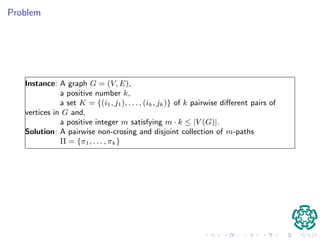
I In this case, independent set problem consists in
nding maximum 
independent set in a given graph G. 
I This is an NP-hard problem, dicult even to be aproximated.
Outline 
Introduction 
Our work
Outline 
Our work 
Identi
cation protocol 
NonCrossingPaths problem 
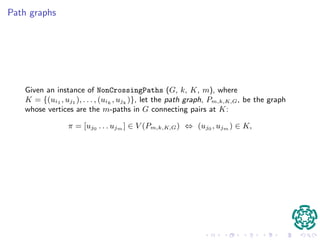
Path graphs
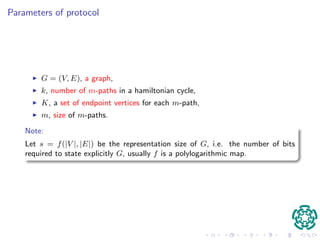
Parameters of protocol 
I G = (V;E), a graph, 
I k, number of m-paths in a hamiltonian cycle, 
I K, a set of endpoint vertices for each m-path, 
I m, size of m-paths. 
Note: 
Let s = f(jV j; jEj) be the representation size of G, i.e. the number of bits 
required to state explicitly G, usually f is a polylogarithmic map.
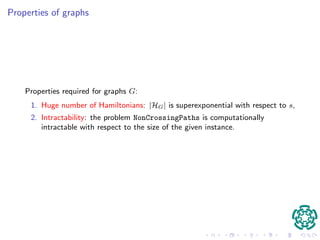
Properties of graphs 
Properties required for graphs G: 
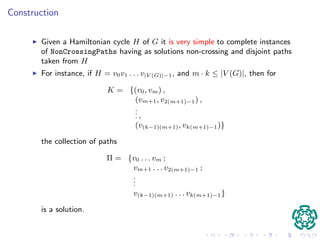
1. Huge number of Hamiltonians: jHGj is superexponential with respect to s, 
2. Intractability: the problem NonCrossingPaths is computationally 
intractable with respect to the size of the given instance.
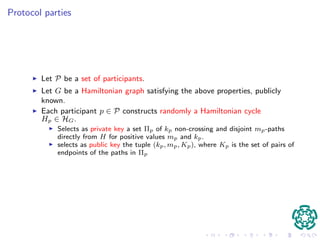
Protocol parties 
I Let P be a set of participants. 
I Let G be a Hamiltonian graph satisfying the above properties, publicly 
known. 
I Each participant p 2 P constructs randomly a Hamiltonian cycle 
Hp 2 HG. 
I Selects as private key a set p of kp non-crossing and disjoint mp-paths 
directly from H for positive values mp and kp. 
I selects as public key the tuple (kp;mp;Kp), where Kp is the set of pairs of 
endpoints of the paths in p
Identi
cation protocol 
Objective 
A prover shall prove to a veri
er that he/she knows the private key p of 
his/her public key (kp;mp;Kp).
Identi
cation protocol 
Procedure 
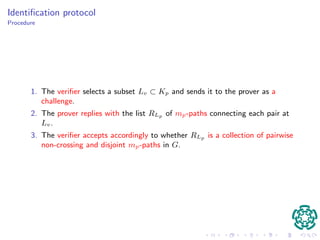
1. The veri
er selects a subset Lv  Kp and sends it to the prover as a 
challenge. 
2. The prover replies with the list RLp of mp-paths connecting each pair at 
Lv. 
3. The veri

Authentication protocols based on zero knowledge proofs (Part 1 - Brief Talk)

  • 1.
    Authentication protocols basedon zero knownledge proof Brief introduction Israel Buitron Damaso1 1Computer Science Department Centro de Investigacion y de Estudios Avanzados del Instituto Politecnico Nacional September 26, 2014
  • 2.
  • 3.
    Outline Introduction Problemstatement Proposed solution Expected contributions Concepts
  • 4.
    Problem I Inmobile devices some alternatives to current protocols are required. I Little instances of hard problems. I In some cases parties should not share credentials. I Applications can reduce data transferences, such that, bank mobile applications
  • 5.
    Outline Introduction Problemstatement Proposed solution Expected contributions Concepts
  • 6.
    Proposed solution IZero-knowledge proof could be used in authetication protocols I In graphs theory, many hard problems can be proposed, one of them is independence set I Some kinds of graphs have a synthetic representation I A good trade-o could be fould between data shared and a good way to reject intruders
  • 7.
    Outline Introduction Problemstatement Proposed solution Expected contributions Concepts
  • 8.
    Contributions I Characterizationof paths graphs I A one-way function will be proposed I An authentication protocol will be proposed I An ecient implementation for mobile devices
  • 9.
    Outline Introduction Problemstatement Proposed solution Expected contributions Concepts Graph theory
  • 10.
    Graph I Agraph is a pair G = (V;E) where V (G) is a
  • 11.
    nite and non-emptyset of vertices, and the set E(G) of edges is an unordered subset of V V I The order and the size of G are the cardinalities of V (G) and E(G) respectively
  • 12.
    Subgraph I Asubgraph H of G is a graph such that V (H) V (G) and E(H) E(G). I If V 0 V (G) then the induced subgraph of G by V 0 is the graph having V 0 as set of vertices I Two vertices u; v in V 0 are joined by an edge in V 0 if and only if uv 2 E(G). I If e = v1v2 2 E(G) then v1 is adjacent to v2 and the vertices v1 and v2 are incident to the edge e.
  • 13.
    Clique I Thecomplete graph Kn of order n is a graph having n vertices, where each one is adjacent to any other. I A clique in G is a complete induced subgraph of G.
  • 14.
    Path and cycle I A path in G with initial vertex v0 and ending vertex vm is a sequence of vertices = v0v1 : : : vm, such that for i = 0; : : : ;m 1, vivi+1 2 E(G), v0; : : : ; vm are pairwise dierent, and m is a positive integer. I The vertices v0 and vm are the end-vertices or endpoints of . I The length jj of the path is m, hence is said to be an m-path. I The internal vertices of are v1; : : : ; vm1 I If v0 = vm, then is a cycle.
  • 15.
    Non-crossing and disjointpaths I The distance dG(u; v) between two vertices u; v in G is the length of the shortest path connecting u and v. I Two paths which are not cycles 1, 2 are non-crossing if there is no common vertex in 1 and 2 which is internal in at least one of the paths. I We say that the paths 1 and 2 are disjoint if no edge appears in both paths.
  • 16.
    Hamiltonian graph IA two-factor in a graph G is a family C1; : : : ;Ck of cycles of G such that any vertex in G belongs to one and only one cycle Ci. I A two-factor of G consisting of only one cycle is a Hamiltonian cycle of G. I Let HG be the collection of Hamiltonian cycles in G, if HG6= ; then G is called Hamiltonian.
  • 17.
    Independent set IAn independent set of G is a subset I of V (G) such that no edge in E(G) contains both endpoints in I. I A maximal independent set of G is an independent set of G that is not a proper subset of another independent set of G. I A maximum independent set of G is a maximal independent set with the largest cardinality, the so called independence number (G) of G.
  • 18.
    Independent set problem I In this case, independent set problem consists in
  • 19.
    nding maximum independentset in a given graph G. I This is an NP-hard problem, dicult even to be aproximated.
  • 20.
  • 21.
  • 22.
  • 23.
    Parameters of protocol I G = (V;E), a graph, I k, number of m-paths in a hamiltonian cycle, I K, a set of endpoint vertices for each m-path, I m, size of m-paths. Note: Let s = f(jV j; jEj) be the representation size of G, i.e. the number of bits required to state explicitly G, usually f is a polylogarithmic map.
  • 24.
    Properties of graphs Properties required for graphs G: 1. Huge number of Hamiltonians: jHGj is superexponential with respect to s, 2. Intractability: the problem NonCrossingPaths is computationally intractable with respect to the size of the given instance.
  • 25.
    Protocol parties ILet P be a set of participants. I Let G be a Hamiltonian graph satisfying the above properties, publicly known. I Each participant p 2 P constructs randomly a Hamiltonian cycle Hp 2 HG. I Selects as private key a set p of kp non-crossing and disjoint mp-paths directly from H for positive values mp and kp. I selects as public key the tuple (kp;mp;Kp), where Kp is the set of pairs of endpoints of the paths in p
  • 26.
  • 27.
    cation protocol Objective A prover shall prove to a veri
  • 28.
    er that he/sheknows the private key p of his/her public key (kp;mp;Kp).
  • 29.
  • 30.
  • 31.
    er selects asubset Lv Kp and sends it to the prover as a challenge. 2. The prover replies with the list RLp of mp-paths connecting each pair at Lv. 3. The veri