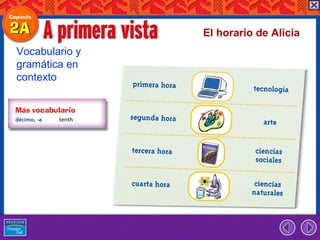
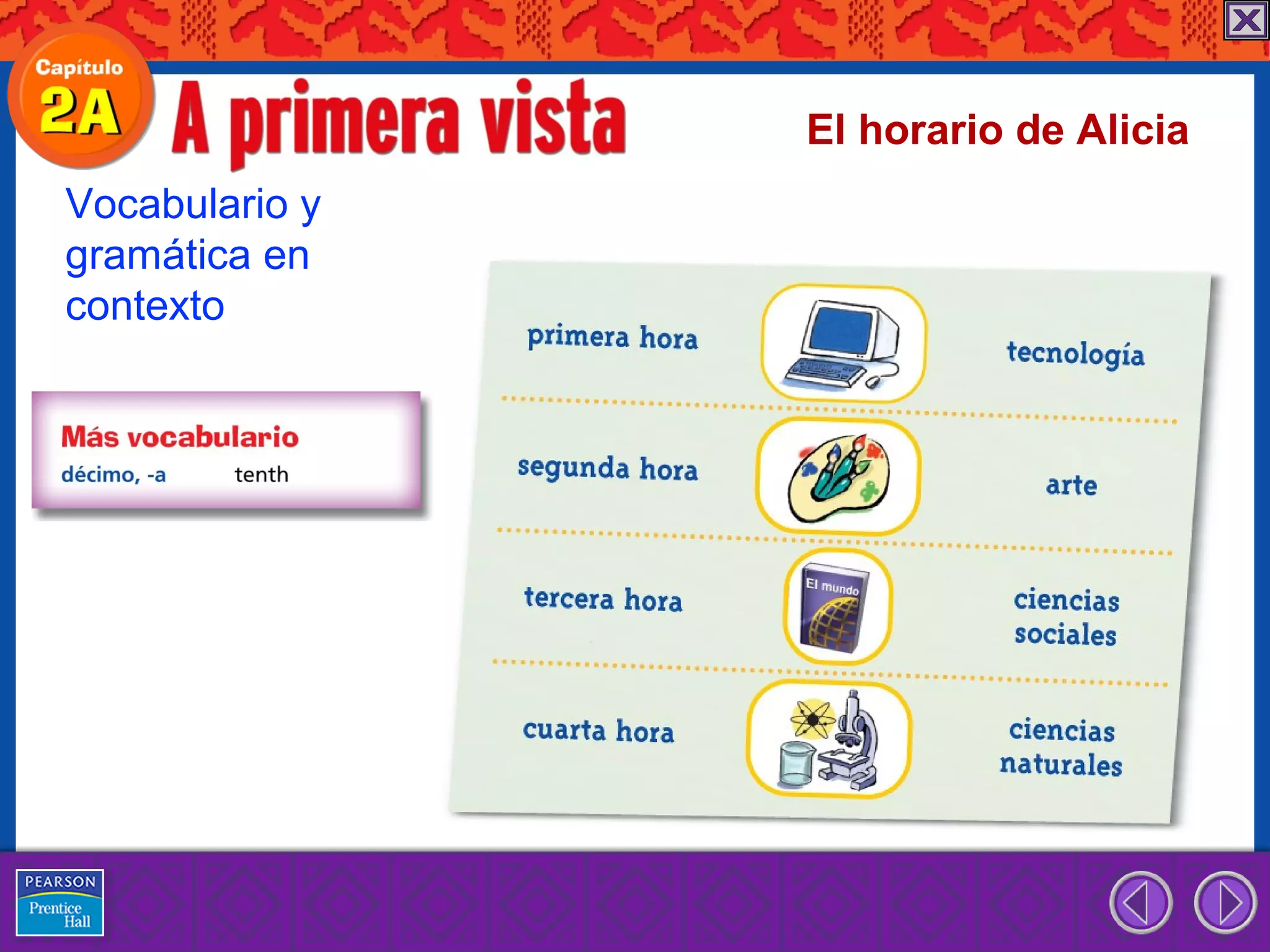
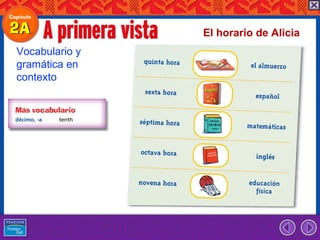
El horario de Alicia
Vocabulario y
gramática en
contexto
El horario de Alicia
Vocabulario y
gramática en
contexto
El horario de Alicia
Vocabulario y
gramática en
contexto


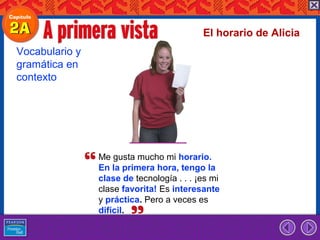
                Me gusta mucho mi horario.
                En la primera hora, tengo la
                clase de tecnología . . . ¡es mi
                clase favorita! Es interesante
                y práctica. Pero a veces es
                difícil.
Vocabulario y
gramática en
contexto


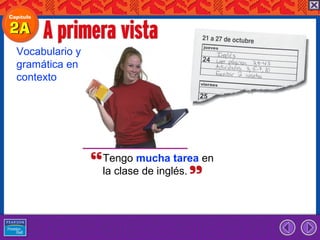
                Tengo mucha tarea en
                la clase de inglés.
Vocabulario y
gramática en
contexto


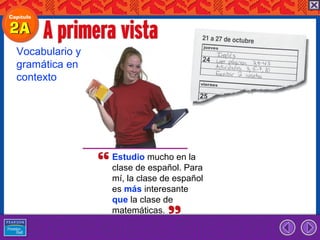
                Estudio mucho en la
                clase de español. Para
                mí, la clase de español
                es más interesante
                que la clase de
                matemáticas.
Vocabulario y
gramática en
contexto


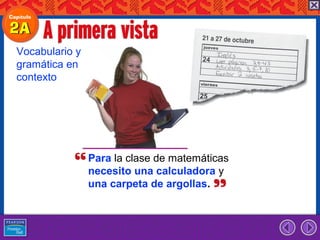
                Para la clase de matemáticas
                necesito una calculadora y
                una carpeta de argollas.
Vocabulario y
gramática en
contexto


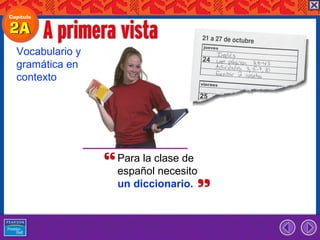
                Para la clase de
                español necesito
                un diccionario.
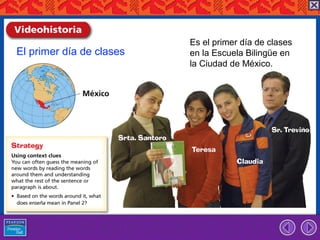
Es el primer día de clases
El primer día de clases   en la Escuela Bilingüe en
                          la Ciudad de México.
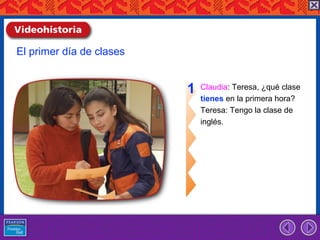
El primer día de clases


                          1   Claudia: Teresa, ¿qué clase
                              tienes en la primera hora?
                              Teresa: Tengo la clase de
                              inglés.
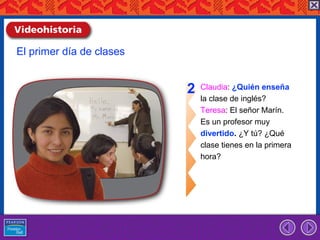
El primer día de clases


                          2   Claudia: ¿Quién enseña
                              la clase de inglés?
                              Teresa: El señor Marín.
                              Es un profesor muy
                              divertido. ¿Y tú? ¿Qué
                              clase tienes en la primera
                              hora?
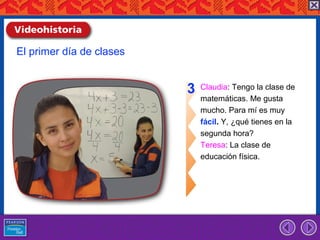
El primer día de clases


                          3   Claudia: Tengo la clase de
                              matemáticas. Me gusta
                              mucho. Para mí es muy
                              fácil. Y, ¿qué tienes en la
                              segunda hora?
                              Teresa: La clase de
                              educación física.
El primer día de clases


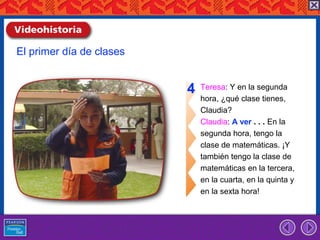
                          4   Teresa: Y en la segunda
                              hora, ¿qué clase tienes,
                              Claudia?
                              Claudia: A ver . . . En la
                              segunda hora, tengo la
                              clase de matemáticas. ¡Y
                              también tengo la clase de
                              matemáticas en la tercera,
                              en la cuarta, en la quinta y
                              en la sexta hora!
El primer día de clases


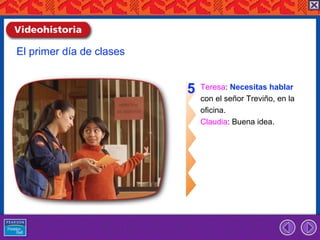
                          5   Teresa: Necesitas hablar
                              con el señor Treviño, en la
                              oficina.
                              Claudia: Buena idea.
El primer día de clases


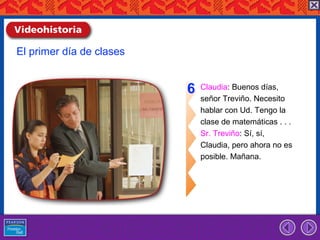
                          6   Claudia: Buenos días,
                              señor Treviño. Necesito
                              hablar con Ud. Tengo la
                              clase de matemáticas . . .
                              Sr. Treviño: Sí, sí,
                              Claudia, pero ahora no es
                              posible. Mañana.
El primer día de clases


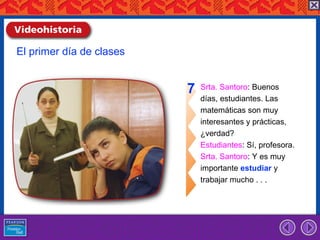
                          7   Srta. Santoro: Buenos
                              días, estudiantes. Las
                              matemáticas son muy
                              interesantes y prácticas,
                              ¿verdad?
                              Estudiantes: Sí, profesora.
                              Srta. Santoro: Y es muy
                              importante estudiar y
                              trabajar mucho . . .
El primer día de clases


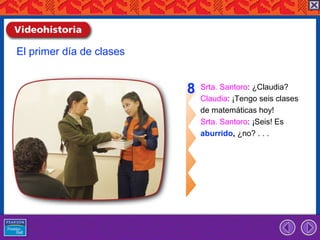
                          8   Srta. Santoro: ¿Claudia?
                              Claudia: ¡Tengo seis clases
                              de matemáticas hoy!
                              Srta. Santoro: ¡Seis! Es
                              aburrido, ¿no? . . .
Subject pronouns

The subject of a sentence tells who is doing the action.
You often use people’s names as the subject:

Gregorio escucha música.         Gregory listens to music.
Ana canta y baila.               Ana sings and dances.
Subject pronouns

You also use subject pronouns (I, you, he, she, we, they) to tell
who is doing an action. The subject pronouns replace people’s
names:

Él escucha música.          He listens to music.
Ella canta y baila.         She sings and dances.
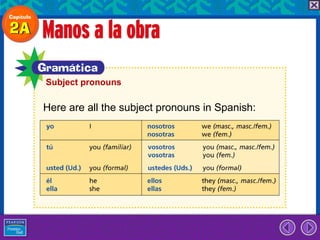
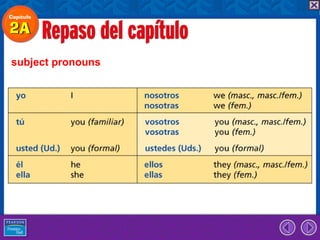
Subject pronouns

Here are all the subject pronouns in Spanish:
Subject pronouns
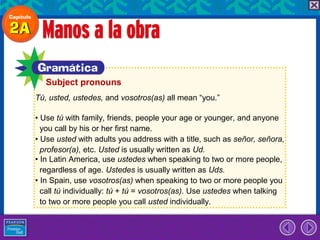
Tú, usted, ustedes, and vosotros(as) all mean “you.”

• Use tú with family, friends, people your age or younger, and anyone
  you call by his or her first name.
• Use usted with adults you address with a title, such as señor, señora,
  profesor(a), etc. Usted is usually written as Ud.
• In Latin America, use ustedes when speaking to two or more people,
  regardless of age. Ustedes is usually written as Uds.
• In Spain, use vosotros(as) when speaking to two or more people you
  call tú individually: tú + tú = vosotros(as). Use ustedes when talking
  to two or more people you call usted individually.
Subject pronouns

If a group is made up of males only or of both males and females
together, use the masculine forms: nosotros, vosotros, ellos.

If a group is all females, use the feminine forms:
nosotras, vosotras, ellas.
Subject pronouns

You can combine a subject pronoun and a name
to form a subject.

Alejandro y yo = nosotros    Pepe y tú = ustedes

Carlos y ella = ellos        Lola y ella = ellas
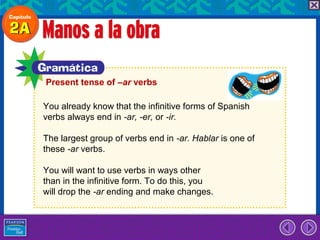
Present tense of –ar verbs

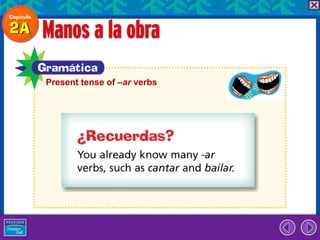
You already know that the infinitive forms of Spanish
verbs always end in -ar, -er, or -ir.

The largest group of verbs end in -ar. Hablar is one of
these -ar verbs.

You will want to use verbs in ways other
than in the infinitive form. To do this, you
will drop the -ar ending and make changes.
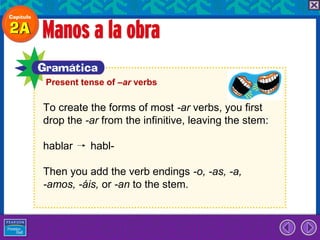
Present tense of –ar verbs

To create the forms of most -ar verbs, you first
drop the -ar from the infinitive, leaving the stem:

hablar    habl-

Then you add the verb endings -o, -as, -a,
-amos, -áis, or -an to the stem.
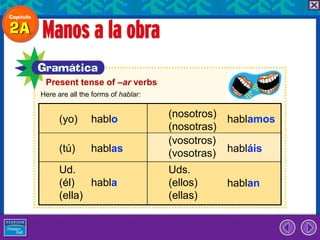
Present tense of –ar verbs
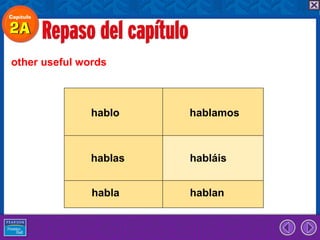
Here are all the forms of hablar:

                                    (nosotros)
      (yo)      hablo                            hablamos
                                    (nosotras)
                                    (vosotros)
      (tú)      hablas              (vosotras)   habláis

      Ud.                           Uds.
      (él)   habla                  (ellos)      hablan
      (ella)                        (ellas)
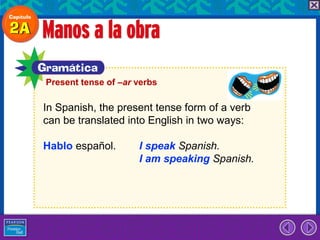
Present tense of –ar verbs

In Spanish, the present tense form of a verb
can be translated into English in two ways:

Hablo español.       I speak Spanish.
                     I am speaking Spanish.
Present tense of –ar verbs

The verb endings always indicate who is
doing the action. In this case, they tell who
is speaking. Because of this, you can often
use the verb without a subject:

Hablo inglés.        ¿Hablas español?
Present tense of –ar verbs

Subject pronouns are often used for
emphasis or clarification.

Ella habla inglés pero él habla español.
The letter c

    In Spanish the pronunciation of the letter c
    depends on the letter that follows it.

    When the letter c comes before a, o, u, or
    another consonant, it is pronounced like the
    c in “cat.” Listen to and say these words:

    computadora     cantar           escuela
    tampoco         cómo             tocar
    correr          practicar        Carlos
The letter c

    When the letter c comes before e or i, most
    Spanish speakers pronounce it like the s in
    “Sally.” Listen to and say these words:

    veces        sociable     gracioso      gracias
    hacer        once         doce          trece
The letter c

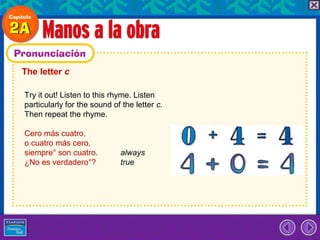
Try it out! Listen to this rhyme. Listen
particularly for the sound of the letter c.
Then repeat the rhyme.

Cero más cuatro,
o cuatro más cero,
siempre° son cuatro.         always
¿No es verdadero°?           true
The letter c

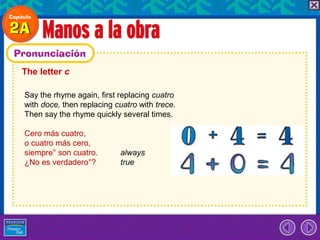
Say the rhyme again, first replacing cuatro
with doce, then replacing cuatro with trece.
Then say the rhyme quickly several times.

Cero más cuatro,
o cuatro más cero,
siempre° son cuatro.       always
¿No es verdadero°?         true
With a population of more than 100 million people, Mexico is
the most populous Spanish-speaking country. It has been shaped
by ancient indigenous civilizations, European colonialism, and
immigration, as well as by its proximity to the United States.
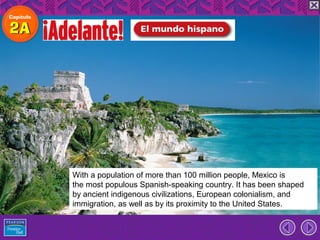
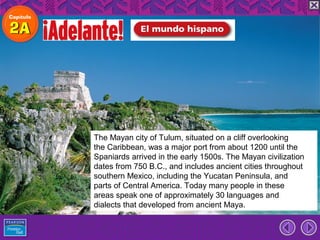
The Mayan city of Tulum, situated on a cliff overlooking
the Caribbean, was a major port from about 1200 until the
Spaniards arrived in the early 1500s. The Mayan civilization
dates from 750 B.C., and includes ancient cities throughout
southern Mexico, including the Yucatan Peninsula, and
parts of Central America. Today many people in these
areas speak one of approximately 30 languages and
dialects that developed from ancient Maya.
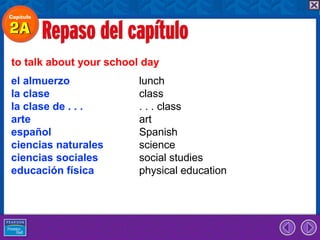
to talk about your school day
el almuerzo              lunch
la clase                 class
la clase de . . .        . . . class
arte                     art
español                  Spanish
ciencias naturales       science
ciencias sociales        social studies
educación física         physical education
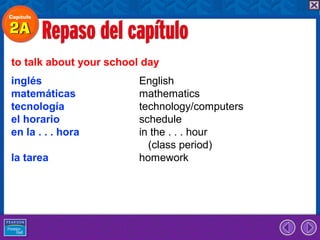
to talk about your school day
inglés                   English
matemáticas              mathematics
tecnología               technology/computers
el horario               schedule
en la . . . hora         in the . . . hour
                           (class period)
la tarea                 homework
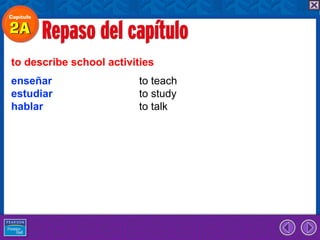
to describe school activities
enseñar                  to teach
estudiar                 to study
hablar                   to talk
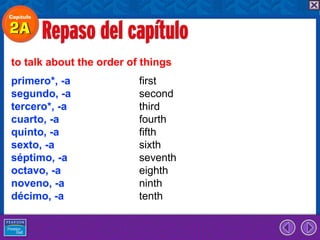
to talk about the order of things
primero*, -a              first
segundo, -a               second
tercero*, -a              third
cuarto, -a                fourth
quinto, -a                fifth
sexto, -a                 sixth
séptimo, -a               seventh
octavo, -a                eighth
noveno, -a                ninth
décimo, -a                tenth
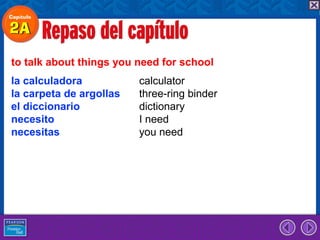
to talk about things you need for school
la calculadora           calculator
la carpeta de argollas   three-ring binder
el diccionario           dictionary
necesito                 I need
necesitas                you need
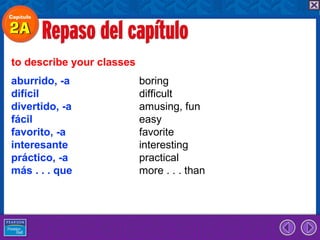
to describe your classes
aburrido, -a               boring
difícil                    difficult
divertido, -a              amusing, fun
fácil                      easy
favorito, -a               favorite
interesante                interesting
práctico, -a               practical
más . . . que              more . . . than
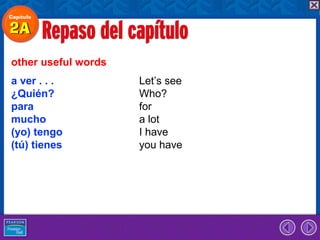
other useful words
a ver . . .          Let’s see
¿Quién?              Who?
para                 for
mucho                a lot
(yo) tengo           I have
(tú) tienes          you have
subject pronouns
other useful words


               hablo    hablamos


               hablas   habláis


               habla    hablan

Real ch.2 a

  • 1.
    El horario deAlicia Vocabulario y gramática en contexto
  • 2.
    El horario deAlicia Vocabulario y gramática en contexto
  • 3.
    El horario deAlicia Vocabulario y gramática en contexto Me gusta mucho mi horario. En la primera hora, tengo la clase de tecnología . . . ¡es mi clase favorita! Es interesante y práctica. Pero a veces es difícil.
  • 4.
    Vocabulario y gramática en contexto Tengo mucha tarea en la clase de inglés.
  • 5.
    Vocabulario y gramática en contexto Estudio mucho en la clase de español. Para mí, la clase de español es más interesante que la clase de matemáticas.
  • 6.
    Vocabulario y gramática en contexto Para la clase de matemáticas necesito una calculadora y una carpeta de argollas.
  • 7.
    Vocabulario y gramática en contexto Para la clase de español necesito un diccionario.
  • 8.
    Es el primerdía de clases El primer día de clases en la Escuela Bilingüe en la Ciudad de México.
  • 9.
    El primer díade clases 1 Claudia: Teresa, ¿qué clase tienes en la primera hora? Teresa: Tengo la clase de inglés.
  • 10.
    El primer díade clases 2 Claudia: ¿Quién enseña la clase de inglés? Teresa: El señor Marín. Es un profesor muy divertido. ¿Y tú? ¿Qué clase tienes en la primera hora?
  • 11.
    El primer díade clases 3 Claudia: Tengo la clase de matemáticas. Me gusta mucho. Para mí es muy fácil. Y, ¿qué tienes en la segunda hora? Teresa: La clase de educación física.
  • 12.
    El primer díade clases 4 Teresa: Y en la segunda hora, ¿qué clase tienes, Claudia? Claudia: A ver . . . En la segunda hora, tengo la clase de matemáticas. ¡Y también tengo la clase de matemáticas en la tercera, en la cuarta, en la quinta y en la sexta hora!
  • 13.
    El primer díade clases 5 Teresa: Necesitas hablar con el señor Treviño, en la oficina. Claudia: Buena idea.
  • 14.
    El primer díade clases 6 Claudia: Buenos días, señor Treviño. Necesito hablar con Ud. Tengo la clase de matemáticas . . . Sr. Treviño: Sí, sí, Claudia, pero ahora no es posible. Mañana.
  • 15.
    El primer díade clases 7 Srta. Santoro: Buenos días, estudiantes. Las matemáticas son muy interesantes y prácticas, ¿verdad? Estudiantes: Sí, profesora. Srta. Santoro: Y es muy importante estudiar y trabajar mucho . . .
  • 16.
    El primer díade clases 8 Srta. Santoro: ¿Claudia? Claudia: ¡Tengo seis clases de matemáticas hoy! Srta. Santoro: ¡Seis! Es aburrido, ¿no? . . .
  • 17.
    Subject pronouns The subjectof a sentence tells who is doing the action. You often use people’s names as the subject: Gregorio escucha música. Gregory listens to music. Ana canta y baila. Ana sings and dances.
  • 18.
    Subject pronouns You alsouse subject pronouns (I, you, he, she, we, they) to tell who is doing an action. The subject pronouns replace people’s names: Él escucha música. He listens to music. Ella canta y baila. She sings and dances.
  • 19.
    Subject pronouns Here areall the subject pronouns in Spanish:
  • 20.
    Subject pronouns Tú, usted,ustedes, and vosotros(as) all mean “you.” • Use tú with family, friends, people your age or younger, and anyone you call by his or her first name. • Use usted with adults you address with a title, such as señor, señora, profesor(a), etc. Usted is usually written as Ud. • In Latin America, use ustedes when speaking to two or more people, regardless of age. Ustedes is usually written as Uds. • In Spain, use vosotros(as) when speaking to two or more people you call tú individually: tú + tú = vosotros(as). Use ustedes when talking to two or more people you call usted individually.
  • 21.
    Subject pronouns If agroup is made up of males only or of both males and females together, use the masculine forms: nosotros, vosotros, ellos. If a group is all females, use the feminine forms: nosotras, vosotras, ellas.
  • 22.
    Subject pronouns You cancombine a subject pronoun and a name to form a subject. Alejandro y yo = nosotros Pepe y tú = ustedes Carlos y ella = ellos Lola y ella = ellas
  • 23.
    Present tense of–ar verbs
  • 24.
    Present tense of–ar verbs You already know that the infinitive forms of Spanish verbs always end in -ar, -er, or -ir. The largest group of verbs end in -ar. Hablar is one of these -ar verbs. You will want to use verbs in ways other than in the infinitive form. To do this, you will drop the -ar ending and make changes.
  • 25.
    Present tense of–ar verbs To create the forms of most -ar verbs, you first drop the -ar from the infinitive, leaving the stem: hablar habl- Then you add the verb endings -o, -as, -a, -amos, -áis, or -an to the stem.
  • 26.
    Present tense of–ar verbs Here are all the forms of hablar: (nosotros) (yo) hablo hablamos (nosotras) (vosotros) (tú) hablas (vosotras) habláis Ud. Uds. (él) habla (ellos) hablan (ella) (ellas)
  • 27.
    Present tense of–ar verbs In Spanish, the present tense form of a verb can be translated into English in two ways: Hablo español. I speak Spanish. I am speaking Spanish.
  • 28.
    Present tense of–ar verbs The verb endings always indicate who is doing the action. In this case, they tell who is speaking. Because of this, you can often use the verb without a subject: Hablo inglés. ¿Hablas español?
  • 29.
    Present tense of–ar verbs Subject pronouns are often used for emphasis or clarification. Ella habla inglés pero él habla español.
  • 30.
    The letter c In Spanish the pronunciation of the letter c depends on the letter that follows it. When the letter c comes before a, o, u, or another consonant, it is pronounced like the c in “cat.” Listen to and say these words: computadora cantar escuela tampoco cómo tocar correr practicar Carlos
  • 31.
    The letter c When the letter c comes before e or i, most Spanish speakers pronounce it like the s in “Sally.” Listen to and say these words: veces sociable gracioso gracias hacer once doce trece
  • 32.
    The letter c Tryit out! Listen to this rhyme. Listen particularly for the sound of the letter c. Then repeat the rhyme. Cero más cuatro, o cuatro más cero, siempre° son cuatro. always ¿No es verdadero°? true
  • 33.
    The letter c Saythe rhyme again, first replacing cuatro with doce, then replacing cuatro with trece. Then say the rhyme quickly several times. Cero más cuatro, o cuatro más cero, siempre° son cuatro. always ¿No es verdadero°? true
  • 35.
    With a populationof more than 100 million people, Mexico is the most populous Spanish-speaking country. It has been shaped by ancient indigenous civilizations, European colonialism, and immigration, as well as by its proximity to the United States.
  • 36.
    The Mayan cityof Tulum, situated on a cliff overlooking the Caribbean, was a major port from about 1200 until the Spaniards arrived in the early 1500s. The Mayan civilization dates from 750 B.C., and includes ancient cities throughout southern Mexico, including the Yucatan Peninsula, and parts of Central America. Today many people in these areas speak one of approximately 30 languages and dialects that developed from ancient Maya.
  • 37.
    to talk aboutyour school day el almuerzo lunch la clase class la clase de . . . . . . class arte art español Spanish ciencias naturales science ciencias sociales social studies educación física physical education
  • 38.
    to talk aboutyour school day inglés English matemáticas mathematics tecnología technology/computers el horario schedule en la . . . hora in the . . . hour (class period) la tarea homework
  • 39.
    to describe schoolactivities enseñar to teach estudiar to study hablar to talk
  • 40.
    to talk aboutthe order of things primero*, -a first segundo, -a second tercero*, -a third cuarto, -a fourth quinto, -a fifth sexto, -a sixth séptimo, -a seventh octavo, -a eighth noveno, -a ninth décimo, -a tenth
  • 41.
    to talk aboutthings you need for school la calculadora calculator la carpeta de argollas three-ring binder el diccionario dictionary necesito I need necesitas you need
  • 42.
    to describe yourclasses aburrido, -a boring difícil difficult divertido, -a amusing, fun fácil easy favorito, -a favorite interesante interesting práctico, -a practical más . . . que more . . . than
  • 43.
    other useful words aver . . . Let’s see ¿Quién? Who? para for mucho a lot (yo) tengo I have (tú) tienes you have
  • 44.
  • 45.
    other useful words hablo hablamos hablas habláis habla hablan