INSTITUTO POLITÉCNICO NACIONAL
“ESCUELA SUPERIOR DE MEDICINA”
METODOLOGÍA DE LA INVESTIGACIÓN Y
ESTADÍSTICA I
GARCÍA CRUZ MARIO ANTONIO
GONZÁLEZ GALLEGOS ANGÉLICA
HERNANDEZ JAHEN MARCO ANTONIO
MONTEMIRA OROZCO DIANA
RIVERA RUBIO FERNANDA ABRIL
3CM10
SÍNTESIS DE DISEÑOS DE INVESTIGACIÓN EN
ESPAÑOL E INGLÉS
PROF. GREGORIO GÓMEZ HERNÁNDEZ
CICLO ESCOLAR 2016-2017/1
27/SEPTIEMBRE/2016
SINTESIS
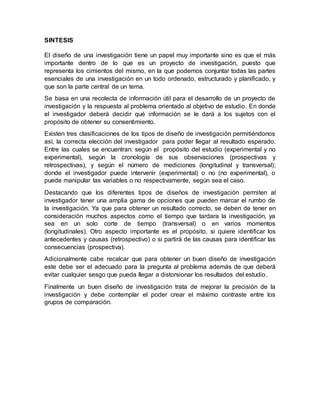
El diseño de una investigación tiene un papel muy importante sino es que el más
importante dentro de lo que es un proyecto de investigación, puesto que
representa los cimientos del mismo, en la que podemos conjuntar todas las partes
esenciales de una investigación en un todo ordenado, estructurado y planificado, y
que son la parte central de un tema.
Se basa en una recolecta de información útil para el desarrollo de un proyecto de
investigación y la respuesta al problema orientado al objetivo de estudio. En donde
el investigador deberá decidir qué información se le dará a los sujetos con el
propósito de obtener su consentimiento.
Existen tres clasificaciones de los tipos de diseño de investigación permitiéndonos
así, la correcta elección del investigador para poder llegar al resultado esperado.
Entre las cuales se encuentran: según el propósito del estudio (experimental y no
experimental), según la cronología de sus observaciones (prospectivas y
retrospectivas), y según el número de mediciones (longitudinal y transversal);
donde el investigador puede intervenir (experimental) o no (no experimental), o
puede manipular las variables o no respectivamente, según sea el caso.
Destacando que los diferentes tipos de diseños de investigación permiten al
investigador tener una amplia gama de opciones que pueden marcar el rumbo de
la investigación. Ya que para obtener un resultado correcto, se deben de tener en
consideración muchos aspectos como el tiempo que tardara la investigación, ya
sea en un solo corte de tiempo (transversal) o en varios momentos
(longitudinales). Otro aspecto importante es el propósito, si quiere identificar los
antecedentes y causas (retrospectivo) o si partirá de las causas para identificar las
consecuencias (prospectiva).
Adicionalmente cabe recalcar que para obtener un buen diseño de investigación
este debe ser el adecuado para la pregunta al problema además de que deberá
evitar cualquier sesgo que pueda llegar a distorsionar los resultados del estudio.
Finalmente un buen diseño de investigación trata de mejorar la precisión de la
investigación y debe contemplar el poder crear el máximo contraste entre los
grupos de comparación.
SYNTHESIS
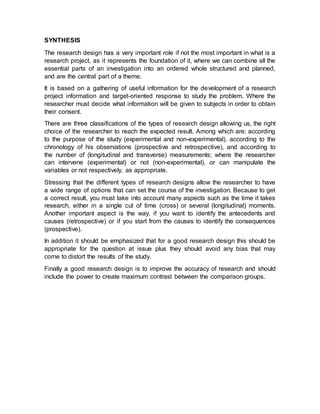
The research design has a very important role if not the most important in what is a
research project, as it represents the foundation of it, where we can combine all the
essential parts of an investigation into an ordered whole structured and planned,
and are the central part of a theme.
It is based on a gathering of useful information for the development of a research
project information and target-oriented response to study the problem. Where the
researcher must decide what information will be given to subjects in order to obtain
their consent.
There are three classifications of the types of research design allowing us, the right
choice of the researcher to reach the expected result. Among which are: according
to the purpose of the study (experimental and non-experimental), according to the
chronology of his observations (prospective and retrospective), and according to
the number of (longitudinal and transverse) measurements; where the researcher
can intervene (experimental) or not (non-experimental), or can manipulate the
variables or not respectively, as appropriate.
Stressing that the different types of research designs allow the researcher to have
a wide range of options that can set the course of the investigation. Because to get
a correct result, you must take into account many aspects such as the time it takes
research, either in a single cut of time (cross) or several (longitudinal) moments.
Another important aspect is the way, if you want to identify the antecedents and
causes (retrospective) or if you start from the causes to identify the consequences
(prospective).
In addition it should be emphasized that for a good research design this should be
appropriate for the question at issue plus they should avoid any bias that may
come to distort the results of the study.
Finally a good research design is to improve the accuracy of research and should
include the power to create maximum contrast between the comparison groups.

Síntesis

  • 1.
    INSTITUTO POLITÉCNICO NACIONAL “ESCUELASUPERIOR DE MEDICINA” METODOLOGÍA DE LA INVESTIGACIÓN Y ESTADÍSTICA I GARCÍA CRUZ MARIO ANTONIO GONZÁLEZ GALLEGOS ANGÉLICA HERNANDEZ JAHEN MARCO ANTONIO MONTEMIRA OROZCO DIANA RIVERA RUBIO FERNANDA ABRIL 3CM10 SÍNTESIS DE DISEÑOS DE INVESTIGACIÓN EN ESPAÑOL E INGLÉS PROF. GREGORIO GÓMEZ HERNÁNDEZ CICLO ESCOLAR 2016-2017/1 27/SEPTIEMBRE/2016
  • 2.
    SINTESIS El diseño deuna investigación tiene un papel muy importante sino es que el más importante dentro de lo que es un proyecto de investigación, puesto que representa los cimientos del mismo, en la que podemos conjuntar todas las partes esenciales de una investigación en un todo ordenado, estructurado y planificado, y que son la parte central de un tema. Se basa en una recolecta de información útil para el desarrollo de un proyecto de investigación y la respuesta al problema orientado al objetivo de estudio. En donde el investigador deberá decidir qué información se le dará a los sujetos con el propósito de obtener su consentimiento. Existen tres clasificaciones de los tipos de diseño de investigación permitiéndonos así, la correcta elección del investigador para poder llegar al resultado esperado. Entre las cuales se encuentran: según el propósito del estudio (experimental y no experimental), según la cronología de sus observaciones (prospectivas y retrospectivas), y según el número de mediciones (longitudinal y transversal); donde el investigador puede intervenir (experimental) o no (no experimental), o puede manipular las variables o no respectivamente, según sea el caso. Destacando que los diferentes tipos de diseños de investigación permiten al investigador tener una amplia gama de opciones que pueden marcar el rumbo de la investigación. Ya que para obtener un resultado correcto, se deben de tener en consideración muchos aspectos como el tiempo que tardara la investigación, ya sea en un solo corte de tiempo (transversal) o en varios momentos (longitudinales). Otro aspecto importante es el propósito, si quiere identificar los antecedentes y causas (retrospectivo) o si partirá de las causas para identificar las consecuencias (prospectiva). Adicionalmente cabe recalcar que para obtener un buen diseño de investigación este debe ser el adecuado para la pregunta al problema además de que deberá evitar cualquier sesgo que pueda llegar a distorsionar los resultados del estudio. Finalmente un buen diseño de investigación trata de mejorar la precisión de la investigación y debe contemplar el poder crear el máximo contraste entre los grupos de comparación.
  • 3.
    SYNTHESIS The research designhas a very important role if not the most important in what is a research project, as it represents the foundation of it, where we can combine all the essential parts of an investigation into an ordered whole structured and planned, and are the central part of a theme. It is based on a gathering of useful information for the development of a research project information and target-oriented response to study the problem. Where the researcher must decide what information will be given to subjects in order to obtain their consent. There are three classifications of the types of research design allowing us, the right choice of the researcher to reach the expected result. Among which are: according to the purpose of the study (experimental and non-experimental), according to the chronology of his observations (prospective and retrospective), and according to the number of (longitudinal and transverse) measurements; where the researcher can intervene (experimental) or not (non-experimental), or can manipulate the variables or not respectively, as appropriate. Stressing that the different types of research designs allow the researcher to have a wide range of options that can set the course of the investigation. Because to get a correct result, you must take into account many aspects such as the time it takes research, either in a single cut of time (cross) or several (longitudinal) moments. Another important aspect is the way, if you want to identify the antecedents and causes (retrospective) or if you start from the causes to identify the consequences (prospective). In addition it should be emphasized that for a good research design this should be appropriate for the question at issue plus they should avoid any bias that may come to distort the results of the study. Finally a good research design is to improve the accuracy of research and should include the power to create maximum contrast between the comparison groups.