Verbos Reflexivos
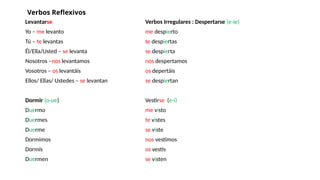
Levantarse Verbos Irregulares : Despertarse (e-ie)
Yo – me levanto me despierto
Tú – te levantas te despiertas
Él/Ella/Usted – se levanta se despierta
Nosotros –nos levantamos nos despertamos
Vosotros – os levantáis os depertáis
Ellos/ Ellas/ Ustedes – se levantan se despiertan
Dormir (o-ue) Vestirse (e-i)
Duermo me visto
Duermes te vistes
Duerme se viste
Dormimos nos vestimos
Dormís os vestís
Duermen se visten
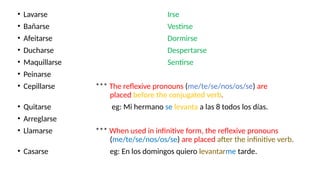
• Lavarse Irse
• Bañarse Vestirse
• Afeitarse Dormirse
• Ducharse Despertarse
• Maquillarse Sentirse
• Peinarse
• Cepillarse *** The reflexive pronouns (me/te/se/nos/os/se) are
placed before the conjugated verb.
• Quitarse eg: Mi hermano se levanta a las 8 todos los días.
• Arreglarse
• Llamarse *** When used in infinitive form, the reflexive pronouns
(me/te/se/nos/os/se) are placed after the infinitive verb.
• Casarse eg: En los domingos quiero levantarme tarde.
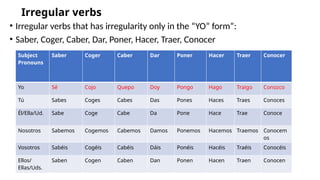
Irregular verbs
• Irregular verbs that has irregularity only in the “YO” form”:
• Saber, Coger, Caber, Dar, Poner, Hacer, Traer, Conocer
Subject
Pronouns
Saber Coger Caber Dar Poner Hacer Traer Conocer
Yo Sé Cojo Quepo Doy Pongo Hago Traigo Conozco
Tú Sabes Coges Cabes Das Pones Haces Traes Conoces
Él/Ella/Ud. Sabe Coge Cabe Da Pone Hace Trae Conoce
Nosotros Sabemos Cogemos Cabemos Damos Ponemos Hacemos Traemos Conocem
os
Vosotros Sabéis Cogéis Cabéis Dáis Ponéis Hacéis Traéis Conocéis
Ellos/
Ellas/Uds.
Saben Cogen Caben Dan Ponen Hacen Traen Conocen
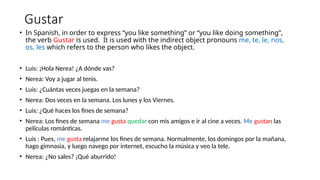
Gustar
• In Spanish, in order to express “you like something” or “you like doing something”,
the verb Gustar is used. It is used with the indirect object pronouns me, te, le, nos,
os, les which refers to the person who likes the object.
• Luis: ¡Hola Nerea! ¿A dónde vas?
• Nerea: Voy a jugar al tenis.
• Luis: ¿Cuántas veces juegas en la semana?
• Nerea: Dos veces en la semana. Los lunes y los Viernes.
• Luis: ¿Qué haces los fines de semana?
• Nerea: Los fines de semana me gusta quedar con mis amigos e ir al cine a veces. Me gustan las
películas románticas.
• Luis : Pues, me gusta relajarme los fines de semana. Normalmente, los domingos por la mañana,
hago gimnasia, y luego navego por internet, escucho la música y veo la tele.
• Nerea: ¿No sales? ¡Qué aburrido!
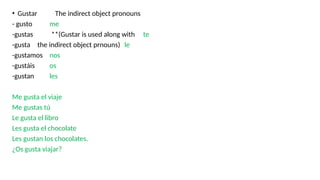
• Gustar The indirect object pronouns
- gusto me
-gustas **(Gustar is used along with te
-gusta the indirect object prnouns) le
-gustamos nos
-gustáis os
-gustan les
Me gusta el viaje
Me gustas tú
Le gusta el libro
Les gusta el chocolate
Les gustan los chocolates.
¿Os gusta viajar?
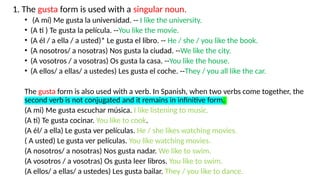
1. The gusta form is used with a singular noun.
• (A mí) Me gusta la universidad. -- I like the university.
• (A ti ) Te gusta la película. --You like the movie.
• (A él / a ella / a usted)* Le gusta el libro. -- He / she / you like the book.
• (A nosotros/ a nosotras) Nos gusta la ciudad. --We like the city.
• (A vosotros / a vosotras) Os gusta la casa. --You like the house.
• (A ellos/ a ellas/ a ustedes) Les gusta el coche. --They / you all like the car.
The gusta form is also used with a verb. In Spanish, when two verbs come together, the
second verb is not conjugated and it remains in infinitive form.
(A mi) Me gusta escuchar música. I like listening to music.
(A ti) Te gusta cocinar. You like to cook.
(A él/ a ella) Le gusta ver películas. He / she likes watching movies.
( A usted) Le gusta ver películas. You like watching movies.
(A nosotros/ a nosotras) Nos gusta nadar. We like to swim.
(A vosotros / a vosotras) Os gusta leer libros. You like to swim.
(A ellos/ a ellas/ a ustedes) Les gusta bailar. They / you like to dance.
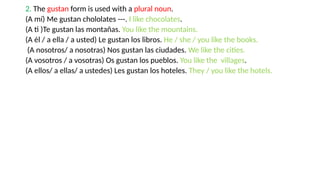
2. The gustan form is used with a plural noun.
(A mí) Me gustan chololates ---. I like chocolates.
(A ti )Te gustan las montañas. You like the mountains.
(A él / a ella / a usted) Le gustan los libros. He / she / you like the books.
(A nosotros/ a nosotras) Nos gustan las ciudades. We like the cities.
(A vosotros / a vosotras) Os gustan los pueblos. You like the villages.
(A ellos/ a ellas/ a ustedes) Les gustan los hoteles. They / you like the hotels.
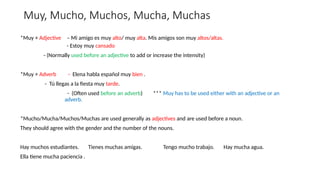
Muy, Mucho, Muchos, Mucha, Muchas
*Muy + Adjective – Mi amigo es muy alto/ muy alta. Mis amigos son muy altos/altas.
- Estoy muy cansado
- (Normally used before an adjective to add or increase the intensity)
*Muy + Adverb - Elena habla español muy bien .
- Tú llegas a la fiesta muy tarde.
- (Often used before an adverb) *** Muy has to be used either with an adjective or an
adverb.
*Mucho/Mucha/Muchos/Muchas are used generally as adjectives and are used before a noun.
They should agree with the gender and the number of the nouns.
Hay muchos estudiantes. Tienes muchas amigas. Tengo mucho trabajo. Hay mucha agua.
Ella tiene mucha paciencia .
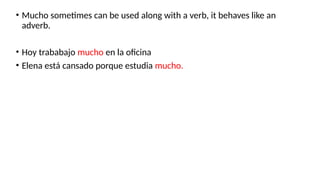
• Mucho sometimes can be used along with a verb, it behaves like an
adverb.
• Hoy trababajo mucho en la oficina
• Elena está cansado porque estudia mucho.
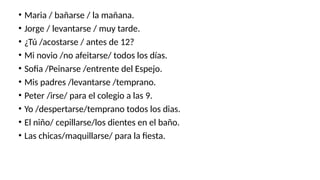
• Maria / bañarse / la mañana.
• Jorge / levantarse / muy tarde.
• ¿Tú /acostarse / antes de 12?
• Mi novio /no afeitarse/ todos los días.
• Sofia /Peinarse /entrente del Espejo.
• Mis padres /levantarse /temprano.
• Peter /irse/ para el colegio a las 9.
• Yo /despertarse/temprano todos los dias.
• El niño/ cepillarse/los dientes en el baño.
• Las chicas/maquillarse/ para la fiesta.
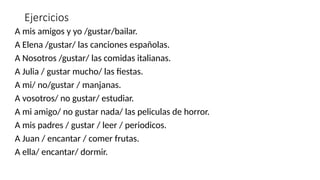
Ejercicios
A mis amigos y yo /gustar/bailar.
A Elena /gustar/ las canciones españolas.
A Nosotros /gustar/ las comidas italianas.
A Julia / gustar mucho/ las fiestas.
A mi/ no/gustar / manjanas.
A vosotros/ no gustar/ estudiar.
A mi amigo/ no gustar nada/ las peliculas de horror.
A mis padres / gustar / leer / periodicos.
A Juan / encantar / comer frutas.
A ella/ encantar/ dormir.

spanish verbsj abdjsjabdsbfbsdbfdbsdb.pptx

  • 1.
    Verbos Reflexivos Levantarse VerbosIrregulares : Despertarse (e-ie) Yo – me levanto me despierto Tú – te levantas te despiertas Él/Ella/Usted – se levanta se despierta Nosotros –nos levantamos nos despertamos Vosotros – os levantáis os depertáis Ellos/ Ellas/ Ustedes – se levantan se despiertan Dormir (o-ue) Vestirse (e-i) Duermo me visto Duermes te vistes Duerme se viste Dormimos nos vestimos Dormís os vestís Duermen se visten
  • 2.
    • Lavarse Irse •Bañarse Vestirse • Afeitarse Dormirse • Ducharse Despertarse • Maquillarse Sentirse • Peinarse • Cepillarse *** The reflexive pronouns (me/te/se/nos/os/se) are placed before the conjugated verb. • Quitarse eg: Mi hermano se levanta a las 8 todos los días. • Arreglarse • Llamarse *** When used in infinitive form, the reflexive pronouns (me/te/se/nos/os/se) are placed after the infinitive verb. • Casarse eg: En los domingos quiero levantarme tarde.
  • 3.
    Irregular verbs • Irregularverbs that has irregularity only in the “YO” form”: • Saber, Coger, Caber, Dar, Poner, Hacer, Traer, Conocer Subject Pronouns Saber Coger Caber Dar Poner Hacer Traer Conocer Yo Sé Cojo Quepo Doy Pongo Hago Traigo Conozco Tú Sabes Coges Cabes Das Pones Haces Traes Conoces Él/Ella/Ud. Sabe Coge Cabe Da Pone Hace Trae Conoce Nosotros Sabemos Cogemos Cabemos Damos Ponemos Hacemos Traemos Conocem os Vosotros Sabéis Cogéis Cabéis Dáis Ponéis Hacéis Traéis Conocéis Ellos/ Ellas/Uds. Saben Cogen Caben Dan Ponen Hacen Traen Conocen
  • 4.
    Gustar • In Spanish,in order to express “you like something” or “you like doing something”, the verb Gustar is used. It is used with the indirect object pronouns me, te, le, nos, os, les which refers to the person who likes the object. • Luis: ¡Hola Nerea! ¿A dónde vas? • Nerea: Voy a jugar al tenis. • Luis: ¿Cuántas veces juegas en la semana? • Nerea: Dos veces en la semana. Los lunes y los Viernes. • Luis: ¿Qué haces los fines de semana? • Nerea: Los fines de semana me gusta quedar con mis amigos e ir al cine a veces. Me gustan las películas románticas. • Luis : Pues, me gusta relajarme los fines de semana. Normalmente, los domingos por la mañana, hago gimnasia, y luego navego por internet, escucho la música y veo la tele. • Nerea: ¿No sales? ¡Qué aburrido!
  • 5.
    • Gustar Theindirect object pronouns - gusto me -gustas **(Gustar is used along with te -gusta the indirect object prnouns) le -gustamos nos -gustáis os -gustan les Me gusta el viaje Me gustas tú Le gusta el libro Les gusta el chocolate Les gustan los chocolates. ¿Os gusta viajar?
  • 6.
    1. The gustaform is used with a singular noun. • (A mí) Me gusta la universidad. -- I like the university. • (A ti ) Te gusta la película. --You like the movie. • (A él / a ella / a usted)* Le gusta el libro. -- He / she / you like the book. • (A nosotros/ a nosotras) Nos gusta la ciudad. --We like the city. • (A vosotros / a vosotras) Os gusta la casa. --You like the house. • (A ellos/ a ellas/ a ustedes) Les gusta el coche. --They / you all like the car. The gusta form is also used with a verb. In Spanish, when two verbs come together, the second verb is not conjugated and it remains in infinitive form. (A mi) Me gusta escuchar música. I like listening to music. (A ti) Te gusta cocinar. You like to cook. (A él/ a ella) Le gusta ver películas. He / she likes watching movies. ( A usted) Le gusta ver películas. You like watching movies. (A nosotros/ a nosotras) Nos gusta nadar. We like to swim. (A vosotros / a vosotras) Os gusta leer libros. You like to swim. (A ellos/ a ellas/ a ustedes) Les gusta bailar. They / you like to dance.
  • 7.
    2. The gustanform is used with a plural noun. (A mí) Me gustan chololates ---. I like chocolates. (A ti )Te gustan las montañas. You like the mountains. (A él / a ella / a usted) Le gustan los libros. He / she / you like the books. (A nosotros/ a nosotras) Nos gustan las ciudades. We like the cities. (A vosotros / a vosotras) Os gustan los pueblos. You like the villages. (A ellos/ a ellas/ a ustedes) Les gustan los hoteles. They / you like the hotels.
  • 8.
    Muy, Mucho, Muchos,Mucha, Muchas *Muy + Adjective – Mi amigo es muy alto/ muy alta. Mis amigos son muy altos/altas. - Estoy muy cansado - (Normally used before an adjective to add or increase the intensity) *Muy + Adverb - Elena habla español muy bien . - Tú llegas a la fiesta muy tarde. - (Often used before an adverb) *** Muy has to be used either with an adjective or an adverb. *Mucho/Mucha/Muchos/Muchas are used generally as adjectives and are used before a noun. They should agree with the gender and the number of the nouns. Hay muchos estudiantes. Tienes muchas amigas. Tengo mucho trabajo. Hay mucha agua. Ella tiene mucha paciencia .
  • 9.
    • Mucho sometimescan be used along with a verb, it behaves like an adverb. • Hoy trababajo mucho en la oficina • Elena está cansado porque estudia mucho.
  • 10.
    • Maria /bañarse / la mañana. • Jorge / levantarse / muy tarde. • ¿Tú /acostarse / antes de 12? • Mi novio /no afeitarse/ todos los días. • Sofia /Peinarse /entrente del Espejo. • Mis padres /levantarse /temprano. • Peter /irse/ para el colegio a las 9. • Yo /despertarse/temprano todos los dias. • El niño/ cepillarse/los dientes en el baño. • Las chicas/maquillarse/ para la fiesta.
  • 11.
    Ejercicios A mis amigosy yo /gustar/bailar. A Elena /gustar/ las canciones españolas. A Nosotros /gustar/ las comidas italianas. A Julia / gustar mucho/ las fiestas. A mi/ no/gustar / manjanas. A vosotros/ no gustar/ estudiar. A mi amigo/ no gustar nada/ las peliculas de horror. A mis padres / gustar / leer / periodicos. A Juan / encantar / comer frutas. A ella/ encantar/ dormir.