GRAMMAR BOOK
Sonia Mayfield
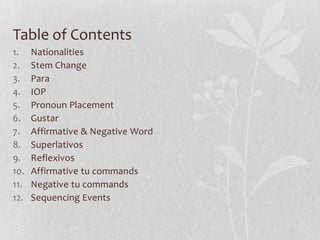
Table of Contents
1.    Nationalities
2.    Stem Change
3.    Para
4.    IOP
5.    Pronoun Placement
6.    Gustar
7.    Affirmative & Negative Word
8.    Superlativos
9.    Reflexivos
10.   Affirmative tu commands
11.   Negative tu commands
12.   Sequencing Events
Nationalities
Stem Change
                      Pedir e -> i
   Dormir o -> ue
      duermo             Pido
      duermes           Pides
  duerme duermen
                      Pide Piden


    Pensar e -> ie
                     Jugar u -> ue
       Pienso
                        Juego
       Piensas
                        Juegas
   Piensa Piensan
                     Juega Juegan
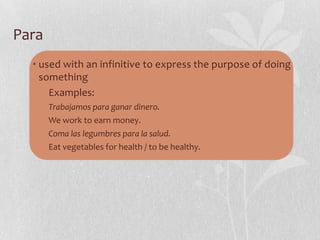
Para
  • used with an infinitive to express the purpose of doing
    something
      Examples:
       Trabajamos para ganar dinero.
       We work to earn money.
       Coma las legumbres para la salud.
       Eat vegetables for health / to be healthy.
IOP
      Me Nos                     - to whom
      Te Os                      - for whom
      Le Les

      S   V       DOP                IOP

      I give flowers to my teachers.

      Le doy las flores a mi maestra.
      Le las doy.
      Se las doy.

                               Gustar (like/please)
      - No goes before the indirect object.
             (No le gusta…)
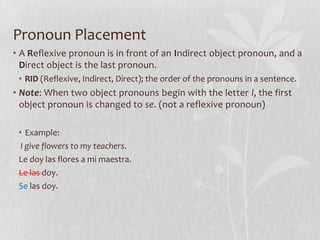
Pronoun Placement
• A Reflexive pronoun is in front of an Indirect object pronoun, and a
  Direct object is the last pronoun.
 • RID (Reflexive, Indirect, Direct); the order of the pronouns in a sentence.
• Note: When two object pronouns begin with the letter l, the first
  object pronoun is changed to se. (not a reflexive pronoun)

 • Example:
  I give flowers to my teachers.
 Le doy las flores a mi maestra.
 Le las doy.
 Se las doy.
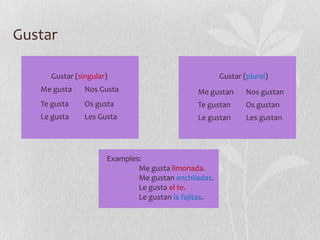
Gustar

      Gustar (singular)                               Gustar (plural)
   Me gusta     Nos Gusta                     Me gustan       Nos gustan
   Te gusta     Os gusta                      Te gustan       Os gustan
   Le gusta     Les Gusta                     Le gustan       Les gustan


                      Examples:
                              Me gusta limonada.
                              Me gustan enchiladas.
                              Le gusta el te.
                              Le gustan la fajitas.
Affirmative & Negative Words
Afirmative:
alguno (any)
siempre (always)
también ( also)
algún (some)
algo (something)
alguien (someone)

Negative:
nada : (nothing)
nunca (never)
nadie ( no-one)
ningún ( anything)
tampoco (nor)
Superlativos
• The suffixes –ísimo, -ísimos, -ísima, and –ísimas are added to adjectives
  and adverbs
• It is equivalent to extremely or very before an adjective or adverb
          malo > malísimo
          muchas > muchísimas
          difícil > dificilísimo
• Adjectives and adverbs ending in c, g, or z change spelling to qu, gu, and c
  respectively
          rico > riquísimo
          larga > larguísima
          feliz > felicísimo
• Adjectives that end in –n or –r form by adding –císimo
          joven > jovencísimo
          trabajador > trabajadorcísimo
Reflexivos
• In the reflexive construction, the subject is also the object
• A person does as well receives the action…
• The subject, the pronoun and the verb are all the same form…
     • Por ejemplo:
      • Yo me levanto a las ocho de la mañana.
      • Ella se despierta muy temprano.
              1.    Conjugate the verb
              2.    Add the reflexive pronouns
                          (me, te, se, nos, os, se)
Posición de las pronombres reflexivos:
1.   In front of the conjugated verb
       1.     Me acuesto a las diez de le noche.
2.      Attached to a gerund
       1.     Estoy acostándome ahora mismo.
3.      Attached to an infinitive
       1.     Voy a acostarme ahora mismo.
4.      Attached to an affirmative command
       1.     Bañate!
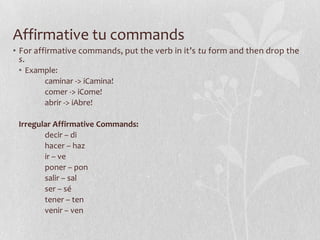
Affirmative tu commands
• For affirmative commands, put the verb in it’s tu form and then drop the
  s.
 • Example:
       caminar -> іCamina!
       comer -> іCome!
       abrir -> іAbre!

 Irregular Affirmative Commands:
        decir – di
        hacer – haz
        ir – ve
        poner – pon
        salir – sal
        ser – sé
        tener – ten
        venir – ven
Negative tu commands
1.   Put the verb in its yo form
2.   Change the vowel (ar -> e, er, ir -> a)
3.   Add an s at the end.
 • Example:
        hablar -> hablo -> іNo hables!
        volver -> vuelvo -> іNo vuelvas!

 Irregular Negative Commands:
         Tener – no tengas
         Venir – no vengas
         dar/ decir – no des/ digas
         ir – no vayas
         ser – no seas
         hacer – no hagas
         estar – no estés
         saber – no sepas/ salgas
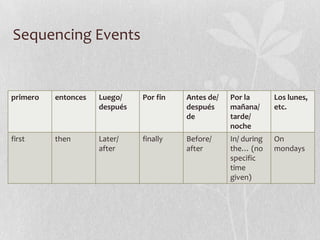
Sequencing Events


primero   entonces   Luego/    Por fin   Antes de/   Por la       Los lunes,
                     después             después     mañana/      etc.
                                         de          tarde/
                                                     noche
first     then       Later/    finally   Before/     In/ during   On
                     after               after       the… (no     mondays
                                                     specific
                                                     time
                                                     given)

Grammar book

  • 1.
  • 2.
    Table of Contents 1. Nationalities 2. Stem Change 3. Para 4. IOP 5. Pronoun Placement 6. Gustar 7. Affirmative & Negative Word 8. Superlativos 9. Reflexivos 10. Affirmative tu commands 11. Negative tu commands 12. Sequencing Events
  • 3.
  • 4.
    Stem Change Pedir e -> i Dormir o -> ue duermo Pido duermes Pides duerme duermen Pide Piden Pensar e -> ie Jugar u -> ue Pienso Juego Piensas Juegas Piensa Piensan Juega Juegan
  • 5.
    Para •used with an infinitive to express the purpose of doing something Examples: Trabajamos para ganar dinero. We work to earn money. Coma las legumbres para la salud. Eat vegetables for health / to be healthy.
  • 6.
    IOP Me Nos - to whom Te Os - for whom Le Les S V DOP IOP I give flowers to my teachers. Le doy las flores a mi maestra. Le las doy. Se las doy. Gustar (like/please) - No goes before the indirect object. (No le gusta…)
  • 7.
    Pronoun Placement • AReflexive pronoun is in front of an Indirect object pronoun, and a Direct object is the last pronoun. • RID (Reflexive, Indirect, Direct); the order of the pronouns in a sentence. • Note: When two object pronouns begin with the letter l, the first object pronoun is changed to se. (not a reflexive pronoun) • Example: I give flowers to my teachers. Le doy las flores a mi maestra. Le las doy. Se las doy.
  • 8.
    Gustar Gustar (singular) Gustar (plural) Me gusta Nos Gusta Me gustan Nos gustan Te gusta Os gusta Te gustan Os gustan Le gusta Les Gusta Le gustan Les gustan Examples: Me gusta limonada. Me gustan enchiladas. Le gusta el te. Le gustan la fajitas.
  • 9.
    Affirmative & NegativeWords Afirmative: alguno (any) siempre (always) también ( also) algún (some) algo (something) alguien (someone) Negative: nada : (nothing) nunca (never) nadie ( no-one) ningún ( anything) tampoco (nor)
  • 10.
    Superlativos • The suffixes–ísimo, -ísimos, -ísima, and –ísimas are added to adjectives and adverbs • It is equivalent to extremely or very before an adjective or adverb malo > malísimo muchas > muchísimas difícil > dificilísimo • Adjectives and adverbs ending in c, g, or z change spelling to qu, gu, and c respectively rico > riquísimo larga > larguísima feliz > felicísimo • Adjectives that end in –n or –r form by adding –císimo joven > jovencísimo trabajador > trabajadorcísimo
  • 11.
    Reflexivos • In thereflexive construction, the subject is also the object • A person does as well receives the action… • The subject, the pronoun and the verb are all the same form… • Por ejemplo: • Yo me levanto a las ocho de la mañana. • Ella se despierta muy temprano. 1. Conjugate the verb 2. Add the reflexive pronouns (me, te, se, nos, os, se) Posición de las pronombres reflexivos: 1. In front of the conjugated verb 1. Me acuesto a las diez de le noche. 2. Attached to a gerund 1. Estoy acostándome ahora mismo. 3. Attached to an infinitive 1. Voy a acostarme ahora mismo. 4. Attached to an affirmative command 1. Bañate!
  • 12.
    Affirmative tu commands •For affirmative commands, put the verb in it’s tu form and then drop the s. • Example: caminar -> іCamina! comer -> іCome! abrir -> іAbre! Irregular Affirmative Commands: decir – di hacer – haz ir – ve poner – pon salir – sal ser – sé tener – ten venir – ven
  • 13.
    Negative tu commands 1. Put the verb in its yo form 2. Change the vowel (ar -> e, er, ir -> a) 3. Add an s at the end. • Example: hablar -> hablo -> іNo hables! volver -> vuelvo -> іNo vuelvas! Irregular Negative Commands: Tener – no tengas Venir – no vengas dar/ decir – no des/ digas ir – no vayas ser – no seas hacer – no hagas estar – no estés saber – no sepas/ salgas
  • 14.
    Sequencing Events primero entonces Luego/ Por fin Antes de/ Por la Los lunes, después después mañana/ etc. de tarde/ noche first then Later/ finally Before/ In/ during On after after the… (no mondays specific time given)