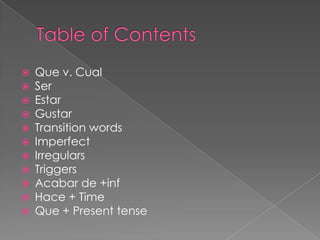
   Que v. Cual
   Ser
   Estar
   Gustar
   Transition words
   Imperfect
   Irregulars
   Triggers
   Acabar de +inf
   Hace + Time
   Que + Present tense
 Verbs like gustar
 Reflexive
 Tu commands
 Direct Object Pronouns and Placement
 Preterite
Que
 What?
 Always used when asking for a definition.
 Ex. What is her name?
Cual
 Which or what?
 Is used in front of „es‟ or any other
  conjugation of ser for all other purposes;
  used to make a selection.
 Descriptions: Que es?
 Origin: De donde es?
 Characteristics: Como es?
 Time: Que hora es?
 Occupation: Que hace?
 Relationship: Quien es?
 Possession: De quien es?
 Events: Cuando/Donde es?
 Dates: Que dia es hoy? Cual es la fecha
  de hoy? Cuando es tu cumpleanos?
   How you feel and where you are is when you
    use the verb estar.
   Estar is only temporary.
   Health: Como estas? (bien, mal, regular,
    enfermo..)
   Emotions: Como estas? (enojado, triste,
    cansado, adotado..)
   Location (EN): Donde estas? (la casa, la
    oficina, la escuela..)
   Present Condition: Como esta? (abierto,
    cerrado, verde..)
   ING: Que estas haciendo?
    › Ar: ando- pasear: paseando
    › Er/ir: iendo- comer: comiendo
    › The verb itself: yendo- leer: leyendo
   Me gusta(n)- it pleases me
   Te gusta(n)- it pleases you
   Le gusta(n)- it pleases him/her/you
   Nos gusta(n)- it pleases us
   Os gusta(n)- it pleases ya‟ll
   Les gusta(n)- it pleases them/you
   Usa gusta antes de unsustantivo singular.
    › Me gusta el boligrafo.
   Usa gusta antes de un infinitivo.
    › Me gusta hablar espanol.
   Usa gustan antes de un sustantivo plural.
    › Me gustan los boligrafos.
 Tambien- Also
 Ahora- Now
 Primero- First
 Asi que- So
 Entonces- Then
 Ni- Or
 Despues- After
 Por eso- Therefore
 Y- And
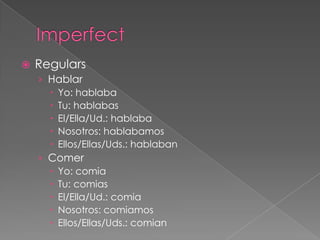
   Regulars
    › Hablar
       Yo: hablaba
       Tu: hablabas
       El/Ella/Ud.: hablaba
       Nosotros: hablabamos
       Ellos/Ellas/Uds.: hablaban
    › Comer
       Yo: comia
       Tu: comias
       El/Ella/Ud.: comia
       Nosotros: comiamos
       Ellos/Ellas/Uds.: comian
› Escribir
       Yo: escribia
       Tu: escribias
       El/Ella/Ud.: escribia
       Nosotros: escribiamos
       Ellos/Ellas/Uds.: escribian
   Irregulars
    › Ir
          Yo: iba
          Tu: ibas
          El/Ella/Ud.: iba
          Nosotros: ibamos
          Ellos/Ellas/Uds.: iban
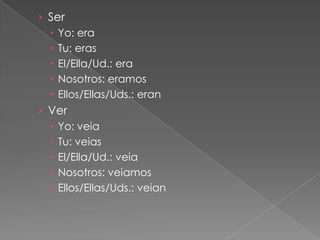
› Ser
   Yo: era
   Tu: eras
   El/Ella/Ud.: era
   Nosotros: eramos
   Ellos/Ellas/Uds.: eran
› Ver
   Yo: veia
   Tu: veias
   El/Ella/Ud.: veia
   Nosotros: veiamos
   Ellos/Ellas/Uds.: veian
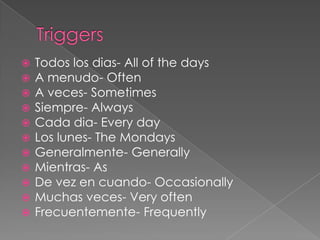
   Todos los dias- All of the days
   A menudo- Often
   A veces- Sometimes
   Siempre- Always
   Cada dia- Every day
   Los lunes- The Mondays
   Generalmente- Generally
   Mientras- As
   De vez en cuando- Occasionally
   Muchas veces- Very often
   Frecuentemente- Frequently
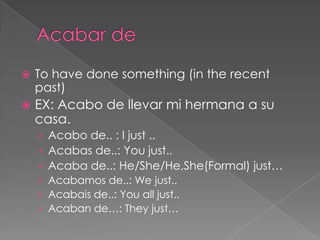
   To have done something (in the recent
    past)
   EX: Acabo de llevar mi hermana a su
    casa.
    › Acabo de.. : I just ..
    › Acabas de..: You just..
    › Acaba de..: He/She/He,She(Formal) just…
    › Acabamos de..: We just..
    › Acabais de..: You all just..
    › Acaban de…: They just…
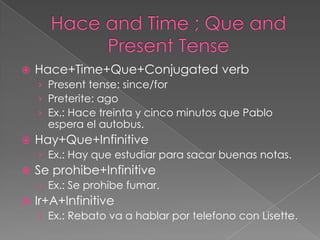
   Hace+Time+Que+Conjugated verb
    › Present tense: since/for
    › Preterite: ago
    › Ex.: Hace treinta y cinco minutos que Pablo
      espera el autobus.
   Hay+Que+Infinitive
    › Ex.: Hay que estudiar para sacar buenas notas.
   Se prohibe+Infinitive
    › Ex.: Se prohibe fumar.
   Ir+A+Infinitive
    › Ex.: Rebato va a hablar por telefono con Lisette.
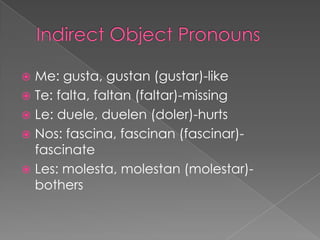
 Me: gusta, gustan (gustar)-like
 Te: falta, faltan (faltar)-missing
 Le: duele, duelen (doler)-hurts
 Nos: fascina, fascinan (fascinar)-
  fascinate
 Les: molesta, molestan (molestar)-
  bothers
 Hace+time+conjugated verb= how
  much time you‟ve been doing
  something
 Hay+que+infinitive= talk about what
  needs to be done
 Se prohibe+infinitive= tells what is
  prohibited
   When the subject and object are the same the
    verb is reflexive. When they are different the
    verb is not reflexive.
   When a verb is reflexive, the infinitive ends in
    "se.“
   Examples:
    ›   Pego: to hit
    ›   Choco: ran into
    ›   Rompio: to break
    ›   Lastimo: to hurt oneself
    ›   Cayo: to fall down
    ›   Corto: to cut
    ›   Sintio: I feel
 Simply drop the „s‟. DOP and IOP can
  attach to an affirmative command.
 Examples:
    › Dilo
    › Comlo
    › Ponlo
 Takes the place of a noun
 Me, te, lo, la, nos, os, los, las
 When you change the syllabification of a
  verb an accent mark is added to the 3rd
  to the last syllable.
 DOP‟s attached to verbs
    › Infinitive= Voy a comerlo
    › Affirmative command= ¡Comelo!
    › Present progressive= Estoy comiéndolo.
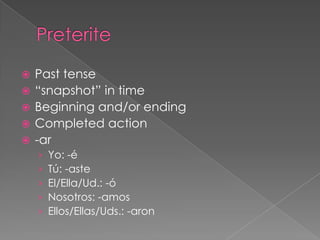
   Past tense
   “snapshot” in time
   Beginning and/or ending
   Completed action
   -ar
    ›   Yo: -é
    ›   Tú: -aste
    ›   El/Ella/Ud.: -ó
    ›   Nosotros: -amos
    ›   Ellos/Ellas/Uds.: -aron
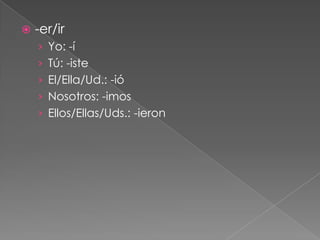
   -er/ir
    › Yo: -í
    › Tú: -iste
    › El/Ella/Ud.: -ió
    › Nosotros: -imos
    › Ellos/Ellas/Uds.: -ieron

Grammar book

  • 2.
    Que v. Cual  Ser  Estar  Gustar  Transition words  Imperfect  Irregulars  Triggers  Acabar de +inf  Hace + Time  Que + Present tense
  • 3.
     Verbs likegustar  Reflexive  Tu commands  Direct Object Pronouns and Placement  Preterite
  • 4.
    Que  What?  Alwaysused when asking for a definition.  Ex. What is her name? Cual  Which or what?  Is used in front of „es‟ or any other conjugation of ser for all other purposes; used to make a selection.
  • 5.
     Descriptions: Quees?  Origin: De donde es?  Characteristics: Como es?  Time: Que hora es?  Occupation: Que hace?  Relationship: Quien es?  Possession: De quien es?  Events: Cuando/Donde es?  Dates: Que dia es hoy? Cual es la fecha de hoy? Cuando es tu cumpleanos?
  • 6.
    How you feel and where you are is when you use the verb estar.  Estar is only temporary.  Health: Como estas? (bien, mal, regular, enfermo..)  Emotions: Como estas? (enojado, triste, cansado, adotado..)  Location (EN): Donde estas? (la casa, la oficina, la escuela..)  Present Condition: Como esta? (abierto, cerrado, verde..)  ING: Que estas haciendo? › Ar: ando- pasear: paseando › Er/ir: iendo- comer: comiendo › The verb itself: yendo- leer: leyendo
  • 7.
    Me gusta(n)- it pleases me  Te gusta(n)- it pleases you  Le gusta(n)- it pleases him/her/you  Nos gusta(n)- it pleases us  Os gusta(n)- it pleases ya‟ll  Les gusta(n)- it pleases them/you  Usa gusta antes de unsustantivo singular. › Me gusta el boligrafo.  Usa gusta antes de un infinitivo. › Me gusta hablar espanol.  Usa gustan antes de un sustantivo plural. › Me gustan los boligrafos.
  • 8.
     Tambien- Also Ahora- Now  Primero- First  Asi que- So  Entonces- Then  Ni- Or  Despues- After  Por eso- Therefore  Y- And
  • 9.
    Regulars › Hablar  Yo: hablaba  Tu: hablabas  El/Ella/Ud.: hablaba  Nosotros: hablabamos  Ellos/Ellas/Uds.: hablaban › Comer  Yo: comia  Tu: comias  El/Ella/Ud.: comia  Nosotros: comiamos  Ellos/Ellas/Uds.: comian
  • 10.
    › Escribir  Yo: escribia  Tu: escribias  El/Ella/Ud.: escribia  Nosotros: escribiamos  Ellos/Ellas/Uds.: escribian  Irregulars › Ir  Yo: iba  Tu: ibas  El/Ella/Ud.: iba  Nosotros: ibamos  Ellos/Ellas/Uds.: iban
  • 11.
    › Ser  Yo: era  Tu: eras  El/Ella/Ud.: era  Nosotros: eramos  Ellos/Ellas/Uds.: eran › Ver  Yo: veia  Tu: veias  El/Ella/Ud.: veia  Nosotros: veiamos  Ellos/Ellas/Uds.: veian
  • 12.
    Todos los dias- All of the days  A menudo- Often  A veces- Sometimes  Siempre- Always  Cada dia- Every day  Los lunes- The Mondays  Generalmente- Generally  Mientras- As  De vez en cuando- Occasionally  Muchas veces- Very often  Frecuentemente- Frequently
  • 13.
    To have done something (in the recent past)  EX: Acabo de llevar mi hermana a su casa. › Acabo de.. : I just .. › Acabas de..: You just.. › Acaba de..: He/She/He,She(Formal) just… › Acabamos de..: We just.. › Acabais de..: You all just.. › Acaban de…: They just…
  • 14.
    Hace+Time+Que+Conjugated verb › Present tense: since/for › Preterite: ago › Ex.: Hace treinta y cinco minutos que Pablo espera el autobus.  Hay+Que+Infinitive › Ex.: Hay que estudiar para sacar buenas notas.  Se prohibe+Infinitive › Ex.: Se prohibe fumar.  Ir+A+Infinitive › Ex.: Rebato va a hablar por telefono con Lisette.
  • 15.
     Me: gusta,gustan (gustar)-like  Te: falta, faltan (faltar)-missing  Le: duele, duelen (doler)-hurts  Nos: fascina, fascinan (fascinar)- fascinate  Les: molesta, molestan (molestar)- bothers
  • 16.
     Hace+time+conjugated verb=how much time you‟ve been doing something  Hay+que+infinitive= talk about what needs to be done  Se prohibe+infinitive= tells what is prohibited
  • 17.
    When the subject and object are the same the verb is reflexive. When they are different the verb is not reflexive.  When a verb is reflexive, the infinitive ends in "se.“  Examples: › Pego: to hit › Choco: ran into › Rompio: to break › Lastimo: to hurt oneself › Cayo: to fall down › Corto: to cut › Sintio: I feel
  • 18.
     Simply dropthe „s‟. DOP and IOP can attach to an affirmative command.  Examples: › Dilo › Comlo › Ponlo
  • 19.
     Takes theplace of a noun  Me, te, lo, la, nos, os, los, las  When you change the syllabification of a verb an accent mark is added to the 3rd to the last syllable.  DOP‟s attached to verbs › Infinitive= Voy a comerlo › Affirmative command= ¡Comelo! › Present progressive= Estoy comiéndolo.
  • 20.
    Past tense  “snapshot” in time  Beginning and/or ending  Completed action  -ar › Yo: -é › Tú: -aste › El/Ella/Ud.: -ó › Nosotros: -amos › Ellos/Ellas/Uds.: -aron
  • 21.
    -er/ir › Yo: -í › Tú: -iste › El/Ella/Ud.: -ió › Nosotros: -imos › Ellos/Ellas/Uds.: -ieron