Subjunctive  with Doubt, Disbelief and Denial and Indicitive with Expressions of Certainty Subjunctivo Con La Duda, La Incredulidad y La Negaci ó n y Indicitivo Con Las Expresiones De La Seguridad
Que es Subjunctivo? Subjunctivo Definido: A mood that represents the speakers attitudes toward events, as well as actions or states the speaker views as uncertain or hypothetical. Como:  Yo  piense  que el esposo de Pen él ope, Javier Bardem  esté  un buen actor. I think  Penelope's husband Javier Bardem is a good actor.   La paparazzi  busque  que fotos de Pen él ope y Javier son difíciles para  consiga. The paparazzi  find  that pictures of Penelope and Javier are hard to  get.
Subjunctivo The subjunctive is always used in a subordinate clause when there is a change of subject and the expression in the main clause implies negation or uncertainty. Como:  Es probable  que  Pen él ope Cruz  gane  otra premio de actuando. Penelope Cruz  is likely  to  win  another acting award. Pen él ope  negó  que su embarazo a la paparazzi para  mantenga  privada en su vida.  ​ Penelope  denied  her pregnancy to the paparazzi  to keep  her life private.
¿Cuándo uso del subjuntivo? W:  wishes E:  emotion I:  impersonal expressions  R:  recommendations D:  doubt/denial O:  ojalá!
El Subjunctivo Con Dudar The subjunctive is always required with expressions of doubt, disbelief, and denial. Como:  Es  no   verdad  que Penélope Cruz es una actriz mala. It  is  not true  that Penélope Cruz is a bad actress. Me cabe duda  de que Penélope se  deje  de actuar. I doubt that  Penélope  will stop  acting.
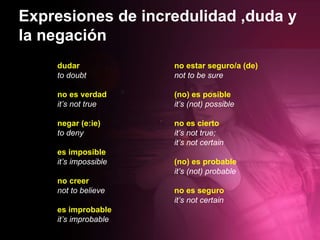
Expresiones de incredulidad ,duda y la negación no estar seguro/a (de)   not to be   sure   (no) es posible   it’s (not) possible no es cierto   it’s not true;  it’s not certain   (no) es probable   it’s (not) probable no es seguro   it’s not certain   dudar   to doubt   no es verdad   it’s not true   negar (e:ie)   to deny   es imposible   it’s impossible no creer   not to believe es improbable   it’s improbable
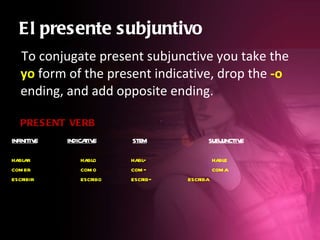
El presente subjuntivo To conjugate present subjunctive you take the  yo  form of the present indicative, drop the  -o   ending, and add opposite ending. INFINITIVE   INDICATIVE   STEM     SUBJUNCTIVE hablar   hablo   habl-   hable comer   como   com-   coma escribir   escribo   escrib-  escriba PRESENT  VERB
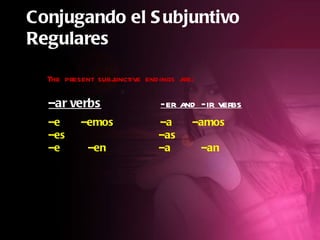
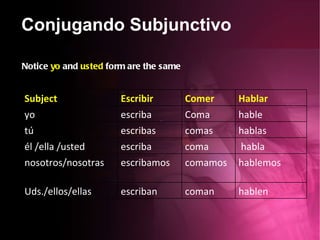
The present subjunctive endings are: Conjugando el Subjuntivo Regulares – ar verbs –er and –ir verbs – e    –emos  –a  –amos – es    –as  – e  –en    –a  –an
Conjugando Subjunctivo Notice  yo  and  usted  form are the same Subject   Escribir Comer Hablar yo  escriba  Coma hable tú  escribas  comas hablas él /ella /usted  escriba  coma habla nosotros/nosotras  escribamos comamos hablemos Uds./ellos/ellas  escriban  coman hablen
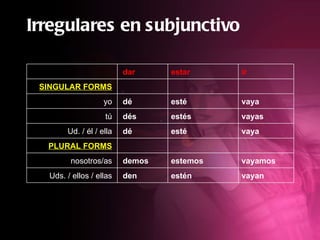
Irregulares en subjunctivo dar   estar   ir   SINGULAR FORMS   yo   dé   esté   vaya   tú   dés   estés   vayas   Ud. / él / ella   dé   esté   vaya   PLURAL FORMS   nosotros/as   demos   estemos   vayamos   Uds. / ellos / ellas   den   estén   vayan
Irregulares en subjunctivo saber   ser   SINGULAR FORMS   yo   sepa   sea   tú   sepas   seas   Ud. / él / ella   sepa   sea   PLURAL FORMS   nosotros/as   sepamos   seamos   Uds. / ellos / ellas   sepan   sean
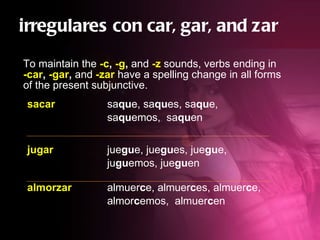
irregulares con car, gar, and zar To maintain the  -c ,  -g ,  and  -z   sounds, verbs ending in  -car ,  -gar ,  and  -zar  have a spelling change in all forms of the present subjunctive. sacar   sa qu e, sa qu es, sa qu e,  sa qu emos,  sa qu en jugar  jue gu e, jue gu es, jue gu e,  ju gu emos, jue gu en almorzar   almuer c e, almuer c es, almuer c e,   almor c emos,  almuer c en
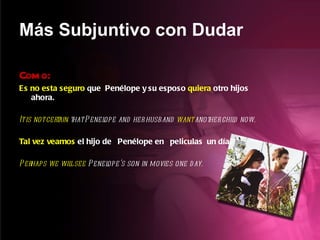
Más Subjuntivo con Dudar Como:  Es no esta seguro  que  Penélope  y su esposo  quiera  otro hijos ahora. It is not certain  that Penelope and her husband  want  another child now. Tal vez veamos  el hijo de  Penélope en  peliculas un día. Perhaps we will see  Penelope’s son in movies one day.
Indicitivo The indicative is used in a subordinate clause when there is no doubt or uncertainty in the main clause. Main Clause   subordinate clause  Es cierto  que Penelope Cruz y Javier Bardem  ganaron   el premio Oscar por la actuación. It is true  that   Penelope Cruz and Javier Bardem  won   the Academy Award for acting.
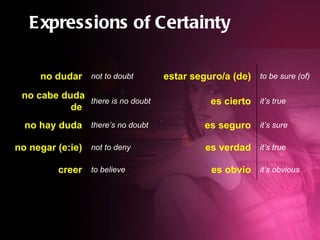
Expressions of Certainty no dudar   not to doubt   estar seguro/a (de)   to be sure (of)   no cabe duda de   there is no doubt   es cierto   it’s true   no hay duda   there ’ s no doubt   es seguro   it’s sure   no negar (e:ie)   not to deny   es verdad   it’s true   creer   to believe   es obvio   it’s obvious
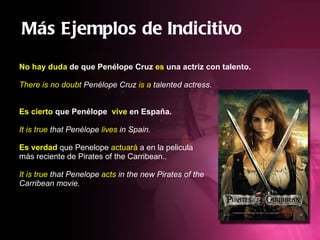
Más Ejemplos de  Indicitivo No hay duda  de que Penélope Cruz  es  una actriz con talento. There is no doubt  Penélope Cruz  is a  talented actress. Es cierto  que Penélope  vive  en España. It is true  that Penélope  lives  in Spain. Es verdad  que Penelope  actuará  a en la pelicula  más reciente de Pirates of the Carribean.. It is true  that Penelope  acts  in the new Pirates of the  Carribean movie.
Recuerdo Uso del subjuntivo con  La Duda, La Incredulidad, y La Negacion y con Uso el indicativo cuando NO HAY DUDA!! W:  wishes E:  emotion I:  impersonal expressions  R:  recommendations D:  doubt/denial O:  ojalá!
Subjunctive  with Doubt, Disbelief and Denial and Indicitive with Expressions of Certainty Subjunctivo Con La Duda, La Incredulidad y La Negaci ón  y Indicitivo Con Las Expresiones De La Seguridad

Subjunctive with Doubt & Denial

  • 1.
    Subjunctive withDoubt, Disbelief and Denial and Indicitive with Expressions of Certainty Subjunctivo Con La Duda, La Incredulidad y La Negaci ó n y Indicitivo Con Las Expresiones De La Seguridad
  • 2.
    Que es Subjunctivo?Subjunctivo Definido: A mood that represents the speakers attitudes toward events, as well as actions or states the speaker views as uncertain or hypothetical. Como: Yo piense que el esposo de Pen él ope, Javier Bardem esté un buen actor. I think  Penelope's husband Javier Bardem is a good actor.   La paparazzi busque que fotos de Pen él ope y Javier son difíciles para consiga. The paparazzi  find  that pictures of Penelope and Javier are hard to get.
  • 3.
    Subjunctivo The subjunctiveis always used in a subordinate clause when there is a change of subject and the expression in the main clause implies negation or uncertainty. Como: Es probable que Pen él ope Cruz gane otra premio de actuando. Penelope Cruz is likely to win another acting award. Pen él ope negó que su embarazo a la paparazzi para mantenga privada en su vida.  ​ Penelope  denied  her pregnancy to the paparazzi  to keep  her life private.
  • 4.
    ¿Cuándo uso delsubjuntivo? W: wishes E: emotion I: impersonal expressions R: recommendations D: doubt/denial O: ojalá!
  • 5.
    El Subjunctivo ConDudar The subjunctive is always required with expressions of doubt, disbelief, and denial. Como: Es no verdad que Penélope Cruz es una actriz mala. It is not true that Penélope Cruz is a bad actress. Me cabe duda de que Penélope se deje de actuar. I doubt that Penélope will stop acting.
  • 6.
    Expresiones de incredulidad,duda y la negación no estar seguro/a (de) not to be sure (no) es posible it’s (not) possible no es cierto it’s not true; it’s not certain (no) es probable it’s (not) probable no es seguro it’s not certain dudar to doubt no es verdad it’s not true negar (e:ie) to deny es imposible it’s impossible no creer not to believe es improbable it’s improbable
  • 7.
    El presente subjuntivoTo conjugate present subjunctive you take the yo form of the present indicative, drop the -o ending, and add opposite ending. INFINITIVE INDICATIVE STEM SUBJUNCTIVE hablar hablo habl- hable comer como com- coma escribir escribo escrib- escriba PRESENT VERB
  • 8.
    The present subjunctiveendings are: Conjugando el Subjuntivo Regulares – ar verbs –er and –ir verbs – e –emos –a –amos – es –as – e –en –a –an
  • 9.
    Conjugando Subjunctivo Notice yo and usted form are the same Subject Escribir Comer Hablar yo escriba Coma hable tú escribas comas hablas él /ella /usted escriba coma habla nosotros/nosotras escribamos comamos hablemos Uds./ellos/ellas escriban coman hablen
  • 10.
    Irregulares en subjunctivodar estar ir SINGULAR FORMS yo dé esté vaya tú dés estés vayas Ud. / él / ella dé esté vaya PLURAL FORMS nosotros/as demos estemos vayamos Uds. / ellos / ellas den estén vayan
  • 11.
    Irregulares en subjunctivosaber ser SINGULAR FORMS yo sepa sea tú sepas seas Ud. / él / ella sepa sea PLURAL FORMS nosotros/as sepamos seamos Uds. / ellos / ellas sepan sean
  • 12.
    irregulares con car,gar, and zar To maintain the -c , -g , and -z sounds, verbs ending in -car , -gar , and -zar have a spelling change in all forms of the present subjunctive. sacar sa qu e, sa qu es, sa qu e, sa qu emos, sa qu en jugar jue gu e, jue gu es, jue gu e, ju gu emos, jue gu en almorzar almuer c e, almuer c es, almuer c e, almor c emos, almuer c en
  • 13.
    Más Subjuntivo conDudar Como: Es no esta seguro que Penélope y su esposo quiera otro hijos ahora. It is not certain that Penelope and her husband want another child now. Tal vez veamos el hijo de  Penélope en  peliculas un día. Perhaps we will see Penelope’s son in movies one day.
  • 14.
    Indicitivo The indicativeis used in a subordinate clause when there is no doubt or uncertainty in the main clause. Main Clause subordinate clause Es cierto que Penelope Cruz y Javier Bardem ganaron el premio Oscar por la actuación. It is true  that   Penelope Cruz and Javier Bardem  won   the Academy Award for acting.
  • 15.
    Expressions of Certaintyno dudar not to doubt estar seguro/a (de) to be sure (of) no cabe duda de there is no doubt es cierto it’s true no hay duda there ’ s no doubt es seguro it’s sure no negar (e:ie) not to deny es verdad it’s true creer to believe es obvio it’s obvious
  • 16.
    Más Ejemplos de Indicitivo No hay duda de que Penélope Cruz es una actriz con talento. There is no doubt Penélope Cruz is a talented actress. Es cierto que Penélope vive en España. It is true that Penélope lives in Spain. Es verdad que Penelope actuará a en la pelicula más reciente de Pirates of the Carribean.. It is true that Penelope acts in the new Pirates of the Carribean movie.
  • 17.
    Recuerdo Uso delsubjuntivo con La Duda, La Incredulidad, y La Negacion y con Uso el indicativo cuando NO HAY DUDA!! W: wishes E: emotion I: impersonal expressions R: recommendations D: doubt/denial O: ojalá!
  • 18.
    Subjunctive withDoubt, Disbelief and Denial and Indicitive with Expressions of Certainty Subjunctivo Con La Duda, La Incredulidad y La Negaci ón y Indicitivo Con Las Expresiones De La Seguridad

Notas del editor

  • #7 don't forget quizas and tal vez.