Vocabulario del horario
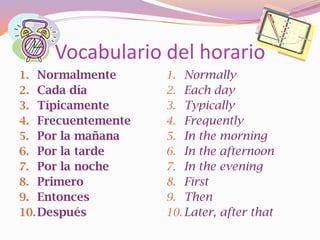
1. Normalmente      1. Normally
2. Cada día         2. Each day
3. Típicamente      3. Typically
4. Frecuentemente   4. Frequently
5. Por la mañana    5. In the morning
6. Por la tarde     6. In the afternoon
7. Por la noche     7. In the evening
8. Primero          8. First
9. Entonces         9. Then
10. Después         10. Later, after that
Las actividades del dia
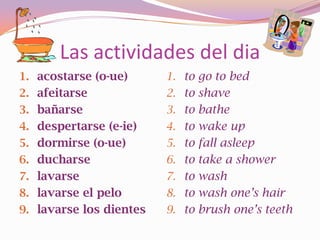
1. acostarse (o-ue)      1. to go to bed
2. afeitarse             2. to shave
3. bañarse               3. to bathe
4. despertarse (e-ie)    4. to wake up
5. dormirse (o-ue)       5. to fall asleep
6. ducharse              6. to take a shower
7. lavarse               7. to wash
8. lavarse el pelo       8. to wash one’s hair
9. lavarse los dientes   9. to brush one’s teeth
La Rutina…
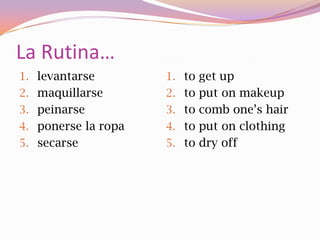
1. levantarse        1. to get up
2. maquillarse       2. to put on makeup
3. peinarse          3. to comb one’s hair
4. ponerse la ropa   4. to put on clothing
5. secarse           5. to dry off
(Challenge set)
1. afeitarse las piernas   1. to shave one’s legs
2. ponerse el              2. to put on deodorant
     desodorante           3. to put on perfume
3.   ponerse el perfume    4. to put on make-up
4.   maquillarse           5. to dry oneself
5.   secarse               6. to dry one’s hair
6.   secarse el pelo       7. to curl one’s hair
7.   rizarse el pelo       8. to straighten one’s
8.   alisarse el pelo         hair
9.   pintarse las uñas     9. to paint one’s nails
¿Qué necesitas?
1. un cepillo              1.   a brush
2. un cepillo de           2.   a toothbrush
     dientes               3.   toothpaste
3.   la pasta de dientes   4.   shampoo
4.   el champú             5.   mirror
5.   el espejo             6.   soap
6.   el jabón              7.   comb
7.   un peine              8.   hair dryer
8.   el secador de pelo    9.   towel
9.   la toalla
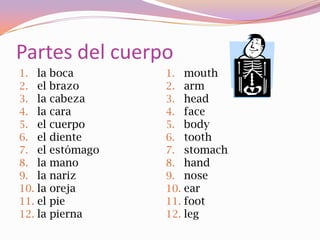
Partes del cuerpo
1. la boca       1. mouth
2. el brazo      2. arm
3. la cabeza     3. head
4. la cara       4. face
5. el cuerpo     5. body
6. el diente     6. tooth
7. el estómago   7. stomach
8. la mano       8. hand
9. la nariz      9. nose
10. la oreja     10. ear
11. el pie       11. foot
12. la pierna    12. leg
Los Quehaceres
1. hacer la cama       1. to make the bed
2. lavar los platos    2. to wash the dishes
3. limpiar el cuarto   3. to clean the room
4. limpio(a)           4. clean (adj)
5. los quehaceres      5. chores
6. poner la mesa       6. set the table
7. quitar la mesa      7. clear the table
8. sucio(a)            8. dirty
Y más…
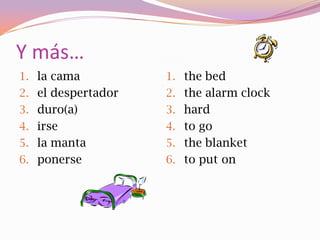
1. la cama          1. the bed
2. el despertador   2. the alarm clock
3. duro(a)          3. hard
4. irse             4. to go
5. la manta         5. the blanket
6. ponerse          6. to put on
Los Verbos Reflexivos
What is a reflexive   A reflexive verb is a
                       verb whose subject
 verb?
                       and object are one
                       and the same.
How is it different   This means that the
 from a normal         subject is both the
                       “do-er” of the action
 verb?                 and the receiver of
                       the action.
Los Verbos Reflexivos
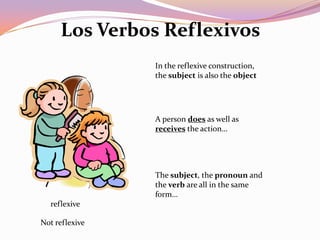
                In the reflexive construction,
                the subject is also the object


                A person does as well as
                receives the action…


                The subject, the pronoun and
                the verb are all in the same
                form…
  reflexive

Not reflexive
Ejemplos…
 I wash the dog.
    (non- reflexive)
 I wash my face.          ¿Puedes escribir más
     (reflexive)          ejemplos?
 Diego hits Roque.
    (non-reflexive)
 Diego hits himself in
  the head.
    (reflexive)
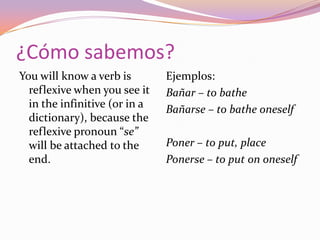
¿Cómo sabemos?
You will know a verb is        Ejemplos:
  reflexive when you see it    Bañar – to bathe
  in the infinitive (or in a   Bañarse – to bathe oneself
  dictionary), because the
  reflexive pronoun “se”
  will be attached to the      Poner – to put, place
  end.                         Ponerse – to put on oneself
Los pronombres reflexivos…
Reflexive verbs use pronouns called
 “reflexive pronouns” to indicate that
 the action is reflexive.

The reflexive pronouns are:
       me, te, se, os, and nos
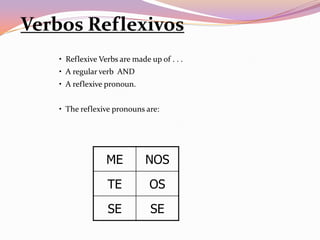
Verbos Reflexivos
    • Reflexive Verbs are made up of . . .
    • A regular verb AND
    • A reflexive pronoun.


    • The reflexive pronouns are:


                  ME          NOS
                  TE           OS
                  SE            SE
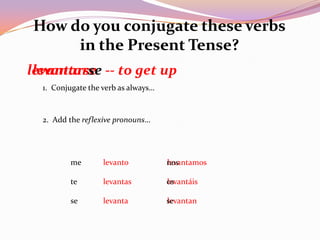
How do you conjugate these verbs
     in the Present Tense?
levantarse -- to get up
 levantarse
  1. Conjugate the verb as always…


  2. Add the reflexive pronouns…


          me       levanto           nos
                                     levantamos

          te       levantas          os
                                     levantáis

          se       levanta           se
                                     levantan
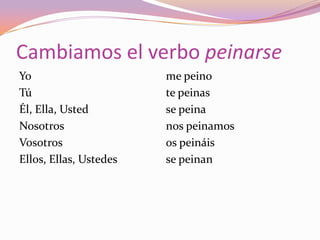
Cambiamos el verbo peinarse
Yo                      me peino
Tú                      te peinas
Él, Ella, Usted         se peina
Nosotros                nos peinamos
Vosotros                os peináis
Ellos, Ellas, Ustedes   se peinan
Verbs similar to peinarse:

 afeitarse    cepillarse    lavarse
 arreglarse   ducharse      maquillarse
 bañarse      entrenarse    secarse


              me      -o    nos       -amos

              te      -as   os        -áis

              se      -a    se        -an
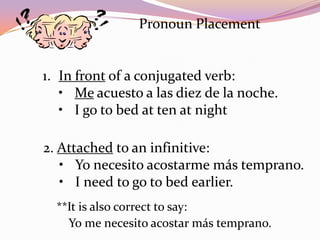
Pronoun Placement


1. In front of a conjugated verb:
   • Me acuesto a las diez de la noche.
   • I go to bed at ten at night

2. Attached to an infinitive:
   • Yo necesito acostarme más temprano.
   • I need to go to bed earlier.
  **It is also correct to say:
    Yo me necesito acostar más temprano.
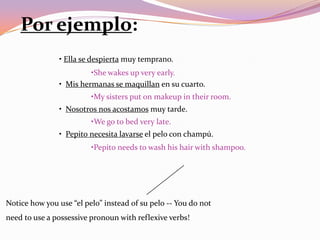
Por ejemplo:
               • Ella se despierta muy temprano.
                        •She wakes up very early.
               • Mis hermanas se maquillan en su cuarto.
                         •My sisters put on makeup in their room.
               • Nosotros nos acostamos muy tarde.
                         •We go to bed very late.
               • Pepito necesita lavarse el pelo con champú.
                         •Pepito needs to wash his hair with shampoo.


Notice how you use “el pelo” instead of su pelo -- You do not
need to use a possessive pronoun with reflexive verbs!
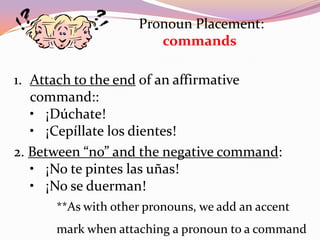
Pronoun Placement:
                       commands

1. Attach to the end of an affirmative
   command::
   • ¡Dúchate!
   • ¡Cepíllate los dientes!
2. Between “no” and the negative command:
   • ¡No te pintes las uñas!
   • ¡No se duerman!
      **As with other pronouns, we add an accent
      mark when attaching a pronoun to a command
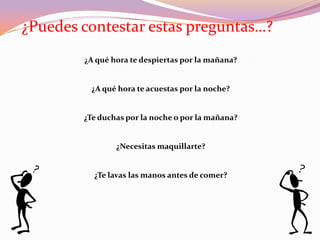
¿Puedes contestar estas preguntas…?
        ¿A qué hora te despiertas por la mañana?


         ¿A qué hora te acuestas por la noche?


        ¿Te duchas por la noche o por la mañana?


                ¿Necesitas maquillarte?


          ¿Te lavas las manos antes de comer?
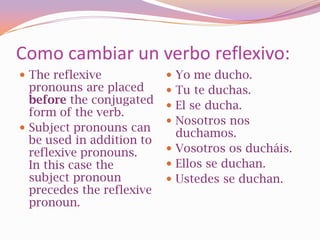
Como cambiar un verbo reflexivo:
 The reflexive             Yo me ducho.
  pronouns are placed       Tu te duchas.
  before the conjugated     El se ducha.
  form of the verb.
                            Nosotros nos
 Subject pronouns can
                             duchamos.
  be used in addition to
  reflexive pronouns.       Vosotros os ducháis.
  In this case the          Ellos se duchan.
  subject pronoun           Ustedes se duchan.
  precedes the reflexive
  pronoun.

U5 e1 vocabulario ppt

  • 2.
    Vocabulario del horario 1.Normalmente 1. Normally 2. Cada día 2. Each day 3. Típicamente 3. Typically 4. Frecuentemente 4. Frequently 5. Por la mañana 5. In the morning 6. Por la tarde 6. In the afternoon 7. Por la noche 7. In the evening 8. Primero 8. First 9. Entonces 9. Then 10. Después 10. Later, after that
  • 3.
    Las actividades deldia 1. acostarse (o-ue) 1. to go to bed 2. afeitarse 2. to shave 3. bañarse 3. to bathe 4. despertarse (e-ie) 4. to wake up 5. dormirse (o-ue) 5. to fall asleep 6. ducharse 6. to take a shower 7. lavarse 7. to wash 8. lavarse el pelo 8. to wash one’s hair 9. lavarse los dientes 9. to brush one’s teeth
  • 4.
    La Rutina… 1. levantarse 1. to get up 2. maquillarse 2. to put on makeup 3. peinarse 3. to comb one’s hair 4. ponerse la ropa 4. to put on clothing 5. secarse 5. to dry off
  • 5.
    (Challenge set) 1. afeitarselas piernas 1. to shave one’s legs 2. ponerse el 2. to put on deodorant desodorante 3. to put on perfume 3. ponerse el perfume 4. to put on make-up 4. maquillarse 5. to dry oneself 5. secarse 6. to dry one’s hair 6. secarse el pelo 7. to curl one’s hair 7. rizarse el pelo 8. to straighten one’s 8. alisarse el pelo hair 9. pintarse las uñas 9. to paint one’s nails
  • 6.
    ¿Qué necesitas? 1. uncepillo 1. a brush 2. un cepillo de 2. a toothbrush dientes 3. toothpaste 3. la pasta de dientes 4. shampoo 4. el champú 5. mirror 5. el espejo 6. soap 6. el jabón 7. comb 7. un peine 8. hair dryer 8. el secador de pelo 9. towel 9. la toalla
  • 7.
    Partes del cuerpo 1.la boca 1. mouth 2. el brazo 2. arm 3. la cabeza 3. head 4. la cara 4. face 5. el cuerpo 5. body 6. el diente 6. tooth 7. el estómago 7. stomach 8. la mano 8. hand 9. la nariz 9. nose 10. la oreja 10. ear 11. el pie 11. foot 12. la pierna 12. leg
  • 8.
    Los Quehaceres 1. hacerla cama 1. to make the bed 2. lavar los platos 2. to wash the dishes 3. limpiar el cuarto 3. to clean the room 4. limpio(a) 4. clean (adj) 5. los quehaceres 5. chores 6. poner la mesa 6. set the table 7. quitar la mesa 7. clear the table 8. sucio(a) 8. dirty
  • 9.
    Y más… 1. lacama 1. the bed 2. el despertador 2. the alarm clock 3. duro(a) 3. hard 4. irse 4. to go 5. la manta 5. the blanket 6. ponerse 6. to put on
  • 10.
    Los Verbos Reflexivos Whatis a reflexive A reflexive verb is a verb whose subject verb? and object are one and the same. How is it different This means that the from a normal subject is both the “do-er” of the action verb? and the receiver of the action.
  • 11.
    Los Verbos Reflexivos In the reflexive construction, the subject is also the object A person does as well as receives the action… The subject, the pronoun and the verb are all in the same form… reflexive Not reflexive
  • 12.
    Ejemplos…  I washthe dog. (non- reflexive)  I wash my face. ¿Puedes escribir más (reflexive) ejemplos?  Diego hits Roque. (non-reflexive)  Diego hits himself in the head. (reflexive)
  • 13.
    ¿Cómo sabemos? You willknow a verb is Ejemplos: reflexive when you see it Bañar – to bathe in the infinitive (or in a Bañarse – to bathe oneself dictionary), because the reflexive pronoun “se” will be attached to the Poner – to put, place end. Ponerse – to put on oneself
  • 14.
    Los pronombres reflexivos… Reflexiveverbs use pronouns called “reflexive pronouns” to indicate that the action is reflexive. The reflexive pronouns are: me, te, se, os, and nos
  • 15.
    Verbos Reflexivos • Reflexive Verbs are made up of . . . • A regular verb AND • A reflexive pronoun. • The reflexive pronouns are: ME NOS TE OS SE SE
  • 16.
    How do youconjugate these verbs in the Present Tense? levantarse -- to get up levantarse 1. Conjugate the verb as always… 2. Add the reflexive pronouns… me levanto nos levantamos te levantas os levantáis se levanta se levantan
  • 17.
    Cambiamos el verbopeinarse Yo me peino Tú te peinas Él, Ella, Usted se peina Nosotros nos peinamos Vosotros os peináis Ellos, Ellas, Ustedes se peinan
  • 18.
    Verbs similar topeinarse: afeitarse cepillarse lavarse arreglarse ducharse maquillarse bañarse entrenarse secarse me -o nos -amos te -as os -áis se -a se -an
  • 19.
    Pronoun Placement 1. Infront of a conjugated verb: • Me acuesto a las diez de la noche. • I go to bed at ten at night 2. Attached to an infinitive: • Yo necesito acostarme más temprano. • I need to go to bed earlier. **It is also correct to say: Yo me necesito acostar más temprano.
  • 20.
    Por ejemplo: • Ella se despierta muy temprano. •She wakes up very early. • Mis hermanas se maquillan en su cuarto. •My sisters put on makeup in their room. • Nosotros nos acostamos muy tarde. •We go to bed very late. • Pepito necesita lavarse el pelo con champú. •Pepito needs to wash his hair with shampoo. Notice how you use “el pelo” instead of su pelo -- You do not need to use a possessive pronoun with reflexive verbs!
  • 21.
    Pronoun Placement: commands 1. Attach to the end of an affirmative command:: • ¡Dúchate! • ¡Cepíllate los dientes! 2. Between “no” and the negative command: • ¡No te pintes las uñas! • ¡No se duerman! **As with other pronouns, we add an accent mark when attaching a pronoun to a command
  • 22.
    ¿Puedes contestar estaspreguntas…? ¿A qué hora te despiertas por la mañana? ¿A qué hora te acuestas por la noche? ¿Te duchas por la noche o por la mañana? ¿Necesitas maquillarte? ¿Te lavas las manos antes de comer?
  • 23.
    Como cambiar unverbo reflexivo:  The reflexive  Yo me ducho. pronouns are placed  Tu te duchas. before the conjugated  El se ducha. form of the verb.  Nosotros nos  Subject pronouns can duchamos. be used in addition to reflexive pronouns.  Vosotros os ducháis. In this case the  Ellos se duchan. subject pronoun  Ustedes se duchan. precedes the reflexive pronoun.