Reflexive Verbs Spanish 102
Definition The action of the verb falls back on the subject of the verb.  It’s something you do to yourself. Reflexive pronouns must agree with the subject of the verb.    “ yo - me” -  I  do it to  myself . I wash myself, the action is directed to me, myself. I wash  myself .  Yo  me  lavo.
Use reflexive pronouns with reflexive verbs.  me  (myself) te  (yourself) se  (yourself, himself,    herself, itself) nos  (ourselves) os  (yourselves) se  (yourselves, themselves) Review pages 141-143,  Puntos de partida. Me afeito.
Verbs can be used reflexively or nonreflexively. Ella  se  levanta.  She “lifts” herself up, she gets herself up . Ella levanta  las pesas .  She lifts the weights, not herself . Voy a clase.  I’m going to class . Me  voy.  I’m leaving .
Prohibido orinar se  en la calle. (No peeing in the street.   )
La culebra  se  levanta al sonido de la flauta. (levantarse) El hombre   se  pierde. (perderse)
Placement of reflexive pronouns Ella  se  acuesta. Tiene que acostar se . Está acostándo se . Before a conjugated verb After an infinitive After a gerund Reflexive pronouns can  always  be placed in front of a conjugated verb.
Él  se  baña. Él está bañándo se . Él  se  está bañando. Él tiene que bañar se . Él  se  tiene que bañar. Notice the placement of the reflexive pronoun “se.”
Reflexive Infinitives This is a list of some common reflexive verbs.  There are MANY reflexive verbs in Spanish.
Se  levanta temprano y  se  acuesta tarde. He gets up early and goes to bed late.
Mi amiga pasa mucho tiempo en el baño cada mañana.  Se  mira en el espejo,  se  cepilla el pelo, y  se  pone  demasiado  perfume.  Después, tiene que poner se  la ropa rápidamente.
El chico está herido . Se  sienta en la silla de ruedas. Se  siente triste y terrible. Ahora  se  aburre todo el tiempo. No  se  divierte.
¡Siénta te ! ¡  No ladres!  C á lla te .
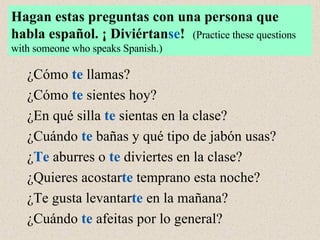
¿Cómo  te  llamas? ¿Cómo  te  sientes hoy? ¿En qué silla  te  sientas en la clase? ¿Cuándo  te  bañas y qué tipo de jabón usas? ¿ Te  aburres o  te  diviertes en la clase? ¿Quieres acostar te  temprano esta noche? ¿Te gusta levantar te  en la mañana? ¿Cuándo  te  afeitas por lo general? Hagan estas preguntas con una persona que habla espa ñ ol. ¡ Diviértan se !   (Practice these questions with someone who speaks Spanish.)

Reflexives

  • 1.
  • 2.
    Definition The actionof the verb falls back on the subject of the verb. It’s something you do to yourself. Reflexive pronouns must agree with the subject of the verb. “ yo - me” - I do it to myself . I wash myself, the action is directed to me, myself. I wash myself . Yo me lavo.
  • 3.
    Use reflexive pronounswith reflexive verbs. me (myself) te (yourself) se (yourself, himself, herself, itself) nos (ourselves) os (yourselves) se (yourselves, themselves) Review pages 141-143, Puntos de partida. Me afeito.
  • 4.
    Verbs can beused reflexively or nonreflexively. Ella se levanta. She “lifts” herself up, she gets herself up . Ella levanta las pesas . She lifts the weights, not herself . Voy a clase. I’m going to class . Me voy. I’m leaving .
  • 5.
    Prohibido orinar se en la calle. (No peeing in the street.  )
  • 6.
    La culebra se levanta al sonido de la flauta. (levantarse) El hombre se pierde. (perderse)
  • 7.
    Placement of reflexivepronouns Ella se acuesta. Tiene que acostar se . Está acostándo se . Before a conjugated verb After an infinitive After a gerund Reflexive pronouns can always be placed in front of a conjugated verb.
  • 8.
    Él se baña. Él está bañándo se . Él se está bañando. Él tiene que bañar se . Él se tiene que bañar. Notice the placement of the reflexive pronoun “se.”
  • 9.
    Reflexive Infinitives Thisis a list of some common reflexive verbs. There are MANY reflexive verbs in Spanish.
  • 10.
    Se levantatemprano y se acuesta tarde. He gets up early and goes to bed late.
  • 11.
    Mi amiga pasamucho tiempo en el baño cada mañana. Se mira en el espejo, se cepilla el pelo, y se pone demasiado perfume. Después, tiene que poner se la ropa rápidamente.
  • 12.
    El chico estáherido . Se sienta en la silla de ruedas. Se siente triste y terrible. Ahora se aburre todo el tiempo. No se divierte.
  • 13.
    ¡Siénta te !¡ No ladres! C á lla te .
  • 14.
    ¿Cómo te llamas? ¿Cómo te sientes hoy? ¿En qué silla te sientas en la clase? ¿Cuándo te bañas y qué tipo de jabón usas? ¿ Te aburres o te diviertes en la clase? ¿Quieres acostar te temprano esta noche? ¿Te gusta levantar te en la mañana? ¿Cuándo te afeitas por lo general? Hagan estas preguntas con una persona que habla espa ñ ol. ¡ Diviértan se ! (Practice these questions with someone who speaks Spanish.)