REFLEXIVE VERBSOct. 5, 2011
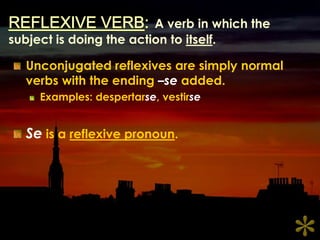
REFLEXIVE VERB:A verb in which the subject is doing the action to itself.Unconjugated reflexives are simply normal verbs with the ending –se added.Examples: despertarse, vestirseSe is a reflexive pronoun.*
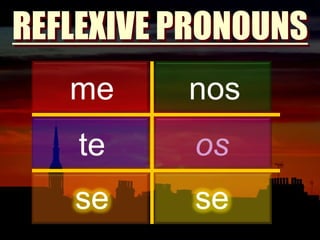
REFLEXIVE PRONOUNSmenosteossese
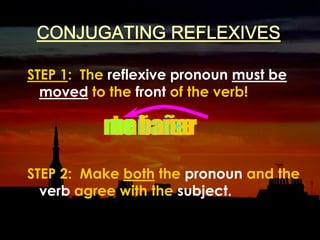
CONJUGATING REFLEXIVESSTEP 1:  The reflexive pronounmust be moved to the front of the verb!STEP 2:  Make both the pronoun and the verb agree with the subject.bañarsese bañarme bañome bañar
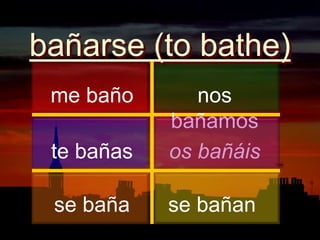
bañarse(to bathe)me bañonosbañamostebañasosbañáisse bañase bañan
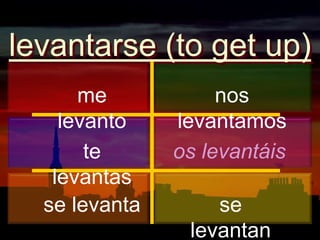
levantarse (to get up)me levantonos levantamososlevantáiste levantasse levantase levantan
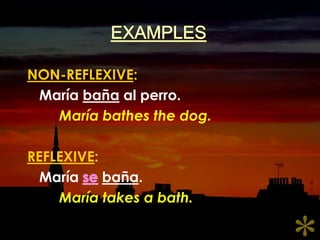
EXAMPLESNON-REFLEXIVE:Maríabaña al perro.María bathes the dog.REFLEXIVE:Maríasebaña.María takes a bath.*
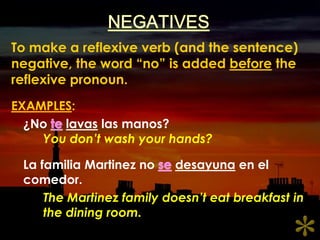
NEGATIVESTo make a reflexive verb (and the sentence) negative, the word “no” is added before the reflexive pronoun.EXAMPLES:	¿No telavaslasmanos?You don’t wash your hands?	La familia Martinez no sedesayuna en el comedor.The Martinez family doesn’t eat breakfast in 	the dining room.*
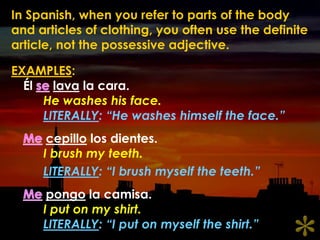
In Spanish, when you refer to parts of the body and articles of clothing, you often use the definite article, not the possessive adjective.EXAMPLES:Élselava la cara.He washes his face.LITERALLY: “He washes himself the face.”Mecepillo los dientes.I brush my teeth.LITERALLY: “I brush myself the teeth.”Mepongo la camisa.I put on my shirt.LITERALLY: “I put on myself the shirt.”*
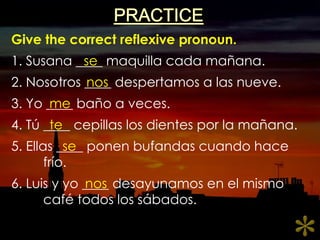
PRACTICEGive the correct reflexive pronoun.1. Susana ____ maquillacadamañana.2. Nosotros ____ despertamos a lasnueve.3. Yo ____ baño a veces.4. Tú ____ cepillas los dientespor la mañana.5. Ellas ____ ponenbufandascuandohacefrío.6. Luis y yo ____ desayunamos en el mismo	café todos los sábados.senosmetesenos*
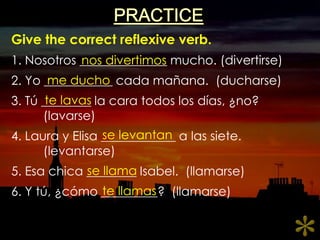
PRACTICEGive the correct reflexive verb.1. Nosotros ______________ mucho. (divertirse)2. Yo ___________ cadamañana.  (ducharse)3. Tú ________ la caratodos los días, ¿no?	(lavarse)4. Laura y Elisa ____________ a lassiete.	(levantarse)5. Esachica ________ Isabel.  (llamarse)6. Y tú, ¿cómo _________?  (llamarse)nosdivertimosme duchote lavasse levantanse llamate llamas*
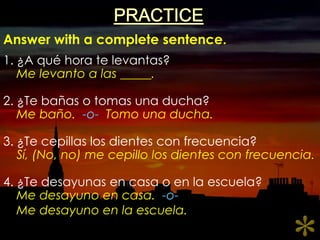
PRACTICEAnswer with a complete sentence.1. ¿A quéhoratelevantas?2. ¿Te bañas o tomasunaducha?3. ¿Te cepillas los dientes con frecuencia?4. ¿Te desayunas en casa o en la escuela?Me levanto a las _____.Me baño.  -o-Tomounaducha.Sí, (No, no) me cepillo los dientes con frecuencia.Me desayuno en casa.  -o-Me desayuno en la escuela.*
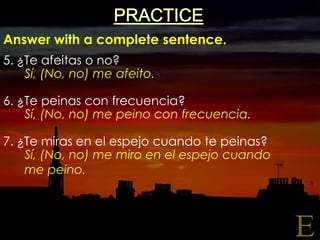
PRACTICEAnswer with a complete sentence.5. ¿Te afeitas o no?6. ¿Te peinas con frecuencia?7. ¿Te miras en el espejocuandotepeinas?Sí, (No, no) me afeito.Sí, (No, no) me peino con frecuencia.Sí, (No, no) me miro en el espejocuandome peino.E

Reflexive verbs - Intro

  • 1.
  • 2.
    REFLEXIVE VERB:A verbin which the subject is doing the action to itself.Unconjugated reflexives are simply normal verbs with the ending –se added.Examples: despertarse, vestirseSe is a reflexive pronoun.*
  • 3.
  • 4.
    CONJUGATING REFLEXIVESSTEP 1: The reflexive pronounmust be moved to the front of the verb!STEP 2: Make both the pronoun and the verb agree with the subject.bañarsese bañarme bañome bañar
  • 5.
  • 6.
    levantarse (to getup)me levantonos levantamososlevantáiste levantasse levantase levantan
  • 7.
    EXAMPLESNON-REFLEXIVE:Maríabaña al perro.Maríabathes the dog.REFLEXIVE:Maríasebaña.María takes a bath.*
  • 8.
    NEGATIVESTo make areflexive verb (and the sentence) negative, the word “no” is added before the reflexive pronoun.EXAMPLES: ¿No telavaslasmanos?You don’t wash your hands? La familia Martinez no sedesayuna en el comedor.The Martinez family doesn’t eat breakfast in the dining room.*
  • 9.
    In Spanish, whenyou refer to parts of the body and articles of clothing, you often use the definite article, not the possessive adjective.EXAMPLES:Élselava la cara.He washes his face.LITERALLY: “He washes himself the face.”Mecepillo los dientes.I brush my teeth.LITERALLY: “I brush myself the teeth.”Mepongo la camisa.I put on my shirt.LITERALLY: “I put on myself the shirt.”*
  • 10.
    PRACTICEGive the correctreflexive pronoun.1. Susana ____ maquillacadamañana.2. Nosotros ____ despertamos a lasnueve.3. Yo ____ baño a veces.4. Tú ____ cepillas los dientespor la mañana.5. Ellas ____ ponenbufandascuandohacefrío.6. Luis y yo ____ desayunamos en el mismo café todos los sábados.senosmetesenos*
  • 11.
    PRACTICEGive the correctreflexive verb.1. Nosotros ______________ mucho. (divertirse)2. Yo ___________ cadamañana. (ducharse)3. Tú ________ la caratodos los días, ¿no? (lavarse)4. Laura y Elisa ____________ a lassiete. (levantarse)5. Esachica ________ Isabel. (llamarse)6. Y tú, ¿cómo _________? (llamarse)nosdivertimosme duchote lavasse levantanse llamate llamas*
  • 12.
    PRACTICEAnswer with acomplete sentence.1. ¿A quéhoratelevantas?2. ¿Te bañas o tomasunaducha?3. ¿Te cepillas los dientes con frecuencia?4. ¿Te desayunas en casa o en la escuela?Me levanto a las _____.Me baño. -o-Tomounaducha.Sí, (No, no) me cepillo los dientes con frecuencia.Me desayuno en casa. -o-Me desayuno en la escuela.*
  • 13.
    PRACTICEAnswer with acomplete sentence.5. ¿Te afeitas o no?6. ¿Te peinas con frecuencia?7. ¿Te miras en el espejocuandotepeinas?Sí, (No, no) me afeito.Sí, (No, no) me peino con frecuencia.Sí, (No, no) me miro en el espejocuandome peino.E