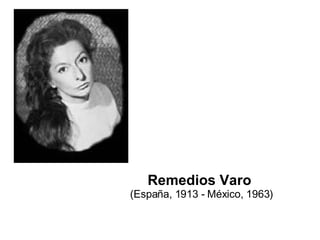
Remedios Varo  (España, 1913 - México, 1963) El inicio                         
El inicio De estilo narrativo con conciencia feminista, esta artista compagina el mundo del artista entre la ciencia y el arte, en una tentativa para revelar el orden interno del mundo de fantasía; basada en sus propias experiencias, en la exploración de lo racional en un mundo de la fantasía, la naturaleza, la alquimia, lo sobrenatural, y la mujer como fuente de sensibilidad y poderes regenerativos, Varo logra la reconciliación de dos mundos: el científico y el mítico, dando origen así a la trascendencia y a la reencarnación.
Nacida el 16 de Diciembre de 1908 en Anglés, España, Varo, desde pequeña, sintió la gran necesidad de expresarse para reflejar el mundo que la rodeaba, creando así un cosmos pictórico lleno de imaginación y poesía.  Su padre, ingeniero hidráulico y libre pensador, fue quién introdujo a Remedios al mundo de la pintura. Desde muy pequeña aprendió a utilizar los instrumentos de su padre, dando muestras de su dominio en la perspectiva y el dibujo.  Por motivación de su padre, ingresa a la Academia de San Fernando de Madrid a los 15 años (1924), convirtiéndose así en una de las primeras mujeres estudiantes.  Al terminar sus estudios, en 1930, se casa con Gerardo Lizarrageside y deciden residir en Paris por un año, y al regreso (1932), se establecen en Barcelona, donde trabajan realizando dibujos publicitarios.
En 1935 Remedios Varo se separa de Gerardo y conoce a Esteban Francés, quien la introdujo al círculo de surrealistas formado por André Breton; al relacionarse con ellos integra el grupo Lógicofobista, es decir "opuestos a la lógica" que intentaba la representación externa de los estados internos del alma humana. En 1936, la exposición de este grupo tuvo cierta resonancia. Al estar en este grupo, Remedios Varo pinta un óleo sobre cobre, L´Agent Double, que anticipa el estilo que desarrollaría quince años más tarde en México.
La guerra civil de España De profundo espíritu pacifista, opta por el lado republicano; el poeta Péret se presenta en su casa para ayudar a los antifascistas, se enamora de ella y regresan a París en 1937, permaneciendo ahí hasta la invasión nazi.
En 1941 Varo y Péret llegan a México ayudados por Varian Fry, un americano. Gracias a la política de Cárdenas los refugiados recibieron inmediatamente asilo y permiso para laborar.  Remedios, para ganarse la vida, realizo toda clase de trabajos artesanales.  En 1947 se separa de Benjamín Péret y él vuelve a París.  Remedios parte para Venezuela a una expedición agrícola y etomológica organizada por el IFAL, desde allá envía trabajos publicitarios para la empresa farmacéutica Bayer de México, firmando estas pinturas con su apellido materno Uranga; ahí mismo trabaja para el Instituto de Malariología Venezolano estudiando en el microscopio a los mosquitos transmisores de la malaria haciendo dibujos detalladísimos de ellos.
En 1949 regresa a México y sigue realizando trabajos comerciales.  En 1952 se casa con un político austriaco refugiado en México Walter Gruen, con quien permanecería hasta el día de su muerte.  Gruen convence a Varo para que deje los trabajos comerciales y se dedique de lleno a la pintura. En 1955 presenta su primera exposición colectiva en la Galería Diana presentando cuatro cuadros: Roulotte, Simpatía, El alquimista y Música Solar.  Al año siguiente presenta su primera exposición individual en la cual logra reunir diez y seis cuadros para su segunda exposición individual en la Galería Juan Martín en el año 1962.
EL FINAL Remedios Varo muere de un paro cardíaco el 8 de Octubre de 1963, en México.  En 1964, es objeto de un homenaje póstumo en el Palacio de Bellas Artes, en el cual recibe más de 50 mil visitantes.  Posteriormente, dos exposiciones individuales, una en 1971 y otra en 1983, se llevan a cabo en el Museo de Arte Moderno de la Ciudad de México.
 
Useless Science or the Alchemist 1955 Oil on masonite  104 x 54 cm.
Tejiendo el manto terrestre  1961
Cazadora de Astros  1956 mixta/cartulina
Papilla Estelar  1958 óleo/masonite  Naturaleza Muerta Resucitando 1963  óleo/tela
Vuelo Mágico  1956 óleo y nácar incrustado/masonite
Tres Destinos  1956  óleo/masonite
Revelación ó El Relojero  1955 óleo/masonite
Nacer de Nuevo  1960 óleo/masonite  Encuentro (La Cita)  1959 óleo/masonite
Premonición  1953 gouache/papel
Mimetismo  1960 óleo/masonite
Tránsito en Espiral  1962 óleo/masonite
Música Solar  1955 óleo/masonite
El Flautista  1955 óleo y nácar incrustado/masonite
Creación de las Aves 1957 óleo/masonite
La Huida 1961 óleo/masonite
Armonía 1956 óleo/masonite
Planta Insumisa 1961 óleo/masonite
Retrato del Dr.Ignacio Chávez 1957 óleo/masonite
1913-16- Her father, Rodrigo Varo y Cejalbo, a hydraulic engineer takes the family around Spain and North Africa. After many journeys, the Varo family establishes their home in Madrid. 1924-Studies painting at the Academia de San Fernando in Madrid. 1930-Marries painter Gerardo Lizárraga in San Sebastián. Travels to Paris to find the avant-garde at its source. 1932-Returnes to Spain, choosing Barcelona as her new city. Separates from Lizárraga. Meets the avant-garde artists Esteban Francés and shares with him a studio in the Plaza de Lesseps.. 1935-36-Frequents the "Logicophobiste" group. Participates in a group exhibition sponsored by ADLAN (Amics de L'Art Nou), a small organization founded in Barcelona for encouraging vanguard movements in literature and the arts. Exhibition of drawings (with José Luis Florit) in Madrid. In Barcelona meets the Spanish surrealist Oscar Domínguez. Meets the French Surrealist poet Benjamon Péret through Domínguez in Barcelona.
1937-Accompanies Péret to Paris. Meets Miró, Max Ernst, Victor Brauner, Wolfgang Paalen, André Breton and Leonora Carrington. Participates in several Surrealist activities. Participates in the International Surrealist Exhibit in Tokyo. The French Surrealist periodical Minotaur publishes her work "Desire." 1938-Some of her works are published in Trayectoire du rêve and Visage du monde. Exhibits (with other Surrealists) in the Gallery Robert Amsterdam of Paris. 1940-The Nazis in Paris. Péret and Varo go to Marseilles where many of the Surrealist (Breton, Ernst, Domínguez, Brauner, among others) wait for their exit visas. They keep the Surrealist spirit alive despite the difficult situation. One of group's favorite activity is the cadavre exquis.
1941-Péret and Varo arrive in Mexico City at the end of the year. They meet many friends from Europe, including Gerardo Lizárraga, Esteban Francés, Leonora Carrington, Gunther Gerszo, Kati Horna and José Horna, and Emerico (Chiqui) Weisz. Finds welcome refuge in Mexico, where she remains until her death. 1942-Writes "Lady Milagra," a story on the theme of the magical ability of women. Develops an extraordinary friendship with Carrington. Studies mystic disciplines and reads metaphysical texts. Varo works with the antifascit propaganda office, making dioramas and small stage sets to illustrate Allied war victories. Lives a hand-to-mouth existence. Works for Clardecor, hand painting designs onto furniture and musical instruments. Designs costumes for theatrical productions and illustrates promotional literature for the pharmaceutical firm Casa Bayer.
1947-49-Separates from Péret who returns to Paris. Meets the French pilot Jean Nicolle. Participates in the International Surrealist Exhibit in the Gallery Maeght, Paris. Travels to Venezuela with Nicolle. Her brother Rodrigo is the chief of epidemiology for the Ministry of Public Health in Maracay. He lives in Venezuela with his family, including Varo's mother, doña Ignacia Uranga y Bergareche. Varo gets a job doing technical drawing for the Venezuelan Ministry of Public Health. Together with Nicolle explores the isolated region of south-central Venezuela. Remains in Venezuela until the beginning of 1949. 1953-Marries Walter Gruen, an Austrian exile and successful businessman in Mexico City. They had met in the early 1940s. Gruen encourages her to resume painting. Varo devotes her time fully to her work. 1955-Participates with four paintings in her first Mexican exhibition at the Galería Diana. Invited to have a solo exhibition there. She includes twelve works. Her exhibition is a huge success. She establishes as a self-supporting artist.
1958-Participates in the First Salon of Women's Art at the Galerías Excelsior of Mexico, together with Leonora Carrington, Alice Rahon, Bridget Tichenor, and other women painters. Receives 3,000-peso first prize for her paintings Harmony and Be Brief. Keeps studying mysticism. Reads texts of alchemy, sacred geometry, the I Ching. Explores the ideas of Jung, Gurdjieff, Ouspensky, Blavatsky, Meister Eckhart, the Sufis, and the legends of the Holy Grail. 1959-Period of experimentation. She works in a mural commission for the new Cancer Pavilion of the Medical Center in Mexico City. Begins work in her only surviving sculpture, the Homo Rodans, a small figure constructed of chicken, fish, and turkey bones wired together. Under the pseudonym Hälicko von Fuhrängschmidt, a German anthropologist, she writes De Homo Rodans.
1960-Participates, with Raúl Anguiano, Gustavo Montoya and Leonora Carrington, in the Bienal Panamericana de Pintura in Mexico City. 1962- Has her second solo exhibition at the Galería Juan Martín of Mexico City, showing fifteen works. Enjoys an overwhelming critical and popular success. 1963-Paints her last picture, Still Live Reviving. Dies in Mexico City, on Tuesday, the 8 of October, of a heart attack.

Varo Remedios

  • 1.
    Remedios Varo (España, 1913 - México, 1963) El inicio                        
  • 2.
    El inicio Deestilo narrativo con conciencia feminista, esta artista compagina el mundo del artista entre la ciencia y el arte, en una tentativa para revelar el orden interno del mundo de fantasía; basada en sus propias experiencias, en la exploración de lo racional en un mundo de la fantasía, la naturaleza, la alquimia, lo sobrenatural, y la mujer como fuente de sensibilidad y poderes regenerativos, Varo logra la reconciliación de dos mundos: el científico y el mítico, dando origen así a la trascendencia y a la reencarnación.
  • 3.
    Nacida el 16de Diciembre de 1908 en Anglés, España, Varo, desde pequeña, sintió la gran necesidad de expresarse para reflejar el mundo que la rodeaba, creando así un cosmos pictórico lleno de imaginación y poesía. Su padre, ingeniero hidráulico y libre pensador, fue quién introdujo a Remedios al mundo de la pintura. Desde muy pequeña aprendió a utilizar los instrumentos de su padre, dando muestras de su dominio en la perspectiva y el dibujo. Por motivación de su padre, ingresa a la Academia de San Fernando de Madrid a los 15 años (1924), convirtiéndose así en una de las primeras mujeres estudiantes. Al terminar sus estudios, en 1930, se casa con Gerardo Lizarrageside y deciden residir en Paris por un año, y al regreso (1932), se establecen en Barcelona, donde trabajan realizando dibujos publicitarios.
  • 4.
    En 1935 RemediosVaro se separa de Gerardo y conoce a Esteban Francés, quien la introdujo al círculo de surrealistas formado por André Breton; al relacionarse con ellos integra el grupo Lógicofobista, es decir "opuestos a la lógica" que intentaba la representación externa de los estados internos del alma humana. En 1936, la exposición de este grupo tuvo cierta resonancia. Al estar en este grupo, Remedios Varo pinta un óleo sobre cobre, L´Agent Double, que anticipa el estilo que desarrollaría quince años más tarde en México.
  • 5.
    La guerra civilde España De profundo espíritu pacifista, opta por el lado republicano; el poeta Péret se presenta en su casa para ayudar a los antifascistas, se enamora de ella y regresan a París en 1937, permaneciendo ahí hasta la invasión nazi.
  • 6.
    En 1941 Varoy Péret llegan a México ayudados por Varian Fry, un americano. Gracias a la política de Cárdenas los refugiados recibieron inmediatamente asilo y permiso para laborar. Remedios, para ganarse la vida, realizo toda clase de trabajos artesanales. En 1947 se separa de Benjamín Péret y él vuelve a París. Remedios parte para Venezuela a una expedición agrícola y etomológica organizada por el IFAL, desde allá envía trabajos publicitarios para la empresa farmacéutica Bayer de México, firmando estas pinturas con su apellido materno Uranga; ahí mismo trabaja para el Instituto de Malariología Venezolano estudiando en el microscopio a los mosquitos transmisores de la malaria haciendo dibujos detalladísimos de ellos.
  • 7.
    En 1949 regresaa México y sigue realizando trabajos comerciales. En 1952 se casa con un político austriaco refugiado en México Walter Gruen, con quien permanecería hasta el día de su muerte. Gruen convence a Varo para que deje los trabajos comerciales y se dedique de lleno a la pintura. En 1955 presenta su primera exposición colectiva en la Galería Diana presentando cuatro cuadros: Roulotte, Simpatía, El alquimista y Música Solar. Al año siguiente presenta su primera exposición individual en la cual logra reunir diez y seis cuadros para su segunda exposición individual en la Galería Juan Martín en el año 1962.
  • 8.
    EL FINAL RemediosVaro muere de un paro cardíaco el 8 de Octubre de 1963, en México. En 1964, es objeto de un homenaje póstumo en el Palacio de Bellas Artes, en el cual recibe más de 50 mil visitantes. Posteriormente, dos exposiciones individuales, una en 1971 y otra en 1983, se llevan a cabo en el Museo de Arte Moderno de la Ciudad de México.
  • 9.
  • 10.
    Useless Science orthe Alchemist 1955 Oil on masonite 104 x 54 cm.
  • 11.
    Tejiendo el mantoterrestre 1961
  • 12.
    Cazadora de Astros 1956 mixta/cartulina
  • 13.
    Papilla Estelar 1958 óleo/masonite Naturaleza Muerta Resucitando 1963 óleo/tela
  • 14.
    Vuelo Mágico 1956 óleo y nácar incrustado/masonite
  • 15.
    Tres Destinos 1956 óleo/masonite
  • 16.
    Revelación ó ElRelojero 1955 óleo/masonite
  • 17.
    Nacer de Nuevo 1960 óleo/masonite Encuentro (La Cita) 1959 óleo/masonite
  • 18.
    Premonición 1953gouache/papel
  • 19.
    Mimetismo 1960óleo/masonite
  • 20.
    Tránsito en Espiral 1962 óleo/masonite
  • 21.
    Música Solar 1955 óleo/masonite
  • 22.
    El Flautista 1955 óleo y nácar incrustado/masonite
  • 23.
    Creación de lasAves 1957 óleo/masonite
  • 24.
    La Huida 1961óleo/masonite
  • 25.
  • 26.
    Planta Insumisa 1961óleo/masonite
  • 27.
    Retrato del Dr.IgnacioChávez 1957 óleo/masonite
  • 28.
    1913-16- Her father,Rodrigo Varo y Cejalbo, a hydraulic engineer takes the family around Spain and North Africa. After many journeys, the Varo family establishes their home in Madrid. 1924-Studies painting at the Academia de San Fernando in Madrid. 1930-Marries painter Gerardo Lizárraga in San Sebastián. Travels to Paris to find the avant-garde at its source. 1932-Returnes to Spain, choosing Barcelona as her new city. Separates from Lizárraga. Meets the avant-garde artists Esteban Francés and shares with him a studio in the Plaza de Lesseps.. 1935-36-Frequents the "Logicophobiste" group. Participates in a group exhibition sponsored by ADLAN (Amics de L'Art Nou), a small organization founded in Barcelona for encouraging vanguard movements in literature and the arts. Exhibition of drawings (with José Luis Florit) in Madrid. In Barcelona meets the Spanish surrealist Oscar Domínguez. Meets the French Surrealist poet Benjamon Péret through Domínguez in Barcelona.
  • 29.
    1937-Accompanies Péret toParis. Meets Miró, Max Ernst, Victor Brauner, Wolfgang Paalen, André Breton and Leonora Carrington. Participates in several Surrealist activities. Participates in the International Surrealist Exhibit in Tokyo. The French Surrealist periodical Minotaur publishes her work "Desire." 1938-Some of her works are published in Trayectoire du rêve and Visage du monde. Exhibits (with other Surrealists) in the Gallery Robert Amsterdam of Paris. 1940-The Nazis in Paris. Péret and Varo go to Marseilles where many of the Surrealist (Breton, Ernst, Domínguez, Brauner, among others) wait for their exit visas. They keep the Surrealist spirit alive despite the difficult situation. One of group's favorite activity is the cadavre exquis.
  • 30.
    1941-Péret and Varoarrive in Mexico City at the end of the year. They meet many friends from Europe, including Gerardo Lizárraga, Esteban Francés, Leonora Carrington, Gunther Gerszo, Kati Horna and José Horna, and Emerico (Chiqui) Weisz. Finds welcome refuge in Mexico, where she remains until her death. 1942-Writes "Lady Milagra," a story on the theme of the magical ability of women. Develops an extraordinary friendship with Carrington. Studies mystic disciplines and reads metaphysical texts. Varo works with the antifascit propaganda office, making dioramas and small stage sets to illustrate Allied war victories. Lives a hand-to-mouth existence. Works for Clardecor, hand painting designs onto furniture and musical instruments. Designs costumes for theatrical productions and illustrates promotional literature for the pharmaceutical firm Casa Bayer.
  • 31.
    1947-49-Separates from Péretwho returns to Paris. Meets the French pilot Jean Nicolle. Participates in the International Surrealist Exhibit in the Gallery Maeght, Paris. Travels to Venezuela with Nicolle. Her brother Rodrigo is the chief of epidemiology for the Ministry of Public Health in Maracay. He lives in Venezuela with his family, including Varo's mother, doña Ignacia Uranga y Bergareche. Varo gets a job doing technical drawing for the Venezuelan Ministry of Public Health. Together with Nicolle explores the isolated region of south-central Venezuela. Remains in Venezuela until the beginning of 1949. 1953-Marries Walter Gruen, an Austrian exile and successful businessman in Mexico City. They had met in the early 1940s. Gruen encourages her to resume painting. Varo devotes her time fully to her work. 1955-Participates with four paintings in her first Mexican exhibition at the Galería Diana. Invited to have a solo exhibition there. She includes twelve works. Her exhibition is a huge success. She establishes as a self-supporting artist.
  • 32.
    1958-Participates in theFirst Salon of Women's Art at the Galerías Excelsior of Mexico, together with Leonora Carrington, Alice Rahon, Bridget Tichenor, and other women painters. Receives 3,000-peso first prize for her paintings Harmony and Be Brief. Keeps studying mysticism. Reads texts of alchemy, sacred geometry, the I Ching. Explores the ideas of Jung, Gurdjieff, Ouspensky, Blavatsky, Meister Eckhart, the Sufis, and the legends of the Holy Grail. 1959-Period of experimentation. She works in a mural commission for the new Cancer Pavilion of the Medical Center in Mexico City. Begins work in her only surviving sculpture, the Homo Rodans, a small figure constructed of chicken, fish, and turkey bones wired together. Under the pseudonym Hälicko von Fuhrängschmidt, a German anthropologist, she writes De Homo Rodans.
  • 33.
    1960-Participates, with RaúlAnguiano, Gustavo Montoya and Leonora Carrington, in the Bienal Panamericana de Pintura in Mexico City. 1962- Has her second solo exhibition at the Galería Juan Martín of Mexico City, showing fifteen works. Enjoys an overwhelming critical and popular success. 1963-Paints her last picture, Still Live Reviving. Dies in Mexico City, on Tuesday, the 8 of October, of a heart attack.