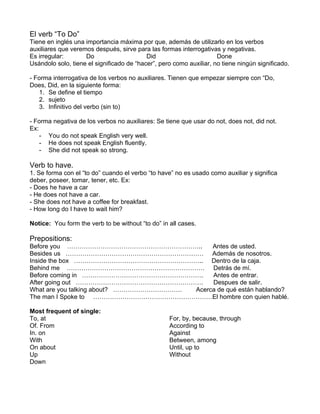
El verb “To Do”
Tiene en inglés una importancia máxima por que, además de utilizarlo en los verbos
auxiliares que veremos después, sirve para las formas interrogativas y negativas.
Es irregular:       Do                     Did                       Done
Usándolo solo, tiene el significado de “hacer”, pero como auxiliar, no tiene ningún significado.

- Forma interrogativa de los verbos no auxiliares. Tienen que empezar siempre con “Do,
Does, Did, en la siguiente forma:
   1. Se define el tiempo
   2. sujeto
   3. Infinitivo del verbo (sin to)

- Forma negativa de los verbos no auxiliares: Se tiene que usar do not, does not, did not.
Ex:
    - You do not speak English very well.
    - He does not speak English fluently.
    - She did not speak so strong.

Verb to have.
1. Se forma con el “to do” cuando el verbo “to have” no es usado como auxiliar y significa
deber, poseer, tomar, tener, etc. Ex:
- Does he have a car
- He does not have a car.
- She does not have a coffee for breakfast.
- How long do I have to wait him?

Notice: You form the verb to be without “to do” in all cases.

Prepositions:
Before you ………………………………………………………..           Antes de usted.
Besides us ………………………………………………………… Además de nosotros.
Inside the box …………………………………………………….. Dentro de la caja.
Behind me ………………………………………………………… Detrás de mí.
Before coming in ………………………………………………….        Antes de entrar.
After going out …………………………………………………….        Despues de salir.
What are you talking about? …………………………… Acerca de qué están hablando?
The man I Spoke to …………………………………………………El hombre con quien hablé.

Most frequent of single:
To, at                                             For, by, because, through
Of. From                                           According to
In. on                                             Against
With                                               Between, among
On about                                           Until, up to
Up                                                 Without
Down
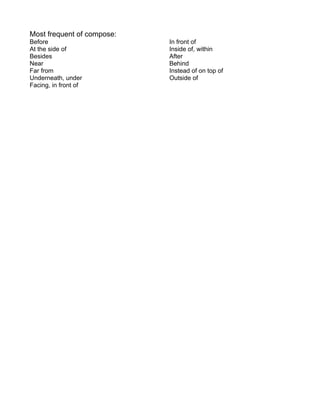
Most frequent of compose:
Before                      In front of
At the side of              Inside of, within
Besides                     After
Near                        Behind
Far from                    Instead of on top of
Underneath, under           Outside of
Facing, in front of

Adverbios IváN

  • 1.
    El verb “ToDo” Tiene en inglés una importancia máxima por que, además de utilizarlo en los verbos auxiliares que veremos después, sirve para las formas interrogativas y negativas. Es irregular: Do Did Done Usándolo solo, tiene el significado de “hacer”, pero como auxiliar, no tiene ningún significado. - Forma interrogativa de los verbos no auxiliares. Tienen que empezar siempre con “Do, Does, Did, en la siguiente forma: 1. Se define el tiempo 2. sujeto 3. Infinitivo del verbo (sin to) - Forma negativa de los verbos no auxiliares: Se tiene que usar do not, does not, did not. Ex: - You do not speak English very well. - He does not speak English fluently. - She did not speak so strong. Verb to have. 1. Se forma con el “to do” cuando el verbo “to have” no es usado como auxiliar y significa deber, poseer, tomar, tener, etc. Ex: - Does he have a car - He does not have a car. - She does not have a coffee for breakfast. - How long do I have to wait him? Notice: You form the verb to be without “to do” in all cases. Prepositions: Before you ……………………………………………………….. Antes de usted. Besides us ………………………………………………………… Además de nosotros. Inside the box …………………………………………………….. Dentro de la caja. Behind me ………………………………………………………… Detrás de mí. Before coming in …………………………………………………. Antes de entrar. After going out ……………………………………………………. Despues de salir. What are you talking about? …………………………… Acerca de qué están hablando? The man I Spoke to …………………………………………………El hombre con quien hablé. Most frequent of single: To, at For, by, because, through Of. From According to In. on Against With Between, among On about Until, up to Up Without Down
  • 2.
    Most frequent ofcompose: Before In front of At the side of Inside of, within Besides After Near Behind Far from Instead of on top of Underneath, under Outside of Facing, in front of